Introduction
In March 2020, the UK declared a lockdown as a result of coronavirus disease 2019 (Covid-19). Given its high transmissibility and large burden on the health system, out-patient clinics, in addition to operating theatre sessions, were cancelled, to allow for the re-distribution of staff and equipment. The outbreak has placed physicians in a difficult position in terms of co-ordinating appropriate patient care, societal welfare and their own safety. Services needed to adopt new strategies for care delivery, with the aim of releasing capacity, and reducing the risk of nosocomial infection to patients and staff associated with travel and face-to-face contact in hospital.
Research has demonstrated that patients with pre-existing medical conditions including cancer, particularly those individuals receiving treatments that cause immunosuppression, have a higher risk of life-threatening consequences.Reference Emami, Javanmardi, Pirbonyeh and Akbari1 Given the demographics of the patient population and the interventional nature of follow up, head and neck cancer patients have been particularly affected. Oncological follow up, as with many specialties, requires detailed history-taking and thorough clinical evaluation. Unique to head and neck cancer patients is the need for endoscopic evaluation, which not only requires a face-to-face appointment and the use of personal protective equipment, but also non-adherence to social distancing guidelines. In addition to the oncological surveillance, management of tracheostomy tubes, surgical wounds and speech valves necessitates face-to-face appointments.
With the goal of ‘cancer survivorship’, head and neck cancer follow up is focused on the early detection of recurrence and second primary tumours, and the evaluation and rehabilitation of acute and chronic treatment-related side effects. In the setting of the Covid-19 pandemic, adherence to previously established standards of care have proven difficult. Physicians have expressed concerns that the limitation on the number of face-to-face appointments could detrimentally affect patients’ health and their psychological wellbeing. During the Covid-19 pandemic, there was increased isolation and anxiety, and difficulty in accessing primary care appointments; in addition, the reassurance that close clinical follow up provides was lacking.
There is no simple answer to these complex clinical issues in the rapidly changing medical environment. One promising strategy used by head and neck surgeons over the past year is the use of telemedicine as an adjunct, and in some cases a replacement for, face-to-face appointments. Telemedicine has been used in different circumstances in medicine since 1970, to facilitate multidisciplinary meetings. Research into the use of telemedicine has mainly focused on its utilisation for patients with chronic conditions, but it has also been shown to be a valuable tool in post-operative follow up. Potential patient benefits include improved satisfaction, a reduced carbon footprint, and a reduction in unnecessary appointments and journeys to hospital.
The Head and Neck Cancer International Group developed an expert consensus document focusing on the management of head and neck cancer patients during the pandemic. It used a modified Delphi process to gather responses from 20 national trial groups across 3 continents.Reference Porceddu, Daniels, Yom, Liu, Waldron and Gregoire2 Regarding oncological follow-up, the following recommendations were made. Eighty per cent of respondents strongly agreed that patients with three or more months following intervention should be monitored using telephone consultations unless there are new suspicious symptoms. Seventy per cent agreed that a combination of telephone and video consultations would be required. There was now agreement that telephone consultations would be appropriate as the sole method for follow up. One hundred per cent strongly agreed that it was not appropriate to stop follow up altogether. Sixty-seven per cent agreed that the frequency of follow up should be maintained in line with previous guidance.
Whilst the concept of using telemedicine as an adjunct to face-to-face appointments raised concerns amongst head and neck cancer surgeons, it was appreciated that in the current crisis this would be required. A decision was made to utilise telephone consultations for the follow up of head and neck cancer patients. The physician could then decide, based on their assessment and each patient's wishes, whether a face-to-face appointment was required. During all consultations, it was stressed to patients that if they developed new symptoms or had concerns, they could contact the head and neck specialist nurses and an expedited face-to-face appointment would be offered. As with all changes in practice, its efficacy and appropriateness require review. The head and neck team within the Royal Victoria Hospital felt that patient involvement and feedback would be crucial in adapting this new service.
Objectives
The primary objective was to assess patients’ perspective on the use of telemedicine for head and neck cancer follow up during the Covid-19 pandemic.
The secondary objective was to identify a subgroup of patients that would be amenable to future ongoing telephone review. Following discussion with the head and neck team, the parameters selected for analysis were: patient age, journey time to hospital, American Joint Committee on Cancer staging of disease and time from initial treatment.
Materials and methods
Site selection, sampling and recruitment
Qualitative interviews were conducted with 219 consecutive patients (over a six-month period) who were under follow up at the regional head and neck cancer unit. During their telephone clinic appointment, patients were asked if they were interested in being contacted for an interview regarding the efficacy of the service. Interested participants were given the option of submitting responses via post or by a telephone consultation. Although using anonymous envelopes would have reduced bias, all patients opted for telephone reviews to minimise their need for travel.
Data collection
Semi-structured interviews were conducted by two researchers (RS and LC). All interviewees gave verbal consent to be interviewed and for their responses to be disseminated. A common interview format combining free prose and a structured question template was utilised. The questions included in the template were agreed by the four head and neck consultants and two specialist nurses. Although the focus of the interview was on patients’ and carers’ views of the telephone clinic, a decision was made to incorporate a Likert scale (ranging from 1 to 5) to help patients make a comparison with traditional face-to-face appointments. All responses were anonymised and free text comments were recorded verbatim.
Patient involvement
Patients were given the opportunity at the end of the telephone interview to suggest other areas of the telephone clinic experience that they felt would be worth analysing.
Results
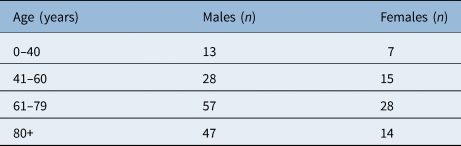
Interviews were conducted with 219 patients, all of whom had undergone a telephone clinic appointment between April and June 2020. Respondents were aged 29–94 years, and included patients’ representatives and family members.
The responses ‘strongly agree’ or ‘agree’ were considered a positive response, whilst ‘strongly disagree’ or ‘disagree’ were considered a negative response, with additional individual break down of responses where relevant.
The qualitative responses were assigned a numerical value (1 = strongly disagree, 2 = disagree, 3 = undecided, 4 = agree and 5 = strongly agree) to enable quantitative comparison. A satisfaction score was calculated by taking the average score with scores closer to 5 representing a more positive response.
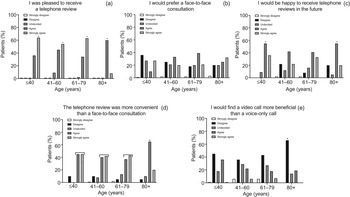
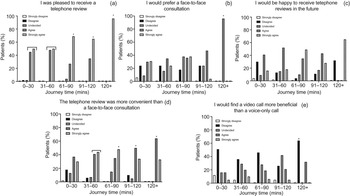
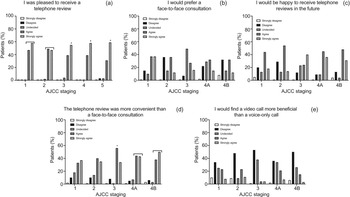
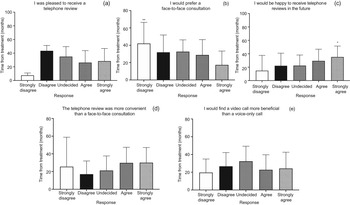
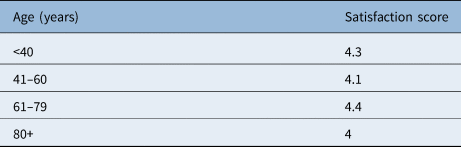
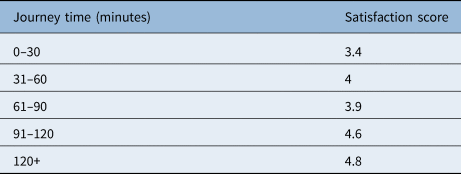
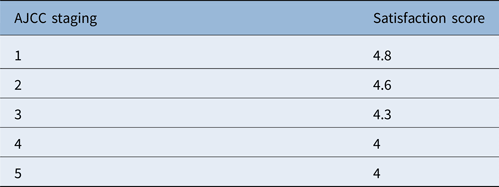
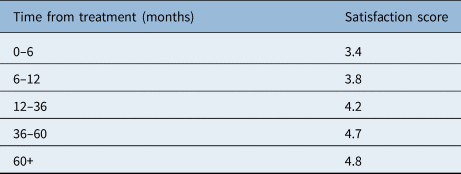
Results were analysed as a total population (Table 1) and then by secondary outcome demographics (Tables 2–5 and Figures 1–4).
Patient satisfaction with telephone head and neck cancer services during the first wave of coronavirus disease 2019 according to age (n = 219). Data underwent Arcsine transformation prior to inferential analysis. *P < 0.05

Patient satisfaction with telephone head and neck cancer services during the first wave of coronavirus disease 2019 according to journey time (n = 219). Data underwent Arcsine transformation prior to inferential analysis. Chi-square analysis demonstrated significant interactions between journey time and happiness to receive a telephone review (part a: χ2 (1) = 8.72; p < 0.001), and between journey time and convenience of a telephone review (part d: χReference Porceddu, Daniels, Yom, Liu, Waldron and Gregoire2 (1) = 13.73; p < 0.01). *P < 0.05

Patient satisfaction with telephone head and neck cancer services during the first wave of coronavirus disease 2019 according to American Joint Committee on Cancer (AJCC) staging (n = 219). Data underwent Arcsine transformation prior to inferential analysis. *P < 0.05

Patient satisfaction with telephone head and neck cancer services during the first wave of coronavirus disease 2019 according to time from treatment (n = 219). Data underwent Arcsine transformation prior to inferential analysis. *P < 0.05; **p < 0.01

Patient characteristics


Average patient satisfaction score by AJCC staging

Full data in Figure 3. AJCC = American Joint Committee on Cancer

Ninety-eight per cent of patients were pleased to receive a telephone review (60 per cent strongly agreed, 38 per cent agreed), stating that the reassurance it provided was very helpful. The 2 per cent who were unhappy felt that they required clinical examination because of concerns regarding disease recurrence. Both of these patients had appointments arranged.
Whilst 60 per cent of patients would have preferred a face-to-face appointment (26 per cent strongly agreed, 34 per cent agreed), 30 per cent stated they were relieved not to be asked to attend hospital. Sixty-eight per cent stated that they would be happy to have further telephone appointments (38 per cent strongly agreed, 30 per cent agreed), with 80 per cent finding telephone consultations more convenient than face-to-face appointments.
In the free text segment of the survey, patients stated they would be content with telephone reviews whilst asymptomatic, as long as they had access to face-to-face appointments if the clinical picture changed.
Only 25 per cent stated that they would have found a video call to be more beneficial than the telephone call.
Results summary
There were no statistically significant differences in satisfaction when stratified by: age, American Joint Committee on Cancer disease staging or time from treatment (Figures 1, 3 and 4). Whilst not significant, there was an increasing trend for satisfaction in those with lower stage disease and with longer time from treatment.
Chi-square analysis demonstrated significant interactions between: journey time and happiness to receive a telephone review (Figure 2a) (χ2 (1) = 8.72; p < 0.001), and journey time and convenience of a telephone review (Figure 2a) (χ2 (1) = 13.73; p < 0.01).
Discussion
Our results show that patients found the telephone consultation to be beneficial. It provided them with emotional support and allowed the clinician to assess their need for a face-to-face appointment. Reassuring the patients that they were still under review, and that if symptoms developed then a face-to-face appointment could be arranged, proved crucial. Whilst some patients would have preferred a face-to-face appointment, a significant group felt relieved about not being asked to attend the hospital. The majority were willing to have telephone consultations become part of their follow up in the future when reassured that face-to-face appointments could be arranged if needed. The option of a video call function was not a priority for the patients, and only a limited number would have had access to it.
The subgroup analysis showed that targeting certain demographics more likely to gain benefit from telephone appointments was difficult. Patients who lived furthest away would be more likely to prefer telephone appointments, but even within this group there were a variety of responses. The data would suggest that patients with lower stage disease, a longer time from their date of initial treatment and who live further away are most likely to find telephone consultations beneficial. However, given the variability in responses, this would need to be reviewed on a case by case basis.
• Ninety-eight per cent of patients were pleased to receive telephone consultations during the pandemic
• Thirty per cent of patients were relieved to not be asked to attend hospital
• Sixty-eight per cent of patients would be happy to have telephone consultations become part of their regular follow up
• Patients with lower stage disease, with longer time from their initial treatment and who live further from the hospital are more likely to be satisfied with telephone consultations
• An individualised approach is required, as patients’ clinical and emotional support requirements vary
Patients reported being concerned that if they opted for telephone review, the diagnosis of disease recurrence could be delayed. Reassuring them that they could contact the head and neck team at any stage, and that a face-to-face appointment would be organised, alleviated these concerns.
Nevertheless, criticism of telemedicine remains, namely regarding the medicolegal consequences of delayed diagnosis or misdiagnosis needing further exploration, and the reduction in direct patient contact, which may diminish the patient–doctor relationship. Whilst this was not a concern of the patients we interviewed, the longer-term impact of telemedicine would need to be evaluated.
Conclusion
Although previous papers have investigated how to maximise the effectiveness of telephone reviews, no study has reviewed the patient's perspective of this change in practice during the Covid-19 pandemic. This study is the largest of its kind, and it demonstrates that patients find the use of telephone consultations in head and neck cancer follow up to be a beneficial adjunct to face-to-face appointments. Given the heterogeneous nature of head and neck cancer, no single system is going to be suitable for all patients or hospital units. Flexibility will be key to providing an individualised approach to the physical and psychological management of these patients during the Covid-19 pandemic and beyond.
Acknowledgement
The authors would like to acknowledge the head and neck team at the Royal Victoria Hospital for their help in collecting the data.
Competing interests
None declared