INTRODUCTION
Livestock production potentially consumes much water (Hoekstra and Chapagain, Reference Hoekstra and Chapagain2007) and threatens sustainable water use. Although the efficiency of livestock production in terms of water use depends on the agroecosystem in which the livestock are raised (Peden et al., Reference Peden, Tadesse, Misra and Molden2007), producing meat generally requires more water than grain. Given increasing water scarcity, increasing human populations and demand for livestock products (De Fraiture, Reference De Fraiture, Wichelns, Rockström, Kemp-Benedict and Molden2007; Delgado et al., Reference Delgado, Mark, Henning, Simeon and Claude2003) in many developing countries, improving the amount of food produced per unit of water depleted is one of the best strategies to reduce the pressure on water resources.
Livestock water productivity (LWP) is defined as the ratio of net beneficial livestock-related products and services (such as meat, milk, traction, hides, manure) expressed in monetary units to the water depleted in producing them (Amede et al, Reference Amede, Geheb and Douthwaite2009; Haileselassie et al, Reference Haileslassie, Peden, Gebresilassie, Amede, Wagnew and Taddesse2009; Peden et al., Reference Peden, Tadesse, Misra and Molden2007). Improving LWP may have positive impacts on sustainable management of the environment and improvement of rural livelihoods in the developing world where the poor depend on livestock and crop production.
Three basic strategies help increase LWP: improving feed sourcing, enhancing animal productivity and conserving water (Amede et al, Reference Amede, Geheb and Douthwaite2009; Peden et al., Reference Peden, Tadesse, Misra and Molden2007). In addition to these, optimal spatial allocation of animals and drinking water sources over large areas enables increased LWP at landscape scales (Peden et al., Reference Peden, Tadesse, Misra and Molden2007).
These strategies are technical in nature and would not be effective unless corresponding institutional innovations are adopted by communities (Amede et al., Reference Amede, Geheb and Douthwaite2009; Peden et al., Reference Peden, Tadesse, Misra and Molden2007). Robust institutions and governance structures for water and grazing land management are essential for adoption of LWP enhancing strategies and increased LWP. In particular, institutional innovations at local levels are of paramount importance for the improvement of LWP in sub-Saharan African countries because most domestic animals are grazed on communal land and drink from community-owned water resources. Improving the governance of community-managed water such as irrigation schemes, communal ponds and water points helps increase production of crops and animal feed. In parallel, improved governance of collectively managed grazing lands and hillside exclosures is also important.
This paper analyses and evaluates existing institutions and governance structures at local levels involving water and grazing land governance. The purpose is to identify institutional and policy recommendations that help increase LWP in the mixed farming systems of Amhara Regional State, Ethiopia. The next section briefly describes the analytical and theoretical framework employed. Section three briefly describes the methods and the study areas. Section four discusses the existing institutions and governance structures at local levels for water and grazing land resources. The last section draws conclusion from the analyses.
Analytical and theoretical framework
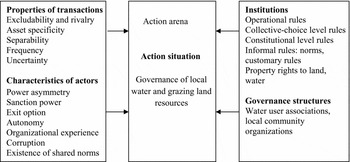
We adapted ‘institutions of sustainability framework’ (IoS) (Hagedorn et al. (Reference Hagedorn, Arzt, Peters and Hagedorn2002)) for institutional analysis for improving and sustaining LWP in mixed crop-livestock systems (Figure 1). The framework is composed of four categories of factors that influence governance. They are: (i) physical features including socio-ecological interactions; (ii) characteristics of actors including organizational experience, power asymmetry, exit options, trust and corruption; (iii) institutions or rules related to access to and use of land and water resources; and (iv) governance structures as water users’ associations, indigenous organizations and markets that implement the rules. The characteristics of physical features and actors are the bases on which institutions and government structures develop.
A modified institutions of sustainability framework for institutional analyses of local water and grazing land resources governance in mixed farming systems of Amhara Region of Ethiopia.

Institutions are conceptualized as the rules that shape human interaction (North, Reference North1990). They can be formal or informal. Their purpose is to create order and reduce uncertainty as well as enhance the predictability of human behaviour in every day social interaction. Governance structures are conceptualized as ways of regularizing socio-ecological interactions among interdependent actors based on attributes of transactions such as excludability, rivalry or subtractability, frequency, uncertainty, asset specificity, jointness and complexity (Hagedorn, Reference Hagedorn2008). Governance structures can be markets (where actions are voluntary and actors have relatively little interdependence), hierarchies (where actions are compulsory and actors have superior–subordinate relations) or hybrids (which are contractual with elements of both markets and hierarchies). In this conceptualization, a community's rules, norms and regulations to govern communal resource systems are institutions while the organizational forms which make use of these institutions to regularize transactions are referred to as governance structures.
The action situations in the context of this study are the governance of local water and grazing land resources. The four components interact with each other and determine the action situation. The transactions determine which institutions emerge or disappear. The actors influence the transactions, the institutions and governance structures and are also influenced by them. The institutions influence the type of governance structures used.
To explain the empirical data collected employing IoS, the study refers to the theories of common pool resources (CPR). In CPR theories, the pessimistic view dominated in the 1960s when the question of ‘commons dilemma’ attracted scientific inquiry. Olson (Reference Olson1965) and Hardin (Reference Hardin1968) concluded that voluntary community-based collective action to sustainably manage CPR is not possible. Consequently, recommendations for better management of CPR focused on privatization or state control. However, numerous case studies confirm that groups can overcome the ‘tragedy of the commons’ and problems of organization. They can contribute to sustainable use of CPR through collective action by establishing provision and appropriation rules, monitoring the condition of the commons and sanctioning non-compliance to rules (Baland and Platteau, Reference Baland and Platteau1996; Ostrom, Reference Ostrom1990; Reference Ostrom1992; Wade, Reference Wade1994).
Ostrom (Reference Ostrom1992) identifies broad design principles for the governance of CPR based on numerous case studies of CPR governance by community groups in various parts of the world. These design principles are elements or conditions that are necessary for the success of collective action in sustaining the CPR and gaining compliance of generations of appropriators to the rules in use. These design principles include: availability of clearly defined boundaries of the resource system, ability of appropriators to alter operational rules, presence of accountable monitors, graduated sanctions for rule breakers and availability of low-cost and rapid conflict resolution mechanisms as well as nested rules (Ostrom, Reference Ostrom1992).
Apart from these, a number of factors related to the characteristics of users also affect success of collective action in the management of CPR. Factors like group size and homogeneity (Baland and Platteau, Reference Baland and Platteau1996; Bardhan, Reference Bardhan1993; Bromley and Feeney, Reference Bromley and Feeney1992), inequality (Bardhan, Reference Bardhan2000; Dayton-Johnson, Reference Dayton-Johnson2000), degree of dependence of the community on the resource, autonomy in organization, trust (Ostrom, Reference Ostrom1998; Reference Ostrom2005) as well as power asymmetry (Agrawal, Reference Agrawal2003; Wade, Reference Wade1994) were indicated as important in determining institutions and success of collective action for the management of CPR.
MATERIALS AND METHODS
Our study used an in depth qualitative case study of two groups of villages (kebeles in Ethiopia's Amharic language). Kebele is the lowest level of government in terms of geographical jurisdiction. The two kebeles were Kuhar Michael kebele from Fogera woreda and Lenche Dima kebele from Gubalafto woreda. Woredas are districts within Amhara Regional State, Ethiopia.
Kuhar Michael kebele is located at 11°50′37″N to 11°53′37″N and 37°38′10″E to 37°42′17″E and has an area of 2755 ha. Its population of 6661 people, who are ethnic Amhara and largely followers of the Ethiopian Orthodox Church, live in six villages within the kebele. The whole area forms part of the Blue Nile Basin. It enjoys one long rainy season during May to September with mean annual rainfall of 1100 mm apart from perennial rivers, streams and springs. There is one modern irrigation scheme known as the Guanta Lomidur Scheme covering 102 ha and a small traditional irrigation scheme (known as mesno) covering about 40 ha. Modern schemes are river diversion or small dams with fully or partly cemented canals constructed by government or non-governmental organizations (NGOs) with farmers' labour contribution. Traditional schemes were constructed by farmers, do not exceed 100 ha and use mostly stream diversions made of uncemented head-works that need frequent repairs. Apart from these, farmers use motor pumps to irrigate crop fields close to Guanta and Gumara rivers, which drain the area in to Lake Tana. The Guanta Lomidur Water Users’ Association (WUA), established in 2001, operates the 102 ha modern scheme while the traditional schemes existing in the kebele are operated by self-organized farmers' groups.
Lenche Dima covering 1546 ha, is a densely populated area with 218 persons per km2. The inhabitants are farmers from the Amhara ethnic group and most of them are Muslims living in five villages. Lenche Dima is located at geographical coordinates of 11°49′13″N to 11°51′57″N and 39°40′07″E to 39°44′22″E. The mean annual rainfall is about 849 mm. The rainfall distribution is bimodal with a small rainy season (called belg, mean 208 mm) during March–May and main rainy season (called kremt, mean 483 mm) during July–October. The area drains to the Alewuha river, which is part of the Awash basin. There are two irrigation schemes nearby: traditional (about 80 ha) and modern (about 360 ha) and both are known as Alewuha schemes as they use the same Alewuha River water. The government-initiated Alewuha WUA, established in 2002 at the time of construction of the irrigation schemes, operates 360 ha irrigated land, while the traditional scheme is operated by self-initiated farmers' group.
These two sites were purposively selected to represent water-sufficient and water-scarce crop-livestock mixed farming systems of the Amhara Region. Contrasting cases were selected with the justification that the problems, institutions and governance structures vary depending on relative water availability and access. The communal resources under scrutiny in the kebeles were irrigation schemes, communal water harvesting ponds and domestic water points as well as grazing lands and hillside exclosure areas temporarily closed for human and animal access.
Qualitative data were collected from each kebele employing focus group discussions, key informant interviews and participant observation. As part of a PhD study, 32 group discussions with farmers and 61 key informant interviews with local officials, experts and farmers were held. The data were collected in between April 2009 and March 2010 and analysed using qualitative data analysis techniques including transcription, coding, abstraction, drawing generalizations and contrasting generalizations with theories.
RESULTS AND DISCUSSION
Small-scale irrigation
Transactions involved in communal water resources utilization create interdependence among actors. Once infrastructure for irrigation, communal ponds and communal domestic water points has been provided, it is difficult to exclude existing and potential water users (difficulty of exclusion) and competition among users develops because water used by one farmer normally cannot be readily used by others (rivalry in water appropriation). Transaction frequency is high because irrigation farming, domestic water use and livestock drinking are daily activities practiced year round. High variability of precipitation generates uncertainty about water demand. Asset specificity is high because farmers invested heavily in construction and maintenance of these resources. Livestock production also creates interdependence among actors.
Free grazing is a socio-ecological transaction with implications for water resources governance. In mixed crop-livestock systems, free grazing damages crops, terraces, bunds and irrigation canals, reduces vegetative cover and contaminates water sources. Overgrazing depletes soil fertility and aggravates water depletion through excessive runoff and evaporation, and thus lowers LWP. Inappropriate animal management undermines child education because families deploy children to protect crops from animal damage. In both kebeles, animals are excluded from modern irrigation. Various governance structures such as the Edir Committee at Kuhar Michael and the Alewuha WUA were established to control free grazing. However, free grazing remains problematic because rules were rarely enforced due to high costs of monitoring illegal grazing activity.
Relative water availability is a key physical feature that affects institutions and governance structures. Low water availability restricts that amount of land that can be irrigated and puts WUAs under pressure to fairly allocate water to farmers. Accordingly, at Guanta Lomidur, water is relatively abundant enabling farmers to irrigate about double that land area anticipated in the WUA official plan. At Alewuha, water is relatively scarce limiting the command area to only about 160 ha. At Kuhar Michael kebele where farmers have options such as groundwater, pumped water from streams and more reliable rainfall, the WUA functioned poorly, although it is a legally registered farmers' co-operative. Where availability of water and diversity of water sources are high, our results suggest that WUAs may have low levels of collective action for irrigation maintenance, absence of clear water allocation procedures, discontinued water fee collection and low level of rule enforcement. In contrast, at Alewuha scheme, where there are few exit options, the WUA is better organized in terms of number of members, scheduling water allocations, existence of nested organization of water user groups, collection of annual water fees, rule enforcement and accountability of leaders to the water users. One consequence is the low incidence of conflict among farmers at Alewuha.
Despite the above differences, both irrigation schemes share certain common characteristics of actors. The majority of water users were not member of the irrigation WUA. Only 28% of 1170 Guanta Lomidur water users and 49% of Alewuha users were WUA members. The WUAs are registered co-operatives and membership requires purchase of at least one share (25 Ethiopian Birr (ETB) or US$1.85). Low WUA membership appears to result from lack of incentives, bad experience with co-operatives, and collectivization of agricultural land and labour from 1974 to 1991, which denied the farmers' ownership of land, capital and farm produce. In group discussions, farmers expressed their reluctance to join WUAs because they perceived that WUAs and former producer co-operatives were similar.
One principle for governance of local commons is participation of users in rule making (Agrawal Reference Agrawal2001, Reference Agrawal2003; Ostrom Reference Ostrom1992). Our studies also indicate that quality of maintenance of irrigation schemes were significantly low in schemes, where farmers perceive the rules to have been made by local elites (Bardhan, Reference Bardhan2000). At both case study modern schemes, rules are made by the WUA members. Non-member water users have no right to participate in rule formulation; rather they are expected to comply with the rules formulated by members. Because most water users are not WUA members, we must conclude that WUA rule-making procedures are not all inclusive and participatory.
Existence of clearly defined boundaries of resource systems is often mentioned as a crucial factor for sustainable governance of local commons (Ostrom, Reference Ostrom1990; Wade, Reference Wade1994), yet neither modern scheme in our study has a clear boundary. At both Guanta Lomidur and Alewuha, farmers from the neighbouring kebele use ‘tail-end’ water for irrigation. Farmers at the head-end insist that tail-enders have no water rights because they are located outside of the originally designed command areas. Members of the WUA let the tail-enders use the water only as long as there is sufficient water for all and for the sake of peaceful coexistence. In both cases, woreda agriculture experts do not give clear answer to the question of the boundary of the scheme. They respond that the water should be used to the last drop, as far as it can reach. As a result the water rights of the tail-enders are neither clear nor secure.
In both Kuhar Michael and Alewuha, traditional water rights are disregarded in favour of modern ones. For example, government officials from the kebeles and woredas uphold water rights claims of farmers who have motorized pumps purchased with credit from the government and disfavour water users in traditional schemes. The intent is enabling farmers with pumps to repay their loans through timely sale of produce. The same is true in Alewuha scheme where farmers in the head-end area are included in the modern scheme and have stronger water rights than tail-enders using traditional irrigation even though the latter have existed longer than the former. In case of water shortage, government priority is given to the modern scheme. Traditional farmers must negotiate their water rights with those in the modern schemes.
Power is an important social factor determining institutions (Knight, Reference Knight1992). Village power asymmetry often results in unequal water rights and distribution among farmers. Here power is conceptualized as the ability to influence social bargaining outcomes in ways that reflect one's own interest (Knight, Reference Knight1992). Agrawal (Reference Agrawal2003) also indicates that institutional choice by powerful groups deliberately disadvantages marginal and less powerful groups. Hence, power and micro politics help determine how resources are used and managed. For example, in a traditional scheme of about 40 ha at Kuhar Michael, a farmer with a lucrative perennial crop of khat (Catha edulis) and fruit trees has managed to influence the water allocation rules in his favour. During the weekends it is always his exclusive right to irrigate his fields while all the other farmers and the local tree nursery irrigate their fields on weekdays. The average schedule for other farmers is only once a month resulting in water shortages and conflict among them. One source of power is positional power arising from holding a strategic position that offers the opportunity to carry out credible threats (Knight, Reference Knight1992). The special water rights of this particular farmer was established long ago while he was a chief priest in the local church and later consolidated by his influence on the local kebele administration after his son became its leader.
Other field evidence also suggests that some farmers, who have leadership roles in the WUA, influence water allocation in their favour. As a key informant farmer from tail-end village at Guanta Lomidur scheme indicated: ‘It is easy to identify the farm fields of WUA officials because they look greener than the other farmers' fields,’ (June 10, 2009).
Farmers who have leadership role in the kebele dictate water allocation rules even if they do not have their own plots in the scheme. Typically, they sharecrop on land in the scheme, take advantage of government programmes to promote motor pumps and irrigate fields which are far from the scheme using motor pumps. Sometimes they do this by blocking main diversion canals so that more water remains in the river enabling them to pump out more water. This results in water shortage at the tail-end areas and violent competition among farmers for scarce water especially in dry seasons and at specific crop growth stages when water access is particularly required.
Corruption, as a characteristic of actors, is a very important institutional form by which local commons are governed in many parts of the developing world (Robbins, Reference Robbins2000). Corruption and lack of accountability of monitors and other officials to users hinders the sustainable management of CPR (Baland and Platteau, Reference Baland and Platteau1996; Ostrom, Reference Ostrom1990). In the Guanta Lomidur scheme, corruption prevails in the tail-end areas with seasonal relative water scarcity. Since the majority of farmers plant onions at the same time, their need for irrigation water coincides. The resultant water scarcity opens a window of corruption for water distributers. In such conditions, water theft also increases. However, farmers indicated that rules are rarely enforced due to nepotism, bribery and fear of retaliation from prosecuted individuals. Key informant farmers indicated that bribes for water during seasons of scarcity range from inviting the water allocator for some beer (water for water as one farmer put it metaphorically) to payment of ETB50–100 (US$4–25) for timely delivery of water. The lack of continuous monitoring and support by local government after the establishment of irrigation schemes aggravates corruption. Our group discussions also revealed that increasing population pressure and the consequent landlessness and poverty among youth results in deteriorating social capital such as trust, reciprocity and mutual respect, which gives way to corruption and opportunistic behaviour.
Land distribution within new irrigation schemes is another important institutional issue. When small- and medium-scale irrigation schemes are constructed there is no land redistribution. Farmers remain with their original farmlands, which are often unequal in size and suitability for irrigation. Inequality is an important factor negatively affecting maintenance of irrigation systems (Bardhan, Reference Bardhan2000; Dayton-Johnson, Reference Dayton-Johnson2000). Our results show, for example, that farmers with small plots in Alewuha are not willing to contribute labour as much as other farmers who hold larger plots. Consequently, labour contribution by many water users is very low and the majority of the farmers are free riders at the expense of those few who hold larger plots.
Communal ponds
In the water-scarce and drought-prone areas of eastern Amhara, communal water harvesting ponds for domestic and livestock water are common. In the Lenche Dima area, every village has one or more communal water harvesting ponds with average water-holding capacities of 300–600 m3. These ponds supply livestock with drinking water during the dry seasons. As indicated earlier, the properties of transaction in small-scale irrigation also hold true in case of communal ponds. They have a high degree of difficulty of exclusion, rivalry in appropriation, asset specificity, uncertainty and high transaction frequency.
Communal ponds are constructed, protected and repaired by the community through the mobilization and monitoring of a governance structure called kire. The kire is a traditional informal farmers' organization mainly created for the purpose of mutual help in case of death of family members. The kire is community initiated and ubiquitously present by various names throughout the Ethiopian highlands. Each village has at least one kire. Often there are two kires, one for men and another for women. In each kire, there is one elected leader called kire-asadari. Apart from mutual help in case of funerals, the kire is also used as a governance structure for the communal rain and flood water harvesting ponds. All farmers in Lenche Dima area are members of the village kire and are required to contribute labour for pond maintenance and protection. Everyone contributes labour equally regardless of the number of livestock they own. Failure to contribute labour is punishable by fines as decided by the kire-asadari.
Generally, there is high level of compliance with the kire among farmers. This is due to the existence of shared norms among the farmers as well as the high sanctioning power vested on the kire-asadaris. Non-compliance with kire rules or disobedience to the kire-asadari is an offence which would result in isolation from the community implying that no one will lend assistance to the offender in case of deaths of family member and funerals. Existence of such shared norms (Baland and Platteau, Reference Baland and Platteau1996) and graduated sanctions (Ostrom, Reference Ostrom1992; Wade, Reference Wade1994) facilitate sustainable governance of local commons. This makes the kire an important local governance structure for water harvesting and community mobilization for various collective actions. Accordingly, the kire can contribute immensely to enhancing LWP by increasing availability of drinking water for livestock and increasing pasture productivity through restraining free grazing.
Communal water supply points
Communal village water points are sources of domestic and livestock water in many villages. These are mostly shallow wells with hand pumps constructed by the woreda Office of Water Resources with financial support from government or NGOs. At Kuhar Michael, except in two villages, many farmers use springs or private hand-dug wells, while at Lenche Dima, all farmers use communal water points for domestic use and livestock.
Community water supply points are managed by a village water committee. The government has a rule that a water committee must be established before construction of water infrastructure. It is also a rule that the water committee consists of three women and two men. Preferably a chairwoman leads the water committee because it is believed that women are more responsible and better water managers because of their dominant roles in fetching water and watering small livestock. After establishing a water committee, villagers must raise matching funds and provide free labour for the construction of water points. Once established, the water committee controls the finance and monitors the construction of the community water points as well as subsequent protection and maintenance.
At Kuhar Michael, only two of the villages have communal water points. Farmers in the other villages use hand-dug wells, springs and streams. Farmers who use the village water points are not required to pay for water at water points and generally water is regarded as a free good. Many farmers believe that water is God's gift and everyone has a right to drinking water. Sale of water is not customary.
Breakage of water pumping equipment and lack of local skills to repair it reduces access to clean domestic and livestock water. At Kuhar Michael many villages have lost access to clean water because of breakage of water pumping equipment such as manual pumps. The woreda water office itself does not have the capacity to repair broken pumps. For instance, in one of the villages of Kuhar Michael, a solar-powered community water point broke down a long time ago. Because of lack of local expertise to fix such sophisticated equipment, the farmers reverted to traditional hand-dug wells for domestic and livestock water.
At Lenche Dima, a diesel motor pump delivers water from a deep well to five community water points, giving most households access to clean domestic and livestock water. Unlike the case of Kuhar Michael, each household pays ETB 0.20 (US$0.015) for a 25 l pail of water. The community sets the price and deals with the money, maintenance and operation of the pump.
At Kuhar Michael, water is a free good. Without charging for water, lack of income results in restricted repair and maintenance activity. Our results suggest that a small charge for water greatly facilitates sustainability of water infrastructure by making repairs and maintenance possible. Well-managed water supply infrastructure enables diverse livelihood strategies including animal and crop production.
Communal grazing lands
Every village has communal small grazing areas that are typically overstocked with animals. Village transactions with respect to common grazing land resembles common water resources due to their high levels of difficulty of exclusion, rivalry in appropriation, transaction frequency, and uncertainty related to precipitation and property rights. Generally, grazing lands are not well managed. Without oversight, weed infestation and encroachment by adjacent farmers are problematic.
At Kuhar Michael, elected individuals, feji, hold a written document describing the boundaries of the village grazing land. The feji’s mandate is to protect grazing lands from encroachment and weed infestation. Due to lack of sufficient oversight and support kebele and woreda administrations do not discharge their responsibilities. Failure to stop encroachment arises when government officials are the encroachers or when do not wish to jeopardize their social ties to them.
Similar age-old indigenous institutions and governance structures also exist in Lenche Dima. Every village has an elected group of farmers, yebere-sar-tebaki, to close, protect and manage plots of communal grazing lands for the benefit of oxen. Yebere-sar-tebaki means guardians of grass for oxen in Amharic. Only oxen used for tillage are allowed to graze in the closed area in a specified times of the year when there is no green pasture elsewhere. We observed that the yebere-sar-tebaki traces back to an ancient ritual where farmers celebrate the annual opening of the pasture with feasting. Today, the yebere-sar-tebaki effectively enforces rules because of farmers' positive regard for this governance structure.
At Kuhar Michael, the government initiated the Edir Committee to protect grazing lands from encroachment, control free grazing and solve local conflicts. Although, free gazing is rampant, no one has ever been punished for letting animals into farmlands. The Edir Committee is composed of elected farmers. However, it does not have real authority and acceptance by farmers because it was externally imposed. Recently, the Edir Committee acquired responsibility to enforce observance of Ethiopian Orthodox Christian holidays through imposition of fines for violation. Rarely do farmers violate observance of holidays because of their deep-rooted belief that if someone does not observe holy days, hail storms will damage the crops all around. Non-compliance invokes fines, social sanctions and, ultimately, isolation from the community. Strong compliance stems from stable, self-enforcing institutions and shared norms.
Communal hillsides closures
A project sponsored by the United States Aid for International Development established hillside closures, terracing, tree planting and gully rehabilitation activities in Lenche Dima kebele. It aimed to stop accelerated soil erosion, flooding and natural resource degradation. The community participated through stakeholder consultations and contribution of labour (food-for-work activities). Sixteen hillside closure and gully rehabilitation groups were established. Each consisted of 15 to 40 farmers and landless youth.
The groups established by-laws describing the rights and duties of members. Each group has a chair, secretary and treasurer. Each group member has access to a parcel of land in either hillside or gully areas for harvesting grasses and tree branches. The group determines harvest dates. Animal access to closures was forbidden and violators subject to fines. Some groups guard the closed hillside themselves, two individuals per day. Others hire guards for ETB 150 (US$11.30) per month and pay their wages with members’ contribution. Long-term absenteeism and failure to contribute the monthly fee for guarding may result in confiscation of the plot.
Area closure can increase LWP by increasing vegetative cover and feed production as they encourage a shift from non-productive evaporation to productive transpiration. On one hand, many farmers indicate increased plant cover helped prevent problems of flooding in down slope villages. Some managed to earn some money from sales of grass and wood. On the other hand, the most farmers complain that feeding animals is now more difficult, especially goats which used to feed on hillside browse. Some farmers were forced to sell all their goats because of lack of access to browsing areas.
Many groups did not protect the closed hillsides very well. Only the closed areas in one village where project activities were intensive are protected. Other hillside areas were reopened for free grazing after the project ended. Group leaders and farmers from two villages indicated that most of the planted tree seedlings were damaged. Group leaders were not able to enforce the groups’ bylaws. Lack of support for rule enforcement from kebeles for closures is a prime reason for their failure. Our observation supports similar findings that sustainable management of local commons by community groups requires supportive external sanctioning governance structures (Baland and Platteau, Reference Baland and Platteau1996; Ostrom, Reference Ostrom1992).
Experience from this closures project highlights conflict and lack of consensus among community members making rule enforcement difficult. Members did not make the transition from use of communal to private tenure effectively. Generally, young and poor farmers with have few livestock, prefer the hillside areas to be closed and remain closed. Their rationale is that they obtain a piece of hillside land and sufficient grass for their few animals when land is divided equally among member farmers. Wealthier and older farmers with larger herd sizes prefer to freely graze their animals on the open hillside areas because they face serious feed shortage and pay much if caught letting their animals into closed areas. This lack of consensus and collective action threatens the sustainability of the group and the closure practice.
CONCLUSIONS
At local levels, overcoming numerous challenges related to water and grazing land resource governance is a prerequisite to increasing agricultural water productivity and crop and livestock production. Non-inclusive and non-participatory WUAs have negative consequences for irrigation water management. Hence, local and regional governments as well as other development partners in the water sector need to create enabling environments for the establishment of all-inclusive and participatory WUAs. Village power play and resulting institutions can be unjust creating rural inequality, corruption and conflict. Hence, in order to deal with these problems, higher level governments need to promote and ensure good governance and accountability at local levels. Moreover, modern irrigation schemes and associated water rights need not undermine traditional water rights on which the livelihoods of a large number of farmers depend.
The case studies provide evidence that inequality in distribution of irrigable farm land deters the smooth functioning of irrigation WUAs and consequently reduces the potential benefit that could be gained from cooperation among water using farmers. Hence, in order to promote sustainable managements of irrigation infrastructure and improve LWP, government need to ensure low level of irrigation land inequality in newly constructed irrigation systems.
The cases provide evidence that locally initiated and autonomous institutions and governance structures, such as the kire and yebere sar tebaki, are effective in terms of rule enforcement and can be sustainable for the management of local commons. On the other hand, outsider-initiated institutions and governance structures such as the hillside closure groups at Lenche Dima and the Edir Committee at Kuhar Michael are not sustainable because they were not truly participatory in their formation and lacked acceptance among farmers. Lack of sufficient support from external sanctioning governance structures also reduces their effectiveness. Therefore, local governments and their development partners need to recognize and support indigenous governance structures for local common pool resources management. They also need to ensure participatory formation of outsider initiated governance structures and provide the necessary sanctioning support in order to contribute to the improvement of LWP.
Acknowledgements
The authors would like to acknowledge the Bundesministerium für wirtschaftliche Zusammenarbeit und Entwicklung (BMZ) for funding this research through the IWMI-led project on ‘Improving Water Productivity of Crop-Livestock Systems of Sub-Saharan Africa’.