Introduction
Understanding the way therapy works to reduce distress, alter unhelpful patterns of behavior, improve relationships, and enhance coping and personal growth is a complex undertaking (Bloch, Reference Bloch2011). Historically, such research has been dominated by “outcomes” leading to a lack of discourse about clinical processes. Indeed, as early as Reference Gendlin1963, Gendlin referred to the “science of how” in psychotherapy as “still mysterious to us in many ways” (pp. 3–4).
Lack of specific data on process outcomes in psychotherapy arises in part because research into the dynamics that influence therapy is difficult to “measure” (Amundson, Reference Amundson2003). As Goodheart (Reference Goodheart2004) explained, “Psychotherapy is first and foremost a human endeavor. It is messy… [and cannot] be reduced to a technical mechanistic enterprise” (p. 2). However, therapeutic process research is important because it can enable the clinician to moderate interventions for improved outcomes and increase aspects known to enhance change (Kazdin, Reference Kazdin2007).
In the setting of physical illness such as cancer, the complexity of psychotherapy is increased by the interaction of physical burden, the meaning attached to the illness, and the ongoing nature of the disease. Psycho-oncology interventions require a unique flexibility as patients manage disease stages, end-of-life issues, and a range of defenses to manage their experience (Straker, Reference Straker1998); thus, the ability to classify the processes that lead to psychological change in people living with cancer is confounded by the setting itself. In spite of these challenges, while undertaking a study of a meaning-based intervention developed for the advanced cancer setting, Meaning and Purpose (MaP) Therapy (Lethborg at al., Reference Lethborg, Schofield and Kissane2012), we conducted an analysis to better understand therapeutic processes involved as a step toward understanding specific components of the intervention that influenced change.
Meaning-centered therapy
A range of novel, clinically based approaches have been developed using meaning-based theory in the setting of advanced cancer to date (Breitbart et al., Reference Breitbart, Gibson and Poppito2004, Reference Breitbart, Poppito and Rosenfeld2012; Breitbart & Poppito, Reference Breitbart and Poppito2014; Chochinov, Reference Chochinov2002; Chochinov et al., Reference Chochinov, Kristjanson and Breitbart2011). While the meaning-based approach to psycho-oncology increases in popularity (Clarke, Reference Clarke2003; Folkman, Reference Folkman1997; Greenstein & Brietbart, Reference Greenstein and Breitbart2000; Holland & Gooen-Piels, Reference Holland and Gooen-Piels2000; Kissane et al., Reference Kissane, Clarke and Street2001; Lethborg et al., Reference Lethborg, Schofield and Kissane2012) and is based on the solid theoretical work of Frankl (Reference Frankl1963), Kierkegaard (Reference Kierkegaard1970), Yalom (Reference Yalom1980), Langle (Reference Langle2008) and others, little has been published in relation to the processes used in this therapeutic work (Faller et al., Reference Faller, Schuler and Richard2013).
MaP therapy
MaP therapy (Lethborg et al., Reference Lethborg, Schofield and Kissane2012), in its briefest form, focuses on the expression of meaning in four-session, individual, face-to-face therapy. This intervention was named to reflect both the acronym for Meaning and Purpose and the process of charting (or “mapping”) an understanding of the concepts of meaning and purpose in the lives of participants.
The framework for MaP therapy has been previously published (Lethborg at al., Reference Lethborg, Schofield and Kissane2012) and is grounded in existential psychology, not a specific approach or intervention as such, but a way of understanding the nature of human beings and how they interact with the world (Yalom, Reference Yalom1980). A central notion of existential theory is that most problems people face originate from anxiety over loneliness, isolation, despair, and, ultimately, death (May & Yalom, Reference May, Yalom, Corsini and Wedding1995). In this view, an event such as a cancer diagnosis can “awaken” death anxiety and concerns over meaninglessness, and is thus an experience in which therapy based on meaning in life could be particularly pertinent.
Prior developmental work (Lethborg et al., Reference Lethborg, Aranda and Bloch2006, Reference Lethborg, Aranda and Kissane2007, Reference Lethborg, Schofield and Kissane2012) has illustrated that MaP therapy enables a refocusing of life goals, a reawakening of a sense of personal meaning, and the related intentionality found in purpose. Following this prepilot work, a MaP therapy manual (Lethborg & Schofield, Reference Lethborg and Schofield2008) was completed and developed into a training program. Five therapists, experienced in therapy in the cancer setting, were trained for the pilot phase.
The initial model of four sessions covered: in session 1, the story of the person's life, which includes his or her experience of cancer; session 2, an agreement is sought on the coherent sources of meaning and purpose so that goals to enhance meaning are created; and session 3, in aiming then for this life that is desired, what priorities need shifting? And session 4: What relationships bring the most meaningful connections? How can these be enhanced despite the restrictions of illness?
Although the primary outcomes of the pilot are “increased meaning” and “reduced psychological distress,” transcribed sessions offer an opportunity to also conduct process analysis. The aim of this study was to identify therapeutic strategies used in MaP therapy that relate to patterns of change for participants across the sessions.
Methods
Participant recruitment
Participants were recruited from the medical oncology service at an inner city general hospital and the melanoma service at a specialist cancer center over a 12-month period. Eligibility criteria included a diagnosis of metastatic cancer (stage 3 or 4), a prognosis of 12 months or less as assessed by the treating doctor, and sufficient English skills to complete the study. Individuals were excluded from the study if assessed by their treating physician to be incompetent because of cognitive dysfunction or a psychotic or other psychiatric illness (other than depression). Potential participants were asked to provide written informed consent after reading material describing the study. Ethical approval was gained from the human research ethics committees at both institutions.
Data
All participants were randomly allocated to the intervention group or waitlist group using a biased coin randomization schedule.
Intervention group: In addition to usual care, this group was allocated to the intervention group that received four sessions of MaP therapy.
Waitlist group: This group was allocated to the waitlist group, receiving usual care while they waited for 6 weeks before receiving four sessions of MaP therapy.
To assess for bias, nonconsenters were asked to provide deidentified basic demographic and medical details. Attrition was monitored and reasons for withdrawal recorded in each arm. A total of 24 individuals participated in four sessions each.
All available therapy sessions (n = 96) were tape-recorded and transcribed for qualitative analysis; this analysis did not identify if participants were in the treatment or waitlist group.
Analysis
Two researchers were engaged to conduct the discourse analysis (Potter & Wetherell, Reference Potter and Wetherell1987). Both were part of the project team, trained and experienced in MaP therapy, but had not provided any of the therapy sessions used in this portion of the study. Both researchers were senior oncology social workers (one doctoral level and one masters level) experienced in both psychotherapy and research methodology. Researchers read through transcripts for themes and processes (McNamee & Gergen, Reference McNamee and Gergen1992) and then met on three occasions to discuss and reach an agreement on patterns or movement between themes that were apparent across sessions, to compare results, and discuss shared outcomes (Henwood & Pidgeon, Reference Henwood and Pidgeon1992).
Themes
A template approach was used to guide the thematic analysis under the frame of “meaning” and “suffering” (Boyatzis, Reference Boyatzis1998). These concepts of focus were developed a priori, based on our previous research (Lethborg et al., Reference Lethborg, Aranda and Kissane2008, Reference Lethborg, Schofield and Kissane2012) in which the central nature of meaning and suffering to MaP therapy was identified. The following descriptions were used in this analysis.
• Suffering referred to statements about physical, emotional, practical, social, existential, psychological, and/or spiritual hardship, stress, or concern.
• Meaning referred to statements about significant, uplifting and inspiring, valuable, or appreciated aspects of participant's lives.
Therapeutic processes
While themes were being reviewed, portions of the text that related to therapeutic processes were also labeled (Burman & Parker, Reference Burman and Parker1993). Researchers described themes relating to the therapist's text as they arose from the data and then labeled them under “therapeutic processes” and also discussed these processes for agreement throughout the analysis period. Thus, researchers read through the transcripts, first coding lines that related to meaning or suffering (by color coding each line). The second reading involved identifying therapeutic processes and placing a code (for example, PA for “positive reappraisal” and HM for “highlighting meaning”) in the margin of the transcript alongside sentences. Finally, the third reading considered any patterns of processes that either commonly occurred together or illustrated a thread through the text (such as “reminiscing” by the participant being followed by highlighting meaning by the therapist and then a statement of “benefit finding” by the participant; or patterns of processes that addressed suffering and then rebalanced to meaning).
Patterns
Researchers were also interested in overriding threads and sequences of ideas occurring throughout the sessions (Guest, Reference Guest2012). In this case, relationships between themes throughout the progression of the therapy were considered to identify apparent links between therapeutic processes and shifts in participant's narratives. For example, if a therapist reflected statements back with a focus on the meaning content of a participant's statement, and a dialog about meaning followed, this would be noted as a relationship.
Proportional focus
With data organized into themes, it was also possible to review portions of time spent on each theme and therapeutic process used within a session; thus, once lines in transcriptions were placed under thematic headings, they could be tallied under each theme and calculated as a percentage figure to identify the main focus of each session for both participants and therapists alike.
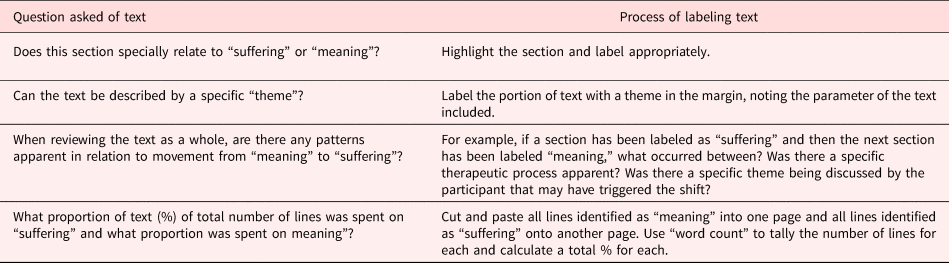
Although each of these steps had a particular focus, the results accumulated to form a comprehensive understanding of the therapy (Braun & Clarke, Reference Braun and Clarke2006). Indeed, although these can be described as specific steps, in reality, the researchers were reading the transcriptions while simultaneously asking the following questions of the text (Table 1).
Directions for analysis of transcriptions

Results
Sociodemographic data
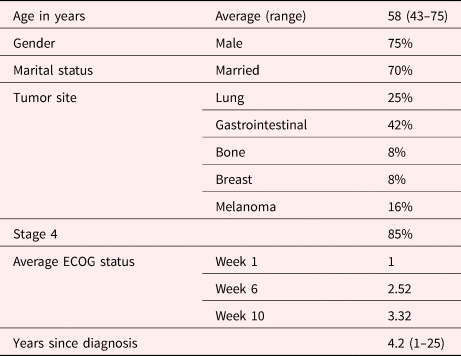
Using convenience sampling, 61 people with advanced cancer were identified as eligible for this trial, with 39 (64%) agreeing to participate. The majority of those who did not want to participate stated that they were either not interested (63%), already too busy with medical appointments (25%), or felt they currently had enough meaning in their life (10%). Of this starting group of 39, 15 (38.4%) withdrew because of disease progression (n = 5, 13%) or death (n = 10, 26%), resulting in a final sample of 24 participants. As Table 2 shows, the cohort represented a cross-section of tumor streams, mostly male (75%), married (66%) participants with an average age of 58. The characteristics of eligible patients did not have statistically significant differences from enrolled participants.
Participant demographic and medical profile (n = 24)

ECOG, Eastern Cooperative Oncology Group.
All participants included in this study completed four of four sessions of MaP therapy. The sessions were completed within a period of 8 weeks with a 1- to 2-week gap between sessions; the variance resulted from working the therapy around visits to the hospital on all occasions, aside from two sessions that were postponed because of the participant feeling too unwell. One session was completed over the phone at the participant's request, 1 week prior to death.
Themes
Sections of transcripts were placed under the template of meaning and suffering; for example, in participant 8's first session, the following narrative sections were placed under the category of (a) meaning and (b) suffering, respectively.
(a) “Work was very important for me – fulfilling. I was good at it.”
“The first time I felt anything like love – true love was when my son was born – it was the most wonderful day.”
(b) “My emotions are largely in turmoil – I usually have control over them.”
“When I think about what my wife and the kids must be going through – it undoes me. I've got the easier job [in facing death].”
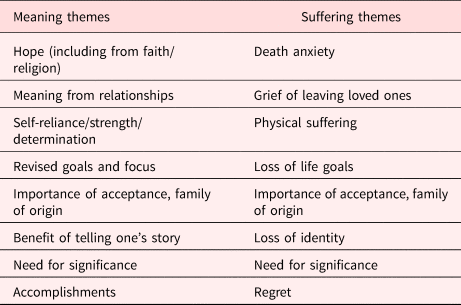
Themes within the suffering category included descriptions about stress, fear of the unknown and of facing death, regrets about chances not taken or accomplishments not achieved, and anticipatory loss. Death anxiety was commonly described in relation to loss: unfulfilled dreams, grief over leaving loved ones, and fear about physical suffering getting worse. Thus, discussion around the concept of death anxiety offered both an expression of suffering and an opportunity to better understand those aspects of life that were most significant or meaningful.
A number of “suffering” themes related to disappointments about not achieving life goals and aspects of participants’ self-concept that they had not felt had been honored or accepted. Family of origin was discussed by many as having let them down in this regard, with two participants in particular describing childhoods of extreme abuse and a lifetime of healing this abuse. The deep desire to be loved for who they were when they were being their “authentic selves” was expressed by all participants.
Meaning themes included significant life moments, influential people, achievements, and the presence of God in participants’ lives as they explained what brought them joy, comfort, and direction. Overwhelmingly, the notion of needing to belong and the desire to be loved for their authentic self underpinned these discussions. Family of origin commonly featured as either the first place where they felt unconditionally loved or the place where they were rejected, requiring them to find healing in the relationships they developed as adults.
The concept of wanting to be accepted for their unique self mentioned in the suffering sections was thus also present in the meaning sections, but here it was expressed in relation to the positive nature of belonging within a family and/or community, being proud of achieving what they had set out to achieve in their lives, feeling a connection or unconditional love with God, and the power of relationships and feeling loved by others. Table 3 offers a summary list of themes under the concepts of meaning and suffering.
Participant themes under the concepts of meaning and suffering

Therapeutic processes
Therapists’ statements were also initially placed under themes arising from transcripts and then under “processes” when analyzers met for discussion. The following excerpts of participant 19's third session illustrate how themes were applied in the therapist's sections of the transcription.

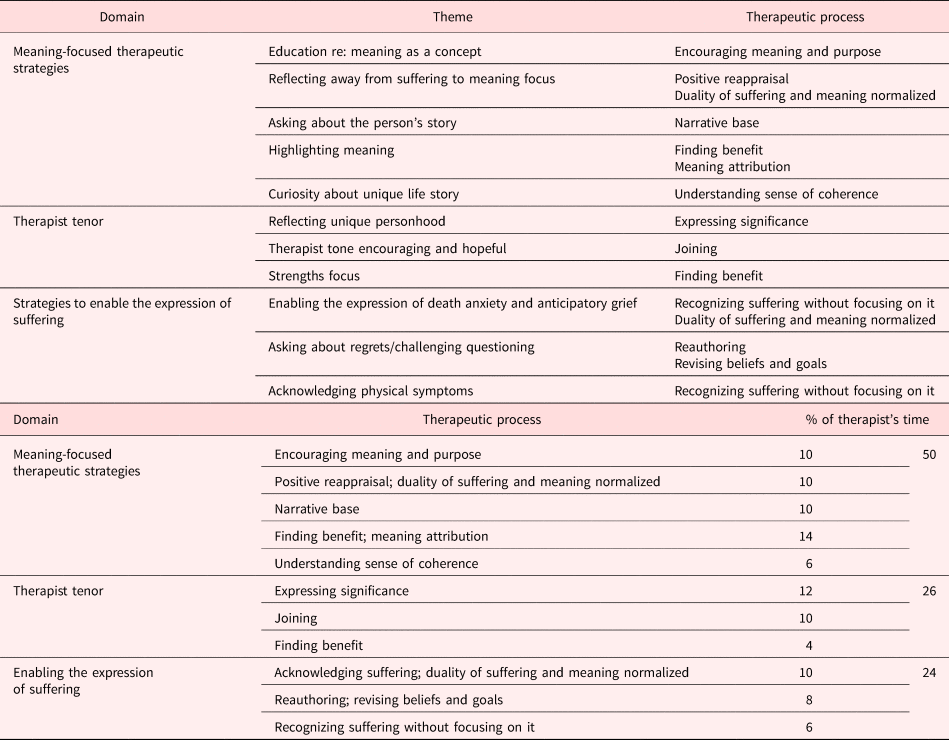
Themes were then placed under “therapeutic processes” and broad domains of “meaning-focused therapeutic strategies”, “enabling the expression of suffering” and “therapist tenor” (Table 4).
Themes, therapeutic processes, and proportion of time spent with each process

Meaning-focused therapeutic strategies were identified across each participant's sessions, enabling the therapy to be illustrated as a process; for example, participant 5 mentioned her garden in passing throughout her narrative.

In the third session, the therapist asked specifically about the meaning of her garden.

When this line of questioning was used, the participant and therapist alike discovered new insights. The participant realized that she was finding comfort in the garden in the way she did as a child in the country. Before her cancer diagnosis, she had worked long hours in an office in the city and now considered herself a “city girl.”. This focus on meaning in relation to the way she mentioned her garden raised insights for her as she stated the following.

This kind of discussion offered an entry into more active pursuit of meaning and purpose for participants such as participant 5 to work toward.
Enabling the expression of suffering involved empathic responses to suffering as opposed to the more directive focus on meaning. That said, the therapist did not just note a statement of suffering and move past it, but where it was important to explore the area of concern, the therapist did so. Once explored, the therapist then refocused back to the meaning either as a response to the suffering or as an alternative focus, for example, in the following excerpt from participant 19's transcript, the therapist briefly explores suffering and then moves to a refocus back to meaning.

In line with the aim of focusing on meaning, the therapist did not pursue the dialog about suffering of the cancer experience as such, but it was also not ignored. Instead, a statement such as “I regret not spending more time with my daughters while they were children” (participant 1), would be acknowledged and then followed up with a refocus on meaning, such as “What are some of the things about your daughters as children that were most meaningful to you, or that you look back at in wonder?” This redirection back to meaning was appreciated by participants. As participant 1 fed back to the therapist in his final session:
I was pretty down when I met you, but what was good for me was that we didn't start by talking about what I was down about. We both knew that cancer was a shadow over my life, but the focus was on my life, not the shadow.
Proportional focus
When tallied, one-half of the therapists’ time was spent on meaning-focused strategies, whereas close to one-quarter was spent on “enabling the expression of suffering.” The tenor of the therapist was also important, with a supportive tone used that encouraged a sense of significance and unique worth (Table 4).
Patterns
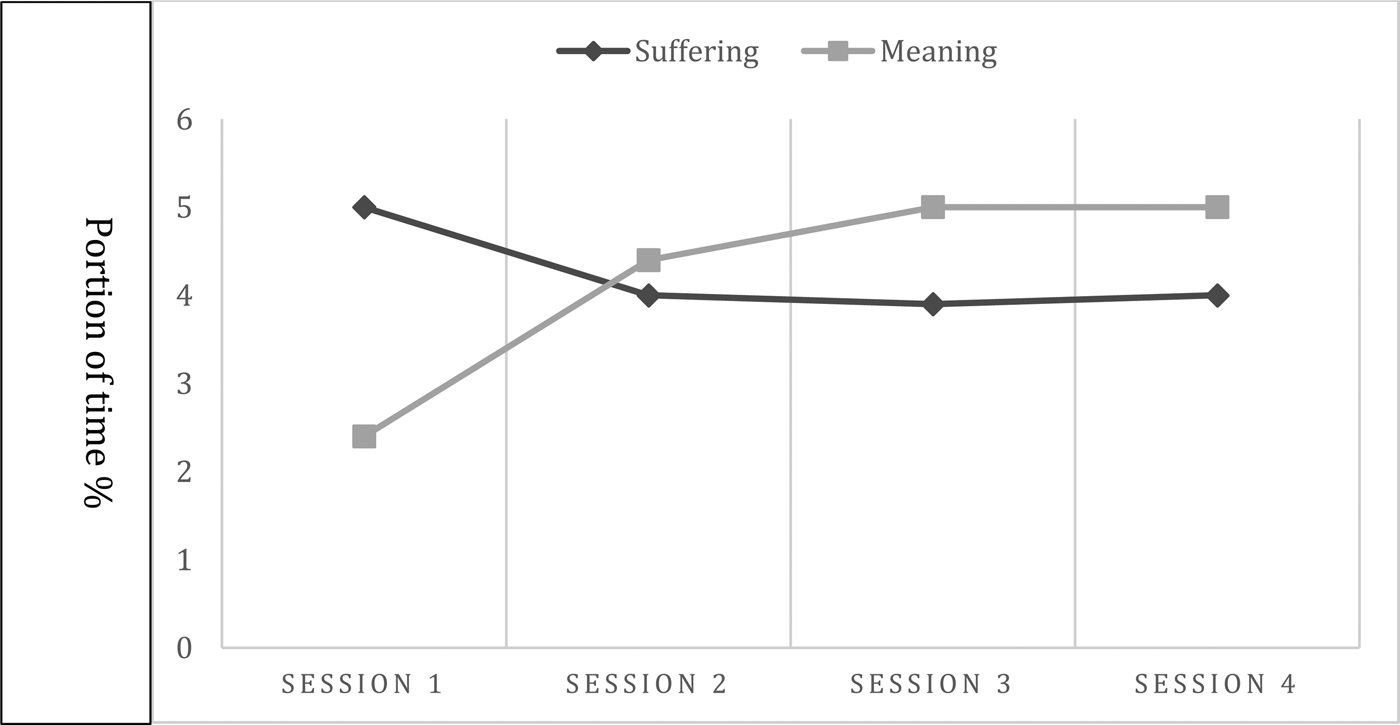
When all transcripts were considered together, there were common patterns that emerged. To begin with, although the therapists’ focus did not differ greatly over the sessions (i.e., the therapeutic bias toward discussing meaning over suffering), there was a common increase in the participant's focus on meaning and decrease on suffering as sessions progressed.
When considered as a line graph (Figure 1) there is a clear, dominant “suffering focus” in session 1 but, as the sessions progressed, there was a gradual crossover effect, and sessions 3 and 4 showed a predominance of meaning over suffering. Although both suffering and meaning were present in all sessions, there was a notable increase in the time spent talking about meaning as sessions progressed. This finding is in spite of the fact that all participants had progressive disease and were living with ongoing challenges.
Portion of time spent by all participants discussing suffering and meaning across the 4 sessions of Meaning and Purpose therapy.

Participant 19's transcripts offer an example of this therapeutic shift. This participant expressed how heartbreaking it would be to leave his loving family, while also declaring that he was working many hours away from them (in spite of having progressive disease and noting that he felt financially secure). Throughout the sessions, his focus shifted to being able to talk more about the positive aspects of his family. He eventually decided to stop work and focus his energy on making the most of the time he had left with them. In the final session, he said; “… pretending this is not happening is just wasting what time I have left, it's so bitter sweet. But, I've started to make plans to finish work and be with the ones I love.”
The other pattern to arise from the data was that many of the concepts that came under the themes of meaning and suffering for participants were counterparts. When “regrets” (suffering) were discussed, so too were “accomplishments” (meaning); when “fear” (suffering) was discussed, “hope” was also apparent (meaning). This coexistence of suffering and meaning was evident in all participants’ narratives.
Discussion
This analysis has been enlightening in relation to the processes and responses that occur between therapist and participant in the setting of MaP therapy.
Themes
The themes arising from the transcriptions reflected the experience of managing suffering in the setting of advanced cancer while being challenged to embrace meaning. These themes align with the aims of MaP therapy in acknowledging suffering while working to enhance meaning and thus rebalance the experience of living with advanced disease. Themes under the concept of suffering were, in the most part, contextual as a background to the participants story and yet cathartic nonetheless in that the expression of fear and pain, in the safety of a therapeutic setting, was described by patients as helpful.
Participants talked about their values in relation to what was important to them to have a meaningful life, that they:
• mattered to others.
• had achieved life goals.
• were close to their significant others.
• had overcome adversity.
Indeed, narratives commonly portrayed an inherent struggle to maintain authenticity against the odds, to achieve even when they had been told they would not amount to anything and to pursue career goals or personal interests not considered appropriate by others. These struggles to maintain integrity as well as acceptance by significant others and being loved authentically were lifelong challenges.
Therapeutic processes
In many ways, the therapists in these sessions were quite directive and deliberate in encouraging meaning to be brought to the fore. Meaning-focused processes were imbedded in the design of each session and the explicit redirection back to what was meaningful and reflective of purpose accounted for more than 70% of the therapeutic focus (including their tenor).
Once trust had been established, the therapists were able to challenge participants to focus on meaning in life, even in the setting of advanced disease. This sense of surety from the therapist seemed to enable participants to access the meaning that had not been apparent to them while they had been preoccupied by their distress. Statements that reflected narratives about meaning further enhanced this and illuminated each participant's unique benefit.
Therapeutic processes revolved around maintaining the tension between suffering and meaning; the benefits of focusing on meaning were openly espoused by therapists as they encouraged participants to reflect back and explore their life stories from the perspective of meaning (Halama, Reference Halama, Batthyany A and Russo-Netzer2014). Although empathy, clarification, and acknowledgment of suffering were offered as participants shared their sense of loss, regret, and fears, this was then followed by a deliberate redirection toward meaning. These patterns could be seen throughout the sessions as participants oscillated between suffering and meaning experiences and insights.
Patterns
Using a simple method of identifying portions of transcripts under themes and concepts enabled a tallying of themes and processes. Here it was illustrated that in spite of worsening Eastern Cooperative Oncology Group status for all participants, there was an increase in meaning focus and a decrease in suffering focus throughout the four sessions. This shift in overall focus as sessions progressed highlights the movement from an initial preoccupation with suffering to a gradual increased awareness of meaning for participants of MaP therapy.
The pattern of moving from a suffering to a meaning focus within sessions, however, was not a direct decrease or increase as such. Indeed, participants clearly experienced the dual existence of both in their lives. As noted in the results, regrets were discussed alongside accomplishments and fear alongside hope. In addition to encouraging a meaning focus then, an important part of the therapy is in acknowledging and normalizing this twofold experience, and the common desire for meaning in spite of suffering.
The progressive nature of advanced cancer complicates the ability of a therapy to move a person through a stressful life event and toward a position of reduced distress and improved coping. It was understandable then that one of the sequences that occurred as the sessions progressed was the way participants weaved around and eventually through the conversation about life and death, until they became aware of the variations in their own narrative that are driven by avoiding fear of death. Indeed, the shift we observed was in part related to the way that participant's previously unspoken threat of death, that may have prevented them from recognizing the importance of meaning, was able to be gently raised, giving way for meaning to offer a buffer to suffering. Importantly, the reality of the courage required to embrace living while accepting the end of life was managed carefully and respectfully at each participant's own pace.
Limitations
This study is limited in its focus on a small cohort from two treatment centers. The convenience sample carries a risk of selection bias, but as an initial test of our model, this design suited our needs adequately. As we began our examination of feasibility of the delivery of the intervention, however, we were caught by recruiting patients with quite advanced disease, and quickly found that our retention dropped to 62%. Attrition from disease progression or death was a limiting factor to our study. As a result, we choose to examine these data qualitatively and regroup our efforts in examining feasibility to the inclusion of patients with advanced cancer whose prognosis was assessed by their oncologist as more than 1 year.
In addition, the study used a priori themes in an attempt to refine the concentration of data into a manageable model that responded to previous findings. Given that 96 transcriptions were assessed including 4 different sessions, 24 participants, and 5 therapists, it was important to narrow the focus to the specific goal of enhancing meaning. Although assigning proportions to lines in transcriptions is, in some ways, a simplistic method of identifying focus, we were able to illustrate and identify an important pattern that will better guide this therapy in the future.
Conclusion
The aim of this paper was to begin to understand the process of MaP therapy itself; in particular, the possible association between the intervention and any therapeutic shifts. These data suggest that challenging a person with advanced cancer to move from grief and suffering toward insights around sources of meaning (and eventual action that will increase this meaning) may be a mediator of change. Such a challenge may increase the person's understanding of self and, once such an insight has been established, he or she will focus more on meaning in subsequent therapy sessions and beyond.
Although the discourse analysis used in this study deconstructed the experience of participants and therapists separately, MaP therapy is, of course, an interactive process that needs to be understood as a whole. There is a journey that takes place, beginning with the participants’ most pressing aspects of their story and then gently generating a focus on that which is most significant in their lives. In many ways, this process highlights the power of death awareness, which lies in its potential to be both psychologically paralyzing and instrumental in mobilizing a tenacious will to live.
Our examination has shown that it is possible to create a shift from preoccupation with suffering to a fresh focus on meaning. This shift relates directly to recognition of the way the threat of death can prevent participants from staying in touch with meaning in their lives, and, importantly, the way that this meaning might offer a buffer to their suffering. This is not to say that embracing living while accepting the end of life does not require immense courage. From a clinical perspective, MaP therapy offers one way: using meaning-focused therapeutic processes to offer a safe context in which to begin.
Acknowledgment
We thank the clinicians, therapists, and patients who have contributed to the study.