INTRODUCTION
The establishment of a parasite within its host is often associated with a remarkable alteration in the host's survival and fecundity, especially when the parasite biomass represents a large portion of the occupied host's organs (e.g. Hurd, 1990; Thompson, 1990). However, a severe decrease in the host life-span or host fecundity reduce on the other hand the duration of parasitic infection and, therefore, yield only low prevalence. As a consequence, an intensive evolutionary feedback occurs between parasite virulence (the detrimental effect on host fitness) and host life-history traits (e.g. Gandon, Agnew and Michalakis, 2002).
In a co-evolutionary context, there are no parasites which are so inextricably linked to a single group of hosts as digenetic trematodes are to snails (Esch, Curtis and Barger, 2001). Growth and reproduction of the trematode larvae (sporocysts or rediae) inside the snail host cause strong energetic constrains (parasites strive to consume host's resources, hosts try to avert this reallocation) as well as spatial constrains (integration of the parasite's volume within the shell-delimited body of the snail host) for both involved parties (Holmes and Zohar, 1990; Gérard and Théron, 1995; Sorensen and Minchella, 2001). In most snail-trematode systems, the growth and reproduction of trematode larvae takes place in the resource-rich tissues of the digestive gland and gonads of the host snail. Irrespective of the location of the trematode larvae in the digestive gland or gonads, there is evidence that the fecundity of the host is always reduced due to the trematode infection. Moreover, parasitic castration is recognized as a universal phenomenon in snail-trematode associations (Baudoin, 1975; Hurd, 1990). Parasitic castration is classified as (1) mechanical castration (according to the ‘food robbery’ hypothesis, Baudoin, 1975), where the trematodes are located in the gonadal tissue of the snail host and cause complete destruction of the gonad (James, 1965; Hoskin, 1975; Wilson and Denison, 1980; Khurshed Alam, Shahadat and Gilman, 1992; Probst and Kube, 1999) and, (2) as chemical castration (according to the ‘host manipulation’ hypothesis, e.g. Jong-Brink de, 1990), where trematodes are mainly located in the digestive gland but inhibit the host's reproduction by alterations in the host's hormonal balance (Joosse and van Elk, 1986; Bayne and Loker, 1987; Thompson, 1990; Théron and Gérard, 1994). The reproductive tissue of the snail host is less essential for the survival of the host and provides therefore an optimal microhabitat for growth and reproduction of the trematode larvae. Under natural conditions, the longevity of the snail hosts and therefore the availability of the parasite's microhabitat is commonly not affected by trematodes if they are located in the organs of the reproductive system (Sousa and Gleason, 1989; Jensen, Latama and Mouritsen, 1996; Keas and Esch, 1997; Tétreault, Himmelman and Measures, 2000; Kube, Kube and Bick, 2002b).
Although parasitic castration of snail hosts has been investigated many times at an individual host level, a quantitative evaluation of the fecundity effect at the host population level has rarely been studied in practice (Lafferty, 1993b; Sokolova, 1995). Fecundity effects at individual host level do not necessarily imply effects at population level too. It is not surprising, therefore, that both hypotheses concerning the severe detrimental effects of trematode infections on the snail host population dynamics as well as about a stable host reproductive success as a result of co-evolutionary feedback between parasites and hosts are still followed in parallel (e.g. Mouritsen and Poulin, 2002versusGandon et al. 2002).
Our own investigations aimed to quantify the impact of parasitic castration by trematode larvae on the reproductive success of mudsnails Hydrobia ventrosa at both the individual host level and the population level. In order to verify the relevance of parasitic induced alterations of host fecundity for population dynamics, the obtained results are discussed in relation to other important life-history parameters measured previously for the same snail population (Probst, Kube and Bick, 2000; Kube et al. 2002b). In those investigations, population dynamics of H. ventrosa and trematode prevalence were followed for a period of 3 successive snail generations to analyse the effects of environmental factors (winter severity and food supply, Probst et al. 2000) as well as the effects of trematode infections on host survival (Kube et al. 2002b).
MATERIALS AND METHODS
Field observations on host population dynamics and prevalence of larval trematodes were simultaneously conducted with laboratory measurements of egg production since in the natural environment only offspring recruitment could be measured. Egg laying experiments were designed in order to be able to apply the quantitative reproduction values so obtained to the related population in the field.
Snail demography and trematode parasitism
Snail demography and trematode prevalence were studied simultaneously in 1995/1996 at 4 different sites in the western Baltic Sea. Since no differences in the seasonal pattern of snail population dynamics and trematode prevalence were detected between study areas, a single site was chosen afterwards to follow year to year variations (Kube et al. 2002b). For this purpose, snail sampling was performed in a brackish shallow lagoon of the Wismar Bay in the western Baltic Sea (54·02 °N, 11·30 °E). A detailed description of the environment of the sampling site has been given by Probst et al. (2000).
The population dynamics of H. ventrosa was followed by collecting sediment core samples (9·6 cm2 Plexiglas tube, 5 cm deep) at monthly intervals between July 1995 and May 1999. A minimum of 3 cores was taken each time and up to 12 cores were taken if density of the snails was low. Core samples were preserved in buffered formaldehyde solution (4%) and sieved through 200 μm mesh size after fixation in the laboratory. Since shells of crawling young are 200 to 300 μm in diameter (Fish and Fish, 1981) our mesh was fine enough to catch the newly hatched juveniles. The shell height (apex to aperture) of all snails was measured to the nearest 0·1 mm. The snails' year class composition was determined using size frequency distributions in combination with the size-sex ratio distributions (Probst et al. 2000).
To quantify the recruitment of offspring, additional samples were taken during the reproductive season in 1997 (every 2 weeks from April to November).
In order to determine the trematode prevalence, several thousand snails were collected at each sampling date by dragging a net (mesh size 1 mm) through the upper 1 cm of the sediment. The live snails were brought to the laboratory in plastic jars containing sea water. About 300 living snails, >1·5 mm (smaller specimens never harboured trematode infections, Probst and Kube, 1999), were selected for the monthly analysis of trematode infections. Size classes were established for 0·1 mm intervals in shell height. A minimum of 10 snails were separated for each 0·1 mm size class to obtain comparable samples per size class for the subsequent data analyses. Snails were sexed and examined for trematode infections by dissection. Pre-patent infections (multiplication and growth of daughter sporocysts/rediae) and patent infections (mature daughter sporocysts/rediae and shedding cercariae; Gérard and Théron, 1995) were distinguished. Cercariae were identified according to Reimer (1971) and Yamaguti (1975). Finally, the obtained (standardized) prevalence values were applied to the density values and the size-frequency distribution of H. ventrosa in the field to determine the prevalence of trematode infections at host generation level.
Quantification of egg production
Since egg production of H. ventrosa could not be measured in the field, laboratory experiments were carried out for this purpose. From May to November of 1997 every 2 weeks living snails were subsampled from the same mudsnail population as described above. Adult specimens of the year class 1996 (>1·8 mm shell height) were sexed by the presence or absence of a penis. Any egg capsules on the shells were carefully removed before the experiment. One hundred female-male pairs were individually placed in 10 cm3 Plexiglas dishes. Female H. ventrosa copulate with several males and store the sperm in a seminal receptacle until fertilization. Thus, most mature females would have laid eggs under experimental conditions even when males are absent. However, we added a male to each female to ensure fertilization.
The snails were maintained in sieved sediment and with brackish water from their natural habitat and fed with diatoms (Thalassiosira fluviatilis) at 3-day intervals. The dishes were kept in a cooled incubator under the natural temperature/light regime. Maintenance was terminated after 2 weeks, before the hatching of the juveniles, which occurs after 20–30 days at an ambient temperature of 15 °C (Fish and Fish, 1981). The snails were removed from their Plexiglas dishes and the sediment of each dish was rinsed out very carefully. The egg capsules on their shells and on the sides and the bottom of the dishes were counted. Each egg capsule was opened to count the number of eggs inside. All female snails were dissected to determine the type and developmental stage of the trematode infections.
The fortnightly sampling of new snails from the field and their maintenance under natural conditions (sediment and water from the sampling site, natural temperature/light cycle) were applied to assure a low divergence between natural and laboratory conditions. However, it remains unknown if egg-laying rates in the laboratory exactly corresponded to egg-laying rates in the filed.
Extrapolation of the parasite effect on snail host fecundity for the whole population
To assess the proportion of uninfected and infected egg-laying females as well as the total number of eggs produced, the egg production observed in the aquaria was subsequently applied to the mudsnail abundance and trematode prevalence obtained by the quantitative field investigations (see above). In order to quantify the effect of trematode infections on the reproductive success at the level of the snail host population the observed egg production of the infected mudsnail cohort was compared with the egg production of an identical, but hypothetically uninfected mudsnail cohort. Egg production of the hypothetically uninfected mudsnail year class was calculated by applying the egg production values of uninfected females obtained from the laboratory egg-laying experiment to the size-frequency distribution and abundance of the field population. This procedure was based on the knowledge that trematode infections do not cause an increase in snail host mortality (Kube et al. 2002b).
RESULTS
Snail demography and trematode parasitism
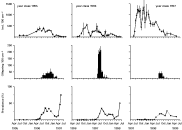
H. ventrosa of the year class 1996 hatched between July and October 1996 and survived until June 1998. Snails of this year class spawned in their second calendar year between June and November 1997. The abundance of fertile H. ventrosa of the year class 1996 during the reproductive season of 1997 was about 167±131 ind. 100 cm−2 (Fig. 1). Most of the snails died at the end of the reproductive period in late autumn 1997, but some overwintered a second time and died next spring/summer. A minimum estimate of the total annual production of recruits in 1997, based on the density values of snails <0·5 mm shell height and on the assumption that newly hatched snails attain a shell height >0·5 mm within less than 4 weeks, was calculated to be 290 ind. 100 cm−2 yr−1 (Fig. 1).

Fig. 1. Abundance of Hydrobia ventrosa of the year classes 1995, 1996, and 1997 in Wismar Bay (upper panels, mean density±S.D.), abundance of recruits (<0·5 mm shell height) of the H. ventrosa year classes 1995, 1996, and 1997 (middle panel, mean density±S.D.), and prevalence of trematode larvae in the H. ventrosa year classes 1995, 1996, and 1997 (lower panel).
The first trematode infections in H. ventrosa of the year class 1996 appeared in May 1997, when the first snails reached fertility. The prevalence increased rapidly until August 1997 reaching 35%, and decreased to about 20% in autumn. The lowest prevalence in this snail year class was recorded in March 1998, but about 50% of the snails that overwintered twice were infected before they died in spring/summer 1998 (Fig. 1).
The component trematode community infecting H. ventrosa included 8 taxa (Paramonostomum alveatum, Himasthla sp., Cryptocotyle concavum, Cryptocotyle sp., Asymphylodora demeli, Maritrema subdolum, Microphallus sp. and, Levinseniella brachysoma; for details see Kube et al. 2002b). The notocotylid P. alveatum was the most prevalent species, followed by the microphallids M. subdolum and Microphallus sp. The parthenitae generation of all trematode species was located in the organs of the reproductive system of their snail hosts. As a consequence, the affected organs, in particular the gonads, showed severe histopathological alterations. The gonadal tissue was almost completely replaced by sporocysts or rediae during patent infection (for details see Probst and Kube, 1999).
Egg production
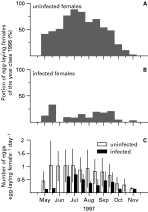
Snails of the year class 1996 displayed a single period of egg laying in 1997 between May and November. About 50% of the uninfected females laid eggs at the beginning of the egg-laying season in May and June 1997. The proportion of egg-laying females increased in late June, and reached a peak in July when 90% of the uninfected females produced eggs. Afterwards the proportion of egg-laying females decreased from 70% in August to 3% at the end of the reproduction period in November 1997. The mean proportion of egg-laying uninfected females was 51% throughout the reproductive season. The low values of variance in the egg production per day of uninfected females illustrates that the amount of sperm for fertilization was not limited for the enclosed female snails (Fig. 2).

Fig. 2. Comparison of the egg production of uninfected and infected Hydrobia ventrosa of year class 1996 in Wismar Bay. (A) Proportion of uninfected egg-laying females during the reproductive period from May until November 1997, (B) proportion of infected egg-laying females during the reproductive period from May until November 1997, (C) number of eggs produced by uninfected and infected females per day.
The egg production of females with trematode infections was significantly reduced (Kolmogorov-Smirnov test, P<0·0001; Fig. 2). Among females with pre-patent infections about 20% were still able to produce eggs throughout the reproduction period 1997. A species-specific calculation of the fitness effect of trematodes was not possible because trematodes could not be determined during the pre-patent period. Among females with patent infections, merely 9% laid eggs.
Egg production of uninfected females decreased from 1·0 egg per egg-laying female per day in spring 1997 to less than 0·5 eggs per egg-laying female per day in autumn 1997. On average, 0·72±0·3 eggs were laid per uninfected egg-laying female per day. The egg production of infected egg-laying females was reduced to 0·31±0·2 eggs per egg-laying female per day (Fig. 2).
Extrapolation of the fecundity effect
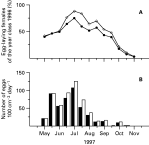
On average 43% of the female mudsnails of the year class 1996 laid eggs throughout their reproductive season in 1997. This value was obtained by applying the egg production of uninfected and infected females measured during the egg-laying experiment to the recorded mudsnail population structure and the trematode prevalence at the sampling site. Considering an identical, but hypothetically uninfected mudsnail population (by applying only the egg-laying activity of the uninfected females to the population structure), on average 51% of the females would have laid eggs throughout the reproductive period. Thus, the number of reproductive females was reduced by about 8% on average. The difference between the proportion of egg-laying females in the natural and the hypothetical populations varied throughout the reproductive season. It was lowest (1%) during the first 2 months of the reproductive period (May, June), when the productivity of the females was highest and reached its maximum in early August (25%), when the productivity of the females was already decreasing (Fig. 3).

Fig. 3. The calculated fitness effect of trematodes in the Hydrobia ventrosa year class 1996 in Wismar Bay. (A) Proportion of egg-laying females in a hypothetically uninfected mudsnail population (open circles) and proportion of egg-laying females in the infected field population (filled circles) during the reproductive period 1997. (B) Calculated number of eggs in a hypothetically uninfected mudsnail population (open bars) and calculated number of eggs in the infected field population (filled bars) during the reproductive period 1997.
The calculated total of the annual egg production of the H. ventrosa year class 1996 was about 6420 eggs 100 cm−2 yr−1 in 1997. The total annual production of recruits was 290 ind. 100 cm−2 yr−1 (see above). Hence, natural egg mortality before hatching was about 95%. A hypothetically uninfected mudsnail population would have laid about 7460 eggs 100 cm−2 yr−1 (estimated as described above for the proportion of egg-laying females). Considering an egg mortality of 95% the total annual production of recruits in an uninfected population would have been about 340 ind. 100 cm−2 yr−1. Finally, the fecundity loss due to parasitic castration of snails could be calculated at about 15%.
DISCUSSION
As expected, larval trematodes caused a measurable fecundity loss to the H. ventrosa host population due to parasitic castration (estimated 15%). Investigations of the trematode prevalence for the same H. ventrosa population from 1995 until 1999 (Kube et al. 2002b), as well as for nearby populations from identical habitats (Kube et al. 2002b), showed that irrespective of the year and the sampling area, the average prevalence of the H. ventrosa populations always fluctuated between 20% and 30% during the snail reproductive season. The species composition and density of waterfowl (the final hosts for the dominant trematode species) did not affect the prevalence values (Kube, Kube and Dierschke, 2002a). The structure of the component trematode community also showed no significant variation over time or between areas (Kube et al. 2002b). Thus, our estimate of fecundity loss for the whole snail host population seems to be representative for the parasite-host system under investigation.
The average prevalence value of 25% also has to be viewed as a mean over time, since the prevalence of a certain host age class increases with host size (10–20% for snails with a height of 1·8–2·4 mm, 20–50% for snails with a height of 2·5–2·8 mm, and, >50% for snails >2·9 mm; Kube et al. 2002a). However, the susceptibility for infection is (for unknown reasons) higher for large-sized (older) than for small-sized (younger) fertile H. ventrosa, since prevalence is much higher in snails that have overwintered twice than in snails that have only overwintered once, although they are infected at the same time (Kube et al. 2002b). The size-dependent pattern of trematode prevalence explains why the value of reduction of egg production was lower than the average prevalence value (about 25%): (1) early maturing females were less infected and (2) early maturing females laid more eggs per day than females maturing later during the reproductive season.
The estimated value of the reduction in host fecundity of about 15% at population level has to be viewed in relation to the influence of other environmental variables on the population dynamics in order to judge its ecological relevance. There are at least two alternatives: (1) reduction of fecundity by trematodes significantly affects snail host demography and population dynamics, (2) the effects of other environmental factors overwhelm the effect of parasitism.
Probst et al. (2000) described the life-history patterns and population dynamics of the same H. ventrosa population from 1995 until 1999. They observed large interannual variations in the total annual production of recruits, with values ranging between 90 ind. 100 cm−2 yr−1 and 290 ind. 100 cm−2 yr−1. Offspring recruitment was low after mild winters, but high after a severe winter (most likely due to variations in egg production). Furthermore, other environmental factors strongly affected the survival of eggs and small offspring (95% due to egg predation, temporal oxygen deficiency in late summer and others). Hence, fertility (number of offspring) at population level underlay severe year-to-year variations caused by a variety of environmental factors.
In contrast to the observed fluctuations in offspring abundance, mean summer density of fertile H. ventrosa did not vary significantly throughout an observation period of 4 successive years (Probst et al. 2000). At the beginning of the reproductive season abundance of fertile snails fluctuated only between 200 and 300 ind. 100 cm−2 due to either immigration or emigration/mortality. A comparable stability of adult abundance in space and time was observed also in other windflats of the western Baltic Sea (e.g. Dierschke, 1996). Trematode prevalence does not differ between these windflats (Kube et al. 2002b).
Probst et al. (2000) suggested that intraspecific competition was the prominent cause for this phenomenon. Intensive migration by floating seems to be the main mechanism of hydrobiid snails for escaping crowded conditions (Anderson, 1971; Levinton, 1979; Armonies and Hartke, 1995). Post-juvenile emigration/mortality in relation to the locally available food supply during the reproductive season (benthic algae and bacteria) is, therefore, the dominant factor regulating the population dynamics of H. ventrosa.
Hence, the reduction in the egg production by about 15% due to parasitic castration cannot have severe detrimental effects on the snail host population under investigation. First, a variety of environmental factors cause year-to-year variations in egg production and fertility which swamp the effect of trematode infection, and second, the snail population is predominantly regulated at carrying capacity by intraspecific competition of adults regardless of parasitism.
The general lack of quantification of the effect of parasite infections on the reproductive effort of their snail host populations makes it difficult to draw any general conclusions from our findings (compare Crews and Esch, 1986). Taking into account the fact that trematode infections lead to a reduction or complete inhibition of the reproductive activity of the snail host it seems likely that natural selection favours host life-history traits which at least partially compensate for the fitness losses. Indeed, there are a few studies of snail-trematode systems, which support the hypothesis that castrating trematodes shape the life-histories of their hosts. Parasite-induced alterations of host life-history traits, in order to compensate for fitness losses, may include (1) temporal shifts of the reproductive cycle, (2) higher resource allocation towards the reproductive activity and, (3) higher resource allocation towards somatic growth.
The data obtained during the investigations, carried out for the H. ventrosa-trematode association, allow the evaluation of all 3 hypotheses. (1) In gastropod populations with a high infection risk, snails that mature early in their life presumably have a higher reproductive success and a selective advantage compared to snails, which exhibit a later start in reproductive activity (Lafferty, 1993a; Jokela, Dybdahl and Lively, 1999). Our study also led us to conclude that early maturity potentially results in a fitness advantage for H. ventrosa and is therefore positively selected (see above), since both snail maturation and miracidia hatching require a minimum threshold temperature (Kube et al. 2002b). However, there are also other environmental factors which favour early maturity in H. ventrosa: eggs laid early during the season have a much higher chance of hatching than late eggs (Probst et al. 2000). It is difficult to state, therefore, that early maturation is a major response to trematode infection. Furthermore, early reproduction cannot be considered as advantageous, in general, since most H. ventrosa populations live in a boreal and temperate climate that shows significant interannual variations in the local climatic conditions. For instance, periods with low temperatures in spring can cause fitness losses for early reproducing snails, because for H. ventrosa the threshold temperature for the start of reproductive activity is >10 °C (Lassen and Clark, 1979; Probst et al. 2000). (2) Higher resource allocation towards the reproductive activity is reported as a short-term consequence of trematode infection (Minchella and Lo Verde, 1981; Thornhill, Jones and Kusel, 1986; Keas and Esch, 1997), as well as an adaptive strategy of snails in populations with a high prevalence of castrating parasites (Krist, 2001). H. ventrosa females harbouring trematode infections at the pre-patent developmental stage did not show an increased egg production but rather a decreased numbers of eggs. Thus, there is no evidence that supports the hypothesis of fecundity compensation by increasing the reproductive effort during the initial stage of trematode infections in H. ventrosa. (3) Enhanced somatic growth is interpreted as an adaptive host strategy in order to prolong host survival and compensate for reproductive losses during the following reproductive season (Minchella, 1985). This hypothesis implies that the adverse effects of trematodes on host reproduction are short lived (relative to the life-span of the host) and remediable. H. ventrosa is a semelparous snail. Therefore, there is no trade off between the energy allocation for current versus future reproductive success. Furthermore, the destruction of the reproductive tissue by trematode larvae is mechanically effected and castrated snails do not outlast their infection. Hence, for the H. ventrosa-trematode association enhanced host growth cannot be considered as a host adaptation in order to compensate for a reduction in fecundity (Probst and Kube, 1999).
The lack of an obvious host life-history alteration due to parasitic castration leads to the assumption that H. ventrosa might use other feedbacks to compensate for the negative effects of parasitism (e.g. immune response).
We would like to thank S. Vopel and A. Holst for their assistance during the field and laboratory work. This study was funded by the Federal Ministry of Education and Research (03F0175A). The experiments comply with the current laws of Germany.