


Introduction
Self-help texts have been in existence since the birth of civilization and written language. The ancient Greeks and Romans wrote plays and texts to help others be more content with their lives, and Albert Ellis highlighted the psychological change elements within religious texts such as the Bible and the Koran (cited in Barrera et al. Reference Barrera, Rosen, Glasgow, Hannah, Christian and Clark1981). Since the 1960s, with the advent of cognitive behaviour therapy (CBT), a form of self-help book has emerged where the reader is encouraged to actively interact with the information in the text. These might broadly be described as therapy treatment manuals which are written to be implemented by the reader.
Clinician support and guidance is broadly considered to increase the effectiveness of self-help materials (Gellatly et al. Reference Gellatly, Bower, Hennessy, Richards, Gilbody and Lovell2007), and a number of systematic reviews have determined that guided self-help (GSH) is effective in the treatment of both depression (Cuijpers, Reference Cuijpers1997; Anderson et al. Reference Anderson, Lewis, Araya, Elgie, Harrison, Proudfoot, Scmidt, Sharp, Weightman and Williams2005; Gellatly et al. Reference Gellatly, Bower, Hennessy, Richards, Gilbody and Lovell2007) and anxiety (van Boeijen et al. Reference van Boeijen, van Balkom, van Oppen, Blankenstein, Cherpanath and van Dyck2005; Hirai & Clum, Reference Hirai and Clum2006; Lewis et al. Reference Lewis, Pearce and Bisson2012). As such, a new type of clinician (psychological wellbeing practitioner; PWP) is part of the English National Health Service following the Improving Access to Psychological Therapies (IAPT) initiative (see Clark et al. Reference Clark, Layard, Smithies, Richards, Suckling and Wright2009). Their role is mainly to perform this function. Other similar developments have occurred in countries such as Australia, Sweden, Canada, Holland and the USA (Bennett-Levy et al. Reference Bennett-Levy, Richards, Farrand, Bennett-Levy, Richards, Farrand, Christensen, Griffiths, Kavanagh, Klein, Lau, Proudfoot, Ritterband, White and Williams2010). PWPs can see over 90% of the referrals for common adult mental health (AMH) problems (although not necessarily exclusively; Richards & Suckling, Reference Richards and Suckling2007); therefore, GSH is a mainstay modality for the treatment for these patients (although PWPs also use other treatment ‘vehicles’).
Worryingly, a small seam of earlier research has indicated that some individuals react negatively to self-help materials. Despite this issue being raised in an early review of the field (Glasgow & Rosen, Reference Glasgow and Rosen1979), it has received minimal empirical investigation and so understanding of the phenomenon is limited. In the USA, 9% of patients reported that they had experienced distress or believed that reading self-help books had caused them harm (Halliday, Reference Halliday1991). Similarly, 8% of US psychologists reported that at least one of their patients had suffered harm from the use of self-help (Starker, Reference Starker1988). For the purposes of this study, we consider harm to be a worsening of some aspect of the individual's clinical condition, motivation or situation. As an illustration, Glasgow & Rosen (Reference Glasgow and Rosen1979) found unsubstantiated claims of benefit on books’ covers, they describe a fear-reduction manual which instructs individuals to perform tasks which some patients reported to be confusing or even upsetting, and note that premature cessation of materials can exacerbate anxieties. Outcome studies have raised similar concerns. Mohr et al. (Reference Mohr, Beutler, Engle, Sholam-Salomon, Bergan, Kaszniak and Yost1990) found that after receiving a self-help intervention for depression, 19% of their participants experienced an increase in symptomatology at follow-up and Scogin et al. (Reference Scogin, Floyd, Jamison, Ackerson, Landreville and Bissonnette1996) found a negative outcome in 9% of participants across five studies. This issue of harm to patients is at the core of clinical practice with non-maleficence being one of the four general ethical principles which underlie the implementation of healthcare (Beauchamp & Childress, Reference Beauchamp and Childress2012).
A literature search revealed no recent studies which have looked specifically at negative impact of self-help materials. Given the prominence of their use in the treatment of common AMH difficulties, and also given the improvements that are likely to have occurred in materials since this point, it is important that this issue is investigated. Hence, the following three, small-scale, linked studies examine quantitatively and qualitatively clinicians’ experience of harm in their patients as a consequence of the administration of self-help materials, before surveying patients’ first-hand views. Specifically, Study 1 uses a survey to obtain psychologists’ experience of self-help materials in this respect. Study 2 uses a qualitative approach to explore the views and experiences of clinicians in greater depth. Study 3 uses a survey approach to explore patients’ experiences of this phenomenon. In studies 1 and 2, clinicians work in a variety of specialities whereas the patients within Study 3 are drawn from an AMH context.
Study 1
Method
Design
A postal survey was based partly on information from previous research (Adams & Pitre, Reference Adams and Pitre2000; copies of the surveys used in studies 1 and 3 are available from the first author upon request). This survey enquired about each clinician's work role and experience, the frequency and purpose of their use of materials, as well as whether they had experienced them causing any harm. If they had, they were then asked for details about the materials and the nature of this harm. After the survey administration, follow-up surveys were sent out approximately 6 weeks afterwards to all psychologists that had not returned the survey. All three studies described in this paper received approval through Northumberland, Tyne & Wear NHS Foundation Trust's ethics committee processes as per the standard protocol for service development projects and local staff surveys. Study 3 was additionally approved by Northumbria Healthcare NHS Trust's ethics committee.
Participants
Participants were recruited from psychologists working in two services in the Northeast of England. Responses were obtained from 49 (75.4%) of the 65 psychologists surveyed. All psychologists were involved in clinical activity. Of these, 63.2% were qualified clinical psychologists. The remaining participants were trainee clinical psychologists (18.4%) and assistant (postgraduate but pre-clinical training) psychologists (18.4%).
Results
Nine psychologists (18.4%) indicated that they had had experience of self-help materials resulting in harm to patients. Five books (6.0% of the materials listed by participants) were identified as causing these effects. One of the books from this sub-sample was a practitioner guide used in a self-help context. Reported issues were associated with patients either feeling overwhelmed by the tasks demanded by the materials, an exacerbation of symptoms provoked by the presented information or being undermined by an inability to grasp the concepts outlined within them. Qualitative comments also described patients adopting a passive ‘victim’ role, being overwhelmed by materials’ case histories and also becoming distressed by the psychological interventions which were outlined within the texts (e.g. graded exposure).
Study 2
Method
Design
Semi-structured interviews were conducted to explore the issues that emerged from Study 1. The initial topic guide was subject to modification following expert peer review. A survey of the literature was also conducted to ensure that, as a minimum, likely factors that are associated with negative effects were covered within the interview. A qualitative methodology was applied and the data was analysed thematically (as per Braun & Clarke, Reference Braun and Clarke2006). To investigate the reliability of themes, one of the interviews was analysed by two of the authors. The same themes were identified, differences being based on the naming of the themes. The remaining interviews were analysed by a single author.
Participants
Clinicians working in psychology departments within the Northeast of England were identified from a local university's email list. Eight individuals were interviewed. Of these, four were qualified clinical psychologists, three were trainee clinical psychologists and one was a qualified nurse therapist. Initially, all of the nine individuals from Study 1 who indicated that they had experience of self-help resulting in harmful effects to patients were invited to participate. Of these, two agreed to participate and thus formed part of this sample of eight participants.
Results
Themes
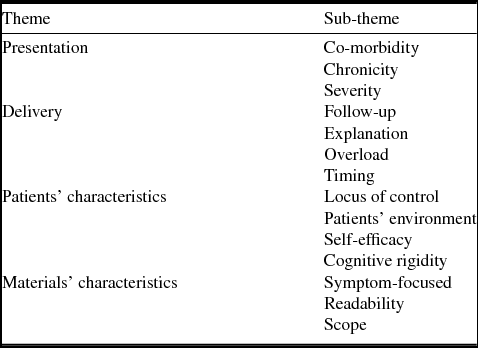
The four main themes are: presentation, delivery, patients’ characteristics, and materials’ characteristics. Table 1 provides a thematic map of the themes and sub-themes. These are described in turn below.
Themes and sub-themes associated with negative effects

Presentation
This theme described situations where self-help had been administered but had proved unhelpful due to the complexity of the patient's presentation. It comprised three sub-themes. The first of these was ‘co-morbidity’. Self-help was unhelpful when a patient had a co-morbid presentation. Some patients had been given self-help that only focused on one part of their presentation which led to confusion and a feeling that the clinician did not appreciate the range of their difficulties. Alternatively, they were given a variety of self-help materials that attempted to deal with all of their problems with the result that they were overloaded with information: ‘Self-help doesn't take into account the range of problems people present with, which was quite confusing for her [the patient] as it only focussed on one part’.
A second sub-theme was ‘chronicity’. Self-help appeared to be unhelpful when the patient had experienced their difficulties for a number of years. By this stage, the problems had become too ingrained for a self-help approach to have an impact. Again, this left patients feeling misunderstood and affected engagement in therapy. ‘For chronic depression . . . self-help on depression with activity scheduling, . . . there's the potential for it to be patronizing’. Finally, there was a sub-theme linked to ‘severity’ where the materials were perceived as being too simplistic: ‘Sometimes the problems people have got are just too serious for self-help and it can pile on the guilt, feelings of hopelessness and negative thoughts if self-help doesn't work for them’.
Delivery
This theme incorporates issues linked to the administration of self-help and comprised four sub-themes. The first was linked to ‘follow-up’ after administration. Patients could disengage if self-help was set but was then not appropriately followed up: ‘In neither case, where there were problems, was the self-help followed up. It was counter-therapeutic in both’. Second, how materials were ‘explained’ and contextualized was not sufficient, leaving some patients feeling that this was all that could be offered in terms of treatment: ‘We need to be clear that there are steps above the self-help one. Patients should know there are other options. It should be used to support work you’re doing but not [be] instead of’. Next, there was a sub-theme of ‘overload’ which occurred when patients were given too many materials. In such instances, patients tended to select parts of materials to complete and hence not engage with the therapy process effectively: ‘The material was all available to her all at once, so she did it piecemeal. . . . The outcome was that it reinforced a behavioural pattern . . . reconfirmed a pattern of engagement in therapy which was to pick and choose’. A final sub-theme is linked to ‘timing’ of the administration of the materials which was considered to be crucial. In particular, difficulties emerged if they were offered them before a complete assessment and formulation had been undertaken: ‘Jumping ahead by giving material before establishing that they can control and modify emotional responses . . . then you can run the risk of them becoming overcome with traumatic emotional responses and dropping out of therapy’.
Patients’ characteristics
Each of the following sub-themes are linked to ‘patients’ characteristics’. The first is ‘locus of control’. Self-help had been reported to be unhelpful to patients with an external locus of control. Specifically, patients who believed that other people should ‘fix’ them did not benefit from self-help, rather they were left feeling frustrated and de-motivated by the materials: ‘They had an external locus of control and [when] encouraged to do work on [his] own . . . made him frustrated and angry – “You’re telling me I’m having to fix myself?”’ The second sub-theme was linked to the ‘patient's environment’. For some who lived in deprived areas, life stressors left them with little time to focus on completing homework tasks. Such patients found it particularly unhelpful: ‘He was in an environment where lots of problems [were] going on and he was unsupported so it was inappropriate to give him self-help at all’. Patients with low levels of literacy also found the materials confusing and this could reinforce any existing issues linked to inadequacy. A third sub-theme was linked to ‘self-efficacy’. Patients with low levels of self-efficacy did not respond positively to self-help materials: ‘He had a low self-esteem and low self-efficacy, felt he was someone who couldn't make things better for themselves – “Not even this is working for me, I’ve been given self-help and I can't even do it”. It fed into his feelings of hopelessness’. Finally, a number of the patients who had found self-help detrimental were perceived to have experienced a degree of ‘cognitive rigidity’. Specifically, participants reported that the patients had been unable to be selective in their approach, therefore either applying information to themselves that was irrelevant or following the self-help advice without critically engaging with it: ‘He experienced bodily symptoms associated with anxiety but not all the bodily sensations that were listed in the self-help, but then he tried to tune into the other ones, which caused him to start experiencing [more] physical symptoms’.
Materials’ characteristics
This theme related to the self-help materials themselves, and encompasses both their quality and underlying principles. It encompasses three sub-themes. First, participants noted that one of the main difficulties with self-help was that it focused on the ‘symptoms’ of a problem, rather than an underlying cause. As such, it was not always considered to be a complete and lasting treatment approach. Consequently, some patients felt de-motivated and less inclined to engage if difficulties persisted or recurred: ‘Self-help had fitted her symptoms but [had] not really appropriately considered the underlying factors. Consequently it made her quite cynical about whether therapy was going to be able to help her’. ‘Readability’ was a second sub-theme, with some patients struggling to understand certain materials: ‘Sometimes the materials are written at too high a level, and people aren't readers, . . . it's not their primary way of taking in information and they’re not over-keen to do it’. A final sub-theme is ‘scope’. With materials generally having been written to be accessible to as wide a range of the population as possible, participants felt that some were too generic for the specific problems that some individuals presented with. Additionally, while some of the information was relevant to a particular patient, there was also inevitably a degree of irrelevance in the content: ‘I had a woman with [a] plane phobia. . . . [The materials] undermined her experience as [they] gave [information about] lots of different phobias. She hadn't thought of her phobia in a category of phobias. She thought “they’re all easy to get over and mine isn’t”’.
Study 3
Method
Design
All participants were asked to complete a short postal survey which asked patients initially about their age, educational experience and reading habits. It then went on to explore their clinical difficulties and the nature of their contact with the clinician. Then, whether or not self-help materials had been prescribed was asked and, if it had been, what the patient believed to be the function of this. The survey then requested a rating on a 5-point Likert scale that ranged from the materials being ‘very helpful’ to ‘very unhelpful’. Then helpful and unhelpful aspects of the materials were requested in free text sections. Finally, an item enquired about the extent to which sessions were focused around the materials. A cover letter for the survey included the name and telephone number of a designated person within the service that participants could contact either if they had any questions about the project or if the survey raised any issues for them.
Participants
Participants were working-age adults who had been referred to a psychology service which was part of an integrated IAPT department. They had also attended at least two sessions and had been discharged in the 6 months prior to survey administration. Participants were drawn from different geographical areas in the Northeast of England. In total, 140 participants were contacted. Of these, 21% replied. However, only 12% (n = 17) reported having been given self-help materials and therefore the subsequent analysis focused on these individuals.
Results
The greater majority of participants reported finding the materials either ‘partly helpful’ (n = 6) or ‘very helpful’ (n = 7). Four people (23.5%) reported unhelpful experiences over categories: ‘very unhelpful’ (n = 1), ‘partly unhelpful’ (n = 1) and ‘did not relate to my problems’ (n = 2). The latter was noted to be a potential harmful effect by clinicians (within the sub-theme of ‘scope’ in Study 2). The survey aimed to explore the nature of any unhelpful experiences. However, given the small number of people in this group we consider the results in a tentative manner below.
In terms of individuals’ previous experience of self-help, neither of the people who found the material to be either ‘partly unhelpful’ or ‘very unhelpful’ had used self-help materials before. Out of the two people who found that the material did not relate to their problems, one had used self-help previously and the other had not. For those who found the materials to be helpful, most (n = 8) had not used self-help before.
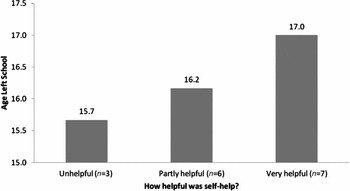
Individuals’ level of education was also investigated. Three of the four people who found the materials to be unhelpful, reported the age they left school. This ranged between 15 and 16 years. The participants who reported having helpful experiences left school between the ages of 15 and 18. In order to compare groups, the scores from the three participants who reported unhelpful experiences were pooled and compared to those who found it either to be ‘partly helpful’ or ‘very helpful’. Figure 1 shows that a trend is visually evident in this data and differences between groups were found at a significance level which is in the realm of ‘suggestive’ of an effect [Curran-Everitt & Benos, Reference Curran-Everitt and Benos2004; Jonckheere–Terpstra trend test (J = 55.50, z = 1.55, p = 0.12)]. Thus it appeared likely that those who found the materials to be most helpful had spent more time in education.
Helpfulness of materials over school leaving age.

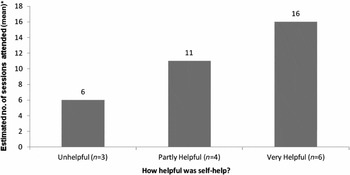
In terms of their current experience, no patients who attended for more than ten sessions reported finding self-help materials to be unhelpful. The trend in number of sessions attended and level of helpfulness was visually evident (Fig. 2) and was shown to be significant (Jonckheere–Terpstra trend test: J = 42.5, z = 2.1, p = 0.04), with a greater number of sessions being linked to better appraisals of the utility of self-help materials.
Helpfulness of materials over number of sessions attended. * Calculated using the mid-points of survey item categories (e.g. for 2–5 sessions = 3.5, for 6–10 session = 8).

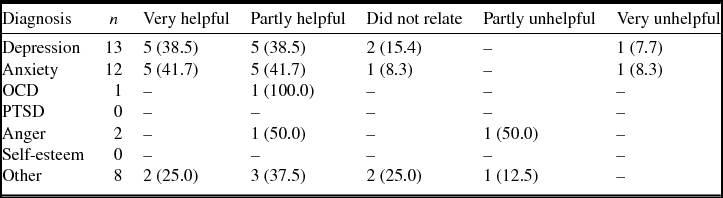
The level of reported utility of materials according to diagnostic category is reported in Table 2. It should be noted that individuals could report more than one diagnostic problem for which they were receiving therapy. Within the confines of the data received, there did not seem to be a pattern in regard to problem presentation and reports of helpfulness.
Helpfulness of materials over diagnosis/problem

OCD, Obsessive compulsive disorder; PTSD, post-traumatic stress disorder.
Values given are n (%).
Discussion
Clinical work involves the navigation through conflicting ethical principles. The patient who verbalizes significant personal risk presents the clinician with a dilemma between the individual's ‘right to autonomy’ on the one hand and the clinician's obligation of ‘non-maleficence’ on the other. Similarly, certain treatments offer ‘beneficence’ but with a risk of lesser negative effects (examples of the latter include pharmacological side-effects such as a loss of libido or personal distress involved in psychological exposure). Consequently, ethical practice involves the clinician engaging in a process of weighing up these ethical factors to avoid harm where possible and maximize benefit for the patient. While our results should be interpreted with caution given the explorative nature of our studies, this paper facilitates clinicians in their ethical decision-making by indicating that the process of providing written materials within a clinical context is not a benign one. It also pinpoints some factors which may contribute to a harmful outcome. Our results do not challenge the overall effectiveness of GSH for common AMH problems but, rather, explore the phenomenon that some patients appear to react negatively to it.
Our three studies are in keeping with earlier studies that found detrimental effects for some. The first survey (Study 1) indicated that over 18% of clinicians had experienced self-help materials as having negative effects. This is a higher percentage than that reported by Halliday (Reference Halliday1991) and Starker (Reference Starker1988). As such, it appears that while materials will have inevitably developed in sophistication over the last quarter century, they continue to cause difficulties for a minority. The clinicians’ feedback identified possible sources for this, for example through use of inappropriate materials (e.g. a text book in a self-help context), over-prescription (overwhelming the patient with too much information), a mismatch between materials and the severity of the patient's condition (e.g. alarming the reader through the use of more severe case examples to their own within the text) and presenting the materials without sufficient prior discussion (potentially resulting in the individuals not grasping concepts within texts or being alarmed by treatment strategies that involve a personal challenge).
Study 2 explored, in greater detail, these and other factors lying behind such possible negative effects. Clinicians’ responses fell into themes centred around the degree of the match between the materials and the patient's disorder, the setting conditions regarding the administration of the materials, characteristics of personality that mean that self-help might be less accessible, and the characteristics of the materials themselves that may lead to them being unhelpful. This study supported possible negative impacts occurring through over-prescribing and insufficient clinical support. It also suggested that difficulties could emerge through the use of CBT-based self-help materials to supplement a therapeutic approach that does not fully complement them. This is an assumption we make from reports that materials were sometimes not followed up by clinicians and also due to reports that some patients lacked confidence in the GSH as they believed that it was not focused upon a level of distress that they saw being the most relevant.
Study 2 also highlighted the importance of matching materials to patients’ characteristics but also expanded upon this. As well as suggesting that matching to the patient's level of education is needed, a matching process is also required regarding the nature of the difficulties (e.g. an absence of co-morbidity), as well as in regard to severity and chronicity. This corroborates the results from a different seam of research that has found that GSH is not appropriate for certain presentations (see Papworth, Reference Papworth2006). Clinicians felt that certain personality characteristics may also affect outcome. For example, individuals with an external locus of control are more likely to find the GSH approach to be difficult. This appears to correlate with clinician comments from Study 1 regarding some patients adopting a ‘passive’ role and is confirmatory of other, earlier preliminary research (Schallow, Reference Schallow1975; Holland, Reference Holland1985). Study 2 also suggested that the timing of the introduction of GSH materials is important (i.e. not too early) and that individuals’ life circumstances need to be borne in mind. This adds support for the relevance of the COM-B model (Michie et al. Reference Michie, Atkins and West2014) to the PWP role. This explicitly considers the role of ‘opportunity’ and ‘motivation’ in targeting behaviour change, and has recently been added to the revised English national curriculum for PWP training.
Study 3 investigated the prevalence of the phenomena by directly surveying patients’ experience of clinical contact. We determined that a degree of negative effect was present in 12–24% of the respondents (depending on how inclusively harm was defined). This result needs to be considered with caution due to the small sample size but is, once again, confirmative of a negative effect for some. This final study supported some findings from Study 2 in terms of an effect on outcome that is linked to the patient's reading age. It seems that there is potentially a positive feedback loop occurring in that those who initially benefit from GSH tend to continue to attend. This is in keeping with some findings from psychotherapy research which indicates a better outcome is observed in early responders (see Lambert, Reference Lambert2005). Therefore, in addition to the importance of the timing of the administration of the materials noted in Study 2, an appropriate, early socialization to the modality appears optimal to fully engage the patient.
The data raises a number of issues, some of which revolve around good, GSH practice and is already partially documented in PWP training texts (Richards & White, Reference Richards and Whyte2011; Papworth et al. Reference Papworth, Marrinan, Martin, Keegan and Chaddock2013), but is less likely to be familiar to other clinicians as it often considered in a cursory manner within non-PWP protocols (e.g. Leahy et al. Reference Leahy, Holland and McGinn2012). Glasgow & Rosen (Reference Glasgow and Rosen1978) described differing levels of support for patients who wish to make use of self-help materials: (a) entirely self-administered, (b) minimal contact, for example weekly brief telephone, email or personal contact and (c) practitioner-administered which usually involves regular, clinician contact associated with clarifying or elaborating on the materials. The data from this paper indicates that a level of clinical contact (option c) would negate some negative factors such as lack of engagement, feeling overwhelmed by the nature or amount of content, as well as the inadequate explanation and contextualization of the materials. Such contact also enables an ongoing monitoring of patient risk and other studies have confirmed that outcomes are improved with such support (see Gellatly et al. Reference Gellatly, Bower, Hennessy, Richards, Gilbody and Lovell2007; Coull & Morris, Reference Coull and Morris2011).
Clearly this is an area where further research is required but these initial findings suggest that it would be helpful for authors, clinicians and services to be mindful of factors falling within the two broad camps: (a) the materials themselves and (b) the process of administering them. In regard to the former, more educated individuals tended to respond better. Thus, it would probably be helpful to consider how to make texts more accessible (e.g. in terms of levels of patients’ literacy required, use of less verbally focused material, materials for minority groups, or greater use of metaphor and illustrative examples). This is in keeping with Martinez et al. (Reference Martinez, Whitfield, Dafters and Williams2008) who found that due to reading level requirements, a significant proportion of the UK population would struggle to use existing, popular CBT self-help materials. Moreover, the sub-theme of ‘scope’ from Study 2 suggests that materials would be more effective if they had a narrower focus. For example, self-help materials might be tailored in a more fine-tuned manner for specific age groups (e.g. adolescents or older people) or for clinical conditions (e.g. for a flying phobia rather than phobias more generally), enabling a greater relevance for illustrative examples.
In regard to the administration of the materials, some basic, best practice principles would appear to be useful to consider. First, the patient should be matched to GSH materials through a discriminative, evidence-based selection process (see IAPT, 2015). Additionally, texts can be made more salient through the clinician customizing examples so that they more closely match the patient's presentation. Materials can best matched to a clinical condition through the maintenance of a personal knowledge base that is updated through use of resources such as the guidance periodically published by National Institute for Health and Care Excellence. This guidance indicates which diagnoses and levels of severity are appropriate for GSH. Materials can also be matched to the patient's reading age and education level. This can be facilitated through a knowledge of the reading level required for national newspapers and self-help materials (e.g. through online readability tools), together with a triage process which includes questions such as: ‘Do you regularly read a paper or magazine, if so what is this?’ The appropriateness of materials can be further refined to suit the patient's personality and preferred learning style by enquiring after individuals’ past preference for learning in other areas of their lives (e.g. ‘Have you learned any skills or hobbies by reading before? If so, how did you find that?’) and/or through the use of brief measures (e.g. Locus of Control Scale; Nowicki & Duke, Reference Nowicki and Duke1974). If a topic is not included within suitable self-help texts then our results indicate that it is not advisable to provide patients with material from a text book. An alternative to this would be to offer notes which describe the key elements of an in-session discussion of the topic. Our results also suggest that a balance exists in terms the pacing of the preliminary stages of low intensity working. While materials which offer a personal challenge should not be given prematurely (i.e. before the patient has a full understanding of what their difficulties are and a rationale how they might be treated), early efforts in the process should be made to engage the patient and create positive expectations (e.g. through explanation of the advantages of GSH). Finally, there are broader issues centred on the need for therapeutic contact to compliment the materials provided (e.g. on a micro-level in terms of terminology, also on a macro-level in terms of illustrative examples and techniques) and to follow-up reading tasks that have been set on previous weeks. This necessitates the clinician having an intimate knowledge of the content of the materials that have been administered.
Conclusion
Further research is needed to investigate this important area, in particular to explore in more depth the service users’ experience of harm as a consequence of GSH. Additionally, we have not explored clinician effects within these studies. For instance, it might be that junior staff are less adept at integrating self-help materials into patient contact or, alternatively, more senior clinicians may be less open regarding harm occurring to patients under their care. We have made suggestions around ethical practice which entails the use of a discrete knowledge base and skills competencies, and propose that it would be helpful to consider how services might best incorporate these findings into triage protocols to screen out individuals who are unsuitable for GSH. For other health professionals, who might distribute self-help materials to patients either as a treatment or more of an adjunctive tool (e.g. general practitioners, mental health practitioners, psychologists or high-intensity therapists), our paper does highlight a need for training around this activity.
Key points
-
• GSH is effective in the treatment of common AMH problems but also appears to be detrimental to a minority of patients. As such, clinicians need to be mindful regarding their use.
-
• It has been previously established that the individual's clinical presentation can impact upon the effectiveness of self-help and these studies reaffirmed this. However, it also appears that matching materials to patients across other dimensions needs consideration (e.g. level of education and type of personality), as well as the timing of the delivery of the materials and socialization to the modality.
-
• A level of ongoing clinician support negates some possible ‘pitfalls’ such as ‘over-prescribing’, inadequate explanation of the concepts contained within the materials or lack of consideration of the individual's personal circumstances; and further allows for the ongoing monitoring of risk.
-
• The studies confirm that materials appear to be more beneficial if they are personalized for the patient by the clinician in terms of examples relevant to their demographic profile and clinical condition.
-
• Possible implications for triage assessment include the use of questioning around patients’ reading habits and the use of brief, specific forms of personality assessment.
Ethical standards
All work within this paper was approved though Northumberland, Tyne and Wear NHS Foundation Trust's ethics processes.
Acknowledgements
Dr Sue Lee helped in the construction of the survey and in the analysis of the results for Study 1. Dr Samrah Ahmed helped to design the survey used in Study 3.
Declaration of Interest
None.
-
(1) To understand the reasons why in some circumstances self-help materials may have a negative effect upon individuals.
-
(2) To understand how possible negative effects of self-help might be avoided in clinical practice.
-
(3) To appreciate some factors that are relevant to how self-help materials might be constructed to minimize negative effects.



Comments
No Comments have been published for this article.