Introduction
The dairy industry requires high-quality raw milk for the production of dairy products. To fulfill this demand, farmers must produce high-quality milk from healthy and highly productive cows. Mastitis affects the yield and composition of milk, i.e., milk yield and contents of lactose and casein are decreased while contents of whey protein and possibly total protein are increased (Kitchen, Reference Kitchen1981; Munro et al., Reference Munro, Grieve and Kitchen1984; Hortet and Seegers, Reference Hortet and Seegers1998).
Mastitis, one of the most common problems in dairy production, may be clinical, presenting symptoms, or subclinical, with no visible signs. Both clinical and subclinical mastitis cause an increase in milk somatic cell count (SCC), changes in milk composition and increased risk for lipolysis and proteolysis. Even at low levels of SCC, i.e., just above 50 000 cells/ml, milk composition is changed in separate udder quarters (Tolle et al., Reference Tolle, Heeschen, Reichmoth and Zeidler1971). Subclinical mastitis is more problematic of the two, being non-symptomatic, which means that milk with lower quality may enter the bulk tank without the farmer’s knowledge and consequently contribute to decreased bulk-tank milk quality (Leitner et al., Reference Leitner, Silanikove, Jacobi, Weisblit, Bernstein and Merin2008). In the case of clinical mastitis, milk is mostly discarded due to clinical signs or antibiotic treatment and contributes less to lower bulk-tank milk quality.
Milk composition is similar between respective quarters in the front and rear of the udder when udder quarter SCC < 100 000 cells/ml (Berglund et al., Reference Berglund, Pettersson, Östensson and Svennersten-Sjaunja2007). Subclinical mastitis often occurs in only one udder quarter (Barkema et al., Reference Barkema, Schukken, Lam, Galligan, Beiboer and Brand1997), whereby composition and SCC of milk from that udder quarter is affected. When cow composite milk samples are taken, the quarter with a high SCC and lower milk quality is often masked due to the effect of milk from the healthy quarters. Interestingly, it has been observed that in cow composite milk samples with SCC < 100 000 cells/ml, more than 10% included individual udder quarters with a California Mastitis Test (CMT) score ⩾ 3; 50% of these quarters were infected with bacteria (Berglund et al., Reference Berglund, Pettersson, Östensson and Svennersten-Sjaunja2004).
Automatic milking (AM) systems provide the possibility of milking each udder quarter separately. The AM systems are equipped with instrumentation to detect individual affected udder quarters. Markers such as milk conductivity and milk color analysis are used for the detection of affected milk (Hovinen et al., Reference Hovinen, Aisla and Pyörälä2006). These systems make it possible to detect affected udder quarters and separate the milk obtained from these affected quarters. In spite of the possibility of detecting affected milk at the udder quarter level, EU regulations state that milk from each animal, i.e., cow composite milk, with organoleptic or physico-chemical abnormalities should not be used for human consumption (EC, 2004). It can be questioned whether this regulation results in a waste of resources since mastitis very rarely affects all mammary quarters within a cow. Furthermore, as mentioned before, it cannot be excluded that supposedly healthy composite milk might contain milk with high SCC from individual udder quarters (Berglund et al., Reference Berglund, Pettersson, Östensson and Svennersten-Sjaunja2004), which could affect the bulk-tank milk during storage due to enzymatic activity.
In this screening test, we wanted to study the composition of milk from cows producing milk that entered the bulk tank on one milking occasion. It is well known that milk composition (Syrstad, Reference Syrstad1977) has a daily variation. Despite this, sampling milk for evaluation of milk quality on one or two occasions is valuable since this is the common routine in official milk recording. The study was designed to investigate milk composition and milk yield at the udder quarter level and at cow composite level, to determine the frequency of occurrence of high SCC and deteriorated milk quality in udder quarters with low and high levels of SCC in cow composite milk. Another aim of the study was to investigate how the yields of various milk components were influenced in affected quarters. The question to be answered was whether it is worthwhile from qualitative and quantitative aspects to separate milk from cows with subclinical mastitis at the udder quarter level.
Material and methods
The study was performed at the Kungsängen Research Centre, Swedish University of Agricultural Sciences and at Jälla Experimental Farm in Uppsala, Sweden. The study was approved by the Uppsala Ethical Committee.
Animals
The study involved 90 cows of the two main Swedish breeds, Swedish Red Breed and Swedish Holstein. The average lactation number and lactation week ± s.d. were 2.1 ± 1.4 and 30.6 ± 17.3, respectively. The average milk production was 25.3 ± 7.6 kg/day. The cows were managed in two different housing systems: two stanchion barns and one loose house barn equipped with an AM system. All cows were fed according to Swedish recommendations (Spörndly, Reference Spörndly2003). The cows in the stanchion barns were milked twice daily with a milking interval of 9 h during the day and 15 h during the night. The cows in the AM barn were milked on an average of 2.4 times per day with an average milking interval of 10.2 h and a range of 5.5 to 19 h. On the sampling occasion, all cows included in the study were producing milk that was delivered to the dairy processor; none of the cows were treated for mastitis.
Milking equipment
Cows in the AM barn were milked with a Voluntary Milking System (VMS™; DeLaval International AB, Tumba, Sweden) with monovac (same vacuum level throughout milking), a pulsation ratio of 70/30, a pulsation rate of 60 cycles/min and a system vacuum of 42 kPa. The cows in the stanchion barns were milked with a special quarter milking machine (DeLaval International AB) with monovac, a pulsation ratio of 70/30, a pulsation rate of 60 cycles/min and a system vacuum of 42 kPa.
Milk sampling and registration
Milk recording was performed on one milking occasion per cow. In both milking systems, all milk removed during the entire milking from each individual udder quarter was collected into one of four separate containers. For each cow, quarter milk samples and representative cow composite samples were collected for analyses. Milk yield from each quarter was registered. The following sampling routine was used in both systems: after gentle stirring, milk samples were collected from each quarter container, all milk from the separate quarters was subsequently mixed together and after gentle stirring a cow composite sample was taken. Milk sampling tubes containing approximately 50 ml milk were prepared with 50 μl (20% w/v) 2-bromo-2-nitropropane-1,3-diol (bronopol; VWR International AB, Stockholm, Sweden), which gave a concentration of 0.02% bronopol. Milk samples were stored at +4°C and analyzed the following day.
Following the milk analysis for SCC, new samples for bacteriological analysis were collected from udder quarters with milk SCC > 300 000 cells/ml, and from quarters with five-fold higher SCC than the quarter with the lowest SCC within an udder, according to Brolund (Reference Brolund1985) and Berglund et al. (Reference Berglund, Pettersson and Svennersten-Sjaunja2002). This was done the day after the first milk sampling. Before collecting this milk in sterile tubes, the teats were wiped with an udder towel, the first beams of milk were rejected, and the teats were disinfected with 70% alcohol and allowed to dry.
Milk analyses
The milk samples were analyzed for SCC using electronic fluorescence-based cell counting (Fossomatic 5000; A/S N. Foss, Hillerød, Denmark). The mid-infrared spectroscopy method (Fourier transform instrument, FT 120; A/S N. Foss) was used for the determination of milk composition, i.e., fat, total protein, lactose, citric acid and whey protein. The proportion of casein was calculated from the whey protein and total protein proportions using rennet–casein method. In short, 60 μl calcium chloride (48% w/v) was added to 40 ml milk, which was then incubated at 40°C in a water bath. When the temperature reached 40°C, 200 μl rennet (180 ± 10 international milk clotting units) was added. The samples were mixed and allowed to coagulate for 15 to 20 min. The curd was cut into small cubes and then filtered (42 μm) to determine the whey protein fraction using mid-infrared spectroscopy. Casein number was calculated as the proportion of casein relative to total protein. Bacteriological analysis of the milk samples was performed by the National Veterinary Institute, Uppsala, Sweden, in accordance with the quality assurance protocol SS-EN ISO/IEC 17025.
Statistical analyses
For statistical analysis, the data were divided into three groups based on SCC in cow composite milk samples. The groups were: 1 – cow composite SCC < 100 000 cells/ml; 2 – cow composite SCC of 100 000–300 000 cells/ml; 3 – cow composite SCC > 300 000 cells/ml, based on the probability of quarters with infection (Brolund, Reference Brolund1985; Hamann, Reference Hamann2003). LS means and estimated standard errors of total protein, casein, whey protein, casein number, fat, lactose, citric acid, SCC and milk yield in the three groups were calculated with the GLM procedure in SAS 9.1 (Statistical Analysis Systems Institute, 2004) using the following model:

where μ is the overall mean effect, αi represents the group effect, βj represents the lactation stage effect, γ describes the effect of number of hours since last milking, tk are known time points and eijkl is a random measurement error.
The lactation stage was described as discrete with the intervals: A = lactation week 5 to 10, B = lactation week 11 to 35 and C = lactation week ⩾36. The number of hours since last milking was described as a continuous variable. Lactation number was not considered, since it had no significant effect on the milk composition and yield in this material. Udder quarters were defined as either healthy (SCC < 100 000 cells/ml) or affected (SCC > 100 000 cells/ml) (Hamann, Reference Hamann2003). The difference in composition parameters and milk production between affected and healthy quarters within cows were calculated and tested if they differed from zero, with paired two-sided t-tests. The opposite healthy quarter, i.e., SCC < 100 000 cells/ml, was compared to the affected quarter. An affected quarter with no healthy opposite quarter was excluded from the calculations. Numerical values of SCC were used for assigning cows to different groups and logarithmic values of SCC were used for all statistical analyses. Bulk-tank values with udder quarters separated were calculated from composite values with merged quarter values. SCC levels for separation were 5 million, 1 million, 500 000, 300 000 and 100 000 cells/ml. To obtain calculated bulk-tank values, the yields from selected udder quarters were merged to cow composite values, summarized and then divided by the total milk yield.
Results
Almost 39% of the cows had no affected udder quarters (SCC > 100 000 cells/ml). 8% of the cows were affected in all quarters, and 28% were affected in only one quarter.
Cow composite milk comparisons
The number of cows in each group and analysis of variance in cow composite milk for milk composition and milk yield are shown in Table 1. Grouping the cows according to SCC level significantly influenced lactose, milk yield and, as expected, SCC. Lactation stage significantly affected all protein variables, fat, milk yield and SCC. Fat and milk yield were affected by the number of hours since last milking. The majority of the cows had SCC < 100 000 cells/ml, almost one-quarter of the cows had moderately increased SCC, 100 000 to 300 000 cells/ml, and 20% had SCC > 300 000 cells/ml in cow composite milk. The LS means of milk composition are presented in Table 1. Casein number (P = 0.045), lactose content (P = 0.004) and milk yield (P = 0.016) were significantly lower in group 3 compared to group 1. Lactose content (P = 0.042) was significantly lower, and milk yield (P = 0.058) showed a tendency to be lower in group 3 compared to group 2. The SCC (P < 0.001) was, as expected, significantly different between all three groups.
Composition and yield of milk (LS means ± s.e.) in cow composite milk for cows grouped into three groups and significance for the effect of hours since last milking and the fix effects group and lactation stage, according to the statistical analysis described in the text

SCC = somatic cell count.
†×1000, displayed as antilogarithmic values.
‡The groups were: 1 – cow composite SCC < 100 000 cells/ml; 2 – cow composite SCC of 100 000 to 300 000 cells/ml; 3 – cow composite SCC > 300 000 cells/ml.
§The lactation stage was described as discrete with the intervals: A = lactation week 5–10, B = lactation week 11–35 and C = lactation week ⩾36.
a–cSignificant differences (P < 0.05).
A–CSignificant differences (P < 0.01).
Milk composition in cows with SCC < 100 000 cells/ml milk (group 1)
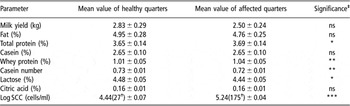
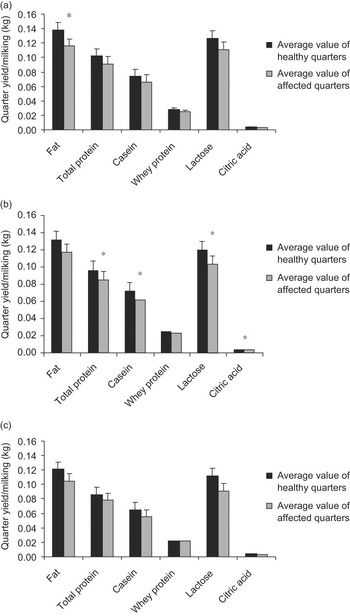
Group 1 (cow composite SCC < 100 000 cells/ml) comprised 49 cows; udder quarters with SCC > 100 000 cells/ml were found in 29% of these cows. There were in total 17 quarters with SCC > 100 000 cells/ml, ranging between 102 000 and 319 000 cells/ml. Of these 17 quarters, four had bacterial growth of coagulase-negative staphylococci (CNS); no other bacteria were found. The mean values of affected and opposite healthy quarters (n = 15) with regard to composition and milk yield are shown in Table 2. The number of quarters compared was 15, since not all affected quarters had healthy opposite quarters. Casein number decreased (P = 0.009) in affected quarters, while the content of total protein (P = 0.034) and whey protein (P = 0.010) increased. The lactose content (P = 0.017) was significantly lower and the SCC level was, due to the definition of groups, significantly higher (P < 0.001) in the affected quarters. The milk yield (P = 0.080) showed a tendency to be lower in affected quarters. When expressing the difference between healthy and affected udder quarters in terms of the yields of milk components, fat yield (P = 0.046) was lower in the affected quarters (Figure 1a). Yields of lactose (P = 0.071) and citric acid (P = 0.073) showed a tendency to decrease in affected quarters.
Comparison of milk composition and milk yield between healthy (<100 000 cells/ml) and affected (>100 000 cells/ml) udder quarters in cows with cow composite SCC < 100 000 cells/ml, n = 15 (group 1) (results shown as mean values of healthy and affected quarters ± s.e. and significance from paired t-tests)

SCC = somatic cell count.
†×1000, displayed as antilogarithmic values.
‡*P < 0.05, **P < 0.01, ***P < 0.001, ns: non-significant.
Mammary quarter yields per milking of the various milk components compared between healthy (<100 000 cells/ml) and affected (>100 000 cells/ml) udder quarters in group 1‡, n = 15 (a), group 2§, n = 25 (b) and group 3||, n = 14 (c). Results shown as mean values of healthy and affected quarters, standard error and P values†. †*P < 0.05, **P < 0.01, ***P < 0.001, ns: non-significant. ‡Cow composite SCC < 100 000 cells/ml. §Cow composite SCC of 101 000 to 300 000 cells/ml. ||Cow composite SCC > 300 000 cells/ml.

Milk composition in cows with SCC of 100 000 to 300 000 cells/ml milk (group 2)
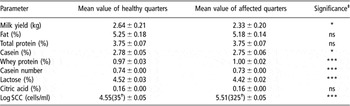
Group 2 (cow composite SCC of 100 000 to 300 000 cells/ml) included 23 cows; 91% of these had at least one quarter with SCC < 100 000 cells/ml. Quarters with SCC higher than 300 000 and 500 000 cells/ml were found in 65% and 26% of the cows, respectively. No quarters with SCC > 1 million cells/ml were found. In group 2, 44% of the cows were positive for bacteria; mainly CNS but a sample with Enterococcus species and another with Staphylococci aureus were also found. The number of affected udder quarters was 41. The mean composition of healthy and affected quarters is shown in Table 3. Only 25 quarters were compared, since not all affected quarters had healthy opposite quarters. The affected quarters had SCC in the range of 104 000 to 964 000 cells/ml. Whey protein content (P < 0.001) was higher in affected quarters while values for casein (P = 0.011), lactose (P < 0.001), casein number (P < 0.001) and milk yield (P = 0.044) were lower. Yields of total protein (P = 0.033), casein (P = 0.022), lactose (P = 0.023) and citric acid (P = 0.043) were lower in affected quarters (Figure 1b). Fat yield (P = 0.061) showed a tendency to decrease in affected quarters.
Comparison of milk composition and milk yield between healthy (<100 000 cells/ml) and affected (>100 000 cells/ml) udder quarters in cows with cow composite SCC of 100 000 to 300 000 cells/ml, n = 25 (group 2) (results shown as mean values of healthy and affected quarters ± s.e. and significance from paired t-tests)

SCC = somatic cell count.
†×1000, displayed as antilogarithmic values.
‡*P < 0.05, **P < 0.01, ***P < 0.001, ns: non-significant.
Milk composition in cows with SCC > 300 000 cells/ml milk (group 3)
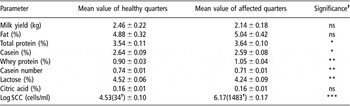
Group 3 (cow composite SCC > 300 000 cells/ml) comprised 18 cows; 72% of these had at least one quarter with SCC < 100 000 cells/ml. All cows had at least one quarter with SCC > 500 000 cells/ml, and 67% had at least one quarter with SCC > 1 million cells/ml. Of the cows in group 3, 39% had positive bacterial samples containing mostly CNS, but one sample had Serratia marcescens and another had Streptococci uberis. The number of affected udder quarters was 48. In Table 4, the means of healthy and affected udder quarters regarding milk composition and milk yield are shown (n = 14). Only affected quarters with a healthy opposite quarter were included in the comparison. The affected quarters had SCC in the interval of 329 000 to 18 433 000 cells/ml. Contents of total protein (P = 0.033) and whey protein (P = 0.002) were higher, whereas contents of casein (P = 0.047), lactose (P = 0.006) and casein number (P = 0.003) were lower in affected quarters. When mean yields of milk components were compared, lactose yield (P = 0.082) showed a tendency to be lower in affected quarters (Figure 1c).
Comparison of milk composition and milk yield between healthy (<100 000 cells/ml) and affected (>100 000 cells/ml) udder quarters in cows with cow composite SCC > 300 000 cells/ml, n = 14 (group 3) (results shown as mean values of healthy and affected quarters ± s.e. and significance from paired t-tests)

SCC = somatic cell count.
†×1000, displayed as antilogarithmic values.
‡*P < 0.05, **P < 0.01, ***P < 0.001, ns: non-significant.
Calculated bulk-tank values after separation at udder quarter level
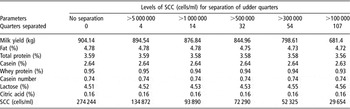
Calculated bulk-tank values after separation at different levels of SCC at udder quarter level are presented in Table 5. After separation of udder quarters with SCC > 5 million cells/ml the bulk-tank SCC decreased from 274 244 to 134 872 cells/ml. At this level of calculated separation, no changes in milk composition could be seen.
Mean composition of calculated bulk tank milk after separation of udder quarters at different levels of SCC (cells/ml)

SCC = somatic cell count.
Discussion
In this study, we showed that cows with low SCC (<100 000 cells/ml) in cow composite milk might have individual quarters, which have elevated SCC, altered milk composition and identifiable bacterial pathogens. Conversely, cows with elevated SCC (>100 000 cells/ml) in cow composite milk often had individual quarters with low SCC and no deterioration in composition. These observations are important when separation of milk at the cow level is considered.
In all groups, when quarters with elevated SCC were compared to healthy quarters, milk composition was found to be different, as reported earlier (Linzell and Peaker, Reference Linzell and Peaker1972; Hamann, Reference Hamann2002 and Reference Hamann2003; Berglund et al., Reference Berglund, Pettersson, Östensson and Svennersten-Sjaunja2007). Despite the relatively small differences in SCC between healthy and affected quarters in group 1, significant differences in total protein, whey protein, casein number and lactose were observed. Thus, milk quality was affected upon a small increase of SCC, which is in agreement with results by Hamann (Reference Hamann2002 and Reference Hamann2003). In groups 2 and 3, values for total protein, casein, whey protein, lactose and casein number differed between affected and healthy quarters. Urech et al. (Reference Urech, Puhan and Schällibaum1999) found significant changes in total protein content and in the ratio of casein and whey proteins within slightly subclinical mastitic quarter milk. The increased total protein content was significantly associated with the inflammatory responses of the udder, which increase the influx of whey proteins such as bovine serum albumin and immunoglobulin. The casein ratio, i.e., casein number, was thus lower in these milk samples (Urech et al., Reference Urech, Puhan and Schällibaum1999). Similar changes in total protein, whey protein, casein and casein number occurred in our study. The lower casein levels in affected quarters in groups 2 and 3 agree with other studies, in which casein levels decreased with increased SCC and subclinical mastitis (Haenlein et al., Reference Haenlein, Schultz and Zikakis1973; Harmon, Reference Harmon1994; Auldist et al., Reference Auldist, Coats, Sutherland, Mayes, McDowell and Rogers1996).
It is well known that milk cannot pass from one udder quarter to another due to the anatomy of the udder. However, it has recently been indicated that there are systemic effects on all quarters when one quarter is affected by an increased SCC (Larsen et al., Reference Larsen, Rasmussen, Bjerring and Nielsen2004; Merle et al., Reference Merle, Schröder and Hamann2007). To our knowledge, the mechanisms behind this have not been fully evaluated yet. Whether similar effects exist for milk composition is not excluded.
An important consideration when evaluating the effect of elevated SCC is whether total yield of a milk component is decreased. Since the changes observed for percentages, although significant, are relatively small, it is the associated change in the milk yield that will be the major determinant of the effect that SCC has on the yield of a milk component. In the affected quarters in group 1, the average fat yield was lower (Figure 1a). In a review by Hortet and Seegers (Reference Hortet and Seegers1998), the average reduction in fat yield and protein yield during the course of the lactation for cows with clinical mastitis varied from 3 to 22 and from 0 to 15 kg, respectively. These phenomena also seem to occur in the case of subclinical mastitis, although we only have the results of one milking occasion. In group 2, the mean protein and casein yields from affected quarters were lower. This affects the economical value of milk from group 2, since less cheese can be produced.
In groups 2 and 3, in which cow composite milk SCC was moderately increased, the majority of cows had a quarter with low SCC; in fact, only 8% of the cows were affected in all four quarters. This indicates that it is rare for all four quarters to be affected. This is in agreement with Barkema et al. (Reference Barkema, Schukken, Lam, Galligan, Beiboer and Brand1997) who found that it is most common for only one udder quarter to be infected. Thus, if high SCC cow composite milk is discarded, the high-quality milk that could be recovered from unaffected quarters is also discarded, representing a waste of the resources used for its production.
According to Berglund et al. (Reference Berglund, Pettersson, Östensson and Svennersten-Sjaunja2004), more than 10% of milk samples with SCC < 100 000 cells/ml will hide individual quarters with elevated SCC, measured with the CMT; at least half of these may be infected by udder pathogens. In that study, CNS were found in a majority of the positive bacterial samples. In the present study, we found an even higher proportion (29%) of individual quarters with elevated SCC and affected milk composition in cow composite milk with low SCC (<100 000 cells/ml). The majority of pathogens in our study were Staphylococci, which agrees with Berglund et al. (Reference Berglund, Pettersson, Östensson and Svennersten-Sjaunja2004) and Coulon et al. (Reference Coulon, Gasqui, Barnouin, Ollier, Pradel and Pomies2002). In the presence of CNS, the most frequently found bacteria in our study, lactose percentages were lower and SCC was higher as compared to healthy quarters; however, the presence of the bacteria was not associated with any clinical signs of mastitis (Coulon et al., Reference Coulon, Gasqui, Barnouin, Ollier, Pradel and Pomies2002). Taponen et al. (Reference Taponen, Koort, Björkroth, Saloniemi and Pyörälä2007) found the SCC in quarters infected with CNS to be rather low compared to other Gram-positive mastitis pathogens. However, the SCC were still about 10-fold higher in infected quarters compared to healthy quarters.
In groups 2 and 3, 44% and 39% of the cows, respectively, had positive bacterial samples. The number of cows with positive bacterial samples was probably higher. A study of cows infected with Staphylococcus aureus showed that there is a cycle for bacteria and SCC during mastitis (Daley et al., Reference Daley, Oldham, Williams and Coyle1991). Low bacterial counts were associated with a high SCC and vice versa. Therefore, the bacteria count may decrease below detectable numbers and lead to false-negative results. In our study, only one bacterial sample was taken. To be able to detect all bacteria, at least two or three samples need to be taken (Pyörälä and Pyörälä, Reference Pyörälä and Pyörälä1997). This may explain the slightly lower proportion of positive bacterial samples in group 3.
According to the calculated bulk-tank values, the major changes after separation of udder quarters were found in SCC. The milk composition seemed to be almost unchanged. These calculations are performed on values of fresh milk from one milking occasion and are only theoretical, but give an indication that it is not easy to change the major milk composition in bulk-tank milk. However, bulk-tank SCC seems to be easy to influence. A reduction of 9.6 kg from 904 kg milk decreased the SCC to almost half the value of the complete bulk tank. The question as to how milk composition will change after a few days of storage in authentic milk has to be raised.
Our results have documented two common occurrences: (1) a cow composite milk sample with low SCC may contain milk from a mammary quarter that has a high SCC, and (2) a cow composite sample with high SCC may contain milk from mammary quarters that have low SCC. On the one hand, identification and isolation of high SCC milk as it is removed from the infected mammary quarter might improve raw milk quality and reduce the wasteful dumping of low SCC milk from the uninfected mammary quarters. On the other hand, calculated bulk-tank values after separation of udder quarters indicate reduction in SCC and no milk composition changes. These findings need to be further studied on real bulk-tank milk with the effect of storage taken into consideration. It was also observed that significant changes in the percentages of a milk component due to an increase in SCC do not significantly affect the total yield of the component unless milk yield is also affected by the increase in SCC.
Acknowledgements
The study was financially supported by the Swedish Research Council for Environment, Agricultural Sciences and Spatial Planning (Formas), strategic money from the Faculty of Veterinary Medicine and Animal Science and Swedish Farmers’ Foundation for Agricultural Research (SLF). The authors wish to thank Lars-Ove Sjaunja and Dietrich von Rosen for statistical assistance.