Introduction
Gastropods are important crop pests in temperate and tropical regions (Barker, Reference Barker2002). Their pest status has increased in the last 30 years, alongside many agricultural changes, probably due to the increasing demand for food quantity and quality. In many parts of the world, slugs as pests were unknown until zero-tillage or reduced cultivation practices were adopted along with changes in cropping patterns, e.g. increased areas of oilseed-rape (Glen, Reference Glen2002; Speiser et al., Reference Speiser, Glen, Piggott, Ester, Davies, Castillejo and Coupland2001). In Europe and in North America, slugs are serious pests of arable and vegetable crops as well as domestic gardens (Moens & Glen, Reference Moens, Glen and Barker2002; Port & Ester, Reference Port, Ester and Barker2002). In North America, slugs are pests of field corn and soybeans (Hammond & Byers, Reference Hammond, Byers and Barker2002); and, in California, snails are pests of citrus production (Sakovich, Reference Sakovich and Barker2002). In Norway, the most important introduction of an exotic gastropod species has been the so-called Iberian slug Arion vulgaris (von Proschwitz & Winge, Reference von Proschwitz and Winge1994).
Arion vulgaris, which has traditionally been regarded as A. lusitanicus 1868 (Anderson, Reference Anderson2005; Quintero et al., Reference Quintero, Rodriguez-Castro, Castillejo, Iglesias-Piñeiro and Rey-Méndez2005), has been used as a model for invasive species with negative impacts on biodiversity and ecosystems (Grimm & Paill, Reference Grimm and Paill2001). It is an important plant defoliator and competes with native slug species, due to its large size and its high population densities. It is one of the most notorious slug pests in Europe, damaging horticultural plants and cultivated crops in agriculture (von Proschwitz & Winge, Reference von Proschwitz and Winge1994; von Proschwitz, Reference von Proschwitz1992, Reference von Proschwitz2008; Dolmen & Winge, Reference Dolmen and Winge1997). Many reasons have been proposed to explain its success: large body size, rapid reproduction, food tolerance and catholic feeding, ecological tolerance, and lack of enemies (Kozłowski, Reference Kozłowski2007). Its dispersive capacity can explain the invasion on local scale and also on larger scales, but the mechanism of this expansion is still not fully understood (Grimm & Paill, Reference Grimm and Paill2001; Grimm & Schaumberger, Reference Grimm and Schaumberger2002).
Many authors have reviewed the role of ground-beetles as pest enemies (Thiele, Reference Thiele1977; Allen, Reference Allen, Erwin, Ball and Whitehead1979), mainly based on laboratory observations. Carabids have been found to feed on aphids (Andersen, Reference Andersen1992; Holopainen & Helenius, Reference Holopainen and Helenius1992), on dipterans (especially on eggs), and on coleopterans and lepidopterans (Kromp, Reference Kromp1999). In total, 30 species of carabids are currently known to predate slugs (Symondson, Reference Symondson and Barker2004; Hatteland, Reference Hatteland2010). Some ground-beetles have been found to be effective in controlling slugs such as Deroceras reticulatum (Müller) (Agriolimacidae) and Arion intermedius Normand (Arionidae) in enclosures, where predation experiments indicated that carabid beetles and birds were responsible for significant mortality of the two slug species (Barker, Reference Barker1991). Abax parallelepipedus Piller & Mitterpacher and Pterostichus madidus F. have been found to be more effective than the molluscicide methiocarb (Asteraki, Reference Asteraki1993) in slug control when tested in sward boxes sown with white clover. No slugs were recovered from the carabid treatments, while more than half were recovered from the methiocarb treatment. Abax parallelepipedus has also been tested as a potential biological control agent against slugs in polythene tunnel experiments. This species was found to be highly effective at reducing the number of slugs and hence crop damage (Symondson, Reference Symondson1994). Studies involving semi-field experiments to test the impact of predation by P. melanarius on the slug D. reticulatum and emulating field conditions in outdoor mini-plots, demonstrate that P. melanarius can reduce slug populations under simulated field conditions (McKemey et al., Reference McKemey, Symondson and Glen2003). The population growth of carabid species was positively correlated with slug abundance, based on a study in an arable field over a five-year period (Symondson et al., Reference Symondson, Glen, Ives, Langdon and Wiltshire2002). Another study found direct and active predation by P. melanarius against its slug prey (Bohan et al., Reference Bohan, Bohan, Glen, Symondson, Wiltshire and Hughes2001). In another experiment (Oberholzer & Frank, Reference Oberholzer and Frank2003), the number of living oilseed-rape plants were counted under different treatments: only slugs present, slugs and P. melanarius present, and slugs and Pterostichus cupreus present. The number of living oilseed rape-plants was significantly lower in the treatment with only slugs, while the number of slugs was significantly lower in the treatment with P. melanarius, indicating that slug predation took place. Other studies have tested the predation by P. melanarius larvae on D. reticulatum and A. intermedius, finding that the larvae killed both slug species (Thomas et al., Reference Thomas, Harwood, Glen and Symondson2009).
The main goal of this study is to investigate the role of the carabid beetles P. melanarius and C. nemoralis as natural enemies of A. vulgaris under semi-field conditions. The following objectives were addressed: investigate if and how P. melanarius affects eggs of A. vulgaris under semi-field conditions; investigate if and how C. nemoralis affects juveniles of A. vulgaris under semi-field conditions; detect slug-DNA of juveniles in gut contents of beetles collected after the experiments.
Material and methods
Semi-field experiments were carried out in a strawberry field, in September 2010 and in May 2011. Eggs and juveniles of A. vulgaris were supplied as prey, and adults of P. melanarius and C. nemoralis were used as predators. Densities were manipulated to assess the effect of beetles on slug density. Predation on A. vulgaris juveniles was studied by detecting slug-DNA in the gut contents of beetles.
Sampling
Beetles and eggs were collected from an uncultivated field in a rural area outside Bergen, during August and September 2010, and April and May 2011. The meadow (60°38′N, 5°34′E) is partly surrounded by deciduous trees and is mown once a year. Beetles were collected with pitfall traps. Pitfall trapping is a well-known method for collecting beetles and is still regarded as the most convenient and cost-effective method (Greenslade, Reference Greenslade1964; Luff, Reference Luff1975; Lang, Reference Lang2000; Ward et al., Reference Ward, New and Yen2001). Pitfall traps were arranged in the meadow in lines of 20 traps, 1–2 m between traps, with a total of approximately 300 traps. Traps were plastic cups 9.5 cm deep with a 7 cm opening, dug into the soil and covered by a metallic roof a few centimetres above the rim. The traps were checked and emptied every third day and target beetles were collected and put into plastic boxes with vegetation. All beetles collected were recorded and identified to species, sex and date of collection. They were kept in a climate chamber (Sanyo Incubator, MIR-553) at 14 °C with simulated light conditions of the field (16 hours of light and eight hours of darkness). After collection, beetles starved one week to get rid of eventual external DNA contamination due to the permanence in the pitfall trap. Subsequently, they were fed earthworms once a week until the start of the semi-field experiment. Only C. nemoralis and P. melanarius were collected, both of which have previously been found to feed on A. vulgaris (Hatteland et al., Reference Hatteland, Grutle, Mong, Skartveit, Symondson and Solhøy2010, Reference Hatteland, Symondson, King, Skage, Schander and Solhøy2011). Eggs of A. vulgaris were collected in the field by searching the vegetation above ground. They were kept at 3 °C to avoid hatching, in plastic boxes with water to avoid drought. Juvenile slugs were collected from Sletten, Bergen, and kept in the same conditions as slug eggs. Juvenile slugs and eggs were identified as A. vulgaris after observation in the field. The identification of juveniles was done based on the external morphological features of A. vulgaris juveniles, while eggs were determined by the shape, colour and size of eggs and clutches.
Semi-field experiment with slug eggs
In this experiment, we investigate if and how the presence of P. melanarius can affect slug densities. The experiment was established in a strawberry field in Askøy, an island near Bergen (60°28′N, 5°12′E). The experiment was carried out from the 14th of September to the 23rd of September 2010. The strawberry patch was 38.5 m × 9.6 m and contained seven rows of strawberry plants, of which three were used. Thirty 1 × 1 m plots were created using metallic fences with a height of 30 cm. The fences were positioned in correspondence to the strawberry rows in order to include the vegetation inside each plot. The fences were dug 10 cm into the soil and a special anti-slug glue (Antischneck-Gel, Neudorff, GmbH, Emmerthal, Germany) was put on the fences to avoid the escape and the entrance of slugs. No manipulation of the plots was done prior to the experiment to maintain the natural field conditions. In each plot, three clutches of eggs were arranged, with 30 eggs per clutch, yielding a total of 90 eggs per plot. Pterostichus melanarius has been shown to be one of the most common and well-adapted carabid species in agricultural landscapes (Lövei & Sunderland, Reference Lövei and Sunderland1996; Thomas et al., Reference Thomas, Parkinson and Marshall1998). Moreover, a positive relationship has been found between slug biomass and numbers of beetles (Symondson et al., Reference Symondson, Glen, Wiltshire, Langdon and Liddel1996), and its peak of activity is around the middle of August, partly corresponding with the egg-laying period of A. vulgaris (Levesque & Levesque, Reference Levesque and Levesque1994; Matalin, Reference Matalin2004; Kozłowski, Reference Kozłowski2007). Treatments were randomly assigned to the plots: ten plots with two beetles per plot, one female and one male; ten plots with three beetles per plot, two females and one male; and ten plots without any beetles as control. The number of beetles was chosen to reflect the natural density based on earlier surveys (Hatteland, Reference Hatteland2010). Beetles were fed earthworms once a week prior to the experiment and then starved for one week before being used in the experiment. The beetles were then marked with a white spot using a marking ink pen to distinguish them from other beetles potentially present inside the plots. At the end of the experiment, eggs were re-collected for later analyses in the laboratory. Eggs were examined by counting and checking their status: eaten, hatched or unaffected.
Semi-field experiment with juveniles
In this experiment, we investigate if and how the presence of beetles can affect slug densities. Semi-field conditions using A. vulgaris juveniles and C. nemoralis were applied to test this. The experiment was established in the same strawberry field used for the previous semi-field experiment and was carried out from the 11th of May to the 21st of May 2011 using the same experimental design as in September. Juvenile slugs were collected and divided into three size categories corresponding to weight: 0.1 to 0.3 g, 0.4 to 0.8 g, and 0.9 to 1.2 g. Altogether, 15 slugs were put inside each plot, using six, six, and three specimens from the three size categories, respectively. The size and number of slugs was chosen to represent what is typically found in the field in May (Hatteland, unpublished data). Treatments were randomly assigned to the plots: ten plots with two beetles per plot, one female and one male; ten plots with three beetles per plot, two females and one male; and ten plots without any beetles as control.
At the end of the experiment, all plots were thoroughly searched to check for the presence of introduced C. nemoralis and A. vulgaris juveniles, moreover alternative predators and prey (carabid beetles, slugs and earthworms) were searched and collected. Introduced slugs and non-introduced ones were collected, identified and weighed. Carabid beetles were collected, subsequently killed and stored at −80 °C for DNA analysis of the gut contents to check what they had eaten. Earthworms found on the surface of each plots were collected, counted and identified. The plots were checked for slugs and beetles for up to four days after the experiment, since it was not possible to collect all of them in one day. For this reason, the experiment ran longer in some plots. This factor was accounted for in the statistical analyses.
Dissection of beetles
The beetles were dissected and their foreguts were put into previously weighed microfuge tubes at −80 °C. Dissection instruments were sterilized with 96% ethanol and flame between specimens. Afterwards, each microfuge tube was weighed to estimate the foregut weight.
DNA extraction
DNA was extracted from beetle foreguts using the DNeasy Blood & Tissue Kit (Qiagen, Oslo, Norway), following the manufacturer's instructions. Extraction negatives (no tissue) were included for all sets of extractions to test for possible contamination during the extraction process. Extractions were stored in elution buffer at –80 °C.
PCR protocols and programmes
All samples were tested for the presence of amplifiable DNA using general invertebrate primers of the mitochondrial cytochrome oxidase I (COI) gene (Folmer et al., Reference Folmer, Black, Hoeh, Lutz and Vrijenhoek1994). PCRs were run in 25 μl reaction volumes, containing 12.5 μl of GoTaq (Promega, Oslo, Norway) Mastermix, 1.0 μl of each primer (2.0 μl in total of 10 μM), 2.0 μl of DNA and 8.5 of dH2O. The thermo-cycling programme consisted of 94 °C for 1.5 min, followed by five cycles of 94 °C for 30 s, 45 °C for 1.5 min, 72 °C for 1 min, then 36 cycles of 94 °C for 30 s, 51 °C for 1.5 min, 72 °C for 1 min, and finally 72 °C for 5 min.
Samples were also tested with two multiplexes for the presence of multiple slug species. The first multiplex was the COI multiplex, which was used for all samples and amplifies fragments of the COI gene of A. vulgaris, A. ater and A. rufus (Hatteland et al., Reference Hatteland, Symondson, King, Skage, Schander and Solhøy2011). The PCR was optimized by adding bovine serum albumin (BSA), which has been proved to be a potent PCR-facilitator, including in gut contents of insects within predator-prey analysis (Juen & Traugott, Reference Juen and Traugott2005, Reference Juen and Traugott2006). PCRs were run in 12.5 μl reaction volumes, containing 6.25 μl of GoTaq (Promega) Mastermix, 0.25 μl of each primer (1.25 μl in total), 0.125 μl of BSA, 1.0 μl of DNA and 3.875 μl of dH2O. The thermo-cycling programme consisted of 94 °C for 2 min, followed by 35 cycles of 92 °C for 30 s, 51 °C for 30 s, 70 °C for 50 s, and a final cycle of 68 °C for 5 min.
A second multiplex was also used, to test if beetles could have fed on other species of slugs; the 12S multiplex with primers for D. reticulatum and Arion spp. (Dodd, Reference Dodd2004; Harper et al., Reference Harper, King, Dodd, Harwood, Glen, Bruford and Symondson2005) amplifying the mitochondrial ribosomal RNA gene. PCRs were run in 10 μl reaction volumes, containing 5 μl of Qiagen PCR Mastermix, 0.25 μl of each primer (1.0 μl), 0.1 μl of BSA, 1.0 μl of DNA, and 2.9 μl of dH2O. The thermo-cycling programme consisted of 95 °C for 15 min, followed by 39 cycles of 94 °C for 30 s, 53 °C for 1.5 min, 72 °C for 1.5. min and a final cycle of 72 °C for 10 min. All PCRs included positive (with target prey DNA) and negative controls (with distilled water instead of DNA). Amplified DNA was checked on 1–2% agarose gel.
Statistical analyses
Statistical analyses were performed using the free software R (version 2.10.0) (R Development Core Team, 2008). Data from the semi-field experiments were treated by arcsine transformation. Linear mixed-effects models (LME) (Lindstrom & Bates, Reference Lindstrom and Bates1988) were applied to analyse the data from the semi-field experiments, to test if higher proportions of eaten eggs and juveniles found in treatments could be explained by the presence of beetles. The different plots were considered as random variables, since each plot was an independent event while the clutches of eggs were considered dependent events.
Results
Semi-field experiment with slug eggs
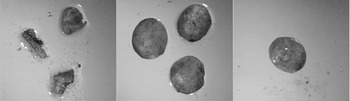
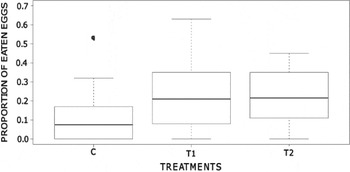
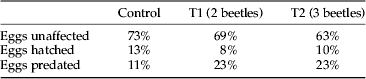
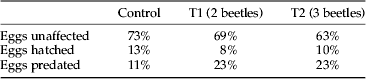
Eggs placed in the plots in the strawberry field were re-collected after the experiment but not all of them were found. The proportion of eggs found per clutch was calculated and a mean value derived for each treatment: 64% for treatment one (two beetles), 69% for treatment two (three beetles) and 75% for controls. The reduction in eggs found was significant (t-test: P < 0.001, T = −19.35) but did not differ significantly between treatments and control, suggesting that it was not due to the presence of the beetles (LME, P = 0.4735). Qualitative features of eggs were quite easy to identify, as the pictures in fig. 1 show; hatched eggs had a recognizable hole on the surface but kept their round shape, while unaffected eggs kept their round shape without showing any hole or damage on the surface, and they were still full of internal liquid. The surface of hatched and unaffected eggs generally did not show any signs of disturbance or bite marks. Eaten eggs showed a very disturbed surface, where bite marks were identifiable, and they lost their round shape and looked smashed and without internal liquids. Eggs eaten by beetles under laboratory conditions (Pianezzola, Reference Pianezzola2011) show the same shape, and we used them as a positive control to compare with eaten eggs from the field. Mean values of the proportions of all categories were calculated (table 1). A significant difference was found between the control and the two treatments (LME, P = 0.0041, N = 90) (fig. 2). However, there was no difference between treatments one and two (LME, P = 0.7862), showing that increasing beetle densities in the plots did not influence egg densities in this study.
Pictures taken under stereoscope showing features of collected eggs from the field (diameter of eggs is almost 4 mm). From left: eaten eggs, unaffected eggs and hatched eggs. The latter is visible due to the hole on the surface of the hatched egg.

Box plot of the mean values of proportions of eggs eaten under the three treatment regimes in the first semi-field experiment. C, control; T1, treatment one (two beetles); T2, treatment two (three beetles).

Egg status under the two treatment regimes and control.
Semi-field experiment with juveniles
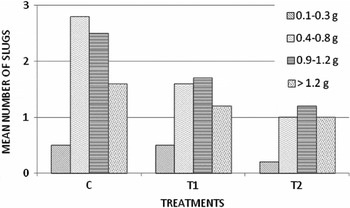
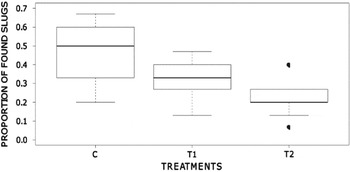
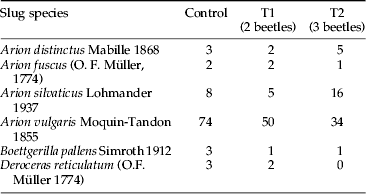
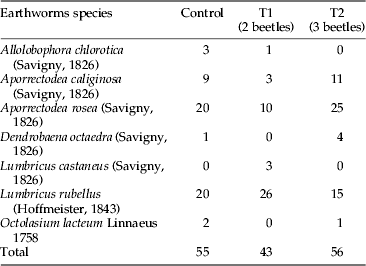
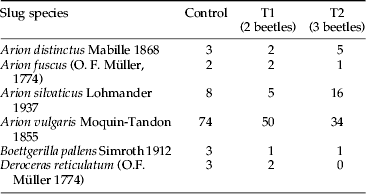
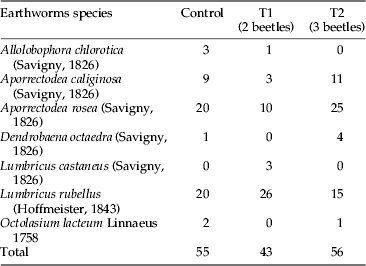
A significant reduction of juveniles (t-test, P < 0.001) was found after the experiment (figs 3 and 4). Moreover, the reduction seemed to be due to the presence of beetles (LME, P < 0.001). In general, the weight of the slugs increased during the experiment (we added an additional category for slugs bigger than 1.2 g, as shown in fig. 3); and statistical analyses show that the two smallest size categories significantly differ between treatments and control, suggesting that beetles preferred slugs smaller than 1 g (LME, P < 0.0001, N = 30). Mean proportions of juvenile slugs found are 49% for control, 33% for treatment one (two beetles) and 23% for treatment two (three beetles) (fig. 4). A significant difference is found between the control and the two treatments (LME, P < 0.001, N = 30), suggesting that beetle presence affects slug densities. Total number of recollected A. vulgaris and non-introduced slugs is listed in table 2. Total number of collected earthworms is listed in table 3. Earthworms seemed to not affect the predation by the beetles (LME, P = 0.8960, N = 30).
Mean number of Arion vulgaris collected after the experiment divided into four weight categories. C, control; T1, treatment one (two beetles); T2, treatment two (three beetles).

Box plot of mean proportion of juvenile slugs in the second semi-field experiment. C, control; T1, treatment one (two beetles); T2, treatment two (three beetles).

Total number of non-introduced slug species and A. vulgaris collected, for treatments and control.
Total number of earthworms collected, for treatments and control in the second semi-field experiment.
In total, 46 specimens of C. nemoralis were recollected at the end of the experiment. They were tested for slug-DNA and eight of 46 beetles were positive for A. vulgaris, proving that at least nearly 20% of the beetles had been feeding on A. vulgaris during the experiment. No other carabid species and no other alternative predators were found.
Discussion
Previous studies have shown that C. nemoralis and P. melanarius feed on eggs and juveniles of A. vulgaris (Hatteland et al., Reference Hatteland, Grutle, Mong, Skartveit, Symondson and Solhøy2010, Reference Hatteland, Symondson, King, Skage, Schander and Solhøy2011), and some authors have also tested these beetles in microcosms and mini-plots (Buckland & Grime, Reference Buckland and Grime2000; McKemey et al., Reference McKemey, Symondson and Glen2003). This study is the first to investigate prey-predation relations in semi-field conditions, by adding known densities of beetles, slug eggs and juvenile slugs to fenced plots. We found that P. melanarius and C. nemoralis can affect slug eggs and juvenile densities, respectively. Previous studies have shown that the egg-laying period is from August to November and that the juvenile phase is mainly from October to June for A. vulgaris in western Norway (Hatteland et al., unpublished data; Roth et al., unpublished data). The egg-laying period, thus, partly overlaps with the activity of P. melanarius, which was still present in late August and the beginning of September. The activity peak of C. nemoralis is in spring (Lindroth, Reference Lindroth1985; Turin et al., Reference Turin, Penev, Casale, Arndt, Assman, Makarov, Mossakowski, Sze´l, Weber, Turin, Penev and Casale2003), when the slugs are highly abundant as juveniles.
Our results demonstrate that P. melanarius may affect densities of slug eggs, but it is not dependent on the number of beetles put into the plots; there is no significant difference between treatment one, with two beetles, and treatment two, with three beetles. We found a significant reduction of eggs not only in treatment plots but also in control plots. Statistical analyses suggest that this reduction is not due to the presence of beetles, and the reason for this reduction cannot be adequately explained. Lost eggs may have been eaten completely or they may have been removed a long way from the clutches by the beetles or other predators.
Personal observations under laboratory conditions (Pianezzola, Reference Pianezzola2011) show that both P. melanarius and C. nemoralis feed on slugs eggs with less voracity than they do on juvenile slugs and earthworms. Foreguts of C. nemoralis fed on slug juveniles have been found to be much heavier than the foreguts of beetles fed on slug eggs, which can suggest that predation on juveniles is higher than on eggs (Hatteland, unpublished data). Observations during the feeding trials suggested that physical features and composition of the eggs can affect their palatability. It is possible that the hard shell inhibits carabid beetles from eating eggs, although personal observations show that carabid beetles can easily break the eggshell.
Previous studies investigating the biochemical composition of the eggs of gastropods find that they are rich in proteins, carbohydrates, calcium, and other inorganic ions (Bayne, Reference Bayne1966; Meenakshi & Scheer, Reference Meenakshi and Scheer1969). Regarding the possible toxicity of slug eggs, Schroeder et al. (Reference Schroeder, Gonzalez, Eisner and Meinwald1999) isolated the defensive diterpene miriamin from A. vulgaris eggs, which deterred the coccinellid Harmonia axyridis from feeding on them. But other studies on carabid beetles feeding on slug eggs suggested that carabid beetles are not affected by this compound, since they actively fed on slug eggs without showing any mortality (Oberholzer & Frank, Reference Oberholzer and Frank2003; Hatteland et al., Reference Hatteland, Grutle, Mong, Skartveit, Symondson and Solhøy2010). It is reasonable to think that the nutritional features of slug eggs are not the reason for their lower susceptibility to predation, but their physical features. Pterostichus melanarius accepted slug eggs in the absence of other prey, while C. nemoralis seemed very reluctant to eat them (Pianezzola, Reference Pianezzola2011). Feeding experiments using multiple prey species are needed to determine the feeding preferences of carabid beetles.
The results of the semi-field experiment with C. nemoralis demonstrate that this carabid beetle may reduce slug densities by consuming juveniles. Moreover, the absence of other carabid species and alternative predators in the plots is further prove that C. nemoralis is the main reason fot the reduction in juveniles. The presence of alternative prey, such as other slug species and earthworms, seems not to affect the predation by beetles. In addition, the total number of slugs and earthworms did not differ significantly between treatments and control.
Compared with P. melanarius, C. nemoralis is bigger and needs to feed more. In previous studies, C. nemoralis has been found to consume juveniles up to 1.3 g, although it preferred slugs smaller than 1 g (Hatteland et al., Reference Hatteland, Grutle, Mong, Skartveit, Symondson and Solhøy2010). This is confirmed in the present semi-field experiment; of the four size categories of juvenile slugs, we found a significant reduction in the first two categories (0.1–0.3 g, 0.4–0.8 g). Moreover, after the semi-field experiment, we found a general increase in slug weight, showing that the slugs had grown or gained moisture and carabid beetles continued to prefer the smaller slugs.
Observations during the feeding trials with earthworms suggest that C. nemoralis is an active feeder; even under stressed conditions, when put into the Petri dish, it attacked the prey without hesitation and kept on feeding for the two hours it was allowed to feed. The same behaviour has been observed in previous studies with C. nemoralis feeding on slugs (Hatteland et al., Reference Hatteland, Grutle, Mong, Skartveit, Symondson and Solhøy2010).
Our results show that there is a trend between treatment one and treatment two in the second semi-field experiments; fewer slugs were found at the end of the experiment for treatment two than for treatment one (LME, P = 0.0758). Although the difference is not statistically significant, the trend suggests that increasing the number of carabid beetles involved may influence slug densities.
DNA analyses of gut contents of C. nemoralis showed that eight of 46 beetles were positive for slug-DNA of A. vulgaris and none of them were positive for the DNA of other analyses for Arion spp. and D. reticulatum. Even if DNA analyses only displays recent feeding activity and does not distinguish between direct predation and scavenging (Juen & Traugott, Reference Juen and Traugott2005; King et al., Reference King, Read, Traugott and Symondson2008), for the aim of our research, DNA-based techniques were the most valuable approach to confirm that C. nemoralis fed on A. vulgaris.
The results of this semi-field experiment suggest that C. nemoralis actively search for juvenile slugs to feed on, possibly by detecting the mucus of the slugs (Digweed, Reference Digweed1994). Ayre (Reference Ayre1995) showed that C. nemoralis can follow mucus of D. reticulatum. In the same way, P. melanarius can find juveniles and adult slugs by smelling them or detecting their chemical substances, as their larvae do (Thomas et al., Reference Thomas, Glen and Symondson2008), but there are no studies yet investigating the same for slug eggs. It is reasonable to assume that P. melanarius feed on slug eggs by finding them at random and without active predation behavior.
Future studies should design semi-field experiments with carabid beetles and slug eggs and juveniles, focusing on multi-prey choice and controlling densities of alternative prey, vegetation type and structure, together with multiplex DNA analyses of the gut contents of the beetles. This would be possible under laboratory conditions or in an artificial arena. Moreover, feeding preference experiments under laboratory conditions need to be done, to investigate whether carabid beetles prefer eggs or juveniles, although our results suggest a preference for juveniles.
Future studies should also investigate how carabid beetles such as C. nemoralis can be used in greenhouses or small horticultural fields, where their densities can easily be controlled. Studies are also needed in open fields to investigate if maintaining the natural presence of these carabid beetles can aid in the control of A. vulgaris, for example by habitat management (Pickett & Bugg, Reference Pickett and Bugg1998). In both cases, studies have to address the possible use of these carabid beetles as a biological control of A. vulgaris, as Symondson (Reference Symondson and Barker2004) suggests, on the basis that biological control is the most realistic approach and best for conservation.
Acknowledgements
Sincere thanks to Kenneth Meland and Louise Lindblom for help with the DNA analyses and to Knut Helge Jensen for help with the statistics. We are grateful to William O.C. Symondson for commenting on the manuscript and University of Bergen and the Norwegian Research Council (project nr. 803194) for funding this study. We also thank Cathy Jenks for English corrections and our field assistants, Thomas Hornick, Marta Ramirez Boixaderes and Roger Colominas.