INTRODUCTION
While interest in human resource management (HRM) in Africa is growing, there is still much to be understood about transplanting Western practices into the continent (Kamoche, Chizema, Mellahi, & Newenham-Kahindi, Reference Kamoche, Chizema, Mellahi and Newenham-Kahindi2012). With the recent influx of multinational corporations (MNCs) into Sub-Saharan Africa (Kamoche, Reference Kamoche2011), especially manufacturers, there is a need to highlight the impact of culture on some important HRM approaches during technology utilisation. Since advanced manufacturing technology (AMT) plays a vital role in economic development, African managers, including Nigerians, may have underplayed the effects of Western prescribed implementation methods, including some vital HRM approaches. An earlier study found that 10 out of 150 medium-sized organisations in Nigeria failed within the study period due to the mismanagement of prescribed innovation strategies, including HRM (Ekpenyong & Nyong, Reference Ekpenyon and Nyong1999).
The search for an ideal technology innovation strategy has widened to include the employment of complementary HRM approaches (Dorenbosch, Van Engen, & Verhagen, Reference Dorenbosch, Van Engen and Verhagen2005). Conger and Kanungo (Reference Conger and Kanungo1988) noted that theorists and practitioners emphasised the importance of HRM approaches such as employee empowerment in advancing implementation efficiency and effectiveness. Siegel, Waldman, and Youndahl (Reference Siegel, Waldman and Youndahl1997) argued that with technological changes, creating an environment that fosters employee empowerment can be a critical source of competitive advantage, strengthening the argument that some empowerment interventions, such as increased training, job responsibility, career opportunities, control and autonomous work groups can assists the AMT implementation process (Siegel, Waldman, & Youndahl, Reference Siegel, Waldman and Youndahl1997; Obi, Reference Obi2000). However, little is known about how appropriate these empowerment approaches are for different national cultures.
Despite the hyperbole of researchers and practitioners, there has not been a concerted effort to investigate the impact of national values on managerial attitudes towards employee empowerment during technology utilisation. The findings of Hui, Au, and Fock (Reference Hui, Au and Fock2004) suggest that the failure to take national values into account in many technology utilisation studies may severely limit the transferability of complementary HRM practices from one culture to another. This limitation is based on the contention that HRM theories mostly reflect the values of their national sources (Nouiga, Gautier, & Truchot, Reference Nouiga, Gautier and Truchot2005). For example, the results of an investigation by Black and Porter (Reference Black and Porter1991) of managerial outlook on empowerment and job performance showed a positive impact in the United States, while the reverse was the case in Hong Kong. Furthermore, it was argued that failure of some Japanese management techniques in the United States was the result of their lack of fit with American culture (Nakata & Sivakumar, Reference Nakata and Sivakumar1996).
Although few cross-national studies have attempted to explore the links between technology innovation and cultural values, they have been found to be indirect and within similar cultures (e.g., Yap, Buisson, & Garret, Reference Yap, Buisson and Garret2000; Khazanchi, Lewis, & Boyer, Reference Khazanchi, Lewis and Boyer2007). Consequently, culturally sensitive societies are likely to face major implementation challenges that arise from technology inventors’ national cultures (Karlsson & Loven, Reference Karlsson and Loven2005). Therefore, despite some empirical evidence (e.g., Obi, Reference Obi2000) that AMT adoption yields better results when complemented with some empowerment approaches, considering cultural differences amongst distinct societies, the claimed positive evidence could overgeneralise the resultant interactions. Therefore, the aim of our study is to use operational-level data collected in two distinct national cultures – Nigeria and New Zealand (NZ) – to fill this gap in the literature. The main research questions are: With reference to their national cultures, to what extent do employee empowerment approaches practiced during AMT utilisation in Nigeria differ from similar approaches practiced in NZ?
We employed Hofstede, Hofstede, and Minkov’s (Reference Hofstede, Hofstede and Minkov2010) cultural dimensions to predict the different extents to which managers empower subordinates to complement AMT utilisation. We chose Nigeria and NZ for our study because they represented developing traditional and developed liberal societies, and also representing noninnovator and innovator of technologies, respectively (Karlsson & Loven, Reference Karlsson and Loven2005). In addition to complying with the emic and etic requirements for the researchers, the two countries belong to two distinct cultural clusters, African and Anglo-Celtic (Hofstede, Hofstede, and Minkov, Reference Hofstede, Hofstede and Minkov2010). Nigeria was chosen from the Sub-Saharan African countries because it represents the largest economy in Africa (Central Bank of Nigeria, 2010). Furthermore, there was the convenience of prior work in NZ (Obi, Reference Obi2000), and sound insider knowledge of a team member in Nigerian organisations and culture. We pooled our samples from manufacturing industries common to both countries.
Despite some comparative attempts in similar cultures (e.g., Yap, Buisson, & Garret, Reference Yap, Buisson and Garret2000; Khazanchi, Lewis, & Boyer, Reference Khazanchi, Lewis and Boyer2007), our study contributes to the literature by establishing differential evidence on AMT–empowerment interactions in two distinct national cultures. The theoretical links are outlined in the conceptual framework section. Furthermore, despite the influx of MNC into Africa (Kamoche et al., Reference Kamoche, Chizema, Mellahi and Newenham-Kahindi2012), our search of the literature found no studies of AMT–HRM interaction.
This article proceeds with the theoretical and conceptual framework we used to generate testable hypotheses. It is followed by our research method, the results, and a discussion of our findings, and concludes with its implications and theoretical contributions, including our study’s limitations and suggestions for further research.
THEORETICAL BACKGROUND
National and organisational culture: Nigerian and NZ
Organisational functional divergence in different nations (Hofstede, Reference Hofstede1980) provides the theoretical framework for our study. However, Hofstede’s functionalist model is not without its critics. For example, McSweeney (Reference Meredith and Suresh2002) argued against Hofstede’s methodology, while Inglehart and Baker (Reference Inglehart and Baker2000) and Shah (Reference Shah2009) argued that some countries may be converging, not diverging, on some of Hofstede’s dimensions. Many studies (e.g., George, Owoyemi, & Onakala, Reference George, Owoyemi and Onakala2012; Taras, Steel, & Kirkman, Reference Taras and Steel2012), on the other hand, suggest that change is not general, but rather minimal, or nonexistent in most cases. For example, in their recent study in Nigeria, George, Owoyemi, and Onakala (Reference George, Owoyemi and Onakala2012) confirmed the ‘enduring’ nature of Nigerian and United Kingdom’s cultures. A further review of the literature provided evidence that Hofstede’s model still has validity and has been successfully applied in a wide range of national and organisational inquiries (Oh, Pieper, & Gerhart, Reference Oh, Pieper and Gerhart2010; Lorca & De Andres, Reference Lorca and De Andres2011). In addition, despite giving some credence to McSweeney’s (Reference Meredith and Suresh2002) criticism of Hofstede’s methodology, Williamson concludes that ‘it is not yet time to abandon either functionalist research into national culture or the great advances it has made in unbundling the black box of culture’ (Reference Williamson2002: 1392).
Hofstede defined culture as ‘the mental programming of the mind, which distinguishes the member of one human group from another’ (Reference Hofstede1980: 25). Therefore, the cultural characteristics and operational uniqueness of a nation can be deduced from the rules, procedures and policies that are typical of its society and its institutions (Haner, Reference Haner2005). It was argued that a nation’s culture will substantially define the culture of the organisations within it (Hofstede, Hofstede, & Minkov, Reference Hofstede, Hofstede and Minkov2010). Hofstede (Reference Hofstede1980) further argued that national culture explained 50% of differences in attitude, much more than did professional role, age or gender. He also argued that organisational cultures are generally related to shared managerial assumptions, beliefs and values that predominantly flow from national culture (Hofstede, Hofstede, & Minkov, Reference Hofstede, Hofstede and Minkov2010). A study of airline pilots revealed that, despite all the intricacies of other criteria, national culture was a defining factor for their decision-making (Merritt, Reference Merritt2000). Many studies have used Hofstede’s (Reference Hofstede1991) cultural dimensions of power distance (PD), individualism/collectivism (IND/COLL), masculinity/femininity (MAS/FEM), uncertainty avoidance (UA) and long-term/short-term orientation (L/STO) to identify organisational value systems and managerial decision-making behaviour (e.g., Taras, Steel, & Kirkman, Reference Taras and Steel2012).
These dimensions were adopted by this study to predict the extent at which Nigerian and NZ managers are influenced in their approaches to employee empowerment by their different values. It is important to note that Nigeria is classified as a high PD, MAS/FEM and UA, and low IND/COLL and L/STO country, while NZ is classified as a low PD, UA and L/STO, and high IND/COLL and MAS/FEM (Hofstede, Hofstede, & Minkov, Reference Hofstede, Hofstede and Minkov2010) one. Though NZ is relatively higher than Nigeria in the L/STO dimensions, however, both countries share some cultural commonalities as they are both classified as high MAS/FEM and low L/STO (Table 3).
PD is the extent to which less powerful members of organisations accept and expect that power is distributed unequally (Hofstede, Hofstede, & Minkov, Reference Hofstede, Hofstede and Minkov2010). The PD literature is centred on constructs such as level of managerial control of decision-making (Kreitner & Kinicki, Reference Kreitner and Kinicki2013). Research shows that a low level of control is associated with low PD, because it signals trust and belief in the inherent capabilities of subordinates, which increases responsibility, leading to faster and flexible decision-making (Jackson, Reference Jackson2004; Kuo, Ho, Lin, & Lai, Reference Kuo, Ho, Lin and Lai2010). This is consistent with NZ values where democratic leadership styles are the norm (Hofstede, Reference Hofstede1991). Unlike in Nigeria, NZ managers are expected to involve and consult their subordinates in decision-making (Kennedy, Reference Kennedy2000). In contrast, a high level of control is associated with high PD societies, because power and authority are retained by superiors (Nakata & Sivakumar, Reference Nakata and Sivakumar1996). This is consistent with Nigerian cultural values, which advocate conformity, unquestioned submission, obedience and respect for elders, chiefs and all in authority (George, Owoyemi, & Onakala, Reference George, Owoyemi and Onakala2012).
IND/COLL is the extent to which people are treated as individuals rather than as part of a group (Hofstede, Hofstede, & Minkov, Reference Hofstede, Hofstede and Minkov2010). This dimension has been considered an important explanatory national value, and one of the key differentiators between Africans and their Western counterparts (Hofstede, Reference Hofstede1991). This is evident in the Nigeria culture (low IND/COLL) where emphasis is placed on the collective success of the community, while the reverse is the case for NZ (high IND/COLL) where an individualistic orientation is the norm (Hofstede, Hofstede, & Minkov, Reference Hofstede, Hofstede and Minkov2010). Research has detailed how Western societies like NZ are better innovators and risk-takers because of their individualistic tendencies (Shane, Reference Shane1993), while in most African countries like Nigeria the people tend to be more laid back, and accepting of fate (Hofstede, Hofstede, & Minkov, Reference Hofstede, Hofstede and Minkov2010).
MAS/FEM reflects the ‘hard’ and ‘soft’ aspects of a society. MAS values such as competitiveness, success, and performance are contrasted with FEM values, such as warmth, social relationships, and care of the weak (Hofstede, Hofstede, & Minkov, Reference Hofstede, Hofstede and Minkov2010). However, there is evidence that FEM, as expressed by management caring about subordinates, is conducive to organisational effectiveness (Jackson, Reference Jackson2004). Adler (Reference Adler2002) argued that a combination of human relations and technical skills produces better outcomes than technical skills alone. Although Nigeria and NZ fall within the same classification on the MAS/FEM dimension, FEM is more consistent with Nigerian values, where protective loyalty is expected from superiors, which serves as a motivator to subordinates (Hofstede, Hofstede, & Minkov, Reference Hofstede, Hofstede and Minkov2010). On the other hand, given country groupings, as they relate to the procedural and purposive nature of masculine over feminine societies, NZ is more prone to empowerment factors than Nigeria (Hofstede, Hofstede, & Minkov, Reference Hofstede, Hofstede and Minkov2010).
UA reflects the organisation’s level of tolerance for uncertainty and ambiguity, and its ability to deal with structured or unstructured situations (Hofstede, Hofstede, & Minkov, Reference Hofstede, Hofstede and Minkov2010). High UA societies are more comfortable with more precise objectives than those from low UA societies. Hofstede, Hofstede, and Minkov’s (Reference Hofstede, Hofstede and Minkov2010) classification of Nigeria as a high UA society suggests that managers in Nigeria are expected to have all the answers, and to behave in ways that will reduce uncertainties, while the reverse is the case in low UA NZ. Hofstede, Hofstede, and Minkov further suggest that Nigeria managers reduce anxieties born out of extreme uncertainties through religious beliefs, while their NZ counterparts adopt technologies to reduce uncertainties
LTO/STO is the advantage that forward-looking cultures have over backward-looking competitors (Hofstede, Hofstede, & Minkov, Reference Hofstede, Hofstede and Minkov2010). Although Nigeria and NZ were classified as low L/STO societies, NZ is more LTO, which represents a stronger work ethic, perseverance and pro-activeness, while the reverse is the case for Nigeria with more STO, including face-saving. Studies show that being preoccupied with the consequences of reputation, including focussing on the preservation of structures, relationships, and positions, works against successful innovation (Adler, Reference Adler2002). This is consistent with Nigerian cultural values where people are more interested in positions, titles, respect and status, while the reverse is the case for NZ (Hofstede, Hofstede, & Minkov, Reference Hofstede, Hofstede and Minkov2010).
AMT and its classifications
Investment in AMT is a major interest in both developed and developing countries because it has enabled manufacturing organisations to gain competitive advantages (Kim & Kim, Reference Kim and Kim2005). AMT provides the tools and techniques that widen the scope for complex manufacturing and eliminates barriers between stages, functions, and goals of production to create a streamlined value-added system (Kim & Kim, Reference Kim and Kim2005). Consequently, AMT has the potential to increase process flexibility with good HRM approaches (Shetty, Reference Shetty2004). The extensive information capability of AMT systems allows critical production information to be accessed on the shop floor, thus permitting decision-making at the operator level and enabling empowerment and production flexibility (Kuo et al., Reference Kuo, Ho, Lin and Lai2010). The AMT adopted for this study include: computer aided engineering (CAE), computer aided design (CAD), computer aided manufacturing (CAM), computer numerical control (CNC), statistical process control (SPC), flexible manufacturing system (FMS), group technology (GT), robotics (ROB) and automated assembly system (AAS).
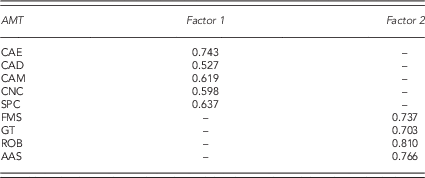
AMT has been classified for different uses and logistic purposes. For example, Meredith and Suresh (Reference Mendenhall, Reinmuth and Beaver1986) grouped AMT as stand-alone, intermediate and integrated, designed for operation, planning and installation, respectively. While for operational reasons, Siegel, Waldman, and Youndahl (Reference Siegel, Waldman and Youndahl1997) classified AMT into two: linked/AMT1 (CAE, CAD, CAM, CNC and SPC) and integrated/AMT2 (FMS, GT, ROB and AAS), designed for implementation and HRM interactions. They characterised AMT1 as serving collectively as the forerunner for more complex AMT2, denoting that the two classifications yield different results when interacting with similar HRM approaches. Hence we adopt Siegel, Waldman, and Youndahl’s (Reference Siegel, Waldman and Youndahl1997) classification for our study as it provides greater opportunity to unravel the interaction between different technologies and empowerment interventions. The factor structures of the technologies are listed in Appendix 1.
EMPOWERMENT
The popular concept of empowerment (Wall, Wood, & Leach, Reference Wall, Wood and Leach2004) involves the delegation of some decision-making authority (Tukar, Altinoz, & Cakiroglu, Reference Tukar, Altinoz and Cakiroglu2011). It also relates to increasing subordinates’ autonomy in their jobs (Siegel, Waldman, & Youndahl, Reference Siegel, Waldman and Youndahl1997; Obi, Reference Obi2000). More importantly for us, by breaking down the traditional structures, empowerment authorises subordinates to make problem-solving decisions (Blanchard, Carlos, & Randolph, Reference Blanchard, Carlos and Randolph1999).
However, in view of Thomas and Velthouse (Reference Thomas and Velthouse1990) construct on cognitive variables that reflects an individual’s orientation, empowerment has some motivational deficiencies (Quinn & Gretchen, Reference Quinn and Gretchen1997). Many managers, especially in traditional societies, are apprehensive at surrendering some decision-making authority to their subordinates for fear of losing control (Hofstede, Hofstede, & Minkov, Reference Hofstede, Hofstede and Minkov2010). Consequently, researchers have cautioned against transferring managerial practices across national boundaries (e.g., Black & Porter, Reference Black and Porter1991; Bond & Smith, Reference Bond and Smith1996). Findings suggest that the extent of empowerment effectiveness across cultures is dependent on the values of the managers (Hui, Au, & Fock, Reference Hui, Au and Fock2004). Hence, we assess the extent of employee empowerment from the managers’, rather than from the employees’ points of view.
AMT–empowerment interaction
Advances in technology have generated a demand for educated and skilled personnel empowered to make decisions (Marri, Gunasekaran, & Sohag, Reference Marri, Gunasekaran and Sohag2007). The potential for AMT to increase productivity is dependent on the ability of employees to develop and use high technology tools while making decisions (Stone, Reference Stone2002). Managers at all levels agree that the best way to instil a strong organisational culture in manufacturing is by committing to employee empowerment (e.g., Styhre, Reference Styhre2004; Tukar, Altinoz, & Cakiroglu, Reference Tukar, Altinoz and Cakiroglu2011), but there is a general consensus that technology innovation failure is due to managers’ failures to empower workers (Chase, Jacobs, & Aquilano, Reference Chase, Jacobs and Aquilano2004).
Empowerment involves varied interventions (Thomas & Velthouse, Reference Thomas and Velthouse1990). According to Darling (Reference Darling1996) and Schrage (Reference Schrage2004), the extent of empowerment cannot be evaluated without specific measurable HRM interventions that support it. Conger and Kanungo (Reference Conger and Kanungo1988) and Thomas and Velthouse (Reference Thomas and Velthouse1990) identified training, job responsibility, career opportunity, control and autonomous work groups as the most common variables that determine an organisation’s level of empowerment.
Training
It is concerned with job-related skills and personal growth and has become increasingly important as organisations seek to use it to empower employees to adapt to AMT (Marri, Gunasekaran, & Sohag, Reference Marri, Gunasekaran and Sohag2007). Hur, Seo, and Lee (Reference Hui and Triandis2005) argue that workers must possess significant knowledge of many technologies to perform first-line operations, while making independent decisions that match job requirements. Others argue that since technology is continuously changing, training must be considered a continuous process for competent employees to make informed decisions (Robert, Reference Robert2000; Marri, Gunasekaran, & Sohag, Reference Marri, Gunasekaran and Sohag2007).
Job responsibilities
Automation and computer technology are changing the way people work (e.g., Connolly, Reference Connolly1996; Dorenbosch, Van Engen, & Verhagen, Reference Dorenbosch, Van Engen and Verhagen2005). Organisations are designing jobs to enrich and increase job responsibilities to achieve flexibility and motivation through empowerment (Chase, Jacobs, & Aquilano, Reference Chase, Jacobs and Aquilano2004). Magjuka and Schmenner (Reference Magjuka and Schmenner1993) found that firms in America, Western Europe and the Far East that have adopted cellular manufacturing principles have devolved responsibilities to their shop floor workers, and conclude that increasing worker job responsibilities increases production flexibility.
Job/career opportunities
There is evidence to suggest that AMT significantly creates job opportunities for employees in manufacturing organisations. A study by Dorenbosch, Van Engen, and Verhagen (Reference Dorenbosch, Van Engen and Verhagen2005) observed that the employment of engineers in mainline design and production is rising faster than overall employment, while Yun (Reference Yun1998) found a positive association between increased job opportunities and technology innovation. These studies suggest that qualified personnel are the key to the long-term success of technology innovation. Likewise, Klein (Reference Klein2003) concluded that with the advent of new technologies there are increases in job opportunities for skilled workers in manufacturing.
Autonomous group
Schermerhorn, Davidson, Poole, Wood, Simon, and McBarron (Reference Schermerhorn2014) see autonomous work groups as the redesign of jobs to create a higher degree of task interdependence and greater employee authority to make many decisions. For example, auto-manufacturer Volvo was selected to illustrate some successful combinations of high-technology-enriched jobs and autonomous work groups (Schermerhorn, Reference Schermerhorn, Davidson, Poole, Wood, Simon and McBarron1993). The results were positive worker attitudes, higher-quality output, and, among others, a lower need for supervision and a higher level of flexibility in decision-making. Gil, Alcover, and Peiro (Reference Gil, Alcover and Peiro2005) found that self-managing work groups have an increased decision-making capability and that this enhances productivity.
ORGANISATIONAL CULTURE AND EMPOWERMENT–AMT INTERACTION
Although there are no reported cross-cultural studies on organisational culture and AMT–empowerment, there have been several on organisational culture, empowerment and innovation capability within the same culture (e.g., Cakar & Erturk, Reference Cakar and Erturk2010). Jung, Chow, and Wu (Reference Jung, Chow and Wu2003) found a positive relationship between organisational culture, innovativeness and empowerment. However, they attributed their finding to their sample mix – for example, people that originated from high PD environments may still expect some level of paternalism when left alone to make decisions. Other studies reported a strong positive relationship between organisational culture that supports participative management practices and technology utilisation (e.g., Ogbonna & Harris, Reference Ogbonna and Harris2000; Knight-Turvey, Reference Knight-Turvey2006). More specifically, Siegel, Waldman, and Youndahl (Reference Siegel, Waldman and Youndahl1997) and Obi (Reference Obi2000) found that positive AMT implementation behaviour comes from a greater sense of control over what people do and how they do it. The implication of the reported findings suggests that a strong organisational culture that supports empowerment intervention approaches would lead to a positive AMT–empowerment interaction.
CONCEPTUAL FRAMEWORK AND HYPOTHESIS
We developed the conceptual framework for this study from the literature. Figure 1 depicts the predictive influence national culture has on organisational culture, which determines the extent of AMT–empowerment interaction, with respect to managerial attitude towards employee empowerment. For example, Hofstede, Hofstede, and Minkov (Reference Hofstede, Hofstede and Minkov2010) suggest that the effective management practices relating to empowerment vary with the degree of PD within a given organisation. As such our conceptual framework is based on theory and research findings, which suggest that the extent of employee empowerment is determined by the willingness of superiors to empower their subordinates during technology innovation (e.g., Khazanchi, Lewis, & Boyer, Reference Khazanchi, Lewis and Boyer2007; Hofstede, Hofstede, & Minkov, Reference Hofstede, Hofstede and Minkov2010).
Conceptual framework of the influence of culture on advanced manufacturing technology (AMT)–empowerment interaction

National culture, through its different dimensions has been claimed as the major determinant of organisational culture (Hofstede, Hofstede, & Minkov, Reference Hofstede, Hofstede and Minkov2010), while organisational culture has been proposed as the key to managing technological innovations (Khazanchi, Lewis, & Boyer, Reference Khazanchi, Lewis and Boyer2007). Organisational culture that supports technology innovation is defined as the ‘social and cognitive environment, the shared view of reality, and the collective belief and value system reflected in a consistent pattern of behaviour among participants’ (Jassawalla & Sashittal, Reference Jassawalla and Sashittal2002: 43). As such, organisational beliefs and value system provide the reference point that guides the managerial extent of empowerment (Jassawalla & Sashittal, Reference Jassawalla and Sashittal2002; Schermerhorn et al., Reference Schermerhorn2014). For instance, mutual trust, high level of control, increased responsibility, participative decision-making and autonomy are all key attributes of organisational culture that support technology innovation (Ogbonna & Harris, Reference Ogbonna and Harris2000; Brunetto & Farr-Wharton, Reference Brunetto and Farr-Wharton2007).
Other findings claim that the competent management of the AMT–empowerment interaction enables organisational effectiveness (e.g., Siegel, Waldman, & Youndahl, Reference Siegel, Waldman and Youndahl1997; Castrillon & Cantorna, Reference Castrillon and Cantorna2005). Khazanchi, Lewis, and Boyer (Reference Khazanchi, Lewis and Boyer2007) suggest that by espousing employee empowerment, managers foster trust that encourages commitment and good decision-making. Other studies (e.g., Detert, Reference Detert2000) suggest that managerial values hinder or enable the empowerment process during technology utilisation. These studies support the argument that the level of empowerment will differ across cultures due to differences in the behaviour of organisational members resulting from their national values (Hofstede, Hofstede, & Minkov, Reference Hofstede, Hofstede and Minkov2010; Oh, Pieper, & Gerhart, Reference Oh, Pieper and Gerhart2010). Unlike previous studies of AMT–empowerment interactions, we contend that managerial behaviour that enables such interactions will be determined by differences in national values.
The review of the literature reveals the main features of NZ’s cultural values as low PD and UA, high IND and MAS, and LTO, and the reverse for Nigeria. In line with related studies (e.g., Harrison, Reference Harrison1995; Hofstede, Hofstede, & Minkov, Reference Hofstede, Hofstede and Minkov2010), we used cultural values to predict the different extents to which managers empower their employees during AMT utilisation.
The propositions were based on the premise that most HRM approaches were formulated in developed Western countries. Therefore, NZ managers will be better positioned than Nigerian managers to adopt empowerment approaches. Thus, we predict that the extent of employee empowerment in NZ will be greater than in Nigeria during AMT utilisation, including for the two classifications, AMT1 and AMT2. Hence, we propose the following hypotheses:
Hypothesis 1: Given AMT–HRM interactions, the extent of employee empowerment will be greater in NZ than Nigeria during AMT utilisation.
Hypothesis 1a: Given AMT–HRM interactions, the extent of employee empowerment will be greater in NZ than Nigeria during AMT1 utilisation.
Hypothesis 1b: Given AMT–HRM interactions, the extent of employee empowerment will be greater in NZ than Nigeria during AMT2 utilisation.
METHODOLOGY
Sampling and issues
The objective of our study was to examine the extent to which employee empowerment practice in Nigeria differs from that of NZ during AMT utilisation. To achieve this, a nonprobability sampling method was used to obtain samples from manufacturing organisations in the two countries (Zikmund, Reference Zikmund1994). The focus of the study was on those primary industry sectors that are common to Nigeria and NZ, such as food processing, brewing, textiles, mechanical and electrical, and electronics engineering. These are important because they contributed only 6.97% of Nigeria’s export earnings (Central Bank of Nigeria, 2010), and as much as 65% of NZ’s (Statistics NZ, 2010).
In line with similar studies, we decided that a questionnaire was the most appropriate means of data collection, and manufacturing/operations managers of large companies with workforces of more than 200, and CEOs of organisations with less than 200 were the most appropriate respondents (Sekaran, Reference Sekaran1992). The respondents were chosen because they are better suited to answer questions on technologies/employee dynamics (Siegel, Waldman, & Youndahl, Reference Siegel, Waldman and Youndahl1997). Furthermore, the decision was consistent with Hofstede’s (Reference Hofstede1980) recommendation that the participants in a cultural study should be people that are conversant with the job responsibilities. Nonetheless, an appeal was advanced in the questionnaire letter to collaborate with the HRM managers where necessary.
To guard against language bias in both countries, we developed the questionnaire in English (Andrews & Mead, Reference Andrews and Mead2009), it being the first language in NZ and the medium of instruction and communication in Nigeria (Fafunwa, Reference Fafunwa1975). To achieve a relevant and consistent language, and subsequently improve the response rate, a pretest of the developed questionnaire was conducted with 75 respondents in Nnewi, Nigeria (35) and Canterbury, NZ (40). The pretest results gave a measure of confidence sufficient to distribute the finalised questionnaire to all the respondents.
It was more difficult to administer the questionnaires in Nigeria than in NZ. In NZ, we distributed it through the postal services, but in Nigeria one of us had to physically deliver/retrieve the questionnaires to/from most of the selected organisations by hand. Hence, we delivered more questionnaires in NZ (148) than in Nigeria (81). Despite the hand delivery in Nigeria being only for logistical expediency/convenience, rather than for questionnaire response accuracy, Nigeria recorded a 93% response rate, compared to NZ’s 56%. The high response rate is not a result of any known trend in Nigeria or Africa, but can be attributed to personal contact with the managers/respondents, who took a special interest in the study, after being assured that the results would be made available to them. The total useable questionnaires (153) were those that were correctly completed – 72 for Nigeria and 81 for NZ. The difference between the two sets of useable data is considered insignificant, and therefore unlikely to bias the results (Dunne & Schmitz, Reference Dunne and Schmitz1995). The total sample consisted of 93% males, with 69% aged between 23 and 51 years. Male dominance in the manufacturing industry is consistent with other published results in the two countries – 71 and 29% for male against female in NZ (Statistics NZ, 2015) and 83% male against 17% in Nigeria (National Bureau of Statistic, 2016). In total, 82% of respondents had worked in their organisation for more than 10 years, and 62% had tertiary qualifications.
Cross-cultural measurement
The measurement of cross-cultural variables has been a source of debate leading to differences in research approaches. Our study aligns with the personality-centred and anthropological approaches. With the personality-centred approach, the respondents’ respective national characteristics are based on the aggregation of their values, while the anthropological approach provides for the use of culture as the inferred bases of analysis and interpretation of hypothetical and exploratory outcomes (Clark, Reference Clark1990; Lenartowicz & Roth, Reference Lenartowicz and Roth1999). We used the respective aggregated cultural values of the managers in Nigeria and NZ as the predictor of their propensity to empower subordinates during AMT utilisation.
We checked for other culture-related problems, such as Galton’s, in the final sample. Galton’s problem is that individuals might reflect the cultural values where they spent the greatest length of time (Barry, Reference Barry1980). This was controlled by posing a question that limited the final sample to respondents who had spent less than 1 year outside their country of origin (Barry, Reference Barry1980; Andrews & Mead, Reference Andrews and Mead2009). No significant distinctions were expected between local organisations and MNC in the two countries because managerial attitudes towards their subordinates are predominantly determined by local/host countries’ cultures (Hofstede, Reference Hofstede1980; Hofstede, Hofstede, & Minkov, Reference Hofstede, Hofstede and Minkov2010). Lastly, no significant demographic patterns/directions were observed between the two countries.
Survey measurement and analysis
The first part of our questionnaire applied the HERMES values survey model (Hofstede, Reference Hofstede1994) to measure the cultural values of the respondents, while the second part tested the hypothesis that AMT–empowerment interaction is different in both countries.
To ascertain the Nigerian and NZ positions on the cultural dimensions, the Value Survey Module 1994 (Hofstede, Reference Hofstede1994) was administered to current data. However, the recalculated index scores should be treated with caution as Hofstede’s dimensions were calculated using many country samples. As reported above, cultural values were measured and determined through the five distinct dimensions of PD, IND/COLLs, MAS/FEM, UA and L/STO. Their scores and values were based on scales adopted from measures developed and tested by Hofstede (Reference Hofstede1994). All survey items in each dimension were limited to the four most relevant determinants of work practices that affect the extent to which managers’ behaviour is consistent with the dimensional values (Hofstede, Hofstede, & Minkov, Reference Hofstede, Hofstede and Minkov2010). For example, ‘work relation with superiors’ and ‘having good physical working condition’ is a good measure of superior–subordinate relationship in the PD and IND/COLL dimensions, respectively (Hofstede, Hofstede, & Minkov, Reference Hofstede, Hofstede and Minkov2010). The items were measured on 5-point Likert scales where 1=‘strongly disagree,’ and 5=‘strongly agree’. For example, 5 in the PD score indicates that managers agree that their subordinates would strongly accept unequal distribution of power across the hierarchy, while the reverse is the case for managers that scored it 1 on the continuum.
We adopted the measures of the extent of empowerment from existing intervention items developed and tested by Conger and Kanungo (Reference Conger and Kanungo1988), Thomas and Velthouse (Reference Thomas and Velthouse1990) and Siegel, Waldman, and Youndahl (Reference Siegel, Waldman and Youndahl1997). These empowerment intervention items ‒ training, job responsibility, job/career opportunity, control and autonomous workgroup ‒ were also measured on 5-point Likert scales, where 1=‘not extensive’ and 5=‘extremely extensive’ uses. The respondents were directed to match the nine AMTs with the empowerment intervention approaches employed. For example, if respondents indicated the utilisation of one particular AMT, they went on to check the extent of empowerment on the 5-point Likert scales of any of the intervention items. The mean values generated from dividing the total number of responses by the total number of respondents would indicate the extent to which the intervention approaches were intensified for each AMT grouping.
The samples from both countries were also grouped according to the technologies utilised. The first group is the total AMT utilisation in Nigeria (72) and NZ (81), while the second and third groups consists of organisations that adopted only AMT1 (42 in Nigeria; 35 in NZ) or AMT2 (20 in Nigeria; 29 in NZ).
Cross-cultural validity, reliability and variability
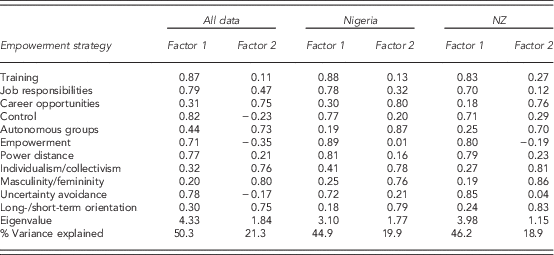
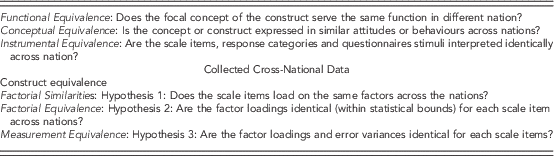
We performed exploratory factor analysis on the samples to determine the validity and reliability of their factor structures. Singh’s model (Appendix 2) was used to determine validity. The functional and conceptual equivalences were controlled through the conceptual framework as it was used to generate the ‘extent of empowerment’ for each country. The instrumental equivalence was also controlled, by giving priority to questionnaires, items and scales that had been developed and tested by other researchers, while other related cross-cultural characteristics, such as English language and level of education, were considered appropriate for both countries (Andrews & Mead, Reference Andrews and Mead2009). Following Hui and Triandis (Reference Hur, Seo and Lee1986), the construct equivalence was assessed using factor analysis, which showed a high level of validity across the variables, affirming structural stability (Table 1 and Appendix 3).
Construct equivalence assessment−orthogonal rotation=varimax

Note. NZ=New Zealand.
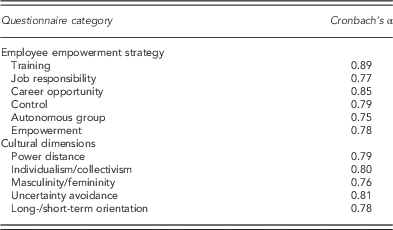
We measured the reliability with the Cronbach’s α coefficient, a popular test for measuring the inner consistency of instruments (Mendenhall, Reinmuth, & Beaver, Reference McSweeney1993; Andrews & Mead, Reference Andrews and Mead2009). As shown in Table 2, 0.7 was set for this study as reliability is a necessary condition for validity in the use of cross-cultural questionnaires (Schwartz & Sagie, Reference Schwartz and Sagie2000).
Cronbach’s α reliability coefficient

We employed the statistical package for social sciences (SPSS), version 11 for this study, specifically a two-tailed t-test to verify that Nigerian and NZ value samples came from populations that had the same distribution (Norusis, Reference Norusis1993). We conducted the Independent-Samples t-test to provide further evidence of the differences between the central tendencies of the populations, and we employed the Wilcoxon matched pair signed-rank test (nonparametric), recommended for testing paired-differences between means of different samples (Mendenhall, Reinmuth, & Beaver, Reference McSweeney1993; Conover, Reference Conover1999), to test the variability in the extent of empowerment between the two country-based samples.
RESULTS
National culture
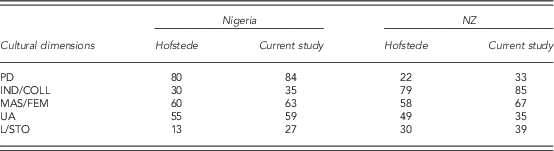
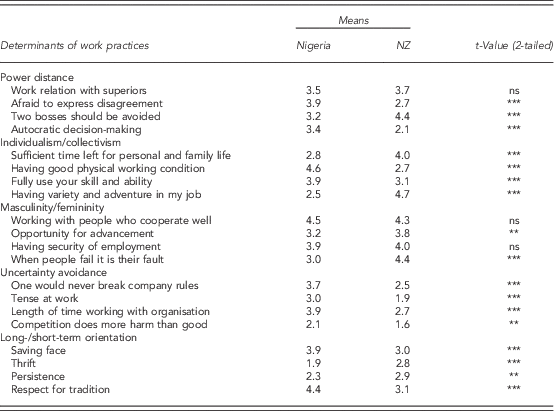
In the conceptual framework, national cultural dimensions of PD, IND/COLL, MAS/FEM, UA and L/STO were stated as the key influencers of organisational culture (Hofstede, Hofstede, & Minkov, Reference Hofstede, Hofstede and Minkov2010), and invariably the key determinants of managerial value/belief systems that directs the extent of employee empowerment. First, to determine the directional compliance, most results of our recalculated index scores in Table 3 appear consistent with those of Hofstede, Hofstede, and Minkov (Reference Hofstede, Hofstede and Minkov2010). The value items used in calculating the dimensions are presented in Table 4. The results showed significant differences between the two countries on most of the dimensional components apart from the MAS/FEM dimension, which showed a slightly higher score in favour of NZ, as against Hofstede’s score that slightly favoured Nigeria.
Hofstede, Hofstede, and Minkov (Reference Hofstede, Hofstede and Minkov2010) recalculated dimensions for Nigeria and New Zealand (NZ)

Note. IDV/COLL=individualism/collectivism; L/STO=long-/short-term orientation; MAS/FEM=masculinity/femininity; PD=power distance; UA=uncertainty avoidance.
Dimensional items for Nigeria and New Zealand (NZ)

Note. ns indicates that difference is not statistically significant.
***Indicates that differences are significant at the 1% level: p<.01.
**Indicates that differences are significant at the 5% level: p<.05.
The PD dimension items showed significant differences between Nigeria and NZ, except for ‘work relation’. One of the essential components of empowerment relates to decision-making style (Bonner, Ruekert, & Walker, Reference Bonner, Ruekert and Walker2002; Hofstede, Hofstede, & Minkov, Reference Hofstede, Hofstede and Minkov2010). NZ being a low PD society shows a very low frequency of autocratic decision-making, while the opposite is the case for Nigeria with a high PD. This suggests that, unlike in Nigeria, managers in NZ are more likely to objectively empower their subordinates. The second element of the PD dimension also show an organisational culture in NZ where the subordinates are ‘not afraid to disagree’ with their superiors. These results confirm Kennedy’s (Reference Kennedy2000) observation that NZ managers encourages subordinates’ assertiveness, and active participation in decision-making beyond their designated job responsibilities. The comparable ‘work relation with superiors’ item in the PD dimension for Nigeria indicated that, although the superiors exhibit a more autocratic style, the overall interests of the subordinates are protected by the paternalistic attributes of the Nigerian culture (Beugre & Offodile, Reference Beugre and Offodile2001; Jackson, Reference Jackson2004). This is consistent with the authoritative powers arrogated to superiors in Nigeria. Such superiors include people like the Obas, Emirs, Obis and their chiefs, elders, parents, including company executives and their managers, who were supposedly chosen by God, but wise and humane enough to protect the interests of their subordinates (Jackson, Reference Jackson2004; George, Owoyemi, & Onakala, Reference George, Owoyemi and Onakala2012). Unlike in Nigeria, an autocratic/authoritative management style in NZ would lead to a negative working relationship between the managers and their subordinates (Kennedy, Reference Kennedy2000).
The IDV/COLL dimension is intimately linked to a societal norm that reflects how people live together (Hofstede, Hofstede, & Minkov, Reference Hofstede, Hofstede and Minkov2010). Hofstede, Hofstede, and Minkov (Reference Hofstede, Hofstede and Minkov2010) suggested that this behaviour affects the structures and functions of institutions, as most traditional managers in high COLL societies like Nigeria do not think of self, but rather about their relatives and community. The aggregated items of the IND/COLL dimension were consistent with Hofstede’s deductions, as the results showed a significant difference between Nigeria and NZ. For example, the NZ sample rated ‘having an element of variety and adventure in the job’ as higher in importance than the Nigerian sample. Work goals that stressed dependence on the organisation are also significantly higher in the Nigerian samples. Consistent with their cultural values, Nigerian managers rated dependence on the organisation (‘good physical condition’) significantly higher than their NZ counterparts (Hofstede, Hofstede, & Minkov, Reference Hofstede, Hofstede and Minkov2010; George, Owoyemi, & Onakala, Reference George, Owoyemi and Onakala2012). The elements of variety and adventure could be considered as motivators within the job, as they relate to an individual’s sense of purpose (Hofstede, Hofstede, & Minkov, Reference Hofstede, Hofstede and Minkov2010). Both countries showed these traits, but NZ managers rated it significantly more important than Nigerian managers.
The results of the MAS/FEM items show that the NZ sample exhibited more masculine traits than the Nigerian, although the latter showed a higher MAS trait than anticipated. The NZ sample was significantly higher on the item ‘when people fail in life it is often their fault’ and ‘opportunity for advancement’. Nigeria, having more traditional values, attributes most natural occurrences to the ‘supernatural’ (Omolewa, Reference Omolewa1991). As such, it is understandable that the Nigerian sample scored lower than that of NZ where people take more responsibility for their actions, in addition to NZers being more ambitious, while Nigerians care more about social status and rewards (Jackson, Reference Jackson2004). Both the Nigerian and NZ samples showed little difference on the FEM items (‘working with people that cooperate’ and ‘having security)’ which portray the importance of relationships and protection.
All the items of the UA dimension showed a significant difference between the Nigerian and NZ samples. The Nigerian managers were more threatened by uncertainties and ambiguous situations than their NZ counterparts, and as such would be more reluctant to empower their subordinates. Considering that the items measure the level of anxiety that exists in a society facing an uncertain future, the significant differences between the two samples indicated that NZ managers are more prepared to venture into the unknown than their Nigerian counterparts (Hofstede, Reference Hofstede1991). For example, Omolewa (Reference Omolewa1991) assert that Nigerian managers would rather rely on supernatural intervention, through prayers or other traditional means, rather than face the uncertainties objectively.
All items of the L/STO dimension were lower in importance for both countries. ‘Persistence’ and ‘thrift’ were rated lower in both samples, although significantly higher in the NZ ones. On the other hand, both countries rated the STO items high, but significantly higher in Nigeria. Coincidentally, ‘saving face’ and ‘respect for tradition’ have been argued to suppress innovation (Hofstede, Hofstede, & Minkov, Reference Hofstede, Hofstede and Minkov2010). For example, Nigerians are more inclined to maintain their cultural and religious traditions in order to escape the wrath of the gods (George, Owoyemi, & Onakala, Reference George, Owoyemi and Onakala2012). The significant difference between the two samples indicated that the Nigerian managers, compared with their NZ counterparts, do not usually empower strategically to complement AMT utilisation.
AMT–employee empowerment interactions
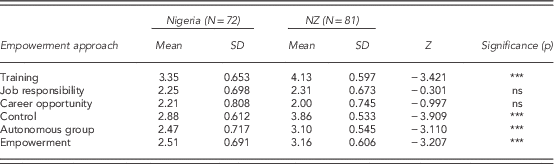
In the conceptual framework, national culture, as an influencer of supportive organisational culture, indicated that the extent of employee empowerment will differ greatly based on national values. Table 5 reveals some differences between the two sample means, especially in the use of three main empowerment approaches – ‘Training’, ‘Control’ and ‘Autonomous Group’. For example, the use of ‘Training’ and ‘Control’ were significantly greater in NZ than in Nigeria. Tests of variability indicated that there are significant differences between the Nigerian and NZ samples in the three intervention methods, while ‘Job Responsibility’ and ‘Career Opportunity’ did not show any differences. However, the cumulative results indicate that the extent of empowerment in NZ was significantly greater (at the 1% level) than in Nigeria, suggesting that the utilisation of AMT necessitated more employee empowerment in NZ than in Nigeria and confirming Hypothesis 1, that ‘employee empowerment will be greater in NZ than Nigeria during AMT utilisation’.
Differential extent of empowerment for overall advanced manufacturing technology utilisation

Note. NZ=new Zealand.
ns indicates that difference is not statistically significant.
***Indicates that differences are significant at the 1% level.
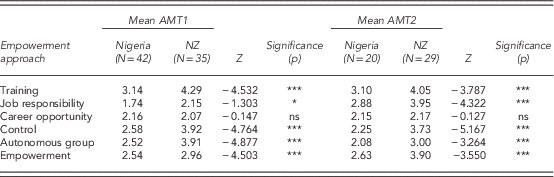
The extent of empowerment during the AMT1 and AMT2 innovation in Nigeria and NZ are presented in Table 6. Increased employee ‘Training’ and ‘Control’ are the two most prevalent forms of employee empowerment in both sets of samples while the reverse is the case for ‘Career Opportunity’ and ‘Job Responsibility’ in both countries. Nonetheless, the results showed that the differences between the Nigerian and NZ sample means in the three main empowerment interventions of ‘Training’, ‘Control’ and ‘Autonomous Group’, including job responsibility, are highly significant. For example, increased employee ‘Training’ and ‘Control’ for the implementation of AMT1 is significantly higher in the NZ sample than in the Nigerian one. The trend was repeated for AMT2. These results suggest a greater extent of empowerment in NZ than in Nigeria in both classifications of AMT.
Differential extent of empowerment for overall advanced manufacturing technology (AMT1) and AMT2 utilisation

Note. NZ=New Zealand.
ns indicates that difference is statistically insignificant.
***Indicates that differences are significant at the 1% level.
*Indicates that differences are significant at the 10% level.
The test of variability also revealed statistically significant differences between the two sets of samples. For example, the test suggests that the cumulative extent to which the NZ managers empower their employees when utilising AMT1 and AMT2 is significantly higher than for their Nigerian counterparts (at the 1% level) despite ‘Career Opportunity’ intervention variable not showing any statistically significant difference between them. Therefore, Hypothesis 1a (employee empowerment will be greater in NZ than Nigeria during AMT1 utilisation), and Hypothesis 1b (employee empowerment will be greater in NZ than Nigeria during AMT2 utilisation) are both confirmed.
DISCUSSION AND CONCLUSION
Drawing on Hofstede, Hofstede, and Minkov’s (Reference Hofstede, Hofstede and Minkov2010) cultural dimensions, this study adds to our understanding of the influence of national culture on the attitude of organisational members towards empowerment during technology innovation. Considering that organisational culture reflects patterns of behaviour within the organisation, it invariably guides managerial decision-making (Jassawalla & Sashittal, Reference Jassawalla and Sashittal2002; Schermerhorn et al., Reference Schermerhorn2014). For example, it has been suggested that organisational culture that supports increases in employee control plays a crucial role in the success of technology innovation (Marri, Gunasekaran, & Sohag, Reference Marri, Gunasekaran and Sohag2007). However, other cross-cultural studies suggest that the extent of success would differ along national cultural boundaries (e.g., Oh, Pieper, & Gerhart, Reference Oh, Pieper and Gerhart2010).
Using operational-level data from two unique cultural settings, this study specifically compared managerial propensity to empower subordinates when utilising AMT. With the help of the literature, especially the use of cultural differences as an influencer, we hypothesised that employee empowerment would be greater in NZ manufacturing organisations than in their Nigerian counterparts when utilising AMT.
The results show that the elements of empowerment played a role in AMT utilisation in Nigeria and NZ manufacturing organisations. In both countries, organisations mostly intensify ‘Training’, ‘Control’ and ‘Autonomous Groups’ when utilising AMT, which aligns with other findings (e.g., Siegel, Waldman, & Youndahl, Reference Siegel, Waldman and Youndahl1997; Obi, Reference Obi2000; Khazanchi, Lewis, & Boyer, Reference Khazanchi, Lewis and Boyer2007). This result is consistent with other findings which suggest that the successful utilisation of technologies requires an organisational cultural environment that supports employee empowerment (e.g., Hui, Au, & Fock, Reference Hui, Au and Fock2004; Kuo et al., Reference Kuo, Ho, Lin and Lai2010; Tukar, Altinoz, & Cakiroglu, Reference Tukar, Altinoz and Cakiroglu2011). However, the rate at which managers empower employees to achieve the required AMT efficiency differs greatly in Nigeria from NZ due to their different cultural values, confirming Hypotheses 1, 1a and 1b. Thus, further discussions will focus more on the culturally attributable reasons for the differential extent of empowerment between the two countries. This analytical approach is consistent with other cross-cultural studies (e.g., Harrison, Reference Harrison1995; Van Oudenhoven, Reference Van Oudenhoven2001; Downing, Gallaugher, & Segars, Reference Downing, Gallaugher and Segars2003) that used culture as an influencer of managerial behaviours.
Hofstede, Hofstede, and Minkov (Reference Hofstede, Hofstede and Minkov2010) defined culture as the collective mental programming of a nation, which invariably dictates organisational value systems. The current comparison of Nigeria and NZ manufacturing organisations on the extent at which they empower their subordinates is based on their cultural differences. Thus, the collective behavioural differences in the management of AMT–empowerment interaction between Nigerian and NZ managers are consistent with the definitions. It has been reported that empowerment doctrine that relates to motivation and leadership is comparatively different along cultural dimensions (Hofstede, Hofstede, & Minkov, Reference Hofstede, Hofstede and Minkov2010).
Most contemporary leadership doctrines also support empowerment through extending considerable decision-making authorities to subordinates (Schermerhorn et al., Reference Schermerhorn2014). However, Hofstede (Reference Hofstede1991: 35) states that such extended decision-making authority is mostly not obtainable in high PD societies where ‘superiors and subordinates are existentially unequal’. He suggested that the manifestation of such ‘existential inequality’ is mostly demonstrated in strict role distinction between managers and their subordinates. This assertion is confirmed in our results, which suggest that NZ with a lower PD, will have a greater propensity to empower their subordinates more than their Nigerian counterparts. Alyahya (Reference Alyahya2004), Littrell (Reference Littrell2007) and Hofstede, Hofstede, and Minkov (Reference Hofstede, Hofstede and Minkov2010) suggested that in high PD societies like Nigeria, subordinates are generally not allowed to disagree with their superiors, while the reverse is the case in low PD societies like NZ, where autocratic decision-making is generally not tolerated (Kennedy, Reference Kennedy2000). In addition, our results challenge the universal empowerment doctrine that advocates low control, less rule and directives, including high delegations to encourage subordinates’ decision-making authority (Schermerhorn et al., Reference Schermerhorn2014). Such empowerment doctrine runs contrary to the Nigerian value system, which stresses uncompromising obedience, respect and submission to people in position of authority (Omolewa, Reference Omolewa1991). In Nigeria this level of superiority are not challenged, but rather believed to have been installed/dictated by God (George, Owoyemi, & Onakala, Reference George, Owoyemi and Onakala2012). To further consolidate on power, superiors can only be addressed formerly as master, ‘oga’ or sir/madam in Nigeria (George, Owoyemi, & Onakala, Reference George, Owoyemi and Onakala2012), unlike in NZ where organisational culture supports first name bases for superiors and subordinates (Kennedy, Reference Kennedy2000).
Furthermore, it was argued that in a high PD society like Nigeria, managers may want to empower their subordinates, but subordinates may be unwilling to accept greater control and responsibility, even when trained to do so (Littrell, Reference Littrell2007). The challenge is that the empowerment philosophy that preaches more decentralisation of authority would compel subordinates to compromise on the sanctity of the natural chain of command (Hoppe, Reference Hoppe1993). In Nigeria, that would constitute a direct challenge and disobedience to the value system, and most offensively to ‘God’ that devolved such powers to the superiors (Omolewa, Reference Omolewa1991). In addition, unlike in NZ, in Nigeria the extensive empowerment of subordinates to complement AMT innovation may lose managers some respect, as it would be considered a betrayal of the natural order (Hoppe, Reference Hoppe1993). Hofstede, Hofstede, and Minkov (Reference Hofstede, Hofstede and Minkov2010) suggest that in a high PD culture like that of Nigeria, an ideal manager is the benevolent autocrat.
IDV/COll dimension is linked to the extent to which people are motivated by self-interest over that of group interest (Hofstede, Reference Hofstede1991). Hofstede, Hofstede, and Minkov (Reference Hofstede, Hofstede and Minkov2010) suggest that the prevailing correlation between IDV and empowerment in an Anglo Saxon society, like NZ, is fuelled by self-interest. As such, the inherent cultural bias of the empowerment doctrine that preaches increased personal autonomy, control, responsibility and involvement in decision-making favoured high IND NZ managers rather than their COLL Nigerian counterparts. Our results suggest that the collective motivational deficiency of Nigerian managers to objectively employ the empowerment intervention approaches on their subordinates during AMT utilisation can best be described as traditional (Quinn & Gretchen, Reference Quinn and Gretchen1997), while the reverse is the case for IND NZ managers. Therefore, contrary to the motivated support for empowerment, it was argued that tradition-directed people hardly think of themselves as individuals, but rather as collectives (Inglehart & Baker, Reference Inglehart and Baker2000).
Contrary to the empowerment theory that advocates relaxed and flexible formal and informal rules, structures, laws and policies that have helped managers to maintain control and orderliness, Sagie and Aycan (Reference Sagie and Aycan2003) argued that an explicit behavioural style should be preferred in the work environments of strong UA societies. Employees from strong UA societies like Nigeria are likely to be more comfortable with more structured and precise objectives than those from low UA societies like NZ. As such, the results of this study are consistent with the different implications for the two countries (Hofstede, Hofstede, & Minkov, Reference Hofstede, Hofstede and Minkov2010). The higher UA in Nigeria than in NZ suggests that the majority of managers in Nigeria would not allow their subordinates to make independent AMT utilisation decisions without requiring consultation (Taras & Steel, Reference Taras, Steel and Kirkman2010). Hofstede (Reference Hofstede1991) has argued that societies that are high in UA may not trust their subordinates enough to empower them, due to fear of usurping their powers. This position is supported by George, Owoyemi, and Onakala (Reference George, Owoyemi and Onakala2012), whose finding suggest that Nigerian managers are traditionally afraid to empower their subordinate who would one day seek equality or even become superior. Therefore, unlike in NZ, in Nigeria pursuing an organisational culture (e.g., decentralisation of decision-making and low formalisation) that supports empowerment, would increase uncertainty and ambiguity, and would not be tolerated by superiors or embraced by subordinates. Nigerian managers would rather resign themselves to supernatural intervention than trust and empower their subordinates to deal with difficult organisational situations. For example, Nigerians have the propensity to shy away from most challenging situations as they may ‘prayerfully’ consider them as ‘an act of God’, instead of taking pragmatic actions to solve the problem (George, Owoyemi, & Onakala, Reference George, Owoyemi and Onakala2012).
Unlike STO, LTO is generally associated with a strong work ethic, perseverance, proactivity and strategic outlook, which are equally linked to empowerment (Hofstede et al., Reference Hofstede, Hofstede and Minkov2010). The low scores on this dimension in both countries suggest that Nigerian managers are not particularly different from their NZ counterparts, although the results indicated that the NZ managers with higher LTO would empower more than their Nigerian counterparts. However, these differences may be linked to other cultural dimensions that may interact (Andrews & Mead, Reference Andrews and Mead2009). For example, intended LTO for AMT utilisation in Nigeria can be hindered by high PD, low IND and high UA. Unlike in NZ, with its liberal cultural attributes (Kennedy, Reference Kennedy2000), in Nigeria a well-intentioned/articulated employee empowerment plan for AMT utilisation can be hindered by a paternalistic drive/obligation to control and protect subordinates (Jackson, Reference Jackson2004). Furthermore, the results indicate that the Nigerian managers’ orientation towards strong traditions will hinder any change in the status quo and, as a result, any move towards greater employee empowerment to complement AMT utilisation may be resisted (Beugre & Offodile, Reference Beugre and Offodile2001; Jackson, Reference Jackson2004).
In conclusion, our conceptual framework, which predicted that national/organisational culture would influence the extent of empowerment during AMT innovation, was correct. However, the empowerment doctrine appears not to fit well with the more traditional Nigerian culture, but shows a far better fit with NZ liberal values.
THEORETICAL CONTRIBUTIONS
The academic contribution is twofold: the use of existing knowledge outside the environment it has been developed for and the nature of national culture. Although not directed at AMT–empowerment interactions, the first of these implications is already noted in the academic literature with few other studies taking the national context into account (Hui, Au, & Fock, Reference Hui, Au and Fock2004). Although some studies (e.g., Shah, Reference Shah2009) have questioned Hofstede’s model, with a cultural convergent argument, others (e.g., George, Owoyemi, & Onakala, Reference George, Owoyemi and Onakala2012) are consistent with the current study, thus confirming Hofstede’s findings.
Through its methodology, this study adds to the accumulating evidence of the relationship between national/organisational culture, HRM approaches and technology innovations (e.g., Siegel, Waldman, & Youndahl, Reference Siegel, Waldman and Youndahl1997; Obi, Reference Obi2000; Khazanchi, Lewis, & Boyer, Reference Khazanchi, Lewis and Boyer2007). However, the interpretation of previous findings was based on the Western cultural mindset, and as such raised more questions for the current study. Thus it has contributed to theory by highlighting the differences in empowerment approaches when applied to non-Western/traditional cultures. For example, the result adds credence to the argument that empowering subordinates through increased control, training, responsibilities and autonomous work grouping would not guarantee consistent universal results (Hofstede, Hofstede, & Minkov, Reference Hofstede, Hofstede and Minkov2010). Most importantly, it points to the fact that future conceptualisation of empowerment theories need to consider cultural implications. Our confirmation of significant differences between a Western society (NZ) and a traditional one (Nigeria) is relevant to future prediction of empowerment approaches to ATM utilisation.
IMPLICATIONS
The results of this study have demonstrated that although national cultures may be converging due to the universality of industrialisation (Kerr, Dunlop, Harbison, & Myers, Reference Kerr, Dunlop, Harbison and Myers1973), managers need to be aware that HRM practices must still be sensitive to the unique aspects of national cultures (Hui, Au, & Fock, Reference Hui, Au and Fock2004). National culture remains an important intervening factor in HRM, especially in strong traditional Africa. In our case, employee empowerment, which has become a ‘buzzword’ in the Western world, does not appear to be completely consonant with the Sub-Saharan African culture of Nigeria.
To increase consonance, it is suggested that manufacturing MNCs need to develop some specific training to create the necessary shift in Nigerian managers’ cultural mindsets (Dowling, Schuler, & Welch, Reference Dowling, Schuler and Welch.1999). This would bridge the gap between the globalised standard and local adaptation of HRM practices (Dowling, Schuler, & Welch, Reference Dowling, Schuler and Welch.1999). Furthermore, faced with multiple HRM issues that result from different cultural contexts, it is suggested that MNC seeking to operate in a country like Nigeria many need an extensive localisation of their managerial workforce (Dowling, Schuler, & Welch, Reference Dowling, Schuler and Welch.1999).
LIMITATIONS AND FUTURE RESEARCH
There are several limitations. First, is the small sample size when compared with other cross-cultural studies (e.g., Hofstede, Reference Hofstede1980). Although every attempt was made to ensure that a broad range of organisations was represented, a follow-up examination may be required using a larger sample size. In addition, the use of the scientific realism approach has certain advantages, such as being able to creatively explore contemporary events (Perry, Riege, & Brown, Reference Perry, Riege and Brown1999). However, the technique has certain drawbacks, such as generalisation. Therefore the current findings should be interpreted with caution. However, we believe that future qualitative studies should allow for greater analysis of the influence of local cultural factors.
Second, although managers/CEOs were the targeted source of data in this study, examining employees’ perception in a future study may provide additional insight. This would help determine whether employees themselves would want more empowerment, and/or are satisfied with paternalistic approaches, especially in more traditional societies.
Finally, the current findings have raised some issues that are beyond the scope of this study. For example, the literature revealed that the essential aim of AMT–HRM interaction is to achieve organisational efficiency (e.g., Obi, Reference Obi2000). Therefore, there is a need to evaluate the economic implications of such interaction in different cultural settings.
Acknowledgements
We would like to thank the following individuals for their constructive comments on this paper: Dr Christina Scott-Young, Dr Ruchi Sinha and Dr Sukhbir Sandhu.
Appendix 1
Rotated factor structure matrix of advanced manufacturing technology (AMT)

Appendix 2
Construct equivalence issues in cross-national research

Appendix 3
Construct equivalence assessment summary