Introduction
Having a family member with a severe brain injury is emotionally draining and most family members find it difficult to adapt to the changed life situation. This has been confirmed several times in studies revealing high levels of anxiety, depression and emotional distress in relatives of persons with severe brain injury (e.g. Harris, Godfrey, Partridge & Knight, Reference Harris, Godfrey, Partridge and Knight2001; Norup, Welling, Qvist, Siert et al., Reference Norup, Siert and Mortensen2012; Oddy, Coughlan, Tyerman & Jenkins, Reference Oddy, Coughlan, Tyerman and Jenkins1985; Sander, High, Jr., Hannay, & Sherer, Reference Sander, High, Hannay and Sherer1997; Turner, Flemming, Parry, Vromans et al., Reference Turner, Flemming, Parry, Vromans, Cornwell, Gordon and Ownsworth2010). Despite this well-known fact relatively few studies have investigated the coping strategies that family members of traumatic brain injury (TBI) survivors use to cope with the new and changed life situation.
Coping explains how individuals handle stressful situations (Carver & Connor-Smith, Reference Carver and Connor-Smith2010; Lazarus, Reference Lazarus1966; Lazarus & Folkman, Reference Lazarus and Folkman1984). An individual's coping strategies interact with the situational demands, and therefore understanding individual coping strategies may provide information about individual differences in appraisals of traumatic experiences (Folkman & Lazarus, Reference Folkman and Lazarus1988). Thus, the concept of coping is essential to include in research examining both short-term and long-term distress caused by stressful life events (Skinner, Edge, Altman, & Sherwood, Reference Skinner, Edge, Altman and Sherwood2003). Chwalisz’ (Reference Chwalisz1996) proposed perceived stress model of caregiver burden is one way to understand coping in relation to being a caregiver or having a family member with brain injury. According to Chwalisz a brain injury in a family member would lead to negative outcomes if the effects of injury are appraised to exceed the caregiver's available resources. In this regard Chwalisz defined burden in caregivers as perceived stress in order to provide a theoretical basis for understanding the effects of emotional distress in previous research on family members of individuals with brain injury. Chronister and Chan (Reference Chronister and Chan2006) have elaborated Chwalisz’ model describing a stress model of caregiving for individuals with TBI, which consists of both exogenous and endogenous variables. The exogenous variables are demographic variables such as relatives’ age, role and gender, and time since injury and the functional competency of the person with the injury, and these exogenous variables are assumed to affect endogenous variables such as avoidant, emotion- and problem-focused coping as well as social support. A second level of endogenous variables includes three domains of family members’ appraisal of the situation: perceived burden, perceived mastery and perceived satisfaction. The last level of the model includes quality of life (QoL), which evaluates the relatives’ overall perceived QoL (Chronister & Chan, Reference Chronister and Chan2006). Chronister and Chan used the situational version of Carver's coping questionnaire with 32 items and grouped the items into three scales: 1) problem-focused coping, 2) emotion-focused coping, and 3) avoidant coping. They found that both avoidant and problem-focused coping was associated with lower quality of life.
In a study by Calvete and de Arroyabe (Reference Calvete and de Arroyabe2012), disengagement (i. e. avoidance and denial) was the most dysfunctional type of coping. Secondary control coping such as acceptance and cognitive restructuring was associated with less grief and less symptoms of depression.
Cruzado and Morena (Reference Cruzado and Morena2013) found that the strategy acceptance was protective in terms of distress, whereas denial, self-blame and emotion-focused strategies were associated with negative outcome.
Sander, High, Hannay and Sherer (Reference Sander, High, Hannay and Sherer1997) found that greater use of emotion-focused coping was related to greater emotional distress in a sample of caregivers of patients with TBI.
Wolters et al. (Reference Wolters, Stapert, Brands and van Heugten2011) found that passive coping styles such as isolation and worrying about the past were associated with lower quality of life and lower family functioning.
However, methodological and measurement differences between the studies make generalisations difficult. Nevertheless, there seems to be some evidence indicating associations between certain coping strategies and caregiver outcome both in terms of quality of life and distress. Family members of Danish TBI-patients experience distress (Norup, Siert, & Mortensen, Reference Norup, Siert and Mortensen2010; Norup et al., Reference Norup, Welling, Qvist, Siert and Mortensen2012), but it is very likely that they can still feel satisfaction and contentment with their life in general (Wells, Dywan, & Dumas, Reference Wells, Dywan and Dumas2005).
The Present Study
Given the scarce amount of research investigating coping mechanisms used by family members when encountering a severe brain injury, we conducted an exploratory study investigating the use of coping strategies in Danish family members living with the consequences of brain injury one year post trauma. This study addresses an existing research gap as it is the first Danish study investigating coping mechanisms in family members of brain injury survivors. Our objectives were two-fold, to: 1) describe which coping strategies were most frequently used one year after injury and 2) explore possible associations between the use of coping strategies and emotional distress and quality of life one year after the patient's brain injury. We hypothesised that specific coping strategies would be associated with fewer symptoms of depression, anxiety and with better health-related quality of life (HRQoL). Findings from the present study will help determine if previous studies on coping among family caregivers following TBI might generalise to families in Denmark.
Method
Participants
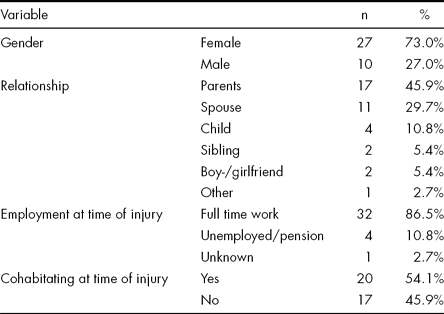
The sample consisted of 37 relatives of persons with severe brain injury, who were predominantly female (73.0%) and either parents (45.9%) and spouses (29.7%) (See Table 1).
Descriptive statistics for participating relatives

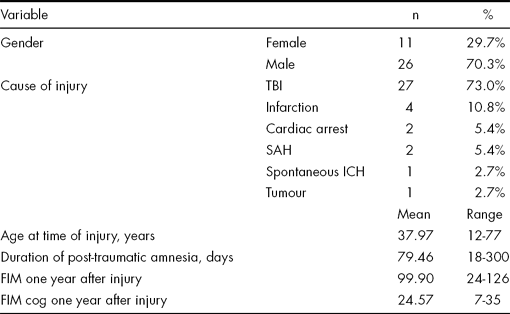
Most patients were male (70.3%), and the mean age was 38 years at time of injury. Most (73.0%) patients had a traumatic brain injury (Table 2), and were admitted for rehabilitation in hospital about 21.37 days after injury (SD 16.87). The patients had been admitted for a long period of rehabilitation at a sub-acute unit with a mean length of stay of 110.19 days (SD 46.41). The patients and relatives were contacted for one year follow-up, and the assessments were conducted on average 388.21 days (SD 21.35) after injury.
Characteristics of the patient sample
Procedure
The sample of relatives had been included in a larger study described elsewhere (Norup et al., Reference Norup, Siert and Mortensen2010; Norup et al., Reference Norup, Welling, Qvist, Siert and Mortensen2012; Norup, Snipes, Siert, Mortensen et al., in press), and a sub-sample of these participants completed the coping measure described below as well as the outcome measures one year post injury. The patients were re-admitted to the hospital for a one day follow-up one year after injury, and in most cases, the relatives were also present for the follow-up. When the relatives did not attend the follow-up, the questionnaires were mailed to the relatives.
Measures
Participants completed measures of coping and mental health: brief COPE (Carver, Reference Carver1997), Symptom Checklist-90-Revised (SCL-90-R: Derogatis, Reference Derogatis1994) and Short Form 36 (SF-36; Ware, Snow, Kosinski, & Gandek, Reference Ware, Snow, Kosinski and Gandek1997). They also provided data on their demographics.
Coping strategies. The brief COPE (Carver, Reference Carver1997) consists of 28 items, and participants are asked to rate how often they used the coping strategies on a four point Likert scale, where ‘1’ corresponds to ‘I haven't been doing this at all’ and ‘4’ means ‘I've been doing this a lot’. The 28 items are paired together describing 14 different coping strategies; active coping, planning, positive reframing, acceptance, humour, religion, use of emotional support, use of instrumental support, self-distraction, denial, venting, substance use, behavioural disengagement and self-blame. Scores for each of these sub-scales range from two to eight with higher scores indicating more use of the particular strategy. Carver reported Cronbach's alpha-values across all strategies between .50 and .90 (Carver, Reference Carver1997). Carver recommends analysing each of the individual 14 coping strategies separately to evaluate associations with other variables. Alternatively, second-order coping factors can be derived from the 14 individual coping strategies (Carver, Scheier, & Weintraub, Reference Carver1989). The composition of these factors should be determined from the given data, as different samples exhibit different patterns (Carver, Reference Carver2012). Unfortunately, this was not possible in our data set because of the small sample size, so we chose to examine the 14 different strategies separately. The relatives completed the questionaire at the follow-up one year after injury and were asked to rate how much they had used the particular strategy during the last year. The relatives were specifically asked to complete the brief COPE in relation to their family member having a brain injury. The scores of the 28 items of the brief COPE were summed together in the 14 different coping strategies as recommended by Carver (Reference Carver1997, Reference Carver2012).
Anxiety and depression. The Symptom Checklist-90-Revised (SCL-90-R); a self-report measure of symptom patterns and level of distress (Derogatis, Reference Derogatis1994). Each item is scored on a scale from 0 (‘not at all’) to 4 (‘extremely’), indicating the degree of distress for that particular item. The respondents are asked to answer each item according to their condition during the past seven days. The scores were evaluated in terms of the gender-specific norms for a Danish sample. The age- and gender-stratified sample included 2040 Danish citizens drawn randomly from The Civil Registration System in Denmark. The Danish population study revealed high alpha coefficients on all the SCL subscales and in particular for the two scales used in this study, depression and anxiety: α = 0.91 and α = 0.86 respectively (Olsen, Mortensen, & Bech, Reference Olsen, Mortensen and Bech2006). The relatives completed the questionnaire one year post injury. Raw scores on the depression and anxiety scale were converted into gender-adjusted T-scores according to the SCL-90-R manual (Derogatis, Reference Derogatis1994).
HRQoL. Each relative completed the Short Form 36 (SF-36; Ware, Snow, Kosinski, & Gandek, Reference Ware, Snow, Kosinski and Gandek1997), a measure of self-reported HRQoL. The questionnaire comprises 36 items addressing eight dimensions of health. For the purpose of this present study, only four scales were used: Role Limitations-Emotional (RE; performance of role as affected by emotional factors), Social Function (SF), Mental Health (MH) and Vitality (VT). Scores in each domain of the SF-36 range from 0–100, with higher scores indicating better health. The scores of the relatives were evaluated according to Danish norms provided by Bjorner, Damsgård, Watt, and Bech (Reference Bjorner, Damsgård, Watt and Bech1997). This normative study showed high Cronbach's alpha coefficients on all the sub-scales used in this study ranging from 0.75–0.85. In the present study, the relatives completed the questionnaire at follow-up one year after patients’ injury.
The Condition of the Patient
PTA. During the patient's rehabilitation, the length of post-traumatic amnesia (PTA) was assessed prospectively with Galveston Orientation and Amnesia Test (GOAT; Levin, O'Donnell, & Grossman, Reference Levin, O'Donnell and Grossman1979) by the neuropsychologists working in the unit as a standard part of the rehabilitation and registered in the local database. The period of PTA is considered terminated, when the patient scores at least 75 points on the GOAT on two consecutive days. Duration of PTA is considered to be one of the best indicators of injury severity (Wilson, Reference Wilson1993).
Functional level and cognitive activity limitations. The FIM (Keith, Granger, Hamilton, & Sherwin, Reference Keith, Granger, Hamilton and Sherwin1987) is an 18-item rating scale assessing activities of daily living (ADL): self-care, bowel and bladder management, mobility, communication, cognition, and psychosocial adjustment. The FIM Scale has been shown to be valid and reliable for measuring functional outcome after TBI (Corrigan, Smith-Knapp, & Granger, Reference Corrigan, Smith-Knapp and Granger1997). FIM was assessed at follow-up one year after injury. The patient's limitation in activity caused by cognitive deficits was assessed with the sub-score on the cognitive domain on the FIM (Cog-FIM). The Cog-FIM has been recommended as a core measure of cognitive activity limitations in a large study of Traumatic Brain Injury outcomes (Wilde et al., Reference Wilde, Whiteneck, Bogner, Bushnik, Cifu, Dikmen, French, Giacino, Hart, Malec, Millis, Novack, Sherer, Tulsky, Vanderploeg and Steinbuechel2010).
Data Analyses
Descriptive statistics are presented using means and standard deviations (SD) for characteristics of relatives and patients the coping and the outcome measures. Correlation analyses were conducted with Pearson's correlations, as the outcome variables as well as the coping scores were reasonably close to a normal distribution.
Results
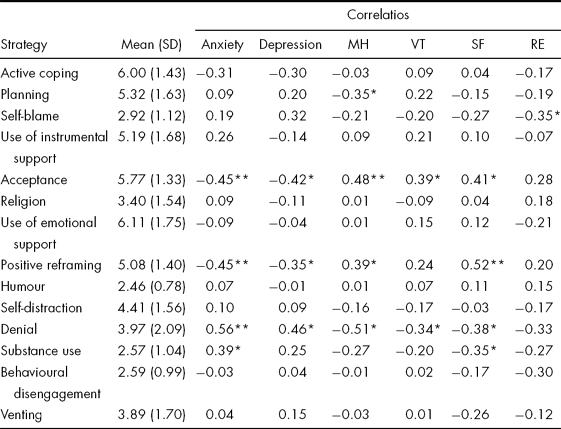
Means, SD and correlation coefficients with outcome measures are shown in Table 3. The family members used the coping strategies active coping (M = 6.00) and use of emotional support (M = 6.11) most frequently. Less used strategies were humour (M = 2.46), substance use (M = 2.57), behavioural disengagement (M = 2.59) and self-blame (M = 2.92).
Scores on the brief COPE one year after injury
* p<0.05, ** p<0.01. RE: Role Emotional, SF: Social Function, VT: Vitality, MH: Mental Health.
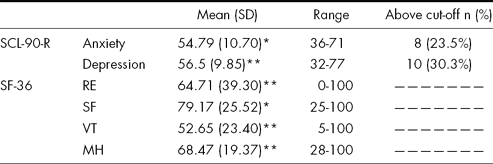
Raw scores on the depression and anxiety scale were converted into gender-adjusted T-scores according to the SCL-90-R manual (Derogatis, Reference Derogatis1994). The sample had significantly higher scores on the depression and anxiety scales (Table 4) compared to reference population (Olsen et al., Reference Olsen, Mortensen and Bech2006). On the anxiety scale, 23.5% scored above the suggested cut-off (T-score ≥ 63) and the corresponding figure was 30.3% on the depression scale. Quality of life scores on the four scales administered were all significantly lower than means reported in a Danish reference population (Bjorner et al., Reference Bjorner, Damsgård, Watt and Bech1997) (Table 4).
Means, standard deviations and ranges on anxiety, depression and quality of life one year after injury.
RE: Role Emotional, SF: Social Function, VT: Vitality, MH: Mental Health.
* p< 0.05, ** p< 0.01
When investigating the correlations between coping strategies and distress and quality of life in Table 3, two strategies stand out as being consistently associated with better mental health on the six outcome measures. The strategies acceptance and positive reframing were significantly associated with fewer symptoms of depression and anxiety and better quality of life. Positive reframing was associated with less anxiety (r = −0.45, p = 0.007) and depression (r = −0.35, p = 0.046), and better HRQoL on the mental health (r = 0.39, p = 0.024) and social function scales (r = 0.52, p = 0.002). The strategy acceptance was associated with less depression (r = −0.42, p = 0.016), less anxiety (r = −0.45, p = 0.009), and higher HRQoL scores on the MH- (r = 0.48, p = 0.005), SF- (r = 0.41, p = 0.023) and VT-scale (r = 0.39, p = 0.026).
One strategy stood out as being consistently associated with a poorer mental health one year after injury. Use of the coping strategy denial was significantly positively correlated with both anxiety (r = 0.56, p = 0.001) and depression (r = 0.46, p = 0.006) indicating that more use of this particular strategy was associated with more symptoms of depression and anxiety. Denial was inversely associated with HRQoL on three of the four scales administered: mental health (r = −0.51, p = 0.002), vitality (r = −0.34, p = 0.049), and social function (r = −0.38, p = 0.030).
Discussion
The current study assessed the use of different coping strategies in Danish family members of survivors of brain injury one year after injury and associations between different coping strategies and depression, anxiety and HRQoL. The family members used the coping strategies of active coping and use of emotional support most frequently, and the less used strategies were humour, substance use, behavioural disengagement and self-blame. The study showed that positive reframing and acceptance were related to better outcome, whereas the strategy denial was associated with poorer outcome in relatives one year after injury.
Positive reframing and acceptance are emotion-focused strategies and were associated with better outcome. Accepting the new situation of life or seeking to find positive aspects are both positive ways of handling or dealing with the situation. These findings correspond to those reported by Cruzado and Morena (Reference Cruzado and Morena2013), who found that caregivers below the clinical level of anxiety or depression used the strategy acceptance more compared to caregivers, who scored above the clinical cut-off for depression and anxiety. This finding is in concordance with earlier studies as Minnes, Graffi, Nolte, Carlson and Harrick (Reference Minnes, Graffi, Nolte, Carlson and Harrick2000) found the strategy reframing to be associated with stress reduction using the Family Crisis Oriented Personal Evaluation Scale (F-COPES). Both studies were conducted in the chronic phase after the brain injury Minnes et al., Reference Minnes, Graffi, Nolte, Carlson and Harrick2000: M = 2.65 years since injury and Cruzado and Morena, Reference Cruzado and Morena2013: M = 3.22 years since injury. Other authors have found strategies labelled ‘secondary control coping’ such as acceptance, cognitive restructuring and distraction to be related to better outcome; for example less grief and depression (Calvete & de Arroyabe, Reference Calvete and de Arroyabe2012), which is in concordance with our results. Calvete and de Arroyabe's study was also conducted in the chronic phase after TBI (M = 8.15 years post trauma).
Denial seemed to be the most mal-adaptive coping strategy, as it was associated with poorer outcome on all the six outcome measures. This is also comparable with the findings of Cruzado and Morena (Reference Cruzado and Morena2013), who found significantly more use of the strategy denial in the groups scoring about clinical cut-off on the anxiety and depression scale. Some authors have argued that denial might serve as a protective factor in the acute phase in terms of avoiding the pain associated with the sudden loss (Brooks, Reference Brooks1991; Romano, Reference Romano1974), but in the long run denial is considered maladaptive creating even more distress and lower HRQoL. Our results suggest that denial is associated with poorer outcome one year after injury.
Wolters and colleagues (Reference Wolters, Stapert, Brands and van Heugten2011) investigated coping styles within the family in the chronic phase after brain injury (M = 2.8 years) and found that caregivers who used a passive coping style (e.g. isolating oneself from others, worrying about the past, taking refuge in fantasies) experienced lower quality of life and family function as well as a higher strain than relatives using an active coping style (e.g. tackling a problem at once, seeing problems as a challenge, remaining calm in difficult situations). The passive coping strategies are very likely comparable to Carver's (Reference Carver1997) coping strategies entitled denial, substance use and self-blame that we found to be related to poorer outcome. All these strategies are internalising and passive coping styles, and they were associated with poorer HRQoL and more strain. Substance use was also associated with poorer outcome. Other researchers have found that use of medication and substances increases after a family member acquires a brain injury (Verhaeghe et al., Reference Verhaeghe, Defloor and Grypdonck2005), and this might be considered as a way of avoiding the event and its consequences.
Categorisation of Coping Strategies
As mentioned in the Introduction, surprisingly few studies in the TBI caregiving literature have included a coping inventory. This might be due to the difficulties related to measuring the construct, as no consensus has been established with regard to measuring coping strategies and in particular how to categorize the different coping strategies (Skinner et al., Reference Skinner, Edge, Altman and Sherwood2003). One distinction is between problem- and emotion-focused coping, which has been described frequently (Folkman, Lazarus, Gruen, & DeLongis, Reference Folkman, Lazarus, Gruen and DeLongis1986). Other distinctions have been suggested such as maladaptive versus adaptive coping, functional versus non-functional, active versus cognitive or positive versus negative coping (Calvete & de Arroyabe, Reference Calvete and de Arroyabe2012; Chronister & Chan, Reference Chronister and Chan2006; Minnes et al., Reference Minnes, Graffi, Nolte, Carlson and Harrick2000; Verhaeghe, Defloor, & Grypdonck, Reference Verhaeghe, Defloor and Grypdonck2005). Despite the lack of consensus on categorisation of coping strategies, some authors consider this necessary as amongst other things it limits the number of tests being done. As described in the Introduction, Chronister and Chan (Reference Chronister and Chan2006) summarised the coping strategies into three categories: emotion-focused, problem-focused and avoidant coping. Emotion-focused coping seeks to change negative feelings about the stressful situations, problem-focused coping changes the negative situation, and avoidant coping seeks to avoid the negative event. They used this distinction and reported that higher scores on the strategies in the avoidant-focused domain inversely related to QoL (Chronister & Chan, Reference Chronister and Chan2006). This finding is in concordance with ours, as we found denial to be associated with poorer HRQoL. Cruzado and Morena (Reference Cruzado and Morena2013) investigated both the individual strategies as well as the following three categories: problem-focused, emotion-focused and search for transcendence. The only category associated with outcome was emotion-focused coping, which was related to poorer outcome. As the emotion-focused category consists of acceptance, growth, positive reinterpretation and religion, this contradicts the results of the analyses of the individual strategies since acceptance was associated with a better outcome. Chronister and Chan (Reference Chronister and Chan2006) did not find any associations between the emotion-focused category and QoL. In our study, the strategies positive reframing and acceptance were associated with less anxiety and depression and with better HRQoL. This incongruence in the findings emphasised the need for investigating the individual strategies as recommended by Carver (Reference Carver2012).
One problem with categorisation according to functions is that the different strategies may serve more than one function, which means that classification of coping strategies into functional categories may be somewhat artificial. Thus, seeking social support may be considered both emotion-focused and problem-focused coping if specific advice is sought (Verhaeghe et al., Reference Verhaeghe, Defloor and Grypdonck2005).
Clinical implications
Along with previous studies, this study has pointed to associations between specific coping strategies and anxiety, depression and HRQoL in relatives one year after injury. The family is heavily affected by the brain injury, and how the relatives cope with the new life situation affects not only the person with the brain injury, but all family members. The family members are constantly dealing with the consequences of brain injury and adapting to changes in the brain injury survivor. This is a continuous adaptation, and coping strategies and processes are important determinants of the gradual adaptation in individual families.
This knowledge should be implemented in intervention programmes dealing with the families of brain injury survivors, as promoting the use of functional and adaptive coping strategies will be beneficial for the psychosocial outcome in relatives. This will in the long run be of benefit for the patient, as some research suggests that the outcome of survivor's rehabilitation is affected by how family members deal with the situation. Thus better adaptation of the family can indirectly influence the person with the brain injury (Florian, Katz, & Lahav, Reference Florian, Katz and Lahav1991; Lehan, Arango-Lasprilla, de los Reyes, & Quijano, Reference Lehan, Arango-Lasprilla, de los Reyes and Quijano2012). The relation between the condition of the person with the brain injury and the psychosocial functioning of the family are reciprocally intertwined and cannot be disentangled. This should be considered in intervention programmes.
Limitations
The study has several limitations. First, the result reported in the current sample must be interpreted with caution, as the sample size was limited in this study. As a result of the small sample size and the associated low statistical power, we may have overlooked associations between coping strategies and the mental state of the relatives. The small sample size was also the main reason for presenting bivariate correlations instead of multivariate analyses. For the 14 coping strategies and the six outcome measures, we evaluated 84 bivariate correlations, of which 18 were significant. Obviously, some of the significant findings may reflect the relatively large number of statistical tests, but given the small sample size and the exploratory nature of the study, we did not find it useful to adjust significance level for the number of statistical tests, but have instead looked at the consistent pattern of significant associations in relation to the six mental health variables and in relation to the available literature. We believe that these considerations support the generalisability of our results.
Second, the study was conducted as a cross-sectional study, which has innate methodological limitations. Because of the cross-sectional design no certain conclusions can be drawn upon the causal relationship between coping strategies, HRQoL, anxiety and depression. Thus, it is not possible to assess whether use of a strategy such as positive reframing results in less distress or the level of distress influences the choice of coping strategy.
Thirdly, all outcome measures as well as the brief COPE was collected as self-report questionnaires, and this may lead to correlations among measures that would not otherwise be observed. For example, our investigation did not include personality assessment, and the broad personality dimension of neuroticism is known to be related to HRQoL, anxiety and depression, but also to coping strategies (Gunthert, Cohen, & Armeli, Reference Gunthert, Cohen and Armeli1999; McCrae & Costa, Reference McCrae and Costa1986). Thus, the inclusion of a personality inventory would have strengthened the study.
Fourthly, coping strategies were assessed retrospectively, about one year after the event leading to brain injury. Obviously, the retrospective self-report may have been influenced by the mental state of the relative, and this might have created association between coping strategies and HRQoL, anxiety and depression. Prospective repeated assessment of coping strategies would obviously be a stronger study design, and such studies should be conducted with longer follow-ups than the present study. Such longitudinal studies would allow a possible confirmation of the reported results and investigation of the causal relationship.
Conclusions
The findings in this study suggests that specific coping strategies such as acceptance and positive reframing are associated with better mental health in relatives of persons with severe brain injury one year after injury and that denial was associated with poorer mental health. The findings in the present study are in many ways consistent with prior research suggesting that coping strategies following TBI are similar in Danish families compared to families in other countries and continents. This study suggests that intervention programmes should focus on changing maladaptive coping strategies to more functional types, and future research should employ a longitudinal design in order to identify the coping strategies with the strongest associations with mental health in relatives to persons with severe brain injury.
Declaration of interest
None to declare.
Acknowledgements
The authors would like to thank participants in the study and additionally acknowledge the work done by the staff at the Department of Neurorehabilitation, Traumatic Brain Injury Unit, Copenhagen University Hospital, Glostrup.