


Introduction
Though evidence for the efficacy of cognitive-behavioural group therapy (CBGT) for obsessive-compulsive disorder (OCD) has been increasing, insufficient data (Jonsson and Hougaard, Reference Jonsson and Hougaard2009) are available in support of such efficacy. Thus, the first aim of this study was to examine the effectiveness of CBGT on OCD patients in Japan.
Distorted beliefs about responsibility and interpretation are among the central themes in cognitive models of OCD (Salkovskis et al., Reference Salkovskis, Wroe, Gledhill, Morrison, Forrester and Richards2000). In contrast, other models of OCD do not regard dysfunctional beliefs as playing an important role (Taylor et al., Reference Taylor, Abramowitz, McKay, Calamari, Sookman and Kyrios2006). To the best of our knowledge, there have been few clinical trials examining the efficacy of CBGT on beliefs of inflated responsibility in OCD patients, and evidence with regard to the effects of cognitive and/or behavioural treatment on inflated responsibility is sorely lacking. Therefore, the second aim of the study was to examine whether CBGT could reduce the inflated responsibility beliefs of OCD patients.
Method
Subjects
Thirty-six subjects with OCD were recruited from among the patients of Chiba University Hospital, Chiba, Japan. The diagnostic criteria for the selection of these patients were in line with those of the Diagnostic and Statistical Manual of Mental Disorders, 4th edition (DSM-IV). All subjects were evaluated using the Structured Clinical Interview for DSM-IV (SCID-IV). The exclusion criteria were: major depression with suicidal risk, bipolar disorder, severe personality disorder, mental retardation, substance abuse, and severe physical illness.
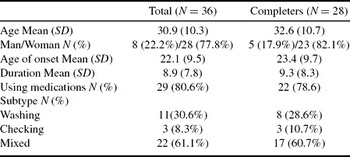
Subjects’ demographic data are shown in Table 1. All subjects were receiving or had previously received pharmacological treatment. Eight of the subjects (22.2%) withdrew before completing 12 sessions. Dosages were kept constant for all of the subjects who were receiving drug therapy. According to the Yale-Brown Obsessive Compulsive Scale (Y-BOCS) symptom-based checklist, OCD subjects were classified as washing types, checking types, and mixed types. Ten of the subjects (27.8%) and eight of the completers (28.6%) had comorbid major depression by Axis I diagnosis.
Demographics and clinical characteristics

Measures
OC symptoms were assessed by the Japanese version of the self-report Y-BOCS (Hamagaki, Takagi, Urushihara, Ishisaka and Matsumoto, Reference Hamagaki, Takagi, Urushihara, Ishisaka and Matsumoto1999). Inflated responsibility was estimated by the Responsibility Attitude Scale (RAS) and Responsibility Interpretations Questionnaire (RIQ) (Salkovskis et al., Reference Salkovskis, Wroe, Gledhill, Morrison, Forrester and Richards2000). The RAS consists of 26 items designed to assess general beliefs about responsibility. Ratings are on a 7-point Likert scale (1 = totally disagree; 7 = totally agree). The score is obtained by calculating the mean rating for all items. The RIQ is designed to assess the frequency of and belief in specific interpretations of intrusive thoughts about possible harm. Ratings of the frequency of intrusive thoughts are on a 5-point Likert scale (0 = never occurred; 4 = always occurring). The score is obtained by calculating the mean rating for all items. Having rated the frequency for each of the items, subjects are asked to rate the extent to which they currently believe a particular interpretation (i.e. their belief at the time of testing). Ratings of the extent of belief range from 0 to 100. The score is obtained by calculating the mean rating for these items. We developed Japanese versions of the RAS and RIQ with Professor Salkovskis’ permission. The severity of depressive symptoms was assessed by the Japanese version of the Beck Depression Inventory, second edition (BDI-II) (Kojima et al., Reference Kojima, Furukawa, Takahashi, Kawai, Nagaya and Tokudome2002).
Treatment protocol
We prepared a manual of CBGT for OCD by consulting previous studies of group therapy for OCD (Anderson and Rees, Reference Anderson and Rees2007). For the present study, we focused on cognitive changes of inflated responsibility based on the cognitive-behavioural model of Salkovskis (Salkovskis et al., Reference Salkovskis, Wroe, Gledhill, Morrison, Forrester and Richards2000). Our treatment program consisted of 12 weekly sessions. Each session lasted 1.5 hours and was facilitated by three psychiatrists.
This treatment protocol represents a blend of cognitive and behavioural techniques. Specific cognitive strategies are incorporated into this program to challenge faulty estimations of danger (e.g. probability testing), inflated responsibility, and thought-action fusion beliefs (Salkovskis et al., Reference Salkovskis, Wroe, Gledhill, Morrison, Forrester and Richards2000). Behavioural experiments, including exposure exercises, were introduced as both an opportunity to test beliefs as well as a way to learn how to habituate to anxiety. The treatment protocol included specific homework exercises attached to each component of the treatment.
Procedure
The study was performed over five successive periods from January 2008 to May 2009 with five to seven (mean = 6) subjects. All patients were attending the psychiatric outpatient service at Chiba University Hospital. This study was carried out using an open-trial design and in accordance with the latest version of the Declaration of Helsinki.
Statistics
Differences between means of Y-BOCS, RAS, RIQ and BDI-II scores pre- and post-treatment were assessed with student's paired t-test. All statistical tests were two-sided, and significance was defined as p < .05. To enable comparisons with prior studies, the effect size (Cohen's d) was calculated for treatment completers only. A responder to treatment was defined as having a decrease of ≧35% in the Y-BOCS score at the end of the study. Patients who responded to treatment were also classified as having complete remission if the Y-BOCS scores were ≦8 after treatment.
Results
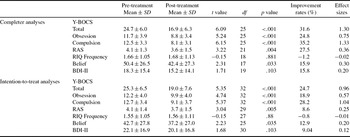
The results the analyses of treatment completers and intention-to-treat (ITT) analyses are shown in Table 2.
Treatment outcomes

Notes: Y-BOCS = Yale-Brown Obsessive Compulsive Scale; RAS = Responsibility Attitude Scale; RIQ = Responsibility Interpretations Questionnaire; BDI-II = Beck Depression Inventory, Second Edition.
Treatment completer analyses
The treatment completer sample consisted of 28 subjects. A significant reduction in Y-BOCS scores was observed. The mean pre–post-treatment Y-BOCS score reduction was 7.8 (31.6%), and the effect size (Cohen's d) was 1.30. Ten subjects (35.7%) met the criterion for improvement, and two subjects (7.1%) reached remission level. Significant reductions of RAS and RIQ (belief) were observed. In contrast, there were no significant differences in RIQ (frequency) and BDI-II.
ITT analyses
The ITT sample consisted of 36 subjects. In the case of treatment dropouts, the last-observation-carried-forward method was used as a conservative estimate of symptomatology for those individuals without outcome measure scores following treatment. Using this method, individuals with missing data following treatment are assigned the score from the last measurement taken.
A significant reduction in Y-BOCS scores was observed. Eleven patients (30.6%) met the criterion for improvement, and two subjects (7.1%) reached the criterion for complete remission. Significant reductions of RAS and RIQ (belief) were observed. In contrast, there were no significant differences in RIQ (frequency) and BDI-II.
Discussion
This study is the first to examine the effect of CBGT on OCD symptoms and responsibility beliefs in Japan. A significant reduction in the Y-BOCS total scores was observed (Table 2). The improvement rate (31.6%) found in this study was comparable with the outcomes of previous group therapy studies (approximately 20–40%) (Jonsson and Hougaard, Reference Jonsson and Hougaard2009). Next, the pre–post effect size of this study (1.30) was comparable with the sizes (1.18 for four randomized controlled trials [RCTs], four non-RCTs, and five open trials; 1.25 for the five open trials) in the previously reported meta-analysis of group therapy for OCD (Jonsson and Hougaard, Reference Jonsson and Hougaard2009). Thus, the results of the present study provide additional support for the effectiveness of CBGT for OCD patients.
We conducted CBGT targeting inflated responsibility, which plays a key role in the cognitive appraisal model of OCD (Salkovskis et al., Reference Salkovskis, Wroe, Gledhill, Morrison, Forrester and Richards2000). The results of this study suggest that CBGT improved the responsibility attitudes and beliefs, but did not improve the frequency of intrusive thoughts (Table 2). Future research should investigate whether the reconstruction of responsibility beliefs may play an important role in reducing OCD symptoms through CBGT.
Limitations of this study include: (a) the lack of a control group; (b) the small sample size; (c) concurrent medication; and (d) comorbidities such as major depression. These conditions may affect the generalizability of our results. In particular, as this trial was not controlled, it is difficult to draw conclusions based on the data. In addition, a previous study indicated that dysfunctional beliefs might play a role in only some types of OCD (Taylor et al., Reference Taylor, Abramowitz, McKay, Calamari, Sookman and Kyrios2006). Therefore, further RCTs with larger samples and follow-up data are required.




Comments
No Comments have been published for this article.