INTRODUCTION
Many plant species in tropical dry forests base their ability to persist partly on resprouting after disturbance (Vieira & Scariot Reference VIEIRA and SCARIOT2006). This ability is due both to the presence of a protected bud bank (Klimešová & Klimeš Reference KLIMEŠOVÁ and KLIMEŠ2007) and on the maintenance of stored reserves to sustain regrowth (Chapin et al. Reference CHAPIN, SCHULTZE and MOONEY1990). Yet the relative importance of stored resources in driving resprouting remains elusive. Thus, while certain studies have proven carbohydrates to be mobilized during resprouting and to constrain regrowth (Bowen & Pate Reference BOWEN and PATE1993), others have suggested nitrogen and phosphorus to be the most limiting resources (Canadell & López-Soria Reference CANADELL and LÓPEZ-SORIA1998, Miyanishi & Kellman Reference MIYANISHI and KELLMAN1986). What's more, a third group has observed no correlation between stored resources and resprouting vigour (Cruz et al. Reference CRUZ, PÉREZ and MORENO2003a). Resprouting may also be conditioned by the interaction between the phenological dynamics of resource mobilisation within the plant and the time when disturbance occurs (Castell et al. Reference CASTELL, TERRADAS and TENHUNEN1994, Cruz et al. Reference CRUZ, PÉREZ, QUINTANA and MORENO2002, Hodgkinson Reference HODGKINSON1992). Thus, species-specific differences in resprouting may arise from differences in bud bank size, ability to store and mobilize reserves, and phenological differences when disturbances take place (Bonfil et al. Reference BONFIL, CORTÉS, ESPELTA and RETANA2004, Canadell & López-Soria Reference CANADELL and LÓPEZ-SORIA1998, Espelta et al. Reference ESPELTA, SABATÉ, RETANA, Rodà, Retana, Gracia and Bellot1999).
Acacia sensu lato is a large circumtropical genus. Some of these species act as pioneers, successfully persisting in highly disturbed areas thanks to their drought resistance and resprouting ability. Numerous studies have reported the high resprouting ability of Acacia spp. in fire-prone ecosystems such as African savannas, as well as in Australian and North American grasslands (Meyer et al. Reference MEYER, WARD, MOUSTAKAS and WIEGAND2005, Schutz et al. Reference SCHUTZ, BOND and CRAMER2009, Wright & Clarke Reference WRIGHT and CLARKE2007). Yet little is known about this response in the Neotropical species from dry forests, although they may behave differently due to the lower importance of fire as a natural ecological driver in this area compared with other disturbance types (i.e. grazing exerted by megaherbivores in Janzen & Martin Reference JANZEN and MARTIN1982, see also Vieira & Scariot Reference VIEIRA and SCARIOT2006). Moreover, despite the harsh dry season undergone by plants in tropical dry areas, and the potential increase in drought intensity as a result of climate change (IPCC 2007), not a single study addresses the effects of the time of disturbance on the resprouting ability in plants of tropical dry forest and the role played by stored resources (e.g. starch, nutrients) in this response.
The main aim of this study was to experimentally investigate the resprouting response of Acacia pennatula to different disturbance regimes. We assessed survival, resprouting vigour and resource concentration (starch, N and P) in individuals, after two types of disturbance of differing intensity (clipping, burning) applied before or after the dry season and repeatedly. We hypothesize that: (1) if resprouting ability in A. pennatula has been selected by fire, we should find few differences in resprouting between clipped and burned individuals (for Mediterranean-type species, see Bonfil et al. Reference BONFIL, CORTÉS, ESPELTA and RETANA2004); (2) if the dry season involves a reduction in the levels of stored reserves so as to support the plant metabolism (Sardans & Peñuelas Reference SARDANS and PEÑUELAS2007), individuals disturbed at the end of this season should show lower resprouting ability (Bonfil et al. Reference BONFIL, CORTÉS, ESPELTA and RETANA2004); and (3) if resprouting ability critically depends on the amount of stored resources, resprouting should be reduced in repeatedly disturbed individuals.
STUDY AREA AND SPECIES
The study was conducted in the Miraflor-Moropotente Terrestrial Protected Landscape in the Estelí Department, north-west Nicaragua (13°19′30″–13°60′30″N, 86°11′00″–86°22′00″W). This protected area covers 290 km2 of wooded rangelands with isolated tropical dry-forest remnants. The mean annual temperature ranges from 16 °C to 30 °C with a mean rainfall of 804 mm y−1 (data from Condega weather station, 1983–2009). Most rainfall episodes (90%) take place between May and November (wet season) and the rest in a dry season from December to April. Soils are ultisols and vertisols developed from an ancient (i.e. Pliocene) volcanic parent material (D. Tarrasón, unpubl. data). According to Tarrasón et al. (Reference TARRASÓN, URRUTIA, RAVERA, HERRERA, ANDRÉS and ESPELTA2010), most of the protected area is occupied by wooded rangelands with scattered A. pennatula trees. Acacia pennatula Benth. is a spiny leguminous tree (up to 8 m), native to Central America, and common in secondary tropical dry forests and disturbed areas from South-East Mexico to Ecuador (Ebinger et al. Reference EBINGER, SEIGLER and CLARKE2000). The indehiscent protein-rich pods of this species are used by local people for cattle-raising (Casassola Reference CASASSOLA2000). Thanks to this type of management, livestock enhance both the spread of A. pennatula seeds and their germination ability (G. Peguero, unpubl. data).
METHODS
Experimental design and sampling
In order to analyse the resprouting ability of A. pennatula under different disturbance regimes, we designed a factorial experiment, combining two types of disturbance applied at different times of the year. Disturbance treatments consisted of: (1) clipping all above-ground biomass and (2) burning. Comparison of these two treatments was done in light of the different disturbance intensities they represent: i.e. clipping does not affect the bud bank located in the root collar whereas burning may (Espelta et al. Reference ESPELTA, SABATÉ, RETANA, Rodà, Retana, Gracia and Bellot1999). The burning treatment was performed by applying the flame of an acetylene hand torch directly to the base of the stump until reaching a mean temperature of 300 °C for an average of 2 min (Lloret & López-Soria Reference LLORET and LÓPEZ-SORIA1993). Temperature was continuously monitored with a thermometric probe (Anritherm Thermometer HL600 Type K). According to the description of wildfire intensity in similar ecosystems (Gibson et al. Reference GIBSON, HARTNETT and MERILL1990), this experimental treatment simulates the low-intensity wildfires that affect savanna-like landscapes. To test disturbance-date effects on resprouting, both treatments were applied: at the start of the dry season (December 2007), at the end of the dry season (June 2008) or at both times (before and after the dry season). Each experimental treatment was applied on 12 individuals randomly selected and replicated on six different sites subjected to similar management practices (hereinafter plots). To check the size of individuals at the start of the experiment, the initial number of stems was counted and the fresh weight of all stems in those individuals clipped or burned was estimated, once cut down, with a field scale. To estimate the initial biomass of individuals assigned to the ‘after dry season’ treatment (i.e. not initially disturbed), we measured the diameter and height of all stems and used allometric equations relating basal diameter with dry biomass (80 °C, 48 h) obtained from a subsample of 30 resprouts (dry biomass = 125.3, basal diameter – 82.1; n = 30; P < 0.0001, R2 = 0.72). At the onset of the experiment, A. pennatula individuals had a height ranging from 0.4 to 1.2 m, an average of eight stems per individual and an above-ground dry biomass of 858 ± 49 g (mean ± SE).
The experiment finished in October 2008 (12 mo after disturbance was applied in the ‘before the dry season’ treatment and 6 mo following the ‘after the dry season’ treatment), when we revisited all individuals and identified them as living or dead (i.e. resprouted or non-resprouted). Even though a different period of time had passed for individuals disturbed before or after the dry season, it is highly improbable that non-resprouted individuals from the later treatment could further resprout after 6 mo, given the rapid resprouting behaviour of this species (personal observation) and other Acacia spp. (e.g. Acacia karoo, Schutz et al. Reference SCHUTZ, BOND and CRAMER2009). In those individuals that survived, we counted and cut down all resprouts to estimate the final biomass produced. To control for the different time individuals disturbed before and after the dry season had for growing before the experiment ended, we calculated a mean growth rate per individual on a monthly basis, as: final biomass divided by 12 mo in individuals disturbed before the dry season and by 6 mo in those disturbed after the dry season.
To assess the effects of the different types and dates of disturbance in the below-ground reserves of starch, N and P, we excavated and collected the first 30 cm of the taproot of 12 individuals per experimental treatment (two per plot) at the end of the experiment. We also took an equivalent sample of taproots from a group of untouched plants designated as controls (12 individuals, two per plot). The protected status of the area precluded the possibility of excavating (destroying) a larger number of plants. Taproots were transported to the lab where they were dried (60 °C, until a constant weight was reached) and ground into fine powder. Starch was extracted with a 90% DMSO solution at 120 °C for 1 h and concentration was determined colorimetrically at 620 nm after reaction with acidic iodine solution (0.06% KI and 0.003% I2 in 0.05N HCl). Nitrogen was analysed by complete combustion according to the Dumas principle, whereas phosphorus was analysed through conventional wet acid digestion and inductively coupled plasma optical emission spectrometry (ICP-OES).
Data analysis
Differences in survival and in the number of resprouts produced according to the experimental treatments were analysed by means of generalized linear mixed models (GLIMMIX procedure; SAS 9.1, SAS Institute), using a binomial error and a logit link function for survival and a Poisson error and a log link function for the number of resprouts. Differences in final biomass and growth rate per individual were analysed by means of general linear mixed models (Statistica 6.0 software, StatSoft Inc.), after dependent variables were log-transformed to meet the assumption of normality. In all of these analyses, disturbance (clipping, burning) and disturbance date (before or after the dry season and repeatedly) were included as fixed factors whereas plot was included as a random factor. To account for the potential effect of the size of individuals in their response to the experimental treatments, initial biomass was also included in all analyses as a covariate.
The effects of type and disturbance date on the concentration of starch, nitrogen and phosphorus (log-transformed) in the taproot were analysed using two separate general linear models, including initial biomass as a covariate. Two separate models for type and disturbance date had to be conducted due to restrictions imposed by the sampling design. Because taproot samples were obtained at the end of the experiment we lacked control individuals for each disturbance date and thus the potential interaction between type and disturbance date could not be tested. Because of the low number of taproots excavated per plot, we did not include plot as a random factor in these analyses.
RESULTS
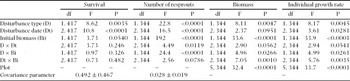
Survival of A. pennatula individuals was significantly affected by the type of disturbance and the date it was applied, but not by the interaction between these two factors (Table 1). Survival was lower in burned than in clipped individuals (respectively, 78% ± 4% and 94% ± 2%; mean ± SE), and whatever the type of disturbance undergone, survival was higher in individuals disturbed before the dry season, slightly lower in those repeatedly disturbed, and much lower in those disturbed only at the end of the dry season (respectively 96% ± 2%, 89% ± 4% and 72% ± 7%).
Results of the effects of disturbance type (clipping, burning), disturbance date (before and after the dry season and repeatedly), initial biomass (Bi) and their interaction on survival, number of resprouts, final biomass and individual growth rate of Acacia pennatula individuals in tropical dry forests in north-west Nicaragua. Effects on survival and number of resprouts were tested by means of generalized linear mixed models (GLMM), while effects on the other variables were analysed by means of a general linear mixed model. For GLMM models the covariance parameter estimate ± SE is shown.

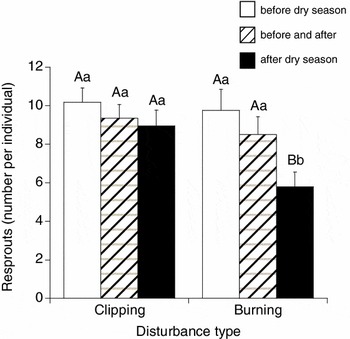
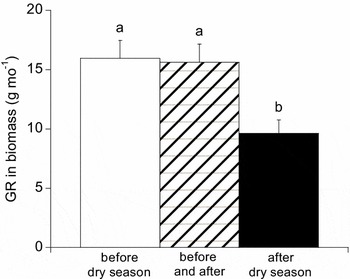
In surviving individuals, resprouting vigour (number of resprouts, growth rate and final biomass) was also affected by the experimental treatments applied (Table 1). Interaction between the type and disturbance date revealed that individuals clipped and burned before the dry season produced a similar number of resprouts, while resprout production was much lower in those burned after the dry season (Figure 1). Moreover, burned individuals exhibited a lower growth rate and attained a lower final biomass than those clipped (Table 1; respectively, 13.3 ± 1.2 g mo−1 vs 14.8 ± 1.2 g mo−1 and 75.3 ± 8.0 g vs 79.1 ± 6.8 g). Not only the type of disturbance, but also the date it was applied, affected the growth rate (Table 1). Curiously, the growth rate of twice-disturbed individuals was similar to that of those disturbed once before the dry season and both were significantly higher than individuals disturbed after the dry season (Figure 2). The positive effect of the initial biomass on resprouting vigour (i.e. number of resprouts, growth rate and final biomass) was greater on burned than on clipped individuals (interaction disturbance type × initial biomass in Table 1), while in terms of disturbance date, the positive effect of size was only observed in individuals disturbed before the dry season (interaction disturbance date × initial biomass in Table 1).
Mean ± SE number of resprouts in Acacia pennatula individuals subjected to burning or clipping before dry season, after dry season and on the two dates (before and after dry season). Different letters indicate significant differences between disturbance treatments for a given season (upper case letters) and between the different seasons within the same disturbance treatment (lower case letters), according to LS means tests.

Mean ± SE growth rate in biomass in Acacia pennatula individuals disturbed before dry season, after dry season and on the two dates (before and after dry season). Different letters indicate significant differences among the experimental treatments according to Fisher-LSD test.

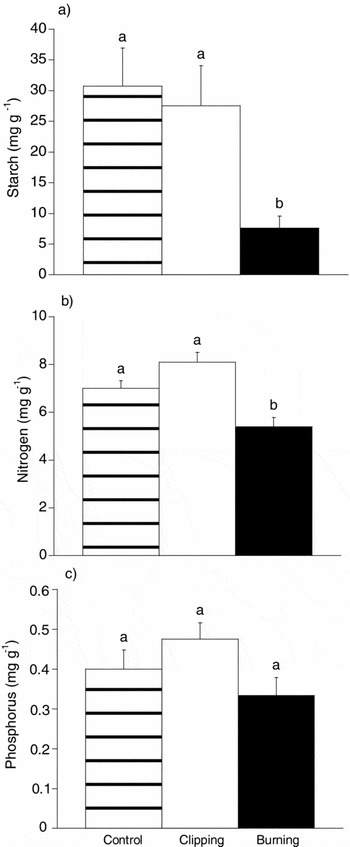
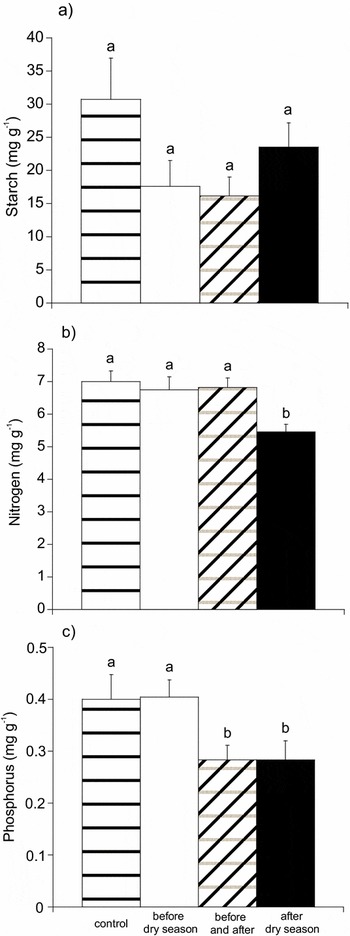
At the end of the experiment, individuals that had been most severely disturbed (burned) had lower starch and N concentrations in their taproots than clipped or control ones (Figure 3, F2,32 = 7.0, P = 0.003 for starch and F2,32 = 12.7, P = 0.0001 for N). As for the date when disturbance was applied, no differences were seen in the concentration of starch; while concentration of N, and especially P, were significantly lower in individuals disturbed after the dry season (Figure 4, F3,71 = 5.0, P = 0.004 for N and F3,71 = 5.3, P = 0.002 for P). Whatever the type and disturbance date, the significance of the covariate effect in these analyses indicated that both starch and P concentration in the taproot were negatively related to the initial biomass of individuals (F1,71 = 14.2, P = 0.0003 for starch and F1,71 = 8.2, P = 0.005 for P).
Mean ± SE concentration of starch (a), nitrogen (b) and phosphorus (c) in the taproot of Acacia pennatula individuals undisturbed (control), clipped and burned. Different letters indicate significant differences according to Fisher-LSD test.

Mean ± SE concentration of starch (a), nitrogen (b) and phosphorus (c) in the taproot of Acacia pennatula individuals undisturbed (control), disturbed before dry season, disturbed after dry season and disturbed on the two dates (before and after dry season). Different letters indicate significant differences according to Fisher-LSD test.

DISCUSSION
The high survival rate of A. pennatula after experimental disturbances is similar to other Acacia sp. (Meyer et al. Reference MEYER, WARD, MOUSTAKAS and WIEGAND2005, Schutz et al. Reference SCHUTZ, BOND and CRAMER2009, Wright & Clarke Reference WRIGHT and CLARKE2007) and may help explain the persistence of this species in highly disturbed areas. However, burned individuals showed higher mortality and lower resprouting vigour compared to the clipped ones. Sensitivity to fire was also evident in the greater positive effect of the initial size on the number of resprouts produced after disturbance for burned than for clipped individuals (interaction disturbance type × initial biomass in Table 1). In light of these results, and taking into account that certain authors have suggested that wildfires have not been a natural ecological driver in tropical dry forests (Janzen Reference JANZEN, Perrow and Davy2002, Vieira & Scariot Reference VIEIRA and SCARIOT2006), the resprouting behaviour of A. pennatula cannot be assumed to be a fire adaptation (sensu Bond & Keeley Reference BOND and KEELEY2005). Alternatively, resprouting ability in these Neotropical species may be a pre-adaptive trait of damage tolerance to the grazing pressure exerted by extinct megaherbivores (Janzen & Martin Reference JANZEN and MARTIN1982).
The lower survival and resprouting vigour in individuals disturbed at the end of the dry season has been noticed in other species living in seasonal climates and attributed to the worsening of the plant water status and the consumption of stored reserves so as to sustain metabolic activity during a harsh dry season (Bonfil et al. Reference BONFIL, CORTÉS, ESPELTA and RETANA2004, Bowen & Pate Reference BOWEN and PATE1993, Cruz et al. Reference CRUZ, PÉREZ, QUINTANA and MORENO2002, Hodgkinson Reference HODGKINSON1992). However, twice-disturbed plants (before and after the dry season) showed a higher survival likelihood and resprouting vigour than those disturbed only at the end of the season. The improvement in resprouting ability with an increasing frequency of disturbance has been observed for some Mediterranean species (e.g. Erica arborea, Riba Reference RIBA1998) but, as far as we know, this is the first report of such a compensatory response (sensu McNaughton Reference McNAUGHTON1983) for an Acacia sp. This higher performance of twice-disturbed individuals may be due to the combination of two factors. First, after being disturbed at the start of the dry season, A. pennatula individuals were able to resprout and quickly develop well-expanded leaves within a few weeks (G Peguero, pers. obs; for A. karoo, Schutz et al. Reference SCHUTZ, BOND and CRAMER2009). This contrasts with species that exhibit a far more delayed resprouting onset (e.g. Mediterranean evergreen oaks, Bonfil et al. Reference BONFIL, CORTÉS, ESPELTA and RETANA2004) and it could be due to the lower leaf construction costs of the thin leaves of Acacia pennatula in comparison to those of sclerophyllous-evergreen species (Wright et al. Reference WRIGHT, REICH, WESTOBY, ACKERLY, BARUCH, BONGERS, CAVENDER-BARES, CHAPIN, CORNELISSEN, DIEMER, FLEXAS, GARNIER, GROOM, GULIAS, HIKOSAKA, LAMONT, LEE, LEE, LUSK, MIDGLEY, NAVAS, NIINEMETS, OLEKSYN, OSADA, POORTER, POOT, PRIOR, PYANKOV, ROUMET, THOMAS, TJOELKER, VENEKLASS and VILLAR2004). Second, in these fast-resprouting individuals of A. pennatula, an oversized root–shoot ratio in comparison to undisturbed plants may help to enhance resource availability and thus improve water status and photosynthetic activity during the dry season (Castell et al. Reference CASTELL, TERRADAS and TENHUNEN1994, Schutz et al. Reference SCHUTZ, BOND and CRAMER2009). Actually, the similar levels of starch concentration of individuals disturbed just before the dry season and those twice disturbed, suggest that the latter were quickly able to replenish part of the starch consumed after their initial resprouting process.
Our results indicate that burn recovery required the mobilization of a greater amount of starch and N than recovery from clipping. As Vesk & Westoby (Reference VESK and WESTOBY2004) have suggested, this could be due to the reconstruction costs of the bud bank (i.e. meristems) and their protective structures (e.g. bark) after more intense disturbances (e.g. burning). Yet the lack of significant differences in starch concentration in plants disturbed before and after the dry season and, especially between once- and twice-disturbed individuals, backs the idea of a minor role of carbon reserves in resprouting under moderate disturbance regimes (Cruz et al. Reference CRUZ, PÉREZ and MORENO2003a, Reference CRUZ, PÉREZ and MORENO2003b). Conversely, the lower N and P levels in individuals disturbed at the end of the dry season, and also lower P levels in those twice disturbed, suggests that, rather than starch, N and especially P availability may constrain the resprouting ability of plants (Canadell & López-Soria Reference CANADELL and LÓPEZ-SORIA1998, Chapin et al. Reference CHAPIN, SCHULTZE and MOONEY1990, Miyanishi & Kellman Reference MIYANISHI and KELLMAN1986, Saura-Mas & Lloret Reference SAURA-MAS and LLORET2009). The key role of P as a limiting nutrient in tropical areas has been widely suggested (Lugo & Murphy Reference LUGO and MURPHY1986) usually associated with a depletion-driven P limitation in old volcanic soils (Vitousek et al. Reference VITOUSEK, PORDER, HOULTON and CHADWICK2010, see also Herbert & Fownes Reference HERBERT and FOWNES1995, Vitousek & Farrington Reference VITOUSEK and FARRINGTON1997). Indeed, soils in our study area have developed from ancient volcanic parent material and show very low P levels (9.5 ± 1.7 ppm, D. Tarrasón, unpubl. data). In addition to soil characteristics, P limitation for resprouting could also arise from a phenological constraint: i.e. the need to carry out a massive mobilization of this nutrient from woody reservoirs towards leaves to improve water-use efficiency during drought conditions (Sardans & Peñuelas Reference SARDANS and PEÑUELAS2007). Moreover, it must be highlighted that A. pennatula as a N2-fixing species (Cervantes et al. Reference CERVANTES, ARRIAGA, MEAVE and CARABIAS1998) may have high P demands (Nguyen et al. Reference NGUYEN, MOHAPATRA and FUJITA2006, Ribet & Drevon Reference RIBET and DREVON1996, Vitousek Reference VITOUSEK1999). Thus, low P levels may limit regrowth not only directly but also indirectly through constraining N-fixation. To the best of our knowledge, this is the first contribution to the hypothesis of a limitation of resprouting response in tropical dry forests mediated by a phenological constraint in nutrient availability (N, P). Nevertheless, given the relatively moderate disturbance intensity we applied, further research should be carried out under more intense disturbance regimes, different watering levels or fertilizing with P. In addition, the significance of the factor ‘plot’ in all traits describing the resprouting success and the effects of initial biomass in the final concentration of starch and N in disturbed plants, indicates resprouting may also be influenced by heterogeneous resources across the site not quantified and other inter-individual differences.
As with other Acacia spp. worldwide, scattered individuals of A. pennatula may be a keystone structure (sensu Manning et al. Reference MANNING, FISCHER and LINDENMAYER2006) in highly disturbed areas in Central America, playing a dual, contrasting role. On the one hand, they may help the early successional recovery of other late-successional tree species through a process of facilitation during seedling establishment (Tarrasón et al. Reference TARRASÓN, URRUTIA, RAVERA, HERRERA, ANDRÉS and ESPELTA2010). On the other, A. pennatula is often an early colonizer during woody succession in grassland (Purata et al. Reference PURATA, GREENBERG, BARRIENTOS and LÓPEZ-PORTILLO1999) which can create problems for maintaining and managing pasture. Hence the results obtained in this study can be used to design ecologically sound management alternatives (i.e. protection or control) of A. pennatula, depending on the management goals (Bond & Archibald Reference BOND and ARCHIBALD2003). Furthermore, our results suggest that A. pennatula plants would perform poorly under some climate-change scenarios which predict a lengthening of the dry seasons in some tropical-dry areas, which may also result in more frequent fires.
ACKNOWLEDGEMENTS
We thank Jordi Sardans and Santi Sabaté for their valuable comments on this study, and Oscar R. Lanuza and Kenny López for field sampling assistance. We are also very grateful to Mr Denis Rodríguez, Mr Andrés Rodríguez and especially Mr Wenceslao Castillo, who allowed us to carry out these experiments on their properties. This study was funded by the project D/026276/09 of the Spanish Agency for International Development and Cooperation (AECID). G.P. is supported by a FI Grant from the Generalitat de Catalunya.