In his History of the Peloponnesian War, Thucydides waits until he has passed the midpoint of Book 1 to introduce an individual speaking ‘character’ into his narrative. He does not do so until the scene of the Congress at Sparta (1.67–88), where it is first ‘the Corinthians’ and then ‘the Athenians’ who plead their cases before the Spartan assembly. One of the functions of this scene is to illustrate the internal division of opinion among the Spartans, and Thucydides now brings two distinct, elite Spartans onstage to voice their conflicting perspectives: King Archidamus addresses his countrymen urging caution (1.80–5), while the ephor Sthenelaidas makes suitably laconic remarks pressing for war (1.86). Before this turning point, Thucydides had carried out his analysis of the war's causes exclusively with reference to foreign rulers and Greek polis-populations (‘the Athenians’, ‘the Spartans’, etc.)—and not to any individual actors or leaders of those poleis, such as Archidamus and Sthenelaidas of Sparta.Footnote 1
How exactly did Thucydides conceive of the agency of the single city-states? Did he see them as what today we would call state actors, even state ‘persons’? My purpose here is to investigate some of the ways in which the fifth-century Athenian evidence, and Ancient Greek's conventions for denoting state actors, might offer alternatives to the modern construction and understanding of state personhood. This will necessarily be an exploratory essay, for the notion of state personhood is entangled with difficult questions of what constitutes a state and how ‘the State’ is construed in relation to ‘the People’, enfranchised or otherwise. These are questions that lie at the very heart of political theory, which is, at least etymologically speaking, theory about the polis. My primary aim in this space is to adduce the topic of state personhood as a generative meeting ground for classicists and political theorists: the Athenian evidence deserves theorists’ attention because it is suggestive of models of state personhood different than those presumed by the modern West, and classicists stand to gain a different set of questions to pose to their ancient sources by attending to modern debates about state personhood. (How, for example, were various personifications of the state imbricated in ancient interstate relations?) After first attempting to establish some co-ordinates for discussion of the issue, I will consider two specific case studies in polis personification, both drawn from the world of the Athenian theater. Several of the other essays in this volume speak to Athenian drama's richness as a source for political thought. My hope is that the case studies here will underscore the potential that the theatrical archive also has to illuminate the Athenian imaginary of both the composition and nature of the state and the dynamics of interstate relations.
‘State Personhood’ between the Singular and Plural
The concept of the personified state has lately attracted considerable attention from international relations theorists, thanks in large part to a 2004 essay by political scientist Alexander Wendt on ‘The State as Person in International Theory’. Wendt begins that account of ‘state personhood’ by noting that most theorists today would agree that the very concept ‘is meaningful and at some fundamental level makes sense’.Footnote 2 But would Thucydides and his contemporaries have also accepted this premise? Wendt locates the origin of ‘the idea of corporate “personality”’ in the Middle Ages, yet his notion of state personhood does, at least at first glance, seem to align with aspects of Thucydides’ depiction of the parties and polities involved in the Peloponnesian War:
To say that states are ‘actors’ or ‘persons’ is to attribute to them properties we associate first with human beings—rationality, identities, interests, beliefs, and so on.Footnote 3
Certainly many of Thucydides’ modern readers have understood the major poleis involved in the war—Athens and Sparta, but also Corinth, Syracuse and others—as entities with distinct ‘rationality, identities, interests, beliefs, and so on’. The existence of ‘beliefs’ held by the State is presumed, for example, by Leo Strauss's notion of the ‘Athenian thesis’ that it ‘is a well-established rule that the weak are oppressed by the strong’ and that ‘people always seek to rule wherever they can’.Footnote 4 Readers of Thucydides’ work have also long been tempted to see the poleis as something like literary ‘characters’ within it. More than a century ago, classicist Francis Cornford even proposed that Thucydides’ ‘Athens’ should be understood as the flawed protagonist of a tragic drama: ‘She is adventurous, restless, quick, ambitious.’Footnote 5
Yet from a modern vantage point, it is difficult to come to grips with just how Thucydides understood the constitutive relationship between polis and people. The ambiguity derives in large part from his habit of referring to cities qua state actors by means of collective ethnonyms: the Athenians, the Spartans, the Corinthians, and so on. Translators often render these ethnonyms as toponyms (Athens, Sparta, Corinth), but to do so is misleading. In the famous ‘truest cause’ passage, for example, Thucydides actually locates the genuine origins of the Peloponnesian War in the rising greatness of the Athenians (not ‘Athens’) and the fear that this provoked in the Spartans (not ‘Sparta’):
τὴν μὲν γὰρ ἀληθεστάτην πρόφασιν, ἀφανεστάτην δὲ λόγῳ, τοὺς Ἀθηναίους ἡγοῦμαι μεγάλους γιγνομένους καὶ φόβον παρέχοντας τοῖς Λακεδαιμονίοις ἀναγκάσαι ἐς τὸ πολεμεῖν
(1.23.6)the truest cause that forced them into war, but also the one least uttered aloud, was, I think, that the Athenians were becoming great and inspiring fear in the Spartans Footnote 6
Here the seat of emotion—in this case fear—is not located in an abstract personified city, but in a plural people. Even in Greek, however, there is the potential for conceptual slippage between the singular polis of Athens and its plural membership. One illustrative passage occurs early in Book 2, when Thucydides is describing the psychological consequences of the Peloponnesian invasions of Attica:
παντί τε τρόπῳ ἀνηρέθιστο ἡ πόλις, καὶ τὸν Περικλέα ἐν ὀργῇ εἶχον
(2.21.3)In every way the polis became agitated, and they regarded Pericles with anger
Thucydides here constructs a parallel between the polis that is subject of the singular verb ἀνηρέθιστο and third-person verb εἶχον, whose plural subject is unexpressed. It was commonplace for authors of Athenian prose to imagine the polis as experiencing and expressing emotion (‘the city mourns or laughs, awakes, is sick unto death, etc.’);Footnote 7 in his famed funeral oration Pericles gives assurance that ‘the city will support’ (ἡ πόλις…θρέψει) the children of the fallen until they come of age (2.46.1).Footnote 8 But while the ‘city of the Athenians’ (ἡ τῶν Ἀθηναίων πόλις) is often the active subject of verbs in classical Athenian prose, ‘Athens’ (Ἀθῆναι) never enjoys the same agency.Footnote 9 The implied subject of εἶχον above, then, must surely be ‘the Athenians’. (By contrast, claims that ‘the US takes care of’ its sick, its troops, its veterans, its people et al. are common, even if disputable.)
Again, this important distinction is easily effaced by translation. Another instructive case occurs in a passage from Aristophanes’ comedy Acharnians of 425 BCE. In the early scene in which the character Theorus is instructing Dicaeopolis, the Athenian comic protagonist, about the excessively ‘philathenian’ disposition of Thrace's King Sitalces, Theorus claims that:
ὑμῶν τ᾽ ἐραστὴς ἦν ἀληθὴς ὥστε καὶ
ἐν τοῖσι τοίχοις ἔγραφ᾽, Ἀθηναῖοι καλοί.
(Ach. 143f.)[Sitalces] was such a true lover to you [people] that he
would even scrawl ‘the Athenians are beautiful’ on the walls.
The line ‘the Athenians are beautiful’, a reference to the graffiti that lovers would write about their beloveds (‘X is beautiful’), is often rendered by translators as ‘Athens is beautiful’,Footnote 10 for modern readers are often inclined to see personification of the city as an abstract entity where the ancient sources refer to plural bodies of citizenry. Certainly the polis could be beautiful, even an object of desire: in the funeral oration, Pericles also instructs the crowd that ‘you (pl.) must truly marvel every day “at the power of the city” (τὴν τῆς πόλεως δύναμιν) and become to her as “lovers” (erastai)’ (Thuc. 2.43.1). Theorus, on the other hand, casts King Sitalces as a ‘lover’, erastēs, not of Athens nor even of the ‘polis of the Athenians’ but of ‘the Athenians’. This discrepancy between ancient and modern imaginaries is palpable across the civic landscape. Whereas, for example, pieces of American currency are always engraved ‘United States of America’, the inscription ΑΘΕ on the iconic Athenian tetradrachm is an abbreviation of the word ΑΘΗΝΑΙΩΝ. The polis minted coins not ‘of Athens’ but ‘of the Athenians’.Footnote 11
Thucydides’ regular use of collective ethnonyms to describe what today we call ‘state actors’ would thus have made perfect sense to his contemporaries, for this was the convention of the Greek that they spoke. Moses Finley once formulated that convention as follows:
An ancient Greek could only express the idea of Athens as a political unit by saying ‘the Athenians’; the single word ‘Athens’ never meant anything but a spot on the map, a purely and narrowly geographical notion. One travelled to Athens; one made war against the Athenians.Footnote 12
And while David Whitehead has documented several instances, in inscriptions and literary prose, of apparent exceptions to the rule, it is notable that none of these consists in an unexpected use of the toponym ‘Athens’ (Ἀθῆναι) where a reference to ‘the Athenians’ (οἱ Ἀθηναῖοι) would have been expected.Footnote 13 In Athenian political discourse, it was always ‘the Athenians’ and never ‘Athens’ who made decisions, pursued policy and invaded other cities. By contrast, for English speakers today the words ‘Athens’ and ‘Sparta’, ‘France’ and ‘China’ can all, depending on the context, denote far more than a ‘spot on the map’. And yet it is also the case that the phrase ‘America fears the rise of China’ somehow feels different than the phrase ‘the Americans fear the rise of the Chinese’. Similarly, ‘Britain decided to leave Europe’ has a different ring—and potentially a different truth value—than ‘the British decided to leave Europe’.
The Greek use of plural ethnonyms to denote polities also foregrounds questions about the relationship between the stereotyped ‘personalities’ of states and of their several citizens. At the Congress of Sparta, the Corinthians are notoriously preoccupied with defining and contrasting the natures—the signature traits—of the soon-to-be warring states: those Athenians are like this, while you Spartans are like that (Thuc. 1.71f.). This proto-Enlightenment discourse of ‘national character’ reaches its pinnacle in Pericles’ funeral oration (2.37–41): we Athenians alone are like this and that is why we are better…Footnote 14 Thucydides’ own narrative does, arguably, go on to deconstruct these early characterizations. (Does Athens really act like ‘Athens’ during the plague, or in the course of the Sicilian expedition?) One nevertheless wonders to what extent it is possible to distinguish, within Thucydides’ History, a difference between a perceived Athenian ‘national character’ and the character of the abstracted polis.
So, why, despite Thucydides’ persistent use of collective ethnonyms, is it still so difficult to shake the impression that his analysis does admit of ‘state actors’ and, at least by Wendt's definition, portray them as ‘persons’? In his book The Realness of Things Past, ancient historian and critical theorist Greg Anderson has recently argued that ‘modern metaphysical commitments’ have largely prevented modern students of classical Athens from understanding how the Athenians imagined their political community. By imposing paradigms of the post-Enlightenment West onto the ancient Athenian sources, scholars have tended to create accounts of Athenian society that imperfectly ‘translate’ Athens into modern terms, and so fall short of accurately accounting for what was effectively an entirely different political ontology. Athens, he argues, cannot be envisioned along the lines of a modern state, for:
this communion known as ‘the Athenians’ was a unitary, free-standing agency in its own right. Unlike, say, liberal civil society, it was not merely an aggregate of pregiven individuals. It was a pregiven corporate subject, one that was not reducible to the particular living, breathing individual subjects who happened to comprise and embody it at any given time.Footnote 15
Anderson further emphasizes that the determining factor of Athenian citizenship was not birth within the territory of Athens, but birth into the social, political community (‘communion’) that was ‘the dēmos of the Athenians’.Footnote 16
Legal scholar Emiliano Buis has also taken up the impossibility of mapping modern Western political paradigms onto the ancient Greek city states. In Taming Ares: War, Interstate Law, and Humanitarian Discourse in Classical Greece, he argues that scholars of international law stand to gain by attending to ancient, alternate paradigms for notions of state subjectivity, personality and personhood. In attempting to uncover some of the deep roots of modern international humanitarian law, he focuses on the evidence surrounding the Peloponnesian War; in doing so, he extensively addressees ‘the issue of the “subjectivity” of non-individual persons under Athenian law.’Footnote 17 Even during the Peloponnesian War—well before the theorization of the ‘legal subject’ (the basis for modern international law)—poleis did act with recognition of something like ‘international law’. Yet Buis also finds that this legal framework did not admit of state personhood as the notion is understood today:
the case of classical Greece provides sufficient historical basis to support the conclusion that international law may exist even before the theorizing of its ‘subjects’, as it reveals a context of fruitful interstate relations that, nevertheless, do not in fact involve ‘legal’ persons distinct from their citizens.Footnote 18
He is ultimately skeptical that Greek international law at the time of the Peloponnesian War recognized states as actors in any way separate from or transcendent of their corporate citizen bodies. Like Anderson, moreover, he also draws attention to the alternate ancient approaches to conceiving of political ‘subjectivity’. Both scholars see the Greek use of ethnonyms to denote poleis as a meaningful indicator of how the ontological status of the polis was imagined, and imagined differently, in classical Greek antiquity.
These recent attempts to identify and describe how the ancient Athenians conceived of their political community will help to orient the approach of my next two sections, in which I turn to the evidence of Athenian drama. In his own work, Buis tantalizingly gestures, if only briefly, to the realm of the theater. Shortly after observing that today ‘the notion of persona is essential to the theoretical grounds of law’, he makes the suggestive point that ‘“persona” is in fact the Latin word for the masks actors used in theaters’.Footnote 19 Buis is primarily concerned with the ways in which personhood ‘involves performing and playing a role in front of others’ and so before the law; here, on the other hand, I will be taking his etymological provocation more literally.Footnote 20 There was a sense in which the Athenians really did endow the polis with a persona, and that was by personifying it on the dramatic stage. In what follows, I draw attention to two theatrical types of state personification that might help us to make better sense of the space between modern and ancient notions of state personhood.
First, I consider the comic representation of the Athenian dēmos in Aristophanes’ Knights: I seek to situate that representation in terms of Athenian drama's broader approaches to personification and to reconsider the nature of the personified dēmos as a dramatic, allegorical figure. I then reflect upon how playwrights personified political entities not as individual characters but as collective choruses. That evidence will lead me to suggest that the identity of Thucydides’ plural state speakers (‘the Corinthians’, ‘the Athenians’, ‘the Melians’ and so on) might be envisioned as ‘choral’, and in turn that the institution of the chorus may well provide modern international relations theorists with a different paradigm—state choruses as opposed to state actors—for conceiving of civic identity. On this reading, the State is imagined neither as a ‘person’ nor as an aggregate and often discordant citizenry (the dēmos), but as a choreographed body characterized by collective action and charged with making harmonies out of its members’ distinct identities. Both ‘dramatic’ paradigms, namely of the personified dēmos and the State-as-chorus, attest to ancient alternatives to modern state-personhood paradigms.
Embodying the dēmos
In an article on ‘Cities and Countries in Ancient Art’ from well over a century ago, Percy Gardner noted that archaic and classical Greek art was generally disinterested in the depiction of material cityscapes. Instead, the strong tendency was to portray cities in ‘human guise’, and so to represent places in terms of their people. His preliminary remarks nevertheless set such representations within a framework that evokes transcendent state personhood: ‘It is scarcely a metaphor’, he wrote, ‘to speak of a city as a personality, and to ascribe to it in its corporate capacity the qualities which appear in its history and make it a factor in politics or commerce or religion’.Footnote 21 Gardner then identified four ‘methods of representation’ of cities in Greco-Roman art, which he posited to have emerged in this order:
I. By the guardian deity.
II. By eponymous hero or founder.
III. By allegorical figure.
IV. By a Tyche or Fortuna.Footnote 22
Classical Athenian drama certainly participated in the first two of these categories. The goddess Athena is brought onstage in her role as patron goddess of Athens (I) in Aeschylus’ Eumenides and, ex machina, in Euripides’ Suppliant Women, Ion and fragmentary Erechtheus. Several surviving plays also bring the city's ‘founders’ (II), or more strictly speaking its early kings, onstage: e.g. Erechtheus in Euripides’ Erechtheus, Aegeus in Euripides’ Medea, Theseus in Euripides’ Hippolytus, Suppliant Women, Children of Heracles and in Sophocles’ Oedipus at Colonus.Footnote 23 While there is scope for debate about to what extent these dramatis personae stand for Athens or are independent characters in their own right, such figures are manifestly present.
Dramatic representations of cities by means of an ‘allegorical’ figure (III) are somewhat more difficult to locate. Characters representing personifications of abstract concepts abound in fifth-century Athenian comedy (e.g. Peace, Wealth, Poetry);Footnote 24 they also appeared, though to a significantly lesser degree, in tragedy (e.g. Kratos and Bia, ‘Authority’ and ‘Force’, in the Aeschylean Prometheus Bound). Tragedy does not seem to have brought allegorical personifications of places onstage, though characters within tragedies do display a capacity for thinking in personifying terms themselves. In Aeschylus’ Persians, Atossa describes her dream of two women, one dressed in Persian and the other in Doric garments, who are allegorical personifications of the two lands, Persia and Hellas, to which the women had been assigned by lot (181–99); in Euripides’ Helen, Helen apostrophizes Troy, then sings to the chorus of how ‘Hellas’ herself has cried out, and even ‘lain her head in her hands’ (ἐπὶ δὲ κρατὶ χέρας ἔθηκεν, 372) in sorrow over all the men she has lost (361–74). Comedy, by contrast, had more flexibility in making such imagined physicality manifest through embodiment, if not by individual actors then at least by members of choruses. The female choruses of several comedies seem to have been comprised of choreutes who represented—and were costumed as—Athenian subject states. I discuss these in the next section. Nevertheless, as far as we know no figure representing a more-or-less straightforwardly personified ‘Athens’—akin to, say, Britain's ‘Britannia’, France's ‘Marianne’ or even the Hellas envisioned by Aeschylus’ Atossa and Euripides’ Helen—appeared in a classical Athenian play.
But while there is no attestation of a personified character of ‘Athens’ onstage, we do know that ‘the Athenians’ could be personified by means of another allegorical figure. In his own essay for this volume, Matt Simonton discusses the striking case of Aristophanes’ Knights of 424 BCE, in which the character Dēmos, an allegorical personification of the dēmos, assumes the role of comic hero. From the mid-fourth century BCE onward, a figural ‘Dēmos’ was often depicted in visual media (and with particular frequency on Athenian document reliefs), but Knights constitutes the earliest known representation of the ‘corporate’ Athenian citizen body.Footnote 25 Like the convention of referring to cities qua political actors by means of collective ethnonyms, this approach to civic personification—not of the polis per se, but of its aggregate citizens—suggests another alternative to modern conceptions of state personhood.
The word dēmos was itself multi-faceted, and each facet reflected a different light. In her study of political personification in classical Athens, Amy Smith notes that the Dēmos of Aristophanes’ Knights represents a conflation of two common senses of the term: dēmos as ‘the sovereign Demos’, that is, the citizen body (cf. the American Constitution's ‘We the People’), and dēmos as the city's low-status ‘commoners’ (cf. Alexander Hamilton's supposed exclamation that the ‘people is a great beast’).Footnote 26 Over the course of the Knights, the Athenian audience would have witnessed Dēmos undergo a transformation from the latter into the former guise. At first, Dēmos is the curmudgeonly dēmos of the Athenian assembly, the dēmos written off as rabble by the elite: one of his slaves describes his master as ‘a bumpkin in nature, a bean-eater, irascible, this Dēmos of the Pnyx, a grouchy, half-deaf old man’ (ἄγροικος ὀργήν, κυαμοτρώξ, ἀκράχολος, | Δῆμος Πυκνίτης, δύσκολον γερόντιον | ὑπόκωφον, 41–3). A sausage seller named Agoracritus vies with the Paphlagonian, a slave in Dēmos’ household and a clear avatar for the populist politician Cleon, for Dēmos’ favor.Footnote 27 In a line reminiscent of King Sitalces’ erotic desire for ‘the Athenians’ in Aristophanes’ Acharnians (discussed above), the Paphlagonian goes so far as to declare to his master: ‘I love you, Dēmos, and am your erastēs’ (φιλῶ σ᾽ ὦ Δῆμ᾽ ἐραστής τ᾽ εἰμὶ σός, Kn. 732). By the end of the play, however, Agoracritus reveals a rejuvenated Dēmos who reemerges from behind the scenes with his former splendor restored. The chorus of knights welcomes and hails him as the ‘“monarch” (μόναρχος) of Hellas and of this land’ and ‘King of the Hellenes’ whose deeds are worthy of the ‘trophy of Marathon’ (1329–34), that is, of the monument set up by the Athenians at Marathon to commemorate their victory over the Persians there in 490 BCE.Footnote 28
Aristophanes’ figuration of the Athenian dēmos as a ‘monarch’ marks an early appearance of a conceit—the dēmos as monarch; the polis as tyrant—that became common in ancient discussions of Athenian politics.Footnote 29 In the Wasps, which premiered only two years after the Knights, Aristophanes would restore a more obviously democratic logic of regarding the dēmos as an antithesis of monarchy, for there the wasp-chorus accuses the young man Bdelycleon of being a ‘dēmos-hater and lover of monarchy’ (ὦ μισόδημε καὶ μοναρχίας ἐραστά, 474) because he will not let his father, Philocleon, out of the house to participate in jury service. Within what framework, then, might the audience have been able to view Dēmos’ ‘monarchic’ transformation in Knights in a positive light? Euripides’ Suppliant Women, a tragedy whose date is not secure but which is usually assigned to the second half of the 420s, may offer some insight. There the character of King Theseus, whose role corresponds fairly neatly to Gardner's second category of personification (‘by an eponymous hero or founder’), offers an account of the ‘monarchy’ of the Athenian dēmos. He explains to his mother Aethra that he will indeed undertake to recover the bodies of the fallen Argive invaders (the ‘Seven against Thebes’) even if it means war with the Thebans, but insists that first he must obtain the mandate of the ‘entire city’ (δόξαι δὲ χρῄζω καὶ πόλει πάσῃ τόδε, Supp. 349). The dēmos will, he clarifies, surely accede to his wishes, but by raising the matter he will find the people ‘more kindly disposed’ (εὐμενέστερον, 351):
καὶ γὰρ κατέστησ᾽ αὐτὸν ἐς μοναρχίαν
ἐλευθερώσας τήνδ᾽ ἰσόψηφον πόλιν.
(Supp. 352f.)For I made it [sc. the dēmos] into a monarchy [government by a sole ruler]
When I liberated this equal-vote polis.
Later, when the herald arrives from Thebes and asks ‘who is the tyrannos of this land’ (399), Theseus will at once reject his premise and respond that the land has no despot but instead is a ‘free polis’ (405) in which the ‘dēmos rules’ (δῆμος δ’ ἀνάσσει, 406).
A significant conceptual challenge of the Suppliant Women is that of making sense of Theseus’ defense of democracy in this scene (i.e., his agōn with the Theban herald) in the light of his own status as king of Athens. On the one hand, Theseus appears in the play in his guise as personified ‘founder’—as synoecist and the hero who ‘liberated’ the polis-of-equal-votes. P.E. Easterling was also surely right that he symbolizes an ‘ideal first citizen who typified all that the Athenians most valued about themselves and their traditions’.Footnote 30 On the other hand, in classing the rule of the dēmos as a ‘monarchy’, Theseus also activates the kind of imagery present in the chorus’ interpellation of Dēmos in Aristophanes’ Knights as ‘monarch of Hellas and of this land’ (1330). Carol Atack has recently argued that Euripides’ presentation of Theseus as a crucial ‘unifying figure’ bespeaks ‘continuing commitment to the specific role of king’, despite Athens’ democratic constitution.Footnote 31 On the comic stage, that ‘commitment’ found another, more overtly ‘democratic’ sort of expression in the Knights, which dramatizes the elevation of Dēmos from ‘Dēmos of the Pnyx’ to the dēmos-monarch that Theseus embodies in Suppliant Women, but whose distinct authority as ‘sole ruler’ Theseus also recognizes and upholds.Footnote 32 In the Politics Aristotle would famously observe that in societies that lack sovereign laws demagogues crop up, with the result that:
μόναρχος…ὁ δῆμος γίνεται, σύνθετος εἷς ἐκ πολλῶν⋅ οἱ γὰρ πολλοὶ κύριοί εἰσιν οὐχ ὡς ἕκαστος ἀλλὰ πάντες.
(4.1292a10–13)The dēmos becomes a monarch, a single composite made of many: for ‘the many’ (hoi polloi) are sovereign not as individuals but all together.
Yet in the fifth century, for Aristophanes and Euripides alike, this notion of dēmos as monarch applied when the dēmos was thriving, not (as Aristotle sees it) on a path to degradation.
As ‘monarch’, the Athenian dēmos partook of the qualities that the Athenians also ascribed to their early legendary kings; here, too, we see aspects of an aristocratic idiom transferred to the context of the Athenian democracy in order to lend it a legible ‘heroic legitimacy’. (On the concept, see Mark Fisher's contribution to this volume.) And yet the essential plurality of the dēmos means that it remains difficult to square the circle of its imagined ‘kingship’. This difficulty is surely owed in large part to the status of the dēmos as a ‘phenomenon in Athenian experience which does not readily correspond to any of our standard social scientific categories’.Footnote 33 Here we may be blinkered by modern paradigms. Within the Athenian imagination, ‘Athens’ was not a transcendent political entity endowed with its own agency, but nor was the dēmos simply the sum of the (enfranchised) citizenry. Anderson attempts to account for the different imagined status of the Athenian dēmos when he characterizes it as:
a person that was ontologically distinct from the particular flesh-and-blood Athenian persons who comprised it at any given time, by turns preceding, incorporating, and outliving them all.Footnote 34
It was the dēmos understood as this ‘deathless corporate self’ that ‘was the active subject of Athenian demokratia’: (monarchical) rule by the dēmos.Footnote 35 This essence of the ruler, and by extension of the State-subject, was at once singular and plural, monarchic and democratic.
The conception of the transcendent ‘deathlessness’ of the dēmos is, arguably, well attested. It informed, for example, the logic of the funeral orations, the conventions of which presumed a consistency of Athenian character from the time of the kings to the democratic present.Footnote 36 It was also what allowed Aeschines, in 346 BCE, to address citizen-judges as if they had put Socrates to death more than a half-century earlier: ‘Did you, men of Athens, “kill” (ἀπεκτείνατε) Socrates the Sophist because he was shown to have educated Critias, one of the Thirty who overthrew the dēmos…?’ (1.173). In these lines Aeschines not only figures the dēmos as capable of being deposed in the manner of a tyrant, he also imagines the citizen-judges of partaking of the deathless body of the dēmos that convicted Socrates and which now stands in judgment over the proceedings against Timarchus. Such addresses, as Andrew Wolpert has persuasively discussed constituted a ‘rhetorical fiction’ that
allowed the Athenians to imagine the rule of the people as transcending time and place, as well as individuals and institutions, and to represent the demos as eternal and unchanging.Footnote 37
This logic of the ‘eternal’ dēmos is dramatized in the Knights by means of Dēmos’ power to rejuvenate himself—a rejuvenation that ironically consists in a restoration of old-fashioned dress to his physical body.Footnote 38 Like the dēmos described by Anderson, Aristophanes’ Dēmos is both one person and many, and by the end of Knights he is triumphantly restored to his true essence as simultaneously old and young.
How does this personification of the dēmos by an actor on the Athenian stage shed light on how Athenians imagined their agency and persona when it came to interstate relations? Aristophanes’ personification of the dēmos is strictly speaking not a personification of ‘the polis’ (or of a ‘city or country’, in Gardner's formulation). Rather, his Dēmos is a figuration of the ‘deathless corporate self’ of the Athenians, an entity that, like the dēmos itself, was also ‘ontologically distinct’ from the actual Athenians participating in civic life at any given moment. The character of Dēmos in Knights, the earliest known personification of the Athenian political community, thus offers insight into the status of the collective ethnonym of ‘the Athenians’ always used to designate the city in its role as ‘state actor’: the Knights squarely belongs to the dossier of evidence for the variety of ways in which fifth-century Athenians could imagine the agency of their civic body. Dēmos is at once a manner of state personification and a challenge to modern established notions of state personhood. He, too, partakes of the Athenian civic imaginary that also informs Thucydides’ representations of collective state actors.
State Actors or State Choruses?
1. Choruses as Representations of Political Systems
In the previous volume of this journal, Page duBois explored how animal, and in particular insect, choruses in Athenian comedy imagined the dēmos as a ‘swarm’. Drawing on modern theories of ‘swarms’, she homes in on the titular chorus of Aristophanes’ Wasps and argues that, within the world of the play, the elderly citizen-judges constitute a ‘swarm that is a positive force for collective action, now embodied in the chorus’.Footnote 39 On duBois's reading, then, the insect swarm—whose members, like the choreutes of the Wasps, subsume their individual identities to the collective—offers another metaphor and model for conceptualizing political collectivity and action.Footnote 40 On the other hand, so too does Aristophanes’ Birds (414 BCE), whose differentiated chorus—each member a different species of bird—speaks also to citizen individuation, and to both toleration of difference and the strength that difference can bring.Footnote 41 Non-animal comic choruses also reward such political readings. In some cases, these are even more explicitly presented as personifications of political communities composed of several members.
One of the most famous plays of Athenian Old Comedy was Eupolis’ Demes (Δῆμοι, 411 BCE?), whose title suggests a chorus that somehow represented the Athenian ‘demes’, that is, the roughly 140 political subdivisions of Attica. Only fragments survive, but the plot of Demes seems to have revolved around the necromancy of four great Athenian leaders of the past (Solon, Miltiades, Aristides and Pericles), who are brought back from the underworld to help right the ship of state in the aftermath of the Sicilian expedition (415–413 BCE). Scholars have been divided as to the composition of this comedy's titular chorus: was the chorus differentiated, with each of its twenty-four members representing a specific deme, or did the choreutes represent the ‘rural population’ of Attica? In classical Athenian sources, references to the dēmoi tended to imply a contrast with the urban center.Footnote 42 Some have proposed that the chorus was a collective personification of the Athenian dēmos (in its ‘eternal and unchanging form’, to borrow Anderson's formulation again), and in that light it is tempting to wonder with Ian Storey ‘how much the character of the chorus of Dēmoi owes to the personification of Dēmos in Aristophanes’ earlier play.’Footnote 43 Already in antiquity, the Knights was suspected as a case of ‘authorial collaboration’ between Aristophanes and Eupolis.Footnote 44
Even the prevailing hypothesis, namely that the chorus represented all of the Attic demes, invites further questions. How did the dancing demes sing and move together to create unity among their several bodies and voices? What conception of the Athenian citizenry was implied or proposed by the choreography?Footnote 45 Similar questions might be asked of other lost comedies whose choruses represented not aspects of Athens, but rather groups of other states and in particular the tribute states of the Athenian empire. Athenians seemed willing to personify the subjects of their empire in a way that seems consistent with modern conceptions of state personhood—that is, as ‘people’—but which they entirely avoided when it came to the representation of their own polis and civic community. This in turn may suggest the degree to which Athenians came to regard the allied states as an aggregate of ‘possessions’—that is, possessed people—as opposed to independent political entities. For example, the chorus of Eupolis’ Cities (Πόλεις, 422 BCE?) consisted of a differentiated chorus of Athenian ‘allies’, in which each member of the chorus represented a different polis under the sway of the Athenian archē: we have fragments in which a character in the play describes the traits, as both islands and allies, of Tinos, Chios and Cyzicus, each of which was presumably embodied by a single choreute (frr.245–7).Footnote 46 Aristophanes is also said to have written a play called Islands (Νῆσοι) and his contemporary Plato Comicus is attributed with a Hellas or Islands (c.415–410 BCE?); these plays may have likewise featured individuated choruses along the lines of Eupolis’ Cities.Footnote 47 (Like the word ‘city’, ‘island’ could be shorthand for an Athenian allied state, while νησιώτης, ‘islander’, was a common appellation for a citizen of one.Footnote 48) Such a chorus is also suggested by an unassigned fragment of a play by Heniochus, a poet of Middle Comedy.Footnote 49
In the cases of Eupolis’ Cities and both Islands plays, the female gender expressed by the costumed appearance of the chorus members would have reflected the grammatical gender of the comic title. (‘City’ and ‘island’ are both grammatically feminine in Ancient Greek.) Ralph Rosen has discussed how this ‘gendering’ of the chorus members is also suggestive of how Athenians imagined the relationship between the city's allies—the subject states of the empire—and its own masculine citizen body. (The word dēmos is grammatically masculine, and it is presumed that the members of the chorus in Eupolis’ Demes presented as men.) Rosen writes:
Just as women represented for Aristotle an element within society that needed by nature a form of rule, so were non-Athenian Greek states regarded as best served when they had Athens ruling over them.Footnote 50
He also emphasizes the prevalence of sexual double entendres in the fragments that discuss the various members of the chorus, a point which further suggests that the imaginary world of this play cast the masculine dēmos of the Athenians as a dominating and exploitative (sexual) master of its allies. When, in other sources and discourses, it is the Athenian polis that is represented as a political leader, the metaphor changes: the polis is not portrayed as a ‘master’, but becomes personified as a mother who rears, directs and cares for her ‘children’, that is, the empire's subject states.Footnote 51
Ultimately, scant information survives about the fifth-century comedies that made choruses out of the Athenian allied states. I nevertheless raise the examples of these plays because all of their titles at least suggest that the Athenian political imagination could admit of a personified yet also ‘choral’ understanding of the tribute states. The various titles of the comedies that I have mentioned here all seem to have subscribed, at least in principle, to a kind of implicit choral political logic, perhaps of the sort that, in the mid-fourth century BCE, would be made explicit in the last and longest of Plato's dialogues, the Laws.Footnote 52 That dialogue stages a discussion of political philosophy between three elderly interlocutors (from Sparta, Crete and Athens), who work together to imagine the constitution of a utopian state called Magnesia. In the course of their conversation, the anonymous Athenian equates choreia (χορεία, the ‘choral art’) with paideia, or ‘education’ (παίδευσις, Laws 672e). It is chοreia that trains the body, voice and soul, and thus for the Athenian it is, as Leslie Kurke has observed, ‘the very core of civic education or education in citizenship’.Footnote 53 On this model, training in choreia is what habituates the child to be the kind of citizen that they must become as an adult, and thus ought to be integral to the education provided by the state in the ideal city of Magnesia.
Perhaps implicit in the choreography of Eupolis’ Demes and Cities and the Islands of both Aristophanes and Plato Comicus was the notion that the chorus is both microcosm and ideal representation of the relationship between the political part and the whole. In dancing and singing together, the several ‘demes’ of Athens constituted the whole of the civic ‘body’ that was the dēmos of the Athenians. On the other hand, the subject-state choruses of the other plays may well have danced an Athenian fantasy of the co-ordinated, in-synch ‘wholeness’ of the holdings of the Athenian empire. On this model, each subject state would be attributed with a version of personhood in the form of the choreute's living body, personhood which did not exist in any meaningful way without the twenty-three other members of the chorus. How might our modern notions of state personhood be reconceived were we to sit as spectators at the performance of a chorus comprised of member states of the United States or, say, the countries that make up NATO or the African or European Union?
2. Choral Diplomacy and the Melian Dialogue as Choral Performance
In a study of collective emotion in Greek tragedy and Thucydides’ History, Eirene Visvardi reminds us that the notion of political communities as being akin to choruses, the notion made explicit in Plato's Laws, is already latent in Thucydides. She reads, for example, Athens’ anger at Mytilene—or really the Athenians’ anger at the Mytileneans (Thuc. 3.36)—as an example of a communal expression of emotion of the sort that citizens would have witnessed performed by tragic choruses at the city's dramatic festivals.Footnote 54 Today, though, we are not embedded as the Athenians were in a culture saturated with choral performances, which is surely another of the reasons modern accounts of state personhood do not consider the alternate possible paradigm of state chorus-hood.
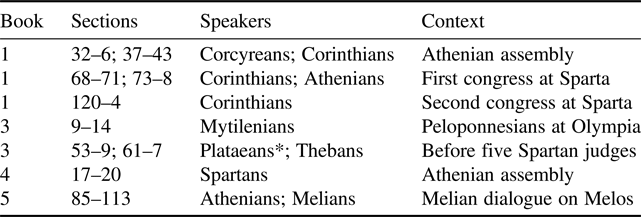
A choral paradigm may nevertheless also provide a model for understanding the speakers who, in fifth-century historiography, are depicted as speaking on behalf of their cities—‘the Corinthians’, ‘the Athenians’, ‘the Thebans’ and so on. Speeches delivered by such collective groups of speakers, usually envoys who have been dispatched by a polis on a particular mission, are frequent in both Herodotus and Thucydides. (It is striking that no instance of direct discourse uttered by a state collective appears in Thucydides’ History after the fireworks of the Melian Dialogue with which Book 5 concludes.) Table 1 indicates the instances of collective speech rendered in oratio recta in Thucydides’ History.
Instances of collective speech rendered in oratio recta in Thucydides’ History

* The speakers are identified as Astymachus, son of Asopolaus, and Lacon, son of Aeimnestus, at 3.52.4, then referred to as ‘the Plataeans’ at 3.60.1.
We even have evidence for Athenian comedies that points to the possibility that groups of envoys could be imagined as having a ‘choral’ collective voice: the comic playwright Leucon wrote a play called Envoys (Πρέσβεις) that premiered at the Lenaea festival of 422,Footnote 55 and Plato Comicus wrote a play by the same name whose chorus may have consisted in ‘stereotypically dressed Spartans coming to Athens’.Footnote 56 Table 1 also speaks to a suggestive intersection between the convention of referring to cities by means of ethnonyms and the significant number of Athenian plays that are titled after the composition of the chorus, such as Aeschylus’ Persians, lost Egyptians and Phrygians, Sophocles’ lost Ethiopians, Aristophanes’ lost Babylonians and Plato Comicus’ lost Laconians (i.e. Spartans) or Poets.Footnote 57 Is the resemblance between these two conventions entirely coincidental, and inconsequential?
Thucydides in particular seems to have toyed with the intersecting conventions for choral identities, play titles and references to states by collective ethnonyms, which itself suggests that similar logics underpinned notions of both choral and civic collective identity. Scholars have, for example, often remarked upon the ‘theatrical’ form of the Melian Dialogue (5.85–113). Even in antiquity, ancient readers were struck by Thucydides’ ‘daring’ choice to construct this scene ‘as a dialogue rather than a pair of speeches’ (ἀντὶ…δημηγορίας διάλογόν τινα τῶν Μηλίων καὶ Ἀθηναίων ἐτόλμησε συνθεῖναι, Scholion to 5.85). In the first century BCE, the historian and literary critic Dionysius of Halicarnassus went so far as to complain that Thucydides ‘infuses the dialogue with characters and turns it into a drama’ (προσωποποιεῖ τὸν…διάλογον καὶ δραματίζει, On Thuc. 37).Footnote 58 Certain Thucydidean manuscripts go so far as to lay out the dialogue in the manner of a dramatic script, with notations indicating switches between the Melian and Athenian speakers.Footnote 59 Perhaps ‘the Athenians’ and ‘the Melians’ might even be understood as two half-choruses: tragic and satyric choruses were in some cases divided into two or even more choral groups, and, though the Melian Dialogue hardly evokes comedy, its formal properties recall the comic convention of hostile ‘semi-choruses’, half-choruses that oppose each other and engage in rapid-fire argumentation.Footnote 60 In Aristophanes’ Acharnians, semi-choruses argue about whether Dicaeopolis’ speech was just or unjust (557–70), while his Lysistrata stages violent clashes between male and female semi-choruses. In sum, the Melian Dialogue would seem to partake of several aspects of dramatic and choral form.
The generative potential for considering dramatic choruses alongside speakers who speak for and as the polis is further suggested by the case of two, somewhat complementary, sets of Corinthian collective speakers. Euripides’ Medea premiered at the City Dionysia in the spring of Pythodorus’ archonship, in 432/1 BCE. Just a few months later, the Peloponnesian War broke out when a Theban force made a night raid on Plataea and irrevocably ruptured the Thirty Years’ Truce. An ancient hypothesis tells us that a crucial part of the plot of Medea was bought with a Corinthian bribe; a scholiast elaborates that it was actually people of Corinth who had killed Medea's children, but that for a price of five talents modern Corinthians convinced Euripides to ‘transfer the children's slaughter to Medea’ (Sch. B Med. 9). Such anecdotes should of course be treated with heavy skepticism, but at the very least these notices serve as reminders of the delicate relationship between Corinth and Athens at the time of the play's premiere. Thucydides’ account of the war's proximate causes consists largely of narratives of conflicts over two of Corinth's colonies (Corcyra and Potidaea) and one of its colony's colonies (Epidamnus). It is, moreover, the Corinthian envoys to the first congress at Sparta who, in the winter of 432/1 (just months shy of the premiere of Medea), seek to elucidate the Spartans ‘just what kind of people you have in the Athenians’ (1.70.1).Footnote 61 There is little reason to think that, even if the Corinthians made such a speech, it would have influenced Euripides’ Medea, yet it is certainly intriguing to consider these two different sorts of choruses—the chorus of Corinthian women in the Medea, and the metaphorical chorus of the Corinthian envoys at Sparta—in conjunction with each other. This rich nexus of semantic and representational intersections, especially when viewed against the backdrop of frequent choral performances in classical Athens, suggests that the institution of the chorus offers a paradigm for conceiving of state identity that would have been more legible to the Athenians than our modern notions of state personhood.Footnote 62
Conclusion
In his landmark essay on state personhood, Wendt made the provocative claim that the State is not only a ‘social’ person, but that it even ‘emulates’ certain traits of ‘biological’ personhood.Footnote 63 The piece provoked lively academic debate, and thinking on the issue has since ‘organized itself into two diametrically opposed camps: those who favor the notion of state-as-person and those who do not’.Footnote 64 (Some theorists who reject Wendt's argument that the State partakes of biological personhood still see it as a ‘social person’.Footnote 65) Meanwhile, the field of ancient history has also seen vigorous conversation around the question of whether ‘states’ even really existed in ancient Greece. In Polis and City-State: An Ancient Concept and Its Modern Equivalent, Mogens Herman Hansen explores in extensive detail the similarities and differences between the ancient Greek polis and the modern state, concluding that ‘in spite of the differences…city-state is the best possible equivalent to polis’.Footnote 66 By contrast, Moshe Berent has argued that the Greek polis was not definitionally a state, but a ‘stateless society’—that Greek political communities were, effectively, ‘tribal’: it is only that modern historians of ancient Greece have been so beholden to the ‘Hobbesian myth of the State’ that they have failed to recognize that the polis was not a true state because it lacked a ‘government’, that is, ‘an agency which has separated itself from the rest of social life and which monopolizes the use of violence’.Footnote 67 Anderson has now proposed a third view, namely that to think of the polis of the Athenians ‘as any kind of “society”, whether state-centered, stateless, or something in between the two, is to misapprehend its essential nature’.Footnote 68
The main purpose of the present essay has been to emphasize the value of bringing together these two streams of debate—about the personhood (or not) of the modern state and the nature of the ancient polis, for each field offers the other a set of different perspectives and questions. By choosing to focus on evidence supplied by the surviving archive of ancient Greek drama, I have also insisted upon the importance of the theater as an expression of the Athenian political imaginary that informs and reveals itself in Thucydides’ History of the Peloponnesian War as well. Today it is a commonplace of scholarship on both the ancient and modern state to cite the general Nicias’ last words in the History—that ‘men make a polis, and not walls or ships devoid of men’ (ἄνδρες γὰρ πόλις, καὶ οὐ τείχη οὐδὲ νῆες ἀνδρῶν κεναί, 7.77.7). It was, however, in the theater that the ancient Athenians witnessed their fellow citizens personify and ‘play’ the polis, in ways that both challenge and suggest alternatives to the modern logic of the state.