


Introduction
Jaspers (Reference Jaspers1962) proposed a division of auditory hallucinations into those heard outside the individual's head and pseudo hallucinations, where the voice is heard inside the head. Investigations into the significance of the location of the voice have found few significant correlates (Copolov, Trauer and Mackinnon, Reference Copolov, Trauer and Mackinnon2004), but have identified that around one-third of all auditory hallucinations are externally located (Copolov et al., Reference Copolov, Trauer and Mackinnon2004; Judkins and Slade, Reference Judkins and Slade1981; Nayani and David, Reference Nayani and David1996). Hunter (Reference Hunter2004) suggested an auditory-perceptual model, asserting the significance of the perceptual system in auditory hallucinations, as opposed to the focus of most models on inner speech.
Several cognitive models have been proposed to explain the development and maintenance of auditory hallucinations. Garety, Kuipers, Fowler, Freeman and Bebbington (Reference Garety, Kuipers, Fowler, Freeman and Bebbington2001) and Beck and Rector (Reference Beck and Rector2003) proposed comprehensive models for the formation of auditory hallucinations, highlighting multiple cognitive processes that may be implicated, including the interaction with biological factors. Other models have focused in depth on key processes, for example, intrusions (Morrison, Reference Morrison2001), the contextual integration of memories during trauma (Steel, Fowler and Holmes, Reference Steel, Fowler and Holmes2005) and the monitoring of speech (Frith and Done, Reference Frith and Done1989). The location of the voice has not been a key consideration in cognitive models of auditory hallucinations, with the models focusing on misinterpretation of internal events, such as intrusions. The focus on perceptual process has concentrated on unstructured sensory input reaching consciousness (Hemsley, Reference Hemsley1993).
The transdiagnostic approach (Harvey, Watkin, Mansell and Shafran, Reference Harvey, Watkin, Mansell and Shafran2004; Mansell, Harvey, Watkins and Shafran, Reference Mansell, Harvey, Watkins and Shafran2008) suggests that cognitive processes, including attention to sensory stimuli, are implicated in the maintenance of diverse psychological disorders. Their analysis suggests that selective attention to external stimuli is important in a range of disorders, including social phobia and psychotic disorders. Our experience of developing formulations with people experiencing a first episode of psychosis often highlighted social anxiety and hypervigilance in the onset of auditory hallucinations. The model we propose draws on cognitive processes described in CBT approaches to anxiety (Wells and Matthews, Reference Wells and Matthews1994; Williams, Watts, MacLeod and Matthews, Reference Williams, Watts, MacLeod and Matthews1988), as well as cognitive psychology research, and extends the role of perception and attention in the onset of auditory hallucinations.
Furthermore, our model may explain why few significant differences have been found between those individuals who experience internal compared to external voices (Copolov et al., Reference Copolov, Trauer and Mackinnon2004). We believe the auditory hallucinations we describe, for which we suggest the name hypervigilance hallucinations, are always located as external, as they are based on real sensory experiences. However, auditory hallucinations that are formed by the processes described by other authors are more commonly located as internal or both internal and external. We believe that hypervigilance hallucinations are a substantial subset of externally located voices. Therefore, the concept of internal or externally located voices may not be a helpful distinction and suggest a more meaningful distinction may be between voices heard more frequently when the individual is preoccupied by internal events, or when the individual is preoccupied by external events, or background noises. Interestingly, Delespaul, deVries and Van Os (Reference Delespaul, deVries and van Os2002) found the general circumstances most likely to trigger auditory hallucinations were both being in the presence of large numbers of people or when alone. We have found it simple to identify hypervigilance hallucinations by asking whether the auditory hallucinations occur more frequently in noisy environments, or when the individual is alone.
The next section outlines a number of cognitive processes and how they potentially relate to the development of auditory hallucinations. This is illustrated through a clinical case example. The individual processes are then amalgamated into a single model, which can be used to formulate the development and maintenance of hypervigilance hallucinations. Finally, the implications of this proposed model for treatment and future research are discussed.
Cognitive psychology
Attention
Moray (Reference Moray1959) demonstrated that if semantic information is presented to the ear that the subject has been asked not to attend to (non shadowed), then it leads to greater interference to the ability to perform on the shadowed ear than non semantic information. This type of research was explained by late selection theories, which hypothesized that people process auditory information beyond a sensory level (Deutsch and Deutsch, Reference Deutsch and Deutsch1963; Norman, Reference Norman1968). Kahneman (Reference Kahneman1973) suggested there is a conscious allocation policy set by (1) enduring dispositions, e.g. the tendency that many animals have to prioritize and process sudden motions and unusual events; (2) momentary intentions that are situational dispositions to allocate resources to a particular source of incoming stimulation. Momentary intentions are likely to be determined by metacognitive processes, e.g. beliefs about self and others. One well recognized example of an enduring disposition is the cocktail party effect, where an individual will be unaware of the content of a neighbouring conversation. However, if their name is used in the neighbouring conversation, it is recognized and attention is allocated. This demonstrates cognitive bias towards recognizing certain stimuli.
Conceptually driven and data driven processing
Data driven processes operate from the bottom up, gathering and processing information in small pieces, which are assembled and interpreted. Conceptually driven processes operate from the top down and can be considered as expectations or plans. Conceptually driven processes take in large amounts of information while making deductions to fill in the gaps. Pollock and Pickett (Reference Pollock and Pickett1964) recorded a conversation between two people and then cut the tapes into isolated words. The tapes were played to subjects who were asked to identify the words and there was a 47% success rate. However, when larger and larger segments of the original tape were added to the single words, identification accuracy slowly improved until a certain critical point was reached. At this point accuracy dramatically improved, i.e. when people had the context of the conversation then conceptually driven processes became active and word accuracy dramatically increased. This study demonstrates how our expectations play a significant role in identifying sounds, but without sufficient context, accuracy is compromised.
Signal Detection Theory (SDT)
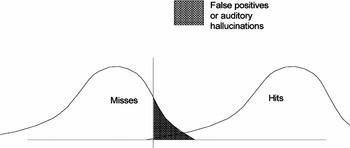
This theory was developed to explore accuracy in pattern recognition systems (Green and Swets, Reference Green and Swets1966). Accuracy varies on two dimensions: first, due to perceptual sensitivity factors, such as the quality of the signal the individual is attempting to detect, and second, due to perceptual bias. For example, how accurately a radar operator will correctly detect a signal will depend on the clarity of the signal, the accuracy of the radar, the acuity of the operator's hearing (perceptual sensitivity), and the skill of the radar operator in judging whether the signal is present (perceptual bias). A signal detection system can be set to avoid false positives (detecting a signal when it is absent) or to avoid false negatives (not detecting a signal that is present). Figure 1 shows how SDT is displayed using two overlapping normal distribution curves, one for the signal being detected, and one for the background noise that the signal emerges from. If the signal is very clear, or the perceptual system very accurate, then the distribution curves may not overlap. However, in most situations there is not such clarity and uncertainty leads to the overlap in distribution curves. Figure 1 depicts the perceptual bias for a smoke detector. This is deliberately set to ensure there are no false negatives, thereby resulting in frequent false positives, when the alarm sounds and there is not a fire. SDT has been used in previous research on auditory hallucinations, showing that people experiencing hallucinations differed from controls in perceptual bias, but not sensitivity, i.e. actuity of their hearing was consistent with controls, but they were prone to avoiding false negatives (Bentall and Slade, Reference Bentall and Slade1985; Brebion, Smith, Amador, Malaspina and Gorman, Reference Brebion, Smith, Amador, Malaspina and Gorman1998).
Signal Detection Theory

Error management theory (Haselton and Nettle, Reference Haselton and Nettle2006) proposes that many human judgements are made in conditions of uncertainty, where there are usually greater costs for either false positives or false negatives. They propose that evolution may lead to a design bias, which is functional and adaptive. For example, if an individual is trying to recognize noises in a wood, it may be potentially fatal to fail to recognize the sound of an approaching bear (false negative). However, incorrectly thinking a bear is approaching when it is not (false positive) does not have severe consequences.
Therefore research from cognitive psychology suggests that we process background information to a complex level and that attention can be drawn to low threshold stimuli if it has particular significance, e.g. the cocktail party effect. Moreover, human beings process information both by analysing the data or stimuli and by imposing their expectations on the data to improve speed and accuracy of processing. Finally, signal detection theory proposes that accuracy is due to both perceptual sensitivity and perceptual bias. It is likely that both the perceptual system and decision making of human beings has evolved to ensure that threat is detected quickly and to ensure that signals that predict danger are not omitted (i.e. there are no false negatives).
Translating theory into practice: formulating a case
Michael was experiencing a series of stressors including break up with a girlfriend and exclusion from seeing their child, heavy street drug use, including amphetamine, and a pending court case for arson. He began to experience auditory hallucinations, hearing people calling him a “nonce”. Michael began to believe that people could read his thoughts, and that people thought he was a paedophile. He coped with these distressing beliefs by avoiding going outside and isolating himself in his bedroom. He became very distressed and his family took him to the local Accident and Emergency Department, where he was assessed and entered hospital under a Section 2 of the Mental Health Act.
Michael was assessed by one of the authors and the following formulation was developed. The formulation highlights the interaction of anxiety and cognitive processes in the onset of psychosis. The formulation has been structured to highlight key processes in the development of his psychotic symptoms. However, these processes interact and are assumed to operate as an open system where Michael's mental state became increasingly disturbed.
Stressors and life events
As described above, Michael had experienced a sequence of life stressors.
Emotional state (shame and intrusions)
During his assessment, he disclosed that when he was 15 or 16 he used to masturbate to a variety of sexual fantasies, one of which was about his younger sister, who at the time was about 8 years old. On returning to his parental home Michael became concerned that his previous sexual fantasies were highly inappropriate and suggested he was a paedophile, leading to intense shame.
Coping
Shame may have two specific effects that may be important in the development of psychoses. First, as shame limits disclosure to others it reduces potential coping strategies. This reduces possible reality testing, from gaining other people's perspective. Second, people cope by trying not to think about the shame inducing event. This attempt to suppress thoughts about an event triggers intrusive thoughts (Gilbert, Reference Gilbert1992) that, due to faulty source monitoring, may be experienced as an internal voice. However, the intrusions also lead to preoccupation about the thought, and the accompanying concern that others may “know” and expose the shame event. The following quote from the Red Badge of Courage by Stephen Crane (Reference Crane1895, p. 110) highlights these difficulties for a soldier who feels ashamed after running away from the frontline in the American Civil War. “Because of the tattered soldier's question he now felt that his shame could be viewed. He was continually casting sidelong glances to see if the men were contemplating the letters of guilt he felt burned into his brow.”
It should be noted that shame may be a trigger to auditory hallucinations that are perceived as internal or external, and may be a crucial factor for people who experience both types of auditory hallucinations. Michael's coping was also reduced by the loss of his girlfriend and his substance misuse.
Cognitive processes in hypervigilance hallucinations
Perceptual hypervigilance
As Michael became increasingly preoccupied by the sexual fantasies he used to have about his sister, he began to become anxious about what would happen if other people knew about these thoughts and feared exposure. Paedophiles were targeted for assaults in his neighbourhood and Michael became convinced that other people may know that he was a paedophile and he started to actively scan background noise from the street to see if anybody was calling him a “nonce”. This may have led to him attempting to detect very ambiguous or “weak” signals. Kahneman's (Reference Kahneman1973) idea of momentary intentions suggests his attention may be drawn to a word, in a similar way to how attention is drawn to your name, even if the signal is weak. Moreover, amphetamine use also increases arousal and vigilance (Snyder, Reference Snyder1973; Verdoux, Grindle, Sorbara and Tourner, Reference Verdoux, Grindle, Sorbara and Tourner2003)
Perceptual sensitivity
A variety of factors can explain how Michael made a cognitive processing or pattern recognition error i.e. how he began to detect the word “nonce” when it was absent. This would be viewed as a false positive in signal detection theory.
System under strain. Michael was not in a normal state of mind; he was highly anxious. Michael's increased anxiety, substance misuse and reduction in sleep all led to an increased probability of perceptual errors. Kahneman (Reference Kahneman1973) suggested that at a certain level of anxiety, the cognitive processing system may become overwhelmed., which has been proposed as a mechanism for the onset of auditory hallucinations (Frith, Reference Frith1979).
Conceptually driven processing. Michael was actively looking for, and expecting to find, people calling him a “nonce”. Conceptually driven processes fill in the gaps and may identify that the target word has been heard when the auditory signal is weak, and data driven processing is ineffective. If the word “nonce” has been recognized, but the accompanying words have not, then conceptually driven processes are likely to fill in the gaps.
A parallel can be drawn with the cocktail party effect. An individual's attention is drawn to their name at a low auditory threshold. However, the preceding context has not reached consciousness, and therefore there is an absence of context. Moreover, the individual may have correctly heard the target word, (e.g. their name) but, without the context, may incorrectly believe it is a reference to them.
Perceptual bias
Error management theory suggests that our perceptual system may be designed to have biases that ensure an adaptive advantage. Michael is trying to detect threat stimuli. His perceptual system is designed to avoid potentially fatal false negatives and tolerate false positives i.e. detecting the threat stimuli (the word “nonce”) when it is actually absent.
In summary, we have identified three types of factors that would result in an increased likelihood of errors in cognitive processing or pattern recognition. All these factors interact and are more likely to operate when the individual perceives themselves to be under threat.
Maintenance or open system
Once Michael believed he had heard the word “nonce” he became even more anxious and hypervigilant, which affected his sleep. He coped with this anxiety by increased drug use. As he had not disclosed his thoughts to others, but was being called a nonce, he developed a delusional belief that other people must be able to read his thoughts. This delusional belief made him more hypervigilant as he believed that he would be assaulted if people read his thoughts and believed him to be a “nonce”. Michael coped with this by avoiding going out, thereby ensuring that he was not reality testing whether the danger was present, and constantly listening to background noises to see if he could hear the word “nonce”. This increased his sleep deprivation and levels of arousal, which led to a vicious circle or open system where the psychotic systems exacerbated his distress, until he was eventually admitted to hospital.
The proposed model: hypervigilance hallucinations
Introduction and assumptions
The stress vulnerability framework and cognitive model underlie the proposed model. The emergence of symptoms is assumed to depend upon the interaction between vulnerability, stress and coping. Moreover, several different processes may occur that lead to psychosis via the creation of a vicious circle (or open system). These processes may operate to different degrees for each individual, and can be viewed as mediators to a psychotic state.
The model
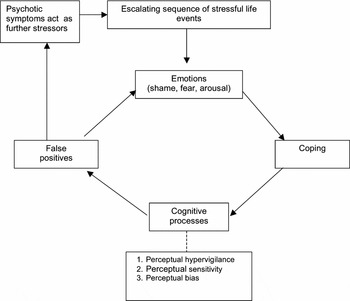
An immediate precipitator, such as a stressful life-event, or drug misuse, triggers a distressing emotional state (see Figure 2). We speculate that feelings of shame and/or fear may be particularly likely to cause the onset of hypervigilance hallucinations. The individual will attempt to cope with the emotional distress and arousal, but some coping strategies and safety behaviour may exacerbate the problem, for example drug use, strong drive to reduce uncertainty when feeling under threat (jump to conclusions), suppression of aversive thoughts, and other safety behaviours. It is possible that the effects of shame in reducing the likelihood of positive coping strategies (disclosure, reality testing) and increasing negative coping (suppression, avoidance, isolation) may make this emotion particularly toxic.
Model of hypervigilance hallucinations

The individual is proposed to be in an extreme emotional state, and employing ineffective coping strategies. Crucially, the nature of their concerns leads them to actively search (or become hypervigilant) for threat stimuli, either for physical threat or exposure.
Three cognitive factors, perceptual hypervigilance, perceptual sensitivity, and perceptual bias, are presumed to interact to increase the likelihood of a false positive or hypervigilance hallucination. Our model proposes cognitive processes that can lead to the onset of anomalous experiences and is compatible with other models (Freeman et al., Reference Freeman, Garety, Kuipers, Fowler and Bebbington2002; Morrison, Reference Morrison2001) that focus on other cognitive processes and maintenance factors.
Further research and clinical implications
This paper describes a model for the formation of hypervigilance hallucinations, based on errors in processing auditory stimuli. The proposed model makes a number of testable predictions, including a key prediction that, under conditions of threat, people are likely to tolerate a high number of false positives to avoid false negatives. The model also predicts that certain cognitive processes (hypervigilance, reliance on conceptually driven processes), emotional states (high arousal, shame) and coping strategies (substance misuse, non disclosure) are likely to be involved in the onset of hypervigilance hallucinations.
An important caveat is that we are identifying a sub-type of psychosis where these processes are important, which is defined by the experience of misinterpreting external auditory stimuli. We believe that splitting hallucinations on the criteria of whether they are experienced as internal or external is flawed, and support a distinction between inner speech and auditory perception (Hunter, Reference Hunter2004). Clinically, this distinction can be made by asking a service user whether the hallucinations are more prevalent when they are alone, where the lack of distraction leads to a focus on inner speech, or when they are in places where there is considerable background noise, which is associated with hypervigilance hallucinations. This is also a testable prediction.
We have found this model easy to use with people experiencing a first episode of psychosis. Initial piloting of face validity and clinical utility suggested that service users found the model easy to understand and powerfully normalizing. Insight into the cognitive processes leading to false positives enabled service users to question their response to sensory stimuli and reduced arousal and preoccupation. Moreover, when the normalizing explanation for the auditory hallucination is provided, then the service user no longer has to develop delusional explanations for their anomalous experience. A further treatment implication is the importance of reducing arousal, either by medication or reducing amphetamine use. The model suggests that shame may be a particularly toxic emotion in the onset of psychosis, and that therapists should actively attempt to identify and treat shame.
Conclusions
This paper describes a subset of auditory hallucinations that we have labelled hypervigilance hallucinations. They are proposed to develop through cognitive processes linked to attention and perception. Error management theory (Haselton and Nettle, Reference Haselton and Nettle2006) suggests that, under conditions of uncertainty, humans will develop design biases as the costs of errors are rarely equivalent. We propose that the human perceptual system has evolved to avoid false negatives, which could be fatal, and tolerate false positives, which are unlikely to have fatal consequences. Several cognitive processes are described that could contribute to false positives. We believe that hypervigilance hallucinations should be viewed as evolutionary by-products of a cognitive system designed to detect threat and avoid false negatives.
Acknowledgements
We are grateful for the comments of Dr Paxton, Dr Dudley and Dr Brabban on earlier drafts of this paper.



Comments
No Comments have been published for this article.