INTRODUCTION
Gastrointestinal nematodes are a major problem in grazing ruminants throughout the world, because of the production losses that they cause (Sykes, Reference Sykes1994). In the past decades, the control of these parasites has essentially relied on the repeated use of chemical anthelmintics. However, the worldwide diffusion of anthelmintic resistance within worm populations (Jackson and Coop, Reference Jackson and Coop2000; Kaplan, Reference Kaplan2004) and the increasing concern of consumers about drug residues in food have stimulated the search for alternative solutions (Waller, Reference Waller1999). These alternatives include bioactive plants, which are rich in secondary metabolites and seem to represent a promising option to reduce the intensity of nematode infections in small ruminants.
To date, most studies on bioactive plants have been dedicated to temperate, tannin-rich legume forages (family Fabaceae), such as sulla (Hedysarum coronarium), big trefoil (Lotus pedunculatus), birdfoot trefoil (Lotus corniculatus), sericea lespedeza (Lespedeza cuneata) or sainfoin (Onobrychis viciifolia) (Min and Hart, Reference Min and Hart2003; Hoste et al. Reference Hoste, Jackson, Athanasiadou, Thamsborg and Hoskin2006; Shaik et al. Reference Shaik, Terrill, Miller, Kouakou, Kannan, Kaplan, Burke and Mosjidis2006). The consumption by small ruminants of these tannin-rich forages has usually been associated with a modulation of nematode biology and with improved host resilience (Hoste et al. Reference Hoste, Torres-Acosta, Paolini, Aguilar-Caballero, Etter, Lefrileux, Chartier and Broqua2005). For most of these forages, anthelmintic activity has been related to a role of condensed tannins (Molan et al. Reference Molan, Hoskin, Barry and McNabb2000, Reference Molan, Meagher, Spencer and Sivakumaran2003; Barrau et al. Reference Barrau, Fabre, Fouraste and Hoste2005; Brunet and Hoste, Reference Brunet and Hoste2006; Brunet et al. Reference Brunet, Jackson and Hoste2008). Nevertheless, in many small ruminant production systems, cultivated forages do not characterize the main feed sources, whereas browser plants (bushes, trees, or shrubs) provide significant nutrition, enabling small ruminants to survive on rangelands during a prolonged dry period, such as in Mediterranean climes. These browser plants provide green forage for grazing animals throughout the year (Papachristou et al. Reference Papachristou, Platis and Nastis2005), and many of them, although belonging to different botanical families, are rich in tannins (Frutos et al. Reference Frutos, Hervas, Ramos, Giraldez and Mantecon2002). However, the possible anthelmintic activity of those plants composing the vegetation of rangelands has received little attention.
Initial in vitro-screening performed on some bushes or trees from the Southern part of France, which represent the feed of goats, indicated anthelmintic properties for 6 species, including Quercus robur, Rubus fructicosus, Corylus avellana, Castanea sativa, Pinus sylvestris and Erica erigena (see Paolini et al. Reference Paolini, Fouraste and Hoste2004; Bahuaud et al. Reference Bahuaud, Martinez-Ortiz de Montellano, Chauveau, Prevot, Torres-Acosta, Fouraste and Hoste2006). Some recent in vivo-field studies have also emphasized some anti-parasitic effects associated with the consumption of heather (Calluna vulgaris) by naturally infected Cashmere goats (Osoro et al. Reference Osoro, Benito-Peña, Frutos, Garcia, Ortega-Mora, Celaya and Ferre2007a, Reference Osoro, Mateos-Sanz, Frutos, Garcia, Ortega-Mora, Ferreira, Celaya and Ferreb). Moreover, it has been shown that the positive effects of heather consumption on nematode populations were not associated with any anti-nutritional effects (Frutos et al. Reference Frutos, Moreno-Gonzalo, Hervás, García, Ferreira, Celaya, Toral, Ortega-Mora, Ferre and Osoro2008).
In the current study, we investigated the possible anthelmintic properties of some common, widely distributed Mediterranean plants. The 7 plants examined were selected because of (a) their large distribution around the Mediterranean basin, (b) their common exploitation by sheep and goats, (c) their large tannin content according to the literature, and (d) their possible use of waste products as feed supplements for 2 species (C. siliqua and O. europaea leaves). The objectives were (i) the in vitro screening of 8 plant extracts for anthelmintic properties against Haemonchus contortus, (ii) the evaluation of the role of tannins in relation to the observed effects by measuring the tannin content in the different plants and employing an inhibitor, and (iii) the confirmation of an in vivo anthelmintic activity for 4 of the plants.
MATERIALS AND METHODS
Plants and preparation
All plants used originated from Creta Island, except the samples from chestnut trees which were collected from the Pelion Mountain on the mainland of Greece. The plant samples were collected from the field in autumn 2007. In total, 8 samples from 7 different plants were collected: leaves from (a) evergreen pistache (Pistacia lentiscus), (b) wild pear tree (Pyrus spinosa), (c) kermes oak tree (Quercus coccifera), (d) carob (Ceratonia siliqua), (e) olive (Olea europaea var. koroneiki) and fruit from (f) chestnut tree (Castanea sativa) and (g) carob (Ceratonia siliqua). Moreover, a tannin-rich plant, sainfoin (Onobrychis viciifolia), known for its anthelmintic activity (Paolini et al. Reference Paolini, Dorchies and Hoste2003, Reference Paolini, De La Farge, Prevot, Dorchies and Hoste2005), was collected from locally cultivated forages as a control.
After oven drying (50°C for 4 days), 5 g of each plant sample were ground (to 1 mm in size) and then extracted by shaking in an acetone:water (70:30) solution for 1 h at <50°C. The filtrate was concentrated under low pressure at 40°C and then washed 3 times in 50 ml of dichloromethane to remove chlorophyll and lipids. Following freeze-drying for 24 h, a powder of plant extract was eventually obtained and subsequently kept at 4°C until use.
In vitro assay
The larval migration inhibition (LMI) bioassay, modified by Rabel et al. (Reference Rabel, McGregor and Douch1994), was used to determine the potential inhibitory effects of the 8 extracts (at different concentrations) on 5 to 6-month-old ensheathed third-stage larvae (L3s) of H. contortus. The L3s were produced from eggs from the faeces from a donor sheep monospecifically infected with H. contortus (MAFF, 1986) and stored at 4°C.
For each plant extract, 3 ml containing 3000 L3s were added to plastic tubes containing a similar volume of either phosphate-buffered saline (PBS; 0·1 m phosphate, 0·05 m NaCl, pH 7·2), as a negative control, or with a range of concentrations of individual plant extracts diluted with PBS. Four concentrations (150, 300, 600 or 1200 μg of extract/ml) were tested per assay. All incubations were carried out at 20°C for 3 h. Thereafter, the L3s were washed (3 times using 3 ml of PBS), and centrifuged (at 2500 g for 5 min). After the last wash, 800 μl aliquots of the L3 suspension were transferred to inserts equipped with a 20 μm mesh, positioned in a conical tube located just above PBS. This mesh was selected to ensure that the migration of L3s through the pores reflected an active process. Three replicates were included for each plant concentration as well as for the negative control. After 3 h at 20°C, the inserts were removed. The numbers of L3 that had migrated through the mesh were counted under a stereomicroscope at a 40-times magnification. The percentage of migration was calculated as M/T×100, where M was the number of L3 present in PBS and T the total number of L3 originally deposited in the insert. When necessary, the percentage of inhibition was calculated as (T−M/T)×100.
In order to ascertain the role of tannins in the in vitro effects on H. contortus L3, an additional assay was performed using PVPP (Sigma Aldrich Ltd) on the 7 samples which had shown potential anthelmintic activity in the previous LMI assay. O. europaea was not included because it lacked a significant effect. Extract samples (using a concentration of 1200 μg/ml PBS) were incubated overnight at 4°C with or without addition of PVPP (50 mg/ml of PBS). PVPP was used because of its property to bind tannins and flavonoids and, consequently, its ability to deplete the samples of tannins (Doner et al. Reference Doner, Becard and Irwin1993). After this first step, the samples were vortexed and then centrifuged (2500 g for 10 min). The supernatant was collected for subsequent use in an LMI assay, as described previously. PBS was used as negative control. Four replicates were run per plant extract, plant extract plus PVPP as well as the PBS control.
In vivo assay
The anthelmintic activity of 4 selected plants was tested in lambs experimentaly infected with gastrointestinal nematodes. Forty-eight, 3-month-old lambs were allocated to 6 groups of 8 animals each. Lambs were kept indoors, each group being in a separate room. Lambs in groups 1 to 4 were fed with P. lentiscus, Q. coccifera, C. siliqua (flour made from fruits, incorporated into supplement) and O. viciifolia hay, respectively. The lambs in groups 5 and 6 comprised a (positive) infected and a (negative) uninfected control group, respectively, receiving lucerne (Medicago sativa) hay.
The sheep raised under helminth-free conditions were drenched with albendazole at the recommended dose rate of 15 mg/kg before the start of the experiment. On day-14, two weeks prior the experimental infection with nematodes, each group of lambs received the specialized diet ad libitum. During the whole period of the study (i.e. 60 days), all groups received a fattening (total mixed) ration, which was isoenergetic and isoproteic and also balanced for crude fibre, Ca, P and Ca:P ratio. For P. lentiscus, Q. coccifera and O. viciifolia hay, the quantity of tannins consumed per day was calculated to represent 0·1% of the metabolic body weight (BW) for the whole period of the experiment. For C. siliqua, this value was estimated to represent only 0·05% of the metabolic BW.
On day 0, individual lambs in groups 1 to 5 were infected with a single dose of 7000 H. contortus and 5000 T. colubriformis L3s. The L3s had been cultured from the faeces of monospecifically infected donor lambs and had been stored under optimal conditions for 1–2 months. The lambs in group 6 remained uninfected. After having been kept indoors under helminth-free conditions, the lambs were euthanized at the end of the 45-day experimental period.
The bodyweights of individual animals were recorded monthly, at the beginning (Day-14), one month (Day 14) and two months (Day 45) in order to estimate the body weight gain (BWG) rate. The refusal rates per group for the consumption of the 4 plants were measured daily during the entire experimental period. Individual faecal samples were taken weekly, from Day 0 to Day 45, to determine the faecal egg counts (FECs), expressed as trichostrongylid eggs per gramme (EPG), according to a modified McMaster technique (Raynaud, Reference Raynaud1970). In addition, during the experimental period (Day 0 to Day 45), blood samples were collected weekly employing tubes with and without heparin to measure the Packed Cell Volume (PCV) using a microhaematocrit method and the inorganic phosphate values using a photometric assay (Robinson et al. Reference Robinson, Roughan and Wagstaff1971).
At necropsy, the abomasa and the first 12 meters of small intestine were removed. The worms were collected from both the luminal contents and the digesta of either the abomasal or intestinal mucosa after a 4-h incubation in a pepsin solution at 37°C. Worm counts were performed according to a 10% aliquot technique (MAFF, 1986). Morphological identification of worm stages, sex and species were conducted using a standard approach (MAFF, 1986).
The fertility of female worms was measured using 10 worms per lamb. For T. colubriformis, eggs in utero were counted after clearing in 85% lactic acid. For H. contortus, the fertility was determined using the method described by Kloosterman et al. (Reference Kloosterman, Albers and Van Den Brink1978). The worms were soaked for 5 min in a large volume of distilled water, before being placed individually in microtubes with 1000 μl of 0·125% hypochloride solution. After 20 min at room temperature (22–24°C), female worms disintegrated in this solution, enabling the direct counting of eggs under a stereomicroscope using an aliquot (10%) of the total volume. All egg counts were performed under a microscope at a 10-times magnification.
Evaluation of tannin content
The contents of total phenols, total tannins and condensed tannins as well as the biological activity for the 8 plant samples as well as that of M. sativa, used as the control plant in the in vivo experiment, were estimated through different measurements.
The biological activity of the plant samples, related to the tannin content was measured using the Radial Diffusion Method (Hagerman and Butler, Reference Hagerman and Butler1978), which is based on the property of tannins to form complexes with proteins. We used bovine serum albumin (BSA) (Sigma Aldrich Ltd) as protein source and tannic acid (Sigma Ltd) as a standard. The results were expressed in g-equivalents of tannic acid/100 g of dry plant (DP).
The Folin Ciocalteu method (Makkar, Reference Makkar2003) was used to determine the total polyphenols (TPs) and total tannins (TTs) in the extracts. After the initial measurements of TPs, PVPP (Sigma Aldrich Ltd) was added to the extract then TTs was calculated as the difference between TPs measured with or without addition of PVPP in the same extract. The TPs and TTs were determined by recording the absorbance at 725 nm using a spectrophotometer (UV-Visible Spectronic Unican, Genesys 8). A tannic acid standard curve was performed and the results were expressed as tannic acid equivalents.
The butanol HCl method (Makkar, Reference Makkar2003) was used to estimate the condensed tannins (CTs) present in the various extracts. The results were measured at an absorbance of 550 nm in a spectrophotometer (UV-Visible Spectronic Unican, Genesys 8). Results were expressed as leucocyanidin equivalents.
Statistical analyses
Significant differences in the LMI values linked to different experimental groups and concentrations were assessed using a general linear model (GLM) procedure with the Systat 9 software (SPSS Ltd, 1999). For the PVPP-based assay, the differences in results between the PBS control, the extract and the extract plus PVPP were analysed using a non-parametric Kruskal-Wallis test. A multiple correspondence analysis (MCA) was also performed using the Systat 9 software (SPSS Ltd) to obtain a synthetic description of the relationships between the effects on larval migration and the main biochemical characteristics associated with polyphenols and tannins in the various plants. The 5 variables composing the column of the matrix used for the MCA were categorical. They included the value of inhibition of migration, the total phenol, total tannin and condensed tannin measurements as well as the value of biological activity. The 8 rows (individual data) of the matrix corresponded to the 8 different plants assayed on H. contortus.
FEC data were log 10(x+1) transformed prior to analysis. For the egg excretion, the PCV and the inorganic phosphate values, comparisons were first performed using an analysis of variance on repeated measurements. In addition, comparison of results to the control values was conducted date by date on a one-way analysis of variance (ANOVA) employing the post-hoc Bonferroni test. The same statistical test was also used to compare the differences in the monthly and overall bodyweight gains. The mean number of each nematode species as well as the total number of worms recovered at necropsy were compared to the control values using the non-parametric Kruskal-Wallis test. A similar test was employed to examine the differences in fertility of female worms (both H. contortus and T. colubriformis) between the experimental and control groups.
RESULTS
Tannin and phenol measurements
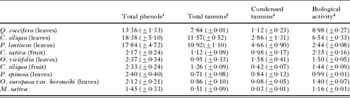
By comparison to M. sativa, the tannin-free plant, the plants tested could be separated into 2 groups, characterized either by high or low TP and TT contents (Table 1). The first group included Q. coccifera, C. siliqua (leaves) and P. lentiscus; the second group comprised C. sativa, O. viciifolia, C. siliqua (fruit), O. europaea and P. spinosa. Overall, the high or low TP and TT of plants coincided with high or low CTs content, respectively, with the exception of O. viciifolia (Table 1).
Mean measurements (±s.d.) of total phenols, total tannins, condensed tannins and biological activity for 8 samples of Mediterranean plants and Medicago sativa

1,2 TPs, TTs: expressed as g-equivalent tannic acid/100 g DP.
3 CTs: expressed as g-equivalent leucocyanidin/100 g DP.
4 BA: expressed as g-equivalent tannic acid/100 g of dry plant (DP).
The plant extracts that showed high protein-binding activity were Q. coccifera, C. siliqua (leaves). Extracts of P. lentiscus, C. sativa, O. viciifolia, C. siliqua (fruit) and O. europaea revealed moderate activity. In contrast, the P. spinosa extract showed the lowest biological activity. The extract of M. sativa was used as a tannin-free control (Table 1).
Anthelmintic activity in vitro
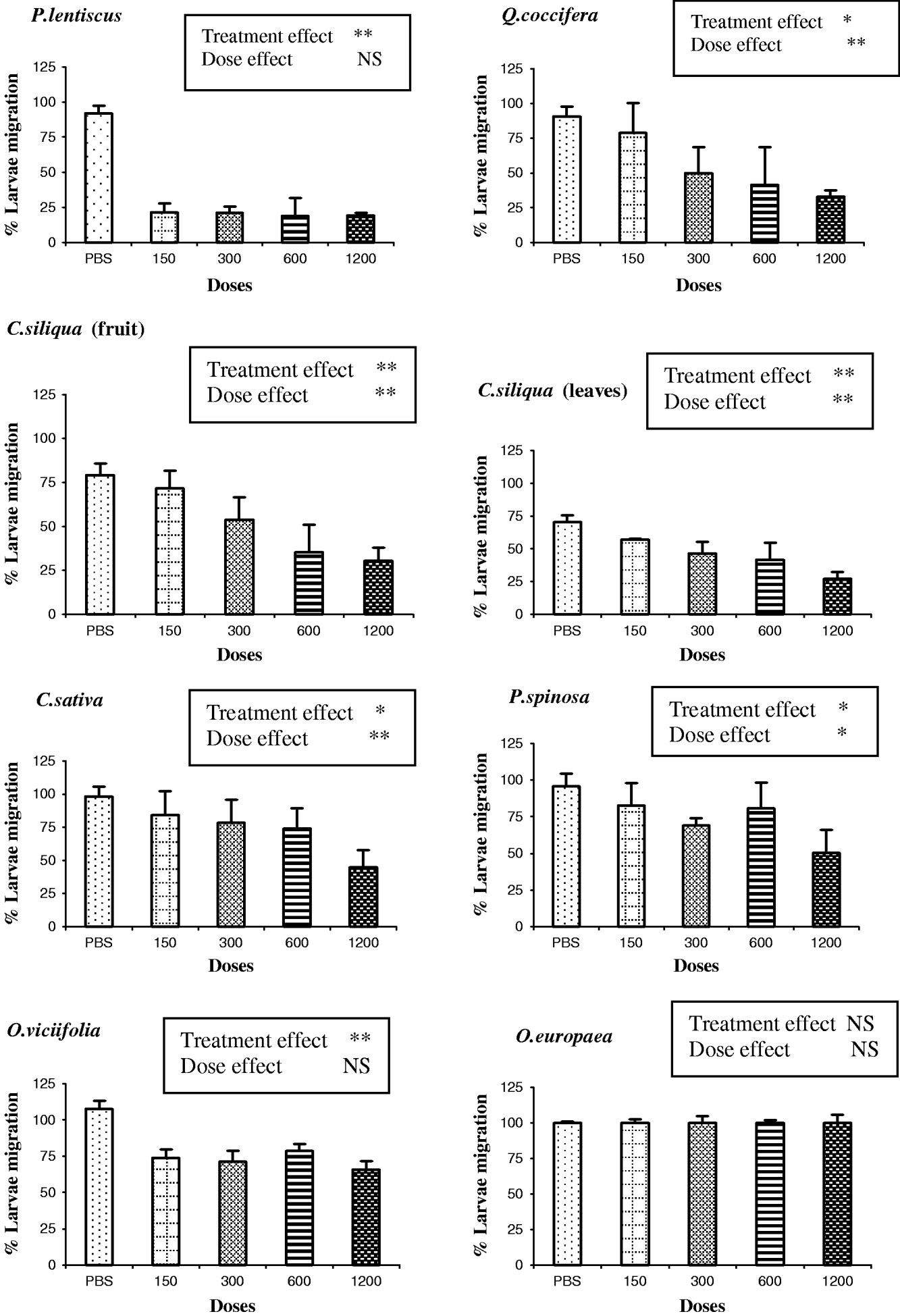
For the negative control (PBS), the mean percentage of migration for H. contortus in the different LMI assays was 93% (±12·9). Overall, most of the plant extracts tested reduced significantly L3 migration. A significant dose-dependent anti-parasitic effect was established for Q. coccifera (P<0·001), C. siliqua fruit (P<0·001), C. siliqua leaves (P<0·001), for C. sativa (P<0·001) and for P. spinosa (P=0·013) (Fig. 1). Significant effects were also determined for P. lentiscus (P<0·001) and O. viciifolia (P<0·001). However, for the latter 2 plants, the statistical analysis did not indicate a dose-dependent effect. In contrast, when compared with the PBS control values, no difference was found for the migration of L3s after contact with O. europaea extracts.
Effects of Mediterranean plant extracts at concentrations of 150, 300, 600, 1200 μg/ml on the migration of infective larvae of Haemonchus contortus. Results are shown as means (±s.d.) of triplicates. PBS was used as a negative control. Results of statistical comparisons according to the 2 factors: plant extract or dose effect are indicated by (* P<0·05; ** P<0·01; NS, non-significant).

At the highest concentration of 1200 μg of extract/ml, the inhibitory effects on H. contortus L3 migration compared with the PBS control values, were 79·1%, for P. lenticus, 63·8%, for Q. coccifera, 61·5% and 61·4% for C. siliqua fruit and leaves, respectively, 54·6% for C. sativa, 47·4% for P. spinosa and 38·9% for O. viciifolia.
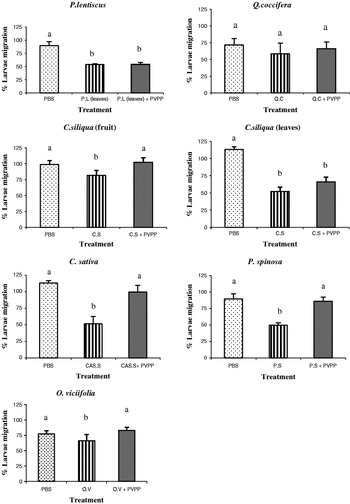
In the second in vitro experiment significant differences in L3 migration were shown following contact with 1200 μg/ml of P. lenticus (P<0·001), C. siliqua fruit (P=0·02), C. siliqua leaves (P<0·001), C. sativa (P<0·001), P. spinosa (P<0·001) and O. viciifolia (P=0·03) but not for Q. coccifera (P=0·313). The addition of PVPP restored values of L3 migration close to control values, which did not differ significantly from those for PBS for C. siliqua (fruit), C. sativa, P. spinosa, O. viciifolia. In contrast, for P. lentiscus and C. siliqua (leaves), the values for L3 migration remained significantly different from the PBS control even after the addition of PVPP (Fig. 2).
Effects of Mediterranean plant extracts at 1200 μg/ml, with or without PVPP addition, on the migration of infective larvae of Haemonchus contortus. Results are shown as means (±s.d.) of triplicates. PBS was used as a negative control. Different superscripts indicate significant differences (P<0·05) between treatments.

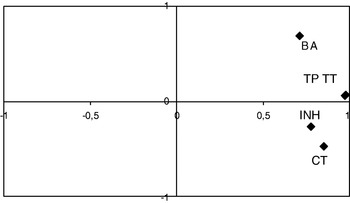
The results of the multivariate analysis are displayed in Fig. 3, with Axis 1 and 2 representing nearly 90% of the total variance. As expected, a close relationship was found between TTs and TPs values. Also a close relationship was found between the CTs and the values for the inhibition of L3 migration, whereas this last variable appeared less related to the biological activity.
Principal plane of interactions obtained from the MCA analysis applied on a matrix of 5 columns (variables) describing the tannin and phenol contents of the plants as well as their biological and anthelmintic activities and 8 rows corresponding to the different extracts. INH, inhibition of migration; TT, total tannins; TP, total phenols; BA, biological activity; CT, condensed tannins.

Testing in vivo
The consumption of the 5 plants offered (P. lentiscus, Q. coccifera, C. siliqua, O. viciifolia and M. sativa) was high during the entire experimental period for all groups of lambs. No refusal (<5%) of intakes was observed, irrespective of the plant tested. During the experimental period, 1 lamb died in the Q. coccifera, C. siliqua, O. viciifolia and the positive control groups, both because of haemonchosis (in the control or Q. coccifera groups) and 2 died due to heat stress.
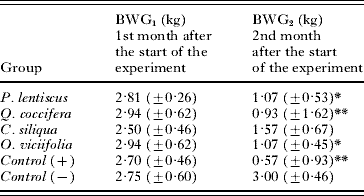
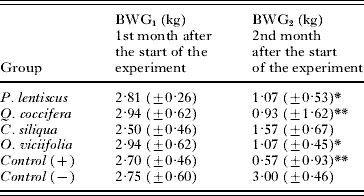
In the first month of the experiment, no statistical difference in growth was found between the 6 experimental groups (Table 2). In contrast, in the second month, a statistical difference (P<0·01) was determined among the groups. All of the infected groups differed from the uninfected control, except the C. siliqua group. As a consequence, when considering the overall, cumulative BWG for the experimental period of 2 months, a statistical difference (P<0·01) was demonstrated between the 5 infected groups when compared with the negative control, but no differences were found among the various experimentally infected groups.
Mean values of bodyweight gain on the 1st and 2nd month of the start of the experiment in the groups of lambs receiving the different plants
(Statistical differences from uninfected control values: * P<0·05; ** P<0·01.)
The analysis of variance on repeated measurements revealed statistical differences in the PCV values for all the infected groups compared with the negative control, whatever the diet. In contrast, the comparison between the different infected groups did not indicate any statistical differences in PCV (data not shown). In contrast, for the inorganic phosphate values, the difference found using the analysis of variance of repeated measurements was not significant, albeit close, to significance (P<0·08) (data not shown).
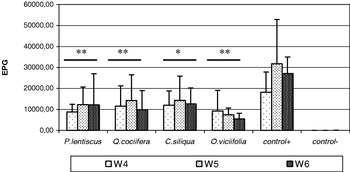
Overall, for the last 3 weeks of the experiment, the results obtained using the ANOVA for repeated measurements indicated that, when compared with the control values observed in the lambs receiving M. sativa, the egg excretion was significantly lower in lambs consuming P. lentiscus, O. viciifolia or Q. coccifera (P<0·01) and for those consuming C. siliqua (P<0·05) (Fig. 4). Reductions in EPG increased between the fourth and sixth week following inoculation with infective L3s. Compared with the control (i.e. M. sativa), the reductions ranged from 55·2 to 61·3% for P. lentiscus, from 36·5 to 63·9% for Q. coccifera, from 33·7 to 55·3% for C. siliqua and from 49·0 to 79·9% for O. viciifolia. This trend towards an increase in reduction of egg output with time was assessed by the analysis of variance performed date by date. No difference to the control group was found 4 weeks after inoculation; a statistical difference (P<0·05) was only found for the O. viciifolia group after 5 weeks. In contrast, statistical reductions in EPGs in the P. lentiscus, Q. coccifera and O. viciifolia groups were assessed at 6 weeks following inoculation.
Comparison of faecal egg counts (arithmetic mean values) on the 4th, 5th and 6th week post-infection, in the groups of lambs fed on browse plants, O. viciifolia or M. sativa. Results of statistical analysis based on analysis of variance on repeated measurements * P<0·05; ** P<0·01.

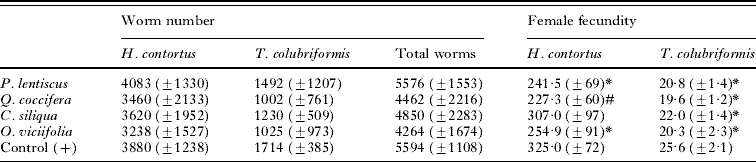
No statistical difference was observed either in the mean total number of worms between the 5 infected groups at necropsy, or in the total number of H. contortus or in the total number of T. colubriformis recovered (Table 3), although when compared with the M. sativa control group, the number of T. colubriformis was substantially lower, e.g. by −28·1%, in the lambs consuming C. siliqua, by −41·5% and −40·2% in those consuming Q. coccifera and O. viciifolia, respectively.
Mean number of worms and mean female fecundity (±s.d.) of the two nematode species recovered from the lambs according to the different feeding regimes
(Each lamb was infected with 7000 and 5000 third-stage infective larvae of H. contortus and T. colubriformis respectively. Results of the statistical analysis by comparison to the control values: * P<0·05; # P<0·06.)
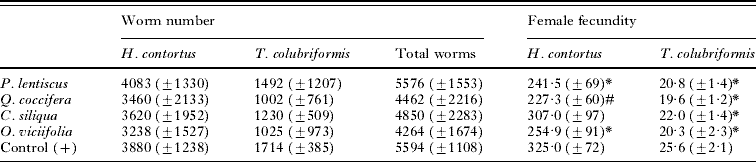
Compared with the control infected group, the number of eggs per female H. contortus was reduced significantly in the lambs consuming P. lentiscus or O. viciifolia (P<0·05). In addition, in the group fed Q. coccifera, the difference was almost significant (P<0·06). In contrast, no statistical difference was observed for the C. siliqua group. For T. colubriformis, the fertility of female worms differed significantly from the control values for the 4 experimental groups (P<0·05) (Table 3).
DISCUSSION
Under Mediterranean conditions, the breeding of small ruminants usually relies on the exploitation of rangelands which are covered with a variety of plants belonging to various botanical families. These plants are usually rich in plant secondary metabolites (PSMs). In the last 10 years, increasing evidence has accumulated to support the hypothesis that anthelmintic properties are associated with some PSMs (Stepek et al. Reference Stepek, Behnke, Buttle and Duce2004; Rochfort et al. Reference Rochfort, Parker and Dunshea2008). In particular, the interest has turned to tannin-rich plants, whose negative effects on gastrointestinal nematodes have been substantiated by consistent experimental results (Hoste et al. Reference Hoste, Jackson, Athanasiadou, Thamsborg and Hoskin2006). However, the majority of studies have focused on temperate legume forages. In contrast, there is a paucity of information on browse plants (Paolini et al. Reference Paolini, Fouraste and Hoste2004; Bahuaud et al. Reference Bahuaud, Martinez-Ortiz de Montellano, Chauveau, Prevot, Torres-Acosta, Fouraste and Hoste2006), despite their palatability and their significance in covering the nutritional needs of small ruminants, whenever grass availability is low in the Mediterranean areas (Morand-Fehr et al. Reference Morand-Fehr, Bourbouze, Le Houérou, Gall and Boyazoglu1983).
Based on the present in vitro screening for anthelmintic properties using the LMI assay, all of the plant extracts, except those of O. europaea, showed anthelmintic activity, which ranged from 31·1 to 79·1% at the highest concentration. With the exception of P. lentiscus and O. viciifolia, this anthelmintic activity was dose dependent. To our knowledge, this is the first evidence of anthelmintic activity for C. siliqua, P. lentiscus, P. spinosa. For 3 other plants, the results confirmed previous data obtained either on the same plant with a different in vitro assay (C. sativa; see Bahuaud et al. Reference Bahuaud, Martinez-Ortiz de Montellano, Chauveau, Prevot, Torres-Acosta, Fouraste and Hoste2006), or with the same LMI assay on a related plant species (Q. robur instead of Q. coccifera; Paolini et al. Reference Paolini, Fouraste and Hoste2004). The lack of anthelmintic activity for Olea europaea var. africana was demonstrated in vivo (Githiori et al. Reference Githiori, Hoglund, Waller and Baker2004). Furthermore, the anthelmintic property of O. viciifolia has often been evaluated in different in vitro assays (Paolini et al. Reference Paolini, Fouraste and Hoste2004; Barrau et al. Reference Barrau, Fabre, Fouraste and Hoste2005). Indeed, this tannin-rich fodder was included in the present study as a positive control.
One of the key questions regarding the potential anthelmintic activity linked to natural products is to determine what is (are) the active compound(s). As stated, the different plants tested here were selected because of their large range of tannin contents, including hydrolysable and condensed tannins. Our second objective aimed at testing the proposal that tannins play a major role in the anti-parasitic efficacy measured.
The latter hypothesis was supported by results of the multivariate analysis, which related the various biochemical measurements of the 8 plant samples with the severity of the inhibition of larval migration. The overall conclusions confirm a major role of tannins, particularly condensed tannins. Secondly, the hypothesis was further supported by the results of the experiment performed using PVPP, which is known for its ability to bind and inactivate tannins and polyphenols (Doner et al. Reference Doner, Becard and Irwin1993; Lorimer et al. Reference Lorimer, Perry, Foster, Burgess, Douch, Hamilton, Donaghy and McGregor1996; Makkar, Reference Makkar2003). Therefore, any restoration of values towards control ones following the addition of PVPP to extracts suggests a major role for tannins in anthelmintic activity.
With the exception of Q. coccifera, the experimental results were consistent between the two LMI assays. The difference observed for Quercus might relate to the lower number of duplicates used to validate the activity in the second assay with PVPP, since only the highest dose was examined. The results obtained for C. siliqua fruit, C. sativa, P. spinosa and O. viciifolia indicated that, for those 4 plant extracts, tannins are largely involved. In contrast, for the extracts of C. siliqua leaves and P. lentiscus, the results were not conclusive, as the addition of PVPP did not fully restore to control values. For both species, a possible explanation could be their high TTs and CTs contents. Therefore, the PVPP quantity used might have been insufficient to inactivate all the tannins in the extracts tested. Another explanation could be the presence of secondary metabolites other than tannins which have potential efficacy against gastrointestinal nematodes. Similar results were shown previously by Barrau et al. (Reference Barrau, Fabre, Fouraste and Hoste2005), who found that in O. viciifolia, besides tannins and flavan-3-ols, some flavonol glycosides (e.g. rutin, narcissin and nicotiflorin), also had an effect on gastrointestinal nematodes.
Studies have emphasized the existence of essential oil in the aerial part of P. lentiscus, consisting of terpenes as major components (Llusia and Penuelas, Reference LIusia and Penuelas1998; Ahmamdi et al. Reference Ahmamdi, Aouinti, Wathelet and Elbachiri2009). In particular, Barazani et al. (Reference Barazani, Dudai and Golan-Goldhirsh2003), when analysing the extract obtained from P. lentiscus leaves, showed the presence of 12 monoterpenes, 7 sesquiterpenes and 1 linear non-terpenic compound. The potential activity of essential oils of various plant species against H. contortus has previously been illustrated. For example, the in vitro hatching of H. contortus eggs was inhibited efficiently by the essential oil of Ocimum gratissimum, in relation to its main component eugenol (Pessoa et al. Reference Pessoa, Morais, Bevilaqua and Luciano2002) or by the essential oils of Croton zehntneri and Lippia sidoides and their respective major constituents, anethol and thymol (Camurca-Vasconcelos et al. Reference Camurca-Vasconcelos, Bevilaqua, Morais, Maciel, Costa, Macedo, Oliveira, Braga, Silva and Vieira2007). The anthelmintic effect could be explained by the existence in high quantities of such constituents, which are not bound by PVPP, in the acetone extract of P. lentiscus. Further studies are necessary to assess the role of these various components and to establish their mode of action against gastrointestinal nematodes.
Our third objective was to confirm, under in vivo conditions, some of the in vitro results. Three of the browse plants (P. lentiscus, C. siliqua, Q. coccifera) with the highest anthelmintic activity in the LMI assay were thus compared with a locally grown O. viciifolia hay. To our knowledge, this is the first in vivo study focusing on the anthelmintic effects of these 3 widespread Mediterranean browse plants, which are commonly consumed by sheep and goats. Overall, the in vivo results confirmed the in vitro findings. By comparison with the control group fed on M. sativa, the lambs receiving the 3 browse plants or the O. viciifolia showed significant decreases in FECs, which seemed to increase with the length of plant consumption, since, in the last week of experiment, some values of reduction reached 80% compared with control levels. Because caution was taken to make the diet in all groups isoenergetic and isoproteic, and because no differences in refusals were observed between the experimental groups, it is suspected that these main differences in the biology of worms were not related to quantitative differences in the diet composition (Coop and Kyriazakis, Reference Coop and Kyriazakis1999), but rather to qualitative differences due to the presence of some active PSMs.
Some studies have examined in vivo the anthelmintic effects associated with the consumption of O. viciifolia in infected sheep (Heckendorn et al. Reference Heckendorn, Häring, Maurer, Zinsstag, Langhans and Hertzberg2006, Reference Heckendorn, Haring, Maurer, Senn and Hertzberg2007) or goats (Paolini et al. Reference Paolini, Dorchies and Hoste2003, Reference Paolini, De La Farge, Prevot, Dorchies and Hoste2005). Although the mode of infection (experimental or natural conditions) and the parasitic species differed, our current results are in agreement with those of these previous studies. Sheep or goats consuming O. viciifolia usually presented significant reductions in nematode egg output, which were related either to a decreased worm fertility (Paolini et al. Reference Paolini, De La Farge, Prevot, Dorchies and Hoste2005) or to a reduced worm number (Heckendorn et al. Reference Heckendorn, Häring, Maurer, Zinsstag, Langhans and Hertzberg2006, Reference Heckendorn, Haring, Maurer, Senn and Hertzberg2007). In contrast to tannin-rich forages, only a few browse species have been investigated in vivo for their potential anthelmintic effects on gastrointestinal nematodes. Osoro et al. (Reference Osoro, Benito-Peña, Frutos, Garcia, Ortega-Mora, Celaya and Ferre2007a, Reference Osoro, Mateos-Sanz, Frutos, Garcia, Ortega-Mora, Ferreira, Celaya and Ferreb) tested the effect of Calluna vulgaris consumption, a tannin-rich plant that thrives in temperate areas, on naturally infected goats and have shown consistent reductions in nematode egg excretion. Similarly, Acacia cyanophylla, a tanniniferous legume shrub, appeared to be able to constrain the parasitic infection due to a significant reduction of FECs in sheep (Akkari et al. Reference Akkari, Ben Salem, Gharbi, Abidi and Darghouth2008).
In the different previous studies on tanniniferous forages (Hoste et al. Reference Hoste, Jackson, Athanasiadou, Thamsborg and Hoskin2006), two different parameters (reduction of worm number and/or of worm fertility) seemed to explain the significant decreases in FECs. However, depending on the plant species, the nematode species and/or the anatomical location, their relative importance varies. In the present study, for Haemonchus number, no statistical difference from the control values was found, whatever the experimental diet. The maximum reduction (16·5%) was found for O. viciifolia. Although important reductions in the intestinal worm numbers, close to 30–40%, were found in the lambs fed on C. siliqua, Q. coccifera or O. viciifolia, the differences from the control group were again not significant. Differences in the effects of tannin-rich plants between abomasal and intestinal nematodes have been reported previously. For instance, using quebracho as a source of condensed tannins, Athanasiadou et al. (Reference Athanasiadou, Kyriazakis, Jackson and Coop2001) found more severe effects on the intestinal genera Trichostrongylus and Nematodirus than on abomasal parasites, such as Haemonchus and Teladorsagia. Paolini et al. (Reference Paolini, De La Farge, Prevot, Dorchies and Hoste2005) also recorded a higher susceptibility in intestinal compared with abomasal species in naturally infected goats receiving O. viciifolia. However, Heckendorn et al. (Reference Heckendorn, Häring, Maurer, Zinsstag, Langhans and Hertzberg2006, Reference Hoste, Jackson, Athanasiadou, Thamsborg and Hoskin2007) found the opposite in lambs infected with Haemonchus and Cooperia.
In the present study, the significant reductions of FECs were principally associated with significant reductions in worm fertility for both nematode species. The sole exception was for H. contortus in lambs fed on C. siliqua. After O. viciifolia consumption by goats, Paolini et al. (Reference Paolini, De La Farge, Prevot, Dorchies and Hoste2005) also associated the reductions in egg excretion with significant decreases in female worm fertility, for both intestinal and abomasal species. Similarly, Lange et al. (Reference Lange, Olcott, Miller, Mosjidis, Terrill, Burke and Kearney2006) related FEC reductions in sheep receiving sericea lespedeza to a decrease in fecundity in Haemonchus. In contrast, Heckendorn et al. (Reference Heckendorn, Häring, Maurer, Zinsstag, Langhans and Hertzberg2006, Reference Heckendorn, Haring, Maurer, Senn and Hertzberg2007) related FEC decreases to reduced worm burdens when testing the effect of O. viciifolia hay or silage in experimentally infected sheep.
Overall, the present results obtained for 3 browser plant species support their potential use to improve the sheep health and welfare, because of the presence of PSMs. Recent studies (Ben Salem et al. Reference Ben Salem, Ben Salem, Nefzaoui and Ben Said2003, Reference Ben Salem, Nefzaoui and Makkar2007, Reference Ben Salem, Priolo and Morand-Fehr2008) have emphasized the interest of such shrub and tree resources in mountainous, arid and semi-arid zones for animal feed either by direct use or by use of agro-industrial by-products. However, the potential negative, anti-nutritive effects of some PSMs was also indicated (Ben Salem et al. Reference Ben Salem, Nefzaoui and Makkar2007). Therefore, it is clear that further research is needed to better understand the exact nature of the plant secondary metabolites responsible for the anthelmintic effects and to analyse their mode of action on the nematodes. On the other hand it will be important to estimate the trade-off between the negative and positive consequences of PSMs either on parasitism or on digestive physiology and to develop technologies enabling the controlled distribution of active compounds to small ruminants to achieve optimal benefits in production.
Mrs Manolaraki is a grateful recipient of a fellowship linked to the EU Marie Curie project entitled ‘Healthy Hay’ (contract: MRTN-CT-2006-035805). The COST project CAPARA is also acknowledged. Ms S. Brunet is thanked for her assistance.