1. Introduction
Definition of the base of early Cambrian Stage 2 (Terreneuvian Series) has become a subject of considerable controversy, especially regarding the reliability and biostratigraphic utility of the micromollusc Watsonella crosbyi Grabau, Reference Grabau1900. This taxon has a widespread distribution, and can be correlated across pre-trilobitic successions of both carbonate and siliciclastic facies in South China, Siberia, Mongolia, Avalonia and west and east Gondwana (online Supplementary Table S1, available at http://journals.cambridge.org/geo). For this reason W. crosbyi has been suggested as a suitable index fossil for global correlation of the as yet undefined Cambrian Stage 2 (Li et al. Reference Li, Zhao, Gubanov, Zhu and Na2011; Peng & Babcock, Reference Peng and Babcock2011). Watsonella crosbyi often co-occurs with the dextrally coiled shells of the stem group mollusc, Aldanella attleborensis (Shaler & Foerste, Reference Shaler and Foerste1888), which shares a similar geographical distribution and has also been suggested as a potential candidate to define the base of Cambrian Stage 2 (Parkhaev, Reference Parkhaev2014).
Comprehensive regional biostratigraphic schemes are crucial for constraining local geo- and bioevents and for developing workable global correlations (Betts et al. Reference Betts, Paterson, Jago, Jacquet, Skovsted, Topper and Brock2016). However, biostratigraphic correlation and concomitant temporal subdivision can be undermined by taphonomic and taxonomic inconsistencies and the diachronism of First Appearance Data (FAD) (see discussion by Landing et al. Reference Landing, Geyer, Brasier and Bowring2013). These factors are especially evident in lowermost Cambrian strata, where many pre-trilobitic biotas (i.e. small skeletal fossils, archaeocyaths and acritarchs) exhibit strong provincialism and facies-controlled distribution (Landing et al. Reference Landing, Geyer, Brasier and Bowring2013). Consequently, there has been an emphasis on chemostratigraphic methods (i.e. carbon and oxygen isotopes) in combination with U–Pb zircon geochronology as an independent (or primary) means of global correlation (e.g. Maloof et al. Reference Maloof, Porter, Moore, Dudás, Bowring, Higgins, Fike and Eddy2010 a; Kouchinsky et al. Reference Kouchinsky, Bengtson, Runnegar, Skovsted, Steiner and Vendrasco2012; Landing et al. Reference Landing, Geyer, Brasier and Bowring2013; but see Parkhaev, Reference Parkhaev2014). Non-biostratigraphic methods have previously been suggested as supplementary proxies for calibration (e.g. the ZHUCE (Zhu, Babcock & Peng, Reference Zhu, Babcock and Peng2006)/I' (Brasier et al. Reference Brasier, Rozanov, Zhuravlev, Corfield and Derry1994) positive δ13C excursion above the incoming of Watsonella; Li et al. Reference Li, Zhao, Gubanov, Zhu and Na2011; Landing et al. Reference Landing, Geyer, Brasier and Bowring2013), although Landing et al. (Reference Landing, Geyer, Brasier and Bowring2013) emphasizes integration of biostratigraphic and chemostratigraphic data. Maloof et al. (Reference Maloof, Porter, Moore, Dudás, Bowring, Higgins, Fike and Eddy2010 a) applied a multiproxy approach to constrain occurrences of skeletal metazoan taxa during the Terreneuvian Series using a δ13CCaCO3 age model calibrated with U–Pb ID-TIMS (isotope dilution thermal ionization mass spectrometry) dates of zircons from five separate ash beds in Morocco (Maloof et al. Reference Maloof, Schrag, Crowley and Bowring2005, Reference Maloof, Ramezani, Bowring, Fike, Porter and Mazouad2010 b) and China. By assigning time bins in 2 Ma intervals, first appearance data of Watsonella from sections in Siberia, Mongolia and China indicate a FAD no older than c. 530 Ma within the Nemakit-Daldynian Stage of the Siberian regional timescale. Expanding on this work, Landing & Kouchinsky (Reference Landing and Kouchinsky2016) suggested that the lower occurrences of W. crosbyi in South China, France and Avalonia, as well as in northern Siberia, are approximately coeval within upper Fortunian deposits.
Landing et al. (Reference Landing, Geyer, Brasier and Bowring2013) proposed that the I’/L4/ZHUCE δ13C positive isotope excursion, occurring just above the first appearance of Watsonella crosbyi and Aldanella attleborensis and the Skiagia ornata-Fimbrioglomerella membranacea acritarch, represents the best multi-proxy approach for defining the base of Cambrian Stage 2. The use of independent time constraints as suggested by Landing et al. (Reference Landing, Geyer, Brasier and Bowring2013) is the most workable means to more accurately define this important Cambrian Stage boundary. However, it is important that all chemostratigraphic signals (especially bulk rock) are carefully evaluated using robust protocols to ensure they are not influenced by local depositional conditions, cryptic disconformities (Miall, Reference Miall, Smith, Bailey, Burgess and Fraser2014; Parkhaev, Reference Parkhaev2014), alteration by fluid–rock interactions during subaerial exposure or by diagenesis in the vadose or phreatic zones (Kaufman & Knoll, Reference Kaufman and Knoll1995; Derry, Reference Derry2010; Swart, Reference Swart2015).
Tracking changes in ichnodiversity and ichnodisparity during the Ediacaran–Cambrian transition has also proven an effective independent means of broadly correlating key phases of the Cambrian radiation (Seilacher, Reference Seilacher1956; Crimes, Reference Crimes1987; Seilacher, Buatois & Mángano, Reference Seilacher, Buatois and Mángano2005; Màngano & Buatois, Reference Mángano and Buatois2014). Trace fossils reveal two distinct phases in body-plan diversification and the establishment of a Phanerozic-style ecological structure (Màngano & Buatois, Reference Mángano and Buatois2014). The Fortunian Stage records a rapid diversification with a global maximum of 42 ichnogenera. Extent of bioturbation was relatively low, and assemblages were dominated by horizontal traces. The transition to Cambrian Stage 2 records a dramatic increase in maximum burrowing depth and the appearance of vertical burrows, especially Skolithos and Diplocraterion ‘piperock’ (Màngano & Buatois, Reference Mángano and Buatois2014). The utility of ichnofossils for global chronostratigraphic schemes is problematic, particularly with respect to the Cambrian period (Babcock et al. Reference Babcock, Peng, Zhu, Xiao and Ahlberg2014, but see Landing et al. Reference Landing, Geyer, Brasier and Bowring2013). Their key limitation is a strong lithofacies dependence, which is exemplified by the almost exclusive appearance of Skolithos in moderate- to high-energy nearshore clastic deposits (Desjardins et al. Reference Desjardins, Gabriela Mángano, Buatois and Pratt2010, see table 1; Màngano & Buatois, Reference Mángano and Buatois2014). Nevertheless, the diversity of ichnotaxa and changes in burrow morphology may prove useful as a broad indicator of age in the absence of small shelly fossils (SSF) (especially in siliciclastic-rich deposits), particularly ‘piperock’ style burrowing that first appears within Cambrian Stage 2.
Documentation of stratigraphic ranges of taxa such as Watsonella crosbyi or Aldanella attleborensis across multiple geographic regions and through various carbonate and siliciclastic successions increases their potential as candidate index fossils to define the base of Cambrian Stage 2. The final task is to integrate biostratigraphic and chemostratigraphic data to build a consistent, robust time-significant signature and to attempt to explain any differences in stratigraphic range which may limit the stratigraphic utility of these taxa.
The occurrence of Watsonella crosbyi in Australia has long been recognized (Daily, Reference Daily1976 a, b; Daily et al. Reference Daily, Firman, Forbes, Lindsay, Twidale, Tyler and Webb1976; Gravestock & Shergold, Reference Gravestock, Shergold, Zhuravlev and Riding2001; Parkhaev in Gravestock et al. Reference Gravestock, Alexander, Demidenko, Esakova, Holmer, Jago, Lin, Melnikova, Parkhaev, Rozanov, Ushatinskaya, Zang, Zhegallo and Zhuravlev2001; Jenkins, Cooper & Compston, Reference Jenkins, Cooper and Compston2002) but lack of formal documentation and poorly understood stratigraphic context has led to confusion about the stratigraphic range and the consequent correlation of this taxon in Cambrian East Gondwana. Landing et al. (Reference Landing, Geyer, Brasier and Bowring2013) and Parkhaev (Reference Parkhaev2014) suggested that the stratigraphic range of W. crosbyi in Australia correlates with the Abadiella huoi trilobite Zone in the basal part of Cambrian Series 2, Stage 3 (broadly equivalent to the Atdabanian Stage in Siberia). However, a new shelly fossil biostratigraphy for lower Cambrian strata of South Australia clearly indicates the strata hosting W. crosbyi are considerably older (Betts et al. Reference Betts, Paterson, Jago, Jacquet, Skovsted, Topper and Brock2016). The aim of this paper is to rigorously establish stratigraphic context of W. crosbyi (and Aldanella sp. cf. golubevi) from measured stratigraphic sections through the lower part of the Normanville Group on Fleurieu Peninsula, eastern Stansbury Basin, South Australia. In addition, Watsonella crosbyi and Aldanella sp. cf. golubevi are formally described and the stratigraphic ranges of other key SSF are reassessed.
2. Geological setting and locality
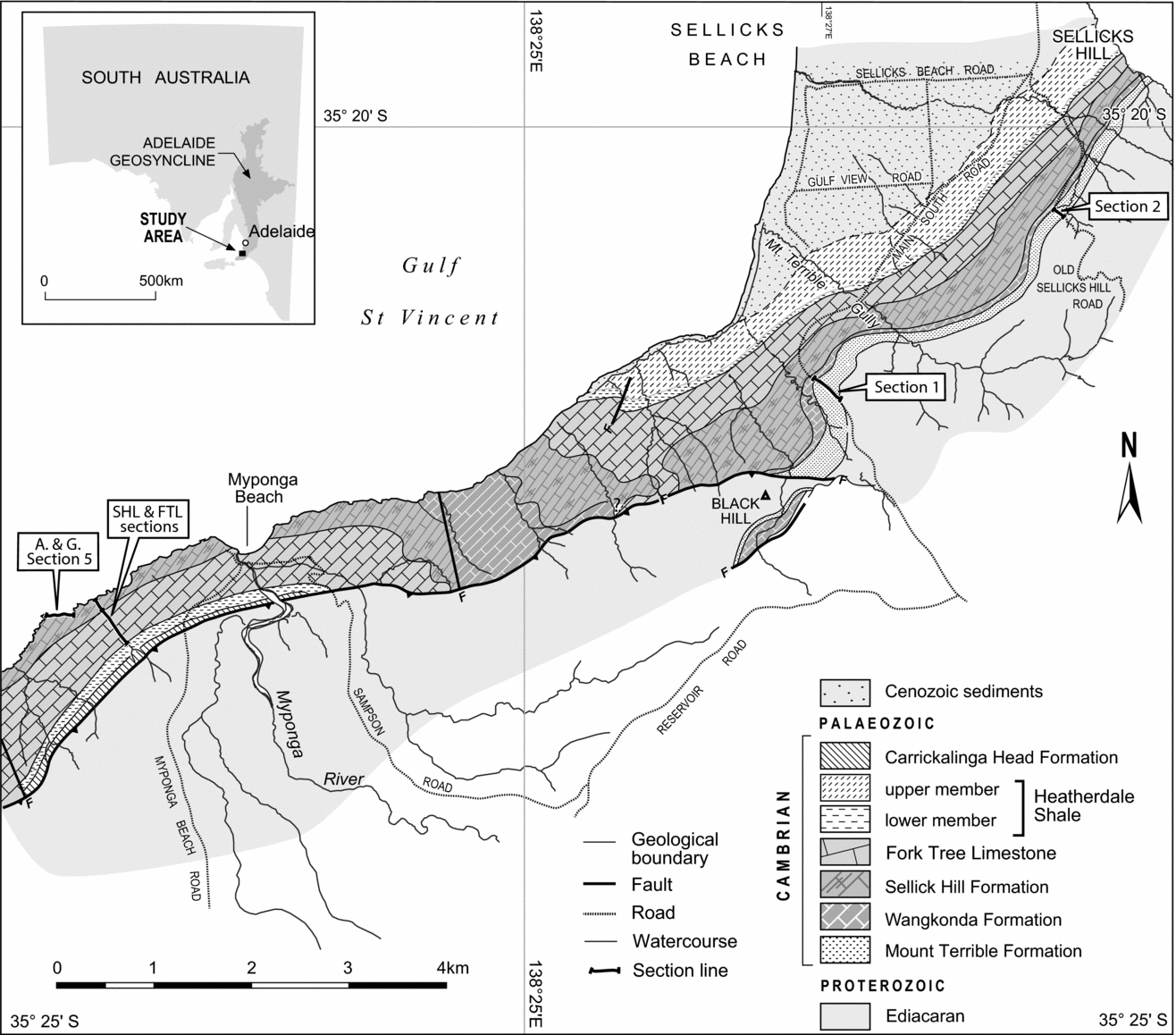
The lower Cambrian Normanville Group (Fig. 1) is a sedimentary package of mixed carbonates, argillites and sandstones exposed along a c. 16km NE–SW-trending coastal tract in the Sellicks Hill–Normanville area on Fleurieu Peninsula, c. 50km south of Adelaide. Early geological and stratigraphic investigations into the Cambrian rocks of this region include the work of Howchin (Reference Howchin1897) and Madigan (Reference Madigan1925, Reference Madigan1927) with detailed mapping and stratigraphy by Abele & McGowan (Reference Abele and McGowran1959) and Daily (Reference Daily1963, Reference Daily, Jones and McGowran1972, Reference Daily1976 b).
Regional geological map of the Normanville Group between Sellicks Hill and Normanville along the Fleurieu Peninsula, South Australia. Measured stratigraphic sections indicated.

The Normanville Group consists of an approximately 1km thick succession of predominantly marine shelf to ramp/slope limestones and shales, with minor arkosic and calcareous sandstones towards the base and significant deposits of black, pyritic shale towards the top. The entire succession represents a transgressive marine event (sequence set Є1 of Gravestock, Reference Gravestock, Drexel and Preiss1995) beginning with a shallow subtidal environment at the base, followed by a shallow shelf setting with archaeocyathan-microbial bioherms, through to a deep-water environment and eventually a mudstone-dominated, basinal setting at the top (Alexander & Gravestock, Reference Alexander and Gravestock1990; Jago, Dyson & Gatehouse, Reference Jago, Dyson and Gatehouse1994; Gravestock & Gatehouse, Reference Gravestock, Gatehouse, Drexel and Preiss1995; Gravestock et al. Reference Gravestock, Alexander, Demidenko, Esakova, Holmer, Jago, Lin, Melnikova, Parkhaev, Rozanov, Ushatinskaya, Zang, Zhegallo and Zhuravlev2001; Jenkins, Cooper & Compston, Reference Jenkins, Cooper and Compston2002).
In their detailed study of the lithology and stratigraphy of lower Cambrian rocks in the Sellicks Hill–Normanville region, Abele & McGowran (Reference Abele and McGowran1959) recognized four distinct and predominantly calcareous units (in ascending order with true thickness): Wangkonda Formation (110 m); Sellick Hill Formation (210 m); Fork Tree Limestone (300 m); and Heatherdale Shale (300 m). Subsequently, Daily (Reference Daily1963) proposed the name Mount Terrible Formation to define a c. 92 m thick package of dominantly clastic rocks resting unconformably above the Ediacaran ABC Range Quartzite (Wilpena Group) and below the Wangkonda Formation. The lower ‘Hyolithes sandstone’ of Abele & McGowran (Reference Abele and McGowran1959, p. 304), originally placed within the Wangkonda Formation, was recognized as the top member of the Mount Terrible Formation by Daily (Reference Daily1963). Together, these five lithostratigraphic units constitute the Normanville Group (Daily & Milnes, Reference Daily and Milnes1973, p. 4), which is overlain unconformably by the extensive greywackes and shales of the lower Cambrian Kanmantoo Group (Jago et al. Reference Jago, Gum, Burtt and Haines2003; Haines et al. Reference Haines, Turner, Foden and Jago2009).
Almost all of the fossil material described here comes from collections originally made by the late Brian Daily (Section 1 in Fig. 1 = ‘New Sellicks Hill Road’, now Main South Road). Unfortunately, Daily (Reference Daily1963) did not provide details on the exact location of his section through the Mount Terrible Formation. Despite changes caused by re-alignment and widening of the Main South Road since the early 1960s, it is possible to closely approximate the position of his stratigraphic section from his existing field notebooks combined with detailed geological mapping by Abele & McGowran (Reference Abele and McGowran1959). This clearly shows where the ‘Hyolithes sandstone’ (= upper member, Mount Terrible Formation of Daily, Reference Daily1963) intersects the Main South Road (Fig. 1). Daily's field notebooks indicate some of his original sampling along the road section was about 0.8km NNE along strike in Mount Terrible Gully.
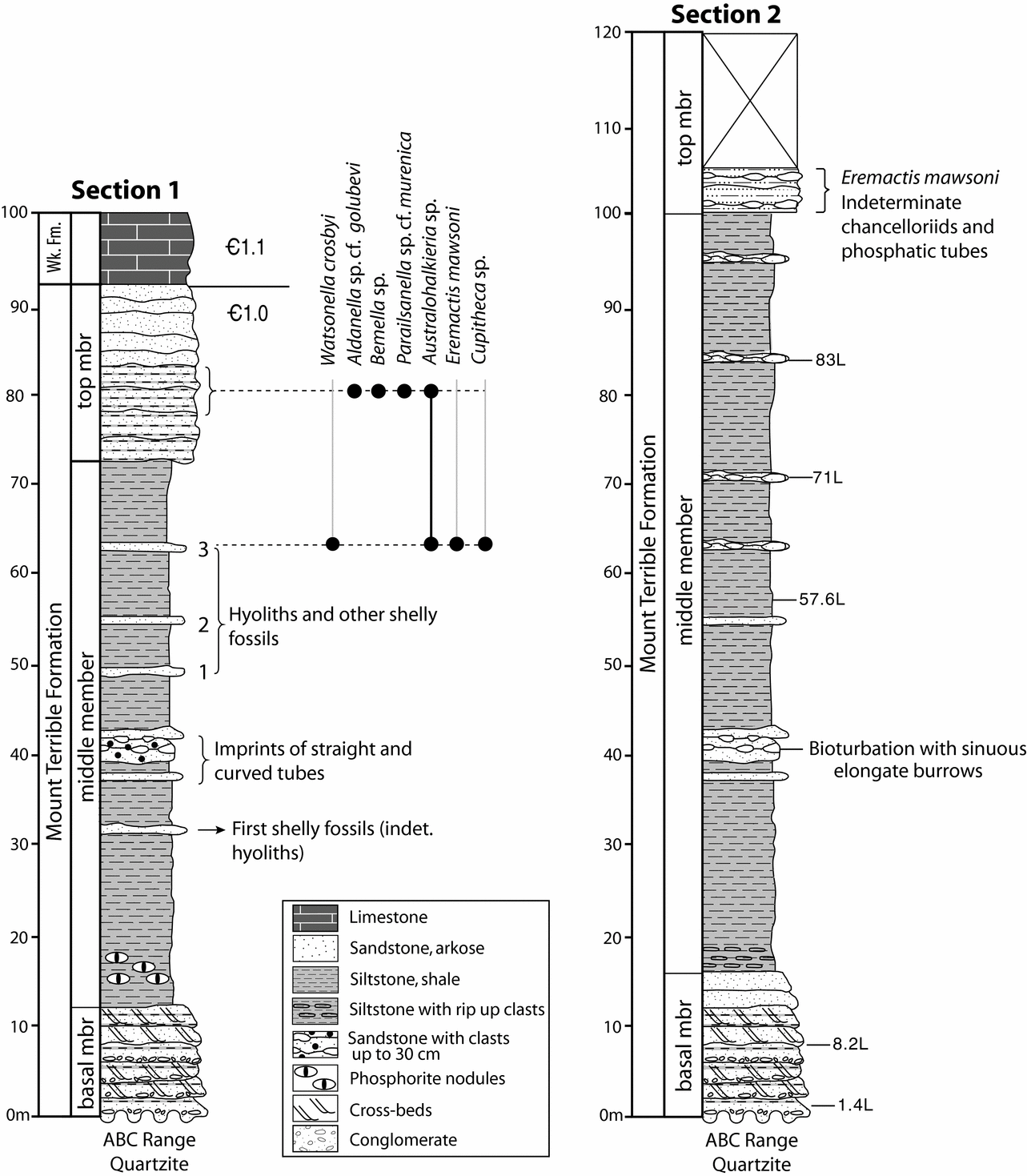
In an attempt to supplement the lithostratigraphic and palaeontological details described by Daily (Reference Daily1963), another section (Section 2, Figs 1, 2) was measured through the Mount Terrible Formation cropping out along Old Sellicks Hill Road, immediately south of Sellicks Hill Quarry and c. 2.8km NNE of Daily's original section. Despite some minor differences in the thickness of the members, the lithologies are remarkably similar (Fig. 1). Unfortunately, despite targeted sampling in the middle and upper members, the section produced very little fossil material (Eremactis mawsoni Bengtson & Conway Morris in Bengtson et al. Reference Bengtson, Conway Morris, Cooper, Jell and Runnegar1990, indeterminate chancelloriids and phosphatic tubes).
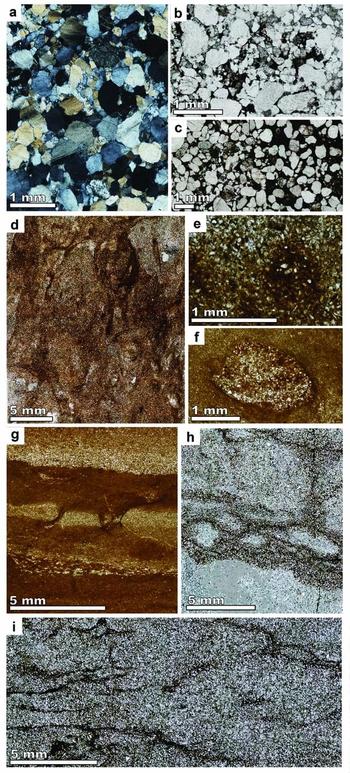
Microfacies from Section 2 (base coordinates: 35°20′30.3″S; 138°28′39.0″E) of the three members of the Mount Terrible Formation. (a–c) Basal member, feldspathic to quartz-rich sandstone; (a) 1.4 m above the base of the section (cross-polarized light); (b, c) 8.2 m above the base of the section; arrows indicate framboidal clusters. (d–g) Middle member, bioturbated siltstones to very fine sandstones, occasionally phosphatic to slightly ferruginized; (d, e) 16.6 m above base of the section; (f, g) 57.6 m above the base of the section, (f) burrow, (g) repeated interlaminae. (h–i) Top member, fine-grained calcareous sandstones siltstone interbeds; (h) 83 m above the base of the section (35°20′28.7″S; 138°28′36.4″E); (i) 100.4 m above base of the section (35°20′28.4″S; 138°28′35.8″E).

3. Lithostratigraphy
3.a. Mount Terrible Formation
Daily (Reference Daily1963, Reference Daily, Jones and McGowran1972, Reference Daily1976 a, b) recognized three informal members of the Mount Terrible Formation. While there is some variation in thickness of the members along strike (Fig. 1), the characteristic lithofacies of all members as described by Daily (Reference Daily1963, Reference Daily, Jones and McGowran1972, Reference Daily1976 a, b) and summarized by Gravestock & Cowley (Reference Gravestock, Cowley, Drexel and Preiss1995), Gravestock et al. (Reference Gravestock, Alexander, Demidenko, Esakova, Holmer, Jago, Lin, Melnikova, Parkhaev, Rozanov, Ushatinskaya, Zang, Zhegallo and Zhuravlev2001, p. 25) and Gravestock & Shergold (Reference Gravestock, Shergold, Zhuravlev and Riding2001) are readily identified in the field.
The Mount Terrible Formation is interpreted to be part of a transgressive systems tract (Є1.0 of Zang et al. Reference Zang, Jago, Alexander, Paraschivoiu, Boult, Johns and Lang2004), equivalent to the Uratanna sequence of Mount & McDonald (Reference Mount and McDonald1992). Despite original claims of conformity (Daily Reference Daily1963, p. 595), there is clearly a disconformable surface separating the lowest member of the Mount Terrible Formation from the underlying quartzites of the Ediacaran ABC Range Quartzite (see also Thomson & Horwitz, Reference Thomson and Horwitz1961). The incised nature of the contact (later noted by Daily, Reference Daily1976 a, p. 48) and the absence of upper Ediacaran rocks between the ABC Range Quartzite and the lowest Cambrian deposits (including the fossiliferous Ediacaran Member in the Rawnsley Quartzite) in the Flinders Ranges indicate a considerable time gap at this stratigraphic level on the Fleurieu Peninsula.
3.a.1. Basal member
The basal member is a feldspathic to quartz-rich sandstone ranging from 12 m to 17 m thick, characterized by thin, planar-tabular bed sets with scoured bases. The basal 3–4 m are comparatively feldspathic, although each bed consists of medium- to coarse-grained quartz-feldspathic arenites with a pebbly, phosphatized base and a bioturbated pyritic siltstone top. Low-angle cross-beds and concordant lineations indicate high-energy conditions in a transgressive marine (possibly marginal marine) environment (Daily, Reference Daily1963, Reference Daily1976 b; Gravestock & Shergold, Reference Gravestock, Shergold, Zhuravlev and Riding2001).
Microfacies reveal a coarse-grained sandstone consisting of a moderately well-sorted mosaic of angular to sub-rounded grains (>1 mm across), predominantly quartz and rare feldspar (plagioclase represents 5–10% of the sample) (Fig. 2a–c). The grains are either tightly packed with no obvious authigenic cement (Fig. 2a) or with a very fine calcareous cement containing iron oxides (possibly hematite; Fig. 2b). The iron oxides are concentrated in some areas to form a dark cement, red at the edges (observable as framboidal clusters), or are coating the quartz grains and filling intergranular spaces (Fig. 2b, c). Some beds (>30 mm thick) exhibit weakly graded bedding which coarsens upwards.
The sediments of the basal member fill small holes and fissures, presumably erosional in origin, in the underlying Ediacaran ABC Range Quartzite (Daily, Reference Daily1976 a). Bioturbation is evident in the pyritic siltstone at the top of the lower member down to 5 m above its base (Daily, Reference Daily1976 a; Gravestock & Shergold, Reference Gravestock, Shergold, Zhuravlev and Riding2001).
3.a.2. Middle member
The middle member ranges in thickness from 60 m to 67 m and comprises grey, highly bioturbated and occasionally phosphatic to slightly ferruginized siltstones to very fine sandstones with weathered, elliptical caverns produced by dissolution of carbonate nodules towards the top of the member. Daily (Reference Daily1963) reported the first shelly fossils (hyoliths) at 20 m above the base of the Main South Road section (Fig. 3) and imprints of indeterminate tubes at 25 m above the base within bands of phosphatic shale (Callen, Reference Callen1971; Daily, Reference Daily1976 a; Gravestock & Shergold, Reference Gravestock, Shergold, Zhuravlev and Riding2001). This package is interpreted as a highstand systems tract (Daily et al. Reference Daily, Firman, Forbes, Lindsay, Twidale, Tyler and Webb1976; Gravestock & Shergold, Reference Gravestock, Shergold, Zhuravlev and Riding2001).
Lithostraigraphic column and biostratigraphy of faunas from the Mount Terrible Formation for Section 1 (after Gravestock & Shergold, Reference Gravestock, Shergold, Zhuravlev and Riding2001, fig. 6.3) and Section 2.

Microfacies of the middle member show the transition to intense sediment mixing, with the original fabric often impacted or destroyed by pervasive, mainly horizontal, bioturbation. In some horizons the fine-grained mottled fabric is represented by uniform, subangular quartz grains (>125 µm) within a frequently hematite-stained calc-silt matrix (Fig. 2d, e). Fabrics unaffected by intensive bioturbation have repeated interlaminae (1–3 mm thick) which are very fine grained and quartz rich, and fine upwards into homogenous silts and micrites (Fig. 2g). Elongate to ovoid clasts within these laminae, often of different lithology to the surrounding matrix, may be compressed in filled horizontal burrows (Fig. 2f).
3.a.3. Top member
In Daily's (Reference Daily1963) section on Main South Road, the top member consists of a 20–30 m package of strongly cavernous, fine-grained calcareous sandstones with pyritic and argillaceous siltstone interbeds. The same lithostratigraphic package in Section 2 (Fig. 3) only exposes the basal beds followed by a c. 20 m covered interval obscuring the contact with the overlying Wangkonda Formation, suggesting the upper member could be slightly thicker than originally measured by Daily (Reference Daily1963). The sandstone is bioturbated, with shelly fossils occurring as phosphatic steinkerns located within a 6 m interval in Section 1 in a weathered band of muddy calcareous siltstone (Daily, Reference Daily1963, Reference Daily and Daily1969; Gravestock & Shergold, Reference Gravestock, Shergold, Zhuravlev and Riding2001; Fig. 3). Microfacies display a predominantly homogeneous fabric of very fine sand- to silt-sized, moderately rounded quartz grains (Fig. 2h, i). Hematite staining is pervasive but forms mainly as irregular wavy solution seams and laminae throughout the unit (Fig. 2h, i).
4. Biostratigraphy
4.a. Regional correlation
4.a.1. Previous work
There has been considerable confusion regarding the age and correlation of the Normanville Group in recent literature. Most contention is traced back to poorly constrained biostratigraphy in the Sellick Hill Formation and the conformably overlying Fork Tree Limestone. Alexander & Gravestock (Reference Alexander and Gravestock1990) conducted a thorough sedimentological study of the Sellick Hill Formation and described five Facies Associations (A to E; oldest to youngest) from coastal exposures along the Fleurieu Peninsula. Although Alexander & Gravestock (Reference Alexander and Gravestock1990) reported the presence of trilobites in Facies Association D of the Sellick Hill Formation, subsequent attempts to locate trilobites in this unit have been unsuccessful. As far as is known there are no substantiated records of trilobites from either the Sellick Hill Formation or the Fork Tree Limestone. Archaeocyaths from the upper Sellick Hill Formation (Facies Association D to E) and lower Fork Tree Limestone have previously been correlated with the Atdabanian–Botoman stages of Siberia (Debrenne & Gravestock, Reference Debrenne, Gravestock, Jago and Moore1990). However, based on the shelly fossil data presented by Betts et al. (Reference Betts, Brock, Jago, Paterson and Andrew2015, Reference Betts, Paterson, Jago, Jacquet, Skovsted, Topper and Brock2016) and the data presented here this correlation requires close investigation. Gravestock (Reference Gravestock1984) and Kruse & Shi (in Brock et al. Reference Brock, Engelbretsen, Jago, Kruse, Laurie, Shergold, Shi and Sorauf2000, p. 14) indicate that the oldest archaeocyaths in the Arrowie Basin are equivalent to Daily's (Reference Daily and Rodgers1956) Faunal Assemblages 1–2, which they suggest are late Atdabanian equivalent in age. However, difficulties including strong endemism (Kruse & Shi in Brock et al. Reference Brock, Engelbretsen, Jago, Kruse, Laurie, Shergold, Shi and Sorauf2000) and identification of archaeocyaths (Gravestock et al. Reference Gravestock, Alexander, Demidenko, Esakova, Holmer, Jago, Lin, Melnikova, Parkhaev, Rozanov, Ushatinskaya, Zang, Zhegallo and Zhuravlev2001) remain a primary concern regarding their utility for regional correlation (Jenkins, Cooper & Compston, Reference Jenkins, Cooper and Compston2002; Peng, Babcock & Cooper, Reference Peng, Babcock, Cooper, Gradstein, Ogg, Schmitz and Ogg2012).
Adding to the confusion surrounding the age of the Normanville Group succession are the assemblage ‘zones’ (especially molluscan zones) erected by Gravestock et al. (Reference Gravestock, Alexander, Demidenko, Esakova, Holmer, Jago, Lin, Melnikova, Parkhaev, Rozanov, Ushatinskaya, Zang, Zhegallo and Zhuravlev2001) based on drill cores and stratigraphic sections measured in the Stansbury Basin. Gravestock et al. (Reference Gravestock, Alexander, Demidenko, Esakova, Holmer, Jago, Lin, Melnikova, Parkhaev, Rozanov, Ushatinskaya, Zang, Zhegallo and Zhuravlev2001) correlated the upper Wangkonda Formation and lower Sellick Hill Formation (Facies Association A of Alexander & Gravestock, Reference Alexander and Gravestock1990) with their Bemella communis zone and the remainder of the Sellick Hill Formation (uppermost Facies Association A to C) to the Stenotheca drepanoida zone. These molluscan zones were suggested to have an Atdabanian age and to correlate with the Abadiella huoi (for discussion of genus see Paterson & Brock, Reference Paterson and Brock2007, p. 127; Landing et al. Reference Landing, Geyer, Brasier and Bowring2013, p. 159) and Pararaia tatei trilobite zones of the Arrowie Basin, despite the fact that trilobites are completely unknown from the Wangkonda and Sellick Hill formations. This correlation was reported in subsequent publications (e.g. Gubanov, Reference Gubanov2002; Parkhaev, Karlova & Rozanov, Reference Parkhaev, Karlova and Rozanov2012; Landing et al. Reference Landing, Geyer, Brasier and Bowring2013). However, the molluscan biozones of Gravestock et al. (Reference Gravestock, Alexander, Demidenko, Esakova, Holmer, Jago, Lin, Melnikova, Parkhaev, Rozanov, Ushatinskaya, Zang, Zhegallo and Zhuravlev2001) have very poorly defined boundaries and are based on poorly preserved, long-ranging taxa. Close inspection of the data given by Gravestock et al. (Reference Gravestock, Alexander, Demidenko, Esakova, Holmer, Jago, Lin, Melnikova, Parkhaev, Rozanov, Ushatinskaya, Zang, Zhegallo and Zhuravlev2001) reveals clear temporal discrepancies between the sections on the Yorke and Fleurieu peninsulas (Betts et al. Reference Betts, Paterson, Jago, Jacquet, Skovsted, Topper and Brock2016). For instance, Gravestock et al. (Reference Gravestock, Alexander, Demidenko, Esakova, Holmer, Jago, Lin, Melnikova, Parkhaev, Rozanov, Ushatinskaya, Zang, Zhegallo and Zhuravlev2001, p. 38) state that ‘the lower boundary of the Bemella communis ‘zone’ is established by the appearance of Bemella communis. . . and Aroonia seposita’ in the Aquitaine SYC-101 well, while in the SADME Minlaton 1 drillhole, they state that the base of the B. communis zone is equivalent to the first appearance of the index species only (p. 44). In fact, no species recorded in the B. communis zone, not even the eponym, is common to all records of that zone. Indeed, the only species representative of the B. communis zone in the Yalkalpo-2 drill core is Pelagiella subangulata (Tate, Reference Tate1892), which is the eponym of the zone below the B. communis zone. The holotype of B. communis (PIN 4664/1331) is a poorly preserved phosphatic steinkern (Gravestock et al. Reference Gravestock, Alexander, Demidenko, Esakova, Holmer, Jago, Lin, Melnikova, Parkhaev, Rozanov, Ushatinskaya, Zang, Zhegallo and Zhuravlev2001, pl. XXIX, fig. 2a–c) from sample SH22 in Facies Association A of the Sellick Hill Formation at a level taken to correspond to the boundary between the B. communis and S. drepanoida zones.
4.a.2. Current study
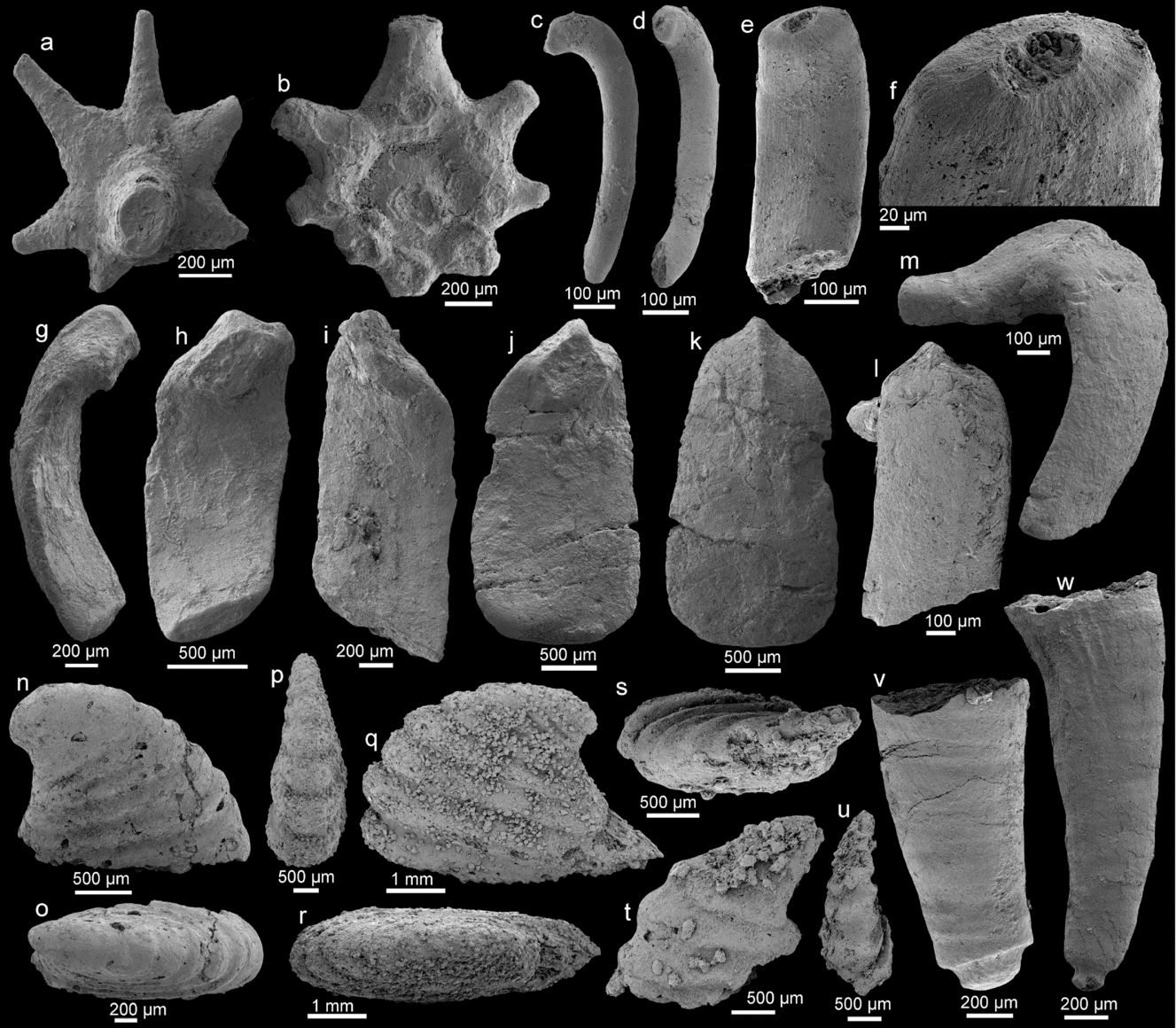
Shelly fossils were recovered from two stratigraphic levels within the Mount Terrible Formation: from the topmost silty-sandstone layer within the middle member, about 63 m above the base of the section; and an approximately 4 m interval (at 79–83 m above the base of the section) within the top member (= Section 1, Fig. 3). The fauna is composed mainly of molluscs (W. crosbyi, Aldanella sp. cf. golubevi, Bemella sp., Parailsanella sp. cf. murenica Zhegallo in Esakova & Zhegallo, Reference Esakova and Zhegallo1996), as well as Eremactis mawsoni Bengtson & Conway Morris in Bengtson et al. Reference Bengtson, Conway Morris, Cooper, Jell and Runnegar1990, Australohalkieria sp., Hyolithellus micans Billings, Reference Billings1871 and Cupitheca sp. This assemblage represents the oldest known shelly fossil assemblage from Australia. Micromolluscs W. crosbyi and A. sp. cf. A. golubevi are described in detail below (Section 5, Systematic palaeontology). Other faunal elements are illustrated for completeness, but poor preservation precludes assignment to species for most taxa (Fig. 4).
(a, b) Indeterminate chancelloriid sclerites; (a) SAM P53318, plan view; (b) SAM P53319, basal view. (c–f) Eremactis mawsoni Bengtson & Conway Morris in Bengtson et al. Reference Bengtson, Conway Morris, Cooper, Jell and Runnegar1990; (c, d) SAM P53320; (c) lateral view; (d) oblique lateral view; (e, f) SAM P53321; (e) lower surface; (f) oblique view of foramen. (g–m) Australohalkieria sp. (g–h) SAM P53322, palmate sclerite; (g) lateral view; (h) lower surface. (i) SAM P53323, palmate sclerite, lower surface. (j, k) SAM P53324, cultrate sclerite; (j) lower surface; (k) upper surface. (l, m) SAM P53325, top member of the Mount Terrible Formation; cultrate sclerite; (l) upper surface; (m) lateral view. (n–r) Bemella sp. (n, o) SAM P53326; (n) lateral view; (o) apical view. (p–r) SAM P53327; (p) supra-apical view; (q) lateral view; (r) apical view. (s–u) Parailsanella sp. cf. murenica Zhegallo in Esakova & Zhegallo, Reference Esakova and Zhegallo1996, SAM P53328. (s) apical view; (t) lateral view; (u) supra-apical view. (v–w) Cupitheca sp. (v) SAM P53329; (w) SAM P53330.

The univalved molluscs Bemella sp. and W. crosbyi range from the middle member of the Mount Terrible Formation (Fig. 3) into Facies Association C of the Sellick Hill Formation (see Gravestock et al. Reference Gravestock, Alexander, Demidenko, Esakova, Holmer, Jago, Lin, Melnikova, Parkhaev, Rozanov, Ushatinskaya, Zang, Zhegallo and Zhuravlev2001, fig. 17). Jenkins, Cooper & Compston (Reference Jenkins, Cooper and Compston2002) reported (but did not figure) Watsonella sibirica (Missarzhevsky, Reference Missarzhevsky, Zhuravleva and Rozanov1974) from the middle member of the Mount Terrible Formation in a restudy of material collected by Brian Daily. Watsonella sibirica is now considered a synonym of Watsonella crosbyi (Landing, Reference Landing1989; Kouchinsky, Reference Kouchinsky1999; Li et al. Reference Li, Zhao, Gubanov, Zhu and Na2011; Devaere et al. Reference Devaere, Clausen, Steiner, Álvaro and Vachard2013). The halkieriid Australohalkieria sp. originally described (as Halkieria sp. A) by Bengtson et al. (Reference Bengtson, Conway Morris, Cooper, Jell and Runnegar1990, p. 77) is now known to range from the middle member of the Mount Terrible Formation up into the Wangkonda Formation (Fig. 3; Bengtson et al. Reference Bengtson, Conway Morris, Cooper, Jell and Runnegar1990, fig. 49A–I). The coeloscleritophoran Eremactis mawsoni ranges from the middle member of the Mount Terrible Formation to Facies Association D of the Sellick Hill Formation in the Normanville Group.
Regional correlation of the Mount Terrible Formation and lithostratigraphic equivalents, including the Winulta Formation (Daily, Reference Daily, Jago and Moore1990) in the western Stansbury Basin (Yorke Peninsula) and at least, partially, the Uratanna Formation (Daily, Reference Daily1973) in the Arrowie Basin, has been hampered by lack of fossils (Daily, Reference Daily, Jones and McGowran1972). Faunal ties between the lowermost Cambrian units on Yorke and Fleurieu peninsulas are limited to indeterminate, long-ranging hyoliths and chancelloriids. The enigmatic sabelliditids (organic-walled tubes) were reported by Daily (Reference Daily1976 a) from the Mount Terrible Formation (lower part of the top member) and from the Uratanna Formation (lower 100–150 m) by Mount & McDonald (Reference Mount and McDonald1992), but these are taxonomically intractable and consequently difficult to utilize for correlation.
The coarse-grained and intensely bioturbated facies of the lowermost c. 60 m of the Mount Terrible Formation was not conducive to the preservation of shelly fossils. The predominance of siliciclastics in the eastern Stansbury and the Arrowie basins explains the absence of W. crosbyi and associated shelly taxa from these regions. The local first occurrence and range of W. crosbyi in the Mount Terrible Formation therefore track lithofacies changes into calcareous sandstone, so are clearly lithofacies-specific (Jacquet, Betts & Brock, Reference Jacquet, Betts, Brock, Laurie, Kruse, García-Bellido and Holmes2016). While the occurrence of W. crosbyi in the Mount Terrible Formation is clearly within Stage 2, this cannot be construed as necessarily correlating with the first appearance of the taxon on a global scale.
Siliciclastic depositional settings are often conducive to the preservation of trace fossils. In the absence of diverse early Cambrian skeletal fauna, the potential for using trace fossils for intra- and inter-basin correlation in South Australian successions has long been recognized (Daily, Reference Daily, Jones and McGowran1972; Gravestock & Shergold, Reference Gravestock, Shergold, Zhuravlev and Riding2001). The predominantly shallow-marine to sub-tidal siliciclastic strata of the basal Cambrian successions in Australia record a transition from an assemblage dominated by shallow-burrowing, architecturally complex traces to an assemblage which is monospecific or of low-diversity and characterized by significantly increased burrowing depth (>1 m) (Màngano & Buatois, Reference Mángano and Buatois2014). Màngano & Buatois (Reference Mángano and Buatois2014) have demonstrated that a clear change in behaviour and benthic community structure, with the emergence of vertical U-shaped burrows (with spreite) such as Diplocraterion, is widespread during the Cambrian Radiation.
While bioturbation is pervasive in the middle member of the Mount Terrible Formation, no ichnotaxa can be clearly identified. In contrast, trace fossils present in the contemporaneous Uratanna Formation in the Arrowie Basin are well documented and include important ichnogenera and species such as Trichophycus pedum (used to define the Ediacaran–Cambrian boundary) and Rusophycus spp. in the uppermost part (Daily, Reference Daily, Jones and McGowran1972, Reference Daily1976 a; Mount, Reference Mount1989; Gravestock & Cowley, Reference Gravestock, Cowley, Drexel and Preiss1995). These ichnotaxa also extend into the lower Parachilna Formation (Jensen, Gehling & Droser, Reference Jensen, Gehling and Droser1998; Gravestock & Shergold, Reference Gravestock, Shergold, Zhuravlev and Riding2001). Trace fossils have also been reported from outcrop in the Winulta Formation (Trichophycus pedum, Plagiogmus arcuatus and Diplocraterion sp.) (Gravestock & Shergold, Reference Gravestock, Shergold, Zhuravlev and Riding2001), the Arumbera Sandstone in the Amadeus Basin (Rusophycus sp., T. pedum, Diplichnites sp. and Plagiogmus sp.) and the Mount Baldwin Formation in the Georgina Basin (Bergaueria sp., Helminthopsis sp., Treptichnus sp. and Diplocraterion parallelum) (Glaessner, Reference Glaessner1969; Daily, Reference Daily, Jones and McGowran1972; Gravestrock & Shergold, Reference Gravestock, Shergold, Zhuravlev and Riding2001). Diplocraterion burrows first appear in the sandy interbeds of the Wangkonda Formation on the Fleurieu Peninsula (Daily, Reference Daily1976 a), and traces identified as D. paralellum are extremely abundant in beds in the lower part of the Parachilna Formation in the Arrowie Basin (Gravestock & Cowley, Reference Gravestock, Cowley, Drexel and Preiss1995; Màngano & Buatois, Reference Mángano and Buatois2014).
The global shift to an advection-dominated system resulting from deep-tiering benthic communities forming straight and U-shaped burrow systems is characteristic of the Terreneuvian, Stage 2 (Màngano & Buatois, Reference Mángano and Buatois2014, fig. 1). This provides some measure of biostratigraphic control for the Mount Terrible Formation, with the first appearance of Watsonella crosbyi below that of Diplocraterion piperock in the overlying Wangkonda Formation therefore indicating an interval broadly equivalent with Cambrian Stage 2.
Watsonella crosbyi was reported from two horizons in Facies Association A and C of the Sellick Hill Formation, which overlies the Wangkonda Formation (Parkhaev in Gravestock et al. Reference Gravestock, Alexander, Demidenko, Esakova, Holmer, Jago, Lin, Melnikova, Parkhaev, Rozanov, Ushatinskaya, Zang, Zhegallo and Zhuravlev2001, pl. XLII, figs 15, 16). Revaluation of the taxa occurring within the upper range of Watsonella crosbyi in the Sellick Hill Formation illustrated by Gravestock et al. (Reference Gravestock, Alexander, Demidenko, Esakova, Holmer, Jago, Lin, Melnikova, Parkhaev, Rozanov, Ushatinskaya, Zang, Zhegallo and Zhuravlev2001) include Bemella communis Parkhaev in Gravestock et al. (Reference Gravestock, Alexander, Demidenko, Esakova, Holmer, Jago, Lin, Melnikova, Parkhaev, Rozanov, Ushatinskaya, Zang, Zhegallo and Zhuravlev2001), B. incomparabilis Parkhaev in Gravestock et al. (Reference Gravestock, Alexander, Demidenko, Esakova, Holmer, Jago, Lin, Melnikova, Parkhaev, Rozanov, Ushatinskaya, Zang, Zhegallo and Zhuravlev2001), Obtusoconus brevis Zhegallo in Esakova & Zhegallo (Reference Esakova and Zhegallo1996), Anuliconus truncatus Parkhaev in Gravestock et al. (Reference Gravestock, Alexander, Demidenko, Esakova, Holmer, Jago, Lin, Melnikova, Parkhaev, Rozanov, Ushatinskaya, Zang, Zhegallo and Zhuravlev2001) and Australohalkieria parva (Conway Morris in Bengtson et al. Reference Bengtson, Conway Morris, Cooper, Jell and Runnegar1990); most are represented by incomplete steinkerns. These co-occurring taxa are either restricted to the Sellick Hill Formation or have very long stratigraphic ranges. The last occurrence of W. crosbyi low in Facies Association C of the Sellick Hill Formation is c. 50 m below the first occurrence of the widespread tommotiid Sunnaginia imbricata Missarzhevsky in Rozanov et al. (Reference Rozanov, Missarzhevsky, Volkova, Voronova, Krylov, Keller, Korolyuk, Lendzion, Michniak, Pychova and Sidorov1969), which occurs through Facies Association C to E of the SHL section (Fig. 5).
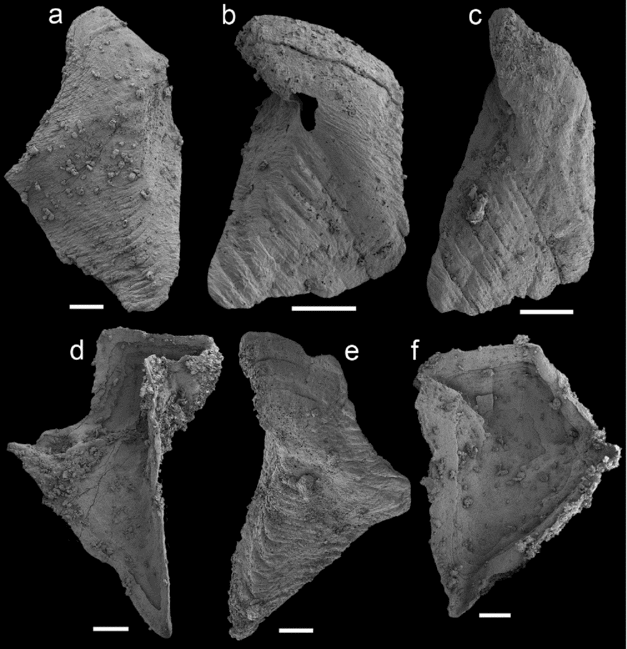
Sunnaginia imbricata Missarzhevsky in Rozanov et al. Reference Rozanov, Missarzhevsky, Volkova, Voronova, Krylov, Keller, Korolyuk, Lendzion, Michniak, Pychova and Sidorov1969 from the Sellick Hill Formation (SHL section base coordinates: 35°22′36.30″S; 138°22′5.30″E); scale bars: 200 µm. (a, b) Dextral sclerites from SHL/82.5, 56.3 m true thickness, Facies Association E; (a) apical view, SAM P53342; (b) apical view, SAM P53343. (c–f) Dextral sclerites from SHL/50.9, 34.7 m true thickness, Facies Association D; (c) apical view, SAM P53344; (d) adapical view, SAM P53345; (e) apical view, SAM P53346; (f) adapical view, SAM P53347.

New stratigraphic sections (SHL and FTL, Fig. 1) measured through upper Facies Association C of the Sellick Hill Formation through the entire Fork Tree Limestone reveal shelly assemblages including Kulparina rostrata, Dailyatia ajax, D. macroptera and a probable new species of the paterinid brachiopod, Askepasma. This assemblage represents the Kulparina rostrata Zone, recently defined in the Arrowie Basin by Betts et al. (Reference Betts, Paterson, Jago, Jacquet, Skovsted, Topper and Brock2016), and entirely pre-dates the incoming of trilobites. This strongly supports a pre-trilobitic, Terrenuevian, Stage 2 age for all units of the Normanville Group below the Heatherdale Shale.
The 300 m thick succession of deep-water, fine-grained siliciclastics of the Heatherdale Shale overlies the Fork Tree Limestone. This unit is generally poorly fossiliferous, although the presence of trilobites (Jago et al. Reference Jago, Daily, Von Der Borch, Cernovskis and Saunders1984; Jenkins & Hasenohr, Reference Jenkins and Hasenohr1989) and bivalved arthropods (Isoxys) (Jago et al. Reference Jago, Gatehouse, Alexander, Cooper, Jago and Zang2006; Paterson et al. Reference Paterson, Edgecombe, García-Bellido, Jago and Gehling2010) suggests a P. janeae Zone age for the upper part of the Heatherdale Shale.
4.b. Global correlation
Daily (Reference Daily, Jones and McGowran1972, Reference Daily1976 a) first suggested the Mount Terrible Formation could be correlated with the Tommotian Stage of Siberia based on shelly faunas (including Watsonella) and sabellitids. This view was later supported by Jenkins, Cooper & Compston (Reference Jenkins, Cooper and Compston2002) who proposed that the occurrence of W. sibirica (= W. crosbyi) in the middle member of the Mount Terrible Formation was evidence of an early–middle Tommotian-equivalent age. Our correlation is mainly based on the occurrence of Watsonella crosbyi and Aldanella sp. cf. golubevi as well as the shelly fauna and trace fossils in overlying strata. Watsonella crosbyi is widely distributed in upper Terreneuvian strata (discussed further below), and A. golubevi is known only from transitional Fortunian Stage 2 strata of Siberia. However, other species of Aldanella have longer stratigraphic ranges in the Terreneuvian (Parkhaev & Karlova, Reference Parkhaev and Karlova2011; Parkhaev, Reference Parkhaev2014). Other taxa recovered from the Mount Terrible Formation are long-ranging and are therefore less useful for global correlation. However, the stratigraphic range of S. imbricata has previously been used to define a biozone in the pre-trilobite Bonavista Group in Newfoundland which succeeds the Watsonella crosbyi Zone of the underlying Chapel Island Formation (Fig. 6) (Landing, Reference Landing1988; Landing et al. Reference Landing, Myrow, Benus and Narbonne1989; Palacios et al. Reference Palacios, Jensen, Barr, White and Miller2011). Similarly, the interval with Sunnaginia imbricata in Facies Association C though to E of the Sellick Hill Formation (c. 50 m above the last local appearance of W. crosbyi in the lower part of Facies Association C) provides strong evidence that the Mount Terrible Formation represents the early part of Cambrian Stage 2 (Fig. 6).
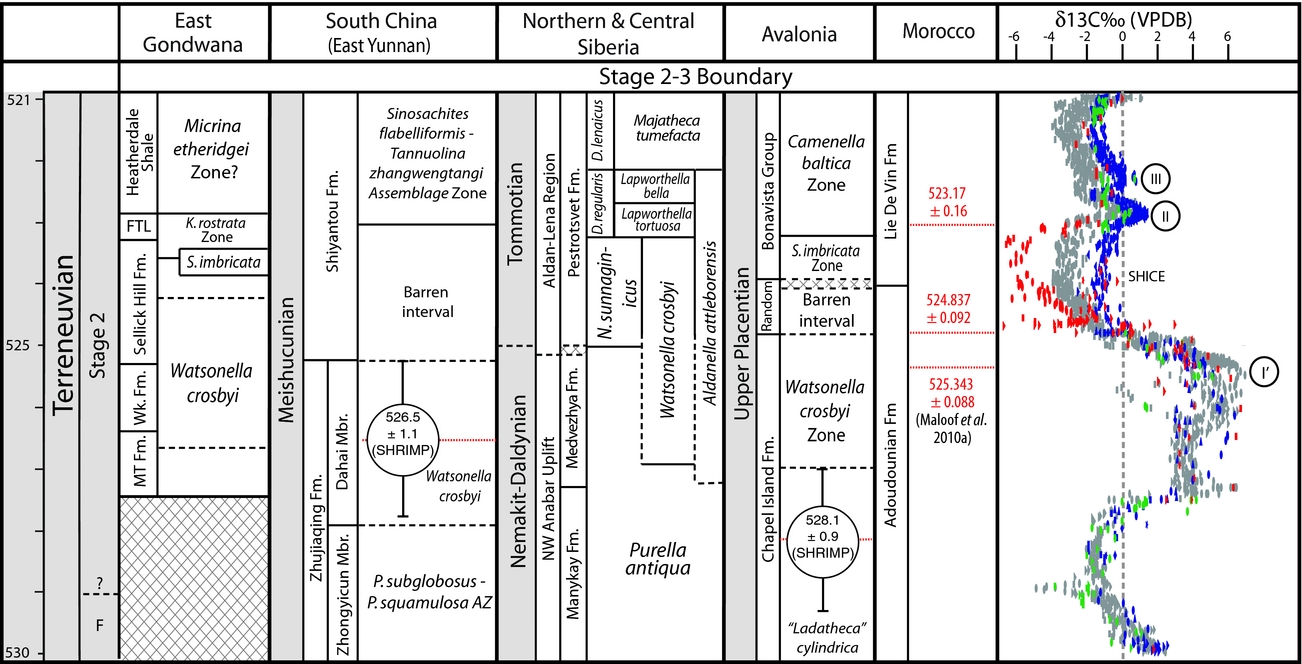
Global chronostratigraphic correlation chart of Terreneuvian Series, Fortunian and Stage 2. Biostratigraphic and biozone data from Steiner et al. (Reference Steiner, Li, Qian, Zhu and Erdtmann2007), Kouchinsky et al. (Reference Kouchinsky, Bengtson, Runnegar, Skovsted, Steiner and Vendrasco2012), Devaere et al. (Reference Devaere, Clausen, Steiner, Álvaro and Vachard2013), Landing et al. (Reference Landing, Geyer, Brasier and Bowring2013) and Landing & Kouchinsky (Reference Landing and Kouchinsky2016). Isotopic data from Maloof et al. (Reference Maloof, Porter, Moore, Dudás, Bowring, Higgins, Fike and Eddy2010 a) and geochronological data from Maloof et al. (Reference Maloof, Porter, Moore, Dudás, Bowring, Higgins, Fike and Eddy2010 a) and Compston et al. (Reference Compston, Zhang, Cooper, Ma and Jenkins2008). Error bars have been included for SHRIMP dates.

In connection with recent efforts to define the chronostratigraphic divisions of the Cambrian period, the stratigraphic range of Watsonella crosbyi has been extensively studied. Watsonella crosbyi is one of the most widely distributed shelly fossils in the early part of the Cambrian period (Terreneuvian) with a near-global distribution (online Supplementary Table S1, available at http://journals.cambridge.org/geo) and has been suggested as a suitable index fossil to define the lower boundary of the Cambrian Stage 2 (Terreneuvian Series) (Li et al. Reference Li, Zhao, Gubanov, Zhu and Na2011; Peng & Babcock, Reference Peng and Babcock2011). However, the utility of W. crosbyi for global correlation has also been questioned because of the supposed long stratigraphic range of the taxon (Parkhaev, Karlova & Rozanov, Reference Parkhaev, Karlova and Rozanov2012; Landing et al. Reference Landing, Geyer, Brasier and Bowring2013). Restudy of the stratigraphic range of W. crosbyi in France (Devaere et al. Reference Devaere, Clausen, Steiner, Álvaro and Vachard2013), Siberia (Landing & Kouchinsky, Reference Landing and Kouchinsky2016), Mongolia (Brasier et al. Reference Brasier, Shields, Kuleshov and Zhegallo1996) and Australia (this article) suggests that it is restricted to early–middle Stage 2 (Fig. 6). However, in Avalonia W. crosbyi has been reported to range from Member 3 of the Chapel Island Formation (W. crosbyi Zone) into the Fosters Point Formation (Camenella baltica Zone) in horizons suggested to correlate with the first appearance of trilobites in Siberia (Landing, Reference Landing1989; Landing et al. Reference Landing, Geyer, Brasier and Bowring2013).
In Siberia, the first appearance of W. crosbyi has usually been suggested to coincide with the base of the Tommotian Stage (Nochoroicyathus sunnaginicus Zone; Rozanov et al. Reference Rozanov, Khomentovsky, Shabanov, Karlova, Varlamov, Luchinina, Demidenko, Parkhaev, Korovnikov and Skorlotova2008). However, it has recently been shown that W. crosbyi occurs substantially below the base of the Tommotian Stage in northern Siberia (Fig. 6) (Nagovitsyn et al. Reference Nagovitsin, Rogov, Marusin, Karlova, Kolesnikov, Bykova and Grazhdankin2015; Landing & Kouchinsky, Reference Landing and Kouchinsky2016). As a complication, the base of the Tommotian remains poorly defined; it is ultimately based on the simultaneous incoming of numerous taxa, coinciding with a hiatus at the base of the Pestrotsvet Formation in the stratotype Dvortsy section in southern Siberia (Landing et al. Reference Landing, Geyer, Brasier and Bowring2013; Landing & Kouchinsky, Reference Landing and Kouchinsky2016).
The W. crosbyi Assemblage Zone in South China (Steiner et al. Reference Steiner, Li, Qian, Zhu and Erdtmann2007; Li et al. Reference Li, Zhao, Gubanov, Zhu and Na2011) is usually correlated with the basal Tommotian Stage of Siberia, although Landing & Kouchinsky (Reference Landing and Kouchinsky2016) suggest that it is better correlated with pre-Tommotian strata in northern Siberia (the Ary-Mas-Yuryakh and Kotujkan River sections). The stratigraphic range of W. crosbyi in Mongolia has also been controversial, with some authors correlating strata in the upper Bayan-Gol Formation containing W. crosbyi with either the Atdabanian (Brasier et al. Reference Brasier, Shields, Kuleshov and Zhegallo1996; Landing et al. Reference Landing, Geyer, Brasier and Bowring2013) or Tommotian (Esakova & Zhegallo, Reference Esakova and Zhegallo1996) stages of Siberia. These views have recently been challenged by Smith et al. (Reference Smith, Macdonald, Petach, Bold and Schrag2015) who argue that this interval is pre-Tommotian based largely on new carbon chemostratigraphic isotope data. Similarly, in the Montagne Noire of France, strata containing W. crosbyi have been correlated with the Botoman (Kerber, Reference Kerber1988), Tommotian (Devaere et al. Reference Devaere, Clausen, Steiner, Álvaro and Vachard2013) and pre-Tommotian stages of Siberia (Landing & Kouchinsky, Reference Landing and Kouchinsky2016).
The global first appearance of W. crosbyi is now demonstrated to occur in strata that pre-date the base of the Tommotian Stage of Siberia (as defined by the FAD of N. sunnaginicus) based on carbon isotope stratigraphy from Mongolia, South China, Siberia and Avalonia (Fig. 6) (Smith et al. Reference Smith, Macdonald, Petach, Bold and Schrag2015; Landing & Kouchinsky Reference Landing and Kouchinsky2016). In all these regions, the FAD of W. crosbyi occur below significant positive δ13C excursions (L4 in China, Li et al. Reference Li, Ling, Jiang, Pan, Chen, Cai and Feng2009; I' in Bol'shaya Kounamka and the Ary Mas Yuryakh section of northern and eastern Siberia, Knoll et al. Reference Knoll, Grotzinger, Kaufman and Kolosov1995, Kouchinsky et al. Reference Kouchinsky, Bengtson, Missarzhevsky, Pelechaty, Torssander and Valkov2001, Landing & Kouchinsky, Reference Landing and Kouchinsky2016; and F in Mongolia, Brasier et al. Reference Brasier, Shields, Kuleshov and Zhegallo1996) which correlate with the 6p excursion in Morocco following Maloof et al. (Reference Maloof, Porter, Moore, Dudás, Bowring, Higgins, Fike and Eddy2010 a).
Caution is advised when correlating carbon isotope curves between continents, especially in the absence of comprehensive biostratigraphic data. Carbon isotope data are lacking for strata containing W. crosbyi in the Montagne Noire of France, but the associated fauna closely corresponds with that from the W. crosbyi Zone of South China (Devaere et al. Reference Devaere, Clausen, Steiner, Álvaro and Vachard2013) and is therefore likely pre-Tommotian equivalent.
In Australia, the Mount Terrible Formation consists predominantly of siliciclastics and is therefore unsuitable for δ13C chemostratigraphic analyses. Betts et al. (Reference Betts, Brock, Jago, Paterson and Andrew2015) presented preliminary carbon-isotope chemostratigraphy measured through the upper 62 m of the Sellick Hill Formation (Facies Association C to E) in the SHL section, Myponga (Fig. 1). The isotopic curve has values from –2 to –4 per mil, presenting a distinctly negative trend similar to the global Shiyantou carbon isotope excursion (SHICE) (Zhu, Babcock & Peng, Reference Zhu, Babcock and Peng2006). More comprehensive sampling and isotopic analyses of carbonates from the Wangkonda and Sellick Hill formations above the Mount Terrible Formation on Fleurieu Peninsula will be presented elsewhere.
The apparently disjunct occurrences of W. crosbyi in France (Kerber, Reference Kerber1988), Mongolia (Brasier et al. Reference Brasier, Shields, Kuleshov and Zhegallo1996) and South Australia (Gravestock et al. Reference Gravestock, Alexander, Demidenko, Esakova, Holmer, Jago, Lin, Melnikova, Parkhaev, Rozanov, Ushatinskaya, Zang, Zhegallo and Zhuravlev2001) have been used as arguments for the supposed diachroneity of the FAD of W. crosbyi (Rozanov et al. Reference Rozanov, Khomentovsky, Shabanov, Karlova, Varlamov, Luchinina, Demidenko, Parkhaev, Korovnikov and Skorlotova2008; Parkhaev, Karlova & Rozanov, Reference Parkhaev, Karlova and Rozanov2012; Landing et al. Reference Landing, Geyer, Brasier and Bowring2013). However, revision of anomalous occurrences has shown that the range of W. crosbyi correlates most closely with the late Nemakit–Daldynian and early Tommotian stages of Siberia (Devaere et al. Reference Devaere, Clausen, Steiner, Álvaro and Vachard2013; Smith et al. Reference Smith, Macdonald, Petach, Bold and Schrag2015; this article). In fact, the only area where W. crosbyi has a range that includes strata above upper Tommotian deposits are in Avalonian Newfoundland. There, W. crosbyi is reported to have a 650 m thick composite stratigraphic interval (Chapel Island to Fosters Point Formation; Landing, Reference Landing1989; Landing et al. Reference Landing, Geyer, Brasier and Bowring2013). However, this range includes the unfossiliferous strata of the Random Formation (Fig. 6). Based on the changes in the perceived stratigraphic ranges and correlations of W. crosbyi in Mongolia, France, Siberia and Australia, the long stratigraphic range of the species in Avalonia seems to invite reinvestigation, especially since the record of this taxon is largely based on relatively poorly preserved specimens on bedding surfaces (Bengtson & Fletcher, Reference Bengtson and Fletcher1983).
5. Systematic palaeontology
All specimens are housed in the palaeontological collections of the South Australian Museum (Prefix SAM P).
Phylum MOLLUSCA Linnaeus, Reference Linnaeus1758
Class, Order and Family Unknown
Genus WATSONELLA Grabau, Reference Grabau1900
Type species. Watsonella crosbyi Grabau, Reference Grabau1900
Remarks. The orientation used here for descriptive purposes is that suggested by Devaere et al. (Reference Devaere, Clausen, Steiner, Álvaro and Vachard2013, fig. 13). Watsonella was described by Pojeta & Runnegar (Reference Pojeta and Runnegar1976) as ‘pseudobivalved’, where the presence of a dorsal ridge or groove (Fig. 6f, g, i, k, n) may represent a variably preserved separation between the two ‘pseudovalves’, similar to more derived rostroconchs.
Designation of Wastonella as the ‘oldest known rostroconch’ (Landing et al. Reference Landing1988, p. 691) deserves reconsideration following new insights into shell microstructures preserved on phosphatic steinkerns. Similarities between shell microstructure textures and their respective spatial distribution on the steinkerns of Anabarella and Watsonella indicate a closer phylogenetic affiliation with bivalves (Kouchinsky, Reference Kouchinsky1999; Carter, Reference Carter2001). Only a few specimens described herein preserve the characteristic ‘spiny’ microstructure (see Vendrasco, Checa & Kouchinsky, Reference Vendrasco, Checa and Kouchinsky2011, pl. 6, figs 1–2, pl. 7, fig. 2) near the dorsum and step-like textures (see Vendrasco, Checa & Kouchinsky, Reference Vendrasco, Checa and Kouchinsky2011, pl. 6, figs 3, 4, pl. 7, fig. 1) on the valves, although polygonal textures are not preserved (Fig. 6h). Comprehensive investigation of the horizontally oriented blades imprinted on the shell surface of Anabarella and Watsonella demonstrate an evolutionary progression towards the laminar structures present in the earliest confirmed bivalves (Pojetaia and Fordilla) (Vendrasco, Checa & Kouchinsky, Reference Vendrasco, Checa and Kouchinsky2011; Vendrasco et al. Reference Vendrasco, Checa and Kouchinsky2011). Stratigraphically, there is also a clear discrepancy in timing between the appearance of Watsonella and the earliest undoubted rostroconchs (Vendrasco et al. Reference Vendrasco, Checa and Kouchinsky2011). In addition, documentation of a bivalved larval shell in a juvenile Watsonella specimen from Tommotian deposits in Yakutia, Siberia (Dzik, Reference Dzik1994, fig. 12g) supports the hypothesis of a closer relationship with bivalves and would serve to separate the genus from the rostroconchs. However, this feature is rarely preserved and undivided or incompletely divided larval shells have also been reported in Watsonella (Vendrasco et al. Reference Vendrasco, Checa and Kouchinsky2011). Nevertheless, there is now mounting morphological, microstructural and stratigraphic evidence to suggest that Watsonella represents a stem bivalve rather than an early rostroconch.
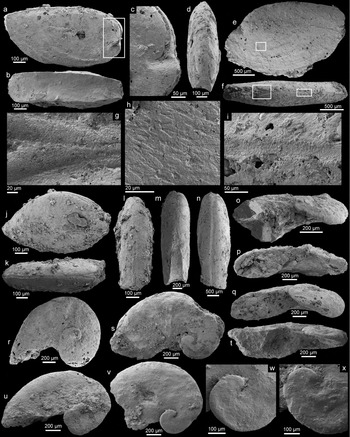
(a–n) Watsonella crosbyi Grabau, Reference Grabau1900, all specimens collected by Brian Daily from the middle member (3) of the Mount Terrible Formation, McGowran Locality, off Old Sellick Hill Road, Sellick Hill, Fleurieu Peninsula. (a–d) SAM P53331: (a) lateral view; (b) ventral view; (c) magnification of apical area; (d) posterior view. (e–i) SAM P 53332: (e) lateral view, square shows location of (h); (f) dorsal view, squares show location of (g) and (i); (g) magnification of diverging dorsal median furrow; (h) magnification of lamella-fibrillar micro-ornament. (j–l) SAM P53333: (j) lateral view; (k) posterior view; (l) dorsal view. (m) SAM P53334, posterior view. (n) SAM P53335, dorsal view. (o–x) Aldanella sp. cf. golubevi, from the upper member of the Mount Terrible Formation. (o) SAM P53336, apertural view; (p) SAM P53337, apertural view. (q–r) SAM P53338: (q) apertural view; (r) spire view. (s, t, x) SAM P53339: (s) spire view; (t) apertural view; (x) magnification of apex. (u) SAM P53340, spire view. (v, w) SAM P53341: (v) spire view; (w) magnification of apex.

Watsonella crosbyi Grabau, Reference Grabau1900 Figure 7a–n
1900 Grabau, Watsonella crosbyi; p. 632, pl. 1, fig. 9a–g.
2013 Devaere, Clausen, Steiner, Álvaro & Vachard; Watsonella crosbyi Grabau; p. 37, figs 14.1-33, 15.1-14 (includes full synonymy).
Figured material. Four internal moulds (SAM P53331-53335), with an additional 33 unfigured specimens.
Diagnosis. See Devaere et al. (Reference Devaere, Clausen, Steiner, Álvaro and Vachard2013, p. 40).
Description. Univalved (pseudobivalved), bilaterally symmetrical and laterally compressed phosphatic steinkerns; subelliptical in lateral view. Steinkerns range over 0.9–2.7 mm in length, 0.54–1.67 mm in height and 0.29–0.57 mm in width. Lateral surfaces nearly flat, but more strongly convex near dorsum and posterior margin where these surfaces are conjoined. In lateral view dorsum variably convex, tending to be most strongly convex towards posterior. Anterior extremity angular (Fig. 7a), broadly acute; posterior extremity with strongly convex apex overhanging strongly concave subapical field; apertural margin tends to be fairly evenly curved. In dorsal view, steinkerns elongate subelliptical to subrectangular, with maximum width tending to be towards posterior (Fig. 7f, k, l, n). Dorsum with narrow median furrow (Fig. 7f, i, n) or very weak ridge (Fig. 7l) along dorsum midline, extending from anterior extremity of shell to just near apex where it sometimes bifurcates (Fig. 7f, g, k). Subapical field very short and poorly preserved in all specimens. Aperture long, slit-like, width similar along entire length (Fig. 7b). In some specimens, what appear to be internal imprints of concentric growth lines are present (Fig. 7a, e). There is also what appears to be an impression of a lamellar texture on the lateral surface of one of the steinkerns (Fig. 7h).
Remarks. Watsonella crosbyi has received thorough taxonomic revision (Parkhaev in Gravestock et al. Reference Gravestock, Alexander, Demidenko, Esakova, Holmer, Jago, Lin, Melnikova, Parkhaev, Rozanov, Ushatinskaya, Zang, Zhegallo and Zhuravlev2001; Li et al. Reference Li, Zhao, Gubanov, Zhu and Na2011; Devaere et al. Reference Devaere, Clausen, Steiner, Álvaro and Vachard2013). The material examined here closely resembles specimens described by Parkhaev (in Gravestock et al. Reference Gravestock, Alexander, Demidenko, Esakova, Holmer, Jago, Lin, Melnikova, Parkhaev, Rozanov, Ushatinskaya, Zang, Zhegallo and Zhuravlev2001, pl. XLII, figs 15, 16) from the Sellick Hill Formation. Parkhaev (in Gravestock et al. Reference Gravestock, Alexander, Demidenko, Esakova, Holmer, Jago, Lin, Melnikova, Parkhaev, Rozanov, Ushatinskaya, Zang, Zhegallo and Zhuravlev2001, p. 188) distinguished the Sellick Hill Formation specimens from the Siberian species, Watsonella sibirica (= Heraultia sibirica Missarzhevsky, Reference Missarzhevsky, Zhuravleva and Rozanov1974), based on its comparatively narrow anterior aperture, flattened valves and ‘less risen anterior margin of the aperture’. Jenkins, Cooper & Compston (Reference Jenkins, Cooper and Compston2002) re-examined material collected by Brian Daily from the Mount Terrible Formation (most likely that documented in this paper), and referred the specimens to W. sibirica. However, W. sibirica is now rightly regarded as a junior synonym of W. crosbyi (Li et al. Reference Li, Zhao, Gubanov, Zhu and Na2011; Devaere et al. Reference Devaere, Clausen, Steiner, Álvaro and Vachard2013) and the features used to delineate the species by Parkhaev (in Gravestock et al. Reference Gravestock, Alexander, Demidenko, Esakova, Holmer, Jago, Lin, Melnikova, Parkhaev, Rozanov, Ushatinskaya, Zang, Zhegallo and Zhuravlev2001) are considered to be within the range of intraspecific variation. Similarly, Yu (Reference Yu2014) described and illustrated specimens of Watsonella yunnanesis (He & Yang, Reference He and Yang1982) from the Dahai Member of the Yuhucun Formation, East Yunnan, China, which are also now considered to be synonymous with W. crosbyi (Li et al. Reference Li, Zhao, Gubanov, Zhu and Na2011; Devaere et al. Reference Devaere, Clausen, Steiner, Álvaro and Vachard2013). Yu (Reference Yu2014) distinguished the Chinese material from the type species based on its smaller size, blunt rounded beak, longer and wider ventral, anterior and posterior gapes, where the latter extends beyond the sub-apical shield and partially along the dorsum (Yu, Reference Yu2014, fig. 5). However, these characteristics vary within the concept of the species (Li et al. Reference Li, Zhao, Gubanov, Zhu and Na2011) including the extended posterior gape, which is most likely a feature caused by secondary phosphatization (see Fig. 7d).
Stratigraphic range in South Australia. Middle and top members of the Mount Terrible Formation and Facies Association A to C of the Sellick Hill Formation, Normanville Group, Fleurieu Peninsula, eastern Stansbury Basin. Terreneuvian, Stage 2.
Order HELCIONELLIDA Geyer, Reference Geyer1994
Family ALDANELLIDAE Linsley & Kier, Reference Linsley and Kier1984
Genus ALDANELLA Vostokova, Reference Vostokova1962
Type species. Aldanella attleborensis (Shaler & Foerste, Reference Shaler and Foerste1888).
Aldanella sp. cf. golubevi Parkhaev, Reference Parkhaev2007 Figure 7o–x
Figured material. Seven figured steinkerns (SAM P53336-53341), with an additional seven unfigured specimens.
Description. Asymmetrical, sinistrally coiled low turbinate shell (Fig. 7o–v); up to 1.64 mm in diameter (average 1.42 mm), shell composed of 1.5–1.7 whorls expanding strongly, with last whorl occupying 58% of the maximum shell diameter. Shell height 32% of maximum shell diameter; spire flattened, projecting only slightly; apex rounded (Fig. 7w, x). Aperture ovate, approximately 2.5 times as wide as high; upper margin flattened, lower margin slightly convex (Fig. 7o–q, t), distal margin strongly curved. Umbilicus broadly concave. Faint, shallow furrows, convex towards aperture are present on the upper surface of some specimens (Fig. 7r).
Remarks. Steinkerns of Aldanella from South Australia all exhibit sinistral coiling (Fig. 7r, s, u, v), unlike the dextral coiling that normally characterizes the genus. Whether the shell is a true mirror image of the typical dextral form or whether it is dextrally hyperstrophic is unknown due to the poor preservation of diagnostic shell features, especially muscle scars. A ‘pathological’ sinistrally coiled Aldanella was originally described by Golubev (Reference Golubev1976, pl. 3, fig. 13), and an assemblage of sinistrally coiled Aldanella was reported by Parkhaev (Reference Parkhaev2007) from the western Anabar Region of the Siberian Platform. The identification of this particular sinistral assemblage as stratigraphically isolated from other dextral species of Aldanella, in conjunction with it having a unique pointed apex, led Parkhaev (Reference Parkhaev2007) to refer the shells to a new species, A. golubevi. This taxon is known to co-occur with both A. attleborensis and A. crassa in Fortunian Stage 2 transitional beds of the eastern and western Anabar Region (Golubev, Reference Golubev1976; Parkhaev & Karlova, Reference Parkhaev and Karlova2011).
The broad similarities between the South Australian material and Siberian sinistrally coiled A. golubevi are limited to the tight coiling of the whorls, their strong expansion and the low to almost flattened spire. These characteristics further distinguish this taxon from other sinistral taxa attributed to the genera Barskovia Golubev, Reference Golubev1976 and Nomgoliella Missarzhevsky, Reference Missarzhevsky1980, which otherwise possess more oval or rounded apertural cross-sections, respectively. Unfortunately, the diagnostic pointed apex of A. golubevi (Parkhaev, Reference Parkhaev2007, pl. 2, figs 7, 10b) is not present in our collection (Fig. 7w, x), which consists exclusively of steinkerns. Consequently, the South Australian material is cautiously compared with A. golubevi.
Stratigraphic range in South Australia. Top member, Mount Terrible Formation, Normanville Group, Fleurieu Peninsula. Eastern Stansbury Basin; Terreneuvian, Stage 2.
6. Conclusion
The paucity of cosmopolitan, biostratigraphically significant shelly taxa hinders early Cambrian global correlation. However, the micromollusc W. crosbyi is now known from China, France, Siberia, Mongolia, Avalonia and Australia, and provides a crucial biostratigraphic link between pre-trilobitic strata in disparate palaeocontinents. The revised interpretation of the stratigraphic range of W. crosbyi in South Australia strongly suggests that it is restricted to early Cambrian Stage 2 (Peng, Babcock & Cooper, Reference Peng, Babcock, Cooper, Gradstein, Ogg, Schmitz and Ogg2012).
In the Mount Terrible Formation, the first occurrence of Watsonella crosbyi pre-dates the incoming of Diplocraterion piperock in the Wangkonda Formation. Furthermore, the stratigraphic range of W. crosbyi in South Australia pre-dates the local occurrence of Sunnaginia imbricata in the upper part of the overlying Sellick Hill Formation, which is succeeded by a fauna indicative of the pre-trilobitic Kulparina rostrata Zone (Betts et al. Reference Betts, Paterson, Jago, Jacquet, Skovsted, Topper and Brock2016). The stratigraphic range of W. crosbyi in the Normanville Group is estimated as c. 244 m (true thickness; per data in Alexander & Gravestock, Reference Alexander and Gravestock1990; Gravestock et al. Reference Gravestock, Alexander, Demidenko, Esakova, Holmer, Jago, Lin, Melnikova, Parkhaev, Rozanov, Ushatinskaya, Zang, Zhegallo and Zhuravlev2001; this article). Carbon isotope values through the Facies Association C to E of the Sellick Hill Formation are suggestive of the negative SHICE event, further supporting an early Stage 2 age for W. crosbyi (although additional chemostratigraphic data through the Mount Terrible and Wangkonda formations is required). The new Australian data strengthens the correlative value of W. crosbyi as an index fossil to define the base of Cambrian Stage 2.
Acknowledgements
Thanks to Jim and Linda Stacey for providing access to their Myponga Beach property and Brendan Carruthers of Southern Quarries Ltd., manager of Sellick Hill Quarry, for providing access for sampling. Special thanks go to: Elinor Alexander (PIRSA) for assistance in the field; Debra Birch and Nicole Vella from Macquarie University Microscopy Unit for technical support with the SEM facilities; Nathan Daczko for use of the petrographic (Nikon Eclipse 50ipol) microscope; David Mathieson for acid processing and picking fossiliferous residues; and Dean Oliver for original drafting of Figure 1. Thanks to Artem Kouchinsky and Li Guoxiang for their constructive reviews. Funding for the project was provided by an ARC Discovery Project #129104251 to GAB.
Supplementary material
To view supplementary material for this article, please visit http://dx.doi.org/10.1017/S0016756816000704.