Understanding students’ motivation for learning new languages has been a concern of teachers and researchers in psychology and applied linguistics for more than five decades (see Dörnyei & Ryan, Reference Dörnyei and Ryan2015; Mercer, Ryan, & Williams, Reference Mercer, Ryan and Williams2012, for reviews). The intensity of students’ effort and engagement in the learning process is a consistent predictor of language achievement (Gardner, Reference Gardner2010; Masgoret & Gardner, Reference Masgoret and Gardner2003) and research indicates that learners are more engaged in learning when it is personally relevant and consistent with their self-concept or identity (Dörnyei & Ushioda, Reference Dörnyei and Ushioda2009; Noels, Chaffee, Lou, & Dincer, Reference Noels, Chaffee, Lou and Dincer2016; Norton, Reference Norton2013; see Mercer & Williams, Reference Mercer and Williams2014, for overview). In turn, it is widely argued that this orientation toward the learning activity can be facilitated or hindered depending upon the students’ interpersonal resources, including the social dynamics within the classroom.
Although the relations between the social context, learner motivation, and linguistic outcomes have been well examined in cross-sectional research, less empirical work has examined motivational processes over the duration of the language course. This temporal perspective is necessary to better examine causal associations and to understand how motivation changes across time. Such a perspective allows researchers to better understand how motivation can be sustained through the hurdles and disappointments and through the challenges and successes that are inherent in the learning process. This study examined longitudinally how feelings of autonomy and competence in the learning process and a sense of connection or relatedness with others in the classroom foster more self-relevant motivational orientations for language learning. In addition, we considered whether people who learn a second language (L2) because it is important to their sense of self and because they find it personally satisfying are better able to sustain their efforts to learn throughout the language course.
THE MOTIVATED LANGUAGE LEARNER
ENGAGEMENT AND ORIENTATIONS
Within language learning, motivation has been conceptualized in many ways. Gardner has suggested that rather than focus on a single definition, one might better describe a motivated person as someone who “is goal directed, expends effort, is persistent and attentive, has desires (wants), exhibits positive affect, is aroused, has expectancies, demonstrates self-confidence (self-efficacy), and has reasons (motives)” (Gardner, Reference Gardner2006, p. 2). The present study focuses on two aspects of this description. First, we address effort, persistence, and attention, which as a group have been called “motivational intensity.” According to Masgoret and Gardner’s (2003) meta-analysis, motivational intensity (i.e., cognitive and behavioral engagement) is one of the strongest and most consistent predictors of language achievement as measured by grades, objective measures, and self-ratings. As linguistic proficiency is often the main objective of language courses, it is important to understand motivation, and particularly engagement, as a major predictor of achievement.
Second, we focus on the “reasons” why one wishes to pursue language study because these reasons frame the quality of the learning experience and can differentially predict the intensity of engagement. Rather than categorize reasons, or “orientations,” in terms of activity-specific themes (e.g., integration, employment, travel; cf. Clément & Kruidenier, Reference Clément and Kruidenier1985; Gardner, Reference Gardner2010), we find it more fruitful to describe orientations in terms of their psychological relevance to the self. Particularly, we maintain that students who endorse self-relevant orientations and have a personal commitment to language learning are likely to engage more intensely and sustain their motivation across time compared to students who endorse orientations based on rewards or pressures originating from other people or situational circumstances.
SELF-DETERMINATION THEORY AND LANGUAGE LEARNING
This claim that endorsing self-relevant reasons for language learning likely enhances and maintains engagement is based on self-determination theory (SDT; Deci & Ryan, Reference Deci and Ryan1985; Ryan & Deci, Reference Ryan and Deci2017), which proposes a continuum of motivational types based on how central the activity is to the self. People generally engage more with self-relevant, voluntarily chosen activities compared to activities imposed upon them. In language learning, this implies that the more people feel that they are learning and using a new language because it is consistent with their sense of self, the more they will engage in the learning process. Language learning, in this case, is integrated into the person’s sense of self. This is termed “integrated regulation” and is one of the most highly self-determined, autonomous forms of regulation.
Of course, not all people acquire a new language because it is integral to who they are. However, even if learning and using the language is not self-defining, people may still believe that there is value in acquiring the language. Knowing the language may facilitate the attainment of goals important to them, such as improving their occupational performance or interaction with people they cherish. When a person has personally identified the value of the activity, this form of regulation is termed “identified regulation” and is relatively self-determined, although less so than integrated regulation.
Alternatively, a person might learn a language less because of her or his own sense of what is important and valuable and more because of a sense that she or he ought to know the language. Such a sentiment often arises because of expectations of significant others or generalized social norms. For example, teachers might convey their belief that knowing another language is an important educational goal, and students might entertain this belief to some degree because they value the teacher’s opinion. Even if the value of learning the language is not evident to them in their personal lives, they might feel that it is something every good student should do. This feeling that one ought to learn a language, termed introjected regulation, is a relatively controlled form of regulation, stemming from self-imposed pressures and expectations that are not necessarily congruent with one’s personal values and identities.
In still other cases, people may learn a language not because it is self-relevant or because they believe it is good to do, but because of clear rewards or punishments for doing so. Examples include fulfilling a required course credit or obtaining a salary increase. Such reasons may have little to do with the importance of that language for a person’s sense of self, but rather more to do with pressures from other people or broader circumstances. When engagement in the activity is controlled by factors external to the person, it is termed external regulation.
These motivational orientations vary in the degree to which language learning is internalized and the regulation of engagement is self-governed. SDT proposes yet another form of motivation, based on the experience of enjoyment and vitality that comes from the “inherent tendency to seek out novelty and challenges, to extend and exercise one’s capacities, to explore, and to learn … [and one’s] natural inclination toward assimilation, mastery, spontaneous interest and exploration” (Ryan & Deci, Reference Ryan and Deci2000, p. 70). Thus, language learning could be pleasurable in and of itself, even if that activity is not tied to one’s sense of self. This experience of intrinsic motivation, in which regulation seemingly emanates from engagement in the activity, is differentiated from the forms of regulation described previously, which as a complex are termed extrinsic motivation (i.e., regulation is extrinsic to interest in the activity per se). Intrinsic motivation is construed as a highly self-determined form of regulation; people generally value and often come to identify with activities they enjoy (and vice versa).Footnote 1
Within L2, correlational research consistently shows that when learners voluntarily participate in language learning because it is meaningful to them, they are more intensely engaged. For example, they participate with greater intensity of effort and greater focus of attention to tasks (Busse & Walter, Reference Busse and Walter2013; Chaffee, Noels, & Sugita-McEown, Reference Chaffee, Noels and Sugita McEown2014). They show a stronger mastery orientation, report greater self-confidence and self-rated competence, and are more likely to attribute their performance to ability and effort (Bonney, Cortina, Smith-Darden, & Fiori, Reference Bonney, Cortina, Smith-Darden and Fiori2008; Tanaka, Reference Tanaka2009). These learners are also likely to be less work avoidant and more persistent in terms of both continued classroom study and extracurricular language study (Comanaru & Noels, Reference Comanaru and Noels2009; Loewen, Ellis, & Hacker, Reference Loewen, Ellis and Hacker2006; Tanaka, Reference Tanaka2009). Greater self-determination is also associated with greater engagement with the target language community (Comanaru & Noels, Reference Comanaru and Noels2009; Peng & Woodrow, Reference Peng and Woodrow2010). In addition to these indicators of engagement, endorsement of more self-determined orientations is also associated with greater achievement, whether assessed globally or in terms of specific competencies, such as reading, writing, listening, and speaking (Tanaka, Reference Tanaka2009; Vandergrift, Reference Vandergrift2005).
In summary, motivational orientations are posited to fall along a continuum of self-determination (although extrinsic and intrinsic motivational processes are assumed to be distinct in several respects), and greater self-determination is associated with more intense engagement in the language classroom and higher language achievement. More controlled orientations, including external and introjected regulations, are unlikely to be strongly and consistently related to engagement and persistence because once pressures are lifted, students will likely engage less in the activity. This organizational scheme is applied not to individuals, but to the reasons they have for their behavior. Thus, people can hold multiple orientations toward an activity; someone who enjoys language learning on its own may also be aware of the career advancement opportunities that knowing the foreign language opens for them, and both factors may orient their engagement in language learning. Moreover, although there may be relatively enduring, traitlike tendencies toward controlled or autonomous orientations across different people (termed “general causality orientations”; Ryan & Deci, Reference Ryan and Deci2017, p. 217), contextual contingencies may make some orientations more salient than others across situations or time points.
FUNDAMENTAL PSYCHOLOGICAL NEEDS
Given that a self-determined orientation is associated with more intense engagement in learning and attainment in the language, a reasonable question is how such an orientation can be fostered. As a humanistic, organismic theory, SDT emphasizes an inherent tendency within humans toward organizational coherence and integration of the self, which potentially leads to self-actualization and well-being (Ryan & Deci, Reference Ryan, Deci, Deci and Ryan2002). Humans thrive when fundamental psychological needs are satisfied. The satisfaction of the needs of autonomy, competence, and relatedness is fundamental for the experience of intrinsic motivation, the internalization of an activity into one’s sense of self, and, ultimately, positive, productive engagement. Autonomy refers to learners’ perceptions that they are voluntarily pursuing personally relevant activities as opposed to being coerced by circumstances or others. Competence refers to learners’ experience that they can effectively meet challenges and bring about desired outcomes. Relatedness refers to learners’ sense of connection with significant others in the context of the activity and their experiences of positive relevant relationships. Across studies from diverse sociocultural contexts, higher perceptions of autonomy, competence, and relatedness have been associated with more self-determined motivational orientations, including identified, integrated, and intrinsic motivations (Carreira, Reference Carreira2012; Chaffee et al., Reference Chaffee, Noels and Sugita McEown2014; Noels, Reference Noels2001a, Reference Noels, Dörnyei and Schmidt2001b; Noels, Clément, & Pelletier, Reference Noels, Clément and Pelletier1999; Noels, Pelletier, Clément, & Vallerand, Reference Noels, Pelletier, Clément and Vallerand2000; Tanaka, Reference Tanaka2009; Wu, Reference Wu2003). This motivational process wherein satisfaction of psychological needs fosters more self-determination and more self-determination fosters more intense engagement is schematized in Figure 1 (adapted from Noels, Reference Noels, Dörnyei and Ushioda2009; Noels et al., Reference Noels, Chaffee, Lou and Dincer2016).
Schematic representation of motivational process (adapted from Noels, 2009).

A TEMPORAL PERSPECTIVE ON MOTIVATION
Although research generally supports the SDT premise that feelings of autonomy, competence, and relatedness are associated with self-determined orientations, and self-determined orientations are associated with engagement, this research is limited for at least two reasons. First, the cross-sectional research that has to date examined language learning motivation through an SDT lens does not provide insight on whether and how components of the motivational process change over time. This observation resonates with recent calls to recognize language learning as a complex dynamic system (CDS) and design empirical investigations accordingly (e.g., see Dörnyei, MacIntyre, & Henry, Reference Dörnyei, MacIntyre, Henry, Dörnyei, Henry and MacIntyre2015, for overview; Waninge, Dörnyei, & de Bot, Reference Waninge, Dörnyei and de Bot2014). One of the major features of a CDS such as language learning is that its components and their interrelationships change over time (de Bot, Lowie, & Verspoor, Reference de Bot, Lowie and Verspoor2007; Hiver & Al-Hoorie, Reference Hiver and Al-Hoorie2016). Because we assume that motivation is temporally (and contextually) variable, we address a basic question about motivational development (i.e., change over time): Which components of the motivational system (i.e., the constructs articulated in SDT) change over time and in what manner do they change? We also examine two other, related, propositions from a CDS perspective. First, because systems are assumed to constantly change through internal self-organization and through interaction with their environment (i.e., other systems; de Bot et al., Reference de Bot, Lowie and Verspoor2007), we expect trajectories of change to potentially vary across individuals and investigated what, within the motivational system, predicts these interindividual differences. Second, complex systems have complete interconnectedness—components of a system are interrelated and changes in one component impact all other components. That is, the temporal dynamics of one variable within a motivational system may be related to the temporal dynamics of another. To address this, we investigated whether and how changes over time in one motivation component are associated to changes over time in other system components. Other assumptions of the CDS perspective are not addressed in the present study, although we believe that our basic questions provide a basis for further empirical investigation of language learning motivation from the CDS approach.
The second limitation of using cross-sectional research designs to investigate language learning motivation is that it prevents a clear assessment of the causal relations proposed by a theory, such as SDT. A simple causation claim is fully justified if there is covariation between variables combined with a temporal sequence in which the proposed “cause” (or exogenous variable) precedes the proposed “effect” (or endogenous variable) under conditions in which the exogenous variable of interest is the only variable manipulated and other possible causes are controlled. Note that this definition does not assume that all causal relations among system components must be direct, unidirectional, or linear; they could be mediated or moderated, multidirectional (i.e., reciprocal and/or transactional) or nonlinear. Although the best test of hypothesized causality would require experimentation, incorporating a time element into the research design at least allows assessment of whether exogenous variables measured earlier predict subsequent endogenous variables after controlling for earlier levels in those endogenous variables. This design and analytic strategy brings us a step closer to more convincingly testing causal claims than cross-sectional designs allow. Thus, the present study used a longitudinal design, allowing time-sequenced assessment of the causal claims proposed by SDT. Given the nature of these claims and the practical constraints of assessing multiple time points, we focus on linear relations between variables. In line with the CDS perspective, however, we also evaluate more complex relationships—specifically, feedback loops and initial states predicting change.
OBJECTIVES
With these two limitations of previous research in mind, we investigated the motivation of students of French over one semester with three goals:
1. To examine whether and how psychological needs, orientations, and engagement change linearly over time;
2. To determine whether initial levels and changes over time in psychological needs and orientations are related to initial levels and changes over time in orientations and engagement, respectively; and
3. To test the hypothesized causal relations between psychological needs and orientations, on the one hand, and orientations and engagement, on the other hand.
According to SDT, earlier levels of need fulfillment are expected to positively predict more autonomous orientations later in the semester, and earlier levels of autonomous orientations would positively predict later levels of engagement.
In terms of change over time, longitudinal research on psychological needs and motivational orientations is scarce, with none focused on language learning. Available research has examined periods ranging from eight days to five years, with none focused on the duration of a semester-long course (Bidee, Vantilborgh, Pepermans, Griep, & Hofmans, Reference Bidee, Vantilborgh, Pepermans, Griep and Hofmans2016; Jaakkola, Wang, Yli-Pippari, & Liukkonen, Reference Jaakkola, Wang, Yli-Pippari and Liukkonen2015). Given that directionality, magnitude, and form of change in a given variable may differ depending on the time span under investigation (e.g., one month vs. one year) as well as the time metric used (e.g., daily vs. monthly measures), we cannot predict the directionality of changes over the semester in psychological needs and motivational orientations based on this research. We might expect that as students spend more time in the language course, they would develop greater competence and autonomy, as well as stronger connections with their classmates and instructor. With these gains in fulfillment of psychological needs, students would be expected to experience gains in more autonomous orientations.
Engagement has been extensively investigated longitudinally in developmental and educational psychology. Studies have examined multiple nested contexts (school, classroom, learning activity), time frames (moment-to-moment, school year, across grades), and developmental periods (middle-to-late childhood, adolescence). This research has consistently found that students become less engaged across the school year and across grades (see Fredricks, Blumenfeld, & Paris, Reference Fredricks, Blumenfeld and Paris2004; Skinner & Pitzer, Reference Skinner, Pitzer, Christenson, Reschly and Wylie2012 for reviews). Consistent with this pattern, the only study that examined change over time in language learning engagement likewise showed a decline (Gardner, Masgoret, Tennant, & Mihic, Reference Gardner, Masgoret, Tennant and Mihic2004). Based on these findings, we expect engagement to decline across the semester. However, given that an autonomous orientation is proposed to encourage higher engagement, increases in intrinsic motivation as well as in integrated and identified regulation would be expected to support engagement, leading to less loss of engagement across time.
METHOD
PARTICIPANTS AND PROCEDURES
The participants were 162 students (73.5% female) registered in first- (20%) and second-year French language courses at a Canadian university in Alberta, Canada, where Francophones comprise 2.13% of the provincial population of 4.08 million people (Statistics Canada, 2017). Participants’ mean age at the onset of the study was 21.14 years (SD = 4.52), with about 88% of participants falling in the 17 to 23 age range. About one fifth of participants were in their first year of university, a quarter in second year, another quarter in third year, a fifth in fourth year, and the remaining were on their fifth or a later year. Most (78.4%) reported English as their mother tongue and the remainder reported a language other than English (LOTE); none reported French as the native language, although 32 claimed some French ancestry.
There was a wide range of multilingualism in the sample. Almost half (44%) of the participants claimed they learned a language other than French and English at some point, with 62% of these participants reporting speaking one other language, 27% two other languages, 8% three other languages, and 1.5% four other languages (1.5% did not answer the question). A total of 32 languages were reported as languages other than French or English, with the largest proportion speaking Spanish (34%). Thus, a sizeable proportion of the sample could be considered multilingual; however, only 11.1% were currently studying a language in addition to French (50% Spanish, and the remainder spread across German, Japanese, Latin, Norwegian, Polish, Russian, and Ukrainian).
With regard to French instruction, participants reported that they spent between 2 weeks to 30 years learning French in school and on average started to learn French at 10.15 years of age (SD = 6.25). About 7% of participants were completing a language-related degree, with the rest representing a wide range of programs and areas of study—most within the Faculty of Arts (about 70%). About 40% of participants were enrolled in a program with a LOTE requirement for degree completion and had not fulfilled this requirement prior to the semester of this study. The remaining 60% either had no LOTE program requirement or had already completed this requirement. With regard to the level of French course in which they were currently enrolled, 19.8% described it as the beginner level, 36.4% said the intermediate level, and 36.4% said the advanced level (7.4% nonresponse); however, placement tests assessed these students as beginners to low-intermediate. All French courses from which participants were recruited focused on linguistic skills (i.e., not literature or cultural studies), with emphasis placed on oral skills and communicative competence. They met for 5 hours per week over a 13-week semester (plus a final examination period). The instructors were generally sessional instructors who either were native French speakers or had near-native competence.
Participants completed an online questionnaire at three points throughout the first semester of the academic year. The first testing session (wave 1) took place over a 10-day period, starting 10 days after the first day of the academic year (September 16 to 25). The second session (wave 2) took place over a 12-day period at mid-term (October 10 to 22), and the third session (wave 3) took place over a 2-week period at the end of the semester, prior to final exams (November 30 to December 13). The participants received $5 for each data wave they completed. The research conformed to ethical guidelines espoused by the university, the Tri-Council Policy of the Canadian national funding agencies, and the Canadian and American Psychological Associations.
MEASURES
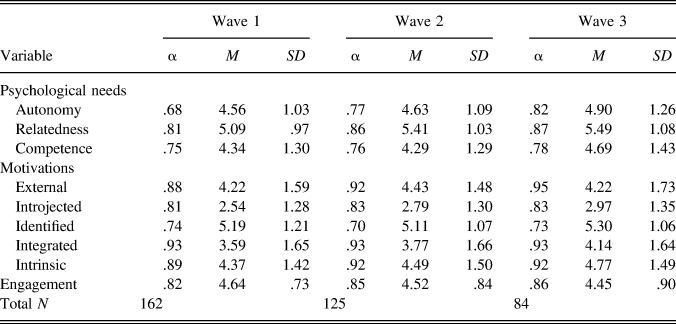
The variables were assessed using psychometrically sound measures reported in previous research, adapted to the French learning context. See Table 1 for the sample means, standard deviations, and Cronbach alpha indices of internal consistency for each of the (sub)scales used.
Descriptive statistics for psychological needs, motivations, and engagement by wave

Note: α = Cronbach’s alpha. Wave 1 = September; wave 2 = October; wave 3 = November/December.
Language Learning Orientations
The Language Learning Orientations Scale (LLOS; Noels et al., Reference Noels, Pelletier, Clément and Vallerand2000) was modified based on confirmatory factor analysis (CFA) results (the final list of items is available online through the SSLA website). This modified instrument contained 24 items reflecting different reasons why students would learn French. Following each item, participants indicated the extent to which the proposed reason for learning French corresponded with their opinion on a seven-point scale (1 = “does not correspond at all,” 7 = “corresponds exactly”). Six items represented intrinsic motivation (e.g., “For the ‘high’ I feel when learning French”); five integrated regulation (e.g., “Because knowing French is a part of my identity”); four identified regulation (e.g., “Because I choose to be the kind of person who can speak more than one language”); five introjected regulation (e.g., “Because I would feel ashamed if I couldn’t speak to French speakers in French”); and four external regulation (e.g., “In order to get a more prestigious job later on”). CFA at wave 1 yielded a satisfactory fit for each subscale (χ2 = 3.36 (5) to 31.81 (5), p < .001 to p = .65; CFI = .94 to .99; RMSEA = .00 to .23; SRMR = .03 to .03). For each subscale, the mean of the items was computed, such that a high mean score indicated a high level of endorsement of that orientation.
Engagement
Gardner’s (Reference Gardner2010) 10-item motivational intensity instrument assessed the effort that students expended to develop their skills in French (e.g., “I really work hard to learn French”). Participants indicated their agreement with each item on a six-point Likert-type scale, where 1 = “strongly disagree” and 6 = “strongly agree.” Negatively worded items were reverse scored, so that a high mean score indicated intense engagement in language learning. CFA yielded a satisfactory fit for a single factor model of the 10 items at wave 1 (χ2 = 71.44 (31), p < .001; CFI = .91; RMSEA = .09; SRMR = .08).
Psychological Needs
The Basic Psychological Needs Scale (Deci et al., Reference Deci, Ryan, Gagné, Leone, Usunov and Kornazheva2001) assessed the extent to which participants felt a sense of autonomy, competence, and relatedness in their French course. Feelings of autonomy were assessed with five items (e.g., “I am free to express my ideas and opinions in my French class”); feelings of competence with four (e.g., “Most days, I feel a sense of accomplishment in my French class”); and feelings of relatedness with six (e.g., “People in my French class care about me”). Participants indicated their agreement with each item on a seven-point scale from 1 = “not at all true” to 7 = “very true.” CFA yielded a good fit for a single-factor model for each subscale at wave 1 (χ2 = 2.50 (2) to 16.38 (9), p = .06 to .55; CFI = .97 to .99; RMSEA = .00 to .09; SRMR = .03 to .04). High mean scores indicated strong feelings of autonomy, competence, and relatedness.
DATA ANALYTIC STRATEGY
After examining the pattern of missing data due to sample attrition, data analyses followed five steps. First, basic descriptive and psychometric statistics of all constructs were examined across waves. Second, measurement invariance was examined for psychological needs, motivational orientations, and engagement (sub)scales to ensure that the indices consistently assessed the constructs of interest across time. Third, latent growth curve models (LGCMs) assessed each construct’s best-fitting model of change across the semester, informing our first research goal to examine how students’ motivational characteristics change across the semester. Fourth, the best fitting LGCM for each psychological need was modelled simultaneously with the best fitting LGCM for each motivational orientation. Similarly, the best fitting LGCM for each motivational orientation was modelled simultaneously with the best fitting LGCM for engagement. These parallel process LGCMs (PPLGCMs) were used to examine the associations between (a) initial levels of and change in students' psychological needs, and (b) initial levels of and change in their motivational orientations, as well as between (a) initial levels of and change in students' motivational orientations, and (b) initial levels of and changes in their engagement over the semester. These analyses informed our second research goal—to determine whether changes in students’ psychological needs and motivational orientations are associated to changes in their motivational orientations and engagement across the semester, respectively. Finally, autoregressive cross-lagged path analyses tested the directionality of across-time associations among psychological needs and motivational orientations and among motivational orientations and engagement. These analyses tested whether the sequence of causal relationships presented by SDT is supported, our last research goal.
Data modeling was computed using Mplus 6.12 (Muthén & Muthén, Reference Muthén and Muthén2012). For all analyses, model fit was examined using the exact fit chi-square test (χ2) and three approximate fit indices: the comparative fit index (CFI), the root mean square error of approximation (RMSEA), and the standardized root mean square residual (SRMR). Nonsignificant chi-squares indicate an exact fit between the model and the data. CFI values of .95 or greater indicate an excellent model fit whereas values of .90 to .94 suggest an adequate fit. RMSEA and SRMR values of .05 or less indicate excellent fit whereas values of .06 to .08 suggest good model fit (Hu & Bentler, Reference Hu and Bentler1999; Kline, Reference Kline2011). The chi-square likelihood ratio difference test (∆χ2) assessed model fit differences across nested models.
RESULTS AND DISCUSSION
PRELIMINARY ANALYSES
Missing Data
Among the 162 participants at wave 1, missing data ranged from 7.4% (external motivation at wave 1) to 48.1% (behavioral course engagement at wave 3) and were handled through full information maximum likelihood estimation (FIML) in the main analyses. FIML produces less biased results than listwise deletion, pairwise deletion, or mean substitution, and produces comparable results to multiple imputation (Johnson & Young, Reference Johnson and Young2011). To justify the missing at random assumption of FIML, Little’s Missing Completely at Random (MCAR) test was used to analyze data across all waves for MCAR data loss (Little, Reference Little1988). The results of this test were nonsignificant (χ2(184) = 197.66, p = .77), indicating that the data are appropriate for analyses using FIML (Raudenbush & Bryk, Reference Raudenbush and Bryk2002). Additionally, to ensure that continued participation in the study was not related to the key variables, 24 t-tests compared missing to present participants at each follow-up wave for differences in each variable at all previous waves. No significant differences were observed after controlling for family-wise error (using Bonferroni corrections).Footnote 2
Psychometric and Descriptive Statistics
The psychometric and descriptive statistics for the entire sample are presented in Table 1. The internal consistency of the (sub)scales were moderate to high for all constructs across waves. Means for psychological needs were moderate at all waves, indicating that most participants saw themselves as somewhat competent in French, perceived that their classroom environment was moderately supportive of learner autonomy, and perceived people in their course as moderately caring of each other. Levels were low for introjected and integrated regulation and moderately high for external regulation, identified regulation, and intrinsic motivation. Mean engagement scores indicated that the participants expended moderate effort to learn French.
Stability of Factor Structures across Time
To ensure that each measure assessed its theoretical construct across the three waves and was appropriate for longitudinal analyses, measurement models with sequentially more equality constraints in model parameters across waves were tested using CFA. Factorial invariance across time was confirmed for all constructs. For psychological needs and engagement measures, models with factor loadings constrained to be equal across waves showed adequate fit according to at least two fit indices (χ2 = 70.27(51) to 749.21(396), p < .001 to p = .96; CFI = .81 to .96; RMSEA = .06 to .09; SRMR = .06 to .12) and did not vary significantly from models in which the loadings were free to vary across waves (Δχ2 = 7.74(10) to 24.19(18), ps = .35 to .85). For motivational orientation measures, models with factor loadings and means constrained to be equal across waves showed adequate fit according to at least two fit indices (χ2 = 148.62(55) to 253.17(140), all ps < .001; CFI = .81 to .91; RMSEA = .09 to .12; SRMR = .06 to .11) and did not vary significantly from models with the means free to vary across waves (Δχ2 = 2.97(8) to 13.83(10), ps = .18 to .94). These results indicate that the items used to operationalize each construct hold their factor structure across waves and hence we can assume at each follow-up wave, the items represent the constructs they initially represented at wave 1 and, therefore, can be used to validly examine changes across time in their corresponding constructs.
LATENT GROWTH CURVE MODELS
Longitudinal changes in psychological needs, motivational orientations, and engagement across one semester were examined using a series of four nested unconditional LGCMs for each construct. The null model tests whether there is a “flat” trajectory over time across all the participants (i.e., no systematic change over time, no interindividual difference). Accordingly, the factor loadings of the three wave indicators were fixed to one to define the latent change growth factor (slope) and the variance of this factor fixed to zero. The latent intercept growth factor (intercept) in this model represented the average level of the construct across all participants at all time points. Next, the random intercept model freed the variance of the intercept to be estimated to test whether mean levels of the construct across all time points varied among individuals.
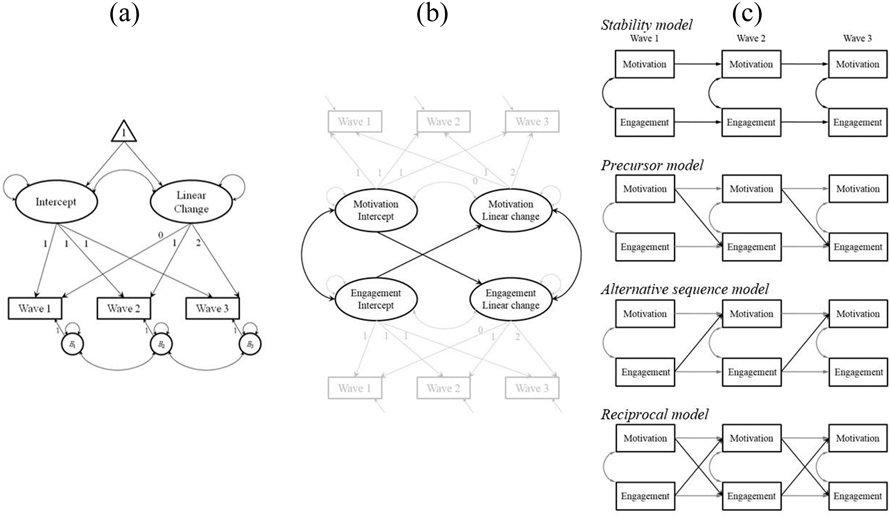
The fixed linear slope model tests whether there is a linear trajectory of change in the construct across time, assuming everyone followed the same rate of linear change. In this model, the factor loadings for the slope were set in accordance with elapsed time of measurement from baseline: 0 (wave 1: beginning of the semester), 1 (wave 2: mid-semester), and 2 (wave 3: end of the semester). The variance of the intercept was freed, and the variance of the slope was fixed to zero. Finally, the random linear slope model assessed interindividual differences in linear trajectories as well as whether individuals’ baseline levels were associated with their rate of change across the semester (e.g., whether students starting the semester more intrinsically motivated experienced more gains in intrinsic motivation across the semester than students starting the semester less intrinsically motivated). Accordingly, the variance of the slope was freed to allow for variability in rates of change across individuals and the intercept and slope factors could covary. Figure 2a presents a generalized version of the random linear slope model. The model that best captured the observed shape of change for each construct was determined by evaluating the intercept and slope factors of each model (i.e., whether significant) and by comparing nested models using Δχ2 tests.
Generalized models of (a) latent growth change, (b) parallel latent growth processes, and (c) cross-lagged associations.

Psychological Needs
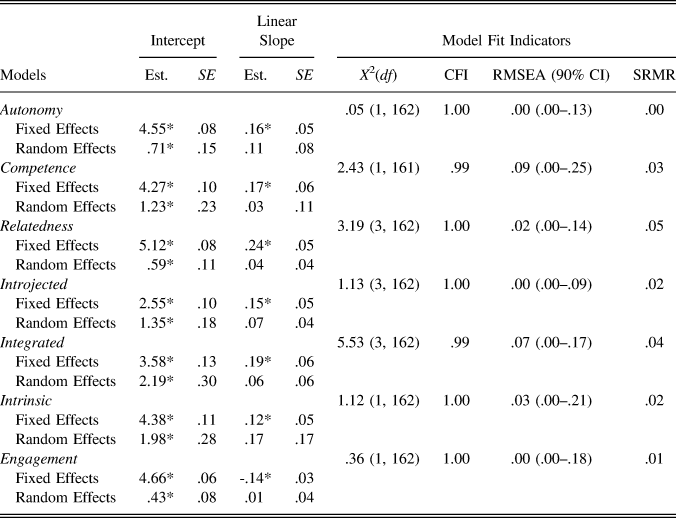
For each psychological need (autonomy, relatedness, competence), the random linear slope model was retained based on chi-square difference tests and the absolute model fit comparing the four nested LGCMs (see Table 2). The retained LGCMs indicated that students experienced significant linear increases over time in their perceptions of autonomy, relatedness, and competence in their language learning from September through November of the school year. In addition, there was significant interindividual variability in the intercept for each construct and, although not significant, there was some variability (i.e., nonzero random effect) in the slope for each construct. Lastly, the covariance between intercept and slope was not significant in any of the three models, indicating that students’ levels of autonomy, relatedness, and competence at the beginning of the semester were not related to the changes they experienced in each of these needs.
Best-fitting LGCMs for psychological needs, motivations, and engagement

Note: *p < .05.
Motivational Orientations
For external and identified orientations, the random intercept model was retained as none of the models including a slope fit the data better, indicating that students’ levels of external and identified regulation remained stable across the semester. The random linear slope model was best fitting for introjected and integrated regulation and for intrinsic motivation, indicating that students experienced significant linear increases over time in these orientations. There was significant interindividual variability in the intercept for each orientation and, although not statistically significant, there was some variability in the slope for each construct (see Table 2). Lastly, the intercept did not significantly covary with the slope in any of the three models, indicating that students’ levels of introjected and integrated regulation and intrinsic motivation at the beginning of the semester were not related to the changes students experienced in them across the semester.
Engagement
The best-fitting model for engagement was the random linear slope model, which indicated that students’ engagement decreased significantly across the semester; that there was significant interindividual variability in baseline (wave 1) levels of engagement; and that, although not significant at conventional levels, there was some variability across students in their engagement slopes (see Table 2). There was a significant positive covariance between intercept and slope factors, indicating that students who had higher initial levels of engagement experienced less loss in engagement over time than did students who had lower initial levels of engagement.
PARALLEL PROCESS LATENT GROWTH MODELS
A series of parallel process latent growth models (PPLGMs) were tested to examine whether and how changes in students’ psychological needs across one semester were associated with changes in their motivational orientation and whether and how changes in motivational orientations across one semester were associated with changes in their engagement across the semester. Only motivational orientations with significant change over time in the LGCM analysis (i.e., introjected and integrated regulation and intrinsic motivation) were used. In the PPLGMs, the slope of each variable could covary with the slope of the other variable. In addition, the slope of each variable was regressed onto the intercept of the other to assess whether baseline levels of the orientation predicted changes in engagement across the semester and, vice versa, whether baseline levels of engagement predicted changes in orientation. These models also accounted for the covariance between the intercept factors of the two variables and between the intercept and slope of each variable. Figure 2b presents a generalized version of a PPLGM.
PSYCHOLOGICAL NEEDS AND MOTIVATIONAL ORIENTATIONS
Autonomy and Motivational Orientations
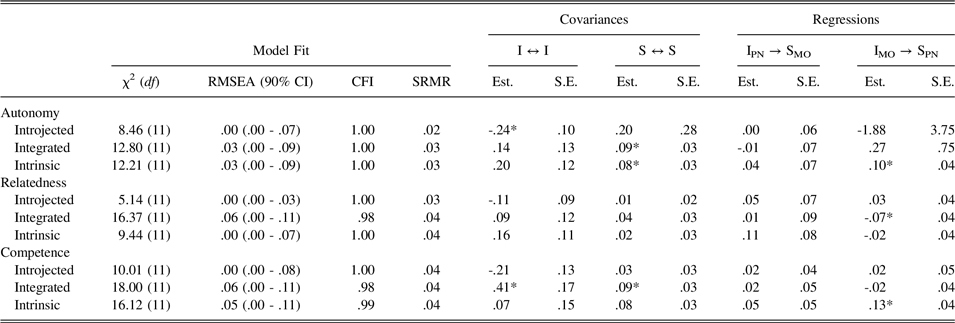
The models examining the associations between students’ sense of autonomy and their introjected and integrated regulations as well as intrinsic motivation fit the data well (see Table 3). Significant covariances were present in all models. Students with higher levels of autonomy as the semester started also showed higher levels of introjected regulation and intrinsic motivation as the semester started. In addition, students who experienced more gains in autonomy across the semester also experienced more gains in integrated regulation and intrinsic motivation across the semester. One significant regression path arose: Initial levels of autonomy predicted gains in intrinsic motivation. Students who started the semester feeling more autonomous in their language learning experienced more gains in intrinsic motivation across the semester than students who started the semester feeling less autonomous.
Fit indices, cross-process covariance estimates, and cross-process regression estimates for parallel process models of psychological needs and motivational orientations

Note: N = 162. I = intercept. S = slope. PN = psychological need. MO = motivational orientation.
* p < .05. Unstandardized estimates provided.
Relatedness and Motivational Orientations
Models examining the associations between students’ sense of relatedness and their introjected and integrated regulations as well as intrinsic motivation fit the data well (see Table 3) but had no significant covariances between the two variables and only one significant regression path. This pattern indicates that initial levels of students’ relatedness and their motivational orientations did not covary with one another nor did their changes over time. The significant regression path indicated that students who started the semester feeling more connected to their peers and instructor in their language course experienced fewer gains in integrated regulation across the semester.
Competence and Motivational Orientations
The models examining the associations between students’ sense of competence and their motivational orientations fit the data well (see Table 3). The model assessing associations between competence and introjected regulation had no significant covariances or regression paths. This pattern indicates that initial levels of students’ competence and introjected orientation did not covary with one another nor did they contribute to changes over time in one another. Changes over time in competence also did not covary with changes in introjected regulation.
Two significant covariances were evident in the model linking competence and integrated regulation. First, initial levels of competence covaried significantly with initial levels of integrated regulation. Students who reported a higher sense of competence at the beginning of the semester also reported higher levels of integrated regulation at the beginning of the semester. Second, change in competence over time did not covary with changes in integrated regulation. Students who experienced more gains in competence also experienced more gains in integrated regulation across the semester. There were no significant regression paths in this model. Although there were no significant covariances in the model linking competence and intrinsic motivation, one significant regression path arose in this model: Initial levels of intrinsic orientation positively predicted change in competence over time. That is, students who started the semester feeling more intrinsically motivated experienced more gains in perceived competence across the semester.
MOTIVATIONAL ORIENTATIONS AND MOTIVATIONAL INTENSITY
Introjected Regulation and Engagement
PPLGCMs examining associations between students’ introjected orientation and engagement fit the data well (χ2 (7) = 8.66, p = .28, CFI = 1.00, RMSEA = .04 (.00-.11), SRMR = .03), but had no significant associations connecting the two processes. This finding indicates that initial levels of students’ introjected regulation and their engagement did not covary with one another nor did they contribute to changes over time in one another. The changes over time in introjected regulation also did not covary with the changes in engagement.
Integrated Regulation and Engagement
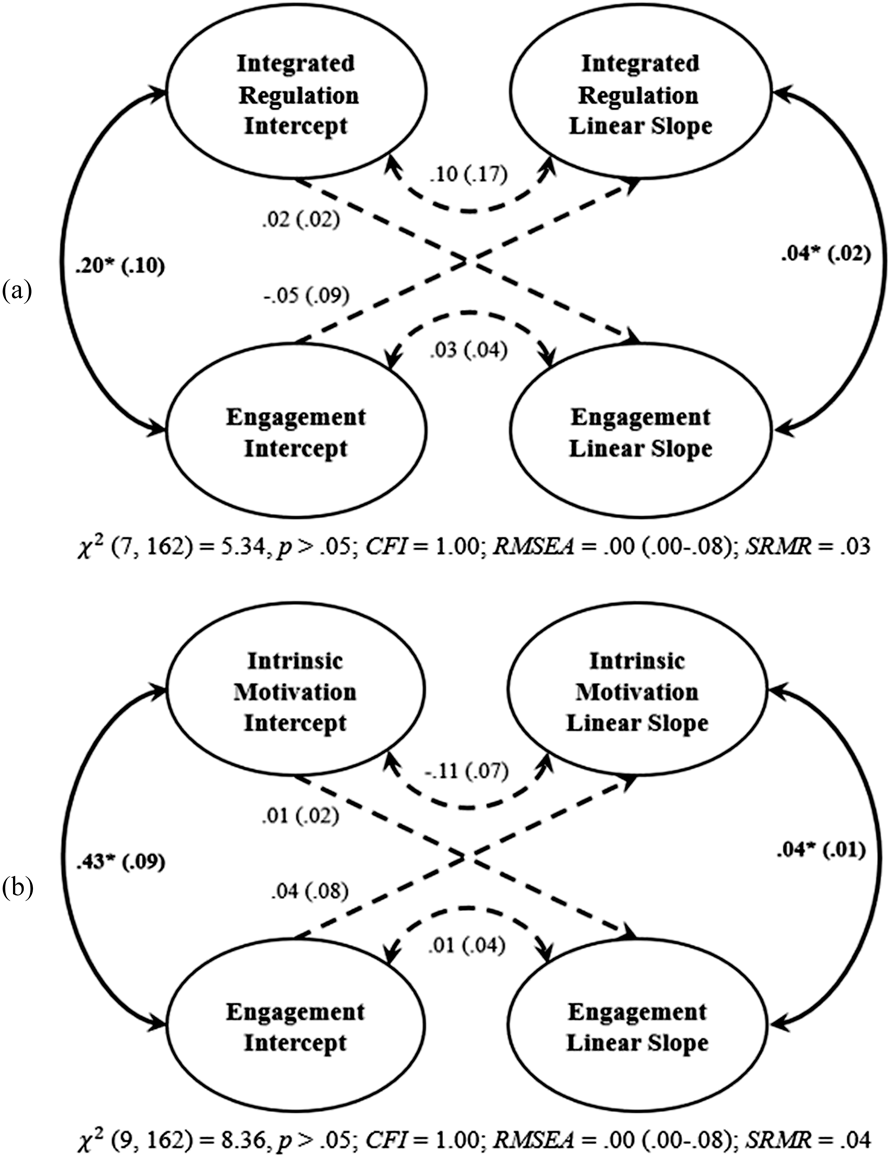
The model examining the associations between students’ integrated regulation and engagement fit the data well (see Figure 3a). The intercepts of these two processes covaried significantly with each other—students with higher integrated regulation at the beginning of the semester also reported higher engagement at the beginning of the semester than students with lower initial levels of integrated regulation. Initial levels of integrated regulation and behavioral engagement did not contribute to changes in one another over time. There was, however, a significant positive covariance between the slope parameters. Students with greater increases in integrated regulation also showed less decline in engagements across the semester.
Parallel process models of associations between students' engagement and their (a) integrated motivation, (b) intrinsic motivation. Note: Unstandardized estimates (and standard errors) are presented. Dashed lines indicate non-significant path estimates. * p < .05.

Intrinsic Motivation and Engagement
The PPLGCM assessing the associations between students’ intrinsic motivation and engagement fit the data well (see Figure 3b). The intercepts of these two variables covaried significantly with each other. Students starting the semester with higher intrinsic motivation also started the semester with higher engagement compared to students starting the semester with lower intrinsic motivation. Initial levels of intrinsic motivation and engagement did not contribute to changes in each another over time. There was, however, a significant positive covariance between the slopes. Students who showed more gains in intrinsic motivation across the semester also showed less loss in engagement across the semester.
AUTOREGRESSIVE CROSS-LAGGED ANALYSES
Four regression models were tested for each pair of constructs (e.g., autonomy–intrinsic motivation, relatedness–intrinsic motivation, intrinsic motivation–engagement) to identify the best-fitting models to represent the directionality of the relationship between psychological needs and motivational orientations and between motivational orientations and engagement in the language course. Each model included the estimated mean for each construct at each wave, regression paths within each construct (i.e., from earlier mean levels of a variable to later mean levels in the same variable), and within-time covariances among the latent residual components across constructs (e.g., covariance between intrinsic motivation and engagement at wave 1; Sayer & Cumsille, Reference Sayer, Cumsille, Collins and Sayer2001). First, the stability model included within variables regression paths and within-time covariances across variables, following the assumption that the relationship between the two constructs was fully represented by the associations modeled between them within each point in time. This model served as a baseline for comparison against more complex models.
Next, the precursor model, consistent with the posited SDT sequence, examined the unidirectional effects of (a) earlier perceived autonomy, competence, and relatedness on later motivational orientations, and (b) earlier motivational orientations on later engagement after adjusting for prior levels of psychological need and motivational orientation in the former, and motivational orientation and engagement in the latter. Next, the alternative sequence model examined unidirectional effects of (a) earlier motivational orientations on later psychological needs and (b) earlier engagement on later motivational orientations after adjusting for prior variable levels. Finally, the reciprocal model; bidirectional reciprocal associations between the two variables across time were examined after adjusting for prior variable levels. Figure 2c presents a generalized version of these four models. The best-fitting model was determined for each variable pair by using chi-square difference tests.
Psychological Needs and Motivational Orientations
All stability models fit the data satisfactorily according to at least two fit indices (χ 2 (8, N = 162) = 10.16 to 26.82, p < .001 to p = .25; CFI = .95 to .99; RMSEA = .04 to .12; SRMR = .03 to .11). Within-time covariances among the variables showed low to modest associations between autonomy and all orientations except external regulation (Bs = .13 to .25, ps = .001 to .05). There were no significant within-time associations between autonomy and external regulation. Relatedness had significant within-time associations only with identified regulation (Bs = .14 to .24, ps = .01 to .05). The majority of within-time associations between competence and identified and integrated motivation, and intrinsic motivation were significant, ranging from low to moderate in strength (Bs = .14 to .45, p < .001 to p = .03), while only one of these associations was significant for competence and introjected regulation (B = .17, p = .03) and none were significant for competence and external regulation. Finally, stability models explained between 38% and 61% of the variance psychological needs and between 38% and 77% of the variance in motivational orientations.
External, Introjected, Integrated Regulations
The stability model best fit the associations between all three psychological needs (autonomy, relatedness, and competence) and external, introjected, and integrated regulation. This result suggests that the associations between psychological needs and these three regulations across time are sufficiently represented by their significant within-time covariations, such that, although they tend to co-occur, these needs do not have a causal relation with these regulations (or vice versa).
Identified Regulation
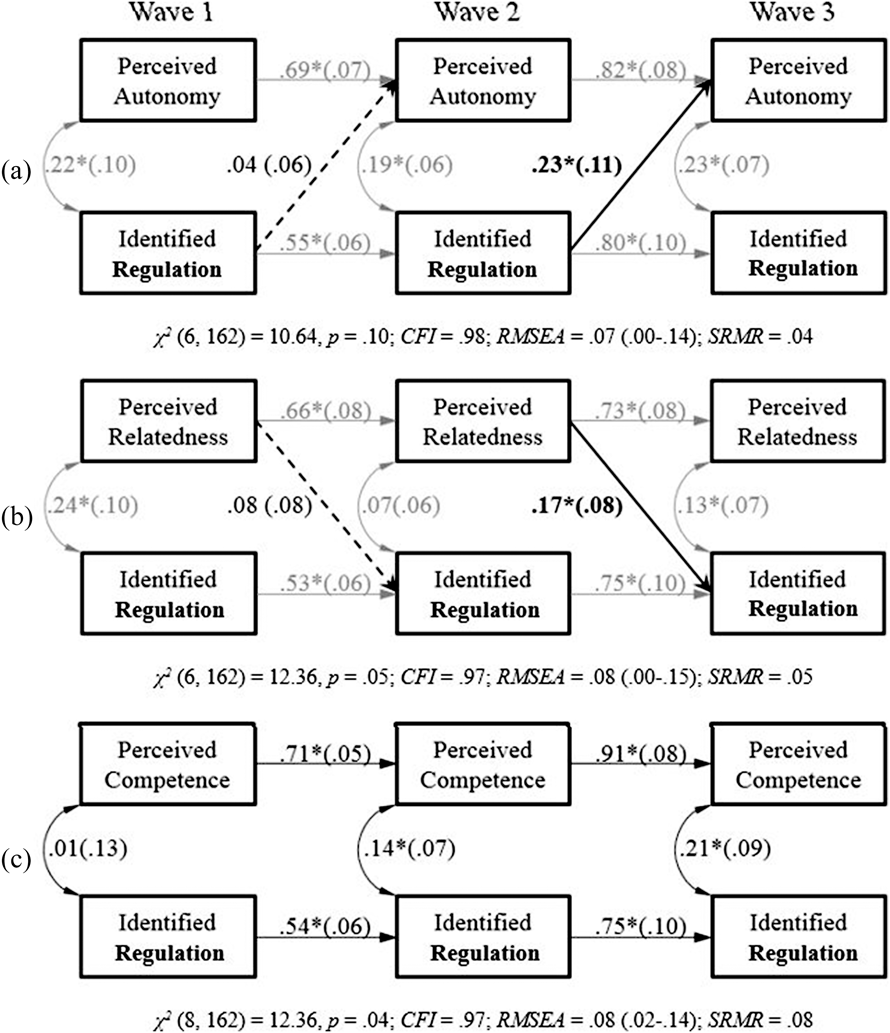
Figure 4 presents the best-fitting models between identified regulation and the three psychological needs. The alternative sequence model between identified regulation and autonomy fit the data well and showed a trend toward significant improvement over the stability model, ∆χ 2 (2) = 5.19, p = .07. One out of the two paths from earlier levels of identified regulation to subsequent levels of autonomy in the alternative sequence model was significant, with identified regulation at wave 2 predicting autonomy at wave 3. This finding suggests that identified regulation contributes to level differences in autonomy, but the reverse may not occur. However, the best model for identified regulation and relatedness was the precursor model, which fit the data well and showed a trend toward significant improvement over the stability model, ∆χ 2 (2) = 5.49, p = .06. The path from relatedness in wave 2 to identified regulation at wave 3 was significant, suggesting that relatedness contributes to mean level differences in later identified regulation. The best-fitting model for the association between identified regulation and competence was the stability model.
Best fitting cross-lagged models for students' identified motivation and their perceived (a) autonomy, (b) relatedness, (c) competence. Note: Unstandardized estimates (and standard errors) are presented. Dashed lines indicate non-significant path estimates. * p < .05.

Intrinsic Motivation
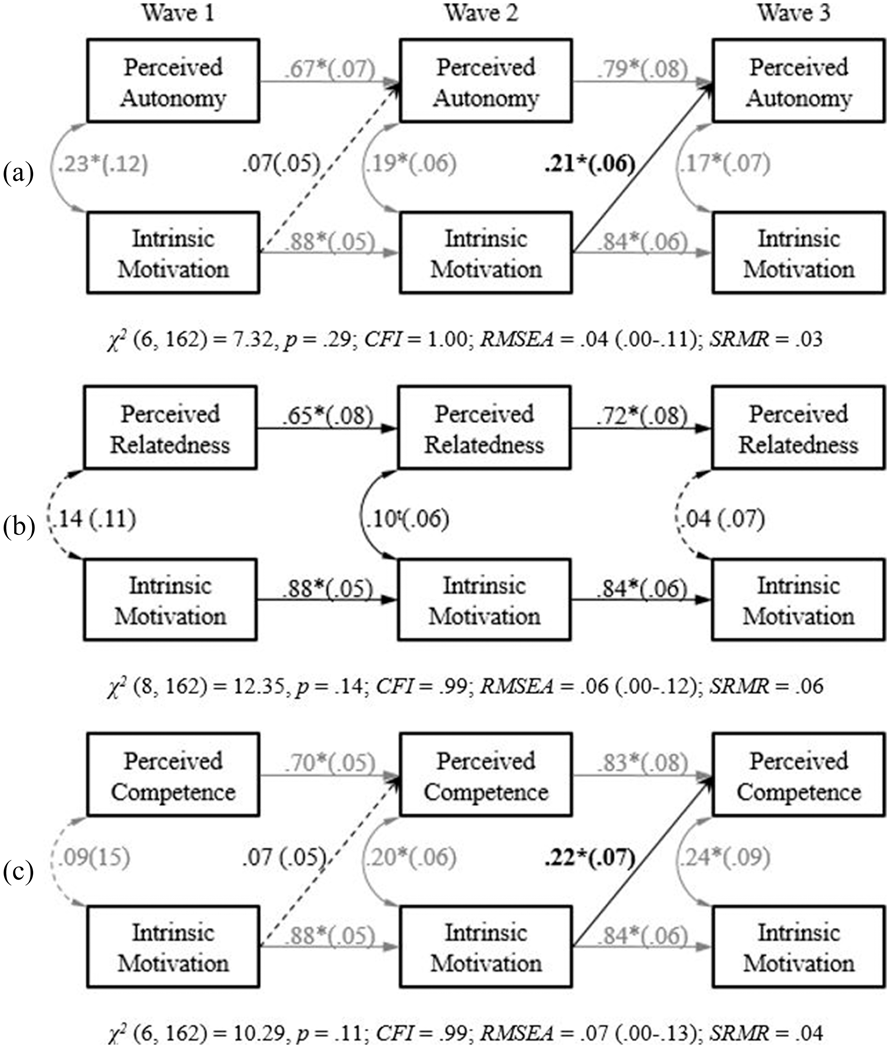
Figure 5 presents the best-fitting models between intrinsic motivation and the three psychological needs. The alternative sequence model between intrinsic motivation and autonomy fit the data well and was a significant improvement over the stability model, ∆ χ 2 (2) = 13.73, p = .001. This result suggests that intrinsic motivation mid-semester contributes to level differences in autonomy by the end of the semester, but the reverse does not occur. Similarly, the alternative sequence model best represented the association between intrinsic motivation and competence, fitting the data well and showing a significant improvement over the stability model, ∆χ 2 (2) = 11.08, p = .004. This result suggests that intrinsic motivation mid-semester contributes to level differences in competence by the end of the semester, but the reverse does not occur. The best-fitting model between intrinsic motivation and relatedness was the stability models.
Best fitting cross-lagged models for students' intrinsic motivation and their perceived (a) autonomy, (b) relatedness, (c) competence. Note: Unstandardized estimates (and standard errors) are presented. Dashed lines indicate non-significant path estimates. * p < .05.

In summary, psychological needs did not predict external, introjected, and integrated orientations across time nor did these orientations predict students’ psychological needs across time. This pattern was also the case for identified regulation and competence as well as for intrinsic motivation and relatedness. Opposite to the expected pattern, identified regulation and intrinsic motivation levels mid-semester predicted perceived autonomy by the end of the semester, but not vice versa. Relatedness mid-semester predicted identified regulation by the end of the semester.
Motivational Orientations and Engagement
All stability models fit the data adequately (χ 2 (7, N = 162) = 11.74 to 19.24, ps = .01 to .11; CFI = .96 to .99; RMSEA = .07 to .10; SRMR = .04 to .11). Within-time covariances among the variables showed low to moderate associations between four of the motivational orientations (introjected, identified, integrated, intrinsic) and engagement, with 6 significant covariances out of 12 (Bs = .08 to .44, p < .001 to p = .048). There were no significant within-time associations between external orientation and engagement. The stability models explained between 60% and 71% of the variance in engagement and between 39% and 75% of the variance in the five motivational orientations.
External, Introjected, and Integrated Regulations
The stability model was best fitting for the associations between engagement and external, introjected, and integrated regulations, suggesting that the associations between these motivational regulations and engagement across time are sufficiently represented by their significant within-time covariations.
Identified Regulation
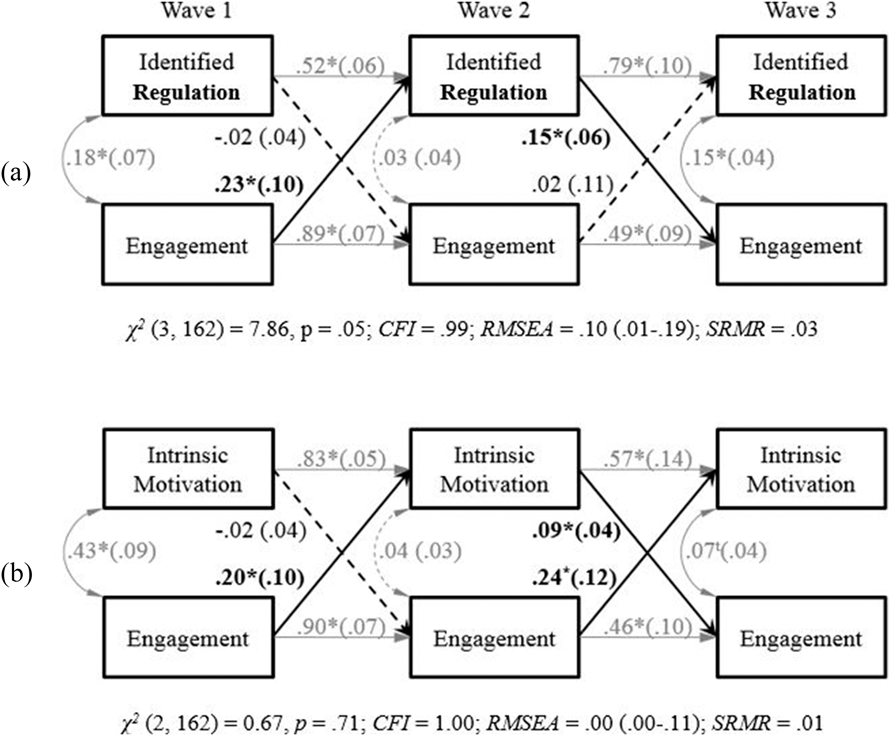
The best-fitting models for the association between identified regulation and engagement as well as between intrinsic motivation and engagement are presented in Figure 6. The reciprocal model for identified regulation and engagement fit the data well, was a significant improvement over the stability model (∆χ2 (4) = 11.38, p = .02), and showed a trend toward significant improvement over the precursor model (∆χ2 (2) = 5.11, p = .08). This reciprocal model added paths from identified regulation to subsequent levels of engagement and vice versa. Two paths were significant: (a) engagement at wave 1 positively predicted identified regulation at wave 2 and (b) identified regulation at wave 2 positively predicted engagement at wave 3. This result suggests that identified regulation and engagement reciprocally contribute to level differences in one another.
Best fitting cross-lagged models for students' engagement and their (a) identified motivation, (b) intrinsic motivation. Note: Unstandardized estimates (and standard errors) are presented. Dashed lines indicate non-significant path estimates. * p < .05.

Intrinsic Motivation
Similarly, the reciprocal model for the associations between intrinsic motivation and engagement fit the data well and was a significant improvement over the stability model (∆χ2 (4) = 12.79, p = .01) and precursor model (∆χ2 (2) = 8.13, p = .02). Three paths were significant, engagement at wave 1 and wave 2 positively predicted intrinsic motivation at waves 2 and 3, respectively, and intrinsic motivation at wave 2 positively predicted engagement at wave 3. This model suggests intrinsic motivation and engagement contribute to level differences in one another, with engagement contributing toward intrinsic motivation starting earlier in the semester.
CONCLUSION
The present research had three objectives: (a) to examine whether and how psychological needs, motivational orientations, and engagement change over time; (b) to investigate whether students’ initial levels of and change over time in psychological needs and motivational orientations related to their initial levels of and change over time in motivational orientations and engagement, respectively; and (c) to test the hypothesized causal relations between psychological needs and orientations, on the one hand, and orientations and engagement, on the other. These objectives are discussed below, followed by a consideration of the study’s limitations and directions for future research.
MOTIVATIONAL TRAJECTORIES AND THEIR INTERRELATIONS
Students began the semester reporting diverse levels of autonomy, competence, and relatedness. Despite these different starting points, these feelings generally increased linearly over time. Similarly, students reported diverse initial levels of most of the orientations, but these initial levels did not predict changes over time. Stated otherwise, students’ gains in psychological needs and motivational orientations (introjected, integrated, and intrinsic) across the semester were independent of whether they began the course with a relatively high or low degree of psychological need satisfaction and more or less self-determined motivation.
These general tendencies of gains in both psychological needs and an autonomous orientation across a language course are consistent with the SDT proposition that the more students feel their needs are met, the more they can internalize their learning activities (i.e., the more they would endorse more self-determined orientations). Results from the PPLGM, however, did not identify significant links between, on the one hand, students’ trajectories for competence and relatedness and, on the other hand, their trajectories for motivational orientations across the semester. It is possible that this lack of association was due to the high homogeneity across students on their trajectories of change for competence and relatedness. In the case of autonomy, for which there was more variability across students’ trajectories, students who experienced more gains in autonomy experienced more gains in integrated regulation and intrinsic motivation than students who experienced less gain in autonomy across the semester.
Unlike the other motivational orientations, neither students’ external nor identified regulation levels changed over time. Stability in external regulation across the language course is not unexpected, given that circumstantial pressures for taking a language course are unlikely to abate across a semester. Wanting to get course credit and land a more prestigious job later, both of which represent external regulation, are contingencies unlikely to change over the period of a semester. Identified regulation is focused on circumstances linked to relatively enduring values (e.g., facilitating the pursuit of a desired personal goal) that are also unlikely to change over the period of a few months. In contrast, people’s experience of self-directed pressure, personal investment, and intrinsic satisfaction might be more dependent on situational factors that can vary over the language course, such as examinations, assignment deadlines, interpersonal interactions in the classroom, and circumstances outside of the classroom.
In contrast with the positive trajectories of change for psychological needs and motivational orientations, students’ engagement decreased over time. This finding was unexpected based on SDT, which would predict that increased levels of self-determination would energize students’ learning and therefore be associated with heightened engagement. However, the fact that engagement decreases over time has been widely observed (Pintrich, Reference Pintrich2003; Wigfield, Eccles, Schiefele, Roeser, & Davis-Kean, Reference Wigfield, Eccles, Schiefele, Roeser, Davis-Kean, Damon and Eisenberg2006). Recently, Tze, Klassen, and Daniels (Reference Tze, Klassen and Daniels2014) found that effort regulation is closely related to class-related (but not learning-related) boredom in university students, such that the former decreases and the latter increases over the semester. They posit that effort regulation diminishes as the student becomes accustomed to and skilled in managing course-related factors such as new content area, workload, and instructor characteristics. This claim is also consistent with the idea that as the semester comes to an end, even if we enjoy and value a given course, we disinvest effort as we grapple with other end-of-semester tasks (e.g., exams including those in other courses) and prepare for subsequent activities (e.g., vacations, new courses).
It appears, however, that this decline in engagement across the semester can be attenuated. The parallel process latent growth curve modeling demonstrated that trajectories of change in engagement covaried with trajectories of change in autonomous orientations. More specifically, the decline in engagement was attenuated for students who experience more gains in self-determined orientations across the semester compared to students who experience fewer gains in self-determined orientations. This result indicates that, although an increase in self-determination was not associated with heightened engagement as expected, an autonomous orientation still plays a positive role as a protective factor attenuating loss of engagement. It is possible that a concentrated focus on more self-relevant reasons for language learning energizes students’ efforts toward this personally valued activity, despite the competing demands at semester’s end.
RELATIONS AMONG VARIABLES OVER TIME
The results of the cross-lagged autoregression analyses showed that most variables were quite stable over time: People who were high (or low) on a certain motivational variable were likely to continue to endorse the variable to the same degree across the semester, and therefore there are no changes across individuals to be explained by antecedents. Despite this stability, some variables predicted other variables over time, and many of the cross-lagged associations suggested more nuanced causal relations among variables than were predicted based on SDT. Given the SDT proposition that psychological need satisfaction impacts how self-determined students’ orientations are, we hypothesized that autonomy, competence, and relatedness early in the semester would predict self-determined orientations later in the semester. Consistent with the hypothesis, students’ sense of relatedness mid-semester positively predicted levels of identified regulation by the end of the semester. The fact that relatedness was linked to identified regulation but not to intrinsic motivation is also congruent with the proposition that relatedness is more important for the internalization process (and therefore for self-determined forms of extrinsic motivation) than for intrinsic motivation (Ryan & Deci, Reference Ryan and Deci2017). For autonomy and competence, however, the pattern was converse to the one hypothesized. A stronger self-determined orientation at mid-semester, particularly intrinsic motivation and identified regulation, predicted greater self-perceived autonomy by the end of the semester. Similarly, learners with greater intrinsic motivation mid-semester reported greater competence by the end of the semester. Maintenance of intrinsic motivation therefore seems to facilitate students’ sense of autonomy and competence—an association that is opposite to the one SDT proposes.
With regard to the relations between orientations and engagement, earlier self-determined orientation levels were hypothesized to predict greater engagement later. Again, a more nuanced causal pattern was evident than that hypothesized. Earlier levels of engagement positively predicted later levels of identified regulation (at mid-semester) as well as later levels of intrinsic motivation (both at mid-semester and by the end of the semester). Between mid-semester and the end of the course, these orientations also predicted engagement. This transactional relation indicates that autonomous orientations and engagement reciprocally cause changes in one another, which we might frame as a dynamic motivational “spiral.” Research that utilizes at a longer time frame could well examine how long and under what conditions such a spiral between orientations and engagement continues.
Thus, the present findings indicate not only that earlier motivational levels matter for later perceptions of psychological need fulfillment and later engagement, but also earlier engagement levels support later motivational orientations. These findings point to a more dynamic, reciprocal picture of motivational processes than what has been previously proposed in language learning research and in SDT. For instance, much emphasis has been placed on the importance of establishing autonomy and competence supportive classrooms to foster more self-determined orientations (Kaplan & Patrick, Reference Kaplan, Patrick, Wentzel and Miele2016; Ryan & Deci, Reference Ryan and Deci2017). The results reported here, however, demonstrate that students’ preestablished orientations influence their perceptions of need support and that, of the three psychological needs, satisfaction with relatedness early in the course, rather than autonomy and competence, influences how learners orient toward their language learning later in their language course. This finding indicates that different psychological needs play an influential role for students’ motivational orientations depending upon the point in the semester.
For motivational orientations and engagement, our findings are congruent with motivational theory and research in which engagement arises through self-processes, particularly a self-determined motivational orientation (Ryan & Deci, Reference Ryan and Deci2017), but they also indicate that students’ efforts, persistence, and attention to their learning influence how central the learning activities are to their sense of self. It is possible that the dynamic system in play here starts with engagement influencing orientations, which then influence later engagement. This possibility has not received attention in language learning research but is in line with broader social psychology theories such as self-perception theory (Bem, Reference Bem1967), which posits that people’s own behaviors inform their sense of what their personal values and attitudes are. It is also noteworthy that the causal and reciprocal dynamics emerge in the latter half of the semester perhaps because it takes some time for classroom and motivational systems to settle into a more stable, predictable pattern (i.e., an “attractor state”; de Bot et al., Reference de Bot, Lowie and Verspoor2007).
LIMITATIONS AND FUTURE DIRECTIONS
Two features of the research design limit the conclusions that can be drawn from this study’s findings. First, although a temporal element was included, the design is correlational and therefore does not control or manipulate variables as an experiment would. To make more convincing causal claims, experimental or intervention evidence would be necessary (although such designs do not generally address reciprocal relations, as were found here). That said, the longitudinal design of this study does improve on cross-sectional designs by including a time ordering to observations, which allows the researcher to determine whether a given observation can be predicted by observations at an earlier time, which is a fundament of causal claims.
Second, the sample size was small and had a 50% attrition rate by the final wave of data. Both features can bring about issues of sample bias and limited generalizability of results, and it can decrease the ability to discover longitudinal trends in behavior. Although it is possible that students who dropped out of our study had different motivational trajectories across the semester compared to those who stayed, the results of our attrition analysis suggest otherwise; there were no meaningful differences in the study variables between students who left the study after wave 1 or wave 2 and those who continued to wave 3. In addition, one of the strengths of structural equation modeling of longitudinal data is that it does not require balanced data from all participants. That is, each participant need not provide data for each wave to be used in the analysis (Singer & Willett, Reference Singer and Willett2003). Nonetheless, a larger sample size across all waves would be more rigorous and would allow more complex models to be assessed, such as a model simultaneously assessing the longitudinal links among psychological needs, motivational orientations, and engagement.
Further longitudinal assessments of the associations across language learners’ needs, orientations, and engagement are needed. This study indicates that language learners’ motivational characteristics change across the academic semester, and future research could examine the forms that these trajectories of change take over different time frames. It is possible that motivational development follows a more complicated trajectory than steady, linear increases or decreases. To explore this question, the design requires more than three measurement occasions, as three time points only allow modeling of linear trajectories (ibid.).
This study sought to examine a well-established conceptual framework for understanding L2 motivation, SDT, with a focus on change over time and complex associations across time—aims that align with a CDS perspective. Accordingly, we considered trajectories of motivational variables over time and whether these trajectories are interconnected. We also tested potential causal relations posited by the theoretical framework, the results of which pointed to not only the important role of self-determined orientations for sustaining engaged effort in language learning, but also the reciprocal dynamic by which engagement enhances identification with and intrinsic interest in language learning. We found that many of the tenets of SDT were upheld, such as the importance of autonomy, competence, and relatedness for self-determined orientations and of self-determination for motivated engagement. These relations, however, were more complex than heretofore proposed by the theory. Future research should consider potential reciprocity between the components of this theory and be attentive to different degrees of interaction between components at different time points. It would be highly useful for SDT scholars to more explicitly incorporate tenets from the CDS perspective into their theoretical formulations.
The questions we addressed were quite basic: Do motivational variables change over time in a linear fashion and, if so, what is this trajectory across a semester-long course and are these trajectories related? Moreover, do mean levels of one variable predict mean levels of another? We think that the analytic approach used here could be a useful tool for answering more complex questions that might be asked from a CDS perspective, including considering more complex trajectories, interactions among more components, and perhaps more attention to how motivational systems are linked to linguistic systems at different levels of context (interpersonal, institutional, sociostructural). As well, an examination of SDT’s claim that the emergence of a more authentic, integrated sense of self parallel the development and internalization of a new language into one’s self-repertoire if autonomy, competence, and relatedness needs are satisfied, would be well suited to analysis from a CDS perspective.
Although more research is needed into the complexities of this dynamic and interacting motivational system, this study provides a useful foundation for examining different ages and developmental periods; larger and smaller time frames; rates and trajectories of change at and across multiple levels (e.g., intra-individually, interindividually, intragroup, and intergroup), among other topics relevant to a developmental perspective. Through such research we can better understand how educators’ support of learners’ experience of autonomy, competence, and relatedness can foster more intense, persistent engagement in the learning process, that in turn could facilitate successful academic achievement, increased linguistic proficiency, and enhanced communicative competence outside the classroom.
SUPPLEMENTARY MATERIAL
To view supplementary material for this article, please visit https://doi.org/10.1017/S0272263118000189