Introduction
Increased incidences of goosegrass [Eleusine indica (L.) Gaertn.] populations that have developed resistance to effective preemergence herbicides, such as prodiamine and oxadiazon (Breeden et al. Reference Breeden, Brosnan, Breeden, Vargas, Eichberger, Tresch and Laforest2017; McCullough et al. Reference McCullough, Yu and Barreda2013; McElroy et al. Reference McElroy, Head, Wehtje and Spak2017), have forced turfgrass managers to rely on postemergence herbicides for E. indica control. Options for postemergence control of E. indica in bermudagrass [Cynodon dactylon (L.) Pers.] have become limited due to restrictions on MSMA use and loss of diclofop (Keigwin Reference Keigwin2013; McCullough Reference McCullough2014). The loss of these herbicides has led turfgrass managers to increase reliance on products that contain foramsulfuron or metribuzin. Unfortunately, foramsulfuron is expensive and provides inadequate control of mature E. indica, while metribuzin can be highly injurious to bermudagrass at effective rates (Busey Reference Busey2004; Johnson Reference Johnson1980).
Topramezone is a newer 4-hydroxyphenylpyruvate dioxygenase (HPPD)-inhibitor herbicide highly efficacious on E. indica, with control observed at one-quarter the labeled rate (Cox et al. Reference Cox, Rana, Brewer and Askew2017). In 2018, topramezone was registered for use in bermudagrass for E. indica control at rates between 12.3 and 18.5 g ae ha−1, which is half the labeled rate in most cool-season turfgrasses (Anonymous 2018). Even at these lower topramezone rates, bermudagrass is still subject to severe phytotoxicity in the form of foliar bleaching that can persist for multiple weeks (Brewer et al. Reference Brewer, Willis, Rana and Askew2016; Cox et al. Reference Cox, Rana, Brewer and Askew2017; Elmore et al. Reference Elmore, Brosnan, Kopsell, Breeden and Mueller2011b). This injury tends to last longer in the transition zone than areas further south due to the shorter growing season and lower accumulation of heat units (Cox et al. Reference Cox, Rana, Brewer and Askew2017; Breeden et al. Reference Breeden, Brosnan, Breeden, Vargas, Eichberger, Tresch and Laforest2017; Kerr et al. Reference Kerr, McCarty, Cutulle, Bridges and Saski2019b; Lindsey et al. Reference Lindsey, DeFrank and Cheng2019; Stanford et al. Reference Stanford, White, Krausz, Thomas, Colbaugh and Abernathy2005). Topramezone would be a more viable E. indica control option for turfgrass managers in the transition zone if programs could be developed to reduce foliar bleaching and injury duration to bermudagrass while also maintaining E. indica control efficacy.
In recent years, multiple researchers have evaluated different fertility, herbicide, and irrigation programs with topramezone to reduce bermudagrass phytotoxicity. Triclopyr applied at 140 g ae ha−1 reduced topramezone bleaching injury on bermudagrass while it also maintained adequate E. indica control; however, the bermudagrass bleaching injury is replaced with unacceptable leaf necrosis and stunting that persisted far longer than topramezone applied alone (Boyd et al. Reference Boyd, McElroy, McCurdy, McCullough, Han and Guertal2020b; Cox et al. Reference Cox, Rana, Brewer and Askew2017). Iron products significantly reduced bermudagrass bleaching caused by topramezone without compromising E. indica control (Boyd et al. Reference Boyd, McElroy, Han and Guertal2020a, 2020b). Researchers have also observed that the addition of irrigation immediately after topramezone applied alone at 12.3 g ha−1 or in combination with metribuzin at 420 g ai ha−1 significantly reduced bermudagrass injury from 53% and 82% to 11 and 22%, respectively, at 1 wk after initial treatment (WAIT) (Kerr et al. Reference Kerr, McCarty, Cutulle, Bridges and Saski2019b). During the same studies, topramezone applied alone and in combination with metribuzin controlled mature E. indica approximately 50% less when irrigation was applied, but these treatments were not affected when E. indica was three tillers or fewer (Kerr et al. Reference Kerr, McCarty, Cutulle, Bridges and Saski2019b).
Another potential tank-mix partner for topramezone is metribuzin, which is a photosystem II (PS II) inhibitor. Research in disparate agronomic systems, such as turfgrass and production crops, has evaluated synergistic combinations of HPPD- and PS II–inhibiting herbicides that led to increased weed control (Abendroth et al. Reference Abendroth, Martin and Roeth2006; Brosnan et al. Reference Brosnan, Armel, Klingeman, Breeden, Vargas and Flanagan2010; Elmore et al. Reference Elmore, Brosnan, Breeden and Patton2013; Kohrt and Sprague Reference Kohrt and Sprague2017). Currently, there are three papers that have been published evaluating topramezone plus metribuzin in turfgrass. Two evaluated the use of topramezone with or without metribuzin for common bermudagrass suppression and E. indica control in seashore paspalum (Paspalum vaginatum Sw.) (Lindsey et al. Reference Lindsey, DeFrank and Cheng2019, Reference Lindsey, DeFrank and Cheng2020). Topramezone at 10 g ha−1 plus metribuzin at 100 g ha−1 was observed to control E. indica 90% to 100% (Lindsey et al. Reference Lindsey, DeFrank and Cheng2020). Kerr et al. (Reference Kerr, McCarty, Brown, Harris and McElroy2019a, Reference Kerr, McCarty, Cutulle, Bridges and Saski2019b) sought to reduce bermudagrass response to topramezone at 12 g ha−1 with or without metribuzin at 420 g ha−1 by immediate post-treatment irrigation. Irrigation at 0.6 cm within 1 min of spray application did not reduce initial bermudagrass injury but slightly improved recovery as assessed at 4 WAIT in South Carolina and Alabama (Kerr et al. Reference Kerr, McCarty, Brown, Harris and McElroy2019a). In another study, immediate irrigation substantially reduced initial bermudagrass injury but also reduced mature E. indica control to less than half of that without irrigation (Kerr et al. Reference Kerr, McCarty, Cutulle, Bridges and Saski2019b). Kerr et al. (Reference Kerr, McCarty, Cutulle, Bridges and Saski2019b) also noted that topramezone at 12.3 g ha−1 alone controlled mature E. indica 66%, while control was increased to 100% with the addition of metribuzin at 420 g ha−1.
These past studies suggest that metribuzin admixtures with topramezone can improve weed control compared with topramezone alone and that there may be some physiological differences that allow for significant selectivity between bermudagrass and E. indica with topramezone-based programs. Metabolism has been suggested to play a role in topramezone selectivity between creeping bentgrass (Agrostis stolonifera L.) and targeted weeds (Elmore et al. Reference Elmore, Brosnan, Armel, Kopsell, Best, Mueller and Sorochan2015), while Grossman and Ehrhardt (Reference Grossman and Ehrhardt2007) showed that topramezone selectivity between corn (Zea mays L.) and giant foxtail (Setaria faberi Herrm.) was primarily based on metabolism.
We hypothesized that 210 g ha−1 metribuzin as an admixture may allow topramezone rates to be lowered compared with previous work, thus gaining bermudagrass safety while maintaining acceptable E. indica control. Furthermore, we hypothesized that metabolism may be involved in selective responses between bermudagrass and E. indica and that metribuzin may alter absorption, translocation, or metabolism, thus modifying plant response. Our objectives, with respect to these hypotheses, were to evaluate (1) multiple topramezone rates alone or with metribuzin compared with similar programs with mesotrione or sulfentrazone, (2) a more refined selection of topramezone rates alone or with metribuzin for response of bermudagrass at eight sites and E. indica at nine sites, and (3) absorption, translocation, and metabolism of topramezone in bermudagrass and E. indica as influenced by metribuzin admixture.
Materials and Methods
Preliminary Experiment Assessing Rates of Topramezone and Mesotrione
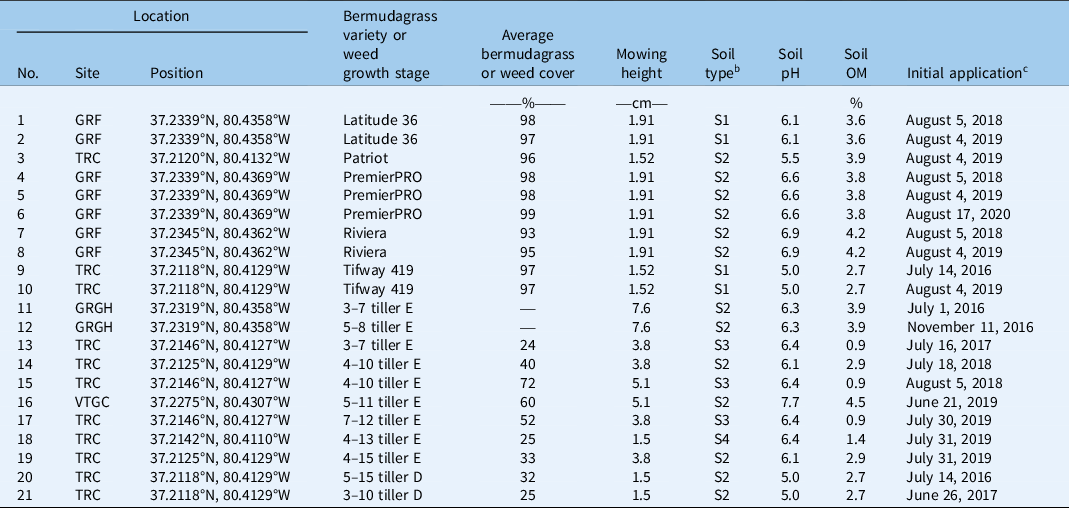
Between 2016 and 2020, field experiments were established as randomized complete block designs with four replications and 0.9 m by 1.8 m plots to evaluate bermudagrass and smooth crabgrass [Digitaria ischaemum (Schreb.) Schreb. ex Muhl.] response to low rates of mesotrione and topramezone compared with sulfentrazone applied in combination with metribuzin. Bermudagrass tolerance was assessed on research fairways at locations 6 and 9 (Table 1) and D. ischaemum control was assessed at locations 20 and 21 (Table 1). Plant composition and soil edaphic variables for all locations can be referenced in Table 1. Both sites were fertilized a week before trial initiation with 24.4 kg N ha−1, and no other fertility or plant protectants were used during the trials. Turf and weedy fallow sites were mowed three times per week with reel mowers, and irrigation was provided as needed to supplement natural rainfall in order to maintain active turfgrass and weed growth.
Plant composition, edaphic variables, and initial application date for 21 unique site locations in Blacksburg, VA, utilized to assess Eleusine indica or Digitaria ischaemum control or bermudagrass turf tolerance to topramezone-based herbicide programs. a

a Abbreviations: D, Digitaria ischaemum; E, Eleusine indica; GRF, Glade Road Research Facility; GRGH, Glade Road Greenhouse; OM, organic matter; TRC, Turfgrass Research Center; VTGC, Virginia Tech Golf Course.
b Soil taxonomy: S1, Duffield silt loam (fine-loamy, mixed, active, mesic, Ultic Hapludalfs)–Ernest silt loam (fine-loamy, mixed, superactive, mesic Aquic Fragiudults) complex; S2, Groseclose-Urban land complex loam (clayey, mixed, mesic Typic Hapludults); S3, USGA specification sand; S4, Udorthents and Urban land plus a sand cap.
c All sites received sequential applications 3 wk after the initial application.
Treatments for these trials are shown in Table 2 and included: topramezone (Pylex®, BASF, 26 Davis Drive, Research Triangle Park, NC 27709, USA), mesotrione (Tenacity®, Syngenta Crop Protection, P.O. Box 18300, Greensboro, NC 27419-8300, USA), and sulfentrazone (Dismiss®, FMC, 1735 Market Street, Philadelphia, PA 19103) applied alone or mixed with metribuzin (Sencor®, Bayer Environmental Science, A Division of Bayer Crop Science, 5000 CentreGreen Way, Suite 400, Cary, NC 27513, USA) and compared with metribuzin alone. All rates represent the lowest possible rate that was expected to potentially control E. indica when mixed with metribuzin. Topramezone-containing treatments were applied with 0.5% v/v of methylated vegetable oil (MVO) (Dyne-Amic®, Helena Chemical, 225 Schilling Boulevard, Suite 300, Collierville, TN 38017, USA), and mesotrione-containing treatments were applied with 0.25% v/v of nonionic surfactant (NIS) (Induce®, Helena Chemical). All treatments were applied using a CO2-pressurized hooded sprayer calibrated to deliver 280 L ha−1 at 289 kPa via two TeeJet® XR6502VS flat-fan nozzles (Spraying Systems, Glendale Heights, IL 62703, USA).
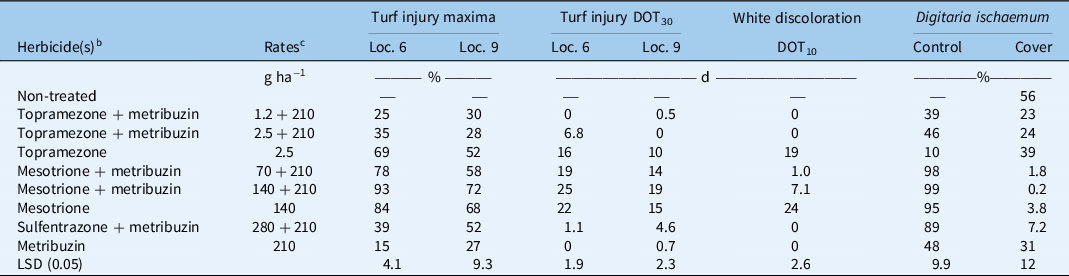
Preliminary experiment investigating herbicide combinations for effects on bermudagrass injury maxima and days over a threshold of 30% turf injury (DOT30), days over a white discoloration threshold of 10% (DOT10), and Digitaria ischaemum control and cover. a

a Data were averaged over two locations (Loc.) if trial by treatment interactions were insignificant (P > 0.05).
b All treatments were applied twice at a 3-week interval.
c Rates given as acid equivalency for topramezone and active ingredient for all other herbicides.
In this preliminary study, turf response and weed control were assessed visually at 0, 1, 2, 4, 5, and 8 WAIT, while D. ischaemum cover was based on line intersect counts using a 0.91 m by 0.91 m grid that contained 240 intersects at 5.72-cm increments at 8 WAIT. Turf injury and weed control were estimated as percentage loss of perceived green vegetation potential based on non-treated turf (Frans et al. Reference Frans, Talbert, Marx and Crowley1986). Turf white discoloration was estimated as the percentage of turfgrass foliage that exhibited white discoloration. The degree to which turfgrass injury and discoloration are objectionable to turf managers is temporally dependent. Longer durations of turf discoloration are generally unacceptable. To assess duration of objectionable injury and white discoloration, data were converted to days over a threshold (DOT) by assuming linear trends between assessment dates and using functional arguments in Microsoft Excel software (Microsoft Excel®, Microsoft Corporation, Redmond, WA 98052, USA) to calculate the number of days that estimated injury or discoloration was above a threshold of 30% or 10%, respectively. These metrics, expressed as DOT30 and DOT10, reflect the amount of time that turfgrass injury and white discoloration were above acceptable levels as has been done in other studies (Cox et al. Reference Cox, Rana, Brewer and Askew2017). In addition to injury duration, maximum injury is also of concern and was calculated by recording maximum observed injury values from each experimental unit over the span of assessment dates.
Turf injury maxima, turf injury DOT30, turf white discoloration DOT10, and D. ischaemum cover and control at 8 WAIT were subjected to a combined ANOVA with sums of squares partitioned to reflect effects of replicate, trial, treatment, and trial by treatment (McIntosh Reference McIntosh1983). Trial was considered a random variable and mean squares of treatment effects were tested by the mean square associated with trial by treatment. If trial by treatment interactions were significant, data were separated by trial, otherwise data were averaged over trial. Means were separated using Fisher’s protected LSD test at α = 0.05.
Performance of Selected Topramezone plus Metribuzin Programs at Multiple Sites
Fifteen field and two greenhouse studies were conducted as randomized complete block designs with four replications to investigate E. indica control and bermudagrass response to topramezone plus metribuzin programs. Bermudagrass response was assessed at locations 1–5, 7, 8, and 10 while E. indica response was assessed at locations 11–19 (Table 1). Plant composition and soil edaphic variables for all locations can be referenced in Table 1. All field locations were fertilized monthly during the growing season to provide 49 kg N ha−1 and irrigated as needed to maintain active turfgrass and weed growth. All bermudagrass turf was mowed three times per week with reel mowers at heights shown in Table 1. Fallow, weedy locations were mowed weekly or biweekly with reel mowers for location 18 and rotary mowers for all other locations. In greenhouse locations 11 and 12, E. indica was clipped with scissors twice per week to maintain an approximate height of 7.6 cm, and pots were irrigated daily. Greenhouse pots were 10.2-cm diameter and filled with a soil and sand (2:1 by wt) mixture supplemented with 25 kg N ha−1 monthly. The soil information can be found in Table 1. Supplemental lighting provided approximately 530 µmol m−2 s−1 photosynthetically active radiation via high-pressure sodium lamps for 14 h each day, and plants were maintained at 26/24 C day/night temperatures.
The plot sizes for the bermudagrass tolerance sites were 1.2 m by 1.8 m, while the plot sizes for the E. indica control sites ranged from 1.2 m by 1.2 m to 1.8 m by 1.8 m. The plot sizes for weed control sites varied due to E. indica pressure and space availability. Treatments included topramezone applied at 1.2, 3.7, and 6.1 g ha−1 plus metribuzin applied at 210 g ha−1, and topramezone at 6.1 g ha−1 applied alone. All treatments included 0.5% v/v of MVO and were applied twice at a 3-wk interval. Greenhouse pots were sprayed using a CO2-pressurized spray chamber that delivered 280 L ha−1 at 289 kPa via one TeeJet® 80015 even flat-fan nozzle. Field plots were sprayed using a CO2-pressurized sprayer with two TeeJet® TTI 11003 nozzles or four TeeJet® TTI 11004 nozzles that delivered 280 L ha−1 at 289 kPa.
Turf response was evaluated at 0, 1, 2, 3, 4, 5, 6, and 8 WAIT. Turf injury maxima, turf injury DOT30, and turf white discoloration DOT10 were assessed as previously described. Turf dark-green color index (DGCI) and green cover were assessed via analysis of aerial images in Field Analyzer (Turf Analyzer, Fayetteville, AR 72701, USA) with selected settings of low hue from 70 to 80, high hue at 360, low saturation from 29 to 38, high saturation at 100, low brightness at 0, and high brightness from 60 to 68. Grid settings included an X-offset of 20 and a Y-offset of 20 to reduce any variable edge effect caused by incorrect sprayer overlap. The normalized difference vegetation index (NDVI) was also collected at the tolerance sites at 1, 2, 4, 5, 6, and 8 WAIT using a multispectral analyzer (Crop Circle™ Model ACS-210, Holland Scientific, 6001 South 58th Street, Lincoln, NE 68516, USA). At the E. indica control sites, visual percent cover and control were assessed (0% to 100% scale) at 0, 1, 2, 3, 4, 6, and 8 WAIT, and final plant counts were taken at 8 WAIT. In the two greenhouse trials, E. indica foliar biomass was also assessed at 9 WAIT by cutting all foliage at ground level, drying at 50 C for 48 h, and weighing. Data were subjected to ANOVA and mean separation as previously described.
Absorption, Translocation, and Metabolism of [14C]Topramezone
PremierPRO™ brand (‘Premier’) bermudagrass sprigs were removed from the field and planted into sand flats in addition to E. indica seed that had been collected from a local turf research area. Both the E. indica and bermudagrass transplants were treated with fluxapyroxad plus pyraclostrobin and 49 kg N ha−1 to help maintain plant health and reduce disease occurrence. Once E. indica matured to the three-leaf stage and bermudagrass was producing new shoots and leaves, plants were selected for size consistency and carefully removed from the flat, rinsed, and transplanted into 50-ml centrifuge tubes with a Hoagland modified basal salt solution (MP Biomedicals, 29525 Foundation Parkway, Solon, OH 44139, USA) mixed at 50% strength, and the plants were held in place by cotton balls. Plants were maintained in hydroponic culture for approximately 1 wk in controlled environment chambers (350 µmol m−2 s−1 PAR for 12 h at 26/20 C day/night temperatures and 40% relative humidity). Eleusine indica seedlings had five leaves and bermudagrass sprigs had a single shoot with six expanded leaves at application time.
Treatments were arranged in a split-split-plot design containing four harvest times as main plots, a two by two factorial arrangement containing two plant species (bermudagrass vs. E. indica) and two herbicide treatments (topramezone vs. topramezone + metribuzin) as subplots, and five plant partitions as sub-subplots. The study was repeated in two separate growth chambers with both studies initiated on January 3, 2021. The two herbicide solutions consisted of [phenyl-U-14C]topramezone (96% radiochemical purity, 4.14 MBq mg−1) dissolved in water and formulated topramezone product (Pylex SC) with 5% v/v MVO or topramezone and formulated metribuzin product (Sencor 75DF) with MVO. For these herbicide solutions, we followed procedures similar to Grossman and Ehrhardt (Reference Grossman and Ehrhardt2007) but used lower topramezone field rates. The ratio of formulated topramezone and metribuzin, water, and MVO were equivalent to that applied in the field studies when topramezone was applied at 3.7 g ha−1, metribuzin was applied at 210 g ha−1, the water volume was 280 L ha−1, and MVO was included at 0.5% v/v. Both E. indica and bermudagrass received two 1-µl droplets of solution applied via microsyringe to the adaxial surface of the third-newest, fully expanded leaf, equaling 7.5 kBq plant−1.
The treated plants were harvested at 0.25, 5, 24, and 48 h after treatment (HAT). At each harvest time, the treated leaf was excised and vortexed in cold 1:1 methanol:deionized water with 1% v/v MVO once for 60 s. Once the leaf wash was complete, the treated leaf, all foliage above the treated leaf, all foliage below the treated leaf, and roots were placed into a freezer at −18 C to await further processing. For extraction, tissue samples were removed from the freezer and macerated in 6 ml of cold methanol with a glass tissue grinder (Pyrex™ Glass Pestle Tissue Grinders, Corelle Brands, Rosemont, IL 60018, USA). The ground tissue and extraction solution were then vacuum filtrated using a Buchner funnel and 55-mm filter paper (Whatman™ Filter Paper Grade 1, Cytiva Life Sciences, Marlborough, MA 01752, USA). All glassware was rinsed into the filtration apparatus with an additional 4 ml of methanol. A 0.5-ml aliquot of the extraction solution, the rinse solution, and the nutrient solution (to assess root exudate) was placed into separate 20-ml glass vials with 15 ml of scintillation cocktail (ScintiVerse® BD, Fisher Scientific, Fair Lawn, NJ 07410, USA), and radioactivity was determined for all three samples by using a liquid scintillation spectrometer (LS 6500 Multi-Purpose Scintillation Counter, Beckman Coulter, Fullerton, CA 92634-3100, USA).
Radioactivity extracted from treated leaves after 48 h was partitioned using thin-layer chromatography (TLC). Homogenates from previously described extraction and filtration procedures were dried in a nitrogen evaporator (N-EVAP™ 112, Organomation Associates, Berlin, MA 01503, USA), and residues were resuspended with 100 µl of cold methanol. This resuspended solution was then delivered to a 20 cm by 20 cm silica gel TLC plate (TLC Silica gel 60G F254, Millipore Sigma, Burlington, MA 01803, USA) and developed in a 3:2 v/v solution of cold ethyl acetate:methanol within an airtight glass chamber. The plates were then air-dried, and radioactive positions, proportions, and corresponding R f values were determined with a radiochromatogram scanner (Bioscan, System 200 Imaging Scanner and Auto Changer 1000, Bioscan, Washington, DC 20007, USA). Parent herbicide was identified by comparison with radiolabeled standards spotted on adjacent lanes of each plate. Radioactive trace peaks were integrated with Win-Scan software (WIN-SCAN Imaging Scanner Software v. 1.6c, Bioscan) with smoothing set to 13 point cubic and background excluded from peak area calculation. Area under each peak was converted to a percentage of total area and expressed as herbicide, more-polar metabolites, and less-polar metabolites.
Data consisted of extracted 14C radioactivity from rinse, treated leaf, above treated leaf, below treated leaf, roots, and nutrient solution at four harvest times. Total absorbed radioactivity was computed as the sum of radioactivity counts from all samples except the rinse, and these were expressed as a percentage of recovered herbicide. Radioactivity extracted from specific plant parts at 24 and 48 HAT were expressed as percentage of absorbed radioactivity. Radioactivity extracted from treated leaves at 48 HAT was expressed as the percentage of all peak areas below (more polar) and above (less polar) the topramezone peak compared with the percentage area under the peak identified as topramezone. All data were subjected to ANOVA with sums of squares partitioned to reflect the split-split-plot treatment structure and the random variable trial. All main effects or interactions of fixed effects were tested by the mean square associated with their interaction with trial. If trial interaction was significant, effects were presented separately by trial; otherwise, significant effects or interactions were averaged over trial.
Results and Discussion
Preliminary Experiment Assessing Rates of Topramezone and Mesotrione
There was a significant trial by treatment interaction for turf injury maxima and turf injury DOT30 (P < 0.0001), so these response variables were separated by trial (Table 2). Turfgrass white DOT10 and D. ischaemum control and cover had a significant treatment effect (P < 0.0001) that was not dependent on trial (P ≥ 0.1023), so data were averaged across trials (Table 2). The trial interaction for turf injury maxima was likely caused by inconsistent injury response to all treatments except topramezone plus metribuzin (Table 2). At location 6 (see Table 1), PremierPRO™ bermudagrass was more injured by most treatments than the ‘Tifway 419’ bermudagrass at location 9. Bermudagrass varieties have been shown to differ similarly in response to topramezone (Cox et al. Reference Cox, Rana, Brewer and Askew2017) and Tifway 419 has been shown to tolerate mesotrione more than some other bermudagrass varieties (Elmore et al. Reference Elmore, Brosnan, Kopsell and Breeden2011a, 2011b).
The addition of metribuzin to either rate of topramezone effectively reduced maximum injury to near or below an acceptable injury level (≤35%) compared with 52% to 69% injury by topramezone alone depending on trial (Table 2). Metribuzin did not improve maximum injury response by mesotrione, which was 58% to 93% depending on treatment and location. Investigation of topramezone at these rates on bermudagrass safety or D. ischaemum control have not been previously reported. Topramezone applied at 5 to 20 times higher rates than the current study and mixed with metribuzin injured bermudagrass greater than 50%, but the bermudagrass recovered to an acceptable injury level (≤30%) after 7 d in Hawaii (Lindsey et al. Reference Lindsey, DeFrank and Cheng2019, Reference Lindsey, DeFrank and Cheng2020). Only one study has evaluated mesotrione in combination with metribuzin at rates similar to those in the current study. Lindsey et al. (Reference Lindsey, DeFrank and Cheng2019) observed that mesotrione at 67 g ai ha−1 plus metribuzin at 100 g ha−1 injured bermudagrass less than 10%, while mesotrione applied alone at 280 g ha−1 injured bermudagrass 66% and 83% (Brewer et al. Reference Brewer, Willis, Rana and Askew2016).
The turf injury DOT30 was dependent on trial location for the same reason as turf injury maxima (Table 2). Topramezone at 1.2 g ha−1 plus metribuzin had only 0 to 0.5 DOT30 depending on location and less than all other treatments except metribuzin at both locations and sulfentrazone plus metribuzin at location 6 (Table 2). Topramezone applied alone at 2.5 g ha−1, by comparison, injured bermudagrass over the 30% threshold for 10 to 16 d depending on location. This dramatic difference in both magnitude of injury and recovery time when metribuzin was mixed with low-dose topramezone treatments was the observation that stimulated the other research in this report. The primary reason that injury levels were substantially reduced when 210 g ha−1 metribuzin was added to topramezone has to do with reduced white tissue discoloration.
Turf white discoloration DOT10 was consistent between trials and was eliminated by adding metribuzin to topramezone. This combination did not result in any days over a 10% threshold of white discoloration to bermudagrass foliage compared with 19 d from topramezone alone (Table 2). Metribuzin also reduced white discoloration DOT10 when added to mesotrione compared with mesotrione alone, despite overall injury from these treatments being unacceptable.
Digitaria ischaemum was controlled best by mesotrione programs or sulfentrazone plus metribuzin (Table 2). Topramezone alone or admixture did not control D. ischaemum more than 46%, despite an improvement when metribuzin was an admixture. Trends in D. ischaemum cover mirrored that of D. ischaemum control (Table 2). Similar to the current study, Elmore et al. (Reference Elmore, Brosnan, Kopsell and Breeden2012) observed that mesotrione applied once at 140 g ha−1 controlled D. ischaemum between 70% and 80%, while topramezone applied once at 4.5 g ha−1 controlled D. ischaemum less than 10%. At this time, no research has been published evaluating combinations of mesotrione or topramezone with metribuzin for D. ischaemum control. The lack of D. ischaemum control in the preliminary study was of little consequence, as our objective was to develop programs for selective E. indica control.
Performance of Selected Topramezone plus Metribuzin Programs at Multiple Sites
Bermudagrass Response
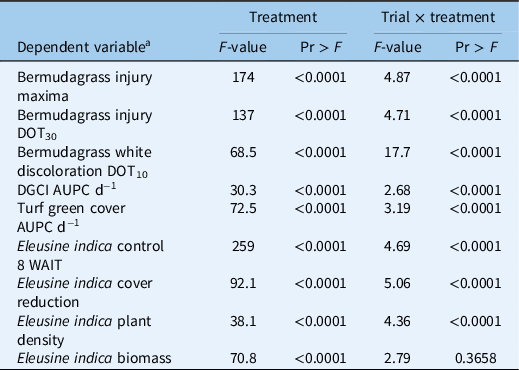
Due to results from the preliminary experiment, three low-dose topramezone treatments mixed with metribuzin and compared with topramezone alone at 6.1 g ha−1 were evaluated at multiple sites to assess consistency of bermudagrass response and E. indica control efficacy. All response variables associated with bermudagrass response and E. indica control, except E. indica biomass, had a significant trial by treatment interaction that we believe is due to the sheer number of study locations involved and is of limited biological significance (Table 3). It was noted that the F-values of the main effects when tested by the mean square error of each main effect’s interaction with trial, was always at least four and usually greater than ten orders of magnitude higher than that of the interaction of each effect with trial. These trends in F-values suggest that the properly tested main effects account for considerably more variance than the trial interactions (Table 3). Upon investigating the likely reason for the trial interactions, we discovered that small deviations associated with the lowest two topramezone rates caused these two treatments to sometimes differ or be equivalent (data not shown). Such deviations in mean rank never occurred in more than two of the eight trials and were associated with low-level responses (e.g., 25% vs. 35%). For these reasons and to reduce presented data by eight orders of magnitude, we decided to present the treatment main effects rather than the trial interactions, but we included the standard errors for each mean as a demonstration of consistency across trials (Table 4).
ANOVA for nine response variables showing summary statistics for treatment main effects and trial by treatment interactions.

a Abbreviations: AUPC, area under the progress curve; DGCI, dark-green color index; DOT10, days over a threshold of 10%; DOT30, days over a threshold of 30%; WAIT, weeks after initial treatment.
Influence of herbicide treatment on bermudagrass injury maxima, days over an injury threshold of 30% (DOT30), days over a white discoloration threshold of 10% (DOT10), average dark-green color index per day (DGCI d−1) based on area under the progress curve (AUPC), digital image–assessed percentage turf green cover AUPC d−1 mean ± SE over 8 site-years.

a All treatments were applied twice at a 3-week interval.
b Rates given as acid equivalency for topramezone and active ingredient for metribuzin.
Topramezone applied at 1.2, 3.7, and 6.1 g ha−1 caused turfgrass injury maxima of 24%, 45%, and 74%, respectively, following two topramezone plus metribuzin treatments at 3-wk intervals (Table 4). All treatments with metribuzin admixture had less maximum injury than topramezone alone at 6.1 g ha−1. As of this writing, there are only three published experiments that evaluated combinations of topramezone with metribuzin (Kerr et al. Reference Kerr, McCarty, Cutulle, Bridges and Saski2019b; Lindsey et al. Reference Lindsey, DeFrank and Cheng2019, Reference Lindsey, DeFrank and Cheng2020), but none evaluated topramezone rates as low as the current trials. Lindsey et al. (Reference Lindsey, DeFrank and Cheng2019, Reference Lindsey, DeFrank and Cheng2020) evaluated topramezone at 10 to 12 g ha−1 with 100 g ha−1 metribuzin on seashore paspalum turf in Hawaii. Kerr et al. (Reference Kerr, McCarty, Cutulle, Bridges and Saski2019b) evaluated topramezone at 12 g ha−1 mixed with metribuzin at 420 g ha−1 on bermudagrass turf in South Carolina. Both researchers observed bermudagrass injury of greater than 50%. The maximum injury observed in the current trial is similar to maximum bermudagrass injury observed by Cox et al. (Reference Cox, Rana, Brewer and Askew2017) when topramezone was applied alone at 6.1 and 12 g ha−1.
Turf injury DOT30 was 0.56 and 7.5 d following two treatments of topramezone at the two lowest rates mixed with metribuzin (Table 4). Two applications of topramezone at 6.1 g ha−1 injured bermudagrass more than 30% for 20 d when mixed with metribuzin and 30 d when applied alone. Topramezone applied twice at 1.2 and 3.7 g ha−1 with metribuzin caused bermudagrass white discoloration above 10% for 0 and 3.8 d. When the topramezone rate was increased to 6.1 g ha−1, bermudagrass white discoloration exceeded 10% for 16 d when metribuzin was added and 30 d when topramezone was applied alone. Cox et al. (Reference Cox, Rana, Brewer and Askew2017) observed that topramezone applied twice (3-wk interval) at either 6.1 or 12 g ha−1 resulted in bermudagrass white discoloration DOT10 between 25 to 40 d and a bermudagrass injury DOT30 between 19 and 30 d across 31 bermudagrass varieties maintained at fairway height of cut in Virginia.
The DGCI area under the progress curve per day (AUPC d−1) and the digitally analyzed green cover AUPC d−1 both exhibit stepwise reductions that mirror the stepwise increase in injury responses (Table 4). The DGCI data were presented instead of NDVI, because trends for both closely followed one another. All herbicide treatments caused at least some reduction in DGCI and green turf cover, so practitioners should expect some level of decline in turfgrass aesthetics. The combinations of metribuzin with topramezone at 1.2 and 3.7 g ha−1 have DGCI and green cover that is close enough to the non-treated turf to suggest that turf aesthetic decline is of low magnitude and transient. This assumption is supported by the maximum injury, injury DOT30, and white discoloration DOT10 data.
These data show that metribuzin substantially lowers both magnitude and duration of turf injury and white discoloration while improving bermudagrass DGCI and green cover. However, the most striking reduction in bermudagrass response requires lowering the topramezone rate to at least 3.7 g ha−1 along with the metribuzin admixture. With bermudagrass safety margins improved 4- to 10-fold, the success of these low-dose topramezone programs now depend on mature E. indica control efficacy.
Eleusine indica control
During the field trials, we rarely observed any treatment controlling E. indica 100% due to occasional plant survival and subsequent seedling germination that occurred near the final assessment. None of the treatments seemed to have significant preemergent suppression of E. indica. When averaged over 9 site-years, two applications of topramezone at 3.7 g ha−1 plus metribuzin controlled E. indica 94% and equivalent to two applications of topramezone applied at 6.1 g ha−1 alone (Table 5). When the topramezone rate was reduced to 1.2 g ha−1, E. indica control fell to 80%. The same trends were evident for E. indica cover reduction, plant density, and foliar biomass. Kerr et al. (Reference Kerr, McCarty, Cutulle, Bridges and Saski2019b) and Lindsey et al. (Reference Lindsey, DeFrank and Cheng2020) both observed that higher rates of topramezone plus metribuzin controlled E. indica 80% to 100%, similar to the results from the lower topramezone rates in the current study.
Influence of herbicide treatment on Eleusine indica control, cover reduction, and plant density per square meter as mean ± SE over 9 site-years and plant biomass per pot averaged over two greenhouse trials.

a All treatments were applied twice at a 3-week interval.
b Rates given as acid equivalency for topramezone and active ingredient for metribuzin.
The results of these studies suggest that two applications of topramezone at 3.7 g ha−1 plus metribuzin at 210 g ha−1 represent an optimal program for selective E. indica control in bermudagrass turf. This program will cause transient injury to bermudagrass but dramatically reduces recovery time, such that the duration of objectionable turfgrass aesthetics is minimized. Other researchers observed that metribuzin admixture with topramezone can increase E. indica control, similar to results in our studies. Further studies were conducted to elucidate the mechanism behind this interaction.
Absorption, Translocation, and Metabolism of [ 14 C]Topramezone
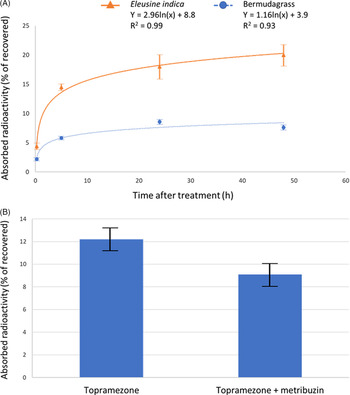
Recovered radioactivity was 93 ± 8% from the 64 plants treated in this study (data not shown). The harvest time by species interaction (Figure 1A) and the herbicide main effect (Figure 1B) were significant for total absorbed radioactivity (P < 0.05). Eleusine indica absorbed three times as much radioactivity as bermudagrass within 48 h following treatment of either [14C]topramezone alone or [14C]topramezone plus metribuzin (Figure 1A). This separation was evident even at 15 min after treatment, suggesting that bermudagrass may absorb topramezone more slowly than E. indica. Eleusine indica, unlike bermudagrass, did not appear to have reached an asymptote for 14C absorption by 48 HAT, suggesting additional herbicide absorption may have occurred with more time. We chose the maximum harvest time of 48 HAT based on work by Grossman and Ehrhardt (Reference Grossman and Ehrhardt2007) that showed no additional absorption in corn or S. faberi between 24 and 48 HAT. The level of absorption observed in both bermudagrass and E. indica is considerably lower than the amount of radioactivity that Grossman and Ehrhardt (Reference Grossman and Ehrhardt2007) extracted from corn and S. faberi. This disparity in absorption rates could be due to a 20-fold increase in the amount of formulated product used by Grossman and Ehrhardt (Reference Grossman and Ehrhardt2007) in their spotting solution. Because our objective was to compare topramezone alone to topramezone plus metribuzin, it was extremely important that we replicate the ratios of water, topramezone, metribuzin, and adjuvant that were used in our field studies.
Percentage of recovered radioactivity over time absorbed by bermudagrass or Eleusine indica averaged over trial and herbicide mixture (A) and the average absorbed radioactivity as influenced by herbicide averaged over trial, time, and species (B).

The addition of metribuzin to [14C]topramezone decreased absorption consistently at all harvest times, and the average 14C radioactivity recovered from plants across all times and both species was 12% when [14C]topramezone was applied alone and 9% when [14C]topramezone was mixed with metribuzin (Figure 1B). This 25% reduction in 14C absorption could partially explain the reduced bermudagrass injury observed in our field studies when metribuzin was mixed with topramezone.
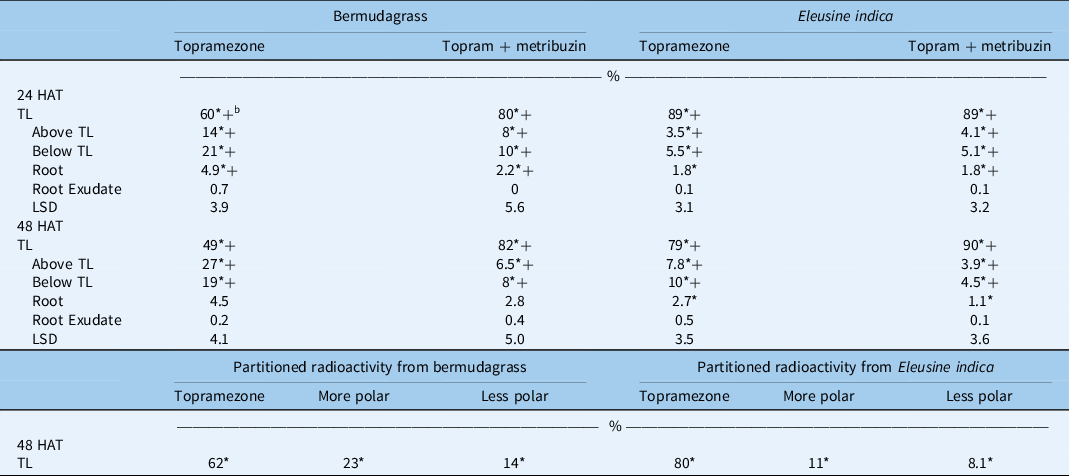
The interaction of sample by herbicide by species was significant (P < 0.05) for percentage of absorbed radioactivity extracted from plants at 24 and 48 HAT (Table 6). At 24 HAT, twice as much absorbed radioactivity translocated out of treated bermudagrass leaves when topramezone was applied alone compared with when mixed with metribuzin. The same trend was not evident in E. indica. Thus, metribuzin may partially protect bermudagrass from the injurious effects of topramezone via altered translocation. At 48 HAT, 51% of absorbed radioactivity had translocated out of topramezone-treated bermudagrass leaves compared with only 18% translocation following treatment of topramezone plus metribuzin (Table 6). Metribuzin had a similar inhibitory effect on 14C translocation in E. indica, but at a smaller magnitude. It is also possible that these changes in 14C translocation may be of no consequence, as the translocated radioactivity could be a metabolite of topramezone rather than the active ingredient.
Percentage of absorbed radioactivity extracted from bermudagrass and Eleusine indica tissue and nutrient solution at 24 and 48 h after treatment (HAT) and percentage of radioactivity traces from thin-layer chromatographic separations of parent herbicide and polar/nonpolar metabolites from treated leaves 48 h following [14C]topramezone or [14C]topramezone plus metribuzin treatment to the adaxial surface of the third-newest leaf, with translocation data averaged over trial and metabolism data averaged over trial and herbicide mixture. a

a Abbreviations: HAT, hours after treatment; TL, treated leaf; Topram, topramezone.
b An asterisk (*) or a plus (+) after a given mean denotes significant difference between herbicide mixtures or species, respectively, based on Fisher’s protected LSD test at P ≤ 0.05.
The main effect of species was significant for percentage proportions of radioactivity between metabolites and parent herbicide (P < 0.0001) and not dependent on trial or herbicide (P > 0.05). At 48 HAT, bermudagrass had metabolized 38% of absorbed radioactivity in treated leaves compared with only 20% metabolism by E. indica (Table 6). Bermudagrass had a greater percentage of polar metabolites compared with nonpolar metabolites, while the two were equivalent in E. indica. Based on previous reports, bermudagrass metabolizes topramezone similar to S. faberi, E. indica metabolizes topramezone similar to sorghum [Sorghum bicolor (L.) Moench], and corn metabolizes topramezone more rapidly than all of these species (Grossman and Ehrhardt Reference Grossman and Ehrhardt2007).
These data show that bermudagrass absorbs one-third as much radioactivity following [14C]topramezone treatment and metabolizes approximately twice as much topramezone compared with E. indica in the first 48 HAT. These trends could explain the differential response between the two species. These data further suggest that altered absorption and/or translocation caused by metribuzin admixture could partially explain why bermudagrass injury and recovery time is substantially reduced by said mixture. The mixture of 3.7 g ha−1 topramezone plus 210 g ha−1 metribuzin applied twice was found to control E. indica at commercially acceptable levels and equivalent to topramezone at 6.1 g ha−1, while reducing days over a 10% white discoloration threshold nearly 10-fold and reducing days over a 30% injury threshold 4-fold. We also found that metribuzin admixture substantially increases D. ischaemum control by topramezone, but not to commercially acceptable levels when topramezone rates are less than 6.1 g ha−1.
As postemergence herbicide programs for E. indica control are limited in bermudagrass, this new program with topramezone applied at 3.7 g ha−1 plus metribuzin at 210 g ha−1 gives turf managers a safe, effective, and economical option to control E. indica at a range of maturity stages in bermudagrass turf. In the future, other herbicides could be added to this base herbicide program to help control a broader range of weed species such as crabgrass (Digitaria spp.), sedge (Cyperus spp.), and broadleaf species.
Acknowledgments
The authors wish to thank BASF for providing [14C]topramezone for the absorption, translocation, and metabolism experiment. The authors also thank Caitlin Swecker, Natalie Stone, Brittany Levy, Veronica Breslow, Heather Titanich, and Jon Dickerson for aiding in trial establishment, data collection, and site maintenance. This research received no specific grant from any funding agency or the commercial or not-for-profit sectors. No conflicts of interest have been declared.