How do you facilitate a collaboration, or even a conversation between groups of people who work in different areas of expertise and communities of practice? This is the challenge that is central to any digital humanities or digital art history project.Footnote 1 In these emerging fields, projects are often designed to push the boundaries of their respective fields in order to develop new approaches to art-historical research and scholarship, as well as the management of art-historical information and objects. Devising successful strategies for tackling this challenge is critical in merely conducting digital art history (DAH) research and scholarship, but even more than this, is necessary to leverage the insights that emerge from DAH projects towards shaping the practice of both librarians and researchers. Transforming practice is a key focus of all the DAH projects we undertake at the Getty Research Institute (GRI), because we seek not only to innovate within the context of specific collections or projects, but also to apply what we learn to the development of infrastructure and modeling of best practices. In doing so, our ultimate goal is to facilitate new and emerging practices in the fields related to art history and cultural heritage in the longer term.
For the past four years, the team working on the research component “Ed Ruscha, Streets of Los Angeles” project has established a collaboration between representatives of all the stakeholders involved in the effort to process and make accessible a collection of photos created by the artist Ed Ruscha, including art historians, art librarians, and technical specialists, such as imaging specialists and software engineers.Footnote 2 On-site and virtual workshops and other convenings have functioned to generate and sustain an ongoing conversation across this group of stakeholders, which consists of Getty staff as well as external researchers whose areas of expertise intersect in some way with the Ruscha collection. The model of collaboration we developed for this project has proved fruitful in many ways. It has confirmed for us the importance of connecting conversations about archival processing with conversations about research, so that the practices of researchers can inform the development of archival infrastructure. In addition, the collaboration within the Ruscha project has validated our overall approach to DAH projects at the GRI, which focuses on a consideration of the entire cycle of research and scholarship, with particular attention paid to how data moves through it.
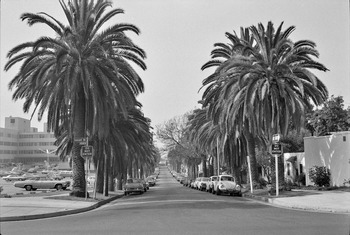
In 1965, artist Ed Ruscha began systematically photographing the building facades lining Los Angeles’ streets, including Melrose Avenue, Hollywood Boulevard, and most famously Sunset Boulevard (Fig. 1). The project continues today, which means that, although the Getty's acquisition includes only those shoots made from 1965 to 2010, Ruscha and his studio assistants have been photographing Los Angeles streets for over fifty years. Ruscha's project is a singularly comprehensive artistic artifact, and now archival collection, consisting of around 740,000 photographs, mostly negatives spooled onto film reels as well as hundreds of contact sheets. Also included are the complete production archives for Ruscha's influential 1966 book Every Building on the Sunset Strip and for his 2005 Steidl publication, Then and Now: Hollywood Boulevard, 1973–2004.
Shoot from Sunset Blvd, Ed Ruscha, 1973. Negative film reel: Sanborn headed west (Image 176). Part of the Streets of Los Angeles Archive, The Getty Research Institute. © Ed Ruscha.

The sheer number of photographs contained in the collection, coupled with the fact that many of them were not printed, presents challenges to accessing and analyzing the archive in its physical form. Digitizing at least a subset of the photographs was therefore a necessary step in facilitating access to the collection. The Getty, which acquired the collection in 2012, began by focusing on the digitization of a selection of 25 “shoots,” that is all the photographs of a single street made in one day. This effort ultimately generated around 130,000 images representing about 20% of the collection.
Due to the unique scale of the collection, as well as the comprehensiveness of its documentation, we felt the project could not proceed merely as a routine mass digitization campaign. The number of images in the collection alone meant that we needed to use innovative methods to generate additional metadata that could be linked to each image. In particular, we sought to support searches by street address. Knowing that it was not feasible to ask library cataloguers to manually assign geospatial information to each of the 130,000 images, we contracted a web development firm to build a tool that would automate the process of generating coordinates for images and assigning them accordingly.Footnote 3 We also employed optical character recognition (OCR) techniques to read the signage and other text in the images.
The cataloguing, digitization, and metadata efforts directed toward the Streets of Los Angeles collection were paired with a program of research. Together all of these activities were designed to fulfill several goals: 1) to process the collection and digitize a subset of it so as to provide item-level metadata for each digitized image (in part to facilitate researchers’ computational analyses of the images in the corpus); 2) to engage a group of researchers to produce unique scholarship around the archive; and 3) to enable public access to images and metadata through web-based user interfaces.
We needed a way to invite and manage feedback from the community of scholars who would be interested in investigating research questions relevant to this collection, a community we imagined might extend beyond art history. To attract the broadest and most diverse group of scholars possible, we issued an open call for participation, inviting researchers from around the world to propose projects focused on the Streets of Los Angeles collection. Out of the forty or so submissions we received, we selected five projects to join us in the collaboration. The twelve researchers working on these five projects were joined by several additional scholars, forming a group of around twenty external research collaborators who would participate in conversations with the team at the Getty, as we undertook the processes of cataloguing, metadata creation and management, user interface design, and software development in connection with the Ruscha collection.
Importantly, this group of external research collaborators was diverse in several ways. First, these researchers came from a number of different institution types, including colleges and universities (e.g. The New School, New Jersey Institute of Technology, Whittier College, and Humboldt University in Berlin), museums, and research centers (e.g. the Lens Media Lab and Digital Humanities Lab, both at Yale). The scholars also represented a variety of fields, including architecture and urban planning history, the history of photography, photo conservation, anthropology, film history, geography, and urban history. Researchers in the group employed a range of methodological approaches as well and had varying degrees of experience and familiarity with the tools and techniques associated with digital art history.
This group understood that their own, individual projects should proceed largely independently from the Getty. Thus, each sub-project had its own area of focus, schedule of work, and outcomes, all of which were determined by the particular sub-project's members. As a result, each of the two groups—the Getty staff working on the collection and the group of external collaborators, all working on their own projects—could act as consultants for the other.
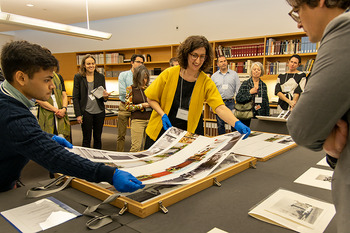
In order to provide a framework for this mutual consultation, we held regular convenings attended by all or parts of the group. These convenings included monthly meetings in Special Collections to view and discuss examples from the “Streets of Los Angeles” and related collections, as well as two workshops, which brought the entire team together at the Getty Center (Fig. 2). As part of such conversations, the group examined objects from Special Collections, and heard presentations from the Getty's library and technical staff about how the collection was being processed and digitized, as well as how new collections data was being generated and managed.
Research partners and GRI staff examine physical materials from the Ed Ruscha Streets of Los Angeles archive during the January 2019 workshop. Image courtesy Peter Leonard.

These group meetings and discussions were helpful in advancing the overall goals for the project in several important ways. First, researchers had the opportunity to become familiar with procedures related to archival processing and the specific strategies the Getty was using to process the Ruscha collection. It was useful in particular to share information with the researchers about both our typical metadata workflows and the more experimental approaches being used for Ruscha's collection. These conversations helped the researchers understand the kinds of metadata we were generating and how it might be useful for investigating their particular research questions. Second, hearing more about researchers’ avenues of inquiry helped the Getty staff gain a better understanding of the kinds of metadata we should focus on in our efforts, as well as our overall priorities for this work. We could understand in specific terms what kinds of data analysis they might want to do, what data formats they would want or need, and what tools they might use to analyze or visualize the collections data.
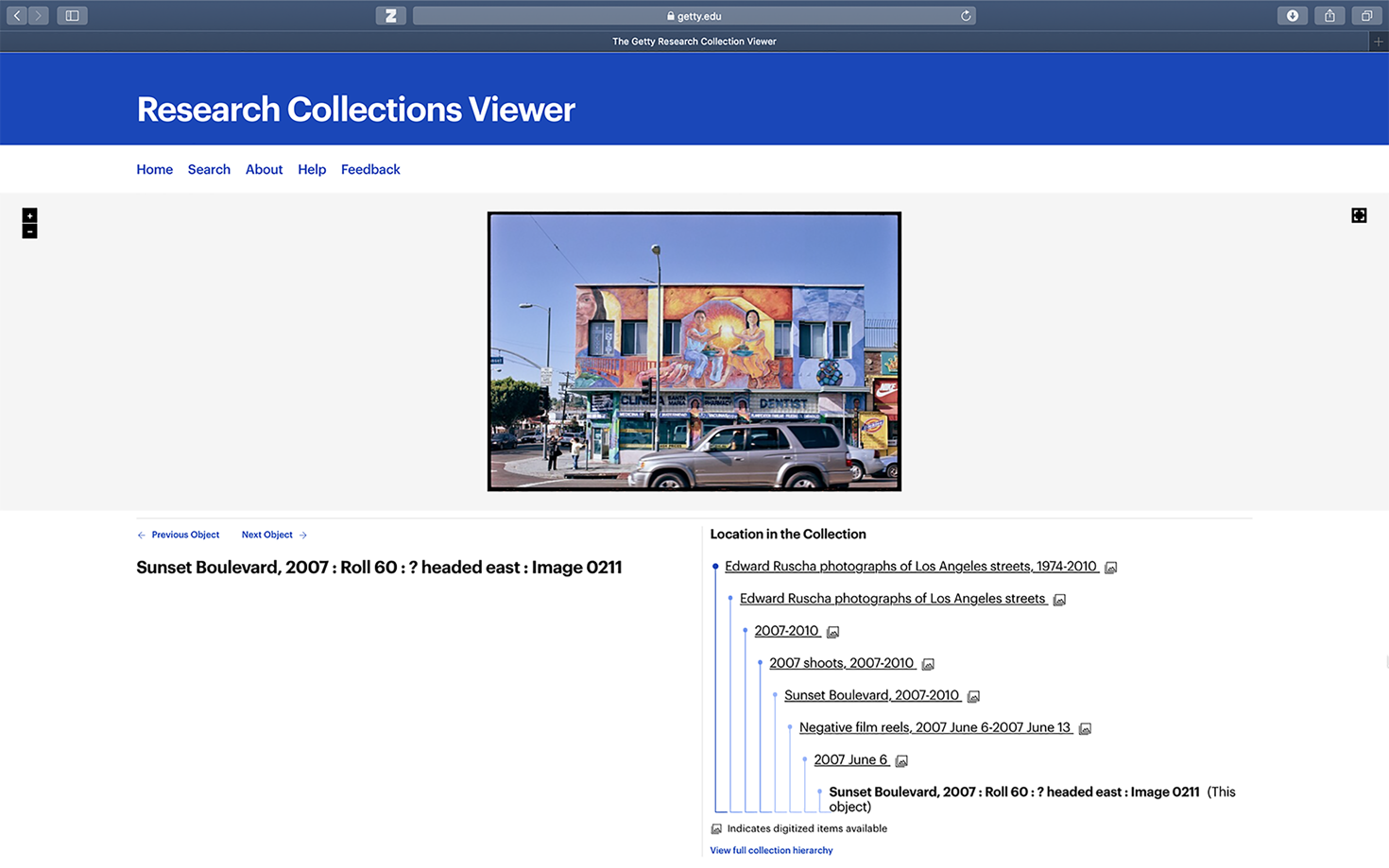
The goals, expectations, and needs for research that these external collaborators shared with us was also useful for the development of the interface built to access this collection (and which will eventually be the access point for all the GRI's collections), the Research Collections Viewer (RCV).Footnote 4 For example, the importance researchers placed on knowing the archival context and location of specific sections of the collection as they navigated it, is reflected in the RCV's two navigation menus (Fig. 3), one that provides series-level context (at the left) and another with a more detailed view of the hierarchy (to the right).
Screen shot, Research Collection Viewer. Showing two navigation menus, one that provides series-level context (at the left) and another with a more detailed view of the hierarchy (to the right), https://www.getty.edu/research/collections/object/101PXT. The image featured in the screenshot is © Ed Ruscha.

These research convenings were invaluable as opportunities for integrating discussions about practical concerns related to collections management with intellectual inquiry. In our first workshop, for example, the group heard a presentation from art historian Dr. Jennifer Quick about how Ruscha borrowed practices from the commercial art world, such as the “paste-up” technique used by graphic designers, and carried these over to his personal artistic practice. As part of the discussion, Quick encouraged the group to regard the Streets of Los Angeles collection as an image or photo “morgue,” a term referring to archives of images that are stored for some possible, future use.Footnote 5 This conceptual framing of the Ruscha collection generated conversations in the group around the definition of “archive” (versus “collection”) and the practice of archiving in both its practical and conceptual senses, creating an area of shared concern that bridged the various fields represented both in the Getty-based staff and amongst the external research collaborators.
The “Streets of Los Angeles” collection, including the images of the 25 shoots initially selected for digitization, was released via the Research Collections Viewer in the fall 2020.Footnote 6 While the phase of the project related to processing, digitizing, and access has concluded, activities related to the research component are ongoing. Specifically, the group is planning a digital publication that will include details about the Getty's project and some of the scholarship produced by our research partners.
As the project continues, we have begun to reflect on what our collaboration has yielded and on how we might build on it. It seems clear to us one key aspect of the collaboration that contributed to its success was its duration: this was not a one time encounter, but a sustained and ongoing conversation that lasted for several years. The extended timeline of the collaboration gave all the participants the opportunity not only to develop and discuss their projects, but also reflect on the ideas and insights that are generated from our conversations. Researchers’ projects, for example, had time to evolve as they learned more about the collection and the possibilities for understanding it with and through data. For example, questions the collection raises regarding who and what parts of Los Angeles are (or are not) represented in it, as well as the ways in which questions of data intersect with those of race and representation became an increasingly pressing concern throughout the project's lifespan. Such questions led us to convene a workshop to explore them in further detail, and to consider the challenges and complexities of this particular archive as a both an authored project and a trove of information that could be mined to tell stories about broader, more diverse groups of people or topics.
Another critical factor in the success of the collaboration was the content of the collection. The fact that this was a project about archiving, which focused on a collection that in many ways was itself about archiving (in a literal and figurative sense) meant that there was a set of shared concerns and issues built into the project. Researchers, librarians, technical imaging specialists, and software engineers alike could join in a conversation in which they all shared interest and had a concrete stake.
An unexpected benefit of the project is that it has, on the one hand, made it possible for the group as a whole to discuss and debate issues related to technologies of collections management and scholarly research, while on the other hand, allowed individual researchers to engage with technology at different levels. This has meant that, for example, researchers who previously had no experience or perhaps even interest in digital technologies have begun to understand the implications of their use in libraries and archives. For others, it has provided a way to integrate data-driven approaches and computational analysis into their research to a greater degree than they had before. In a survey we issued after our January 2020 workshop, 83% of the researchers reported that they were more inclined to pursue digital approaches after working on the Ruscha project. As one commented, “I am really starting to come to terms with how problematic it is to segregate or silo so-called ‘digital methodologies’[;] my scholarly practice (like the rest of my life) shifts seamlessly between digital and analogue.”Footnote 7
While addressing some of the Getty's questions regarding the processing, digitization, and use of the Ruscha collection, the collaboration has also opened some new avenues of inquiry. The project has prompted us to consider how we gauge and/or manage user confidence around computer-generated collections data. How do we manage the processing of such data, and how do we prioritize efforts to mitigate computer-generated data for accuracy? The decision of whether and how to include in the RCV the data gleaned from OCR techniques, for example, prompted rich internal discussion across Getty staff. In addition, while we want to encourage the use of collections as data, the Ruscha project helped us recognize the need to understand better how and when collections data becomes research data, and the stakes around this issue. Exposing such areas of ambiguity is yet another way this collaboration with external research partners has proved generative.
The collaboration has yielded other unexpected outcomes as well, including several courses related to the collection. Research partner Eva Ehninger, Professor of Modern Art History at Humboldt University in Berlin, taught a graduate seminar in the summer of 2020 focused on the Streets of Los Angeles, one outcome of which was a website featuring her students’ work.Footnote 8 The Streets of Los Angeles corpus and project has also inspired courses at the Harvard Graduate School of Design and the Southern California Institute of Architecture (SCI-Arc). The work of our collaborators on their own research projects continues as well. Francesca Russello Ammon (Assistant Professor of City and Regional Planning at the University of Pennsylvania), Brian Goldstein (Assistant Professor of Art History at Swarthmore College), and Garrett Dash Nelson (Curator of Maps and Director of Geographic Scholarship at the Boston Public Library) recently received a NEH Digital Humanities grant for their project “Sunset Over Sunset,” which combines images from the Ruscha collection with US Census statistics, real estate data and other information to tell a “bottom up” story of urban growth and change in Hollywood, from the 1960s through the early 2000s.Footnote 9
While we hope to repeat the model of collaboration we established with the Ruscha project, we would certainly make some changes to our approach. For example, in the future we might work with smaller groups of external partners, since the administrative work of managing the collaboration proved extremely time intensive. Regardless, we are very grateful to all of the researchers who are involved in this project, for their open and positive attitudes towards the project, and their general willingness to experiment with us in a new form of engagement. Similarly, we are thankful for the internal collaborations this project generated, which produced thoughtful discussions amongst staff in the Getty Library, the DAH department, and Getty Digital. The project received considerable support from Getty leadership as well, especially from Lily Pregill (Systems Architect, Getty Digital) and Andrew Perchuk (Deputy Director, GRI), as well as from external funders, specifically the Terra Foundation for American Art.
Now that the “Ed Ruscha, Streets of Los Angeles” project has helped us begin the development of an infrastructure for a robust digital art history ecosystem, what is next? Is it enough to create outward avenues for affiliated research projects, or are there ways these avenues can create effective channels back in toward our own internal methodologies? As we consider approaches to answering these questions that remain, the value of the processes and platforms that have been articulated as part of the “Ed Ruscha, Streets of Los Angeles” project have set a standard for us, and for the digital art history projects to come.