Introduction
‘This is the theology of painting’, Luca Giordano1 exclaimed when he first saw Las Meninas in 1692. If by that he meant that it was on a higher plane than that of the paintings of his time he was entirely right: if all figurative art is an illusion Velázquez created a meta-illusion, an illusion of an illusion, a proposition that this article will try to sustain.
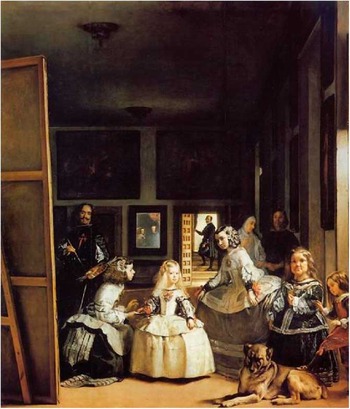
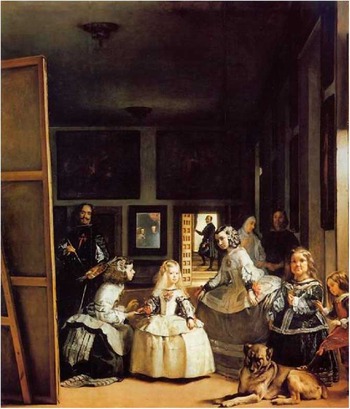
For the purposes of this paper Las Meninas (Figure 1) needs only a very brief description. The room depicted is Velázquez's studio (called the Cuarto del Príncipe) at the Alcázar of Madrid (the Royal Palace), in which the painter's self-portrait appears, painting on a large canvas. He is surrounded by the Infanta Margarita and her retinue. At the room's back there is a large mirror on which the torsos of the king Philip IV and his queen Mariana appear to be reflected. Above the mirror there are two large pictures both on subjects from Ovid: on the left Minerva punishing Arachne, and on the right Apollo's victory over Marsyas, both copies by Velázquez's assistant and son-in-law, Juan Bautista Martínez del Mazo, which were thought to be from Peter Paul Rubens and Jacob Jordaens respectively, although the latter has recently been re-identified (Ref. 2, p. 137) as the contest of Pan and Apollo from an original also by Rubens. (It is probably not accidental that both pictures represent Apollonian art triumphing over the Dyonisiac.) On the right of the mirror there is a gentleman, José Nieto Velázquez (no relation), the Queen's aposentador (chamberlain). The first impression that the painter creates with great care is that he was painting in his studio, surrounded by the Infanta and retinue, when her parents popped in the room and their torsos were reflected in the back mirror. There is very little doubt that this tableau was presented to enhance both the status of painters (little more than artisans in the view of Spanish society at the time) and also to establish Velázquez's position at the court in the hope that he would be ennobled, which came to fruition in 1659 after the painting was finished. That a painter's position was precarious in the court is shown by the inquisition into Velázquez's antecedents and circumstances done by the knights of the Order of Santiago, when the painter had to show that he was not in trade because he never sold his pictures, being the Court's painter. As it happened, the Cross of Santiago that appears on his chest in Las Meninas was painted posthumously.
Diego Velázquez, Las Meninas. Museo del Prado. Madrid.
When Velázquez died his estate contained 154 books, a large number for the time, on a variety of subjects, mathematics, architecture, natural science and so on: he was a well-read man. Illusion was obviously not alien to him, in more than one way. It must have impressed him in painting during his visit to Italy, from where he brought two quadratura experts (Ref. 3, p. 105). And he could not have failed to be influenced by Calderón de la Barca, who had performed at the Court in his own timeReference Greer4 and whose La vida es sueño, first produced when Velázquez was 36, was a philosophical manifesto: ‘¿Qué es la vida? Un frenesí. /¿Qué es la vida? Una ilusión, /una sombra, una ficción,’ (‘What is life? A frenzy./ ‘What is life?, an illusion/ a shadow, a fiction’.) So there is no question that Velázquez knew that between impression and reality a cloak of illusion may well fall.
Facts about Las Meninas and its Characters
Palomino1 states that Velázquez finished the picture in 1656. The Infanta Margarita, the child at the centre of the picture, was five at that time. She was not Philip IV's elder daughter: María Teresa, her elder half-sister by the king's first marriage, however, was engaged to be married to the French king, Louis XIV, but in order to forestall the latter's territorial ambitions, she had been made to renounce all claims to the Spanish succession. Margarita was thus the presumptive heir to the throne. Even more, because she had been engaged at an early age to Leopold I, the Holy Roman Emperor, she was Empress of the Holy Roman Empire. However, Philip IV's second wife, his niece Mariana, who had married him at 15 when he was 41, gave birth in 1657to a boy, Felipe Próspero, who then became the heir apparent until his early death in 1661.
In the Alcázar's inventories from 1666 to 1700 the picture appears as Retrato de la Señora emperatriz con sus damas (Portrait of the Empress with her ladies), but after the fire of the Alcázar in 1734 is given the title of La familia del Señor rey Phelipe Quarto (The family of King Philip IV) and in the new Royal Palace it is listed as La Familia (The Family). It is only in 1843 that it was given its current name in the catalogue of the Prado museum. In order to discuss the various interpretations given to Las Meninas it is necessary to review some recent physical studies made on it.
Studies of Las Meninas
X-ray studies were made in 1960Reference López-Rey5 that show that Velázquez's head was rotated from left to right in the final stage. Also, between him and the edge of the canvas on which he is painting there is a pentimento of the head of a lady in a coif, which could possibly have been displaced in the final stage to the position occupied by Doña Marcela de Ulloa (the woman next to a man in the shade). In 1982 further studies were made by the Prado experts in collaboration with a Harvard University team. X-rays confirmed the previous study and reflectography showed the lack of an underlying sketch.Reference Mena Marqués6 The painting was restored in 1984 in the museum workshop with the collaboration of John Brealey of the Metropolitan Museum of New York. Manuela MenaReference Mena Marqués6 mentions another pentimento, a ring, presumably heraldic, in the infanta's hand. In 1997 Manuela Mena published a paperReference Mena Marqués7 based on the 1984 study, in which she proposed a heraldic interpretation of the painting, casting doubts on the presence of Velázquez's self-portrait in the original version, of which more later. This, however, was firmly contradicted a year later by Brown and GarridoReference Brown and Garrido8 who insist that the pentimento of a female figure shown by X-rays, mentioned above, does not interfere with the figure of the man in Velázquez's position. It is worth mentioning also that JustiReference Justi9 describes a sketch of the picture, the composition of which is very similar to the final painting.
Interpretations
I shall first briefly discuss the least likely of the interpretations of Las Meninas, based on the results that Manuela Mena allegedly derived from physical examination of the picture, which were uncritically accepted by the French art historian Arasse.Reference Arasse10 He claims that there was no male figure in the underpainting in the position in which Velázquez appears but rather a female servant who offers a baton to the infanta Margarita, in order to make quite clear her position as heir presumptive, thus quashing any residual hopes that might have been entertained by the French in relation to the elder sister María Teresa. The suggestion is thus made that Las Meninas was not originally planned to contain a self-portrait of the painter but that this was overpainted after the birth of Margarita's brother Felipe Próspero. As we have already discussed, the work of Brown and Garrido clearly shows that the alleged servant was no more than a pentimento of a figure later moved to the right of the picture and that it never affected the sketch of the male in Velázquez's position. And, in any case, the hypothesis that the composition was radically changed contradicts the evidence already mentioned by JustiReference Brown and Garrido8 that this was not so.
The foremost scholar on Velázquez, Jonathan Brown,Reference Brown11 in an essay from 1978, suggested that the double portrait of king and queen that appears on the back mirror is just a direct reflection of the royal personages. Some years later Martin Kemp (Ref. 3, pp. 105–108), made a careful perspective study of Las Meninas and, having hypothesized that what the artist is painting on the large canvas is a double portrait of the royal couple, showed that it would be reflected on the back mirror as actually shown in the picture. This hypothesis was later embraced by BrownReference Brown11 himself, in a 1995 postscript to his 1978 essay.
Brown and Kemp are amongst the most eminent art historians of their generation, so I shall offer the reflexions that follow on Las Meninas with the greatest respect to these scholars. I shall consider two major problems that affect their hypotheses, in relation to the existence or otherwise both of the double portrait and of the back mirror. Admittedly, the double portrait was mentioned by Palomino, but his testimony comes some 50 years after the completion of the painting and there are three questions to be answered if it is to be accepted. First, the canvas on which Velázquez is painting in the picture is much too large for a double portrait, more suited for a full equestrian portrait, such as the one he did of Philip IV in 1635–1636, which is almost of the same size as Las Meninas, 301 cm by 314 cm (Las Meninas is 318 cm by 276 cm but it has been trimmed on the left edge at some stage). Secondly, the contents of the Alcázar were well recorded in 1686, some 30 years after Las Meninas was finishedReference Rodríguez Rebollo and Martínez Leiva12 and such a portrait, which would have had an extraordinary importance, is not recorded in the inventory and is nowhere else mentioned. Thirdly, and most importantly, it is very unlikely that the king would have countenanced the painting of such a subject. In fact, Velázquez had not painted his Royal patron for over ten years before embarking on Las Meninas: this portrait from 1644 is now in the Frick Collection in New York. And there is a very good reason for just a large gap. Stratton-Pruitt (Ref. 2, p. 139) quotes the following letter of July 1653 from the king to Sor Luisa Magdalena de Jesús, in which the king explains why he is not sending her his portrait: ‘No fue mi retrato porque ha nueve años que no se ha hecho ninguno, y no me inclino a pasar por la flema de Velázquez, así por ella, por no verme envejeciendo.’ (My portrait was not sent because it is nine years that not one such has been done, and I do not incline to go through Velázquez's phlegm, so as not to see myself aging for it.)
This letter must be taken very seriously because its internal evidence agrees with the known facts: nine years had actually passed since the 1644 portrait. Admittedly, the king's qualms were overruled in 1656 (the year when Las Meninas was finished) when several portraits of the king were prepared for Maria Teresa who, on account of her impending marriage to Louis XIV, was soon to leave Spain. One portrait remains in the Prado, and seems to be the source for another by Velázquez's workshop, now at Versailles, and a third one is at the National Gallery, London.
That the king dreaded his sittings with Velázquez is also documented in letters to his confessor, Sor María de Jesús de Ágreda, where he says so, complaining that every time Velázquez makes him look older.Reference de Jesús de Ágreda13 If the king was worried about his appearance it would require a great deal of optimism to expect that he would have agreed to a double portrait when his queen was only 22 against his 51, so that the ravages of age would be even more painful in comparison with the flowering youth of Mariana.
However serious the three problems are about the double-portrait hypothesis, it is the case that most critics agree with the view that what is being painted in the great canvas shown in Las Meninas is a double portrait of the royal couple. Either this double portrait or the royals themselves are then posited to be reflected on the mirror at the back. I shall now show that the existence of this mirror is just as elusive as that of the double portrait. But in order to gain insight into this problem a short account of the history of mirrors at this period is required.
Seventeenth-century Mirrors
Venice held a virtual monopoly on mirrors until late in the seventeenth century. At that time they were made by first blowing a cylinder, then cutting it and flattening it out onto a metal plate. This was done at Murano and the plate was finished in Venice backing it with an amalgam of tin and mercury. Few glass blowers had the strength to blow a cylinder a little longer than 90 cm and they commanded colossal salaries. Because of this and the great delicacy of the manufacturing process, mirrors were extremely valuable: a Venetian mirror at the time was worth almost three times a picture by Raphael,Reference Melchior-Bonnet14 (worth itself a great deal more than a Rubens).
As was their custom, Venetians guarded the secrets of the industry under pain of death, but Louis XIV's finance minister Jean-Baptiste Colbert managed in the 1660s to arrange for three key workers to be spirited away to France where he opened the Manufacture Royale des Glaces de Miroirs at Faubourg St Antoine. A new method was invented there in 1687 in which glass was cast on a metal tray, but by 1698 they had managed to produce only three mirrors of around two metres in height. (The vast mirrors at the Hall of Mirrors at Versailles, built between 1678 and 1682 contained 21 panes of glass.) In 1666 an informer of Colbert writing to him from Venice mentions in awe a most remarkable worker who produced for an emperor a mirror as high as 127 cm. In the same year, in a letter dated 30 April from Paris to the State Inquisitors of Venice, Marcantonio Giustinian, Venetian ambassador and future Doge, reports that the French, with the help of the Venetian workers, produce mirrors ‘of the largest size’ up to 42 pollici, about 107 cm.Reference Zecchin15 It is thus reasonable to assume that this was at that time just about the upper limit for normal large mirrors. We can now go back to the existence or otherwise of the mirror at the back of Las Meninas.
The Mirror in Las Meninas
There are three problems with this mirror. First it is not listed in the 1636 inventoryReference Rodríguez Rebollo and Martínez Leiva16 nor in that already cited of 1686.Reference Rodríguez Rebollo and Martínez Leiva12 The absence of any reference to this mirror is totally inexplicable, given that the latter would have been immensely more valuable than the del Mazo copies in the Cuarto del Príncipe (Velázquez's studio), which are all recorded, and that many other mirrors, normally in groups, are faithfully listed, including a single one of about 60 cm square in one of the ‘small rooms that lead to the garden’.
The second problem is its unusually large size for a mirror of that period. This can be fairly well estimated in comparison with the figure of José Nieto, which is on the same vertical plane. On taking a conservative estimate of 1.60–1.70 m for his height, that of the mirror must be 94–99 cm, that is, no more than about 10 cm below the probable maximum height at the time. In the Salón de los Espejos, built around 1621, eight mirrors are listed that are smaller, 84 cm high. It is only in the Pieza del Despacho de Verano, the king's study, that seven mirrors are listed that are somewhat larger than our putative one, 108 cm in height with ornate frames (but they were probably made up of more than one pane). Given the great prestige value of mirrors it is most unlikely that the court painter had one in his studio that was even larger than those in the Hall of Mirrors and compared with the mirrors in the king's study.
There is a third problem: the frame. Valuable mirrors were often exported from Venice with ornate frames,Reference Child17 such as those in the last-mentioned room, of gilded bronze, with ebony mouldings. One would not expect an important mirror like that in our picture to be framed in plain wood, even if it was ebony. According to Toso,Reference Toso18 wooden frames in any case were not used until the eighteenth century, although I have not been able to obtain independent confirmation of this fact. Be this as it may, that this frame faithfully matches the architrave of the adjoining door, makes it even more suspicious.
A Possible Scenario for the Painting of Las Meninas
I shall now try to speculate about the painting entirely on the basis of established facts: Ockham's razor quickly eliminates from my analysis both the double portrait and the mirror itself. If we do this the first question is: what is Velázquez painting on his large canvas? Carr, Bray, Elliott, and Portús suggest in their bookReference Carr, Bray, Elliott and Portús19 that this may well be Las Meninas, a suggestion that merits serious consideration and which I shall accept, given that Portús is a curator at the Prado with a special interest in Velázquez.
There was a time in the early twentieth century when it was thought that Velázquez painted this picture by looking at the scene in a mirror. Such an assumption is now well and truly forgotten: a mirror of the required size did not exist at the time, but it is not implausible to imagine that Velázquez wanted to encourage this reading from the viewer, his gaze being in the right direction. What he would have done to achieve this result is to stand in front of the scene depicted perhaps a few metres in front of the first plane of the picture, and have a man of the right size in his place dressed in his, gentleman's not painter's, clothes. This would be the person visible in the X-ray, except that in order to achieve the desired effect his head was rotated to the right when the final figure was painted, for which Velázquez would have used one of the many small mirrors he possessed.
Having disposed of this problem we must now direct our attention to the royal couple, for which we must guess the painter's motivation. It is not too speculative to accept that Velázquez wanted to enhance both the status of painters (for which his presence in his studio in gentleman's clothes was important) as well as his status in relation to the royal family, in order to increase his chances of being ennobled. So their presence had to be shown, but not just as mere sitters but rather as informal visitors to the studio of the king's friend (such friendship and the king's frequent visits to Velázquez's studios at that time are well recorded20). So the royals had to appear just to have popped in, the king's mastiff included,Reference Glen21 on their way to their own rooms. Thus, the queen's chamberlain had to be there, opening the door for her, cup in hand as court etiquette required. And, most importantly, Velázquez had to record the presence of the royal couple: but he knew only too well that the king would not tolerate a double portrait, humiliating for him side by side with his so much younger queen. To solve the conundrum, ingenious Velázquez painted a mirror at the back (incidentally giving him the painterly advantage of a bright spot in an otherwise dull area). He does this as if the couple were standing at the point where he had painted the main picture, so that because the reflection laws double the length of the room for the specular image, their picture appears discreetly indistinct. (Moreover, not all mirrors produced perfect images at that time.) Notice also that the king's head appears smaller than that of Nieto, thus mimicking the effect of the double distance entailed by the mirror. It is not too fanciful to imagine that what Velázquez is doing in Las Meninas is to actually fill in the mirror with the royal countenances at which he is gazing, since this would be a sensible way for him to do the image in the pretended mirror.
So, we have the right clues, all consistent, and we have the right motivation: all that remains is the jury's verdict. Meanwhile we might reflect that in this painting Velázquez anticipated M.C. Escher by three centuries in producing a self-referential painting. Even more, if what the canvas contains is the picture of Las Meninas, this starts an infinite regress, getting firmly into Jorge Luis Borges country. We cannot ask more of an illusion of an illusion.
Acknowledgements
I am most indebted to Dr Gloria Martínez Leiva from Madrid for her extraordinary generosity in providing me with detailed information of the Alcázar's inventory prior to publication. Also to Dr Gianfranco Toso from Venice for some very useful conversations about Venetian mirrors and for the generous work he did on my behalf to obtain the information I needed. I am also grateful to Professor Rossella Lupacchini of Bologna, for having asked me to contribute a paper on symmetry and art from which this work arose, and for her warm encouragement.
Simon Altmann is a mathematical physicist with a deep interest in symmetry and its manifestations in art. Besides his seven mathematical or philosophical books, he has written one, Icons and Symmetries (Oxford: Oxford University Press, 1992), where he has explored in detail the question of mirror symmetry and because of that he has delved into the problems of mirrors in paintings. His personal relation with Las Meninas is somewhat profound: he once spent a week in which he was in front of this picture some three hours each day. He is also a published poet.