Introduction
The anxiety disorders are the most prevalent mental health problem in Europe with an estimated 69.1 million individuals affected across all age groups (Wittchen et al., Reference Wittchen2011). This remains a highly prevalent problem in older age with large studies having estimated prevalence rates in the elderly as between 2.2–6.6% in developed countries (Bland et al., Reference Bland, Newman and Orn1988; Regier et al., Reference Regier1993; Henderson et al., Reference Henderson, Andrews and Hall2000). In a large survey of 7 lower and middle-income countries prevalence of anxiety disorder in those over 65 ranged from 2.3–8.9% excluding China where anxiety prevalence was surprisingly reported at only 0.2% (Prina et al., Reference Prina, Ferri, Guerra, Brayne and Prince2011). 12 month prevalence rates for social phobia in the elderly have been estimated as 1.32–4.51% (Cairney et al., Reference Cairney2007; Chou, Reference Chou2009a), for specific phobia 1.83% (Chou, Reference Chou2009b); and for panic disorder at 1.17% (Chou, Reference Chou2010).
Anxiety disorders in the elderly have a particular comorbidity and risk factor profile. Mood disorders are highly co-prevalent in the old – with up to 47.5% of those with depression having a diagnosable anxiety disorder and 26.1% of those with an anxiety disorder having diagnosable depression (Beekman et al., Reference Beekman2000). A further Australian study estimated the population attributable fraction of suicidal ideation in the elderly due to anxiety and comorbid anxiety at 34.8% (Almeida et al., Reference Almeida2012b). Anxiety disorders in the elderly have been associated with neurotic personality trait, cognitive decline, and increased burden on physical health including frailty, worsening physical functioning, increased disability and increased taking of medications (Gale et al., Reference Gale2011; Ní Mhaoláin et al., Reference Ní Mhaoláin2012). Social engagement is significantly impaired in those with generalized anxiety disorder, an association which maybe etiological or resultant to the disorder (Golden et al., Reference Golden, Conroy and Lawlor2009).
However, much of what is known has been established from cross-sectional analysis of large epidemiological studies. Although this methodology allows for large data sets to be gathered at low cost, cross sectional studies are considerably limited by recall bias and cannot differentiate associations of disease from risk factors or consequences of the disorder. Thus although cross sectional studies may tell us who is more likely to develop anxiety and the risk factor profile, they have limited utility in informing us of the prognostic implications of the anxious older-age patient who presents to us. There is a thus need to understand the longitudinal implications of anxiety in the old in terms of clinical course, prognosis and natural history. No previous Systematic Review has focused on this topic. We thus aimed to undertake a Systematic Review of longitudinal studies looking at the outcome of anxiety in old age.
Methods
Inclusion/exclusion criteria
The Inclusion Criteria were identified as (1) Studies looking at diagnosed anxiety disorders in older persons aged 55 or over (2) Longitudinal cohort or follow-up studies and (3) Papers which help elucidate: (a) natural history and/or (b) prognosis. Exclusion Criteria were: (1) Papers looking at treatment or intervention; (2) Studies using measures of trait or symptom anxiety with no diagnosed anxiety disorder and (3) Cross-sectional studies reporting on risk-factors or prevalence rates only.
Search strategy
The search for literature was undertaken 27th January 2014 in MEDLINE and PsycINFO databases using the OvidSP platform. Additional searches were undertaken in Cochrane Clinical Trials Register and the TRIP Medical database (www.tripdatabase.com/). Filters were applied for papers on human subjects published in the English language without date restriction. The search terms used were:
(“old age” OR “later life” OR “older adul*” OR “older peopl*”) AND (anxiety OR agitat* OR panic OR phobia OR agoraphobia) AND (prognos* OR longitudinal OR remission OR death OR suicide OR mortality)
Electronic search was further complemented by hand-searching the references of all identified studies for further relevant papers.
Data extraction and risk of bias
Data were extracted from papers on the sample studied, country, age of participants, methodology, follow-up period and diagnoses. Where available data were extracted for numbers of individuals enrolled onto the trial rather than completers (intention analysis). Outcome measures, results and limitations were further extracted for each included study. Where possible outcome data were extracted separately for diagnoses where specified for anxiety, phobic disorders and generalized anxiety with depressive disorder. If the study included a non-anxious depressive group outcome data were extracted for this group separately.
We identified five major biases which could affect study validity which we tried to account for: (a) recall bias was minimized by inclusion of longitudinal studies with more than a single time point of measurement, (b) selection bias was screened for by noting recruitment and selection method of sample (random selection, self-selection or clinician selection), (c) measurement bias was screened for by extracting information on the instruments used for diagnosis of anxiety disorder and measure outcomes in the study (d) attrition bias was noted by extracting drop-out rates and noting where not noted and (e) confounding was screened for by nothing whether adjustment had taken place for possible concomitant risk factors.
Results
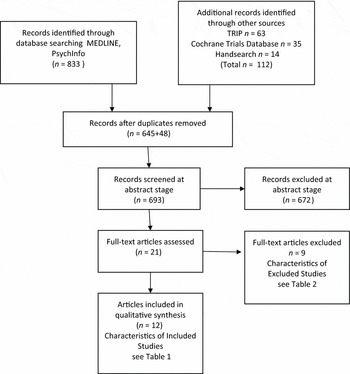
Through the systematic search strategy 945 papers were identified in total, which left 693 papers when duplicates were removed. The numbers of papers screened and the filtering process is seen in Figure 1. In total 21 full papers were identified for screening full text stage. 12 papers were ultimately identified for inclusion into our systematic review (see Table S1, available as supplementary material attached to the electronic version of this paper at www.journals.cambridge.org/jid_IPG). The other remaining 9 papers were excluded (see Table S2, available as supplementary material attached to the electronic version of this paper at www.journals.cambridge.org/jid_IPG), reasons for exclusion there were not enough patients to justify inclusion (Mulsant et al., Reference Mulsant, Reynolds, Shear, Sweet and Miller1996; MacDonald et al., Reference MacDonald, Crum, Storr, Schuster and Bienvenu2011), they were cross sectional studies assessing symptoms at one time-point only (Schoevers et al., Reference Schoevers, Beekman, Deeg, Jonker and van Tilburg2003; Bierman et al., Reference Bierman, Comijs, Jonker and Beekman2005; Lenze et al., Reference Lenze2005) or they were looking at symptoms of anxiety rather than anxiety disorder (De Beurs et al., Reference de Beurs, Beekman, Deeg, Van Dyck and van Tilburg2000; Van Hooren et al., Reference van Hooren2005; Brenes et al., Reference Brenes2007; Bierman et al., Reference Bierman, Comijs, Rijmen, Jonker and Beekman2008).
Literature search results.

Of the 12 included papers these detailed analysis of 10 separate longitudinal studies: 1 study (Longitudinal Aging Study Amsterdam, (LASA)) was represented by 3 papers, each presenting different analyses of data points. In total the studies represented 34,691 participants with (where specified) 2,421 individuals with pure anxiety disorders at baseline, 2,778 with mixed anxiety and depressive disorders and 3,532 individuals with depression with no anxiety. The largest group was of 23,375 elderly individuals with neither depression nor anxiety at baseline. Follow-up period ranged from 3 months to 22 years. Drop-out rate of trials where specified over the follow-up period ranged from 20–48%, including mortality and moving out of area. 6/12 papers used random sampling methods from community samples, 5/12 relied on clinician selection for recruitment in clinically defined populations (e.g. all inpatient admissions, referrals to clinic, previous treatment responders) whereas 1/12 relied on self-selection of participants using a response rate in a large population surveyed (Almeida et al., Reference Almeida2012a). The main outcome measures in trials were (i) mortality; (ii) cognitive and functional status and (iii) persistence / remission of anxiety and mood disorders at follow-up. These will be dealt with below separately.
Mortality
Three papers have examined this area, all using community death registers (Allgulander et al., Reference Allgulander and Lavori1993; Van Hout et al., Reference van Hout2004; Holwerda et al., Reference Holwerda2007). The largest study was a retrospective Swedish study following up inpatient admissions for depression or anxiety disorders over the next 22 years. There was no significant difference between depression, anxious or anxious depression groups in overall mortality. However, there was noted to be a significant increase in the anxious depression group in the number of suicides being almost eight-fold that expected (p < 0.001). These still accounted for a very small percentage of the overall mortality in this group (26/668, 3.9%) Similarly two papers from the LASA study found no overall risk of mortality from anxiety or depressive anxiety on 7.5 and 10 year follow-up. However, the study by Van Hout et al (Reference van Hout2004), demonstrated increased mortality in the anxious older male: OR 1.51 (95% CI 1.22–1.87); where this group was noted to have a heavier burden of physical comorbidities and ischemic heart disease, which was not represented in anxious older females.
Cognitive and functional status
Two studies examined this area (Sinoff and Werner, Reference Sinoff and Werner2003; DeLuca et al., Reference DeLuca2005). In a community study in Haifa, where baseline Mini-Mental State Examination (MMSE) was >24, Sinoff and Werner, demonstrated a reduction of 4.1 on the MMSE in anxious patients (vs.) 1.1 in the non-anxious group. Similarly there was significantly more impaired functioning in the anxious group as noted on the modified Barthel score. DeLuca et al., undertook cognitive and functional testing in 79 elderly depressed individuals in a tertiary centre in Pittsburgh, USA with follow-up after 4 years. Those with comorbid anxiety disorders were noted to have a significant decline on the Memory of Dementia Rating Scale (MDRS), even after controlling for benzodiazepine use and a non-significant decline on MMSE scores (0.5). There was no decrease in functional ability.
Persistence/remission of anxiety and mood disorders
8 papers were identified in this regard. Pure anxiety disorders were likely to persist or have a relapse to anxiety or other mood disorder after a year from 16.3% (Préville et al., Reference Préville2010), after two years 29.2% (Almeida et al., Reference Almeida2012a), to 39–52% after 3–6 years (Schoevers et al., Reference Schoevers, Deeg, van Tilburg and Beekman2005; Schurmans et al., Reference Schoevers, Deeg, van Tilburg and Beekman2005). This was based on community studies from predominantly developed countries – Canada, Australia and the Netherlands. One study in the United Kingdom (Livingston et al., Reference Livingston, Watkin, Milne, Manela and Katona1997) showed persistence rates of anxiety disorders of 80% on those who remained in the study after 2–3 years. However, the vast majority of completers with pure anxiety disorders in this study suffered from phobic disorders with 40/50 patients with phobic disorders suffering from a persistent phobia and 6/12 of patients with anxiety disorders suffering from persistent anxiety. In this study a difference was noted between early onset phobia (age of onset <65) which had less disturbance on quality of life and late onset phobia (age of onset >65), the most common of which was agoraphobia which had a marked impact on deterioration of quality of life similar to that of a depressive disorder.
Two studies provided information whether baseline pure anxiety disorders would persist in anxiety disorder or migrate across diagnostic categories to depressive or anxious depressive disorders (Schoevers et al., Reference Schoevers, Deeg, van Tilburg and Beekman2005; Almeida et al., Reference Almeida2012a). Analysis of a three year follow-up of the anxious cohort of the AMSTEL study (Schoevers et al., Reference Schoevers, Deeg, van Tilburg and Beekman2005) showed generalizability in diagnosis in the 25 patients with Generalized Anxiety Disorder (GAD) with 3 persisting to have GAD at 3 years, 6 having a pure depressive disorder and 4 developing an anxious depression picture. A second study (Almeida et al., Reference Almeida2012a) looking at a larger cohort of older anxious patients (n = 936), noted on two year follow-up that whereas 21.7% continued to have anxiety, 2.5% had pure depressive disorder whilst 6.3% had progressed to a depressive anxiety picture. These were all significantly more than the follow-up rates of these disorders found in the baseline non-anxious sample, which remained on multivariate analysis.
Those patients who have a mixed anxious depression disorder were more likely to persist or suffer from relapse of anxiety or mood disorder: after two years 47.3% (n = 360, Almeida et al., Reference Almeida2012a), after 3 years 73.5% (n = 35, Schoevers et al., Reference Schoevers, Deeg, van Tilburg and Beekman2005).
Two trials have looked at rates of relapse in cohorts in who have previously been enrolled in alternate treatment studies prior to enrollment (Flint and Rifat, Reference Flint and Rifat1997; DeLuca et al., Reference DeLuca2005). Both trials were undertaken of follow-up after the initial treatment of depressed elderly patients. The earlier Canadian study studied 83 individuals over two years, approximately half of whom had features of significant anxiety, and all of whom continued to be treated with antidepressant to which they had responded; whereas the more recent American study enrolled 79 depressed patients, both responder and non-responders, 37 of whom were anxious for 4 year follow-up. There was more frequent contact with the psychiatric research team in both studies, with monthly follow-up in the two year study and yearly follow-up in the 4 years study. These studies showed lower rates of relapse in patients with anxiety depression than the rates cited above: of 28% at 2 years and 41% at 4 years. Furthermore, both studies revealed no significant difference in relapse rates between those with pure depression only or mixed anxiety and depression. Flint and Riffat further demonstrated that persistent anxiety symptoms at the time of remission were indicative of a shorter time to relapse (0.001 < p < 0.02).
Prognostic factors
Some studies did attempt to delineate factors which may impact remission rates. In the 6 year follow-up of the LASA study baseline neuroticism was associated with persistent anxiety even when baseline anxiety symptom severity was controlled for (OR 1.19; 95% CI 1.02–1.38) (Schuurmans et al., Reference Schuurmans2005). Similarly the increase in the number of chronic health problems between baseline and follow-up was significantly associated with the persistence of all mood disorders including depression and anxiety (OR 1.19; 95% CI 1.06 to 1.34) (Préville et al., Reference Préville2010).
Treatment of anxiety
Two studies were made up of depressed samples who had previously been enrolled in alternate studies in their relative centers (Flint and Rifat, Reference Flint and Rifat1997; DeLuca et al., Reference DeLuca2005). 95–100% of patients enrolled into the longitudinal follow-up of these trials were on antidepressant medication. As has been noted, it is likely that the more favorable remission rates seen in these two trials are due to high treatment rates. This is more likely to be achieved in a psychiatric outpatient setting. In a third study, Steffens et al., Reference Steffens and McQuoid2005 conducted at the Mental Health Clinical Research Centre at Duke Medical University, USA; 203/204 participants were on antidepressant medication.
Three other studies reported on medication rates in community samples. Livingston et al., Reference Livingston, Watkin, Milne, Manela and Katona1997 found a baseline medication rate of 15% (13/86) in their cohort of those with anxiety or mood disorder. Although half of patients in this trial had a pure phobia, where psychotropic medication is less advantageous, the other half had a depressive or generalized anxiety disorder. Préville et al., Reference Préville2010, in their large community study found use of antidepressants rates of 32.8% in their anxious group at baseline and 44.4% in the depressive-anxious group, with rates of benzodiazepine use of 20.9% and 28.6% respectively. On 6 year follow-up Schuurmans et al., Reference Schuurmans2005 noted persistent anxiety had only been treated with an antidepressant in 7% of occasions and only 14% had been in contact with a mental health facility.
One study noted that benzodiazepine use is not a favorable factor - patients who require benzodiazepines are significantly less likely to remit than those who do not take benzodiazepines (Steffens et al., Reference Steffens and McQuoid2005). A community study in Canada also demonstrated a high persistence of Benzodiazepine dependence of 27.5%, comparatively higher to mood disorder persistence at two years (Préville et al., Reference Préville2010).
Discussion
Earlier work showed considerable morbidity of anxiety disorders in the community. The prevalence of neurotic disorder in those over 65, using GMS-AGECAT tool was noted to be 2.4% in a Liverpool community study (Copeland et al., Reference Copeland1987) whereas Lindesay et al., (Reference Lindesay, Briggs and Murphy1989) found prevalence rates of 3.7% for Generalized Anxiety and 10% for phobia in London using a survey designed for purpose. A subsequent review of 8 studies showed the prevalence of anxiety disorders in the elderly to be less prevalent than that of the young (Flint, Reference Flint1994). More recent reviews have pointed out shortcomings in the earlier literature in defining caseness and lacking valid diagnostic instruments in the elderly (Bryant et al., Reference Bryant, Jackson and Ames2008; Volkert et al., Reference Volkert, Schulz, Härter, Wlodarczyk and Andreas2013). The burden of anxiety disorders in this age group has been noted to be high with significant costs incurred with considerable individual distress, increased psychiatric and medical co-morbidity and poorer prognosis of comorbidity (Wolitzky-Taylor et al., Reference Wolitzky-Taylor, Castriotta, Lenze, Stanley and Craske2010; Blay and Marinho, Reference Blay and Marinho2012). Given this, it is perhaps surprising that this is, to our knowledge the first systematic review of longitudinal studies of anxiety disorders in older adults. On perusal of the literature a number of key themes emerge.
The literature points to anxiety disorder being neither a risk factor nor protective factor for overall mortality in the elderly. However, there are important attenuations in mortality such as increased risk of suicide in the anxious depressed and anxiety in older men with physical comorbidities leading to an increased risk of death.
There is also little to suggest that anxiety has overall effect on cognitive function. Although the Israeli study (Sinoff and Werner, Reference Sinoff and Werner2003) demonstrated a significant reduction in MMSE this study is limited in two key features. First the instrument used to diagnose anxiety disorder was the Sinoff Short Anxiety Test, which has a sensitivity of 75% and specificity of 79% for diagnosis of anxiety disorder (Sinoff et al., Reference Sinoff, Ore, Zlotogorsky and Tamir1999). Consequently the validity of the anxiety group may be questioned. Second the anxious group had significantly more complaints regarding memory at baseline than the non-anxious group (54.8% vs. 8.6%), although baseline MMSE scores were comparable. Thus it is possible that the study may be picking up anxiety symptoms of Mild Cognitive Impairment as a neuropsychiatric sequalae rather than a separate anxiety disorder (allocation bias). Similarly in the alternative study (DeLuca et al., Reference DeLuca2005), although MDRS scores were significantly impaired in the anxiety group at 4 year follow-up there was no significant differences in MMSE or functional ability. The MMSE has limited utility in this regard as it is a screening tool for diagnosis of dementia rather than a continuous measure of cognitive function. Overall, it thus appears that older age anxiety may have a small effect on memory performance over time but this does not affect functional ability.
This review also sheds light on persistence of anxiety disorders. The study by Schoevers et al., Reference Schoevers, Deeg, van Tilburg and Beekman2005, demonstrates generalizability of anxiety to depressive and anxious depressive disorders at three year follow-up. There are however limitations to this study – the anxious group represents a small cohort (n = 25) and the study evidenced a high (45%) attrition rate. Furthermore, the GMS-AGECAT system on which the study was based has been criticized as being overinclusive of dysphoric symptoms and over-diagnosing depressive disorders (Newman et al., Reference Newman, Sheldon and Bland1998). The larger study (Almeida et al., Reference Almeida2012a) appears to support these results, also showing a transdiagnostic course of anxiety disorders at follow-up. This was a much larger cohort (n = 136) with a lower drop-out rate (21%), however, the instrument used for assessing depression was the Patient Health Questionnaire (PHQ-9) whilst anxiety was assessed on the Hospital Anxiety and Depression Scale – Anxiety subscale (HADS-A). These are both screening instruments and have questionable diagnostic validity. Nonetheless these two studies indicate that a presentation on anxiety disorder in the elderly may evolve into a depressive or depressive anxious picture over the natural course of the disorder. More work is required to replicate these findings with more robustly validated diagnostic instruments and to determine how this differs from anxiety in younger age patients.
Both studies also show that anxious depression is a poorer prognostic state. Persistence rates appear to be clearly higher than comparative results from the same trials with baseline pure anxiety disorder, although only Schoevers et al. formally tested this to demonstrate significance. Remission rates in baseline depressive anxiety have also be shown to be significantly lower than baseline pure depression alone in both 3 and 6 year follow-up (Schoevers et al., Reference Schoevers, Deeg, van Tilburg and Beekman2005; Steffens et al., Reference Steffens and McQuoid2005) indicating depression anxiety has a worse prognosis than pure depression alone or anxiety alone.
The purpose of this Systematic Review was not to compare treatment strategies and all studies included were naturalistic trials without treatment intervention. However, it is startling to note that tertiary center trials had antidepressant therapy at 95–100% whereas in community samples this varied from 7–44%. These results clearly show that anxiety and anxious depression is under-recognized and under-treated in the non-specialist setting, which may impact on the high persistence and relapse rates of the community trials.
Under-treatment is a particular concern as treatment appears to be effective long-term. The two studies which looked at follow-up of patients with anxiety depression who had previously been enrolled in medication trials showed reduced relapse (28% at 2 years, 41% at 4 years (Flint and Rifat, Reference Flint and Rifat1997; DeLuca et al., Reference DeLuca2005)), almost half of that of the community studies (47.3% at 2 years, 73.5% at 3 years (Schoevers et al., Reference Schoevers, Deeg, van Tilburg and Beekman2005, (Almeida et al., Reference Almeida2012a). This indicates that early treatment with aim of full cessation of anxiety symptoms and optimizing psychiatric follow-up of mixed anxiety and depression in the elderly has a considerable beneficial prognostic modulating effect on the combined disorder, with the benefit remaining several years on. Both studies were open-label, naturalistic studies, the benefit could be more robustly demonstrated in double blinded randomized controlled trials which were out of the scope of this review.
Although treatment appears to be a favorable factor, no study looked specifically at identifying other prognostic factors as the main aim. From the current studies baseline neuroticism and physical ill-health have been suggested as adverse factors (Schuurmans et al., Reference Schuurmans2005; Préville et al., Reference Préville2010). However, because of the post-hoc nature of these findings, and the small effect sizes, these findings require replication in further clinical trials designed for purpose, but act as useful guides for further avenues of research.
Taken together, the findings of these naturalistic studies thus provide important supporting information for key hypothesis put forward regarding anxiety disorders in later life. These include: (i) the high relapse and persistence rates of anxiety disorders in the elderly with upto 39–52% relapse in 3–6 years; (ii) the trans-diagnostic course of anxiety disorders in later life – with substantial conversion to depression and anxiety-depression (iii) the value of a “mixed anxiety-depression” diagnosis with a significant morbidity and alternative course from pure depression or pure anxiety; (iv) the attenuation of anxiety disorders on mortality in suicide and older men, without overall increase in gross mortality and (v) identification of possible adverse prognostic factors such as neuroticism and medical co-morbidity. However, perhaps the most significant finding is (vi) the considerable under-treatment of anxiety disorders in community settings. This is all the more surprising since recent reviews and a systematic meta-analysis have established the value of both pharmacotherapy, particularly antidepressant medication and psycho-social interventions, particularly Cognitive Behavioral Therapy, for the effective treatment for anxiety in this age-group (Wolitzky-Taylir et al., Reference Wolitzky-Taylor, Castriotta, Lenze, Stanley and Craske2010; Gonçalves and Byrne, Reference Gonçalves and Byrne2012). In fact, active research is being undertaken in establishing new modalities of therapeutic intervention including acceptance and commitment therapy, exposure therapy, integration of spiritual values and combined psychotherapy and pharmacotherapy (Shrestha et al., Reference Shrestha, Robertson and Stanley2011). However, it appears from our results that even adequate antidepressant mono-therapy is a relatively rarity outside the non-specialist setting. This may indicate poor recognition or a therapeutic pessimism of anxiety disorders outside of secondary care, poor treatment seeking behavior on the part of patients and poor advocacy by specialists on their behalf. A radical reform of public health awareness to this problem is needed, alongside referral to and provision of resources for specialist assessment and treatment.
Strengths and limitations
We regard the strength of this paper as looking at large cohort of major longitudinal trials. A thorough literature search was undertaken and we attempted to identify key sources of bias present individually and systematically in the studies. However, we do regard there to be limitations to our work. First this work look at published data only and unpublished data have not been presented. This maybe mitigated somewhat, as larger trials are likely to have been published. Second all studies except one were in predominantly developed countries and for validation of our findings internationally other populations need to be studied. Thirdly there were a wide variety of instruments to diagnose anxiety disorders. These included screening instruments (e.g. PHQ, HADS-A), instruments with low sensitivity and specificity (e.g. SAST) and instruments for use in younger populations. This is an issue throughout the anxiety literature with a recent systematic review finding 91 different measures used in the assessment of anxiety in older adults, most of which had been designed for the younger population (Therrien and Hunsley, Reference Therrien and Hunsley2012). Future studies should aim to use standardized tools with good internal and external validity, specifically designed for the old age population such as the Geriatric Anxiety Inventory (GAI) is recommended (Pachana et al., Reference Pachana2006). Fourth the findings were significantly affected by relatively high attrition rates in follow-up (20–48%). The mortality studies did not report attrition rates, however, they are also likely to have been affected by this phenomena, as they searched local community death registers and did not take account for those who may have moved out of area or whose records were otherwise not locatable. Fifthly not all of the secondary outcomes we have reported on were in trials designed for purpose. This is particularly the case with the prognostic factors, and further longitudinal trials designed for purpose of specifically assessing these factors need to be undertaken. Finally the studies included were of those aged 55 or over. A tighter criteria would have been of those aged 65 and over. The definition of older age tends to be associated with retirement age and varies in different countries with our age group being more inclusive than exclusive. However, a tighter criteria would have excluded several studies and our review would have been of limited utility. We recommend that future studies aim to target the over 65 age group.
Conclusions
Anxiety disorders are a common prevalent disorder of the elderly with considerable burden on societal cost and individual quality of life. Major longitudinal studies are establishing the high risk of relapse and persistence alongside the progression to depression and anxiety depression states. There is more limited evidence from longitudinal studies on the adverse cognitive and activities of life functioning. Although effective treatments both pharmacological and psycho-social have been rigorously evaluated and proven, there is considerable under-treatment in community studies. Specialist assessment and treatment and major public health awareness of the challenges of anxiety disorders in the elderly are required to combat this disease.
Conflict of interest
None.
Description of author's roles
M. Sami, Specialist Registrar in General Adult Psychiatry, and R. Nilforooshan, Consultant Psychiatrist for Older Adults and visiting Senior Fellow in University of Surrey, conceived the idea. M. Sami carried out the literature search. M. Sami and R. Nilforooshan reviewed the papers. M. Sami wrote the first draft. R. Nilforooshan was supervisor and reviewed the paper.
Supplementary material
To view supplementary material for this article, please visit http://dx.doi.org/10.1017/S1041610214001847.