Introduction
Lowland tropical rainforests (TRF) are considered the terrestrial ecosystems with the highest net primary productivity (NPP, defined as the total new organic matter produced during a specified time interval) in the world (Clark et al. Reference Clark, Brown, Kicklighter, Chambers, Thomlinson and Ni2001a; Pan et al. Reference Pan, Birdsey, Fang, Houghton, Kauppi, Kurz, Phillips, Shvidenko, Lewis, Canadell, Ciais, Jackson, Pacala, McGuire, Piao, Rautiainen, Sitch and Hayes2011; Saugier et al. Reference Saugier, Roy, Mooney, Roy, Saugier and Mooney2001). However, most of them are located on poor soils, with extreme acidity and aluminum (Al) toxicity (Baillie et al. Reference Baillie and Richards1996; Chapin III et al. Reference Chapin, Vitousek and Van Cleve1986). Therefore, soil fertility, especially nitrogen (N), phosphorus (P), and potassium (K) concentrations (Wieder et al. Reference Wieder, Cleveland, Smith and Todd-Brown2015), is considered among the main factors that determine the NPP of TRF (Cleveland et al. Reference Cleveland, Townsend, Taylor, Alvarez-Clare, Bustamante M.M., Chuyong, Dobrowski, Grierson, Harms, Houlton, Marklein, Parton, Porder, Reed, Sierra, Silver, Tanner E.V. and Wieder2011, Jiménez et al. Reference Jiménez, Peñuela-Mora, Sierra, Lloyd, Phillips, Moreno and Quesada2014; Vitousek Reference Vitousek1984).
Although the availability of nutrients limits NPP in TRF (Wieder et al. Reference Wieder, Cleveland, Smith and Todd-Brown2015), each nutrient generates different effects on the above- and below-ground components of NPP (Aragão et al. Reference Aragão, Malhi, Metcalfe, Silva-Espejo, Jiménez, Navarrete, Almeida, Costa, Salinas and Phillips2009; Cleveland et al. Reference Cleveland, Townsend, Taylor, Alvarez-Clare, Bustamante M.M., Chuyong, Dobrowski, Grierson, Harms, Houlton, Marklein, Parton, Porder, Reed, Sierra, Silver, Tanner E.V. and Wieder2011; Paoli and Curran Reference Paoli and Curran2007; Quinto-Mosquera and Moreno-Hurtado Reference Quinto-Mosquera and Moreno-Hurtado2017). In this regard, Vitousek (Reference Vitousek1984) hypothesized that the edaphic content of available P is the main limiting factor of above-ground NPP in these ecosystems, because P loss by leaching and its immobilization in Fe and Al oxides reduce its availability for plants (Vitousek et al. Reference Vitousek, Porder, Houlton and Chadwick2010; Walker Reference Walker and Syers1976). Contrary to this, the availability of soil N in TRF tends to be high, for which it has been described as less limiting (Cleveland et al. Reference Cleveland, Townsend, Taylor, Alvarez-Clare, Bustamante M.M., Chuyong, Dobrowski, Grierson, Harms, Houlton, Marklein, Parton, Porder, Reed, Sierra, Silver, Tanner E.V. and Wieder2011; Vitouse Reference Vitousek1984; Vitousek et al. Reference Vitousek, Porder, Houlton and Chadwick2010). Likewise, soil availability of K has been considered a limiting factor for NPP at a global scale, but it has been little evaluated in tropical forests (Sardans and Peñuelas Reference Sardans and Peñuelas2015; Tripler Reference Tripler, Kaushal, Likens and Walter2006). In summary, the nutrient limitation of NPP in TRF has been poorly tested through field experiments; for this reason, the current debate about this issue requires further studies.
To experimentally test the hypothesis of nutrient limitation, it is necessary to add fertilizers or organic amendments and evaluate their effects on the above- and below-ground components of NPP (Sullivan Reference Sullivan, Alvarez-Clare, Castle, Porder, Reed and Schreeg2014). The few studies that have evaluated this limitation in TRF show that the factorial application of N, P, and K has positive, null, and/or even negative effects on the components of NPP (Sayer and Banin Reference Sayer, Banin, Goldstein and Santiago2016). However, only a limited number of long-term fertilization experiments in lowland tropical rainforests have simultaneously evaluated above- and below-ground components of NPP, and results remain variable and context-dependent (Wright et al. Reference Wright, Turner, Yavitt, Harms, Kaspari, Tanner, Bujan, Griffin, Mayor, Pasquini, Sheldrake and Garcia2018, Reference Wright, Harms, Hernández, Garcia, Yavitt, Muller-Landau and Wright2024). Consequently, the extent to which total NPP and its allocation are constrained by nutrient availability, particularly in extremely wet tropical forests, is still not fully resolved.
Most fertilization experiments in lowland tropical forests have been conducted in sites receiving less than 5000 mm of annual rainfall. Thus, empirical evidence from forests with higher rainfall remains limited, and nutrient effects in these systems are still poorly constrained. For example, it is believed that above this level of precipitation, NPP tends to decrease drastically (Schuur Reference Schuur2003). Rains usually cause nutrient losses through leaching and runoff (Austin and Vitousek Reference Austin and Vitousek1998; Posada and Schuur Reference Posada and Schuur2011; Quinto-Mosquera and Moreno-Hurtado Reference Quinto-Mosquera and Moreno-Hurtado2016), lower foliar concentration of nutrients, and a decrease of N mineralization and nitrification rates [Alvarez-Clare and Mack Reference Alvarez-Clare and Mack2011; Santiago et al. Reference Santiago, Schuur and Silvera2005; Schuur and Matson Reference Schuur and Matson2001]. Therefore, a greater nutritional limitation of the ecosystem NPP is expected under such conditions.
To test the hypothesis of nutritional limitation of NPP in high-rainfall tropical forests, two forest sites were selected in the biogeographic Chocó region, which has one of the highest rainfall levels in the world (≈10,000 mm annually) (Poveda et al. Reference Poveda, Rojas, Rudas, Rangel and Rangel2004). At these sites, a fertilization experiment with N, P, and K was conducted to test the following hypotheses regarding the effects of nutrient addition: (1) nutrient addition increases total NPP; and (2) nutrient addition alters NPP allocation patterns, leading to a decrease in below-ground NPP and an increase in above-ground NPP allocation. This study therefore addresses the following questions: (1) How does the addition of N, P, and K affect total NPP and its components, and does nutrient addition lead to a redistribution of NPP among plant components? (2) Is NPP limited by nutrient availability in these ecosystems, and if so, which nutrient is most limiting?
Materials and methods
Study area
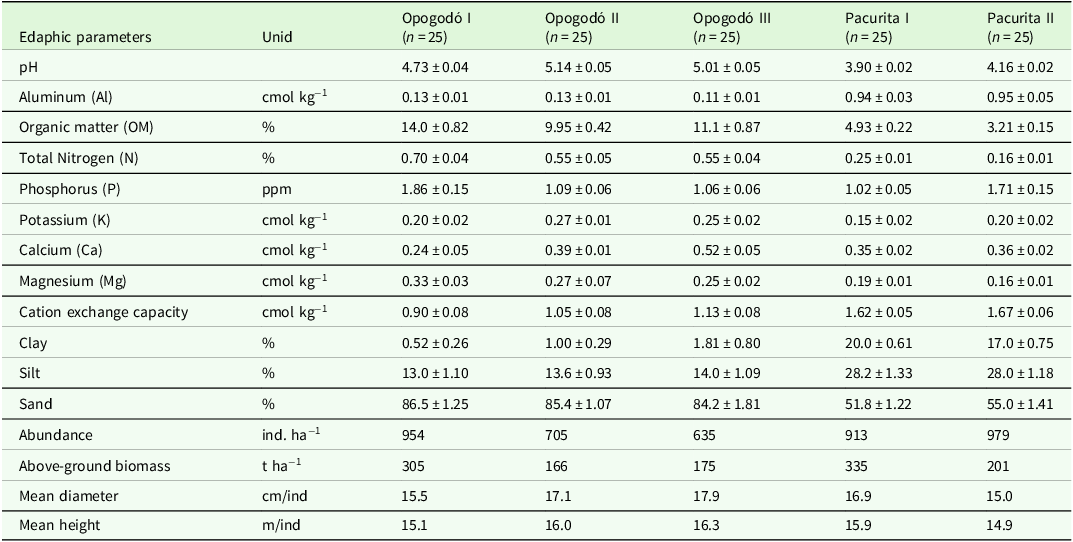
The present study was conducted in a tropical rain forest located in the localities of Pacurita (municipality of Quibdó) and Opogodó (municipality of Condoto), department of Chocó, Colombia. The mean temperature is 26°C, and annual precipitation is about 8000 mm. These localities are within the geomorphological unit of Tertiary sedimentary hills, which are characterized by low altitudes and are composed of sedimentary rocks, including sandy argillolites, sandstones, and limestones (Quinto-Mosquera and Moreno-Hurtado Reference Quinto-Mosquera and Moreno-Hurtado2017). The soils of both sites are strongly acidic (pH between 3.9 and 5.2), with very low P content (1.02–1.83 ppm) and low exchangeable base concentrations. In Opogodó, soils have higher contents of sand (85–87%), organic matter (10–14%), and total N (0.56–0.72%); whereas in Pacurita they have lower pH, greater Al saturation, and are loam, with lower contents of sand and higher of clay (Table 1). Soil chemical and physical properties reported in Table 1, where the analytical methods used for each variable are also specified, were obtained from Quinto-Mosquera and Moreno (Reference Quinto-Mosquera and Moreno-Hurtado2017). In Opogodó the sampling was carried out in three permanent plots—one ha each—installed in a primary forest located in the facilities of the Technological University of Chocó ‘Diego Luis Córdoba’. In Pacurita, the study was carried out in two permanent plots of a forest located on the left margin of the road between Quibdó and Pacurita (Table 1).
Edaphic (mean ± SE) and structural parameters of five permanent plots in the Chocó region, Colombia. Soil data (replicates per site collected from the 0–20 cm soil layer) and forest structural parameters (e.g., tree density and above-ground biomass) were obtained from the supplementary material of Quinto-Mosquera and Moreno-Hurtado (Reference Quinto-Mosquera and Moreno-Hurtado2017). Soil analyses were conducted using standard procedures: the Bouyoucos method for soil texture, potentiometric determination in water solution (1:2) for pH, the Walkley and Black method for organic matter, Micro-Kjeldahl for total N, available P determined by the ascorbic acid method after Bray II extraction using a UV–VIS spectrophotometer, and ca, mg, and K determined by atomic absorption after extraction with ammonium acetate

Table 1. Long description
The table presents edaphic and structural parameters for five permanent plots in the Chocó region, Colombia. It includes data for Opogodó I, Opogodó II, Opogodó III, Pacurita I, and Pacurita II. The table has 18 rows and 7 columns. Column headers are Edaphic parameters, Unid, Opogodó I (n=25), Opogodó II (n=25), Opogodó III (n=25), Pacurita I (n=25), Pacurita II (n=25). Row labels include pH, Aluminum (Al), Organic matter (OM), Total Nitrogen (N), Phosphorus (P), Potassium (K), Calcium (Ca), Magnesium (Mg), Cation exchange capacity, Clay, Silt, Sand, Abundance, Above-ground biomass, Mean diameter, Mean height. Each row provides specific values for each plot. Notable trends include higher sand and organic matter content in Opogodó plots and lower pH and higher clay content in Pacurita plots.
In both locations, sampling was carried out in well-preserved primary forests. Although tree density, above-ground biomass, mean diameter, and height varied among plots, values were within the range reported for mature tropical rainforests in the region (Quinto-Mosquera and Moreno-Hurtado Reference Quinto-Mosquera and Moreno-Hurtado2017).
Methods
Experimental design
We used a randomized complete block design with five fertilization treatments (N, P, K, NPK, and control) and five replicates (Shieh and Jan Reference Shieh and Jan2004). At each site, a 100 × 100 m forest area was established in 2013. Within this area, five parallel strips of 20 × 100 m (0.2 ha) were established. Each strip was subdivided into five experimental units of 20 × 20 m, to which the five fertilization treatments were randomly assigned. A 2 m buffer zone was established within each experimental unit, resulting in an effective treated area of 18 × 18 m. Understory vegetation within the buffer zones was not removed, and thus potential lateral root uptake between adjacent experimental units cannot be entirely ruled out. Each experimental unit was further subdivided into four 9 × 9 m subplots to facilitate fertilizer application, soil sampling, and subsequent NPP measurements.
Fertilizers were applied by broadcast application, that is, evenly distributed over the soil surface of each experimental unit without soil incorporation (Mirmanto et al. Reference Mirmanto, Proctor, Green and Nagy1999; Wright et al. Reference Wright, Yavitt, Wurzburger, Turner, Tanner, Sayer, Santiago, Kaspari, Hedin, Harms, Garcia and Corre2011). The annual dose of fertilizer was applied in four equal doses throughout the year 2014, in the months of February, May, August, and November. Thus, in the treatment of N, 125 kg N ha−1 year−1 was applied in the form of urea [(NH2) 2CO]; in the treatment of P, 50 kg P ha−1 year−1 was applied in the form of phosphate rock; in the treatment of K, 50 kg K ha−1 year−1 was applied in the form of potassium chloride (KCl); in the treatment of NPK, each of the doses mentioned in the previous treatments was applied together; and in the control, no fertilizers were applied.
Measurement of tree diameters and heights
Two censuses of the plots were carried out in the months of August of 2013 and 2014 on individuals with diameter at breast height (DBH) ≥10 cm. In each census the living, dead, and recruited individuals (i.e., those that reached the DAP ≥ 10 cm) were recorded. For all trees measured, the morpho species were identified up to the maximum taxonomic level possible (NN ‘unidentified specimens’, species, genus, botanical family) in the Herbarium of the Technological University of Chocó ‘D.L.C.’ ‘Herbario Choco’. This identification was made using the specialized keys of Gentry (Reference Gentry1993).
We marked the perimeter of the tree trunk where the diameter was measured with yellow paint in order to ensure that subsequent measurements were made in the same area of the first measurement. All measurements were made in areas free of knots, buttresses, or branches. In addition, the location of each individual in the grid was recorded. All trees measured were also marked with aluminum tags. Heights were measured in 40% of the trees with a Suunto clinometer at fixed distances of 15 and 20 m from the tree; likewise, the heights of the smallest trees (heights less than 10–15 m) were measured with a graduated rod. For the remaining 60% of trees, Equations (1) and (2) (Quinto-Mosquera and Moreno-Hurtado Reference Quinto-Mosquera and Moreno-Hurtado2011) were used to estimate the height of the trees based on the ecological groups of species.
 $\begin{align}&{\rm Total\ height\ of\ non-pioneer\ species\ (m)} \\&\,\,\,\,\,\,\,= 6.28 + 0.607 \times {\rm DBH}\end{align}$
 ${\rm Total\ height\ of\ pioneer\ species\ (m)} = 7.422 + 0.411 \times {\rm DBH}$
Measurement of litter and fine-root production: a litter trap (1 × 0.5 m) was installed 1 m above ground at the center of the 20 × 20 m sampling subplot. In total, 125 traps were installed for litterfall sampling. The litter accumulated in the collectors was collected every month for one year in plastic bags. Given the warm and humid conditions of the study sites, some decomposition of leaf litter may have occurred between monthly collections. To measure the NPP of fine roots, we used the ingrowth core method (Cuevas & Medina Reference Cuevas and Medina1988) modified by Moreno-Hurtado (Reference Moreno-Hurtado2004). In this method, a volume of soil is extracted and the soil removed; then, this volume of root-free soil is returned back to the orifice previously left on the forest floor. Cores are left in the soil for a period of two months to allow fine-root growth; subsequently, the cores are extracted, roots are removed, and fine-root NPP is determined (Cuevas & Medina Reference Cuevas and Medina1988, Hendricks et al. Reference Hendricks, Hendricks, Wilson, Mitchell, Pecot and Guo2006).
The modified ingrowth cores were located in the center of each 10 × 10 m subplot; for this purpose, two soil samples (0–10 cm and 10–20 cm deep) were extracted with an Eijkelkamp® soil auger (8 cm diameter and 15 cm long). Fine roots (FR) (with diameters ≤ 5 mm) were manually separated in the field using plastic trays and sieves (0.5 and 1.0 mm). After extracting FR, the soil was introduced again into the holes, while roots were transported to the laboratory for processing. This procedure was performed every three months for one year; in each sampling, 100 soil cores were evaluated at two depths per plot, which resulted in a total of 1000 FR samples per field campaign. In the laboratory, the FR sampled quarterly were washed and sieved (0.5 and 1 mm) to remove the remaining soil. Subsequently, the FR were oven-dried (70°C for 48 hours) and weighed in an analytical balance (accuracy ± 0.0001 g). The NPP of fine roots was determined as the value accumulated over time and expressed in t ha−1 year−1.
Data analysis
For the estimation of tree above-ground biomass (AB), we reviewed seven models generated with information from tropical wet forests of different areas of the world (Bake et al. Reference Baker, Phillips, Malhi, Almeida, Arroyo, Di Fiore, Erwin, Killeen, Laurance, Laurance, Lewis, Lloyd, Monteagudo, Neill, Patiño, Pitman, Silva and Vásquez2004; Brown Reference Brown1997; Chave et al. Reference Chave, Andalo, Brown, Cairns, Chambers, Eamus, Fölster, Fromard, Higuchi, Kira, Lescure, Nelson, Ogawa, Puig, Riera and Yamakura2005); the model from Chave et al. (Reference Chave, Andalo, Brown, Cairns, Chambers, Eamus, Fölster, Fromard, Higuchi, Kira, Lescure, Nelson, Ogawa, Puig, Riera and Yamakura2005; Equation 3) was chosen because it had a higher average correlation coefficient with the AB estimates of the other models, according to the evaluation made by Quinto-Mosquera and Moreno-Hurtado (Reference Quinto-Mosquera and Moreno-Hurtado2011); in addition, the model was chosen because it includes as predictors three key variables of wood biomass (DBH, total height, and wood density) (Quinto-Mosquera and Moreno-Hurtado (Reference Quinto-Mosquera and Moreno-Hurtado2011). The below-ground biomass in coarse roots (BB, Equation 8) was estimated as 21% of AB (Aragão et al. Reference Aragão, Malhi, Metcalfe, Silva-Espejo, Jiménez, Navarrete, Almeida, Costa, Salinas and Phillips2009).
 ${\rm AB\ (kg)} = \exp\left[ -2.557 + 0.94 \times \ln\left( \rho_i \times {\rm DBH}^2 \times H \right) \right].$
 ${\rm BB\ (kg)} = 0.21 \times {\rm AB}$
Where ln is the natural logarithm, H is the total height, and ρi is the wood density. The increase in forest biomass was calculated from the information of AB and BB of each sample and measurement. For the estimation of wood density, we used the values published in two databases, generated mainly in forests of the Amazon (Baker et al. Reference Baker, Phillips, Malhi, Almeida, Arroyo, Di Fiore, Erwin, Killeen, Laurance, Laurance, Lewis, Lloyd, Monteagudo, Neill, Patiño, Pitman, Silva and Vásquez2004) and in tropical forests of different regions of the world (Brown Reference Brown1997). If any species or genus found in the plots was not reported in these databases, the average wood density of the respective genus or family was used; for the taxonomically undetermined individuals, we used the average wood density of the plot.
The total NPP and its components were determined with Equations (5) – (8) (Chapin III Reference Chapin, Woodwell, Randerson, Rastetter, Lovett, Baldocchi, Clark, Harmon, Schimel, Valentini, Wirth, Aber, Cole, Goulden, Harden, Heimann, Howarth, Matson, McGuire, Melillo, Mooney, Neff, Houghton, Pace, Ryan, Running, Sala, Schlesinger and Schulze2006; Clark Reference Clark, Brown, Kicklighter, Chambers, Thomlinson, Ni and Holland2001b):
 ${\rm NPP} = {\rm NPP}_{{\rm above-ground}} + {\rm NPP}_{{\rm below-ground}}$
 ${\rm NPP}_{{\rm above-ground}} = \Delta{\rm AB}_{{\rm survivors}} + \Delta{\rm AB}_{{\rm recruited}} + {\rm NPP}_{{\rm litterfall}}$
 ${\rm NPP}_{{\rm above-ground\ wood}} = \Delta{\rm AB}_{{\rm survivors}} + \Delta{\rm AB}_{{\rm recruited}}$
 ${\rm NPP}_{{\rm below-ground}} = \Delta{\rm BB}_{{\rm survivors}} + \Delta{\rm BB}_{{\rm recruited}} + {\rm NPP}_{{\rm fine\ roots}}$
Where ∆AB survivors is the increase in aerial biomass (AB) of surviving trees, determined as the final AB (second measurement) minus the initial AB (first measurement) of each surviving tree; ∆AB recruited is the increase in AB of trees recruited between samplings, calculated as the AB of the recruited trees (new individuals that reached DBH ≥10 cm) recorded in the second measurement minus the AB of an individual of 10 cm of DBH. Trees that died between censuses were recorded as mortality and were excluded from aboveground biomass increment calculations. The increase of coarse root biomass (∆BB, Equation 8) was determined similarly to the increase of AB of Equation (6). NPP fine roots is the production of fine roots determined by the ingrowth core technique described above (Clark et al. Reference Clark, Brown, Kicklighter, Chambers, Thomlinson, Ni and Holland2001b).
A linear mixed-effects model was used to evaluate the effect of soil fertilization treatments and the locality on total NPP and its components, including the interaction between fertilization and locality. Fertilization treatment and locality were treated as fixed effects, while the experimental plot was included as a random effect to account for spatial dependence among experimental units. Models were fitted assuming independent residuals within plots. Model assumptions were evaluated by inspecting residuals, and normality and homoscedasticity were assessed using the Shapiro–Wilk test and Levene’s test, respectively. When assumptions were violated, data were log-transformed [log(x + 1)] prior to analysis. For clarity of presentation, untransformed data (mean ±2 standard errors) are shown in the text, tables, and figures. When significant main effects or interactions were detected, Fisher’s least significant difference (LSD) test was used for post hoc comparisons. Given the number of response variables and derived ratios analyzed, marginally significant results were interpreted with caution to minimize potential inflation of Type-I error. All statistical analyses were performed in the R statistical computing environment version 4.4.3 (R Core Team 2025), using the package ‘nlme’ version 3.1–137 (Pinheiro et al. Reference Pinheiro, Bates, DebRoy, Sarkar, Heisterkamp and Van Willigen2018). All raw data and R scripts used in the analyses are made available as Supplementary material (dataset S1).
Results
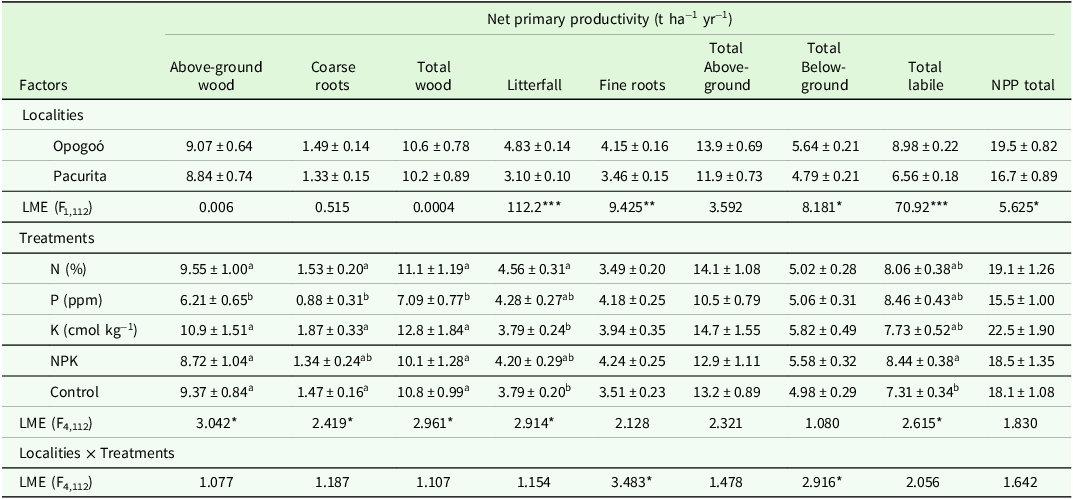
Opogodó had values of total NPP significantly higher than Pacurita, with several components of NPP accounting for this result, particularly higher NPP of labile components (litterfall NPP and fine-root NPP). Below-ground NPP was also higher, mostly as a result of higher fine-root NPP (Table 2). Fertilization treatments had variable and even contrasting effects on different components of NPP, so the effect on total NPP was not significant. Fertilization treatments had a significant effect on the following components of NPP: above-ground wood, coarse roots, total wood, litterfall, and total labile (Table 2). In particular, P-fertilization decreased the production of woody tissue (above-ground wood, coarse roots, and total wood). N-fertilization increased the litterfall production, and the NPK-fertilization increased the total labile NPP; no other significant effects of treatments were found (Table 2).
Effects of the localities and fertilization treatments on NPP and its components in tropical rain forests of the Chocó region, Colombia

Table 2. Long description
A table comparing net primary productivity (NPP) across different localities and fertilization treatments in tropical rain forests of the Chocó region, Colombia. The table has 19 rows and 12 columns. Column headers include factors, localities, treatments, and various NPP components such as above-ground wood, coarse roots, total wood, litterfall, fine roots, total above-ground, total below-ground, total labile, and NPP total. Row labels include localities (Opogóo, Pacurita), treatments (N percent, P ppm, K cmol kg^-1, NPK, Control), and statistical measures (LME). Each row provides specific values for each NPP component. Notable trends include higher total NPP in Opogóo compared to Pacurita, and variable effects of fertilization treatments on different NPP components.
LME is the Linear Mixed-Effects Model. F values with asterisks indicate statistically significant differences *P < 0.05. **P < 0.01. ***P < 0.0001. Different letters indicate statistically significant differences between treatment levels. Total wood = above-ground wood + coarse roots; total labile = litterfall + fine roots. Total above-ground = above-ground wood + litterfall; total below-ground = coarse roots + fine roots.
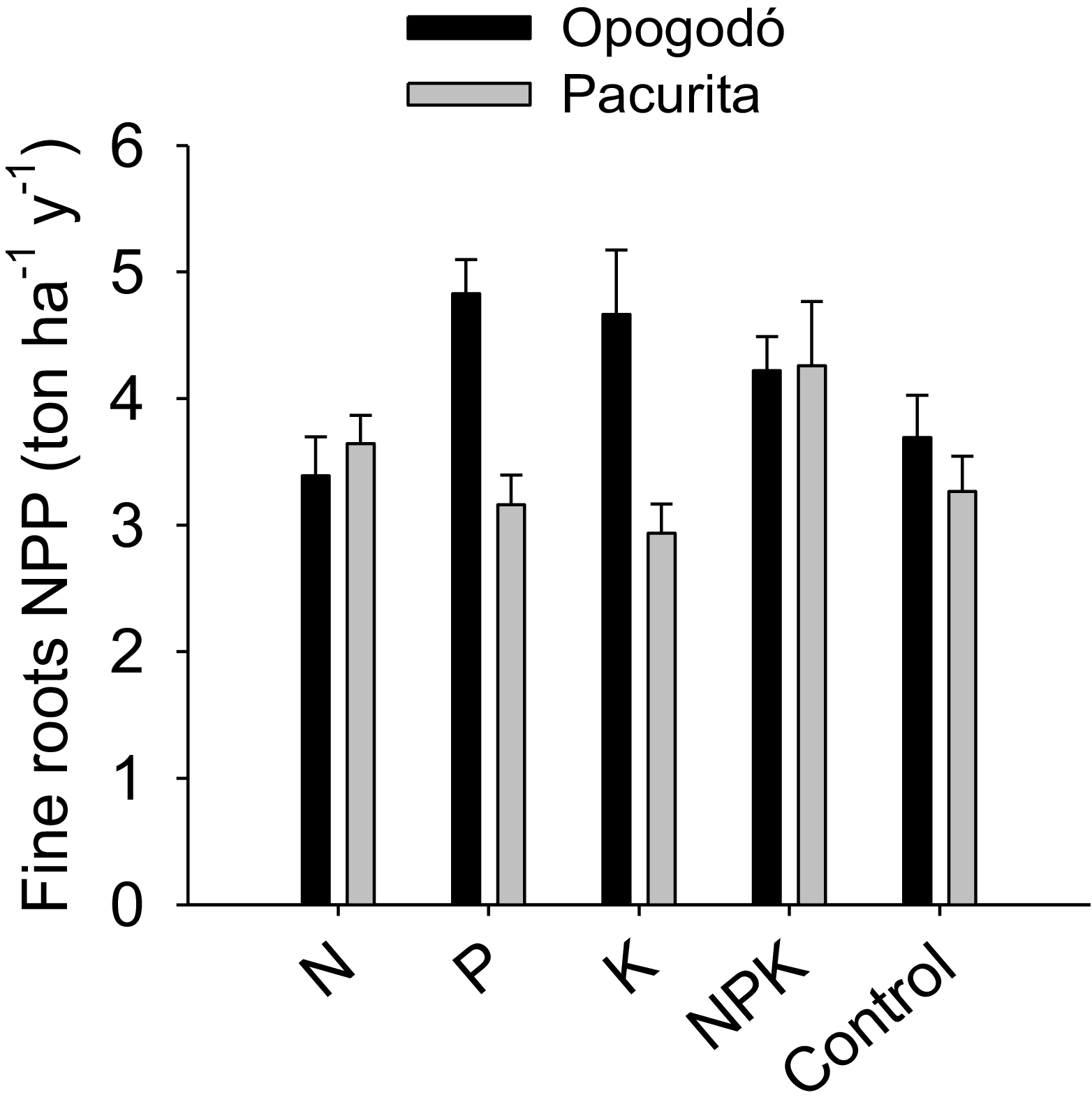
The fertilization treatment × location interaction was significant for fine roots and total below-ground NPP (Table 2, Figure 1). In Opogodó, the P-fertilization treatment increased the production of these two components, which were higher than for the control and N-fertilization treatments. Similarly, the K treatment also produced higher values for these two variables as compared to the N treatment in Opogodó, which showed the lowest values among all fertilization treatments in this location (Figure 1). In Pacurita, the NPK treatment produced higher values than K for these two variables; no other significant effect was detected.
Locality × fertilization interaction on fine-root NPP in tropical rain forests of the Chocó region, Colombia. Different letters indicate statistically significant differences between treatment levels (P < 0.05).

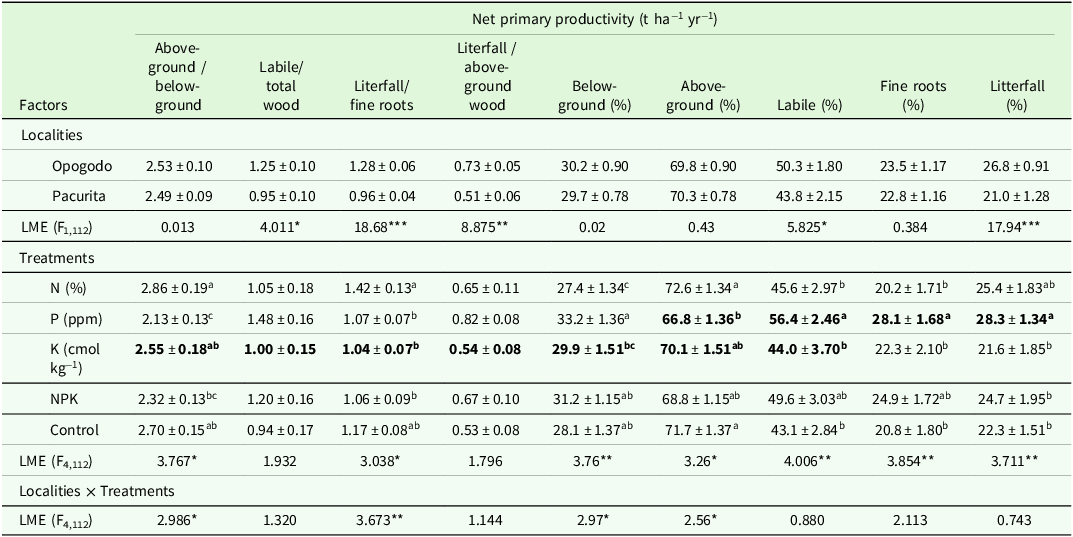
Several ratios among components of NPP were significantly different between locations; particularly, labile/total wood, litterfall/fine roots, and litterfall/above-ground wood were higher in Opogodó. Likewise, the percentages of labile NPP and litterfall NPP were higher in Opogodó than in Pacurita (Table 3).
Effects of the localities and fertilization treatments on the ratios among components of NPP in tropical rain forests of the Chocó region, Colombia

Table 3. Long description
The table presents data on net primary productivity (NPP) ratios among components in tropical rain forests of the Chocó region, Colombia. It includes measurements from two localities, Opogodo and Pacurita, and various treatments such as N (percent), P (ppm), K (cmol kg^-1), NPK, and Control. The table has 12 columns and 14 rows, including headers and grouped rows for localities and treatments. Key columns include Above-ground/below-ground, Labile/total wood, Litterfall/fine roots, Litterfall/above-ground wood, Below-ground (percent), Above-ground (percent), Labile (percent), Fine roots (percent), and Litterfall (percent). Notable trends include higher labile/total wood, litterfall/fine roots, and litterfall/above-ground wood ratios in Opogodo compared to Pacurita. Additionally, the percentages of labile NPP and litterfall NPP are higher in Opogodo than in Pacurita.
LME is the Linear Mixed-Effects Model. F values with asterisks indicate statistically significant differences *P < 0.05. **P < 0.01. ***P < 0.0001. Different letters indicate statistically significant differences between treatment levels (P < 0.05). Above-ground (%) and below-ground (%) represent the proportional contributions of these compartments to total NPP and are complementary measures.
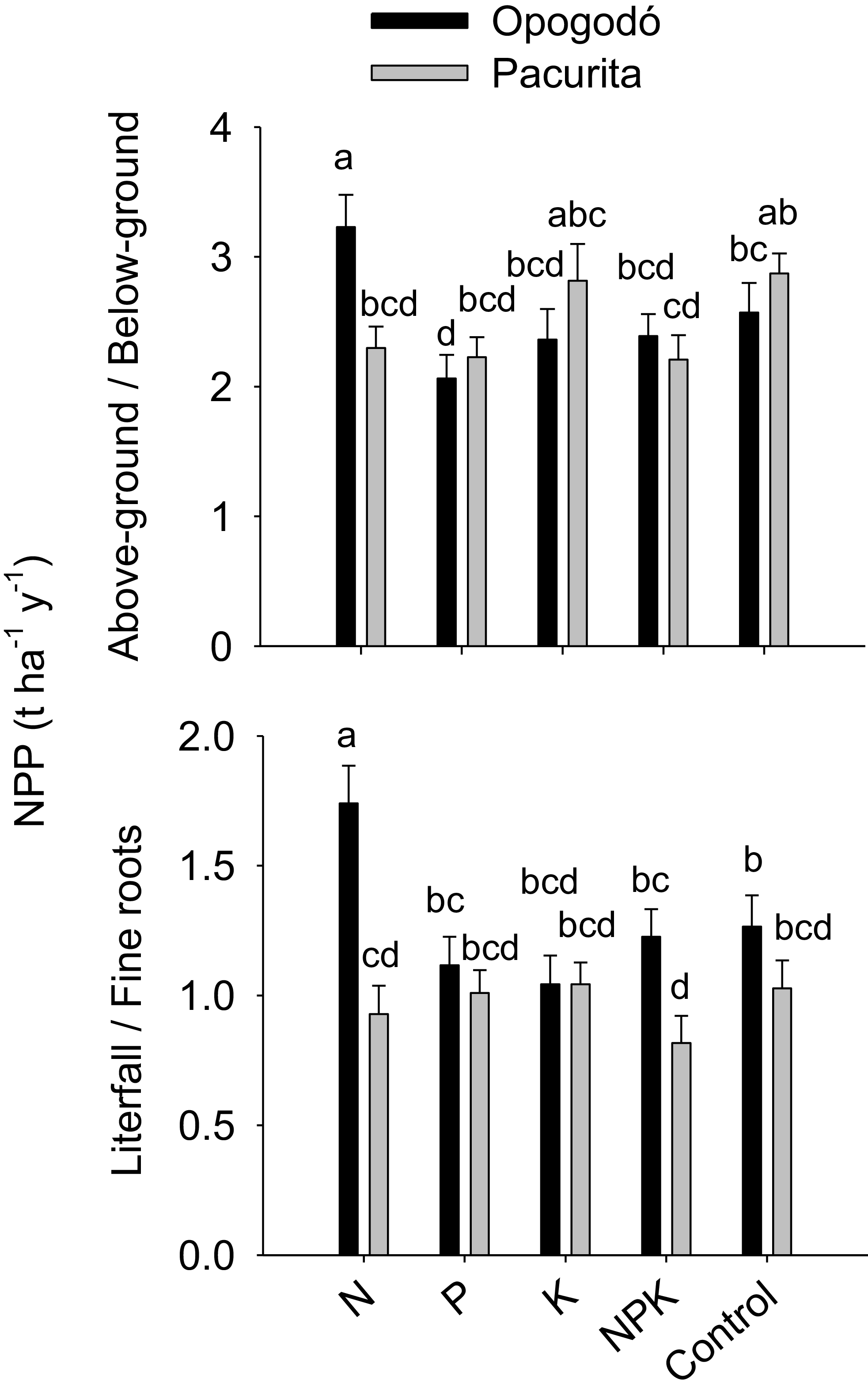
Fertilization treatments did not have significant effects on labile/total wood NPP and litterfal/above-ground wood NPP. They were significant on other ratios, particularly on above-ground/below-ground NPP and litterfall/fine roots NPP; however, the effects varied between locations (the interactions localities × fertilization treatments were significant for both variables Table 3). In Opogodó, the above-ground/below-ground NPP was significantly higher under N fertilization as compared to all other treatments, while P fertilization decreased this ratio as compared to the control (Figure 2). In Pacurita, the NPK treatment decreased this ratio as compared to the control. Similarly, in Opogodó the litterfall/fine-root NPP ratio was higher under N fertilization than under the other treatments. In Pacurita, the lowest value of this ratio was observed under the NPK treatment; however, differences among fertilization treatments at this site were not statistically significant (Figure 2).
Locality × fertilization treatments interaction on the ratios above-ground/below-ground and litterfall/fine-root NPP in tropical rain forests of the Chocó region, Colombia. Different letters indicate statistically significant differences between treatment levels (P < 0.05).

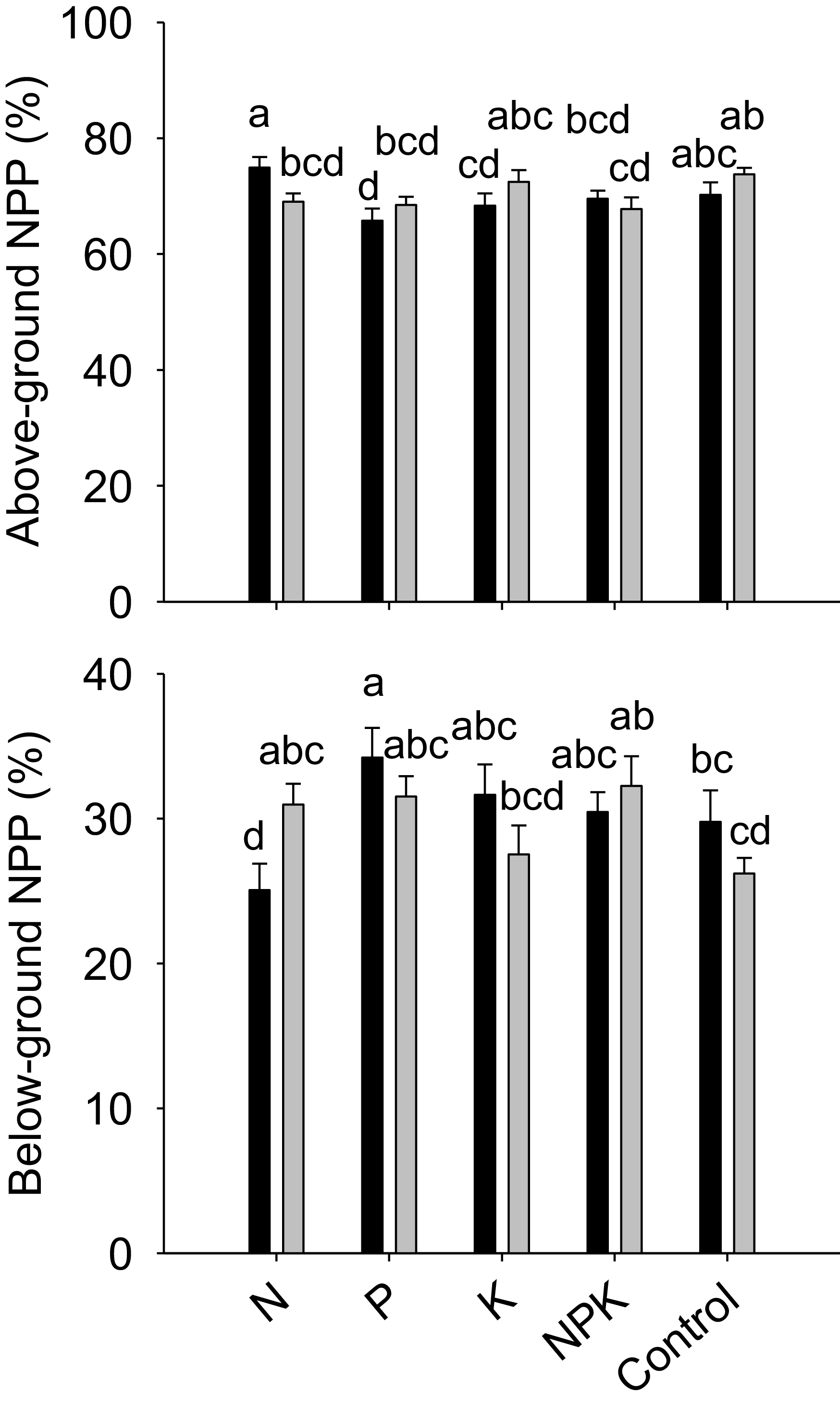
Fertilization treatments also had significant effects on the allocation of NPP to different compartments, measured as percentages, particularly on below-ground NPP, above-ground NPP, labile NPP, fine-root NPP, and litterfall NPP (Table 3). The percentage of NPP allocated to labile, fine roots, and litterfall NPP increased significantly under the treatment of P fertilization as compared to the control (Table 3). The effects of fertilization treatments on the percentages of above-ground and below-ground NPP varied between localities. The percentage of above-ground NPP in Opogodó decreased with P fertilization as compared to the control and N, while in Pacurita, this variable was lower with the NPK treatment as compared to the control (Figure 3). In Opogodó, the percentage of below-ground NPP increased with P-fertilization as compared to treatments with control and N; likewise, this variable was lower under N fertilization as compared to all other treatments. In Pacurita, below-ground NPP was higher under the NPK treatment as compared to the control.
Locality × fertilization treatment interaction on the allocation percentage of NPP to above- and below-ground components in tropical rain forests of the Chocó region, Colombia. Different letters indicate statistically significant differences between treatment levels (P < 0.05).

Discussion
Effects of fertilization on total forest NPP. None of the soil fertilization treatments applied had significant effects on total NPP of the tropical rainforests evaluated. This result does not support the hypothesis of P limitation of NPP (Aragão et al. Reference Aragão, Malhi, Metcalfe, Silva-Espejo, Jiménez, Navarrete, Almeida, Costa, Salinas and Phillips2009; Cleveland et al. Reference Cleveland, Townsend, Taylor, Alvarez-Clare, Bustamante M.M., Chuyong, Dobrowski, Grierson, Harms, Houlton, Marklein, Parton, Porder, Reed, Sierra, Silver, Tanner E.V. and Wieder2011; Vitousek Reference Vitousek1984), as well as the N limitation of NPP of this forest, as suggested by several investigations (Lebauer and Treseder Reference Lebauer and Treseder2008, Mirmanto 1999). Nevertheless, it should be noted that NPP components were measured over a single year following fertilization, and longer-term observations may reveal delayed, cumulative, or transient responses that are not captured at short temporal scales, as documented in long-term fertilization experiments in other tropical forests (Wright et al. Reference Wright, Turner, Yavitt, Harms, Kaspari, Tanner, Bujan, Griffin, Mayor, Pasquini, Sheldrake and Garcia2018, Reference Wright, Harms, Hernández, Garcia, Yavitt, Muller-Landau and Wright2024). Consistent with these findings and with the limited number of published studies, total NPP in mature tropical forests appears to be only weakly influenced by nutrient addition or by unforeseen increases in nutrient availability, even after fertilization periods longer than ten years (Wright et al. Reference Wright, Yavitt, Wurzburger, Turner, Tanner, Sayer, Santiago, Kaspari, Hedin, Harms, Garcia and Corre2011, Reference Wright, Harms, Hernández, Garcia, Yavitt, Muller-Landau and Wright2024). Accordingly, total NPP in the studied rainforests does not seem to be limited by the addition of N, P, or K. Several reasons might explain the unresponsiveness of total NPP to the addition of fertilizers:
1) Structure and diversity of vegetation: these old-growth rainforests of the biogeographic Chocó have high diversity of tree species (Faber-Langendoen Reference Faber-Langendoen and Gentry1991; Quinto-Mosquera and Moreno-Hurtado Reference Quinto-Mosquera and Moreno-Hurtado2014), with different ages, sizes, wood densities, nutrient contents, light requirements, photosynthetic capacity, and growth rates; that enormous variability might produce differences in the amount of the most limiting nutrients required for the production of organic matter (Alvarez-Clare et al. Reference Alvarez-Clare, Mack and Brooks2013; Quinto-Mosquera and Moreno-Hurtado Reference Quinto-Mosquera and Moreno-Hurtado2017). In particular, differences in life histories of plants lead to differences in the nutritional requirements and therefore, in the responses to fertilization (Santiago Reference Santiago2015; Sullivan et al. Reference Sullivan, Alvarez-Clare, Castle, Porder, Reed and Schreeg2014); for example, it is known that small trees respond to fertilization differently from large trees (Alvarez-Clare & Mack Reference Alvarez-Clare, Mack and Brooks2013; Quinto-Mosquera and Moreno-Hurtado Reference Quinto-Mosquera and Moreno-Hurtado2017; Santiago et al. Reference Santiago, Wright, Harms, Yavitt, Korine, Garcia and Turner2012; Wright et al. Reference Wright, Yavitt, Wurzburger, Turner, Tanner, Sayer, Santiago, Kaspari, Hedin, Harms, Garcia and Corre2011). This situation would make it difficult to prove effects of the application of nutrients on NPP at the ecosystem level in low-altitude tropical forests (Chapin III Reference Chapin, Vitousek and Van Cleve1986; Wright et al. Reference Wright, Turner, Yavitt, Harms, Kaspari, Tanner, Bujan, Griffin, Mayor, Pasquini, Sheldrake and Garcia2018). Additionally, the presence of species adapted to nutrient-poor soils may contribute to limited responses to nutrient addition, as such species may have relatively low nutrient requirements and growth rates (Wright et al. Reference Wright, Turner, Yavitt, Harms, Kaspari, Tanner, Bujan, Griffin, Mayor, Pasquini, Sheldrake and Garcia2018).
2) Chemical, physical, and biological processes: The added nutrients can be fixed and immobilized by soil microorganisms (Richardson and Simpson Reference Richardson and Simpson2011), by inorganic absorption processes, and/or chemical solubility phenomena in the soil (Chapin III Reference Chapin, Vitousek and Van Cleve1986; Gyaneshwar et al. Reference Gyaneshwar, Naresh Kumar, Parekh and Poole2002; Olander and Vitousek Reference Olander and Vitousek2004); particularly, the edaphic P can react with oxides of Fe and Al, making it not available for plants (Dalling et al. Reference Dalling, Heineman, Lopez, Wright, Turner, Goldstein and Santiago2016; Walker and Syers Reference Walker and Syers1976). The applied nutrients can also be leached by frequent rains (Austin and Vitousek Reference Austin and Vitousek1998; Quinto-Mosquera and Moreno-Hurtado Reference Quinto-Mosquera and Moreno-Hurtado2016; Santiago et al. Reference Santiago, Schuur and Silvera2005), which in the study area range between 8000 and 10000 mm per year (Poveda et al. Reference Poveda, Rojas, Rudas, Rangel and Rangel2004); in these sites, leaching may be further enhanced by the low pH of soil, with high saturation of Al in the exchange complex. Furthermore, added nutrients can be absorbed and stored in labile plant tissues, such as leaves and fine roots (Alvarez-Clare and Mack Reference Alvarez-Clare and Mack2015; Mayor et al. Reference Mayor, Wright and Turner2014; Mirmanto et al. Reference Mirmanto, Proctor, Green and Nagy1999; Newbery et al. Reference Newbery, Chuyong, Green, Songwe, Tchuenteu and Zimmermann2002; Wright et al. Reference Wright, Turner, Yavitt, Harms, Kaspari, Tanner, Bujan, Griffin, Mayor, Pasquini, Sheldrake and Garcia2018), with little effect on tissue production due to the low availability of other nutrients not included in the fertilization treatments, such as Ca and Mg. Although nutrient leaching is proposed as a plausible mechanism contributing to the weak NPP response, leachate chemistry was not measured in this study, and therefore direct evidence of nutrient losses is not available.
The high concentration of total N in these soils (Table 1) (Quinto-Mosquera and Moreno-Hurtado Reference Quinto-Mosquera and Moreno-Hurtado2016) and the high expected rates of biological fixation of N resulting from the abundance of legumes in these forests (Cleveland et al. Reference Cleveland, Townsend, Schimel, Fisher, Howarth, Hedin, Perakis, Latty, Von Fischer, Elseroad and Wasson1999; Posada and Schuur Reference Posada and Schuur2011) could explain the unresponsiveness of total NPP to the application of N. Despite the low stores of available P in these soils (Quinto-Mosquera and Moreno-Hurtado Reference Quinto-Mosquera and Moreno-Hurtado2016), its application did not affect the total NPP, probably due to the adaptive strategies that allow plants to obtain the required P from soil. Such strategies include the development of mycorrhizal associations that increase the surface area for P uptake, the solubilization of P retained in Fe and Al sesquioxides in the soil (Lambers et al. Reference Lambers, Raven, Shaver and Smith2008; Smith and Read Reference Smith and Read2008), and the formation of cluster roots that release carboxylates into the rhizosphere, thereby mobilizing poorly available edaphic P (Finlay Reference Finlay2008; Smith et al. Reference Smith and Read2008). Likewise, the increased activity of phosphatase enzymes, released by plants and microorganisms, allows the absorption of P from soil organic matter (Vitousek et al. Reference Vitousek, Porder, Houlton and Chadwick2010). These strategies could explain the effect of P fertilization on the increased below-ground NPP, which will be further discussed. K is a highly soluble nutrient, easily leached from the soil, even more than other macronutrients such as N or P (Boxman et al. Reference Boxman, Cobben and Roelofs1985; Sardans and Peñuelas Reference Sardans and Peñuelas2015); therefore, its edaphic availability decreases with high rainfall (Austin and Vitousek Reference Austin and Vitousek1998). For these reasons, K also shows large deposition rates to the soil by foliar leaching (Duchesne et al. Reference Duchesne, Ouimet, Camire and Houle2001; Kopacek et al. Reference Kopacek, Turek, Hejzlar and Santruckova2009; Santiago et al. Reference Santiago, Schuur and Silvera2005). Consequently, despite the low content of K in the soils (Table 1), it should not be limiting NPP in these forests and consequently its unresponsiveness to K application.
The application of N, P, and K produces eco-physiological responses in tropical trees, such as the increase in foliar content of nutrients, maximum photosynthetic rate, stomatal conductance, transpiration, water use efficiency, and tree growth and production, among others (Santiago Reference Santiago2015). However, these responses could be modified by other limiting factors, such as light, temperature, soil aeration, etc. (Alvarez-Clare and Mack Reference Alvarez-Clare and Mack2011; Santiago et al. Reference Santiago, Schuur and Silvera2005; Schuur and Matson Reference Schuur and Matson2001). In particular, the cloudy skies typical of this rainy region could be an important factor in decreasing the solar radiation incident, limiting the total photosynthesis of the forest. Consequently, this combination of factors would explain that the effects of nutrient application at the forest community level are more difficult to detect even in experiments longer than a few years (Chapin III et al. Reference Chapin, Vitousek and Van Cleve1986; Santiago et al. Reference Santiago, Wright, Harms, Yavitt, Korine, Garcia and Turner2012; Wright et al. Reference Wright, Turner, Yavitt, Harms, Kaspari, Tanner, Bujan, Griffin, Mayor, Pasquini, Sheldrake and Garcia2018). The effects would be even more diluted when considering that NPP limitation for each nutrient can be different (Lambers et al. Reference Lambers, Raven, Shaver and Smith2008; Sayer and Banin Reference Sayer, Banin, Goldstein and Santiago2016; Sullivan et al. Reference Sullivan, Alvarez-Clare, Castle, Porder, Reed and Schreeg2014), and that the ecosystem could be limited by more than one factor (Alvarez-Clare et al. Reference Alvarez-Clare, Mack and Brooks2013; Kaspari et al. Reference Kaspari, Garcia, Harms, Santana, Wright and Yavitt2008; Mirmanto et al. Reference Mirmanto, Proctor, Green and Nagy1999). In this context, although soil chemistry was not re-evaluated after fertilization, the randomized assignment of treatments within each locality, together with the strong baseline edaphic contrasts between sites, supports the interpretation that the observed NPP responses primarily reflect treatment effects interacting with site-level soil constraints.
Effects of fertilization on the above- and below-ground allocation of forest NPP. It is known that the availability of resources such as water, nutrients, or solar radiation stimulates a redistribution of NPP between the above- and below-ground components of vegetation (Malhi et al. Reference Malhi, Doughty and Galbraith2011; Thornley Reference Thornley1972). Plants allocate biomass and NPP according to the most limiting resource; consequently, a greater proportion of NPP and biomass is allocated to fine roots in soils with limited availability of water and nutrients. However, when solar radiation is a limiting factor, higher NPP is allocated to aerial structures, such as stems and canopy (Aerts & Chapin III Reference Aerts and Chapin2000; Bloom et al. Reference Bloom, Chapin and Mooney1985; Malhi et al. Reference Malhi, Doughty and Galbraith2011; Poorter et al. Reference Poorter, Niklas, Reich, Oleksyn, Poot and Mommer2012; Portsmuth & Niinemets Reference Poortsmuth and Niinemets2007). The differential allocation can profoundly affect the ecosystem functioning; for example, a greater proportion of canopy NPP influences the photosynthetic capacity and the production of flowers and fruits; the wood NPP represents the long-term carbon storage in the ecosystem; and the fine-root NPP determines the acquisition of water and nutrients from the soil (Malhi et al. Reference Malhi, Doughty and Galbraith2011).
This hypothesis has received different names, among them optimal partitioning theory (Thornley Reference Thornley1972), hypothesis of differential allocation (Hendricks et al. Reference Hendricks, Hendricks, Wilson, Mitchell, Pecot and Guo2006), hypothesis of balanced growth, and functional balance of biomass allocation (Poorter et al. Reference Poorter, Niklas, Reich, Oleksyn, Poot and Mommer2012). Few studies have evaluated the relation between the above- and below-ground components of NPP and the edaphic availability of nutrients in tropical rainforests (Aragão et al. Reference Aragão, Malhi, Metcalfe, Silva-Espejo, Jiménez, Navarrete, Almeida, Costa, Salinas and Phillips2009; Jiménez et al. Reference Jiménez, Peñuela-Mora, Sierra, Lloyd, Phillips, Moreno and Quesada2014; Quinto-Mosquera and Moreno-Hurtado Reference Quinto-Mosquera and Moreno-Hurtado2017), with variable results. Aragão et al. (Reference Aragão, Malhi, Metcalfe, Silva-Espejo, Jiménez, Navarrete, Almeida, Costa, Salinas and Phillips2009) found that total and root NPP increased with the available soil P, in accordance with this hypothesis, in the sense that edaphic P limits the below-ground NPP (Vitousek Reference Vitousek1984). Quinto-Mosquera and Moreno-Hurtado (Reference Quinto-Mosquera and Moreno-Hurtado2017), working in the same forests studied here, found correlations explaining variation in both above- and below-ground NPP components in relation to nutrient availability, except for available P, likely because P concentrations were low and showed little variability in that study; however, the relationship between the availability of nutrients and total NPP was not significant. The higher total NPP and below-ground NPP, as well as the labile components of NPP (litterfall and fine roots) in forests of Opogodó in this study, which have higher sand content as well as higher availability of several nutrients (organic matter, N, K, and Mg), support the well-established idea that total NPP is affected by soil fertility (Quinto-Mosquera et al. Reference Quinto-Mosquera, Valois-Cuesta and Pérez-Abadía2024); these results show additional evidence of differential allocation to components of NPP as a result of variation of soil fertility, probably as a mechanism to capture resources in oligotrophic soils (Quinto-Mosquera and Moreno-Hurtado Reference Quinto-Mosquera and Moreno-Hurtado2017), according to the differential allocation hypothesis mentioned above. Our results with the application of P are similar in the sense that it increased the below-ground and the percentage of labile components of NPP (litterfall and fine roots) in these forests whose soils have very low contents of P (Table 1). Although this pattern is consistent with an ecophysiological reallocation of carbon aimed at improving P acquisition, alternative, non-mutually exclusive mechanisms should also be considered. P addition may have promoted changes in species composition or relative growth rates, favoring fast-growing species or functional groups characterized by higher fine-root turnover and litter production. Such community-level responses could contribute to the observed shifts in NPP allocation without necessarily implying direct physiological reallocation within individual plants. Disentangling these mechanisms would require species-specific and trait-based analyses that were beyond the scope of the present study.
Based on the differential allocation hypothesis, the response to the application of nutrients should be a redistribution of NPP among its components (Chapin III et al. Reference Chapin, Vitousek and Van Cleve1986). This was the response evidenced in the present study, where the application of N increased the litterfall NPP, the addition of P decreased the NPP of woody tissue, while NPK increased the total labile NPP (Table 2). P-fertilization also increased the percentage of NPP allocated to leaf litter, fine roots, and total labile (Table 3). The significant interactions of fertilization treatments × localities for several variables show the differential effect of fertilization treatments on components of NPP depending on local soil conditions. In Opogodó, N-fertilization increased the ratios of litterfall/fine root as well as above-ground/below-ground NPP; P application had the opposite effect, with a lower percentage of above-ground NPP and, consequently, higher allocation to below-ground NPP. Although fertilization responses in Pacurita were lower, it is remarkable the higher allocation to below-ground NPP in response to NPK application; this lower response to fertilization treatments in Pacurita could be related to the lower contents of most nutrients, and more importantly, lower pH and higher Al saturation in their soils; Al has toxic effects on plants and affects the absorption of other nutrients (Sharma et al. Reference Sharma, Datta and Sharma2025). For this reason, future fertilization studies in tropical forests with acidic soils would benefit from including an acidity neutralization treatment.
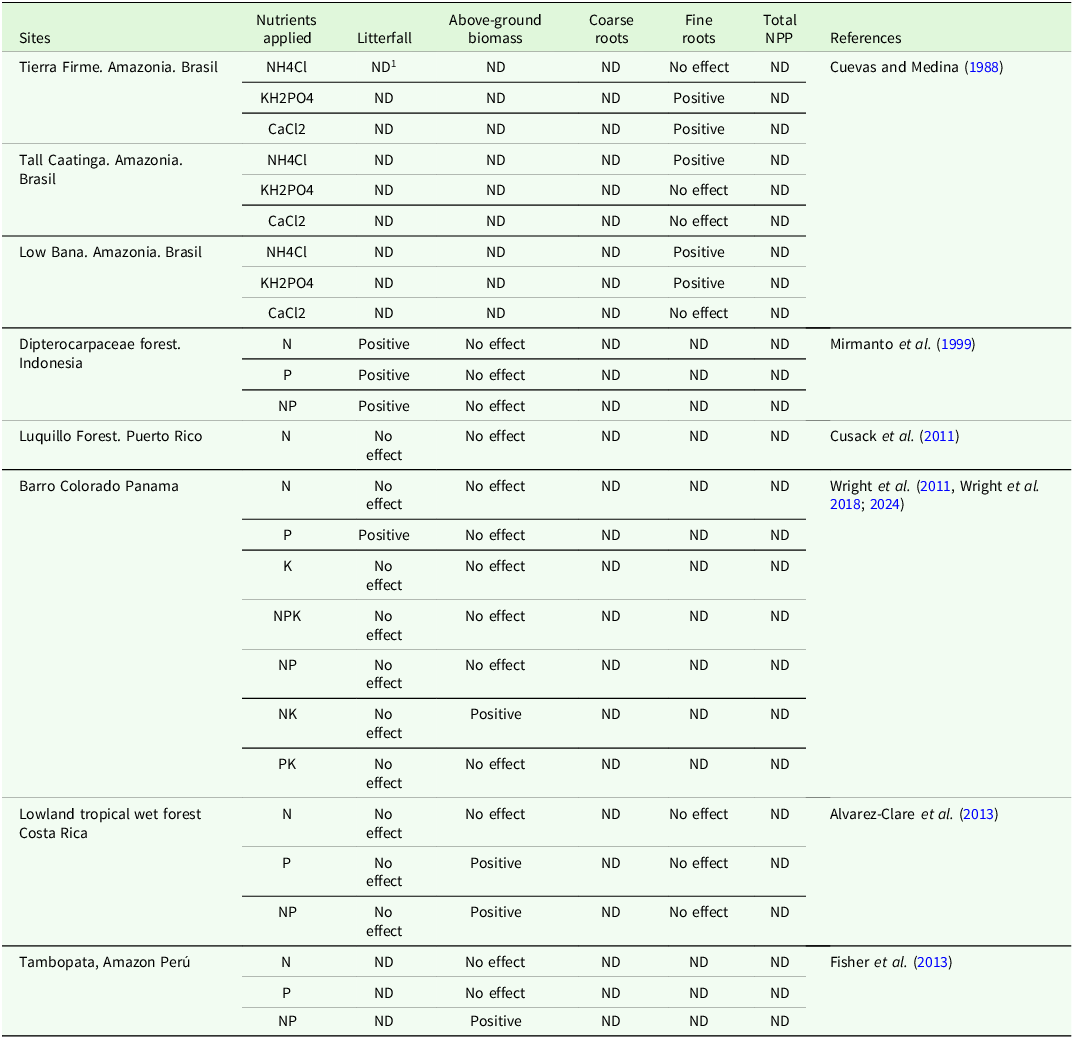
Studies on the effects of fertilization in tropical rainforests show that NPP responses can be differential according to the NPP component measured and the nutrients evaluated (Table 4). In this regard, Mirmanto et al. (Reference Mirmanto, Proctor, Green and Nagy1999) and Wright et al. (Reference Wright, Yavitt, Wurzburger, Turner, Tanner, Sayer, Santiago, Kaspari, Hedin, Harms, Garcia and Corre2011), in forests of Indonesia and Panama, respectively, showed increases in litterfall NPP with the application of nutrients (N, P, and N + P) but did not show significant changes in tree diameter growth rates. Similarly, Sayer et al. (Reference Sayer, Wright, Tanner, Yavitt, Harms, Powers, Kaspari, Garcia and Turner2012) observed an increase in litterfall NPP with the application of N, P, and organic matter. Contrarily, other investigations did not detect changes in litterfall NPP with the application of nutrients (Alvarez-Clare et al. Reference Alvarez-Clare, Mack and Brooks2013; Cusack et al. Reference Cusack, Silver, Torn and McDowell2011; Newbery et al. Reference Newbery, Chuyong, Green, Songwe, Tchuenteu and Zimmermann2002). On the other hand, increases in growth rates of small trees (5–10 cm of DBH) with the application of P were reported, but effects on fine roots or litterfall NPP were not identified (Alvarez-Clare and Mack Reference Alvarez-Clare and Mack2015; Alvarez-Clare et al. Reference Alvarez-Clare, Mack and Brooks2013). Despite these results showing the variability and complexity of NPP responses to fertilization, the present study experimentally proves that fertilization generated a redistribution of the above- and below-ground components of NPP.
Summary of nutrient-addition experiments conducted in lowland tropical rainforests evaluating total net primary production (NPP) and/or its main components. Studies were selected based on the availability of ecosystem-level NPP measurements and comparable experimental designs. The table includes representative studies from different tropical regions and is not intended to be an exhaustive review of all fertilization experiments

Table 4. Long description
A table with 8 rows and 7 columns summarizing nutrient-addition experiments in tropical rainforests. The columns are Sites, Nutrients applied, Litterfall, Above-ground biomass, Coarse roots, Fine roots, Total NPP, and References. The table includes data from various sites such as Tierra Firme, Amazonia, Brasil; Tall Caatinga, Amazonia, Brasil; Low Bana, Amazonia, Brasil; Dipterocarpaceae forest, Indonesia; Luquillo Forest, Puerto Rico; Barro Colorado Panama; Lowland tropical wet forest Costa Rica; and Tambopata, Amazon Peru. Each row provides information on the nutrients applied and their effects on litterfall, above-ground biomass, coarse roots, fine roots, and total NPP. The references column lists the studies that conducted these experiments.
1 ND: undetermined.
Final remarks
Most tropical forests are characterized by high NPP rates (Lu et al. Reference Lu, Chung, Malhi and Huang2025; Pan et al. Reference Pan, Birdsey, Fang, Houghton, Kauppi, Kurz, Phillips, Shvidenko, Lewis, Canadell, Ciais, Jackson, Pacala, McGuire, Piao, Rautiainen, Sitch and Hayes2011; Saugier et al. Reference Saugier, Roy, Mooney, Roy, Saugier and Mooney2001) despite growing on nutrient-poor soils with low nutrient concentrations (Chapin III et al. Reference Chapin, Vitousek and Van Cleve1986). This apparent paradox has led to the hypothesis that these ecosystems are limited by key nutrients such as N, P, and K (Aragão et al. Reference Aragão, Malhi, Metcalfe, Silva-Espejo, Jiménez, Navarrete, Almeida, Costa, Salinas and Phillips2009; Cleveland et al. Reference Cleveland, Townsend, Taylor, Alvarez-Clare, Bustamante M.M., Chuyong, Dobrowski, Grierson, Harms, Houlton, Marklein, Parton, Porder, Reed, Sierra, Silver, Tanner E.V. and Wieder2011; Fisher Reference Fisher, Malhi, Torres, Metcalfe, van de Weg, Meir, Silva-Espejo and Huasco2013; Paoli and Curran Reference Paoli and Curran2007; Vitousek Reference Vitousek1984). However, the results of the present study experimentally demonstrated that total NPP in extremely pluvial tropical forests of the biogeographic Chocó is not limited by the availability of N, P, or K, at least over the time scale evaluated. The rejection of this first hypothesis constitutes an important finding, as it indicates that total NPP can be remarkably insensitive to nutrient addition even under conditions of severe soil nutrient limitation.
Instead of increasing total productivity, nutrient addition primarily promoted a redistribution of NPP between above- and below-ground compartments, with particularly strong effects of phosphorus addition, thereby supporting the second hypothesis. Phosphorus fertilization increased the relative contribution of below-ground and labile components (fine roots and litterfall) while reducing allocation to woody biomass. This shift in allocation may represent an adaptive strategy to enhance nutrient acquisition and retention in soils where phosphorus is scarce and strongly immobilized (Finlay Reference Finlay2008; Lambers et al. Reference Lambers, Raven, Shaver and Smith2008; Smith Reference Smith and Read2008).
These findings suggest that fertilization effects in highly pluvial tropical forests may be better detected through changes in carbon allocation patterns rather than through responses of total NPP. Future fertilization experiments in these ecosystems should therefore prioritize long-term designs and integrative approaches that include nutrient cycling, fine-root dynamics, plant–microbial interactions, and hydrological constraints in order to improve understanding of the mechanisms regulating productivity and carbon allocation under conditions of extreme rainfall.
Supplementary material
The supplementary material for this article can be found at https://doi.org/10.1017/S0266467426100856.
Acknowledgements
We are grateful to Dr. J. Wright for reviewing the manuscript. Likewise, we thank Monica Minotta, Lehner Córdoba, Jefferson Córdoba, and Yeison Rivas for their support in the field activities. We are also acknowledged by the hospitality and collaboration of the inhabitants of the locality of Opogodó (municipality of Condoto) and Pacurita (municipality of Quibdó).
Financial support
This study was financed by the Departamento Administrativo de Ciencia, Tecnología e Innovación de Colombia – COLCIENCIAS (https://www.colciencias.gov.co), the Universidad Tecnológica del Chocó ‘Diego Luis Córdoba’ (https://www.utch.edu.co/portal/es), and the Universidad Nacional de Colombia sede Medellín (https://medellin.unal.edu.co). This research was funded through the Project ‘Evaluación del Efecto de la Fertilización del Suelo sobre la Producción neta del Ecosistema en Áreas Degradadas por Minería, como Estrategia para Potenciar la Captura de Carbono y la Venta de Servicios Ambientales en el Chocó Biogeográfico’, code 1128-852-72243, contract 494-2020.
Competing interests
The authors declare no conflict of interest. Authors must identify and declare any personal circumstances or interest that may be perceived as inappropriately influencing the representation or interpretation of reported research results. The funders had no role in the design of the study, in the collection, analyses, or interpretation of data, in the writing of the manuscript, or in the decision to publish the results.