Introduction
Owls (Aves: Strigidae, Tytonidae) are an amazing group of predatory birds found on every continent except Antarctica. The 205 species exhibit extraordinary anatomical and behavioural adaptations (Duncan Reference Duncan2003). Despite being historically revered by many indigenous cultures and charismatic icons in modern times, owls face many threats and challenges to their continued existence (Duncan Reference Duncan2003; Morris Reference Morris2009). In Canada, 16 species of owls are known (Godfrey Reference Godfrey1986), of which 12 have been recorded in Manitoba (Carey et al. Reference Carey, Christianson, Curtis, de March, Holland and Koes2003). As part of a larger, long-term survey of ectoparasites on birds in Manitoba, we have had the opportunity to examine chewing lice (Phthiraptera: Amblycera, Ischnocera) infesting all species of owls that are known to occur in the province, with the exception of the burrowing owl, Aethene cunicularia (Molina) (Aves: Strigidae), which is endangered.
Chewing lice infesting owls have been the subjects of numerous taxonomic revisions (i.e., Amblycera – Price and Beer Reference Price and Beer1963a, Reference Price and Beer1963b; Ischnocera – Clay Reference Clay1974, Reference Clay1977; Clayton and Price Reference Clayton and Price1984; Clayton Reference Clayton1990) and regional faunal surveys (i.e., Spencer Reference Spencer1957; Kutzer et al. Reference Kutzer, Frey and Nöbauer1982; Hunter et al. Reference Hunter, Gutiérrez, Franklin and Olson1994; González-Acuña et al. Reference González-Acuña, Muñoz, Cicchino and Figueroa2006; Dik Reference Dik2010). Two species of Amblycera – Kurodaia magna Emerson (Phthiraptera: Menoponidae) (Emerson Reference Emerson1961), Kurodaia painei (McGregor) (Judd Reference Judd1953) – have been recorded from owls in Canada, as are eight species of Ischnocera (Strigiphilus Mjöberg (Phthiraptera: Philopteridae) species) (Wheeler and Threlfall Reference Wheeler, Threlfall and Kennedy1989). However, there are no quantitative studies of lice on owls in Canada and few studies in which quantitative data on infestation parameters have been presented for owls elsewhere in the world (e.g., Hunter et al. Reference Hunter, Gutiérrez, Franklin and Olson1994; González-Acuña et al. Reference González-Acuña, Muñoz, Cicchino and Figueroa2006). Using the same collecting techniques as in previous studies (Galloway and Lamb Reference Galloway and Lamb2014, Reference Galloway and Lamb2015a, Reference Galloway and Lamb2016), our objectives in the present study were to investigate infestation parameters and population structure for chewing lice infesting owls in Manitoba.
Materials and methods
Most owls were obtained from rehabilitation hospitals in Manitoba, Canada (Wildlife Haven and Prairie Wildlife Rehabilitation Centre), from 1994 to 2017, where injured or disabled birds died or were euthanised before being individually bagged and frozen for at least 48 hours to kill all ectoparasites. A small number of birds were obtained from the Wildlife Branch of Manitoba Sustainable Development. Dead owls are sometimes submitted to Wildlife Branch regional offices where they are frozen and ultimately processed in the Winnipeg Office and made available for our investigations. Birds were thawed to the point where the limbs and head became flexible, then thoroughly washed three times, twice in warm soapy water and once with clean warm water (Galloway and Lamb Reference Galloway and Lamb2014, Reference Galloway and Lamb2015a, Reference Galloway and Lamb2016). Water from each wash was passed through a 90-μm sieve and retained material, including lice, was preserved in 70% or 95% ethanol. Lice were sorted from the sample under a dissecting microscope and preserved in 70% or 95% ethanol. One young-of-the-year barn owl (Tyto alba (Scopoli); Aves: Tytonidae) from near Oakville, Manitoba (Manitoba Sustainable Development 2018), was not washed, but ruffled and the feathers examined using magnifying lenses for the presence of lice. Representative specimens were mounted in Canada balsam using the method described by Richards (Reference Richards1964). Voucher specimens for all species of chewing lice were deposited in the J.B. Wallis/R.E. Roughley Museum of Entomology in the Department of Entomology, University of Manitoba, Winnipeg, Manitoba, Canada.
The following data were recorded where available for each individual bird for each host species: collection date, location, body weight (in most cases), hospital case number, numbers of adult males and females, and nymphs for each louse species. These data were used to estimate: prevalence – the proportion of birds infested; mean intensity – the mean number of lice on infested birds; sex ratio – the ratio of males to females; and the ratio of nymphs to females (Rózsa et al. Reference Rózsa, Reiczigel and Majoros2000). Owls were sometimes identified as adults or juveniles, but birds that had fledged recently often could not be reliably distinguished from adults.
Infestation parameters were calculated using Quantitative Parasitology 3.0 as described by Rózsa et al. (Reference Rózsa, Reiczigel and Majoros2000). All other statistical analyses were conducted using SYSTAT Software (2009).
Results
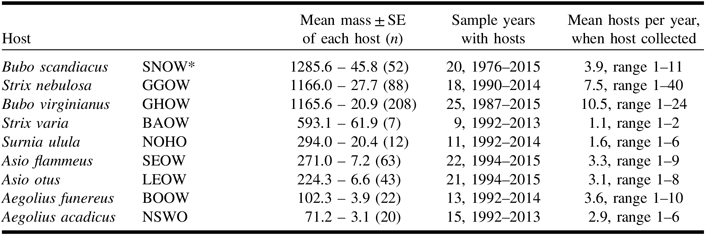
Characteristics of nine host owl species examined for lice are presented in Table 1. Each species was collected in a total of 9–25 years with a typical annual sample size of two or three but up to 40 specimens per year (Table 1). Two other owls (barn owl, Tyto alba (Scopoli); Aves: Tytonidae – two specimens; and eastern screech owl, Megascops asio (Linnaeus); Aves: Strigidae – 59 specimens) were also examined, but these data were excluded from analyses because no lice were found on these hosts. Each owl species varied in average size from 71 to 1286 g (Table 1).
Owls (arranged in the order of host body mass) collected in southern Manitoba, Canada, and parameters for the collections.

* Acronyms for common names according to the Institute for Bird Populations (2014).
BAOW, barred owl; BOOW, boreal owl; GGOW, great gray owl; GHOW, great horned owl; LEOW, long-eared owl; NOHO, northern hawk owl; NSWO, northern saw-whet owl; SEOW, short-eared owl; SNOW, snowy owl.
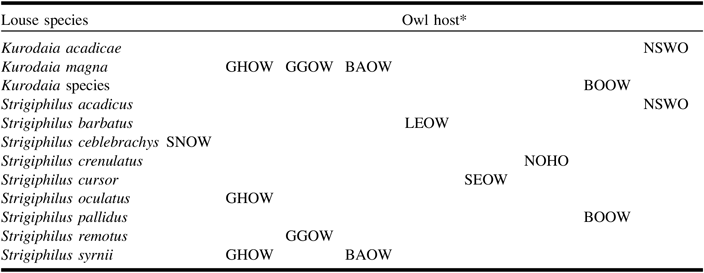
A total of 113 810 lice was collected in this study. The distribution of the 12 species of lice among host species is shown in Table 2. Each species of infested owl hosted a different species from the genus Strigiphilus (monoxenous), and when there was a second louse species present, it was from the genus Kurodaia. Three species of owls were infested by Kurodaia magna Emerson (Table 2). Strigiphilus oculatus (Rudow) was the predominant species of this genus infesting great horned owls (Bubo virginianus (Gmelin); Aves: Strigidae), but five great horned owls (2%) were infested with Strigiphilus syrnii (Packard). All species of lice infesting owls appear to be feather-feeders. Blood was never observed in the guts of any of the species.
Chewing lice (Phthiraptera: Menoponidae, Philopteridae) infesting owls, and their hosts in southern Manitoba, Canada.

* See Table 1 for acronyms for common names of owls.
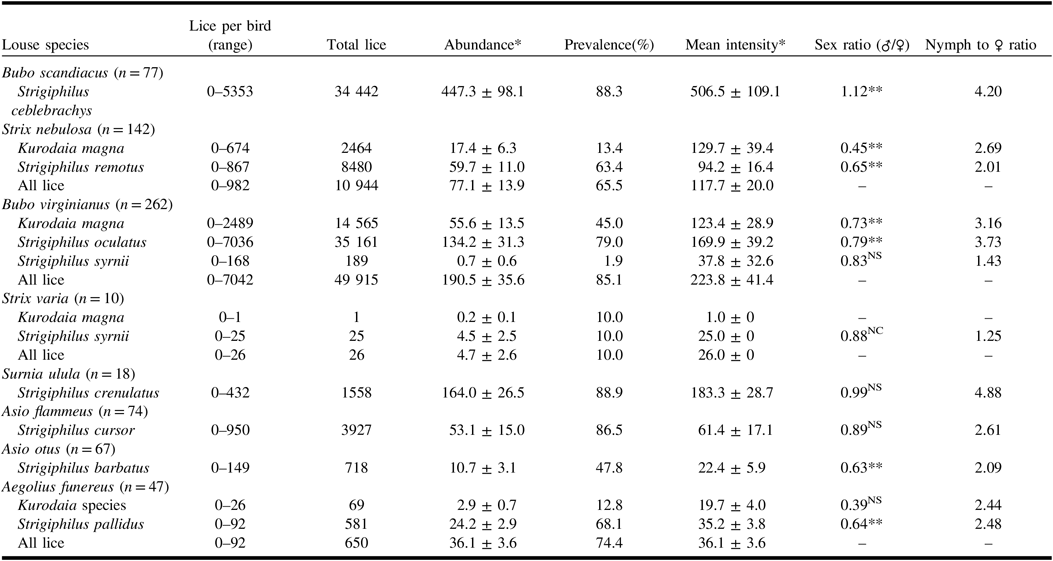
Infestation parameters for the lice are presented in Table 3. Barred owl (Strix varia Barton; Aves: Strigidae) had the lowest prevalence of lice, at 10%, although the small number of specimens (n = 10) made estimates of louse infestation parameters uncertain for this host. The remaining hosts had total prevalence of infestation of at least 48%. When more than one species was present on a host, the species of Strigiphilus always had a higher prevalence than the species of Kurodaia (Table 3). Mean intensity varied from about 10 for Kurodaia acadicae Price and Beer infesting northern saw-whet owl (Aegolius acadicus (Gmelin); Aves: Strigidae) to about 507 for Strigiphilus ceblebrachys (Denny) on snowy owl (Bubo scandiacus (Linnaeus); Aves: Strigidae). Prevalence and mean intensity were not related for louse–host species combinations (Pearson product moment correlation, r = 0.457, P = 0.14, n = 12), or for the overall abundance of lice on the hosts (Pearson product moment correlation, r = 0.568, P = 0.14, n = 8). The overall abundance of lice ranged from a mean of five per bird on barred owl, to 447 per bird on the largest host, snowy owl (Table 3).
Infestation parameters for lice on nine species of owls (arranged in the order of host body mass, Table 1), from 1976 to 2015 in southern Manitoba, Canada.

* Mean ± standard error.
** Sex ratio significantly different from 0.50, P < 0.05, χ 2, df = 1.
NC, numbers of lice too few, not calculated; NS, sex ratio not significantly different from 0.50, P ≥ 0.05.
The sex ratio (total males to total females) of a louse species on a given host was usually < 1, as low as 0.39 for Kurodaia on boreal owls (Aegolius funereus (Linnaeus); Aves: Strigidae) but as high as 1.1 for S. ceblebrachys on snowy owls (Table 3). Nymphs usually outnumbered females, with ratios of 1.6–4.2 (Table 3). The one exception was a ratio of 0.68 for K. acadicae on northern saw-whet owls, the least abundant louse species. Both sex and nymph-to-female ratios increased with louse abundance (Pearson product moment correlations, r = 0.806, P = 0.001, n = 12 and r = 0.685, P = 0.014, n = 12, respectively).
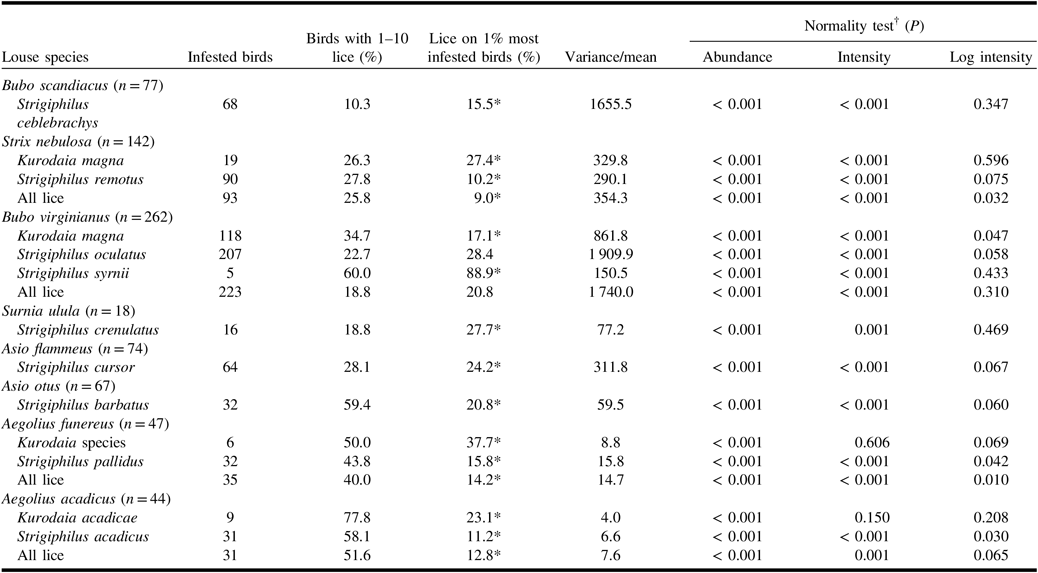
The distribution of lice on individual birds was highly aggregated, with variance to mean ratios usually > 4, and often over 100 (Table 4). On average, about 38% of all lice were on birds with 1–10 lice per bird (Table 4). Some individual specimens of snowy and great horned owls had over 5000 lice of a particular species, and the most heavily infested specimens accounted for about 22%, on average, of the lice on owls (Table 4). Abundance was not normally distributed for any host or louse species, and the intensity of infestation was not normally distributed in 15 of 17 cases (Table 4). When intensity was log-transformed, the distribution approached normal for some species, but the distributions were often too skewed to be considered normal even after transformation (Table 4).

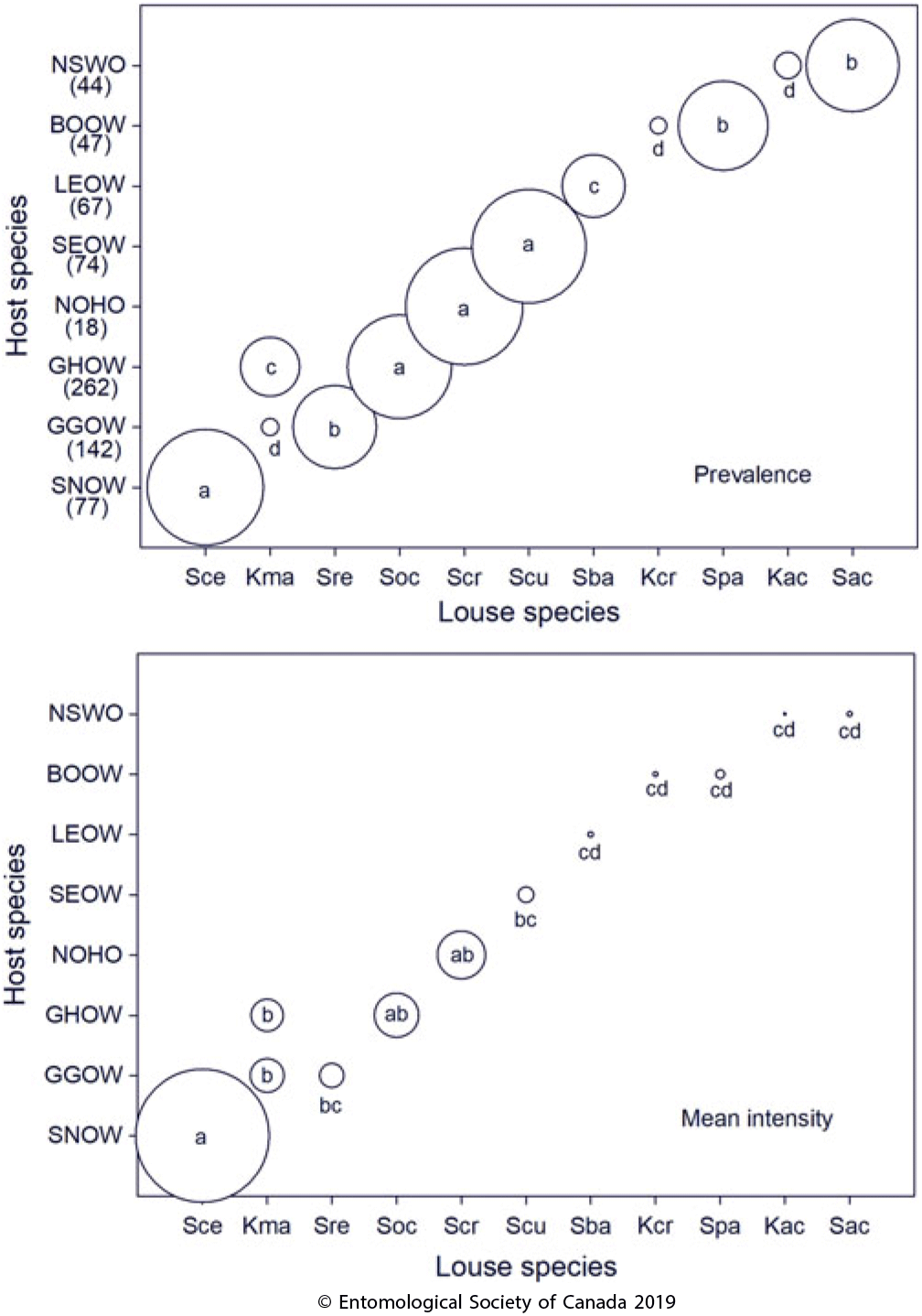
The numbers of lice of the 12 species that infested owls varied both among the species that infested the same host and among the species that infested different hosts (Fig. 1). Kurodaia magna had relatively low prevalence on great grey owl (Strix nebulosa Förster; Aves: Strigidae) but intermediate prevalence on great horned owl (Fig. 1). The mean intensity of S. ceblebrachys on snowy owl was more than twice that of any other louse species, and lice had a higher mean intensity on great grey, great horned, and northern hawk owls (Surnia ulula (Linnaeus); Aves: Strigidae) than other owl species (Fig. 1).
Comparison of prevalence and mean intensity for 12 species of lice infesting eight owl species (see Table 1 for definitions of acronyms of owl names). The diameter of each circle represents the value of prevalence or intensity (Table 3); circles with the same letter do not differ significantly among louse species (prevalence: χ2 tests of independence; mean intensity: analysis of variance of log intensity). The numbers of owls assessed for each host species are shown on the y-axis for prevalence.

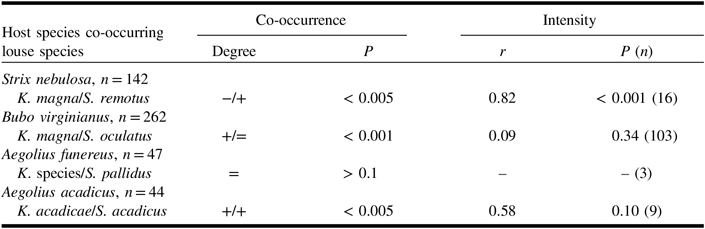
For the four species of owls that hosted more than one species of louse, these louse species often occurred on the same host specimen (Table 5). In other words, for four of eight species of lice, if a specimen had one louse species, it was more likely to have the other louse species that occurs on that host (Table 5). This statement was not true for K. magna on great grey owls, which was less likely to occur when Strigiphilus remotus (Kellogg and Chapman) was present than expected by chance. On the other hand, S. remotus was more likely to occur on great grey owls when K. magna was present than when it was not. For three hosts where the sample of birds was sufficient, and where two species of lice co-occupied the same bird, the intensity of one species was positively correlated with that of the other, and in the case of great grey owls significantly so (Table 5).
Association between louse (Strigiphilus and Kurodaia) species infesting the same host for four species of owls collected from 1976 to 2015 in southern Manitoba, Canada.

Note: A χ2 test of independence was used to assess whether two species of lice occurred on the same host specimen more frequently than by chance: P < 0.05 indicates significance. Pearson’s correlation coefficient (r) was used to assess whether the intensities of lice species on the same host were related.
Louse populations showed no clear pattern of seasonal variation, although the monthly samples of species of lice and owls were too small to assess for most hosts. On the most commonly collected host, great horned owl, K. magna and S. oculatus had their lowest abundance in June and May–June, respectively, around the end of the nesting period. Nevertheless, neither louse species differed in abundance, prevalence, mean intensity, sex ratio, or nymph-to-female ratio between the six cold months (October–March) and the six warm months (April–September) (t < 0.01–1.35, P < 0.21, df = 10). Both louse species had high nymph-to-female ratios in winter and warm months. Relatively few great grey owls (132) were examined, and only one to six per month from May through November. No consistent seasonal pattern of abundance was detected for K. magna or S. remotus, although abundance for the latter species was the highest from November through April. High nymph-to-female ratios were observed in both winter and warmer months. Most of the 75 monthly records for snowy owls were for October–December, leaving too few in the other months for assessing seasonal patterns. However, high nymph-to-female ratios (> 5.0) were observed from October to February.
Discussion
This study is the most extensive quantitative survey of lice infesting owls. A total of 802 owls of eleven species from 220 locations, mostly from Manitoba, were examined for lice in this 25-year survey. We include 11 of the 12 species of owls that typically occur in Manitoba. There are certainly biases in the distribution of locations for owls that were included in the survey. Slightly more than one-quarter (28.7%) of all owls came from Winnipeg, while about one-tenth (10.4%) were from unspecified locations in Manitoba.
Most of the owls were salvaged from wildlife hospitals and from district offices of the provincial Wildlife Branch. Because of the charismatic appeal of owls for the general public, injured birds are prime candidates to be reported and surrendered for rehabilitation. Consequently, some of the more abundant and spectacular species of owls, such as great horned owl (n = 262), great grey owl (n = 142; the Manitoba provincial bird), and snowy owl (n = 77), were well represented in our study. Owls compose an excellent guild of related predatory birds among which to make comparisons of louse infestations. Four species of owls are large (snowy owl, great horned owl, great grey owl, and barred owl); there are five medium-sized owls (northern hawk owl, long-eared owl, short-eared owl, barn owl (only two sampled in this study), and burrowing owl (none examined in our study)), and three small owls (eastern screech owl, northern saw-whet owl, and boreal owl). Five species of owls in Manitoba are permanent residents (great horned owl, great grey owl, barred owl, eastern screech owl, and boreal owl), while six species are seasonally migratory (snowy owl (nests in the far-north but migrates into southern Manitoba under certain conditions), long-eared owl, short-eared owl, burrowing owl, northern hawk owl, and northern saw-whet owl). Given this ecological variability, the relative abundance of most species, and comparable diversity in many parts of the world, it is surprising that this appears to be the first detailed analysis of their louse communities, especially given the attention directed to the taxonomy and identification of these lice.
The genus Strigiphilus is specific to owls (Clayton Reference Clayton1990), and was the most abundant genus of louse collected on owls in our study. With the exception of lice on barn owl, for which only two specimens were examined, all but one species of this genus that are expected to occur (Price et al. Reference Price, Hellenthal, Palma, Price, Hellenthal, Palma, Johnson and Clayton2003) on the hosts examined here were collected. Strigiphilus otus Emerson infests eastern screech owl in North America, but none were collected in this study. Two species of Kurodaia are also reported to infest eastern screech owl (Price et al. Reference Price, Hellenthal, Palma, Price, Hellenthal, Palma, Johnson and Clayton2003), but neither of these was found. Eastern screech owl is at the northern limit of its range, which has expanded further into Manitoba in recent decades (Artuso Reference Artuso2009); it is possible that environmental factors precluded survival of any of these lice on their host. More detailed collections from eastern screech owl throughout its range are needed to address this biogeographical question. All other monoxenous and pleioxenous species of Strigiphilus and Kurodaia that have been reported to infest these owls (Table 2) were collected in this study. We did find a species of Kurodaia infesting boreal owls. Kurodaia cryptostigmatia (Nitzsch) is found on A. funereus (Price et al. Reference Price, Hellenthal, Palma, Price, Hellenthal, Palma, Johnson and Clayton2003), but is a Palaearctic species (Price and Beer Reference Price and Beer1963b; Rékási Reference Rékási1978) and differs from specimens collected from this host in Manitoba. For the purposes of this paper, we have chosen the more conservative approach and refer to it simply as Kurodaia species. Colpocephalum brachysomum Kellogg and Chapman infests three species of owls, including two species (great horned owl and short-eared owl) (Price et al. Reference Price, Hellenthal, Palma, Price, Hellenthal, Palma, Johnson and Clayton2003) examined in this study. Although recorded from great horned owl in Manitoba (Galloway et al. Reference Galloway, Proctor, Mironov, Cárcamo and Giberson2014), this species was not encountered on the 262 great horned owls or 74 short-eared owls examined in the present study. Colpocephalum brachysomum appears to be rare; further collections throughout the range of its host owls are needed to gain insights to its interrelationships.
With the exception of eastern screech owl and barn owl, the nine owls in this study were each infested by 1–3 species of lice. There was no obvious pattern to the diversity of species of lice infesting each species of owl on the basis of host size or migration habits, though, in the four species of owls infested by only one species of louse, each belonged to the genus Strigiphilus (Table 4). For the only species of owl infested by three species of lice, great horned owl, two species of lice (S. oculatus and K. magna) predominated (Table 4).
Quantitative data for lice infesting owls are rarely presented and in no case are comparable with data from the present study because either numbers of owls examined were relatively small and/or collection techniques differed. For example, Kutzer et al. (Reference Kutzer, Frey and Nöbauer1982) examined 10 species of owls in Austria. Four species of lice were found to infest three species of owls, but prevalence was generally low. One of 44 tawny owls (Strix aluco Linnaeus; Aves: Strigidae) was infested by three species of lice, and approximately one-third of 14 little owls (Athene noctua (Scopoli); Aves: Strigidae) were infested by Strigiphilus cursitans (Nitzsch). Adam and Daróczi (Reference Adam and Daróczi2006) examined one adult in each of three species of owls in Romania. Although all three owls were infested each with one species of Strigiphilus, the intensities of infestation were low: Strigiphilus cursitans on A. noctua, 1; Strigiphilus laticephalus (Uchida), 15; and S. barbatus on A. otus, 35. The small numbers of nymphs in their study are perhaps an indication that actual numbers of lice were underestimated. Catlin (Reference Catlin1971) examined boreal owls and northern saw-whet owls during two banding seasons in southern Ontario, Canada. By visually inspecting these owls, two of five of the former were infested with what was presumed to be S. pallidus. About half of approximately 100 saw-whet owls were infested with a Strigiphilus species that was undescribed at the time, but in all likelihood was S. acadicus. Although no quantitative data were provided on the numbers or population structure of lice on these two hosts, general information on spatial distribution was described. Dik (Reference Dik2010) examined one long-eared owl in Turkey and collected six males, 14 females, and eight nymphs. Pfaffenberger and Rosero (Reference Pfaffenberger and Rosero1984) visually inspected two great horned owls and three barn owls infested with lice in eastern New Mexico, United States of America. The great horned owls were infested with a mean of 27.5 S. oculatus, while the barn owls were infested by a mean abundance of 3.3 Strigiphilus aitkeni Clay and Kurodaia subpachygaster (Piaget). Gonzalez-Acuna et al. (Reference González-Acuña, Muñoz, Cicchino and Figueroa2006) examined 96 owls of six species in Chile. Although prevalence data were not reported, mean abundance could be calculated to range from 0.3 to 11.0 per bird, depending on the species of host. Abundance and numbers of nymphs (0–10) collected were relatively low.
In one of the largest studies on owls to date, Hunter et al. (Reference Hunter, Gutiérrez, Franklin and Olson1994) examined approximately 1000 spotted owls (Strix occidentalis Xantus de Vesey; Aves: Strigidae) in their demographic studies in the western United States of America from which they collected lice encountered during their banding efforts. They also examined 54 museum skins of three subspecies of lice. They collected only S. syrnii in this study. Because of collection methods used for live birds, no quantitative analyses were attempted, but 14.8% of museum skins harboured this louse.
Strigiphilus syrnii is a pleioxenous species known to infest five species of owls (Clayton Reference Clayton1990), three of which – great horned owl, barred owl, and great grey owl – were examined in our study. In Manitoba, only the former two species were infested by S. syrnii. Taft and Jacobs (Reference Taft and Jacobs2000) examined 644 mist-netted northern saw-whet owls for ectoparasites during spring and fall migration in Wisconsin, United States of America. They observed small numbers of S. acadicus and K. acadicae (n = 23) at low prevalence (< 2%), but found these lice very difficult to detect on live hosts.
Prevalence and intensity of infestation with lice were high in all species of owls surveyed in this study (Table 3), except for S. varia where only one of 10 individual hosts had lice. The distributions of louse infestations were also highly aggregated (Table 4). These characteristics are important in terms of the probability of successful horizontal transmission of lice among these species of territorial nesters. Owls are generally asocial, so horizontal transmission from one bird to another, other than at the times of courtship, mating, and nesting, are probably limited. The role of Hippoboscidae (Diptera) has often been stressed as a means of phoretic dispersal in lice as an integral mechanism to locate patchily distributed hosts (Harbison et al. Reference Harbison, Bush, Malenke and Clayton2008; DiBlasi et al. Reference DiBlasi, Johnson, Stringham, Hansen, Beach, Clayton and Bush2017). Phoretic relationships between owl lice and hippoboscids are seldom recorded (see review by Keirans Reference Keirans1975). Hippoboscids (predominately Icosta americana (Leach)) were collected on four species of owls in our study (great grey owl, great horned owl, long-eared owl, and short-eared owl), most often on great horned owls (85 adult flies infesting 50 of 262 birds) (T.D.G., unpublished). None of the 96 hippoboscids collected on owls carried lice.
Therefore, it appears that a high prevalence and intensity of louse infestation should favour vertical transmission for the species of lice infesting owls in Manitoba. Why these high infestation parameters are the case is a matter of speculation. Owls were obtained from rehabilitation hospitals, and it is possible that there was a greater proportion of starving and debilitated birds less able to preen effectively. However, birds of prey obtained from these hospitals often have suffered traumatic injury, as a result of collisions with vehicles, fences, and wires, and there is no reason to suspect a disproportionate number of less-fit birds in this category. The feather covering in owls is complex and dense, perhaps allowing lice an advantage to escape grooming activities of the host. Strigiphilus conform to the general body structure of head lice (Johnson and Clayton Reference Johnson, Clayton, Price, Hellenthal, Palma, Johnson and Clayton2003) and are most often seen in the head and neck regions (T.D.G., personal observation) where grooming is perhaps more difficult for the host. Species of Strigiphilus certainly had higher infestation parameters compared with amblyceran genera, which are generally considered body lice. A detailed study on the distribution patterns of different species of lice is required to verify this hypothesis.
One exception to the rule of high prevalence and intensity of infestation is the occurrence of S. syrnii on great horned owl. Its prevalence and mean intensity were low, especially for a large owl, 1.9% and 37.8%, respectively (Table 3). This pleioxenous louse infests five species of owls in the New World (Clayton and Price Reference Clayton and Price1984; Clayton Reference Clayton1990). Clayton (Reference Clayton1990) suggested that S. syrnii may originally have been a parasite of Strix Linnaeus owls, and subsequently switched to sympatric populations of great horned owl, which is widely distributed throughout North America and South America. Great horned owls commonly predate other owl species, presenting the opportunity for S. syrnii to switch hosts, though no other species of Strigiphilus seem to have made the jump. More extensive collections, detailed molecular analyses, and construction of phylogenies (Clayton Reference Clayton1990) are needed to test this hypothesis.
There are often clear patterns in abundance of chewing lice on birds throughout the season. Seasonal declines in abundance may be associated with moult cycles (e.g., Woodman and Dicke Reference Woodman and Dicke1954; Ash Reference Ash1960) or host reproduction (e.g., Baum Reference Baum1968). However, peaks and lows in abundance may be associated with other times of the year, as Galloway and Lamb (Reference Galloway and Lamb2015b) found for lice infesting pigeons in Manitoba. It is interesting that we detected no clear patterns in seasonal abundance of lice infesting owls, though, by the presence of nymphs of all species of lice at all times of the year when owls were examined, we conclude that reproduction is continuous. Infestations can be quite high, especially among the larger species of owls, such as snowy owl, great horned owl, and great grey owl, where mean intensities of infestation exceeded 100 (Table 3). Some birds were infested with thousands of lice – the most heavily infested being a great horned owl from Domain, Manitoba, in August 2011, which was infested with 7042 lice. It is possible that our opportunistic sampling methods associated with wildlife rehabilitation hospitals obscured seasonal patterns in louse infestations, by virtue of the presence of some species in only certain times of the year. For example, snowy owls were available only in colder months, and migratory species such as long-eared and short-eared owls were available only during breeding and migration seasons. However, great horned owls were sampled in all months of the year, and yet no clear pattern of abundance in infestation was evident. A more systematic approach to sampling owls may be necessary to determine whether or not patterns in seasonal dynamics occur.
Although Clayton et al. (Reference Clayton, Gregory and Price1992) reported on populations of Ischnocera on Neotropical birds where the sex ratios for some species were male-biased, females overwhelmingly outnumbered males in most studies on lice (Marshall Reference Marshall1981). Among the 11 species of lice collected from owls in the present study, males outnumbered females only for S. ceblebrachys infesting snowy owls. Where the same procedure was used to collect lice from other species of birds in Manitoba, males did not outnumber females for Mulcticola macrocephalus (Kellogg) (Galloway and Lamb Reference Galloway and Lamb2015a) infesting common nighthawk (Chordeiles minor (Förster); Aves: Caprimulgidae) or for any of the one amblyceran and six ischnoceran species of lice collected from woodpeckers (Aves: Picidae) (Galloway and Lamb Reference Galloway and Lamb2016). Galloway and Lamb (Reference Galloway and Lamb2014) found that males outnumbered females in one species of ischnoceran louse (Campanulotes compar (Burmeister); Phthiraptera: Philopteridae) out of four species infesting pigeons (Columba livia Gmelin; Aves: Columbidae)). Because there is no reason to suspect unequal sex ratios at the time of hatching for most species, it has been suggested that longevity in males is shorter than for females or mortality rates for males are higher (Marshall Reference Marshall1981). Why S. ceblebrachys is the only one of nine species of Strigiphilus on owls in Manitoba in which the sex ratio is male-biased is a matter of speculation. Its host, snowy owl, is the largest owl in our study, but size alone is unlikely to account for the observed bias because great horned and barred owls are much larger than other species of owls in the survey, yet male Strigiphilus did not outnumber females on their hosts. However, snowy owl is the only species of owl for which birds examined were all from outside the breeding range. Snowy owls typically breed in the Arctic tundra zone in Canada, and there are occasional irruptive migrations south during winter, especially when prey becomes scarce, though a combination of factors may be involved (Holt et al. Reference Holt, Larson, Smith, Evans, Parmelee and Rodewald2015). The majority of the owls that migrate are juveniles, though adults also migrate south (Holt et al. Reference Holt, Larson, Smith, Evans, Parmelee and Rodewald2015). Snowy owls in our study were not aged, but it can be inferred that most were juveniles. Perhaps the skewed host age structure may have affected the sex ratio of S. ceblebrachys. It is more likely that birds were stressed by long-distance travel from their breeding grounds, and louse infrapopulations were increasing (note the high nymph-to-female ratio for snowy owls, Table 3), thereby increasing the likelihood of greater numbers of males. Before we can conclude that a male bias in the sex ratio for S. ceblebrachys is a species characteristic, a more comprehensive and geographically widespread study should be undertaken where snowy owls from the breeding range are included and compared with dispersers.
Certain morphological and behavioural characteristics in chewing lice may be a reflection of the region of the host body occupied (Johnson and Clayton Reference Johnson, Clayton, Price, Hellenthal, Palma, Johnson and Clayton2003). The enlarged, somewhat trapezoidal shape of the head and rounded body in Strigiphilus is indicative of species that occur principally on the head and neck of their host. The amblycerans infesting owls, Kurodaia for example, are principally body lice. The resulting host partitioning may be a mechanism for species in these genera to avoid competition when more than one species co-occurs on a host. Evidence of competitive exclusion was demonstrated by Bush and Malenke (Reference Bush and Malenke2008) when typically segregated populations of lice on pigeons were present in large numbers. We saw no evidence of competition, however, when species of Strigiphilus and Kurodaia infested the same host. In fact, it was more likely than by chance that when one species was present, the other also occurred. A similar relationship was reported for lice infesting tinamous (Aves: Tinamidae) (Ward Reference Ward1957) and woodpeckers (Galloway and Lamb Reference Galloway and Lamb2016). In the absence of empirical data from controlled experiments, it is unclear why this relationship should occur. Perhaps co-occurrence is a reflection of grooming efficiency of the host. Grooming activity has a significant impact on infrapopulations of lice, as affected by host morphology and intensity of grooming behaviour (Clayton et al. Reference Clayton, Koop, Harbison, Moyer and Bush2010). Birds less able to reduce or eliminate populations of lice by their grooming activities may be more likely to retain co-infestations of prevalent species of lice (Galloway and Lamb Reference Galloway and Lamb2016).
Owls are a monophyletic group (Mahmood et al. Reference Mahmood, McLenachan, Gibb and Penny2014) infested by a diversity of species of chewing lice (Price et al. Reference Price, Hellenthal, Palma, Price, Hellenthal, Palma, Johnson and Clayton2003), offering a wide range of opportunities for comparative studies. As pointed out by Clayton and Walther (Reference Clayton and Walther2001), this approach in examining parasite community ecology is restricted by inconsistencies in methodology among studies that make valid comparisons tenuous. In our examination of lice infesting owls in Manitoba, spanning nearly 25 years, we have presented a summary of infestation parameters and host–parasite relationships for owls and their chewing lice in Manitoba, using the same collecting method throughout. This work should provide a baseline for future research in Manitoba and elsewhere in helping to understand factors that regulate louse populations and have ramifications for host behaviour and fitness. Such studies may help reflect upon future considerations for host and parasite conservation.
Acknowledgements
This research could not have been completed without the assistance of many technical staff and students in the Department of Entomology to wash birds, in particular, Dave Holder, Chérie Dugal, and Lisa Babey. We thank the staff at the Wildlife Haven and Prairie Wildlife Rehabilitation Centre for the care with which they assessed and processed the owls available for our research. Jim Duncan and Ken DeSmet (Manitoba Sustainable Development) provided owls and advice from their offices in Saulteaux Crescent, Winnipeg; discussions with Spencer Sealy (Department of Biological Sciences, University of Manitoba) are greatly appreciated; permits to possess and process salvaged owls for the presence of lice were provided by Manitoba Sustainable Development (previously Manitoba Conservation). This research was funded in part by grants from the National Sciences and Engineering Research Council of Canada and the Sustainable Development Innovations Fund (Manitoba Conservation). We especially thank the Department of Entomology and the Faculty of Agricultural and Food Sciences, University of Manitoba, for their continued support.