Sudden cardiac death is defined as the unexpectedly occurred death without a trauma in a person who previously seemed healthy.Reference Link and Estes 1 Sudden death of an athlete during sport facilities is really a tragedy. In addition to being a painful condition to the family, when the media potentials are taken into account at the present, this situation is a source of anxiety for young athletes wishing to participate or who have already participated in sports.
It is thought that, rising stress, autonomic nervous system changes such as increased sympathetic stimulus, haemodynamic alterations, acute myocardial ischaemia, and electrical instability during sportive facilities could raise the incidence of sudden cardiac death. The risk of sudden cardiac death varies according to the type and intensity of sport, competition during sport, and also the age, gender, race, and genetic background of athletes.Reference Link and Estes 1
In spite of being a matter of common knowledge that exercise and sport increase the quality of life, the risk of sudden death in young athletes is between 1 and 3 per 100,000. The circumstances such as hypertrophic cardiomyopathy, coronary artery anomalies, myocarditis, arrhythmogenic right ventricular dysplasia, ion channel defects, and aortic stenosis contribute to aetiopathogenesis.Reference Koester 2 Recently, sudden cardiac deaths seen during sportive facilities have moved the physicians all over the world to think about the policies having priority in that subject, as in our country.
The best screening method with the minimum cost has been discussed rather than the need for a screening at the past. According to recommendations of American Heart Association, personal and family history together with physical examination are considered for screening, whereas European Society of Cardiology recommends the addition of electrocardiography to screening.Reference Maron 3 , 4 In studies related to sudden cardiac death in young athletes, it has been shown that the incidence of sudden cardiac death could be decreased by screening programmes.
We are encountered to clinic applications to get a certificate to conform with sports in our daily practice. Because of the absence of a standard approach method to these applications in our country, every clinic tries to serve by doing numerous tests by their own practice and experience. In this study, it was aimed to assess the utility and feasibility of a comprehensive cardiac screening protocol in young athletes before participation in sports.
Materials and method
A total of 380 young athletes – 57 female and 323 male – referring to the paediatric cardiology clinic before participation in sports, between April, 2014 and April, 2015, were included in this study.
A standard and comprehensive screening protocol has been applied to all athletes, including personal and family history, physical examination, 12-lead electrocardiography (Cardiofaxm ECG-1350; Nihon Kohden Corp., Tokyo, Japan), transthoracic echocardiography (iE33 Ultrasound System; Philips, The Netherlands), 24-hour rhythm Holter analysis (CardioScan 11.0; DM Software Inc., Nevada County, California, United States of America), and treadmill exercise test (Series 770 Treadmills; Mortara Instrument Inc., Milwaukee, Wisconsin, United States of America).
The findings obtained by the screening protocol have been classified as “negative” or “positive”, “normal” or “abnormal”, and “insignificant” or “significant” according to previously published international recommendationsReference Corrado, Pelliccia and Heidbuchl 5 , Reference Drezner, Sharma and Baggish 6 that were highlighted in a recently published guideline by The Association for European Paediatric Cardiology Working Group on Cardiovascular Prevention.Reference Fritsch, Dalla Pozza and Ehringer-Schetitska 7 Personal history is considered positive in case of chest pain, dyspnoea, dizziness, fainting, or palpitations during exercise. Family history is considered positive when there is a history of sudden death or a disabling heart disease, such as cardiomyopathy, coronary artery disease, or arrhythmia. Physical examination is considered positive in patients with a pathological heart murmur (diastolic or >2/6 grade systolic), single or widely split second or fixed heart sound, diminished femoral pulse, irregular rhythm, or hypertension. Electrocardiographic and rhythm Holter findings were also classified according to these previously published international recommendations. Echocardiographic findings were considered significant if a haemodynamically important lesion was detected. The result was considered positive in case of T-wave inversion, pathological ST segment depression, or elevation during exercise test.Reference Corrado, Pelliccia and Heidbuchl 5 – Reference Fritsch, Dalla Pozza and Ehringer-Schetitska 7
This study was approved by the Institutional Ethics Committee (ref no: 2014-006), and informed consent was obtained from parents of all individuals included in the study.
The data obtained during screening of these athletes were evaluated by using Binary Logistic Regression analysis, and all variables were put on correlation analysis by using Pearson’s test.
Results
The mean age of patients was 12.4±2.3 (6–18) years. The patients were dealing with football (38.2%), defense sports (37.9%), basketball (7.9%), volleyball (6.1%), and others (9.9%).
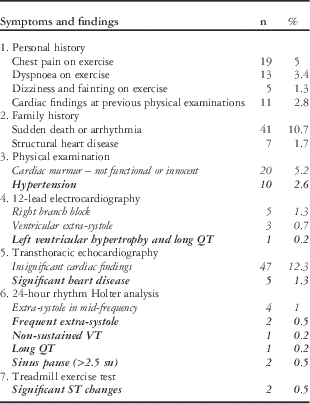
The most frequent complaints were chest pain in 19 (5%), dyspnoea in 13 (3.4%), and dizziness and fainting in five patients (1.3%) on exercise. There was sudden death and arrhythmia in 41 patients (10.7%) owing to family history. A heart murmur was present in 20 (5.2%) and hypertension in 10 patients (2.6%) on physical examination (Table 1).
The results of screeningFootnote *

* 199 symptoms or findings demonstrated in the table have been identified in 380 patients, whereas 94 symptoms or findings marked in italics have been identified as potentially serious conditions in 70 patients, and 20 patients were prohibited from sport activities because of 25 symptoms or findings marked with italic–bold .
The 12-lead electrocardiography was abnormal – right branch block, ventricular hypertrophy, long QT, and ventricular extra-systole – in nine patients (2.4%). Transthoracic echocardiography was normal in 328 (86.3%) and the findings were insignificant – rheumatic or structural valve disease, valve insufficiency, septal defect, and valve stenosis – in 47 patients (12.3%). In five patients (1.3%), a haemodynamically important structural heart disease – septal defect, ventricular hypertrophy – was detected by transthoracic echocardiography. The 24-hour rhythm Holter analysis was abnormal – non-sustained ventricular tachycardia, long QT, sinus pause >2.5 sn, and frequent extra-systole – in six patients (1.5%). There were significant ST changes in two patients (0.5%) on treadmill exercise test with normal findings on myocardial perfusion scans (Table 1).
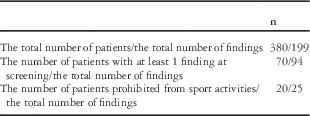
The screening in this study identified 94 potentially serious conditions in 70 patients and 25 serious conditions in 20 patients. Therefore, there are groups intersecting in Table 1 and the statistics were made according to the number of subjects and not according to the number of findings, because of the need of individualisation at the final decision.
Adding 12-lead electrocardiography, transthoracic echocardiography, 24-hour rhythm Holter analysis, and treadmill exercise test to medical history, family history, and physical examination identified 94 potentially serious conditions in 70 patients (18.4%), and 20 patients (5.2%) were prohibited from sport activities because of 25 serious conditions including hypertension, long QT, non-sustained VT, sinus pause >2.5 sn, significant heart disease, and positive treadmill exercise test (Table 2).
The distribution of patients and findings at screening

The patients had a high proportion of symptoms; however, the conditions identified by 12-lead electrocardiography, transthoracic echocardiography, 24-hour rhythm Holter analysis, or treadmill exercise test showed no significant relationship with the symptoms of patients: p=0.128 for 12-lead electrocardiography, p=0.136 for transthoracic echocardiography, p=0.462 for 24-hour rhythm Holter analysis, and p=0.549 for treadmill exercise test.
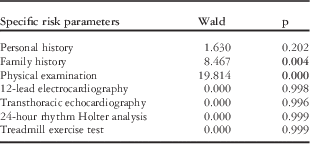
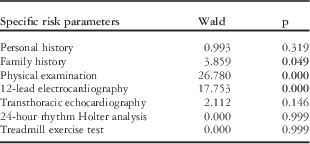
When binary logistic regression analysis was applied to 70 patients with potentially serious conditions, a significant relationship was determined for family history (p<0.01) and physical examination (p<0.001) (Table 3). However, when this test was applied to 20 patients prohibited from sport activities, it was observed that the significance was achieved for family history (p<0.05), physical examination (p<0.001), and 12-lead electrocardiography (p<0.001) (Table 4).
The binary logistic regression test results of 70 young athletes

Bold values indicate significance level p<0.05.
The binary logistic regression test results of 20 young athletes

Bold values indicate significance level p<0.05.
Because of the significance determined for 12-lead electrocardiography in 20 patients who were a subset of 70 patients, we studied the relationship between family history, physical examination, and 12-lead electrocardiography to decide whether 12-lead electrocardiography could be referred as an additional screening to family history or should be used as a necessary screening tool initially. No significant relationship was determined between family history and physical examination (p=0.904) or 12-lead electrocardiography (p=0.891). As a result, it seems to be better to use 12-lead electrocardiography initially rather than using it as an additional screening to family history.
Because of male predominance in the study group, we also studied the relationship between gender and the findings of 20 patients prohibited from sport activities. There was no significant relationship between gender and the final result of screening (p=0.199).
Discussion
Pre-participation screening methods are currently in use with various application types even though there is no consensus on a standard protocol. Nowadays, many physicians are encountered to clinic applications of persons to get certificate to conform with sports in our country. There is also no standard method established by scientific laws of polity and accepted by health community in our country. Therefore, every clinic tries to serve by doing numerous tests by their own practice and experience.
Performing screening before participation in sports may help us diagnose patients with cardiovascular anomalies and may prevent the risk of sudden cardiac death by prohibiting them from competitive sports.Reference Maron and Zipes 8 According to the guideline of American Heart Association, it is convenient to participate in sports after a precise evaluation of athletes including personal history, family history, and physical examination to reveal any cardiovascular disease that may be a reason for sudden death. 4 , Reference Maron, Thompson and Ackerman 9 In this study, family history and findings at physical examination were shown as significant determinants in defining the group of athletes who are risky in terms of sudden death. However, the screening only with history taking and physical examination has a very low sensitivity, because the first sign is mostly sudden cardiac death in most of the athletes without any previous symptom.
It is thought by European Society of Cardiology and in Italy that adding electrocardiography would increase the sensitivity of screening protocols, in regard that they are performing screening to participate to sports for long time.Reference Maron 3 , Reference Corrado, Basso and Pavei 10 – Reference Pelliccia and Maron 12 The basis of this is the demonstration of increase in sensitivity and specificity by adding electrocardiography to the screening programme in well-designed and large-scale studies. Besides, these studies showed that just 25% of cases could be determined when they were evaluated with American Heart Association screening criteria.Reference Magalski, McCoy and Zabel 13 , Reference Baggish, Hutter and Wang 14
In this study, adding 12-lead electrocardiography, transthoracic echocardiography, 24-hour rhythm Holter analysis, and treadmill exercise test to personal history, family history, and physical examination identified a potentially serious condition in 70 patients (18.4%), and 20 patients (5.2%) were prohibited from sport activities. The significant relationship was reached for family history and physical examination when 70 patients were accepted as having a potentially serious condition. This significant relationship was also achieved for 12-lead electrocardiography findings when 20 patients were prohibited from sport activities.
Cardiac evaluation before participation in competitive sports should start with detailed history taking and physical examination when literature data and results of this study are encountered. Addition of electrocardiography to screening will increase the sensitivity. However, in some studies using screening programmes including electrocardiography, false positivity was stated between 2 and 20%.Reference Baggish, Hutter and Wang 14 , Reference Marek, Bufalino and Davis 15 Anderson et al suggest performing transthoracic echocardiography to decrease false positivity ratio in patients with suspicion of cardiovascular disease according to electrocardiography findings.Reference Anderson, Grenier and Edwards 16 Exercise tests should be proposed only to athletes either with complaints during exercise or after the age of 35 years. In case of continuing suspicion for serious cardiovascular disease, it could be required to perform coronary angiography or electrophysiologic study.Reference Glover, Glover and Maron 17 Here, we should state that myocardial perfusion studies should not be done unnecessarily in children because of high quantity of radiation.
It was demonstrated that, in 80% of athletes with sudden cardiac death, the first cardiac sign is sudden death. This situation brings out the importance of pre-participation screening tests. Maron et al investigated 1866 events with sudden death of young athletes and determined that deaths were because of cardiovascular reasons in 56% and commotio cordis in 22%. The most frequent cardiovascular reasons were hypertrophic cardiomyopathy (36%) and congenital coronary artery anomalies (17%).Reference Maron, Doerer and Haas 18
It is not possible to determine all athletes with a risk of sudden cardiac death, and currently there is no known strategy to provide this. For example, in most of the athletes with congenital coronary artery anomalies, there is no distinctive sign at surface electrocardiography. Besides, commotio cordis could not be prevented by screening.Reference Palacio and Link 19 For this reason, it is necessary to be ready for cardiopulmonary resuscitation and early defibrillation to reduce unexpected deaths and increase the likelihood of athlete survival. The reason of sudden deaths is frequently ventricular fibrillation and there is a short invaluable time period until brain damage and death happened. Resuscitation and defibrillation with automatic external defibrillator during this time period is life-saving.Reference Link, Maron and Stickney 20
The pre-participation screening programmes of athletes have been used routinely for nearly 40 years. However, there is an existing debate for their efficacy owing to lack of standardisation. A standardised process in that subject should be conducted to protect lives of athletes because of continuing rise in sport participation and the growing number of cases with sudden death in competitive sports.Reference Conley, Bolin and Carek 21 There are two important matters in determining our approach. First are the genetic and social factors and second is the cluster that we have to screen. There are some ethnically determined differences in cardiovascular adaptation to physical exercise.Reference Papadakis, Wilson and Ghani 22 Furthermore, to whom we are going to perform the screening? Athletes with clinical symptoms or signs, athletes with findings on history or physical examination on routine clinical practice, or athletes suspected of having cardiovascular disease during large population screenings. There is no agreement in that subject too.Reference Maron, Douglas and Graham 23
As a result, the best way to prevent sudden cardiac death during sport facilities is to determine the risky athletes for cardiovascular diseases – primary prevention. Therefore, every population should prepare screening programmes according to their own dynamics and also maintain maximal effort to perform efficient cardiovascular resuscitation when the risk of sudden cardiac death occurred – secondary prevention.
Conclusion
This study demonstrated no significant relation between the findings of screening protocol and transthoracic echocardiography, 24-hour rhythm Holter analysis, or treadmill exercise test results. Therefore, pre-participation screening in young athletes should consist of a targeted personal history, family history, physical examination, and 12-lead electrocardiography. In particular, in patients presenting with positive family or personal history, the predictive value of 12-lead electrocardiography could not be denied. The other tests should be applied only if the screening indicates the presence of a cardiovascular disease.
Acknowledgements
None.
Financial Support
This research received no specific grant from any funding agency, commercial, or not-for-profit sectors.
Conflicts of Interest
None.
Ethical Standards
The authors assert that all procedures contributing to this work comply with the Helsinki declaration of 1975, as revised in 2008, and has been approved by the Institutional Ethics Committee.