Recent emphasis on the early diagnosis of autism spectrum disorder (ASD; including autism [AUT] and pervasive developmental disorder not otherwise specified [PDD-NOS]) has led to more focused attention on the development of ASD symptoms in infants and toddlers. Retrospective and prospective studies of children with ASD have begun to elucidate aspects of the ontogeny of ASD, including “when” and “how” symptoms unfold (e.g., as overt symptoms, loss of previously gained skills). Focus on these questions is critical for studying risk factors and risk processes with the overall aim of an understanding of the timing and patterns of initial symptom expression that can eventually lead to prevention (Dawson, Reference Dawson2008). The purpose of this study is to extend the literature on the ontogeny of behavioral manifestations of ASD by examining retrospective parent reports of the attainment and loss of specific skills in the first 4 years of life. Furthering knowledge regarding the development of ASD in infants and toddlers advances the field of developmental psychopathology by elucidating the processes by which social and communication skill trajectories diverge from typical development (TD).
Studies examining when symptoms unfold and when delays become significant are critical for identifying symptoms indicative of a later diagnosis of ASD. These studies generally suggest that behavioral differences begin to emerge in children later diagnosed with ASD during the critical developmental period of 6 to 12 months of age, although the “symptoms” during this period are heterogeneous and not yet specific to ASD (Tager-Flusberg, Reference Tager-Flusberg2010). To date, studies using standardized instruments at 6 months of age have not found differences between children who later develop ASD and children with language delays or unaffected children (Landa & Garrett-Mayer, Reference Landa and Garrett-Mayer2006; Zwaigenbaum et al., Reference Zwaigenbaum, Bryson, Rogers, Roberts, Brian and Szatmari2005). By 12 to 14 months, prospective studies show that delays on standardized measures of receptive and expressive language emerge, when children later diagnosed with ASD are compared with unaffected children (Landa & Garrett-Mayer, Reference Landa and Garrett-Mayer2006; Ozonoff et al., Reference Ozonoff, Iosif, Baguio, Cook, Hill and Hutman2010). However, these studies collect data at only a few time points (e.g., visits at 6, 12, and 18 months), which limits their ability to define the time course of skill and symptom development among children who develop ASD.
Retrospective video studies have also provided information regarding early symptom onset. For example, impairments in social behaviors such as response to name have been noted in 8- to 10-month-old children later diagnosed with ASD (Werner, Dawson, Osterling, & Dinno, Reference Werner, Dawson, Osterling and Dinno2000). Although ASD symptoms have been reported to occur during the first year of life, these findings are not specific to ASD. Delays in crucial skills such as decreased use of gestures (by 12 months) are observed in children with nonspectrum developmental delays (DD) as well as children with ASD (Osterling, Dawson, & Munson, Reference Osterling, Dawson and Munson2002). Numerous studies have reported that early delays in ASD are quite similar to those seen in children with nonspectrum DD until some point in the second half of the second year of life (Osterling et al., Reference Osterling, Dawson and Munson2002; Pandey et al., Reference Pandey, Verbalis, Robins, Boorstein, Klin and Babitz2008). This lack of difference between children with ASD and those with other DD under 2 years of age could be a function either of later emergence of ASD symptoms or loss of previously attained skills (Werner et al., Reference Werner, Dawson, Osterling and Dinno2000). Evaluating the timing of symptom emergence in ASD may help to address when and how ASD symptoms unfold, as well as provide information that will facilitate the differentiation of ASD from other DD or variation in TD.
A major stumbling block for the study of how symptoms unfold in ASD relates to the phenomenon of regression. Although definitions of regression have varied widely, regression is generally described as a phenomenon that occurs during the second year of life, wherein children lose skills previously attained (Ozonoff, Heung, Byrd, Hansen, & Hertz-Picciotto, Reference Ozonoff, Heung, Byrd, Hansen and Hertz-Picciotto2008). Regression is often reported to specifically occur in AUT (Shinnar et al., Reference Shinnar, Rapin, Arnold, Tuchman, Shulman and Ballaban-Gil2001), raising clinical as well as theoretical questions about early biological and environmental processes that may contribute to the development of the disorder. One clinical hypothesis is that a biological “hit” has occurred that derails critical brain development with possible connections ranging from the onset of seizures or abnormal EEG activity (Baird, Robinson, Boyd, & Charman, Reference Baird, Robinson, Boyd and Charman2006) to an immune response (Vargas, Nascimbene, Krishnan, Zimmerman, & Pardo, Reference Vargas, Nascimbene, Krishnan, Zimmerman and Pardo2005). In theory, regression may exemplify the extreme display of the “discontinuity” (Ozonoff, Pennington, & Solomon, Reference Ozonoff, Pennington, Solomon, Cicchetti and Cohen2006) that is triggered during the developmental shift that coincides with the initial onset of AUT symptoms. This alteration, most likely occurring early in the second year of life during rapid neural and synaptic formation, appears to also derail basic structures and functions required for optimal brain plasticity (Cicchetti & Cohen, Reference Cicchetti, Cohen, Cicchetti and Cohen2006).
Kanner's original description of AUT included only children who had abnormalities present by 12 months of age. However, a follow-up publication noted that a subset of children had normal development until 18 to 20 months, followed by symptom onset that occurred in the context of language regression and “withdrawal of affect” (Kanner, Reference Kanner1956, p. 57). Although both of Kanner's descriptions fit early trajectories that were subsequently observed in studies of ASD, other onset patterns have been described more recently. For example, Ozonoff and colleagues described a “delay + loss” pattern, defined by the presence of early symptoms or delays as well as a demonstrable loss of skills (Ozonoff et al., Reference Ozonoff, Heung, Byrd, Hansen and Hertz-Picciotto2008; Ozonoff et al., Reference Ozonoff, Iosif, Baguio, Cook, Hill and Hutman2010). A “plateau” phenomenon has also been described, characterized by intact early skills with a failure to progress to higher developmental achievements (Kalb, Law, Landa, & Law, Reference Kalb, Law, Landa and Law2010; Ozonoff et al., Reference Ozonoff, Heung, Byrd, Hansen and Hertz-Picciotto2008). However, prior studies often defined regression as loss of speech without including broader acquisition or loss of other sociocommunicative skills. Because these studies did not quantify comprehensive descriptions of the child prior to reported loss, they may not have fully captured regression or specific patterns such as plateau or delay + loss (Kurita, Reference Kurita1985; Lord, Shulman, & DiLavore, Reference Lord, Shulman and DiLavore2004; McVicar, Ballaban-Gil, Rapin, Moshe, & Shinnar, Reference McVicar, Ballaban-Gil, Rapin, Moshe and Shinnar2005; Rogers & DiLalla, Reference Rogers and DiLalla1990; Shinnar et al., Reference Shinnar, Rapin, Arnold, Tuchman, Shulman and Ballaban-Gil2001). Dichotomization of regression continues to be used in current research to look for potential biological markers of a “subtype” of AUT (Nordahl et al. Reference Nordahl, Lange, Li, Barnett, Lee and Buonocore2011), despite a lack of an operationalized or consistent definition (for a recent review, see Barger, Campbell, & McDonough, Reference Barger, Campbell and McDonough2012).
In the present study, skill loss refers to having attained a skill that is consistently used for at least a month and then subsequently losing that skill, and skill attainment refers to the initial acquisition of a specific skill (e.g., age of first words, age child started pointing). Determination of skill attainment (and thus any known initial delay in the acquisition of skills) is essential, given that there may be significant loss of skills even in the absence of TD. Several descriptive studies have reported that children with AUT with regression were delayed in skill attainment prior to the loss of skills (Kurita, Reference Kurita1985; Maestro et al., Reference Maestro, Muratori, Cesari, Pecini, Apicella and Stern2006; Ozonoff, Williams, & Landa, Reference Ozonoff, Williams and Landa2005; Werner & Dawson, Reference Werner and Dawson2005). It is precisely in studying the nature and specifics of these patterns that we can determine the developmental pathways and ultimately mechanisms leading to AUT, and specifically address the questions of whether and when specific developmental delay patterns can be considered “prodromal.”
A few studies have provided data on preloss skill attainment; however, none has examined the specific ages of skill attainment. Werner and Dawson (Reference Werner and Dawson2005) used responses to the Autism Diagnostic Interview—Revised (ADI-R; Le Couteur, Lord, & Rutter, Reference Le Couteur, Lord and Rutter2003) to assess loss of words, communicative intent, or loss of other skills in a sample of 72 children with ASD, 34 children with DD, and 39 TD children, and they found developmental abnormalities of social, communicative, repetitive, or regulatory behaviors in nearly one-half of children with AUT and regression. Another study used a parent report questionnaire tool that includes a total “early development” score based on questions related to social, communicative, and repetitive behaviors (Ozonoff et al., Reference Ozonoff, Williams and Landa2005). The findings from this study of 60 children with AUT indicated that children with definite regression (defined by having loss in both communication and social skills) showed significantly more preloss skills than did an early onset group (no regression). However, when early skills were examined, 35% of the definite regression group also had delays in three or more different skills typically attained by 18 months of age. A third study used parent interviews and medical records to obtain information about preloss skills and word loss in 53 children with narrowly defined AUT, 105 children with broadly defined ASD, and 97 nonspectrum DD (Baird et al., Reference Baird, Charman, Pickles, Chandler, Loucas and Meldrum2008). Age of first words, age of phrase speech, and early developmental problems were included to calculate an early development score. First words, but not first phrases, were found to occur earlier in children with language regression when compared to children without language regression. Luyster and colleagues examined both loss of language and sociocommunicative skills in a large sample of 351 children with ASD and 21 children with DD using an interview that included both ADI-R regression questions as well as questions about specific skills in prespeech behaviors, phrase comprehension, games and routines, actions with objects, pretending to be a parent, first communicative gestures, and vocabulary (Luyster et al., Reference Luyster, Richler, Risi, Hsu, Dawson and Bernier2005). At 24 months, children in word loss and non-word loss groups had greater skill attainment than children in a no loss group. By 36 months, children in the no loss group were reported to have more skill attainment than those in the loss groups. Although preloss skills were included in loss definitions (i.e. the non-word loss group included only children who lost at least 25% of the skills they had gained in an area, in at least three areas), this definition did not consider the number/amount of skills a child had prior to the loss. As such, the non-word loss group included children who lost as few as 3 out of 12 attained skills (1 out of 4 skills attained in at least three areas) and children who lost all of the 83 skills measured.
These studies illustrate that delays in development are often reported in children who later have a noticeable loss of skills. Limitations of these studies include varying criteria used to describe regression (with few studies including loss of sociocommunication skills other than words) and lack of detailed consideration of the amount of skill attainment/delay used to meet criteria when identifying regression. That is, specific types and amounts of preloss skills have not been used to determine whether regression occurred, leaving dichotomous regression/no regression groupings to include children with widely varying preloss skill attainment. To date, studies have not comprehensively reported on the timing of skills that are attained prior to regression and, with the exception of Luyster et al. (Reference Luyster, Richler, Risi, Hsu, Dawson and Bernier2005), have used either parent questionnaires (rather than interview) or standardized diagnostic instruments that contain only a few questions about loss to determine regression status.
Although prospective studies can provide information about skill attainment and loss, small time intervals would be needed to capture the exact timing and nature of skill attainment and losses. For this reason, parent report of age of skill attainment and age of loss will often be more beneficial in giving a comprehensive picture of a child's onset pattern. The current study provides novel data by utilizing a detailed caregiver interview that includes timing information about both attainment and any loss of skills to capture onset patterns in young children. Control groups of children with nonspectrum DD and TD were included in the current empirical study, and AUT and PDD-NOS groups were examined separately to detect differences in early development patterns within ASD. Delay is defined by initial attainment of skills later than in TD children. Specific study hypotheses were (a) all children with AUT and PDD-NOS with and without skill loss would show significant delays with respect to attainment of basic language and sociocommunicative skills compared to children with DD and TD and (b) a majority of children with AUT and PDD-NOS would have a reported loss of one or more skills.
Method
Participants
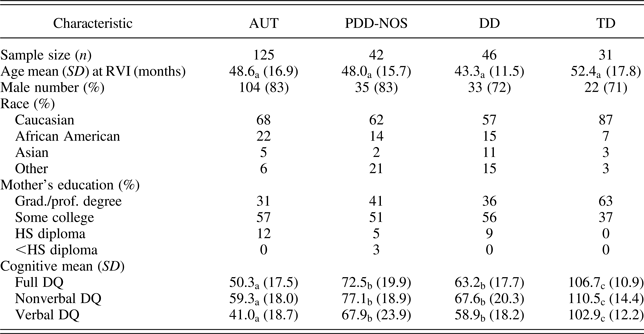
This study included a sample of 244 children screened for enrollment into AUT research studies at the National Institute of Mental Health in Bethesda, Maryland. Participants included 125 children with AUT, 42 with PDD-NOS, 46 with DD, and 31 with TD. Participant demographics and characteristics are presented in Table 1. The age range of the children at the time of the caregiver interview (Regression Validation Interview—Revised [RVI], described below) was 15.4–83.5 months, and there were no group differences on age. The groups had similar percentages of males. Cognitive scores obtained from the Mullen Scales of Early Learning (Mullen, Reference Mullen1995) or Differential Ability Scales II (Elliott, Reference Elliott2007) indicated a wide range of functioning within and across groups. Because some children were out of the age range for the Mullen test (birth to 68 months), and because several children achieved the lowest possible standard score, developmental quotients (DQ), based on age equivalents divided by chronological age multiplied by 100, were used to more fully characterize individual variation and to be consistent across tests.
Summary of participant characteristics

Note: Means in the same row with different subscripts differ significantly at p < .05 on a Tukey honestly significant difference post hoc comparison. AUT, autism; PDD-NOS, pervasive developmental disorder not otherwise specified; DD, nonspectrum developmental delay; TD, typical development; RVI, Regression Validation Interview; HS, high school; DQ, developmental quotient.
Procedures
All participants completed a diagnostic evaluation, including administration of the ADI-R and the Autism Diagnostic Observation Schedule (ADOS; Lord et al., Reference Lord, Risi, Lambrecht, Cook, Leventhal and DiLavore2000). A Toddler version of the ADI-R (Lord et al., Reference Lord, Shulman and DiLavore2004) was administered to children under 4 years of age. Diagnosis was determined by expert, doctoral-level clinicians. Children were classified as AUT if they met the cutoff scores for AUT on the ADI-R and ADOS, and were found by clinical judgment to have a diagnosis of autistic disorder. Children were classified as PDD-NOS if they met cutoff scores for ASD on the ADOS and ADI-RFootnote 1 and were found by clinical judgment to have PDD-NOS. Children in the DD group scored at least 1.5 SD below the mean on either the overall cognitive standard score or verbal standard score as measured on the Mullen or Differential Ability Scales II. ASD was ruled out in all children with DD following administration of the ADI-R and ADOS. The DD group was quite heterogeneous and included children with a variety of medical and genetic diagnoses, including one child with Down syndrome, two with Rett-like syndromes, one with tetrasomy, and a child with fetal alcohol syndrome. The majority of children in the DD group had unidentified etiologies. Some children in the DD group were recruited specifically for inclusion in an AUT comparison group; others were referred for ASD but were found to meet criteria for the DD group following an evaluation. Inclusion in the TD group required that cognitive scores (e.g., combined verbal and nonverbal IQ) were 78 or above and scores on ADI-R and ADOS were well below cutoff. Exclusion criteria for the TD group included a first-degree relative with ASD or a history of receiving special education services prior to study enrollment.
Coding of skill attainment and loss
Parents of participants were interviewed using the RVI, a modified version of a structured caregiver interview previously used in a study of regression (Luyster et al., Reference Luyster, Richler, Risi, Hsu, Dawson and Bernier2005). The RVI was administered to parents during the same session as the ADI-R (or Toddler ADI-R). The RVI is a detailed semistructured interview that includes questions about attainment and loss of specific skills that are different from the ADI-R loss items. The RVI includes questions in the following areas: prespeech behaviors (7 items), communicative gestures (7 items), and vocabulary (10 items). For purposes of this study, 15 sociocommunicative items were examined, including all prespeech and communicative gesture items as well as first words. For each RVI item, questions included the following: whether the child “ever attained” the skill at some point prior to the time of interview (such that it was consistently present for at least one month), and if so, at what age; whether the skill was lost (which required the caregiver to describe a substantial loss of the skill), and if so, at what age; and whether the skill was regained, and if so, at what age. Regaining of skills was not examined in this paper because of a limited number of data points indicating a full regaining of skills (i.e., specific age in months).
Statistics
For each skill, a 2 × 4 chi-square test was used to examine the proportion of participants who attained the skill in each group. When omnibus tests were significant, 2 × 2 chi-squares were used to examine pairwise group differences with Bonferroni corrections.
Kaplan–Meier survival analysis was used to analyze the length of time needed to attain a skill after birth. Survival analysis is a statistical method used to examine the average length of time needed to reach a given event. In the case that a participant does not reach the event of interest, the individual's data can be used to the point it was last observed. The method adjusts for participants who may be observed for longer periods of time or, as in this case, are older than their counterparts. This method can accommodate a wide range of ages. A log rank test was used to compare the groups on the time to attain each skill. Pairwise comparisons were used with Bonferroni corrections to follow up significant log rank tests. Similar statistics were used for skills lost. Only children who initially attained a skill were included in these analyses.
A secondary analysis was performed to determine whether age at study participation influenced group differences in age at attainment and age at loss. Cox regression models were used where group was entered into the model and age at study participation was added. For each skill, age at study participation did not alter the significance of group differences in ages of skill attainment and loss. A linear mixed model was used to examine the trajectory of skill attainment and loss over the first 30 months of life. For skills reported to be attained after 30 months, the amount of available data was small enough to raise concerns about the reliability of the model, thus the model included fixed effects for time, group, and their interaction. Analyses were conducted by diagnostic group (AUT, PDD-NOS, DD, and TD) and by comparing AUT loss (children in the AUT group who lost at least one skill), AUT no loss (children in the AUT group with no skill loss), DD, and TD groups. Schwarz's Bayesian criterion was used to determine the best fitting variance–covariance structure, which was determined to be a first order autoregressive model. Random effects for subject and intercept were not included as they did not contribute to the model. Bonferroni-corrected simple effects tests were used to examine group differences at individual time points. Significance was evaluated at p < .05, which were two tailed for all statistics. The Cohen d was used as a measure of effect size. Values of 0.2, 0.5, and 0.8 are conventionally interpreted as small, medium, and large effect sizes, respectively (Cohen, Reference Cohen1988). IBM SPSS Statistics 19.0 was used for all analyses.
Results
Skill attainment
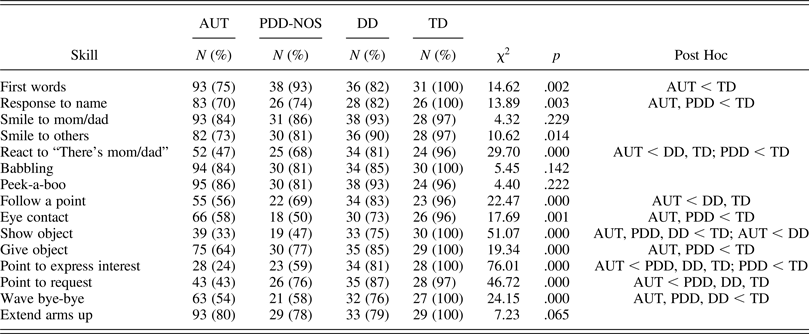
The number and percentage of children in each group reported to initially attain the 15 individual RVI skills at any point prior to administration of the RVI is shown in Table 2. As previously described, initial attainment did not include any skills possibly reattained after any losses. A majority of children in the TD group (92%) were reported to have attained all 15 skills; whereas only 5% of the 125 children in the AUT group attained all skills. Ten of the 15 skills were reportedly attained by a significantly lower percentage of children with AUT compared to TD. In children with AUT, pointing to express interest and show object were the least frequently attained skills, reported in 24% and 33% of children, respectively. Seven of the 15 skills were reportedly attained by a significantly lower percentage of children with PDD-NOS compared to TD. In the PDD-NOS group, showing and waving were reported to be the least frequently attained skills, reported in 47% and 58% of children, respectively, with 59% reported to point to express interest.
Number and percentage of children reported to attain skills by time of administration of the Regression Validation Interview
Note: The post hoc column indicates significant group differences following correction for multiple comparisons, such that ps < .008 were considered significant. Groups are presented in order of percentages from lowest to highest. The arrows indicate the direction of the difference. Groups separated by commas are not significantly different. Semicolons indicate a new set of group comparisons. AUT, autism; PDD-NOS, pervasive developmental disorder not otherwise specified; DD, nonspectrum developmental delay; TD, typical development.
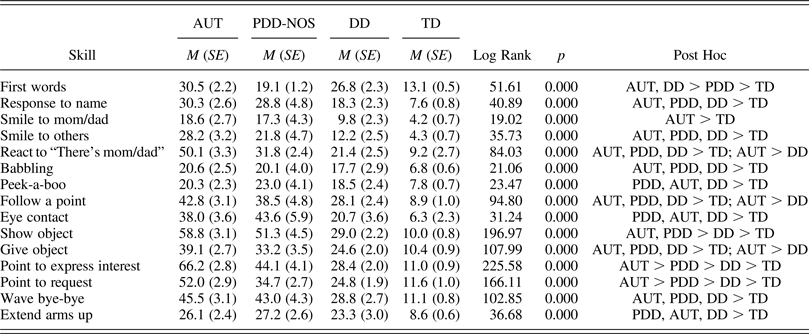
Mean ages of skill attainment and statistical differences based on log rank tests are shown in Table 3. Separate Kaplan–Meier survival analyses for each skill indicated that the TD group developed all skills significantly earlier than the AUT group and developed all skills except smiling to mom/dad significantly earlier than the PDD-NOS and DD groups.
Mean and standard error for age (months) of skill attainment by the time of administration of the Regression Validation Interview
Note: The post hoc column indicates significant group differences following correction for multiple comparisons, such that ps < .008 were considered significant. Groups are presented in order of means from highest to lowest. The arrows indicate the direction of the difference. Groups separated by commas are not significantly different. Semicolons indicate a new set of group comparisons. AUT, autism; PDD-NOS, pervasive developmental disorder not otherwise specified; DD, nonspectrum developmental delay; TD, typical development.
Skill loss
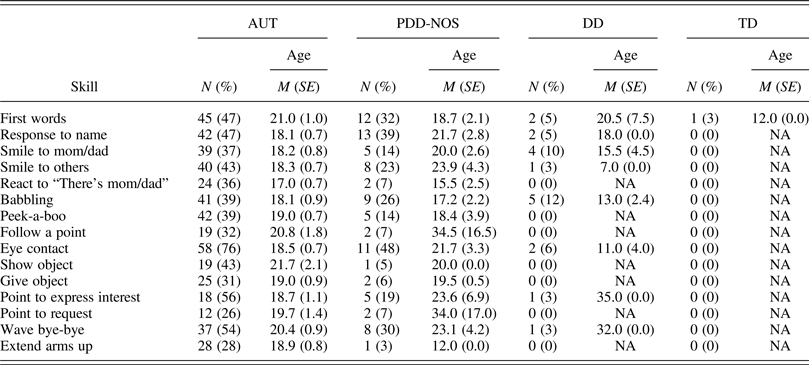
Examination of the percentage of children reported to have lost at least one skill revealed that the AUT group had the largest percentage of children with caregiver report of any loss (63%, n = 79), followed by PDD-NOS (60%, n = 25), DD (24%, n = 11), and TD (3%, n = 1; χ2 = 49.42, p < .0001). Table 4 shows the percentage of children in each group reported to have lost each of the 15 RVI skills, along with the mean ages of loss. These percentages included all children reported to have lost skills, even if missing data for age of attainment of specific skills precluded inclusion in the Kaplan–Meier analyses of skill attainment. Eye contact was the most frequently reported skill lost in children with AUT or PDD-NOS. Loss of pointing to express interest, waving “bye-bye,” and eye contact were all reported in more than 50% of children with AUT who had attained the skills. In contrast, the most frequently reported skill lost in the DD group was babbling (12%), followed by smiling to mom/dad (10%). One child in the TD group was reported to lose words. No other skills were reported lost in the TD group.
Frequency and age of skill loss in children who previously gained skills
Note: AUT, autism; PDD-NOS, pervasive developmental disorder not otherwise specified; DD, nonspectrum developmental delay; TD, typical development.
We also examined the raw counts of specific skills reported by caregivers to be lost in children with AUT by age. The first skill loss was reported at 9 months of age. By 15 months, 25% of all loss occurred, with the following six skills lost most frequently: Eye contact, babbling, smile to mom/dad, respond to name, smile to others, and “peek-a-boo.” These six skills remained the most frequently lost skills at 18 months, when 59% of all loss had occurred, as well as at 24 months (with the addition of loss of first words), when 89% of all loss had occurred. By 36 months 99% of all loss had occurred.
Skills lost in comparison to skills attained
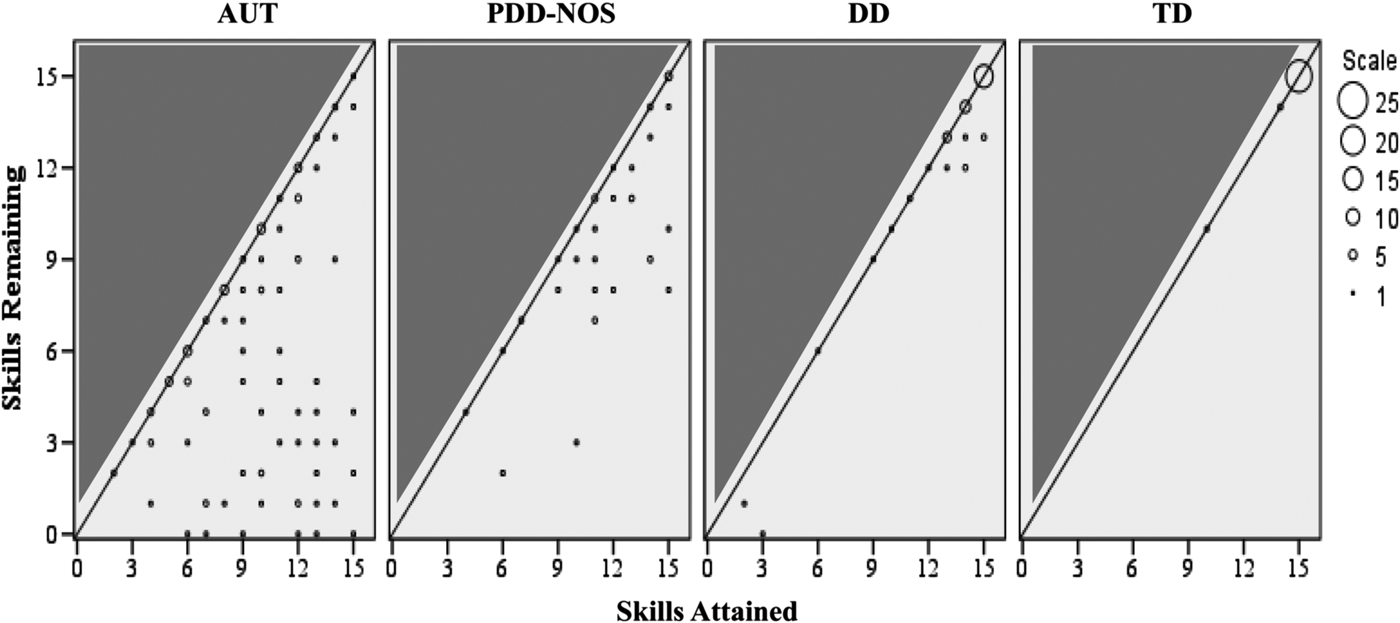
Another way to examine loss, beyond counting an inventory of lost skills, is to consider the proportion of skills lost compared to skills attained. Figure 1 displays participants by the number of skills caregivers reported to have been attained prior to loss in relation to the number of skills reported to be remaining after skill loss. Minimal loss was observed in the TD and DD groups, and a pattern of skill loss that included retaining most skills was found in the PDD-NOS group. In the AUT group, loss was distributed across the number of skills gained such that even some children with few attained skills were reported to have lost one or more skills. Only one child (.8%) acquired and subsequently lost all 15 skills, and this child was in the AUT group. Regardless of how many skills were developed, the loss of all skills was uncommon, occurring among only 6% of children with AUT.
Skills attained prior to loss versus skills remaining after loss, according to diagnostic group. Data points on the line indicate skills attained but not lost. Data points shown “under” the line (to the right and below, in the lower triangle) indicate that a loss of skills occurred. As indicated by the scale above, larger circles indicate multiple children.
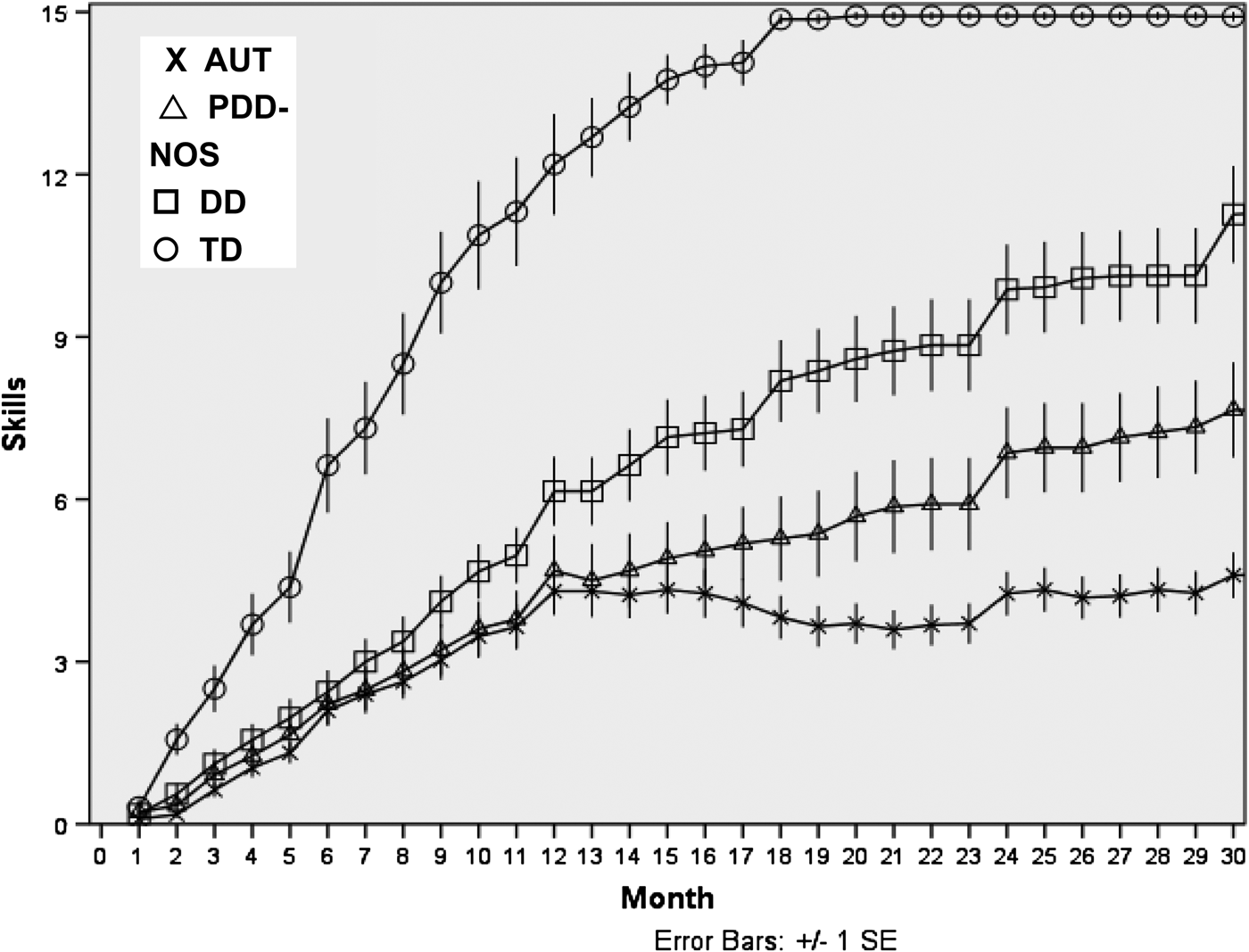
The pattern of skill acquisition and loss over time in all four diagnostic groups from birth to 30 months is shown in Figure 2. A linear mixed model indicated significant main effects for group (F = 920.92, df = 3,3239, p < .001) and time (F = 278.80, df = 29,254, p < .001) as well as a significant interaction (F = 21.39, df = 87,257, p < .001). Post hoc tests indicated that TD children had significantly more skills compared to the AUT (effect sizes range d = 0.91–2.08), PDD-NOS (d = 0.65–1.50), and DD (d = 0.56–1.09) groups from 2 to 30 months. In addition, the DD group began to have significantly more skills compared to AUT at 14 months (d = 0.54) and PDD-NOS at 18 (d = 0.52), respectively, with significant differences remaining through 30 months. The PDD-NOS group had significantly more skills than the AUT group at 21 (d = 0.49) and 24–30 months (d = 0.54–0.67).
Patterns of skill attainment and loss over time in children. AUT, autism; PDD-NOS, pervasive developmental disorder not otherwise specified; DD, developmental delay; TD, typical development.
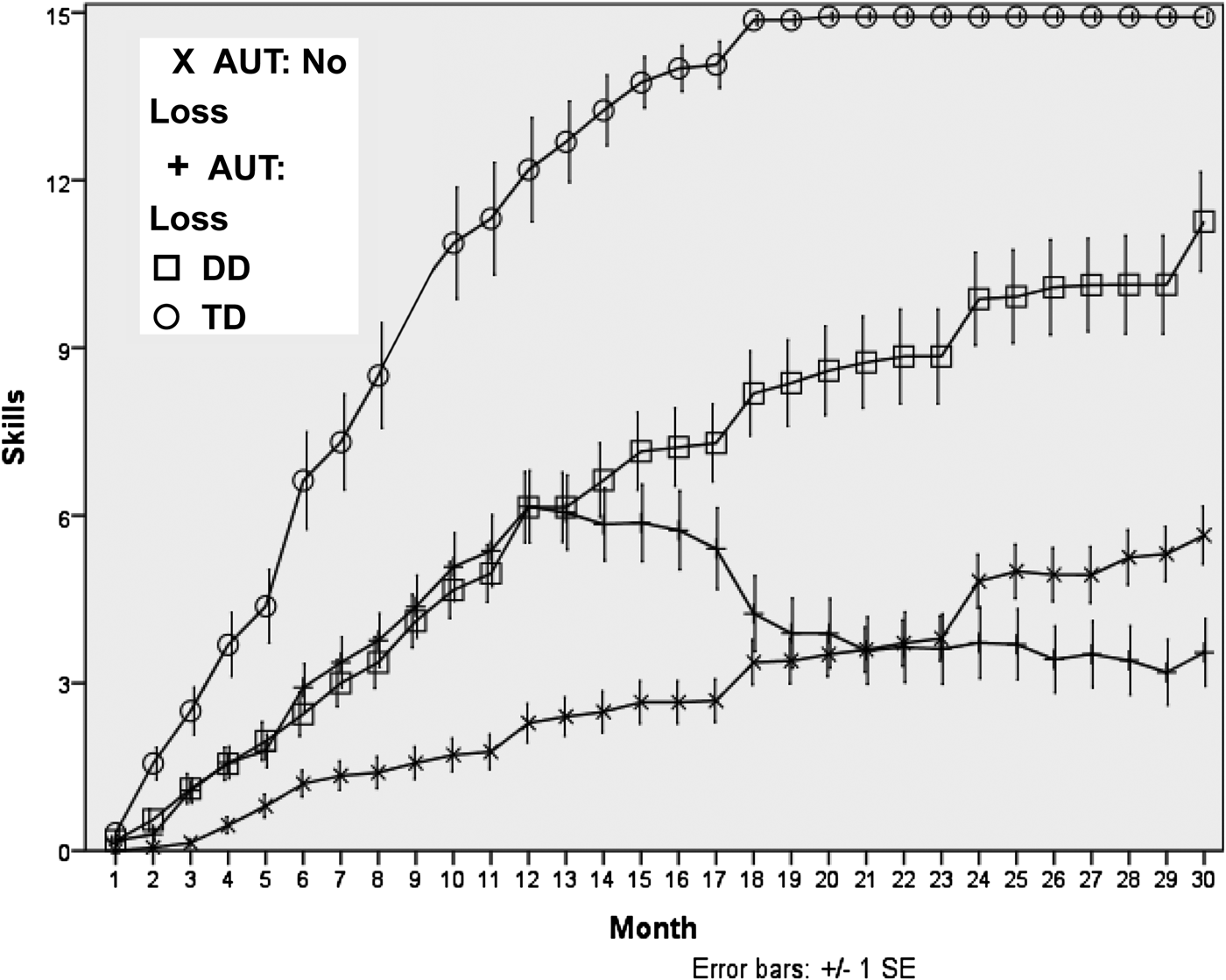
Figure 3 shows the pattern of skill acquisition and loss reported over time with AUT children who lost at least one skill (AUT loss; n = 79) compared to AUT children with no loss (AUT no loss; n = 46), as well as the DD and TD children from birth to 30 months. A linear mixed model indicated significant main effects for group (F = 1017.09, df = 3,2704, p < .001) and time (F = 294.04, df = 29,209, p < .001) as well as a significant interaction (F = 26.80, df = 87,215, p < .001). Post hoc tests indicated that the TD group had more skills than the other three groups from age 2 to 30 months (effect sizes ranging from d = 0.65–2.20). The AUT loss group had more skills than the AUT no loss group from 3 to 4 (d = 0.57–0.61) and 6 to 17 months (d = 0.59–0.95). The DD group had more skills than the AUT no loss group from 3 to 4 (d = 0.51–0.58) and 8 to 30 months (d = 0.55–1.29) and more than the AUT loss group from 18 to 30 months (d = 0.90–1.78).
Patterns of skill attainment and loss over time in children with autism (AUT) by “No loss” (AUT: No loss) and “Loss” (AUT: Loss), developmental delay (DD), and typical development (TD).
Summary of findings
As expected, TD children were found by caregiver report to develop significantly more sociocommunicative skills in early childhood than children with ASD. When children with ASD did attain these skills, delays were indicated by attainment at older ages compared to TD children. Delays in specific skills (e.g., pointing and showing) were also reported in ASD when compared to DD. Exploration of loss of previously attained skills among the diagnostic groups found that loss occurred in all groups, although it was rare in the TD group, not common in the DD group, and common in the PDD-NOS and AUT groups. Loss of skills was reported to occur between 9 and 36 months of age in 99% of the sample. Children with AUT, PDD-NOS, and DD diverged from the trajectory of TD by 2 months of age. In addition, the DD group surpassed the AUT group at 14 months and the PDD-NOS group at 18 months in skill attainment, with the PDD-NOS group surpassing the AUT group after 2 years of age. When children with AUT with and without any loss of skills were considered separately, the TD group was reported to continue surpassing the other diagnostic groups starting at 2 months. The AUT no loss group was reported to show significant delays compared to children with DD prior to 1 year of age (i.e. 8 months), whereas the AUT loss group was not reported to have significant delays compared to children with DD until after 18 months.
Discussion
The purpose of this study was to further describe the ontogeny of ASD, as well as typical and delayed development, by examining caregiver reports of attainment and loss (i.e., regression) of 15 specific sociocommunicative skills among children with ASD, children with nonspectrum DD and children with TD. Building on studies that have measured early skill attainment and subsequent loss of skills, the current study adds novel data that quantified “ever” attainment (whether the child was reported at the interview to have ever initially attained the skill), the timing of attainment (the age at which the skill was attained), and losses when they occurred. Use of a detailed, semistructured interview allowed for descriptions of specific behaviors and the timing of their attainment and loss (when applicable) to be prompted. Thus, data on timing were reported in this study in addition to yes/no data on whether or not a child attained and/or lost specific skills, allowing age-delineated skill attainment and loss to be represented. These data allowed the developmental processes that encompass ASD onset to be explored more fully.
Skill loss in relation to skill attainment
The findings on the ever attainment of specific skills showed that 10 of the 15 skills studied were initially attained by significantly more children in the TD group than in the AUT group. The TD group also attained all 15 skills significantly earlier than the AUT group, and 14 of these skills significantly earlier than the PDD-NOS group. In TD, the skills were generally attained prior to a child's first birthday. However, in the AUT group, even those skills that were reportedly attained by a majority of children were delayed. For example, peek-a-boo was the skill reportedly attained by the largest percentage (86%) of children with AUT (about the same proportion as in TD), but its acquisition was delayed on average by 1 year in the AUT group compared to TD. The present findings add to the growing literature indicating that subtle behavioral differences are present in the first year of life among many children who later develop ASD (Mitchell et al., Reference Mitchell, Brian, Zwaigenbaum, Roberts, Szatmari and Smith2006; Zwaigenbaum et al., Reference Zwaigenbaum, Bryson, Rogers, Roberts, Brian and Szatmari2005).
Inclusion of the DD group in this study was important for the evaluation of when, and in what ways, early sociocommunication delays are specifically associated with ASD. Our hypothesis that children with DD would acquire sociocommunicative skills earlier than children with ASD was only partially supported. The DD group was reported to attain six skills significantly earlier and five of these more frequently than AUT children. These five skills (react to “There's mom/dad,” follow a point, show object, point to express interest, and point to request) all require joint attention and impairments represent early indicators for ASD (Sullivan et al., Reference Sullivan, Finelli, Marvin, Garrett-Mayer, Bauman and Landa2007) that may be present as young as 12 months (Rozga et al., 2011). However, most skills were not acquired more frequently in the DD group compared to the AUT and PDD-NOS groups, and the DD group lagged behind the PDD-NOS group in the attainment of one skill (first words). Group differences in skill development between the DD and AUT groups starting at 14 months, and between DD and PDD-NOS starting at 18 months, underscore difficulties distinguishing between children with DD and ASD (PDD-NOS in particular) prior to 18 months of age (Osterling et al., Reference Osterling, Dawson and Munson2002; Ventola et al., Reference Ventola, Kleinman, Pandey, Wilson, Esser and Boorstein2007). After 18 months, the AUT and PDD-NOS groups lagged behind the DD group in development of the 15 sociocommunicative skills.
Few studies have examined loss of skills in children with TD and DD. The results of this study show that loss of skills is rare among children with TD, with only one child reported to have lost skills (i.e., words). Loss was reported to occur to a greater extent in children with DD, an important finding given that regression is often considered a phenomenon specific to ASD. The findings of skill loss among 24% of the DD group were somewhat higher than in reports by Baird (Reference Baird, Charman, Pickles, Chandler, Loucas and Meldrum2008) and Lord et al. (Reference Lord, Shulman and DiLavore2004), who reported loss of language skills in 3% and 14% of their respective nonspectrum developmental delay samples. Skill loss in the present DD sample was also higher than in Pickles et al. (Reference Pickles, Simonoff, Conti-Ramsden, Falcaro, Simkin and Charman2009), who found loss of language in 1% of a sample of children with specific language impairment. The higher rate of skill loss in the current DD group may be at least partially explained by differences in measurement of skills loss, referral status (with some children in the current DD group originally referred for ASD) and possible differences in medical comorbidities (e.g., several children in the current DD sample had medical problems, such as seizures).
In the present study, skill loss was reported to be frequent among children with ASD, with loss of at least one skill occurring in the majority (60%–63%) of children with ASD. Although loss of skills occurred at a much higher rate among children with ASD compared to TD and DD, it is important to note that a loss of skill(s) in a child is not necessarily pathognomonic of ASD, as it is not universal (at least per caregiver report) nor is it unique to ASD. As described above, it is not possible to compare the frequency of loss described in the current study to reports of regression in prior studies. Whereas the current study examined a continuum that included loss of one or more skills, other studies have examined a category defined as “regression” (e.g., loss of words; Pickles et al., Reference Pickles, Simonoff, Conti-Ramsden, Falcaro, Simkin and Charman2009) and/or loss of a set of sociocommunicative skills (Luyster et al., Reference Luyster, Richler, Risi, Hsu, Dawson and Bernier2005; Werner, Dawson, Munson, & Osterling, Reference Werner, Dawson, Munson and Osterling2005). The results of this investigation thus provide novel parent-report data showing that loss of skills is quite commonly reported by caregivers of children with ASD. The high frequency of loss currently reported is consistent with a recent observational report of prospectively studied high-risk infants, in which loss of sociocommunicative skills (defined as gaze to faces, social smiles, directed vocalizations or social engagement) was observed in 86% of a small sample (n = 25) of children who developed ASD (Ozonoff et al., Reference Ozonoff, Iosif, Baguio, Cook, Hill and Hutman2010).
Although loss of at least one skill occurred in the majority of children with ASD, the number (and type) of skills lost was quite variable. Varying patterns in amount of skill attainment and amount of skill loss were found among children, such that attainment and loss can be considered somewhat independent of each other. For example, even children with few attained skills were reported to have lost skills. Even within the same individual, loss of specific skills often occurred at different times over the period spanning 9 to 36 months, providing further evidence for variability in loss.
Implications for research on onset and regression in ASD
The findings from the present study provide specific information on the developmental trajectories of children with ASD compared to TD and DD, informing the questions of developmental processes, including when and how ASD develops. Differences were found to emerge early in the first year of life, when, by 2 months of age, the TD group had significantly more skills than children with ASD. However, these early delays were not specific to the ASD group. In contrast to this early divergence from TD for children with ASD, results indicated a relative lack of differentiation of AUT from DD and PDD-NOS until 14 and 21 months, respectively.
The current data underscore the process of how symptoms of ASD unfold, including early delays in sociocommunicative skills as well as loss of at least one skill in the majority of children. However, with few exceptions (e.g., Werner et al., Reference Werner, Dawson, Munson and Osterling2005), regression has been studied with dichotomous regression/no regression groupings that include children with widely varying preloss skill attainment. It is therefore not surprising that studies of regression have had such mixed findings with respect to differences in outcome between the two seemingly dichotomous groups (e.g., Davidovitch, Glick, Holtzman, Tirosh, & Safir, Reference Davidovitch, Glick, Holtzman, Tirosh and Safir2000; Hansen et al., Reference Hansen, Ozonoff, Krakowiak, Angkustsiri, Jones and Deprey2008), even when other onset categories and those that consider early delays have been included (Jones & Campbell, Reference Jones and Campbell2010; Kalb et al., Reference Kalb, Law, Landa and Law2010; Ozonoff et al., Reference Ozonoff, Iosif, Young, Hepburn, Thompson and Colombi2011; Shumway et al. Reference Shumway, Thurm, Swedo, Deprey, Barnett and Amaral2011). Categories (e.g., regression, no regression), including those that account for early delays (e.g., early delays + loss), entail arbitrary boundaries for skill attainment and loss, both of which were found to be continuously distributed in the present study. Thus, the term regressive AUT may not be appropriate in describing the vast majority of children with ASD who are reported to lose skills. As a consequence, using regression categorically is likely of limited use in familial phenotypic (Parr et al., 2010) or phenotype–genotype studies (Losh, Sullivan, Trembath, & Piven, Reference Losh, Sullivan, Trembath and Piven2008; Molloy, Keddache, & Martin, Reference Molloy, Keddache and Martin2005). Modeling onset dimensionally may be more fruitful in future studies of etiology and neurodevelopmental mechanisms.
Specifically, the results of this study support the need to consider skill attainment (if and when skills are attained) as a relatively independent dimension from the equally important dimension of loss of skills. Recent studies that include direct observation at multiple time points support that varying degrees of “worsening” are observable and appear independent of initial concerns, although they may not be consistent with traditional parent report of regression when using measures such as the ADI-R (Lord, Luyster, Guthrie, & Pickles, Reference Lord, Luyster, Guthrie and Pickles2012; Ozonoff et al. Reference Ozonoff, Iosif, Baguio, Cook, Hill and Hutman2010). This suggests moving away from current conceptualizations considering regression as a categorical distinction creating multifinality (i.e., subtypes of ASD with regression and ASD without regression) to varying degrees of skill delay and/or loss (worsening) as a process leading to the equifinality of an ASD. Although equifinality complicates how ontology of ASD symptoms can be explored vis-à-vis potential correlates or outcomes, this conceptualization is consistent with other areas of developmental psychopathology (Beauchaine, Reference Beauchaine2003) and consistent with current knowledge regarding how varied etiologies may result in developmental derailment leading to ASD. Further investigations may consider whether more finely tuned measurements and/or measurements of different developmental milestones may be even more sensitive to manifestations of an ASD-specific prodrome (Yirmiya & Charman, Reference Yirmiya and Charman2010) in the first and second year of life, or whether normal variability in development prohibits this.
Whether achieved by observation and/or parent report, detailed measurement of onset profiling utilized in the present study, which includes information about both extent of delays and extent of loss, will facilitate adequate assessment of onset for research (and potentially clinical) purposes. Measurement of attainment and loss of critical sociocommunicative skills (such as the 15 skills measured in the current study), including if and when the skills were attained and lost, is critical for acquiring adequate data on the two dimensions needed to capture onset of symptoms: delay and loss. However, additional studies are necessary to confirm the exact skills that are most critical (some or all of the 15 skills described in the current study or others). The results from this study also inform the debate about optimal timing of ASD-specific screening (Zwaigenbaum et al., Reference Zwaigenbaum, Bryson, Lord, Rogers, Carter and Carver2007) by contributing data that support a gradual onset of symptoms specific to ASD (Tager-Flusberg, Reference Tager-Flusberg2010) and reflect the need to screen at multiple time points that extend at least into the third year of life.
Study limitations
Because caregiver interviews were the source of data on milestone attainment and skill loss, the results of this study are limited by parents' ability to recall historical information. Retrospective reports introduce the potential for recall bias. Although minimization of such effects, including the “telescoping effect” (Pickles et al., Reference Pickles, Neale, Simonoff, Rutter, Hewitt and Meyer1994), was sought by including a cohort of young children, parent-recall inconsistencies may still have created some “noise” in the data. Recent publications suggest that telescoping effects may mean that when caregivers are asked about ages of early milestones repeatedly when their children are approximately 2, 3, 5 and 9 years old, milestones are often reported to occur later after a period of 3 to 7 years has elapsed, particularly in children with significant delays. Further, recent reports specifically examining convergence of caregiver reports of regression with direct observation or retrospective video indicate that when regression occurrence is ascertained and categorized from three specific questions of the ADI-R interview, caregivers may underestimate its occurrence (Ozonoff et al., Reference Ozonoff, Iosif, Baguio, Cook, Hill and Hutman2010, Reference Ozonoff, Iosif, Young, Hepburn, Thompson and Colombi2011). The current study attempted to minimize potential bias of utilizing caregiver report by (a) collecting data on children when they were relatively young, and (b) using methodology such as an in-depth semistructured interview specifically designed with detailed probes regarding the timing of skill attainment and loss, a strategy specifically recommended as a way to improve upon the accuracy of caregiver reports (Ozonoff et al., Reference Ozonoff, Iosif, Young, Hepburn, Thompson and Colombi2011) given that other methods for identifying regression such as videotape analysis also have significant limitations (Baranek, Reference Baranek1999; Zwaigenbaum et al., Reference Zwaigenbaum, Bryson, Lord, Rogers, Carter and Carver2007).
Conclusions
The developmental trajectories of children with ASD are as individualized as those of typically developing children. However, a variety of sociocommunicative skills are attained in typically developing children prior to the first birthday, and there are significant delays in these skills in most children later diagnosed with ASD. Moreover, reported loss of at least one of these skills is common in ASD. Nevertheless, what is colloquially called regression in ASD may best be represented as a continuous phenomenon that starts with varying degrees of early delays in the attainment of sociocommunicative skills and is then joined by varying degrees of loss. Future research examining onset in ASD both clinically and etiologically should take into account both attainment and loss of social and language skills by systematically measuring both while also exploring the onset of other symptoms, such as repetitive behaviors. Research that closely tracks the early developmental trajectories for children diagnosed with ASD or DD will be important for distinguishing early developmental markers of the disorders, which in turn informs the larger field concerning timing and processes that go awry early in development.