INTRODUCTION
Situated in the Arctic, Greenland is geographically separated from the rest of the Danish Realm by several thousand kilometers. The colonization of Greenland is a complex process, which began in the 1700s with representatives of the Danish state attempting to carry out missionary work among the indigenous Inuit population. Danish presence has been continuous since then, and in the beginning of the twentieth century—with the political support from the US—Denmark claimed the entire island of Greenland a Danish colony. The history of Danish colonialism in Greenland is a story of domination and separation politics, and even though Greenland was in 1953 included as an administrative district (an amt) on par with other Danish districts, there were never equal rights for Danes and Greenlanders (see e.g. Rud Reference Rud2017). The colonial relation between the two countries has been formalized in different ways. In 1979 Greenland gained home-rule government, which meant some independence from the Danish state, and in 2009 self-government, which meant further independence. However, Greenland is still part of the Danish Realm (Rigsfællesskabet), and many political areas, such as Greenland's foreign policy, are still governed by the Danish state. Despite this relation, the colonial bonds between Greenland and Denmark (both historically and contemporary) have not been a subject of public debate until recently. The Danish-Greenlandic relation has typically been described as a type of positive colonialism or even an equal relationship, imbedded into an overarching ideology of Nordic exceptionalism (Loftsdóttir & Jensen Reference Loftsdóttir, Jensen, Jensen and Loftsdóttir2012; Andreassen & Vitus Reference Andreassen and Vitus2015). During the last years, though, a ‘new history’ is being told, and in this article, we show how this happens through, for example, actions taken by public institutions such as the National Museum, and through public and political debates. However, the process of telling the past in new ways is complex, and actions taken to change constructions of the well-known has resulted in heated media debates.
We examine struggles related to the recasting of the collective memory connected to Danish colonialism, and the exhibitions and communication from the Danish National Museum are the central objects of analysis. By use of multimodal and semiotic landscape analysis, we show how the Danish National Museum works to reformulate the historical relationship between Greenland and Denmark in ways that avoid the colonizer's language and at the same time describe and construct complex relations of past and present. The analysis demonstrates how a temporal ambiguity is present in the museum exhibitions, not offering a conclusive understanding of the colonial period. At the same time, we show how the presence and absence of colonial language in public space is inscribed into temporal frames legitimizing or problematizing their status.
Whereas public institutions and several large commercial enterprises have taken action in renewing their ways of naming the Greenlandic people, in line with a critical view on the past, some politicians and businesses have insisted on using what is by many viewed as demeaning terms depicting Greenlanders. This is for instance seen in the way several members of the Danish Parliament are defending the term Eskimo, as well as in the use of this term to designate a popular ice cream. This debate encapsulates the temporal tensions in the Danish understanding of itself as a colonizing nation, and it is highly relevant in the case of the Danish National Museum, which is clear from the analyses below. In the following we offer a theoretical and methodological outline, followed by analyses of instances of communication from the museum regarding their removal of the word Eskimo from their exhibitions, and part of the political debate that followed. Then we move on to an analysis of the museum landscape, where we focus on temporality, voicing, and the built environment. Finally, we sum up the main findings and results.
THEORETICAL OUTLINE
Coloniality
In the case of Greenland and Denmark the theoretical term ‘postcolonial’—understood as a state of independence from former colonial rule—is not entirely applicable. Rather, the concept of coloniality is suited for describing the relation between the two countries since it complicates the temporal development of prior and past indicated by the term ‘post'colonial. Coloniality discards the entire idea of a clear divide of before and after in favor of highlighting the continuations of colonial oppression understood as complex dynamics of domination, which permeate modern-day global society (Quijano Reference Quijano2000; Grosfoguel Reference Grosfoguel2011). Coloniality can be categorized as Southern Theory, developed and based on cultural experiences from the Southern hemisphere. Thus, the term is not commonly applied to Arctic contexts, and generally the Arctic remains marginal in critical colonial studies (however, see Andersen, Hvenegård-Lassen, & Knobblock Reference Andersen, Hvenegård-Lassen and Knobblock2015). This may be explained by the phenomenon Nordic exceptionalism—the general self-perception of the Nordic countries as peripheral in relation to colonialism and contemporary processes of globalization. It is a declared innocence regarding colonialism, often representing Nordic states as humane and caring colonizers (e.g. Mortensen & Maegaard Reference Mortensen and Maegaard2019). Even though the colonial past and present of the Danish nation is not frequently publicly debated, in recent years the colonial relations between Denmark and Greenland have been the object of debate several times (see Rud & Heinrich Reference Rud and Heinrich2018 for a feature article, and Altinget 2020 for a news article on the Danish prime minister's apology to Greenlanders who were removed from their parents as children). One such case of discussion is the debate we are focusing on in this article.
Semiotic landscapes and temporality
In line with the tradition of linguistic landscape research this article focuses on the presence and absence of discursive elements in public spaces (Shohamy & Gorter Reference Shohamy, Ben-Rafael and Gorter2008, Jaworski & Thurlow Reference Jaworski, Thurlow, Jaworski and Thurlow2010). In this case we specifically focus on the shift from presence to absence of a particular word in public space and the collective national history at large with the aim of understanding the ‘motives, pressures, ideologies, reactions, and decision-making’ (Shohamy & Ben-Rafael Reference Shohamy and Ben-Rafael2015:1) of people involved in and affected by the shift. We follow Jaworski & Thurlow (Reference Jaworski, Thurlow, Jaworski and Thurlow2010:2) in their approach to the concept ‘semiotic landscape’ as ‘in the most general sense, any (public) space with visible inscription made through deliberate human intervention and meaning making’. In our analyses we examine not only written discourse, but also other modalities, for example, visual images, sound, video, and the built environment. We conduct analyses of semiotic landscapes both as physically manifested, for example, in a museum, and as digital semiotic landscapes on social media (the museum's Facebook site).
Much linguistic and semiotic landscape research has focused on space and paid less attention to time as an influential parameter in how semiotic landscapes take on meaning. In this article we seek to address space and time. We approach space both in the concrete sense of physical spaces as well as virtual spaces and in the more abstract sense of public space as represented by the mass media and the public debate platforms they provide. We approach time as a social construct that is discursively produced in various ways by different actors. The analysis demonstrates how the museum in certain places discursively outlines events as following a developmental movement. In line with Adam (Reference Adam1995) and Moran (Reference Moran2015), however, we view temporality as more than simply past-present-future. Rather, temporality is a multifaceted phenomenon that can take on various expressions as we see in the following analysis. Thus, we approach temporality not as an abstract and ungraspable phenomenon, but as meaningful when connected to social meaning. We ask what exactly happens when people invoke ‘the past’ and more specifically labels of the past in present day interaction and storytelling? Furthermore, we focus on such temporal expressions as memory, collective national history creation, the contemporary, and forces of change. Whereas memory and collective history are well established terms in museum studies, these have more recently been subject of analysis in linguistic landscape studies by looking at the discursive dynamics around built memorials (Ben-Rafael & Shohamy Reference Ben-Rafael and Shohamy2016; Blackwood & Macalister Reference Blackwood and Macalister2020). In this article we are interested in tracing how it plays out and which discursive tactics are deployed when a nation is trying to cope with its colonial past.
Temporality is obviously central in studies of history, memory, and memorials, but it is also central to sociolinguistic studies of change. Recently, sociolinguistics has developed an interest in theoretically connecting linguistic change to larger global processes of sociocultural change, through the theoretical concept of sociolinguistic change (e.g. Androutsopoulos Reference Androutsopoulos2014; Coupland Reference Coupland and Androutsopoulos2014, Reference Coupland and Coupland2016; Maegaard Reference Maegaard, Maegaard, Monka, Mortensen and Stæhr2020). In analyzing the National Museum semiotic landscape and the process of removing or maintaining a specific word of the past in contemporary contexts, we illuminate how discourse is an inherent part of such transformational processes.
Museums
Museums can be said to manifest and materialize the central ideologies of society. As expressed by Preziosi they are ‘uniquely powerful semiotic and epistemological instruments for the creation, maintenance, and dissemination of meanings by fielding together and synthesizing objects, ideas, bodies and beliefs’ (Reference Preziosi, Knell, Aronsson, Amundsen, Barnes, Burch, Carter, Gosselin, Hughes and Kirwan2011:55). A crucial aspect of museums is that they are often constructed—especially by the public—as neutral, authoritative, and trustworthy (Knell Reference Knell, Knell, Aronsson, Amundsen, Barnes, Burch, Carter, Gosselin, Hughes and Kirwan2011:4). The representation in the museum is usually perceived as accurate and precise, and this makes the museum very powerful in establishing how the world ought to be understood. National museums are a special case, constructing and performing ideologies of the nation. Even though the authority of the museum is often seen as non-disputable, the authority of the exhibitions at the Danish National Museum is in fact disputed by prominent politicians, whose explicit national ideologies do not correspond to the ones enacted at the museum (cf. analyses below in Removal of a word).
Time and place are central to museums’ constructions of meaning, and this is especially salient in historic museums like national museums. History is typically represented through the exhibition of material objects collected in specific places at specific times. This makes the museum space a complex place where objects indexing places and times different from the ‘here’ and ‘now’ are displayed. Exhibitions are experienced in the present, but they point to places, people, and times delimited from the museum guest through the physical distance to the object (e.g. behind glass) and the interpretation offered through the authoritative voice of the museum in writings on display texts or as the narrating voice in videos or audio material. These voices tell the guest how to place the object in time and space and how to interpret its significance to a specific past culture or people. Museums can also be said to create and preserve collective memory, which can be seen as the continual presence of the past in the present. The collective memory is maintained through ‘rituals, ceremonies, “traditions”, commemorations, festivals, sites, memorials and institutions (including museums) created and preserved to reinforce it’ (Black Reference Black2011:421).
The national history as it is presented in a museum forms the kind of collective memory and remembrance that Ben-Rafael discusses in relation to memorials, and just like memorials, national museums may be ‘arenas of conflicts of political interests, clashes of ideologies or antagonisms of religious beliefs’ (Reference Ben-Rafael, Ben-Rafael and Shohamy2016:207). We might expect to find this clash especially pronounced regarding museum exhibitions designated to the colonial history of a nation, since here moral issues of guilt and shame become highly important.
The word Eskimo and language struggle
The word Eskimo has been in common usage in Danish since the early nineteenth century, like it has in many other languages. It is a loan from French esquimau, possibly originally an Algonquian word ayashkimew. However, the etymology is somewhat unclear, and its original meaning not established. Nevertheless, as is the case with many other potentially problematic words, the crucial aspect of its meaning is not its etymological referential meaning, but the indexicalities associated with it. It is not a local Greenlandic Inuit word, but a word that has been introduced by the Danish colonizers. Already in 1980, the Inuit Circumpolar Council (the association of indigenous people in the Arctic) decided to replace the word Eskimo with Inuit (as well as other terms in other parts of the Arctic; cf. ICC 1980), and in this perspective, the recent debate in Denmark may seem somewhat delayed.
In her analysis of verbal hygiene dynamics Cameron (Reference Cameron2012:133 ff.) has pointed out three different underlying views of language that are pertinent in any debates on ‘political correctness’. First, there is an (ultra)conservative understanding that argues that all attempts to change linguistic labels is a break with tradition and thus problematic. Second, there is a liberal position, which imagines that language is—or should be—a neutral code through which opposing parts can engage in debate and reach comprises. Finally, there is a critical understanding that language is never neutral and always reflects the history of power in favoring the privileged and demeaning or fully silencing the marginalized. In the debate on the word Eskimo we see the conservative and the liberal position go hand in hand. Those in favor of using the word mobilize arguments that both highlight the values of sticking to tradition as well as profess neutrality of the linguistic code and thus innocence.
THE NATIONAL MUSEUM
The analysis is two-sided. First, we focus on a case of conflict over the removal of the word Eskimo in the Danish National Museum. We analyze the museum's mediated public explanation to this change, given on their Facebook site. Second, we analyze the semiotic landscape of the museum exhibitions to investigate how the museum represents the colonial relation between Greenland and Denmark.
Removal of a word
In August 2020 the Danish National Museum began a longer process of removing the word Eskimo from its exhibitions and general communication. This was picked up by the national newspaper, Kristeligt Dagblad, who on July 29—a few days before the process was due to begin—ran a news story on the museum's decision.Footnote 1 The article featured an interview with the responsible museum manager about the underlying reasons for the decision, together with a paralleling of other similar actions of replacing the word Eskimo with other words (e.g. in the promotion of a popular ice cream). The story formed headlines in all types of news media, and politicians began commenting on the story. The following day the National Museum issued a post on its official Facebook page explaining the decision.Footnote 2 The post begins with the greeting ‘Dear friends’ (kære venner), signaling proximity and appreciation between the museum and potential readers, followed by an appeal that the reader share the content with others. The text is quite long, and we only analyze parts of it in detail. The museum offers two reasons why the term Eskimo ought to be changed.
(1) National Museum Facebook post (our translation)
1 First of all we do it because the word ‘Eskimo’ is scientifically unnuanced.
2 The word is used as a collective term for several different peoples from Greenland, Canada,
3 Siberia and Alaska, and the word is simply too inaccurate to describe them well.
4 At the most general level, most people in the eastern Arctic (Arctic Canada and Greenland)
5 most often use the term Inuk / Inuit
[…]
6 Thus there are tons of much more precise terms that can be used, all of which are linked to
7 the places the individual people come from. It requires us to be more careful when we
8 describe them. And basically, we think we owe this to each other and to history
The first argument is based on the unscientific nature of the term Eskimo. It is a ‘collective term’, not ‘nuanced’ enough, ‘too inaccurate’, and so on. Between lines 5 and 6 there is a long list of different Arctic peoples and their own terms. This argument resembles the accuracy argument accounted for by Cameron, where ‘the highest value to which language-users can aspire is accuracy’ (Reference Cameron2012:135). This argument is thus well-known in verbal hygiene debates as an argument which downgrades social evaluations and highlights precision in communication. Yet, in lines 7 to 8 the argument develops into another direction. There is an ‘us’ and a ‘we’, and it is unclear whether the text refers to ‘us, staff at the national museum’, ‘us, Danes’, ‘us, former colonizers’, or something completely different. Nevertheless, this ‘us’ is set in clear contrast to ‘them’, the Arctic peoples, and in line 8 the ‘we’ is presented as having moral obligations in this regard: ‘we owe this to each other and to history’. Thus, while the argument started by drawing on discourses of a quest for scientific clarity, it changes into a moral argument, involving potential blame and guilt. This type of argument—that one should avoid offending others—is what Cameron terms the civility or sensitivity argument, and this is a type of argument which usually gives rise to much more debate and counter argumentation than the first type (as is clear from the media debate discussed below).
(2) National Museum Facebook post continued (our translation)
1 Many Arctic groups perceive the word as the term used by the colonial power to describe those
2 whom they dominated. That is another reason why we are now changing the term.
3 We have an excellent collaboration with the Greenland Museum and the other Arctic museums,
4 and we believe that it is generally a good thing to change your behavior if someone perceives
5 what you call them as derogatory.
6 We want to show consideration to the people we communicate with.
Extract (2) follows extract (1), and the appeal to show considerations towards other people continues. It is stated that the word is by ‘many Arctic groups’ perceived as a word used by the colonizers when describing the colonized. The text repeats its moral position about changing one's behavior in line 4, and again in line 6: ‘We want to show considerations to the people we communicate with’.
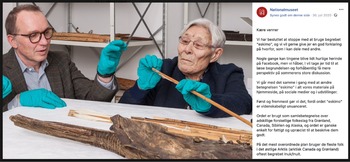
The post ends with a photo from the museum, showing two men examining museum objects (see Figure 1). The text above the photo explains that this is a photo of a museum researcher and a visiting member of a group of people from the Canadian Kitikmeot Heritage Society, studying cultural artefacts from their ancient past in the museum. The post concludes by commenting that ‘In Knud Rasmussen'sFootnote 3 archives from the expedition, they are called copper-Eskimos. But they call themselves Inuinnait’. By presenting the two terms ‘copper Eskimos’ and ‘Inuinnait’ next to each other, the example works to highlight the primitivity and outside perspective of the former, while positioning the latter as both an emic term (‘they call themselves…’) and possibly a more accurate term. Furthermore, by ascribing the use of the inappropriate term to a (in Denmark) famous and respected historic person like Knud Rasmussen, the text tells the reader that even well-respected people can make judgements that later come to be evaluated as wrong—or at least uninformed. And in combination with the moral advice to ‘show consideration’ towards others, this example works to convince the reader that they might change their use of the word too, and that this would not be problematic—it is just the way history works. The argumentation draws on an understanding of time as crucial in meaning-making, and thus as time as closely tied to the social world. This means that by invoking temporality in the argument, the museum stresses an understanding of language and its meaning as directly connected to aspects of time (Moran Reference Moran2015), while at the same time opening up for the possibility that perhaps language that used to be considered legitimate (by the majority society) was perhaps in certain ways always problematic. The photo underscores the argument of respect for the depicted people and their emic knowledge by displaying the visiting Inuinnait as an expert—the one holding and actively examining the object, which is center of attention for both persons in the photo. The photo is set in the backstage of the museum where the scientific investigation happens with historic objects on stockpiles in the background. Like the Danish museum staff, the visitor is wearing researcher attire (plastic gloves) and thus appears to be as much in a position to define objects as the Danish staff.
Photo from Facebook post by the National Museum, 30 July 2020.

On the day of the museum's Facebook post, July 30, the Minister of Culture was formally called in to answer questions by members of parliament.Footnote 4 Extract (3) shows the formal question as it was formulated by MP Pernille Bendixen, representative of Dansk Folkeparti.
(3) (Our translation)
1 Will the minister account for whether the minister agrees with the National Museum that the
2 word ‘Eskimo’ no longer should be used in the museum exhibitions, and that the term ‘Eskimo’
3 is ‘(…) an instrument for maintaining white dominance (…)’? We refer to the article…
The question formulated by Dansk Folkeparti asks two questions: first, it asks whether the minister agrees to the removal of the word from exhibitions. Then, in lines 2–3, a reference to an article from the large national newspaper Berlingske Tidende Footnote 5 is brought into the question. Interestingly, the referenced article is an overview—the daily morning summary—which only includes a few very simple headlines of the story, and not the actual full article. Furthermore, the quote taken from the article is somewhat distorted, since in the article representatives of the National Museum do not themselves voice the referenced perception, but instead refer to others who feel this way. In the Berlingske Tidende article the museum staff is referenced as saying that ‘the designation is by many people perceived as an instrument to maintain white dominance and to categorize people in a super simplistic version’ (our translation), thus not presenting this view as their own or even the museum's. Two additional questions lead the debate in the same direction: One focuses on the changing of names and the ‘removal of cultural memorials’ in public space in general, the other focuses on the minister's role in protecting Danish cultural heritage from ‘identity political attacks’. Thus, the action taken by the National Museum was soon taken into a general political discussion about the appropriateness of changing the semiotic landscape of public space based on considerations of past assaults. The minister answered in a short statement that she was content with the fact that the museum had not removed the word from their archives or other historic material, but only in their communication to the public in the exhibitions, which she found very reasonable. However, the debate did not end here, and during the next year the discussion continued to appear.
The examples analyzed above show how the removal of a word in a national institution led to nationwide and political debate involving ideologies of Danish humane colonialism and anti-‘identity politics’. Below we focus on the actual museum landscape, centering our analysis on the relatively new exhibition ‘Voices from the colonies’.
The museum landscape
While the museum communicates a clear awareness of their position regarding use of the word Eskimo, they similarly and more generally communicate a will to change the way of positioning former Danish colonized people in the museum. In 2017, marking the sale of the Danish Virgin Islands to the US in 1917, the National Museum launched a new permanent exhibition ‘Voices from the colonies’ (Stemmer fra kolonierne) focusing on Danish colonial history. The stated focus of this exhibition was to make all people involved in the Danish-led colonization visible and have their stories told. In the following we analyze the semiotic landscape of this exhibition, exemplified through different parts of the exhibition which we offer special attention. Our aim is not to assess whether the exhibition is good or bad, or more or less successful. What we wish to do in this analysis is to discuss and critically pursue the discursive and linguistic components of the exhibition to see which positions they create for the represented and for the viewer/visitor encountering them.
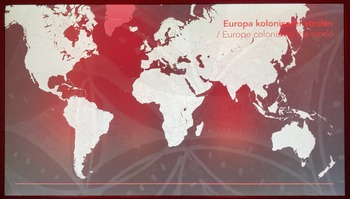
Entering the exhibition, the visitor is met by a large video screen with a world map showing with changing colors the European colonization of the earth (see Figure 2). The video tells the story of Danish colonization following a chronological timeline—each colonized country is added with a color when the narrating voice reaches the relevant year. Eventually a large part of the world is colored on the map, and the narration continues to explain about the ending of colonization and the colors disappear from the relevant countries. When the video ends, Greenland is the only country that remains colored on the map, indicating that a colonial relation is ongoing. The accompanying narration states that ‘around the year 2000 only few areas of the world have colonial status. But some countries are still tied in a relationship of dependency with the former colonial power. One of them is Greenland’. This suggests a view of the Danish-Greenlandic relation as not strictly post-colonial.
Video screen at the exhibition ‘Voices of the colonies’ (authors’ photo).

Another world map in the exhibition is shown in a less prominent position, further into the exhibition. It is shown on a poster with bullet points indicating Danish colonies accompanied by timespans. In the case of Greenland, we see this text: ‘Greenland (1721–?)’. The question mark can either be read as indicating that the colonization has not ended so far, and that it is unclear when it will, or it can be understood as indicating that the end is difficult to pinpoint. Either way, together these two maps tell the story of a complex colonial history of the two nations. However, on other display texts, it is explained that the colonial period officially ends in 1953, when Greenland becomes an integrated administrative district in Denmark (Danish amt). These examples communicate a temporal ambiguity in which the relation between Denmark and Greenland remains uncategorizable or pending. At the same time, it is an example of how time and the interpretation of time is not an objective fact, but is ‘an enacted, material, social practice’ that organizes temporality (Moran Reference Moran2015:289). The timelines suggested by the museum are different options for interpretation of the relation between Denmark and its (former) colonized nations. This way, the museum refrains from communicating a clear stance on the relation between Greenland and Denmark, and this position corresponds well to the way the museum is making an effort to represent multiple voices in the exhibition.
Voices in the exhibition
It is a central idea behind the construction of museums ‘that the museum's authority rests on its objective representation of the world’ (Knell Reference Knell, Knell, Aronsson, Amundsen, Barnes, Burch, Carter, Gosselin, Hughes and Kirwan2011:5). In our analyses we use the concept of the authoritative voice of the museum when describing this performance of neutrality and objectivity. However, in the exhibition other voices are present too, and below we show how these different voices are combined in a complex narration of the colonial past. This happens not only through linguistic means, but also through choices of visual materials, sound, emplacements of objects, the interactional order of the space, and so on.
Before going into detail with the analysis of the voices in the exhibition, it is worth noting that the Greenlandic voices in the exhibition have been translated into Danish and English. This means that there is no Greenlandic linguistic material present in the exhibition. As pointed out by Blackwood & Macalister ‘memorials have the potential to erase linguistic diversity as much as they can entextualize multilingualism’ (2020:4), and in the context of the Danish National Museum's colonial exhibition, local languages are not present. This is a choice that potentially creates further distance between the stories and the individuals who experienced the narrated events.
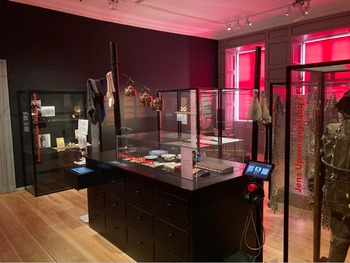
The Greenlandic part of the exhibition is mainly located in one room (see Figure 3) and is composed of a range of glass cases, each devoted to the story of a single person whose name is displayed in red on the side of the case. Written either directly on the glass or on display texts next to the glass cases, the story of the thematized individual is told in Danish and English.
The spatial layout of the Greenlandic part of the exhibition ‘Voices from the colonies’ (authors’ photo).

The texts on most of the glass cases and displays are voiced in a way that is not directly the authoritative voice of the museum. An example of this is seen in a display text that reads ‘Christian morality is at risk. The evidence is there in a flesh. Children born out of wedlock…’. This voice, speaking about the ‘risk’ of Christian morality not being adhered to and about ‘wedlock’ is speaking from a position of moral values of a certain kind and is arguably not the voice of the museum. It is more likely the voice of the Danish colonizers. Conversely, on another glass case it says: ‘Can a priest really speak to the spirits and the souls of hunted animals?’, here voicing the skepticism of the local Inuit in the meeting with Christian priests. In contrast the performance of neutrality and objectivity is mainly found in the videos and on the maps. In the exhibition texts history is almost exclusively presented in present tense, that is, historical present. This is seen in texts like: ‘Being educated at the local settlement school and raised in a hunting family is no barrier for Mathias. He gets the highest grades at the teacher training college in Godthåb (Nuuk), and is later appointed dean of North Greenland and awarded the Danish Knight's Cross’. Historical present has the effect of presenting the past as happening in the here-and-now—or perhaps rather placing the reader or listener in the past, in a position to experience the historic events as they unfold.
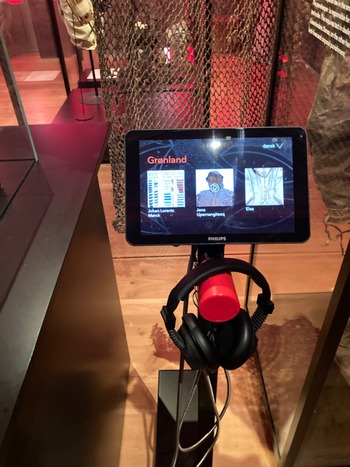
Additional voices are seen in the audio narratives in which a narrator tells the story of a particular individual in the colony (e.g. the wife of a Danish colonial representative, an Inuit school teacher, a local shaman), by use of third person storytelling. The narratives are not voiced by the actual people appearing in the narratives, since the information providing the basis for the stories have not been collected as audio recordings, and the people are for the most part not alive any longer. Neither this voice can be said to be directly the authoritative voice of the museum, since it tells the stories through indirectly citing the individual's thoughts, not as a neutral and objective voice. This happens through audio stands placed next to the glass cases, each presenting short texts, drawings, and a set of headphones (see Figure 4). To engage with an individual story the visitor is required to sit down and put on headphones. In contrast the written texts on the posters face the visitor directly as they enter the space and as genre mirror a general museum space. Therefore, these texts receive more immediate attention from the viewer. Despite the presence of many different voices and positions in the exhibition, some voices have more prominence than others, and the individual stories are the least directly accessible. By contrast, these are the only interactive parts of the exhibition, and the invitation to engage actively with the museum space can add to the museum guest's personal experience of the exhibition (Perin Reference Perin, Karp, Kreamer and Lavine1992). By using modern technology these individual stories are made accessible for the visitor who have not themself lived through the represented experiences. This reflects a wider tendency in which, as Landsberg (Reference Landsberg2003) describes it, new technologies and the commodification in mass culture enable a transgression of the memories an individual has access to by offering larger audiences an intimate and experiential entry into events and times they themselves have not lived through. Landsberg terms such access ‘prosthetic memory’ as the memory due to its mediated form is not ‘natural’ or ‘authentic’ in its traditional sense. Whereas this of course blurs the museum's official ambition of making the actual ‘voices of the colonies’ accessible, such mediations of (individual) memories may, according to Landsberg, carry a potential for progressive politics and collective action by enabling an experience of empathy across identity categories and belongings. In this way the variety of formats together make the exhibition an assemblage of different voices speaking from different positions, all interpreting life in the colonies in different ways.
Interactive audio stand (authors’ photo).

As can be seen from the above, temporality is explicitly displayed in the exhibition in visual chronological timelines, in the changing layout of the video world maps, and in the placing of the exhibited objects in a specific time. Furthermore, grammatical present tense (historical present) is used frequently in the personal histories of people in the colonies, here working to bring the events closer to the museum guest.
The way the different voices are brought into the exhibition are in some respects similar to what Gavin & Onodera (Reference Garvin and Onodera2020) describe in their analysis of a World War II memorial for Japanese Americans. Through the use of linguistic landscape analysis, they find that ‘competing narratives, multiple voices or “ways of telling” the story’ are present, and that ‘the unified national narrative … is contested’ (Reference Garvin and Onodera2020:153). In the same way, our analysis shows the presence of multiple voices narrating history in different ways, and the contestation of one unified narrative, as we have seen above. Furthermore, the built environment and the way it is presented in the museum adds even further to the multiplicity of times and voices in the exhibition, as we see below.
Semiotics of the building
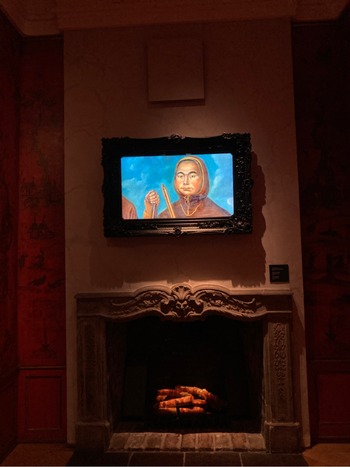
Time is furthermore part of the semiotic landscape of the exhibition in a different way, through the built environment. The exhibition is set in the part of the national museum called Prinsens Palæ (‘the Prince's Mansion’). The building is placed in a rather peripheral area of the museum, and it is unlikely to be accessed by chance. This means that the physical location of the exhibition makes it less obvious to pass by than other places in the museum. However, there may be other reasons for choosing this building as the frame for a Danish colonial exhibition. The Prince's Mansion was built on wealth from colonial trade in the eighteenth century, and the interior has been renovated to preserve the original design. This results in a stark contrast between the modern, simplistic aesthetics of the exhibition and its surrounding interior decorations. Placing the colonial exhibition in this mansion links it to history in subtle ways, not explicitly expressed in the museum. Figure 5 shows how exhibited pieces are in some cases integrated into the traditional interior, here a video screen showing videos narrating the tough life trajectories of individuals from three different Danish colonies, framed in a heavily decorated black frame and hung above the fireplace, resembling a classical romantic painting. In Figure 5 the video is showing part of a painting by the Danish painter Bernhard Grodtschilling, depicting the two Greenlandic Inuit Pooq and Qiperoq.Footnote 6 The two Inuit hunters were brought to Copenhagen in 1724 to perform their hunting skills in the inner-city canals to a Copenhagen audience, in an attempt by the mission to secure support for the continuous missionary work and colonization of Greenland. Placing the individuals in this frame indicates a certain value attributed to these by the museum, and a focus on them. At the same time, the guests are positioned as onlookers, distanced from the people whose images are placed on the wall, as if they were in the position of the original residents of the mansion.
Interior design of the exhibition ‘Voices of the colonies’ (authors’ photo).

The original red and golden wallpaper is decorated with ‘exotic’ illustrations from different colonial contexts, mainly from Asia. In a specific place, though, between temples and palm trees, two men in kayaks are depicted, probably Pooq and Qiperoq discussed above. This detail is not explicitly communicated by the museum, but a glass plate has been mounted on this part of the wall, which shows the guest that this piece of wallpaper may be something to examine closer. In this case the museum abstains from using its explicit authoritative voice, but instead let the semiotics of the traditional built environment ‘speak for itself’ and more subtly invite the visitor to reflect.
While the interactive design of one part of the exhibition positions the visitor as an active participant, personally selecting which voices and stories they wish to hear, this part of the exhibition can be seen to implicitly position the visitor, with or without their will, in the place of the colonizer, in a colonial mansion, watching the fire burn in the fireplace, and looking at the depicted colonized Others at a distance—in the video in the frame above the fireplace. This way, the museum not only presents different voices from the colonies, but also positions the visitor differently in different parts of the exhibition. The location of the exhibition in this particular building thus brings different times and different perceptions of colonialism into dialogue, again adding to the plurality of voices articulating times and stances in relation to colonialism. This complexifying of temporality and voice in the exhibition shows again how time is not presented as an objective fact, but as performed and constructed (Moran Reference Moran2015) through the presentation of semiotic material indexing different times, while at the same time positioning the museum guest as both in the here-and-now and in those different pasts. Milani & Richardson's application of the Foucauldian notion of découpages du temps ‘slices of time’ to the analysis of an Italian memorial, illuminates precisely this overlapping of different times and their relation to space. The concept ‘emphasises the overlaying pattern arising from the connections between space and time’ and the nonlinear shape of collective remembering (Milani & Richardson Reference Milani and Richardson2022:3), thus offering a theoretical lens for grasping the simultaneous past and present and its connection to space.
As seen from the above, the Danish National Museum has initiated changes in their exhibitions regarding the authorized version of Danish colonialism. In contrast to the museum's traditional ethnological collections exhibiting foreign objects with reference to which white polar researcher had collected them when and where, the new exhibition not only removes inaccurate labels but seeks to voice the objects through storytelling of the lived experiences of specific individuals. This is in line with contemporary museum trends where museums revisit existing collections, evaluating their relevance, and making changes. The role of museums is changing ‘from the collection and presentation of a single authorized past to that of cultural mediator, incorporating and representing the memories of previously marginalized groups’ (Black Reference Black2011:422). As also mentioned by Sandell, museums play a significant part ‘in shaping the social and political conditions within which human rights are negotiated, continually recast and disseminated, constrained or advanced’ (Reference Sandell2017:192). This inherent and inevitably political character of museums is increasingly acknowledged by professionals, if not by the general public, and new ways of narrating the past emerge as museum staff engage in the project of giving voice to marginalized groups (Janes & Sandell Reference Janes, Sandell, Janes and Sandell2019:8). This change brings tensions with it, as we have seen, between defenders of the previously authorized version of the past and supporters of revision. In the political debate around the use of the word Eskimo, one MP declared that “I understand from the minister that by removing the word Eskimo now a new history can be communicated and that is really what I don't want (.) I want to communicate history as it was and maintain the words that we used then and that we still use”.Footnote 7 This quote encapsulates much of the tension in the debate. Efforts to change the collective memory of a nation at the same time challenges the personal memory of the individual, and here this is constructed as painful.
CONCLUSION
As Black points out in his account of memory and museums:
In contemporary museum display, there is an ongoing conflict between the construction of meanings that support an authorized collective memory, frequently linked to a linear narrative of progress, and an ambition to act as places of pluralism and inclusion that give voice to the disenfranchised, the oppressed and the silenced. (2011:415)
We have seen that this conflict is not only visible in the museum display, but also in public debates on how to construct the past. In the museum landscape and in the public debates, different positions regarding Denmark's role and responsibility as a colonizing nation are present. Giving voice to ‘the oppressed’ (cf. above) has the potential to change public perceptions of Danish colonialism. The decisions made by the National Museum and the following public debate on the national history, show that the collective memory of a nation is extremely important to many people, and that people are highly affectively invested in it (Ahmed Reference Ahmed2004).
We have focused on how people negotiate the semiotics of collective memory, and especially on how a society can come to terms with its colonial past and present. The analyses not only center on the authorized storytelling in the National Museum, but also on mediated debates involving politicians. One focus point was the shift from presence to absence of a particular word in public space and how this is connected to changes in the collective national history at large. As we have seen, arguments for keeping the word draw on several rhetoric. Interestingly, a rhetoric of accuracy is often drawn upon when supporters advocate for using the word. As is seen in the examples from politicians, non-use of the word is being presented as a misrepresentation of history and as tied to ‘identity political attacks’. This in combination with a declared innocence regarding colonialism makes the use of the word Eskimo unproblematic.
The opposing view similarly draws on several rhetoric. First, again a rhetoric of accuracy is drawn upon: using the word simply results in imprecise communication. This is primarily used in arguments communicated from the National Museum. Since Eskimo is not the correct scientific or emic term, other—and more accurate—terms ought to be used instead. This argument is combined with rhetoric of civility and sensitivity (Cameron Reference Cameron2012), in statements saying that ‘we’ need to show respect towards the people ‘we’ are depicting. Interestingly, this is the argument, which is picked up by the opponents, who argue that people should not be offended by this term, since there is nothing problematic in it (cf. above in Removal of a word). The argument that rests upon Eskimo being imprecise and unscientific is never touched upon or argued against.
The Danish National Museum attempts to remove the unified authoritative voice from the telling of history and replace it with a plurality of voices. In doing this, the museum seeks to deconstruct traditional storytelling by presenting multiple perspectives, which erodes the entire idea of one collective history. Our analyses of the semiotic museum landscape show that while different voices and meanings are present in the exhibition, the interactional order of the space does not offer equal grounds for all voices. Some voices are easily accessible as written on posters or glass cases, whereas the individual stories are the least directly accessible. This means that even though the individual stories of the lived experiences of people in the colonies can be said to be the central stories of the exhibition, in fact they are the stories, which the museum guest is least likely to experience. Nevertheless, the exhibition space represents a completely different museum space from the traditional ethnological collections, and the representation of voices, the interactive design, as well as the location in the Prince's Mansion all work to articulate positions and experiences, which were nonexistent in the museum before. The new version of Danish colonial history interferes with the previously authorized version of the collective memory of the nation and, as we have shown, the process of negotiating this collective memory is a complex matter in which many actors are highly affectively invested, and in which decision-making and stance-taking is continuously carried out and questioned by different actors.