


1. INTRODUCTION
The modern science of high pressure started with the pioneering work of William Percy Bridgman who received the Physics Nobel prize in 1946 for this research. This is studied experimentally in the laboratory by using static and dynamic techniques. In static experiments, the sample is squeezed between pistons or anvils. In the dynamic experiments shock waves are created. Since the passage time of the shock wave is short in comparison with the disassembly time of the shocked sample, one can do shock wave research for any pressure that can be supplied by a driver. The shock wave science in the laboratory is the driver for creating high energy density physics (Eliezer & Ricci, Reference Eliezer and Ricci1991; Eliezer et al., Reference Eliezer, Ghatak, Hora and Teller2002; Hora, Reference Hora1991; Hoffmann et al., Reference Hoffmann, Blazevic, Ni, Rosmej, Roth, Tahir, Tauschwitz, Udrea, Varentsov, Weyrich and Maron2005).
It is well known that the interaction of a high power laser with a planar target creates a one dimensional (1D) shock wave (Fortov & Lomonosov, Reference Fortov and Lomonosov2010; Eliezer, Reference Eliezer, McKenna, Neely, Bingham and Jaroszynski2013). The theoretical basis for laser induced shock waves analyzed and measured experimentally so far is based on plasma ablation. For laser intensities 1012 W/cm2 < I L < 1016 W/cm2 and nanoseconds pulse duration hot plasma is created. This plasma exerts a high pressure on the surrounding material, leading to the formation of an intense shock wave moving into the interior of the target. The momentum of the out-flowing plasma balances the momentum imparted to the compressed medium behind the shock front similar to a rocket effect.
The highest pressures so far of about 1 Gbar in the laboratory have been achieved with high power lasers (Eliezer, Reference Eliezer2002; Cauble et al., Reference Cauble, Phillion, Hoover, Holmes, Kilkenny and Lee1993). For I L < 1016 W/cm2, the ablation pressure is dominant. For I L ≫ 1016 W/cm2, the radiation pressure is the dominant pressure at the solid-vacuum interface and the ablation pressure is negligible. In this last case, the ponderomotive force drives the shock wave.
In this paper, we are interested in laser irradiances I L > 1021 W/cm2 in order to get a relativistic laser induced shock wave. The theoretical foundation of relativistic shock waves is based on relativistic hydrodynamics (Landau & Lifshitz, Reference Landau and Lifshitz1987) and was first analyzed by Taub (Reference Taub1948). Relativistic shock waves may be of importance in intense stellar explosions or in collisions of extremely high energy nuclear particles. Furthermore, relativistic shock waves may be a new route for fast ignition nuclear fusion (Eliezer & Martinez Val, Reference Eliezer and Martinez Val2011; Eliezer, Reference Eliezer2012). Furthermore, relativistic acceleration of micro-foil has been suggested with the very high laser irradiances (Esirkepov et al., Reference Esirkepov, Borghesi, Bulanov, Mourou and Tajima2004; Eliezer et al., Reference Eliezer, Martinez Val and Pinhasi2013).
In Section 2, the relativistic shock wave equations are given. Section 3 analyzes the laser induced shock wave where the pressure is caused by the laser irradiance. In this section we calculate the shock wave parameters such as compression, pressure, and shock velocities. The discussion in Section 4 includes also an analysis of the possible temperatures derived in the relativistic laser induced shock wave.
It seems fascinating that although the next generation of lasers might allow obtaining relativistic shock waves, this possibility is suggested in this paper for the first time. So far relativistic shock waves have been discussed in astrophysics including general relativity (Vogler & Temple, Reference Vogler and Temple2012).
2. RELATIVISTIC SHOCK WAVES
The relativistic (or non-relativistic, see Zeldovich & Raizer, Reference Zeldovich and Raizer1966) shock wave is described by five variables: the density ρ, the pressure P, the energy density e, the shock wave velocity u s and the particle flow velocity u p, assuming that we know the initial condition of the target (ρ0, P 0, e 0 and, the particle flow velocity u 0) before the shock arrival. The four equations relating the shock wave variables are the three Hugoniot relations describing the conservation laws of energy, momentum, and particle and the equation of state connecting the thermodynamic variables of the state under consideration. The relativistic Hugoniot equations in the shock wave rest frame of reference, namely the conservation laws across the shock wave singularity describing accordingly the flux densities conservation of energy and momentum and the particle number flux are explicitly given by the following equations
 $$\eqalign{& \left[{1 - \left({\displaystyle{{{\rm v}_0 } \over c}} \right)^2 } \right]^{ - 1} {\rm v}_0 \left({e_0 + P_0 } \right)= \left[{1 - \left({\displaystyle{{{\rm v}_1 } \over c}} \right)^2 } \right]^{ - 1} {\rm v}_1 \left({e_1 + P_1 } \right)\cr & \left[{1 - \left({\displaystyle{{{\rm v}_0 } \over c}} \right)^2 } \right]^{ - 1} \left({\displaystyle{{{\rm v}_0 } \over c}} \right)^2 \left({e_0 + P_0 } \right)+ P_0 \cr &= \left[{1 - \left({\displaystyle{{{\rm v}_1 } \over c}} \right)^2 } \right]^{ - 1} \left({\displaystyle{{{\rm v}_1 } \over c}} \right)^2 \left({e_1 + P_1 } \right)+ P_1 \cr & \left({\displaystyle{{{\rm v}_0 } \over c}} \right)\left[{1 - \left({\displaystyle{{{\rm v}_0 } \over c}} \right)^2 } \right]^{ - 1/2} {\rm \rho} _0 = \left({\displaystyle{{{\rm v}_1 } \over c}} \right)\left[{1 - \left({\displaystyle{{{\rm v}_1 } \over c}} \right)^2 } \right]^{ - 1/2} {\rm \rho} _1 }$$
where c is the speed of light, v 0 and v 1 are the inflow and outflow onto the shock wave singularity. Assuming that the target is initially at rest, u 0 = 0, the shock wave velocity u s and the particle flow velocity u p in the laboratory frame of reference are related to the flow velocities v 0 and v 1 in the shock wave rest frame of reference by
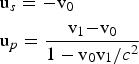 $$\eqalign{& {\rm u}_s = - {\rm v}_0 \cr & {\rm u}_p = \displaystyle{{{\rm v}_1 {\rm - v}_0 } \over {1 - {\rm v}_0 {\rm v}_1 /c^2 }}}$$
The solution of the three conservation laws given in Eq. (1) are given in the laboratory frame of reference by
 $$\eqalign{& \displaystyle{{{\rm u}_s } \over c} = \sqrt {\displaystyle{{\left({P_1 - P_0 } \right)\left({e_1 + P_0 } \right)} \over {\left({e_1 - e_0 } \right)\left({e_0 + P_1 } \right)}}} \cr & \displaystyle{{{\rm u}_p } \over c} = \sqrt {\displaystyle{{\left({P_1 - P_0 } \right)\left({e_1 - e_0 } \right)} \over {\left({e_0 + P_1 } \right)\left({e_1 + P_0 } \right)}}} \cr & \displaystyle{{\left({e_1 + P_1 } \right)^2 } \over {{\rm \rho} _1 ^2 }} - \displaystyle{{\left({e_0 + P_0 } \right)^2 } \over {{\rm \rho} _0 ^2 }} = \left({P_1 - P_0 } \right)\left[{\displaystyle{{\left({e_0 + P_0 } \right)} \over {{\rm \rho} _0 ^2 }} + \displaystyle{{\left({e_1 + P_1 } \right)} \over {{\rm \rho} _1 ^2 }}} \right]}$$
The last of Eq. (3) is known as the Hugoniot equation. The equation of state (EOS) taken here in order to calculate the shock wave parameters is the ideal gas EOS
 $$e = {\rm \rho} c^2 + \displaystyle{P \over {\Gamma - 1}}$$
where Γ is the specific heat ratio. Substituting the EOS equation (4) into the Hugoniot equation we get the Hugoniot function for an initial pressure P 0 = 0
 $$\displaystyle{{P_1 } \over {{\rm \rho} _0 c^2 }} = \left({\displaystyle{{\left({\Gamma - 1} \right)^2 } \over \Gamma }} \right)\left[{\left({\displaystyle{{{\rm \rho} _1 } \over {{\rm \rho} _0 }}} \right)^2 - \;\left({\displaystyle{{\Gamma + 1} \over {\Gamma - 1}}} \right)\left({\displaystyle{{{\rm \rho} _1 } \over {{\rm \rho} _0 }}} \right)} \right]$$
Note that Eq. (5) is defined only for compression larger than (Γ + 1)/Γ − 1), namely for Γ = 5/3 the curves of Eq. (5) starts from ρ1/ρ0 = 4, P 1 = 0, T 1 = 0. Therefore in the general case, we cannot assume P 0 = 0 and in this case we obtain the following Hugoniot curves
 $$\eqalign{& \Pi ^2 + B\Pi + C = 0 \cr & \Pi = \left({\displaystyle{1 \over 2}} \right)\left({ - B + \sqrt {B^2 - 4C} } \right)\cr & B = \displaystyle{{\left({\Gamma - 1} \right)^2 } \over \Gamma }\left({{\rm \kappa} _0 {\rm \kappa} - {\rm \kappa} ^2 } \right)+ \Pi _0 \left({\Gamma - 1} \right)\left({1 - {\rm \kappa} ^2 } \right)\cr & {\rm C = }\displaystyle{{\left({\Gamma - 1} \right)^2 } \over \Gamma }\left({{\rm \kappa} - {\rm \kappa} _0 {\rm \kappa} ^2 } \right){\rm }\Pi _0 - {\rm \kappa} ^2 \Pi _0 ^2 }$$
where we use the following definitions
 $${\rm \kappa} \equiv \displaystyle{{{\rm \rho} _1 } \over {{\rm \rho} _0 }}\semicolon \; {\rm }{\rm \kappa} _0 \equiv \displaystyle{{\Gamma + 1} \over {\Gamma - 1}}{\rm \semicolon \; }\Pi \equiv \displaystyle{{P_1 } \over {{\rm \rho} _0 c^2 }}{\rm \semicolon \; }\Pi _0 \equiv \displaystyle{{P_0 } \over {{\rm \rho} _0 c^2 }}{\rm }$$
For Π0 = 0, Eq. (6) reduces to Eq. (5). For a non-zero Π0, we have a quadratic equation in Π with two solutions; however only the plus sign is appropriate since C < 0 and Π > 0. Note also that Π = 0 only if Π0 = 0 and κ = 1 for Π = Π0. In general, Π is a function of κ and Π0 as a parameter, Π = f(κ; Π0), and Π is positive for compressions larger than 1as requested by a shock wave.
3. LASER INDUCED SHOCK WAVE
For laser induced relativistic shock waves, the initial pressure can be neglected and Eq. (5) is a very good approximation implying that the compression is practically always larger than (Γ + 1)/Γ −1). Therefore, we use Eq. (5), namely P 0 = 0 and chose Γ = 5/3 for our laser-shock wave calculations. From the above relativistic shock wave analysis we take the following equations in order to analyze the shock wave induced by ultra-high laser irradiances:
 $$\left. \matrix{\displaystyle{{{\rm u}_p } \over c} = \left[{\displaystyle{{\Pi \left({1.5\Pi + {\rm \kappa} - 1} \right)} \over {\left({1 + \Pi } \right)\left({1.5\Pi + {\rm \kappa} } \right)}}} \right]^{1/2} \hfill \cr \displaystyle{{{\rm u}_s } \over {{\rm u}_p }} = \displaystyle{{e_1 } \over {e_1 - e_0 }} = \displaystyle{{5{\rm \kappa} + 2{\rm \kappa} \left({{\rm \kappa} - 4} \right)} \over {5\lpar {\rm \kappa} - 1\rpar + 2{\rm \kappa} \left({{\rm \kappa} - 4} \right)}} \hfill \cr \Pi = \left({\displaystyle{4 \over {15}}} \right){\rm \kappa} \left({{\rm \kappa} - 4} \right)\hfill} \right\}{\rm for }\;{\rm \kappa} \ge 4$$
With the development of laser irradiances (Piazza et al., Reference Piazza, Muller, Hatsagortsyan and Keitel2012) larger than 1021 W/cm2 it became possible to obtain relativistic shock waves due to the laser pressure P = 2I F /c, where I F is the laser irradiance in the accelerated foil rest frame and c is the speed of light and it is assumed that the reflection in the foil rest frame is one. The laser irradiance I L and angular frequency ωL in the laboratory are related to their appropriate values in the foil rest frame (denoted by subscript F) by Doppler equation (see appendix A),
 $$\eqalign{& I_L = I_F \left({\displaystyle{{{\rm \omega} _L } \over {{\rm \omega} _F }}} \right)^2 = I_F \left({\displaystyle{{1 + {\rm \beta} } \over {1 - {\rm \beta} }}} \right)\cr & P = \displaystyle{{2I_L } \over c}\left({\displaystyle{{1 - {\rm \beta} } \over {1 + {\rm \beta} }}} \right)}$$
where cβ is the foil velocity in the laboratory frame of reference. For the ultra-high laser irradiance, I L ~ 1021 W/cm2 and higher, we use the laser piston model to describe the shock wave. In this case, we assume that the laser pressure given by Eq. (9) pushes the target like a piston with velocity cβ. In this model, one has the following relations
 $$\eqalign{& \displaystyle{{{\rm u}_p } \over c} = {\rm \beta} \cr & {\rm \beta} = \displaystyle{{2\Pi _L - \Pi } \over {2\Pi _L + \Pi }}\semicolon \; {\rm }\Pi _L \equiv \displaystyle{{I_L } \over {{\rm \rho} _0 c^3 }}}$$
The second of Eq. (10) is derived from the second of Eq. (9) with the definition of Π from Eq. (7). The first of Eq. (10) is the definition of the laser piston model where the particle velocity in the shocked area is equal to the piston velocity.
Equating the first of Eq. (8) to Eq. (10) and substituting Π from Eq. (8) yields a quadratic equation in κ
 $$4\left({1 - {\rm \beta} ^2 } \right){\rm \kappa} ^2 - 12\left({1 - {\rm \beta} ^2 } \right){\rm \kappa} - 9{\rm \beta} ^2 - 16 = 0$$
with one physical solution for the compressibility κ and the dimensionless pressure Π
 $$\eqalign{& {\rm \kappa} = \displaystyle{3 \over 2} + \left({\displaystyle{5 \over 2}} \right)\displaystyle{1 \over {\sqrt {1 - {\rm \beta} ^2 } }} \cr & \Pi = \left({\displaystyle{4 \over 3}} \right)\left({\displaystyle{5 \over {1 - {\rm \beta} ^2 }} - \displaystyle{2 \over {\sqrt {1 - {\rm \beta} ^2 } }} - 3} \right)\cr & \quad \quad \simeq {\rm }\left({\displaystyle{4 \over 3}} \right){\rm \beta} ^2 \quad {\rm for }\, {\rm \beta} { \lt \!\!\!\lt 1}}$$
Substituting the relation between Π and β in Eq. (10) we get the numerical solutions of κ, Π, and β as a function of the dimensionless laser intensity ΠL as described in Figures 1, 2, and 3. From the second of Eq. (8) we get the shock wave velocity u s/c as given in Figure 4.
(Color online) The piston velocity β (in units of the speed of light c) as a function of the laser irradiance in dimensionless units ΠL = I L/(ρ0c 3), where I L is the laser irradiance in the laboratory frame of reference, ρ0 is the target initial density before the shock wave arrival. The inserted table gives some numerical examples for convenient estimation of the figure under consideration.

(Color online) The compression compression κ, κ = ρ/ρ0 where ρ is the density of the shocked target and ρ0 is the target initial density before the shock wave arrival, as a function of the laser irradiance in dimensionless units ΠL (see Fig. 1 caption for definitions and the inserted table).
(Color online) The dimensionless shock pressure Π, Π = P/(ρ0c 2) where P is the pressure in the shocked target, as a function of the laser irradiance in dimensionless units ΠL (see Fig. 1 caption for definitions and the inserted table).
(Color online) The shock wave velocity u s (in units of c) in the laboratory frame of reference as a function of the laser irradiance in dimensionless units ΠL (see Fig. 1 caption for definitions and the inserted table).
The relativistic speed of sound c S for an ideal gas EOS is
 $$\displaystyle{{c_s } \over c} = \left({\displaystyle{{\partial P} \over {\partial e}}} \right)_S = \left({\displaystyle{{\Gamma P} \over h}} \right)^{1/2}$$
where h is the enthalpy density defined by
 $$h = e + P = {\rm \rho} c^2 + \displaystyle{{\Gamma P} \over {\Gamma - 1}}$$
In Eq. (14) the ideal gas equation of state (4) has been used. Eq. (13) yields
 $$\displaystyle{{c_S } \over c} = \left[{\displaystyle{{\Gamma \left({\Gamma - 1} \right)\Pi } \over {\left({\Gamma - 1} \right){\rm \kappa} + \Gamma \Pi }}} \right]^{1/2}$$
 $$\displaystyle{{c_S } \over c} = \left[{\displaystyle{{4\left({{\rm \kappa} - 4} \right)} \over {3\left({2{\rm \kappa} - 5} \right)}}} \right]^{1/2} = \left[{\left({\displaystyle{{10} \over 3}} \right)\left({\displaystyle{{1 - \sqrt {1 - {\rm \beta} ^2 } } \over {5 - \sqrt {1 - {\rm \beta} ^2 } }}} \right)} \right]^{1/2}$$
Eq. (16) are obtained for Γ = 5/3 after using the third of Eq. (8) and our solution (12). In Figure 5, the sound velocity is plotted as a function of the dimensionless laser irradiance ΠL. It is interesting to point out the limits: c S(β → 0) = 0, κ(β → 0) = 4 and c S(β → 1) = (2/3)1/2c, κ(β → 1) = ∞.
(Color online) The speed of sound Cs (in units of c) as a function of the laser irradiance in dimensionless units ΠL (see Fig. 1 caption for definitions and the inserted table).
In the shocked medium, the characteristic velocity c ch of a disturbance from the piston to the shock wave front is given by
 $$\eqalign{& c_{ch} = \displaystyle{{c_S + u_p } \over {1 + \left({\displaystyle{{c_S u_p } \over {c^2 }}} \right)}} \cr & \displaystyle{{c_{ch} } \over c} = \displaystyle{{\left({c_S /c} \right)+ {\rm \beta} } \over {1 + {\rm \beta} \left({c_S /c} \right)}}}$$
The second of Eq. (17) follows in our piston model where βc = u p. Note that in the compressed domain c ch(β → 1) = c and c ch > u s (see Fig. 6) so that the shock wave is stable.
(Color online) The characteristic velocity c ch (in units of c) describing the speed of a disturbance from the piston to the shock wave front in the shocked medium as a function of the piston velocity β.
4. DISCUSSION
This paper analyzes the shock wave created in a planar target by the ponderomotive force induced by very high laser irradiance. In this domain of laser intensities, the force acts on the electrons that are accelerated and the ions that follow accordingly. The system of the negative and positive layers is called a double layer (DL). In our case, we have DL acceleration by the laser irradiance (Eliezer et al., Reference Eliezer, Nissim, Martinez Val, Mima and Hora2014; Eliezer & Hora, Reference Eliezer and Hora1989). This DL acts as a piston driving a shock wave (Naumova et al., Reference Naumova, Schlegel, Tikhonchuk, Labaune, Sokolov and Mourou2009; Eliezer et al., Reference Eliezer, Martinez Val and Pinhasi2013). This model is supported in the literature by particle in cell (PIC) simulation (Esirkepov et al., Reference Esirkepov, Borghesi, Bulanov, Mourou and Tajima2004; Naumova et al., Reference Naumova, Schlegel, Tikhonchuk, Labaune, Sokolov and Mourou2009) and independently by hydrodynamic two fluid simulations (Hora et al., Reference Hora, Lalousis and Eliezer1984; Lalousis et al., Reference Lalousis, Hora, Eliezer, Martinez Val, Moustaizis, Miley and Mourou2013; Reference Lalousis, Foldes and Hora2012). However, the laser-induced relativistic shock wave parameters, such as compression, pressure, shock wave, and particle flow velocities, sound velocity and temperature are calculated here for the first time in the context of relativistic hydrodynamics.
The collisions of non-relativistic shock waves have a significant effect in increasing compression, pressure and temperature (Jackel et al., Reference Jackel, Salzmann, Krumbein and Eliezer1983) in an effective way. This idea has been suggested (Betti et al., Reference Betti, Zhou, Anderson, Perkins, Theobald and Sokolov2007) in order to simplify and improve the fast ignition scheme (Basov et al., Reference Basov, Guskov and Feoktistov1992; Tabak et al., Reference Tabak, Hammer, Glinsky, Kruer, Wilks, Woodworth, Campbell, Perry and Mason1994). Following our relativistic shock waves enormous pressures and temperatures can be achieved. From Figure 3 one gets that for initial densities of the order of 1 g/cm3 a laser irradiance of 2.5 × 1024 W/cm2 yield a pressure of the order of 1015 atmospheres, a 1000 times more than the maximum shock wave pressures achieved so far in the laboratory (Cauble et al., Reference Cauble, Phillion, Hoover, Holmes, Kilkenny and Lee1993). The temperatures associated with these shock waves are also high as can be seen from the ideal gas equation of state relating temperature to density (Eliezer et al., Reference Eliezer, Ghatak, Hora and Teller2002) P = nk BT, or equivalently by
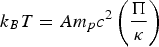 $$k_B T = Am_p c^2 \left({\displaystyle{\Pi \over {\rm \kappa} }} \right)$$
A is the atomic mass of the target (e.g., for a deuterium-tritium plasma we have A = 2.5), m p is the proton mass, n and T are accordingly the ion particle density and the temperature and k B is the Boltzmann constant. κ and Π are calculated in Figures 2 and 3 accordingly as a function of the dimensionless laser irradiance ΠL. A laser irradiance of 2.5 × 1024 W/cm2 (ΠL = 0.691 and initial density ρ0 = 1 g/cm3) yields Π/κ ~ 0.1 implying a temperature of about (100 MeV)A. These high temperatures might trigger fast ignition induced by a heat wave as described recently in the literature (Eliezer & Pinhasi, Reference Eliezer and Pinhasi2013). However, a clarification about temperature is needed at this stage.
The extremely high temperatures as derived from Eq. (18) are exaggerated since for hot and dense plasmas the electrons and the photons can also contribute to the pressure besides the ions as given above. Thermal equilibrium for each species implies in general three temperatures T i, T e, and T r for ions, electrons, and radiation accordingly. Assuming thermal equilibrium between the ions, electrons and photons T i = T e = T r = T one has
 $$\eqalign{& P = \left({Z + 1} \right)n_i k_B T + \left({\displaystyle{1 \over 3}} \right)aT^4 \cr & a = \left({\displaystyle{1 \over {15}}} \right)\left({\displaystyle{{k_B ^4 } \over {h^3 c^3 }}} \right)= 7.56 \cdot 10^{ - 15} \lsqb erg/\lpar cm^3 K^4 \rpar \rsqb }$$
Z is the degree of ionization relating the ion density n i to the electron density n e by the charge neutrality relation n e = Zn i and the last term on the right-hand side of Eq. (19) is the radiation pressure. The radiation pressure becomes the dominant term in this equation for temperatures (in energy units) larger than 1.6 keV × [(Z + 1)(n i/1023cm−3)]1/3, namely for a solid uncompressed density with Z = 1 the radiation pressure is dominant for temperatures larger than about 2 keV. Therefore, in this case, the shock wave temperature is of the order of
 $$T \sim \left({\displaystyle{{3P} \over a}} \right)^{1/4}$$
For pressure of the order I L/c ~ 1015 atmospheres one gets a shock wave temperature of the order of 100 keV. The temperature estimation of Eq. (20) is based on the assumption that radiation is in thermal equilibrium with the electron plasma. For our shock wave density, with a compression of the order 10 and with an initial solid density, it is conceivable that electrons and ions are in thermal equilibrium, i.e., T e = T i, however the shocked area is not optically thick for the energetic photons and they are leaving the system; implying T r ≪ T e or one can have a situation where radiation temperature is not defined at all. In this case, one has to consider the energy loss due to the photons that escape the shocked area without interaction. In this case, we can write
 $$\left({\displaystyle{{Am_p c^2 } \over {k_B }}} \right)\left({\displaystyle{\Pi \over {\rm \kappa} }} \right) \gt T \gt \left({\displaystyle{{3P} \over a}} \right)^{1/4}$$
For temperatures larger than required to fully ionize the target (between 10 keV and 100 keV depending on the target under consideration) and for densities considered in this paper, our plasma is optically thin and the photon spectrum will be determined by the bremsstrahlung emission of the charged particles. The bremsstrahlung losses (per unit volume and per unit time) from the electrons with a temperature T are (Eliezer et al., Reference Eliezer, Henis, Martinez Val and Vorobeichik2000)
 $$P_B \left({\displaystyle{{keV} \over {cm^3 \cdot s}}} \right)= 2.94 \cdot 10^{ - 15} Z^2 n_e n_i T_{keV} ^{1/2} \left({1 + \displaystyle{{2T_{keV} } \over {511.1}}} \right)$$
Where 2T keV/511.1 is a relativistic correction term. Thermal equilibration of photons and electrons does not take place, since the hot photons are leaving the plasma before the equilibrium is established. Therefore, for the cases considered here the radiation does not reach a Planck distribution and T r does not exists. In this case, the overestimated radiation losses (Eliezer et al., Reference Eliezer, Henis, Martinez Val and Vorobeichik2000) due to the inverse Compton effect is not relevant.
As mentioned above the interesting relativistic shock waves are for laser irradiance of the order of 2.5 × 1024 W/cm2. This implies a laser irradiation pressure of the order I L/c ~ 1015 atmospheres that does a work PΔV; in our model via the piston described in Section 3. The absorbed laser energy ΔW L conservation (per unit area) is distributed along the shocked distance x between the internal energy xΔe and the mechanical work PΔV according to
 $$\Delta W_L = x\Delta e + P\Delta x$$
The absorbed energy A L and the reflected laser energy R L (A L + R L = 1) in our model is given by
 $$A_L = \displaystyle{{2{\rm \beta} } \over {1 + {\rm \beta} }}\semicolon \; {\rm }R_L = \displaystyle{{1 - {\rm \beta} } \over {1 + {\rm \beta} }}$$
Therefore, the absorbed energy and piston pressure are
 $$\eqalign{& P = \displaystyle{{I_L } \over c}\lpar 1 + R_L \rpar \cr & W_L = A_L I_L {\rm \tau} _L }$$
In this model, it is important to point out that for temperature derived by our EOS the bremsstrahlung losses are by far smaller than the laser absorbed energy per unit volume (of the shocked target) per unit time for the laser irradiances and pulse time duration (1024 W/cm2, τL ~ 10 fs) and electron and ion plasma densities of the order of 1024 cm−3 in the shocked volume.
 $$P_L \equiv \left({\displaystyle{{W_L } \over {V{\rm \tau} _L }}} \right)= \left({\displaystyle{{I_L } \over {u_s {\rm \tau} _L }}} \right)\gt\!\!\! \gt P_B$$
Therefore, the estimated temperature can be larger than 1 MeV in energy units and therefore very excited physics like electron positron (e +e −) formation is expected in the shocked area. For temperature about the pion mass, k BT ~ m πc 2 ~150 MeV, where m π is the pion mass, the very interesting regime of quark-gluon plasma can be achieved. Before reaching such an important conclusion the energy losses to e +e − must be calculated.
We end this section with some comments regarding the important subject of the EOS. The EOS in shock wave physics is one of the most complicated subjects (Eliezer, Reference Eliezer, McKenna, Neely, Bingham and Jaroszynski2013; Fortov & Lomonosov, Reference Fortov and Lomonosov2010) and for the relativistic shock wave it requires a separate paper. In this paper, we take the ideal gas EOS with the specific heat ratio of Γ = 5/3. Our justification for this particular ideal gas EOS is the high temperature T > 100 keV with a fully ionized target. In a general paper discussing the stability properties of relativistic shock waves (Russo, Reference Russo1988), the hot matter is described by politropic EOS, e.g., ideal gases with different values of Γ. The most striking difference in our case for different Γ is the practically compression larger than (Γ + 1)/(Γ−1); For example, an ideal electron gas with SIX degrees of freedom (three translational degrees of freedom times two spin degrees of freedom) has Γ = 4/3 implying a compression larger than 7. Other possibility (Russo, Reference Russo1988; Eliezer et al., Reference Eliezer, Ghatak, Hora and Teller2002) is the degenerate EOS for electrons. It should be mentioned that we do not expect the degeneracy of the electrons since the electron temperature T is larger than the Fermi temperature T F given by
 $$\eqalign{& k_B T_F = \left({\displaystyle{{h^2 } \over {8m_e }}} \right)\left({\displaystyle{3 \over {\rm \pi} }} \right)^{2/3} n_e ^{2/3} \cr & n_e = {\rm \kappa} \left({\displaystyle{{{\rm \rho} _0 Z} \over {Am_p }}} \right)}$$
Z is the degree of ionization and we expect a fully ionized plasma for the temperature under consideration, T > 100 keV. Using an initially solid state target and our calculated compression κ ~ 8 the electron density n e is of the order of 1025 cm−3 in the shocked plasma. In this case, Eq. (27) yields a Fermi temperature T F ~ 100 eV. Therefore, in our laser induced shock waves T ≫ T F and the electrons in the compressed shock wave area are not Fermi degenerate.
Finally, as is well-known (Eliezer, Reference Eliezer, McKenna, Neely, Bingham and Jaroszynski2013; McQueen, Reference McQueen, Eliezer and Ricci1991) from the non-relativistic shock wave experimental data the relation between the shock wave (u s) and the flow particle (u p) velocities are connected by a linear relation for many materials. In our relativistic case, this relation is described in Figure 7 (note that u p ≡ β in this case). From our Figure 7 one can see that in the domain 0 < β< 0.4 also a very good fit (R 2 = 0.9997) is derived by the linear relation
(Color online) The shock velocity us in units of speed of light c as a function of the particle velocity u p = cβ.
 $$\displaystyle{{u_s } \over c} = 0.0044 + 1.2827{\rm \beta}$$
APPENDIX A
In this appendix, we justify our Eq. (9). The laser irradiance I is related to the Poynting vector S (in Gaussian units)
 $${\bf S} = {\rm I}\left({\bf k}/{\rm k} \right)= \lpar {\rm c}/{\rm 4}{\rm \pi} \rpar {\bf E} \times {\bf H}$$
where E and H are the electric and magnetic field strengths accordingly, k/k is a unit vector with k the wave number and bold letters denote vectors in the three space dimension. We are considering two frames of reference moving relative to each other with a velocity β (we take c =1 units, namely velocities are measured in units of the speed of light) in the x direction. Subscript F and subscript L denote the variables in our piston frame of reference and in the laboratory frame of reference accordingly. The x, y, z subscripts are vector components in the x, y, z directions.
The Lorentz transformation of the electric and magnetic fields are given by
 $$\eqalign{& E_{Lx} = E_{Fx} \semicolon \; E_{Ly} = {\rm \gamma} \left({E_{Fy} + {\rm \beta} H_{Fz} } \right)\semicolon \; E_{Lz} = {\rm \gamma} \left({E_{Fz} - {\rm \beta} H_{Fy} } \right)\cr & H_{Lx} = H_{Fx} \semicolon \; H_{Ly} = {\rm \gamma} \left({H_{Fy} - {\rm \beta} E_{Fz} } \right)\semicolon \; H_{Lz} = {\rm \gamma} \left({H_{Fz} + {\rm \beta} E_{Fy} } \right)\cr & {\rm \gamma} = \displaystyle{1 \over {\sqrt {1 - {\rm \beta} ^2 } }}}$$
Using the two Lorentz invariant quantities E·H = 0 and E2 − H2 = 0 and Eqs. (29) and (30) one gets our first of Eq. (9). This can easily be checked for the special case of linear laser polarization E = (0, E, 0), H = (0, 0, H).
For the proof of the second of Eq. (9), we have used the first of Eq. (9) and the equality
 $$P_L = P_F$$
where P L = 2I L/c and P F = 2I F/c are the pressures on the piston in the laboratory and the piston frames of reference accordingly. Eq. (31) is based on the fact that forces acting on the piston, the ponderomotive force in our case, FL and FF are in the x direction and F Lx = F Fx. Using the Lorentz transformation on Newton send law F = d p/dt, where p is the momentum under consideration, one easily gets F Lx = F Fx; F Ly = (1/γ) F Fy; F Lz = (1/γ) F Fz.
APPENDIX B
In this appendix, we give a derivation of Eq. (1) and their solution given in Eq. (3) using Taub's four-dimensional formalism (Taub, Reference Taub1948). The relativistic shock waves are considered in the context of relativistic fluid dynamics (Landau &Lifshitz, 1987). The equations of motion are described by the relativistic energy-momentum four-tensor T μν given by
 $$T_{{\rm \mu} {\rm \nu} } = \lpar e + P\rpar U_{\rm \mu} U_{\rm \nu} + Pg_{{\rm \mu} {\rm \nu} }$$
A Greek index takes the values: 0,1,2,3 while we use the Latin index for the space values 1, 2, 3. U μ = (γc, γv 1, γv 2, γv 3) is the four-velocity where (v 1,v 2,v 3) is the fluid element velocity in three dimension (x,y,z), e is the internal energy density of the fluid which includes the rest energy mass of the fluid particles, P is the pressure, the metric tensor g μν is g 00 = −1, g 11 = g 22 = g 33 = 1, g μν = 0 for μ ≠ ν and for a three dimension velocity v one defines
 $${\rm \gamma} = \displaystyle{1 \over {\sqrt {1 - {\rm \beta} ^2 } }}\semicolon \; {\rm }{\rm \beta} {\rm = }\displaystyle{{\rm v} \over c}$$
Since Eq. (32) is the starting point of our calculations, we write it more explicitly
 $$\eqalign{& T_{00} = {\rm \gamma} ^2 \left({e + P} \right)- P \cr & T_{0i} = T_{i0} = - {\rm \gamma} ^2 \left({e + P} \right)/c\, \, {\rm for \, \, i = 1\comma \; 2\comma \; 3} \cr & {\rm T}_{ij} = {\rm \gamma} ^2 \left({e + P} \right)\left({\displaystyle{{{\rm v}_i } \over c}} \right)\left({\displaystyle{{{\rm v}_j } \over c}} \right)+ P{\rm \delta} _{ij} \, \, {\rm for \, \, i\comma \; j = 1\comma \; 2\comma \; 3}}$$
δij = 1 for i = j and δij = 0 for i ≠ j. T 00 is the energy density [J/m3], −T 0i/c is the momentum component density [kg/m2 · s] and T ij is the momentum flux density. The equations describing the relativistic fluid motion (neglecting internal friction and thermal conduction) are
 $$\eqalignno{& {\rm The\, energy - momentum\, conservation\colon \; } \displaystyle{{\partial T_{\rm \mu} ^{\rm \nu} } \over {\partial x^{\rm \nu}}} \equiv \partial _{\rm \nu} T_{\rm \mu} ^{\rm \nu} = 0\, \cr & {\rm for }\, {\rm \mu} {\rm \;= 0\comma \; 1\comma \; 2\comma \; 3}{\rm .} \cr & {\rm The\, particle\, number\, conservation\colon }\quad \quad \displaystyle{{\partial \lpar nU^{\rm \mu}\rpar } \over {\partial x^{\rm \mu}}} \equiv \partial _{\rm \mu} \left({nU^{\rm \mu}} \right)= 0 \cr & {\rm The\, equation\, of\, State\colon }\quad \quad \quad \quad \quad \quad \quad P{\rm \;=\; }P\left({e\comma \; n} \right)}$$
The Einstein summation convention (from 0 to 3) is assumed for identical indexes. We assume a one-dimensional shock wave where the shock propagates in the x direction and the shock wave surface singularity is in the y-z plane. Furthermore, the shock wave is time independent by looking into a coordinate system where the shock front is at rest. In this shock wave reference system (the shock system), the observer is at rest relative to the material on both sides of the shock front. We use the subscript 0 and 1 to denote the variables in front (where the shock wave did not arrive yet) and in the back (the shocked area) of the shock wave, respectively. The physical quantities: pressure P, particle density n, mass density ρ, energy density e, entropy density s and temperature T are measured in their proper frame of reference, defined as the reference frame where the corresponding fluid element is at rest. The flow velocities v 0 and v 1, assumed in the x direction, are measured in the shock wave reference system. In this case, we define β0 = v 0/c, β1 = v 1/c, and γ0, γ1 according to Eq. (33).
The conservation laws across the shock wave singularity describe the flux densities conservation of energy –c[T 0x]0 = –c[T 0x]1 and momentum [T xx]0 = [T xx]1 as defined in Eq. (34) and the particle number flux conservation defined by [nU x]0 = [nU x]1. These conservation laws are explicitly given by the following equations accordingly
 $$\eqalign{& {\rm \gamma} _0 ^2 {\rm \beta} _0 \left({e_0 + P_0 } \right)= {\rm \gamma} _1 ^2 {\rm \beta} _1 \left({e_1 + P_1 } \right)\cr & {\rm \gamma} _0 ^2 {\rm \beta} _0 ^2 \left({e_0 + P_0 } \right)+ P_0 = {\rm \gamma} _1 ^2 {\rm \beta} _1 ^2 \left({e_1 + P_1 } \right)+ P_1 \cr & {\rm \gamma} _0 {\rm \beta} _0 n_0 = {\rm \gamma} _1 {\rm \beta} _1 n_1 }$$
Regarding the particle conservation, the third of Eq. (36) it is important to clarify that for very high temperature T new particles can be created, such as electron-positron pairs. In this case, we consider the electric charge conservation of the electron-positron system in this example and the barion number conservation in the case of the ions. However, for the case that number of electrons (+positrons) is not order of magnitude more than the number of ions and new particles are not created in significant numbers one can change the particle number with the density according to
 $$n_o = \displaystyle{{{\rm \rho} _0 } \over {Am_p }}\semicolon \; {\rm }n_1 = \displaystyle{{{\rm \rho} _1 } \over {Am_p }}$$
Substituting Eqs. (37) and (33) (for subscripts zero and one) into Eq. (36) one gets the first equation of this paper — Eq. (1).
In order to solve Eq. (36) we substitute
 $${\rm \gamma} _{\rm j} = {\rm cosh \, x}_{\rm j} \;{\rm \lpar } \! \! \Rightarrow {\rm \beta} _j = \tanh {\rm x}_{\rm j} {\rm \rpar \;for \, j = 0\comma \; 1}$$
into the first two equations of (36) to obtain
 $$\eqalign{& \lpar e_0 + P_0 \rpar \sinh x_0 \cosh x_0 = \lpar e_1 + P_1 \rpar \sinh x_1 \cosh x_1 \cr & \lpar e_0 + P_0 \rpar \sinh ^2 x_0 + P_0 = \lpar e_1 + P_1 \rpar \sinh ^2 x_1 + P_1 }$$
Substituting into Eq. (39) (after squaring the first equation)
 $$y_j = \cosh ^2 x_j {\rm }\;\left({ \Rightarrow \sinh ^2 x_j = y_j - 1} \right){\rm \;for \,\, j = 0\comma \; 1}$$
one gets two linear equations in y 0 and y 1 with the following solution
 $$\eqalign{& y_0 = \displaystyle{{\left({e_1 - e_0 } \right)\left({e_0 + P_1 } \right)} \over {\left({e_0 + P_0 } \right)\left({e_1 + P_0 - e_0 - P_1 } \right)}} \cr & y_1 = \displaystyle{{\left({e_1 - e_0 } \right)\left({e_1 + P_0 } \right)} \over {\left({e_1 + P_1 } \right)\left({e_1 + P_0 - e_0 - P_1 } \right)}}}$$
Using the hyperbolic identities we have
 $${\rm \beta} _j ^2 = \tanh ^2 {\rm x}_{\rm j} = 1 - \displaystyle{1 \over {\cosh ^2 {\rm x}_{\rm j} }} = 1 - \displaystyle{1 \over {y_j }}{\rm \;for \; j = 0\comma \; 1}$$
Substituting y j (j = 0, 1) from (41) into (42) we get the velocities βj = v j/c for j = 0,1 as has been used in the two first equations of (3)
 $$\eqalign{& \displaystyle{{{\rm v}_0 } \over c} = {\rm \beta} _0 = \sqrt {\displaystyle{{\left({P_1 - P_0 } \right)\left({e_1 + P_0 } \right)} \over {\left({e_1 - e_0 } \right)\left({e_0 + P_1 } \right)}}} \cr & \displaystyle{{{\rm v}_1 } \over c} = {\rm \beta} _1 = \sqrt {\displaystyle{{\left({P_1 - P_0 } \right)\left({e_0 + P_1 } \right)} \over {\left({e_1 - e_0 } \right)\left({e_1 + P_0 } \right)}}} }$$
Substituting these solutions into the third equation of (36) and using Eq. (37) we got the Hugoniot relation — namely the third of Eq. (3)



