The current scholarship on compliance with EU legislation mostly covers policy areas with limited immediate distributive implications. Thus, the potential conflict among societal actors, and the attendant role of unevenly distributed power resources in the domestic arena, has remained relatively understudied. Conversely, the implementation of the Services Directive (SD) requires the opening to competition of regulated professions and is therefore bound to create concentrated winners and losers. This article also joins the relatively few works on EU compliance that study actual, as opposed to formal, compliance (for a review, see e.g. Thomann and Sager Reference Thomann and Sager2017).
The original draft of the SD hinged on the home country principle, which extended the principle of mutual recognition of services, and required that service providers be regulated by the country where they were established rather than the country where they operated. Due to strong opposition from several trade unions and Member States, the home country principle was eventually dropped (Schmidt Reference Schmidt2009; Höpner and Schäfer Reference Höpner and Schäfer2010). In its place, the final version of the SD introduced the “freedom to provide services” (Art. 16), establishing the general rule that service provision should not be subject to authorisation by government authorities, which effectively requires the opening of the domestic markets for professional services (Davies Reference Davies2007; Wiberg Reference Wiberg2014). An indication of the persisting importance of the SD for the European Commission and of the domestic difficulties it has created is that by June 2019, ten years after its implementation deadline, Member States have yet to fulfil their administrative and regulatory obligations, prompting the Commission to start legal action against all Member States (Brunsden Reference Brunsden2019).
Greece is perhaps the Member State where the disruptive effects of the SD should be most apparent. On the one hand, professions in Greece started from a very high level of regulation. One year after the first Memorandum of Understanding (MoU) was signed, Greece’s professions were among the most regulated in the Organisation for Economic Co-operation and Development (European Commission 2011). On the other hand, compared with other EU Member States, Greece has been under especially heavy pressure to implement the SD: Between 2010 and 2018, the country was subject to external conditionality through three successive economic adjustment programmes, each formalised by a MoU with its international creditors, which mandated structural reforms, including the liberalisation of regulated professions.Footnote 1
We focus on the elimination or lowering of market entry barriers (Paterson et al. Reference Paterson, Fink, Ogus, Merz, Fink and Berrer2003). These barriers regard access to the whole profession or to specialisations within it, as well as the rules limiting the geographical areas in which professionals are entitled to practice. Thus, by increasing competition, liberalisation creates potential winners and losers and this article assesses the extent to which power differentials among them affected the outcome of the implementation process.
Hence, this article links the implementation of EU legislation to the broader issue of bias in interest intermediation, a classic issue in the study of politics that has been relatively neglected in recent years. It does so by connecting two established approaches to the study of interest groups, one focusing on interest groups’ resources and access to policymakers and the other focusing on interest groups’ influence, that have for the most part followed separate paths.
We further innovate on the interest group literature in two respects. While the interest group research that has included professions has assumed their members share the same policy preferences (Dür and Mateo Reference Dür and Mateo2013; Rasmussen and Carroll Reference Rasmussen and Carroll2014; Dür and Mateo Reference Dür and Mateo2016), we show that professions, especially those based on sophisticated technical knowledge, are profoundly divided over the regulation of competition.
Also, again in a departure from the literature, we aim to explain not only the differences in the professions’ influence on policy outcomes, i.e. on the extent of liberalisation, but also the differences in how quickly access to the professions was opened. We show that the speed of liberalisation across the four professions was affected by their relative power and by whether they were unified or divided over liberalisation. This argument also contributes to the EU compliance literature, which has attributed crossnational and crosspolicy variation in the speed of implementation to institutional differences or national preferences.
Not only is Greece a case where the SD has a high disruptive potential, but it is also an excellent locale for the study of bias. This is because bias is especially significant in systems characterised by clientelistic linkages between the parties and the interest groups, and Greece is one of the European countries where clientelistic practices are most prevalent (Kopecký et al. Reference Kopecký, Mair and Spirova2012; Sotiropoulos Reference Sotiropoulos2018).
Clientelism is an exchange relationship, whereby party actors provide private goods (including jobs in the public administration) or club goods such as regulation, in exchange for electoral support (Kitschelt and Wilkinson Reference Kitschelt, Wilkinson, Kitschelt and Wilkinson2007). In clientelistic systems, policymakers will respond to the pressures of specific groups rather than being accountable to voters at large (Kitschelt Reference Kitschelt2000; Kitschelt and Wilkinson Reference Kitschelt, Wilkinson, Kitschelt and Wilkinson2007), the bureaucracy will be politicised, and policymaking will be particularistic rather than programmatic, i.e. based on broad electoral platforms. In other words, clientelist systems of interest intermediation are characterised by low state autonomy, as state authorities will be especially receptive to the demands of narrow interests, and hence more likely to favour policy outcomes that reflect the power differences among these interests.
Greece is thus a “most likely case” for the expectation that power differences among interest groups have a significant impact on their ability to influence policy outcomes (Eckstein Reference Eckstein, Greenstein and Polsby1975). Specifically, clientelism in Greece resembles the parentela relationships, featuring party–interest group entanglement and party control over the entire hierarchy of the government bureaucracies, that Joseph LaPalombara identified in Italy (LaPalombara Reference LaPalombara1964). First, parties have captured the public administration (Lyrintzis Reference Lyrintzis1984; Pagoulatos Reference Pagoulatos2003; Katsimi and Moutos Reference Katsimi and Moutos2010; Chatzopoulou Reference Chatzopoulou2015). Second, observers stress the particularistic interdependence between the parties and the interest groups: the main parties permeate the membership of organised interests and, in turn, these interests are directly represented among the party cadres and leadership (Lavdas Reference Lavdas2005; Monastiriotis and Antoniades Reference Monastiriotis, Antoniades, Kalyvas, Pagoulatos and Tsoukas2013; Sotiropoulos Reference Sotiropoulos, Kalyvas, Pagoulatos and Tsoukas2013; Trantidis Reference Trantidis2016). If power differentials cannot be shown to significantly affect implementation here, this would invalidate our argument (Eckstein Reference Eckstein, Greenstein and Polsby1975).
Of the more than 150 professions and occupations affected by the implementation of the SD, the 4 professions covered in this article vary along the two dimensions of interest group unity and power, the latter defined in terms of the access resources they control. Along the first dimension, we distinguish between unified (tourist guides and taxi owners) and divided (lawyers and engineers) professions, based on whether there was intra-professional conflict over liberalisation. Along the second dimension, we follow two outsider groups, tourist groups and taxi owners, and two insider groups, lawyers and engineers. Lawyers and engineers control greater access resources than taxi owners and tourist guides because of their insider status and their deep connections to all major parties. Of the two outsider groups, taxi owners, through their institutionalised partisan connections, have greater access resources than tourist guides.
This article shows that the outcome and speed of liberalisation has reflected the power differentials, in terms of access resources, across and within the four professions, and this even at a time when the Greek government was under very significant external pressure to open up all regulated professions (see the online Appendix for how the liberalisation of these professions fits in the broader process of professional liberalisation in Greece).
This article is based on original research on tourist guides, engineers and lawyers. For taxi owners, we rely on recent work by Exadactylos and Zahariadis (Reference Exadactylos and Zahariadis2014), which we have complemented and updated. We interviewed 26 respondents knowledgeable about the liberalisation process between March 2016 and May 2018. The interviews were integrated with and checked against secondary literature and primary documents (see also the online Appendix).
The next section places the liberalisation of professions within the EU compliance and interest groups literature, describes the institutional context of the four interest groups and introduces our hypotheses. The second section presents the evidence. The third section discusses our findings and the final section concludes.
The theoretical framework and the Greek context
Until recently, research on compliance in the EU was mostly concerned with formal compliance (for reviews, see Toshkov Reference Toshkov2010; Treib Reference Treib2014; Thomann and Sager Reference Thomann and Sager2017), while studies of actual implementation or application of EU policies in the Member States were rather rare (Héritier Reference Héritier1997; Börzel Reference Börzel2000; Falkner et al. Reference Falkner, Treib, Hartlapp and Leiber2005; Versluis Reference Versluis2007; Falkner and Trieb Reference Falkner and Trieb2008).
While there has lately been a renewed interest in implementation (Dimitrova and Steunenberg Reference Dimitrova and Steunenberg2013; Exadactylos and Zahariadis Reference Exadactylos and Zahariadis2014; Batory Reference Batory2016; Thomann and Sager Reference Thomann and Sager2017; Dimitrova and Steunenberg Reference Dimitrova and Steunenberg2017; Schmälter Reference Schmälter2018), most of this work has focused on policy areas without major domestic distributive implications. The relatively little research that has focused on areas of potential domestic distributive conflict has indeed found that domestic interests can have a powerful impact on implementation, either facilitating (Börzel Reference Börzel2000; Slepcevic Reference Slepcevic2009) or hindering it (Héritier Reference Héritier1997; Falkner et al. Reference Falkner, Treib, Hartlapp and Leiber2005; Exadactylos and Zahariadis Reference Exadactylos and Zahariadis2014).
However, even this work has not systematically addressed the impact on implementation of power differentials among domestic actors. Conversely, in this article we focus on the actors that were involved in the distributive conflict generated by the dismantling of professional monopolies in Greece, their relationship with political parties and the variation in their ability to influence the liberalisation of professional services.
The unequal influence on outcomes among interest groups raises the question of bias, namely of whether the policymaking process consistently favours some interests over others. Addressing this question requires distinguishing power from influence (Arts and Verschuren Reference Arts and Verschuren1999), and conceptual and operationalisation problems have led to the marginalisation of bias as a research topic (Baumgartner and Leech Reference Baumgartner and Leech1998; Dür and De Bièvre Reference Dür and De Bièvre2007b).
To be sure, the interest group literature has recently returned to the concepts of power and policy influence. Nonetheless, with the important exception of work that mostly focuses on EU lobbying (Dür and De Bièvre Reference Dür and De Bièvre2007a; Mahoney Reference Mahoney2007; Klüver Reference Klüver2013; Dür and Mateo Reference Dür and Mateo2016), it has developed along two largely parallel tracks, as one approach has focused on the resources the interest groups can exchange for access to policymakers, and the other on interest group influence. Hence, both the influence and the exchange approach have sidelined the relationship between the distribution of power and the distribution of influence and thus have not tackled the question of bias head on.
The exchange approach ultimately derives from Walter Korpi’s work on power resources (Korpi Reference Korpi1985), and it assimilates interest groups’ power to the resources they can exchange for access to the policymakers. This approach emphasises the mutual dependence between policymakers and interest groups and is consistent with the insider-outsider distinction between the interest groups that have or do not have regular access to policymakers. Insiders are interests that are normally consulted by policymakers, e.g. through parliamentary hearings or by sitting on ministerial committees and advisory bodies (Maloney et al. Reference Maloney, Jordan and McLaughlin1994; Page Reference Page1999; Braun Reference Braun2012; Fraussen et al. Reference Fraussen, Beyers and Donas2015). Their involvement provides resources to the policymakers in terms of highly technical knowledge and other resources for policy design and implementation (Grant Reference Grant2000; Witko Reference Witko2009; Dür et al. Reference Dür, Bernhagen and Marshall2015).
In fact, the exchange approach emphasises policy-relevant information as the key “access good” (Bouwen Reference Bouwen2004; Chalmers Reference Chalmers2013). However, interest groups can also provide political and electoral support (Klüver Reference Klüver2013; Binderkrantz et al. Reference Binderkrantz, Christiansen and Pedersen2014; Klüver Reference Klüver2018). In this sense, clientelism, qua exchange relationship, can be subsumed within the exchange approach: Political resources are especially valuable in parentela systems where parties are the linchpin between interest groups and the bureaucracy.
Work in the exchange vein assumes a tight connection between exchangeable resources and access (Bouwen Reference Bouwen2002, Reference Bouwen2004; Beyers and Braun Reference Beyers and Braun2014), when it does not effectively equate the two (Beyers Reference Beyers2004). However, while access has indeed a close empirical connection to influence (Truman Reference Truman1951), the exchange approach has not pursued the question of how and under what conditions access becomes influence.
As for the influence approach, it has developed increasingly sophisticated measures of policy influence, conceived as “control over policy outcomes” (Dür and De Bièvre Reference Dür and De Bièvre2007b, 3), and usually operationalised as preference attainment, namely, the distance between the policy outcomes and the interest groups’ ideal points (Dür Reference Dür2008; Bunea Reference Bunea2013; Bernhagen et al. Reference Bernhagen, Dür and Marshall2014; Dür et al. Reference Dür, Bernhagen and Marshall2015). However, similarly to the exchange approach, the influence approach does not study whether and how power differences translate into different degrees of policy influence across interest groups.
Most research that does connect interest groups’ resources and influence has been at the EU level (Dür and De Bièvre Reference Dür and De Bièvre2007a; Mahoney Reference Mahoney2007; Klüver Reference Klüver2013; Dür and Mateo Reference Dür and Mateo2016). This work has produced important findings, for instance on the relative influence of concentrated versus diffuse interests (Dür and De Bièvre Reference Dür and De Bièvre2007a), or on how economic interests that control major investment decisions enjoy significant influence on EU policymakers (Klüver Reference Klüver2013).
However, with the exception of Dür and Mateo (Reference Dür and Mateo2016), it has not extended into the domestic arena of the EU Member States, although the implementation of EU legislation requires the cooperation of national governments and domestic interest groups, and the domestic political arena remains the focus of voters’ attention (Hobolt Reference Hobolt, Castells, Bouin, Caraça, Cardoso, Thompson and Wieviorka2018). Conversely, this article links interest groups’ resources and influence at the domestic level. As interest groups’ power and influence vary across issues (Dür and De Bièvre Reference Dür and De Bièvre2007b), we focus on a specific policy issue, the liberalisation of access to the professions, that has significant distributive implications.
Furthermore, interest group research has rarely discussed professions, but when it has, it has assumed the homogeneity of their interests (Dür and Mateo Reference Dür and Mateo2013; Rasmussen and Carroll Reference Rasmussen and Carroll2014; Dür and Mateo Reference Dür and Mateo2016). However, the regulation of competition is an issue that can unify or divide interests groups, depending on whether the regulatory changes affect most members in the same way or divide them between those who stand to lose or win from them (Smith Reference Smith2000).
As actors operating in a market economy, the members of a profession are also competitors. They are therefore liable to be in conflict with each other and, as in the similar case of business associations (Schmitter and Streeck Reference Schmitter and Streeck1999), a key issue for professional associations is the management of these divergent internal interests. For divided professions, as for interest groups more broadly, the institutional structure of interest aggregation defines which interests within the profession will find political representation.
Alexandre Afonso’s (Reference Afonso2011) and Thomas Paster’s (Reference Paster2014) studies of business associations have shown how these associations are divided by a dimensional cleavage, and how whoever (large or small and medium enterprises) controls the institutions of interest representation and aggregation of the association, also controls the association’s political action (see also Streeck Reference Streeck2009 for Germany). We argue that similar dynamics apply to professional interests, and especially the most technically sophisticated ones, as they are divided by size, location and specialisation.
We also innovate from the broader interest group literature, in that we aim to explain not only the content of policy change, i.e. the bias in the influence over policy outcomes, but also the speed of change. Speed matters as it makes a difference to interest groups if favourable or unfavourable changes occur rapidly or are pushed into the more distant, and uncertain, future.
Furthermore, both the European Commission and research on EU compliance have been concerned with the timeliness of implementation, for significant differences in the speed of implementation across Member States pose a threat to the single market and distort competition. While the EU compliance literature points to national preferences and national capacity for the explanation of the variation in the timeliness of implementation across policy areas and across Member States (e.g. Thomson Reference Thomson2007; König and Luetgert Reference König and Luetgert2009; Haverland et al. Reference Haverland, Steunenberg and Van Waardn2011), we emphasise the role of domestic interest groups.
We argue that the speed of implementation will depend, ceteris paribus, not only on the relative power of pro- and anti-change interest groups, but also on the extent to which interest groups are unified or divided. Especially, if powerful interest groups are divided over the regulatory change mandated by EU legislation, the need to first settle their internal conflict will slow down implementation regardless of which position (for or against change) ends up controlling access to domestic policymakers.
Before distinguishing between the unified and divided professions among the four professions covered in this article, we discuss the distribution of resources across them. Both lawyers and engineers are insiders. Their associations [respectively, the Bar Associations and the Technical Chamber of Greece (TCG)] are integral to the exercise of the functions of the Greek State (Koukias Reference Koukias1994). The Bar Associations are key actors ensuring the operation of the legal system and the TCG provides technical information to public actors. Representatives of both the most important Bar Associations (and the Athens Bar Association in particular) and of the TCG are regularly consulted by the relevant ministries and attend parliamentary hearings. Their insiderness is reinforced by their traditional over-representation among Members of Parliament (think-tank researcher, 24 January 2017) (Lakasa Reference Lakasa2011), which means that both professions enjoy close political connections with all main parties.
Taxi owners and tourist guides are outsiders, hence they do not enjoy regular access to policymakers. Both have fewer information resources to exchange compared to lawyers and engineers. As for political resources, taxi owners have fewer of them than lawyers and engineers, as their political connections are close, but limited to only one party. In turn, tourist guides have fewer political resources and thus access than taxi owners.
While taxi owners are organised in cooperatives (Exadactylos and Zahariadis Reference Exadactylos and Zahariadis2014), tourist guides are individual agents, which makes them much more difficult to mobilise (Olson Reference Olson1971). Tourist guides can join the Panhellenic Tourist Guides’ Federation, which, however, has no established connections to parties, and is run largely by volunteers and lacks access to timely information on policy changes potentially affecting the sector. In contrast, taxi owners can resort to disruptive strikes and mobilise electorally through their union [Syndakato Aftokinitiston Taxi (SATA)]. SATA, which used to be aligned with the center-right New Democracy (ND) party, has become close to left-wing Synaspismós Rizospastikís Aristerás (SYRIZA) since this party formed its first government in 2015.
In the case of professions, the insider-outsider dimension largely reflects their technical sophistication and institutionalisation and thus maps onto the degree of its internal differentiation, whether it be in terms of the location, dimension or specialisation of the professional actors. Differentiation (insiders) or lack thereof (outsiders) means that insiders can be expected to be divided, and outsiders unified, over liberalisation. Tourist guides and taxi owners are consistently opposed to the increased competition spurred by the elimination of professional monopolies; among lawyers and engineers, there is a clear differentiation between the winners and losers of liberalisation.
For lawyers, the interests within the profession are chiefly based on the size of the actors and of the market in which they operate: law firms and larger practices versus smaller practices, and lawyers serving larger urban markets versus lawyers in more peripheral markets. The larger, more competitive professional actors can be expected to view liberalisation with equanimity, if not as an opportunity to expand.
As for engineers, in Greece as elsewhere, the specialisations are separated early in the tertiary education process, and this separation is the basis for the legal definition of which professional tasks and areas are accessible to each subdiscipline. In Greece, "insurgents,” relatively new engineering specialisations such as chemical or environmental engineering, have been pitted against more established specialisations (civil and mechanical engineering) over the distribution of professional tasks; a similar conflict exists between engineers with a four-year BA from institutes of tertiary technological education (technological universities) and engineers with a five-year BA from general universities. Contrary to the case of lawyers, it is the more established actors that oppose liberalisation as that would mean opening up the boundaries of their disciplinary turfs.
Finally, with regard to their institutional structure (see also the online Appendix), for engineers, the TCG controls the process of preference aggregation, so that whoever controls it also controls the public position of the profession. In the case of lawyers, while there is no process to commit the whole profession to specific positions, the Athens Bar Association enjoys privileged access to national policymakers and thus its preferences carry much greater political weight than those of the other Bar Associations. Anti-liberalisation actors control the key institutions of TCG; conversely, the outsized position of the Athens Bar Association favours the representation of the interests of the potential winners from increased competition, such as the larger law practices from Athens and Thessaloniki.
The hypotheses
We define influence as preference attainment with regard to the implementation of the liberalisation measures introduced by the SD, and we determine the preferences of professional actors based on interviews and primary and secondary documents (Mahoney Reference Mahoney2007; Dür Reference Dür2008; Baumgartner et al. Reference Baumgartner, Berry, Hojnacki, Kimball and Leech2009; McKay Reference McKay2012; Bunea Reference Bunea2013; Klüver Reference Klüver2013; Bernhagen et al. Reference Bernhagen, Dür and Marshall2014; Dür et al. Reference Dür, Bernhagen and Marshall2015).
With regard to the implementation of EU legislation, the literature typically assesses it in terms of its speed and extent (“implementation must occur ‘in due time’ and ‘correctly’” (König and Luetgert Reference König and Luetgert2009, 164). In this article, these are operationalised with reference to the adherence of the actual liberalisation measures, including laws and specific regulations, to the content (scope) and implementation schedule (speed) of the liberalisation measures required by the MoUs in order to properly implement the SD.
As we are concerned with the extent to which the various professional actors were able to achieve their preferences, scope refers to the implementation of the liberalisation measures that were deemed crucial by each profession. It can range from full (all crucial liberalisation measures are implemented) through partial (only some key measures are implemented) to minimal or none.
Finally, we define power as control over access goods/resources, and we expect the more powerful professional interests, i.e. those with more access goods (information and political resources, including control of their professional associations), to have greater influence on the outcome and process of liberalisation. Distinguishing between professions that are united in their opposition to liberalisation (tourist guides and taxi owners) and those that are internally divided (lawyers and engineers), we have the following hypotheses:
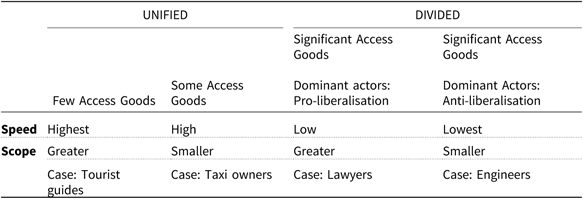
(H1a) Unified professions: The more powerful a unified profession, the smaller the scope of liberalisation
(H1b) Divided professions: The scope of liberalisation will be smaller (larger) depending on whether anti-(pro-) liberalisation interests control the profession’s internal institutions
With regard to our four professions, we therefore expect the scope of liberalisation to be smaller for taxi owners than for tourist guides, as the former are more powerful than the latter due to their political connections. We also expect the scope of liberalisation to be smaller for engineers than for lawyers, as the institutions of interest representation are controlled by anti-liberalisation actors for engineering and by pro-liberalisation actors for lawyers.
As for the speed of implementation, this refers to the promptness of implementation relative to the original deadline for the implementation of the SD (2009), from highest to lowest. Speed will depend on the power of the professional actors that oppose liberalisation, and on whether their professions are united or divided:
(H2a): The more powerful the opponents of liberalisation, the slower the liberalisation
(H2b): Liberalisation will be slower for divided professions than for unified professions
In the case of professions that are unified against liberalisation, such as tourist guides and taxi owners, we expect liberalisation to be slower for the latter than for the former because of their respective power. However, we also expect the liberalisation of both to be faster than that of lawyers and engineers. As liberalisation elicits conflict between its supporters and opponents among lawyers and engineers, and as these professions control significant access goods (both in terms of information and of political connections), their intra-professional conflict must be settled before implementation can occur. Between lawyers and engineers, we expect liberalisation to be faster for the former than for the latter as lawyers supporting liberalisation eventually lost their struggle, while the opponents of liberalisation won in engineering.
Table 1 summarises our expectations on the implementation of the SD with regard to the elimination of professional monopolies for the four professions along the two dimensions of scope and speed.
Expected implementation outcomes by profession type

The opening of professional jurisdictions in Greece, 2010–2018
The implementation of the SD for the liberalisation of professional services was included among the key structural reforms required by all three MoUs, and the first MoU singled out for liberalisation lawyers and engineers alongside other technically advanced professions (European Commission 2010).
Although it did not formally refer to the SD, law 3919/2011 was the first significant step for its actual implementation (academic lawyer, 23 June 2016). Its very quick approval reflects the extent of the pressure from the Troika: the law was presented to Parliament in December 2010, approved in late February 2011 and published in early March of the same year. It mandated the elimination of all existing restrictions on access to more than 150 professions after four months from its publication, subject to a public consultation process whereby the affected professions could make a case before the Hellenic Competition Commission (HCC) for maintaining some of these restrictions based on the principles of necessity, proportionality and public interest. In other words, for most professions, access would be subject to a simple notification to the authorities from the service provider and no longer to an authorisation.
For lawyers and engineers and other high-skill professions, law 3919/2011 set a specific reform path, which was meant to streamline implementation by devoting a subsequent dedicated piece of legislation for their liberalisation. Ironically, however, this strategy contributed to significant implementation delays. According to observers, including the HCC, these delays were due less to technical issues than to the lobbying power of lawyers and especially engineers (HCC opinion 11/VI/2011) (European Commission 2011; Mitsopoulos and Pelagidis Reference Mitsopoulos, Pelagidis, Kalyvas, Pagoulatos and Tsoukas2013; Trantidis, Reference Trantidis2016; former senior Finance Ministry official, 20 June 2017).
Lawyers were deeply divided over the elimination of territorial restrictions to the practice of civil and administrative law. Existing regulations mandated that lawyers practising outside of the jurisdiction of their Bar Association cooperate with a local lawyer. The Troika aimed to eliminate this requirement, against the strong opposition of the peripheral Bar Associations (academic lawyer, 19 June 2017).Footnote 2 However, the Bar Association of Athens decided not to oppose the change, even failing to participate in a plenary meeting called to discuss the profession’s position (Ta Nea 2010). The issue would only be addressed two years later, with the new Lawyers’ Code.
A new government led by former Bank of Greece Governor Lucas Papademos and supported by the Socialist party (Panellinio Sosialistiko Kinima or PASOK), center-right New Democracy (ND) and Laikós Orthódoxos Synagermós (LAOS) a small right-wing party, signed the second MoU in March 2012. The two national elections of May and June 2012 were marked by the collapse of the electoral support for ND and PASOK, with the electoral loss especially severe for PASOK, and the rise of several anti-MoU parties, and in particular of left-wing SYRIZA. Still, ND, PASOK and the smaller Democratic Left were able to form a new government, headed by the leader of ND, Antonis Samaras.
The second MoU (2012–2015) explicitly mentioned the need to implement the SD with regard to the abolition of excessive access requirements for professions. In 2012 and 2013, the Troika continued to press for the implementation of 3919/2011 with regard to lawyers and engineers. The Samaras government committed to introducing a new Lawyers’ Code by December 2012, but failed to meet this deadline. Measures to open up the provision of engineering services to a greater number of engineering specialisations were supposed to be introduced by March 2013, and this deadline was also missed (European Commission 2013).
Parliament finally approved the new Lawyers’ Code (law 4194/2013) in September 2013. Although the SD included the easing of restrictions on multidisciplinary practices and the Troika had recommended it since the first financial assistance program, the Code retained the existing ban, which all lawyers strongly supported.Footnote 3 The new Code maintained other existing regulations affecting the mandatory fees due to the Bar Associations, but it made re-entry in the profession easier, and eliminated minimum fees for lawyers. It eliminated age limits for taking the Bar exam and moved the responsibility of Bar exams from the local Bar Association to the Ministry of Justice. Finally, the Code eliminated territorial restrictions to the practice of civil and administrative law.
The abolition of geographical barriers is already favouring the expansion of practices and law firms from Athens and Thessaloniki to the smaller peripheral markets that had heretofore been sheltered from big-city competitors (law firm partner, 26 January 2018; senior official of the Athens Bar Association, 24 January 2018). Likewise, the new Lawyers’ Code, by eliminating minimum fees and ensuring the relatively easy access to the profession, provides advantages to established lawyers, law firms and corporate employers (especially banks). They can have access to cheap professional labour and employ lawyers by the hour (senior official of the Athens Bar Association, 24 January 2018), in what is effectively a process of de-professionalisation of junior lawyers (Brook Reference Brook2011).Footnote 4
As for engineering, the legislation that had developed since the 1930s defined exclusive occupational activities taking no account of the experience acquired by engineers during their career outside of their studies. The opening up of several previously reserved engineering activities has been the object of a veritable struggle between the established subdisciplines (in particular, civil engineering) and the five-year general universities on the one hand and the relatively newer, “insurgent” subdisciplines (e.g. chemical and environmental engineering) and the four-year technical universities on the other. The established subdisciplines, however, have a stranglehold on the internal institutions of the TCG, and in particular, the presidency and executive (see the online appendix). As the head of one of the insurgent subdisciplines put it, “TCG serves the interests of the majority of members (civil, mechanical, and electrical engineers), while the minority suffers” (26 January 2017).
Already in 2011, one of the subdisciplines had appealed to the respective European-level organisation, which the following year raised the issue of excessive restrictions with the Greek Minister of Development and with Directorate General Competition of the European Commission. In a bid to use the EU institutions to push for a favourable domestic outcome (Grossman Reference Grossman2006; Woll and Jacquot Reference Woll and Jacquot2010; Callanan Reference Callanan2011), the leader of this specialisation even linked up directly with the Troika. His goal was to exert pressure for the opening of engineering, which prompted the then President of TCG to call him an “enemy agent” and request a disciplinary action against him (Euro2day 2013).
Between 2011 and 2013, the Troika found both the Greek governments and the TCG to be wilfully delaying the liberalisation of engineering, and even to provide misleading information (Euro2day 2013). As a result, in 2013, the European Commission contracted a Greek academic, Dimitris Augtidis, to conduct a study on the exclusive activities reserved for certain professions, including engineers. The Augtidis report formed the basis for opinion 34/2014 of the HCC (Papamakariou Reference Papamakariou2017), which was incorporated into law 4254/2014.Footnote 5 The law moved from a regulation of professional activities based on the formal qualifications given by the five-year degrees granted by general universities to a new regulation based on “individual aspects of professional activities,” thus opening most activities to graduates of four-year technical universities, and on qualifications gained also through work experience. The implementation provisions of the law, however, gave veto power to the TCG, as they made the Presidential Decree for the redefinition of the professional activities subject to a binding opinion of the TCG. This decree was never approved.
The third MoU (2015–2018) was signed by the first SYRIZA government, a coalition with Independent Greeks Anexartitoi Ellines (ANEL), a small right-wing anti-MoU party.Footnote 6 The third MoU did not raise again the issue of the liberalisation of lawyers, but did include the reform of the professional restrictions that remained with regard to the engineering specialisations. Thus, the SYRIZA-led government was forced to return to the question of the organisation of engineering with law 4439/2016. Under strong pressure from the Troika (senior TCG official, 26 June 2017), the law deprived TCG of its veto power and mandated the creation of a committee to prepare the groundwork for the necessary Presidential Decree (Art. 29). In order to balance the power of the TCG executive, the committee included a representative of the TCG and one of the HCC as well as representatives of the four relevant ministries and of the relevant academic discipline for the specialisation under review.
However, the Art. 29 Committee only finished its work in June 2017. As per its commitments with the Troika, by then the government was to have already issued the Presidential Decree (European Commission 2017, 19). By December 2018, the Presidential Decree had not been published yet.
Moreover, the SYRIZA government actually used law 4439/16 to roll back the opening introduced by law 4254/2014. In law 4439/16, the definition of activities was “manipulated to protect certain specializations, for instance, giving a very expansive definition of mechanical or civil engineering tasks in order to limit access to other specializations” (engineer, Ministry of Transportation and TCG representative for one of the subdisciplines, 24 January 2017); moreover, in a significant setback for the technical universities, several engineering activities were again closed to their graduates. These rollbacks (see also the case of vocational schools for tourist guides below) occurred when Greece’s economic position began improving in mid-2017, consistently with the argument that economic conditions affect the bargaining power of governments in international negotiations (Dür and Mateo Reference Dür and Mateo2010; Zahariadis Reference Zahariadis2017).
Moving to the outsider groups, the national tourist guide association failed to raise objections by the four-month deadline in the public consultation process for law 3919/2011. In any event, the substitution of notifications for authorisations to carry out the professional activity had already been introduced in December 2010, i.e. even before law 3919/2011. This measure also eliminated the prohibition, strongly defended by the tourist guides, for guides to practise at sites other than those for which they were certified.
Law 4093/2012 was part of the government’s implementation programme for the second MoU, specifically with regard to completing the implementation of law 3919/2011. It included measures that significantly changed the rules for access to the tourist guide profession. Until then, access to the profession was through graduation from vocational schools lasting two and half years. Law 4093/2012 defunded these schools and opened the tourist guide profession to all university graduates with relevant degrees (e.g. archaeology and history) after the passage of short university courses. The tourist guide association strongly opposed the change, as it feared it would lead to a flood of cheap guides that would provide their services only as a form of temporary, stopgap employment; furthermore, the vocational schools provided employment for the guides. However, the Tourism Minister, from ND, showed no interest in their concerns, refusing their requests for consultation (senior tourist guide association official, 16 May 2017).
SYRIZA had campaigned on an anti-MoU platform and as the defender of the common people against the privileges of the elites (Hope Reference Hope2017). The SYRIZA government was thus much more willing to listen to the tourist guides than previous governments. In contrast to the non-relationship with the Tourism Minister in the Samaras government, the tourist guide association developed a much closer relationship with the new SYRIZA Minister, and they pressed for the reintroduction of the vocational schools (senior tourist guide association official, 23 January 2017). In summer 2017, they achieved their goal as the first vocational school was reopened, and courses started in autumn 2017. However, they have lost their control over entry into the profession, since access also continues to be possible to all university graduates of relevant disciplines who have passed the short specialisation courses.
As for taxi services, they were included in the professions to be opened by law 3919/2011. The key issue was the liberalisation of taxi licences. While taxi drivers supported it, taxi owners firmly opposed and they responded with strikes strategically timed for the summer high season (Exadactylos and Zahariadis Reference Exadactylos and Zahariadis2014). Moreover, taxi owners constitute an electoral basin that is vastly larger than that represented by tourist guides, and their political resources are correspondingly greater: There are 28,000 taxi licences in the whole country (Exadactylos and Zahariadis Reference Exadactylos and Zahariadis2014, 173), and more than 13,000 in the Athens region alone (KEPE 2015, 56), against approximately 2,000 tourist guides nationally (senior tourist guide association official, 14 May 2018).
By the time the second MoU was signed in March 2012, liberalisation had not yet been achieved. Again in sharp contrast with the tourist guides, taxi owners enjoyed a close relationship with ND (Exadactylos and Zahariadis Reference Exadactylos and Zahariadis2014, 174). The Papademos government introduced Law 4070/2012, which enacted a mathematical formula to calculate the maximum number of licences in each district. However, “the new legal framework did not prevent continuing opposition to implementation” (senior Tourism Ministry official, June 2016). Some regional authorities only started the new licensing procedure in 2014; moreover, in many districts, including the largest cities (Athens and Thessaloniki), the existing number of licences turned out to be higher than the number based on the mathematical formula, implying that no new licences would be issued for the foreseeable future (KEPE 2015).
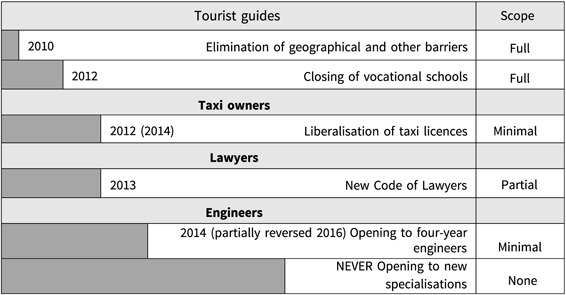
Table 2 summarises our findings. The horizontal bars refer to the speed of liberalisation from the original 2009 deadline for the implementation of the SD. The year of liberalisation varies from 2010, even before law 3919/2011 (tourist guides), to never (opening to new engineering specialisations). For taxi owners, liberalisation was formally introduced in 2012, but the liberalisation of licences only became generally operative in 2014. Thus, the overall length of the implementation time for taxi licences was comparable to that for the introduction of the new Code of Lawyers in 2013.
Speed (time elapsed from the 2009 deadline) and scope of implementation

The liberalisation measures are listed on the right-hand side, and the scope of liberalisation ranges from full to none. For tourist guides, we do not consider the reopening of the vocational schools under the SYRIZA government to be a reversal of liberalisation, since it does not reintroduce the tourist guides’ ability to control access to the profession, although it restores a source of employment. Finally, we consider the liberalisation of licences to have been minimal since, while it was finally introduced in 2014, its actual implementation effectively prevented the issuing of new licences in the most important markets.
Discussion
How do our hypotheses fare against the evidence presented in the previous section? The first two hypotheses connected the access goods available to the professional actors to their ability to influence the scope of liberalisation. Hypothesis 1a referred to relatively weak professions that are united in their opposition to liberalisation, and Hypothesis 1b to powerful, but divided, insider professions. Consistently with the first hypothesis, the scope of liberalisation was smaller for taxi owners than for tourist guides. Although both are outsider professions, taxi owners have greater political resources due to the connections, first with ND and later with SYRIZA. The second hypothesis is also confirmed. For the potential winners and losers from liberalisation among lawyers and engineers, controlling the institutions of interest representation and aggregation of the respective association meant controlling the association’s political action and thus the ability to exert influence to push towards greater (lawyers) and smaller (engineers) implementation scope.
The second set of hypotheses connected the speed of liberalisation to the access goods of liberalisation opponents (Hypothesis 2a) and to whether the profession was united or divided (Hypothesis 2b). Combining the two hypothesis leads to the following ordering of the professions from highest to lowest speed: Tourist guides (unified profession without access goods), taxi owners (unified profession with some access goods), lawyers (divided profession with significant access goods; pro-liberalisation actors controlling professional representation) and finally engineers (divided profession with significant access goods; anti-liberalisation actors controlling professional representation).
The actual ordering of liberalisation was only partially consistent with these expectations. While it was indeed fastest for tourist guides and slowest for engineers, the speed of liberalisation was similar for taxi owners and lawyers. Beside the European Commission having singled out advanced insider professions such as lawyers and engineers for early liberalisation (economic journalist, 29 January 2018) (European Commission 2010, 2011), the discrepancy between this outcome and our expectations points to the inherent difficulty in comparing power and influence across the insider/outsider divide. We have based our expectations on a conceptualisation of power rooted in access goods such as exchangeable information (where insiders have an advantage over outsiders) and political connections (broader, we argued, for lawyers and engineers than for taxi owners, let alone tourist guides). However, professions, like many interest groups, can resort to “voice” strategies, such as demonstrations or strikes, that do not rely on direct access to the policymakers but can still allow them to exert influence on the policy outcomes (Beyers Reference Beyers2004). Taxi owners are a case in point: their influence was increased, and the speed of liberalisation of taxi licences reduced, through their use of strategically timed strikes.
A further aspect this article could not fully explore was the extent to which links between parties and professions are based on ideology rather than a clientelistic relationship. Party-interest group relations are in part based on the existing cleavages in society (Beyers et al. Reference Beyers, Eising and Maloney2008), and the recent work has indeed studied the ideological links between the parties and the interest groups and how they might affect policy outcomes (Beyers et al. Reference Beyers, De Bruycker and Baller2015; Eising et al. Reference Eising, Rasch, Rozbicka, Fink-Hafner, Hafner-Fink and Novak2017; Otjes and Rasmussen Reference Otjes and Rasmussen2017; Wonka Reference Wonka2017; Klüver Reference Klüver2018).
In the case of Greece, the parties such as PASOK and ND, which dominated Greek politics until the rise of SYRIZA, had for a long time moved away from ideology and towards particularistic appeals in their relationship with interest groups (Featherstone Reference Featherstone2005; Afonso et al. Reference Afonso, Zartaloudis and Papadopoulos2015; Gemenis and Nezi Reference Gemenis and Nezi2015). SYRIZA, conversely, remains an ideological party (although this does not exclude its developing clientelistic links), that sees the Troika’s push for liberalisation as “devil’s work” (economic journalist, 29 January 2018). Reinstating the vocational schools for tourist guides in fact reflected the different attitude of the SYRIZA government compared to its predecessors with regard to the losers of liberalisation.
Table 3 summarises the outcomes by profession type. With regard to the speed of liberalisation for taxi owners and lawyers, we have assessed it as “Medium” for both, as it is in between the liberalisation speed for tourist guides (fastest) and engineers (slowest).
Implementation outcomes by profession type

Conclusions
Domestic distributive conflicts and the impact of power differentials among domestic interests have received relatively little attention in the EU compliance literature, which has for the most part emphasised administrative capacity, institutional variables and national preferences as key factors explaining the variation in the extent and timeliness of domestic implementation across policy areas and, especially, Member States. However, this article has shown that differences in power across and within professions have shaped the scope and speed of implementation of the Services Directive in Greece, even when Greek policymakers were under very strong pressure to comply with EU legislation as part of the structural reforms required by the Troika.
Beside the EU compliance literature, we have also aimed to contribute to the interest group literature. We have emphasised the speed of policy change as an important explanandum in the context not only of the implementation of EU legislation, but also of the distributive conflicts pitting interest groups against each other. We have also shown that professions can be divided over regulatory issues, and that, at least for the professions covered in this article, the divided/unified distinction overlaps with that between insider and outsider interest groups.
Finally, and perhaps most importantly, this article has focused on bias in interest intermediation, showing how powerful actors are able to influence the policymaking process even under the very constraining circumstances of the Troika’s intervention in Greece. The study of bias has been sidelined for several years, and even though important work on this topic has been done at the EU level (Dür and De Bièvre Reference Dür and De Bièvre2007a; Mahoney Reference Mahoney2007; Klüver Reference Klüver2013; Dür and Mateo Reference Dür and Mateo2016), research has been lacking on bias in domestic systems of interest intermediation.
Bias at this level has greater political implications than at the EU level, as it is domestically that most citizens will be aware of it, and thus it is at the domestic level that it might have significant repercussions on voters’ perceptions of the fairness of the political system and on their voting choices. From this point of view, professions are an especially important area of research, since occupations are an important site in the formation of political attitudes (Kitschelt and Rehm Reference Kitschelt and Rehm2014).
More broadly, the liberalisation of professions matters because it is part of the current global restructuring of work. Labour markets remain the main channel of income distribution (Rueda Reference Rueda2008), and professional and occupational monopolies play a significant role in how labour markets distribute income (Weber Reference Weber1978). The transformation or elimination of professional boundaries, such as the changing nature of work more generally, results partly from regulatory choices and from the conflict over them among actors with unequal political power (Atkinson Reference Atkinson2015).
We have argued that in clientelistic systems, such as Greece, political connections with policymakers allow narrow interests to be especially influential, and thus that Greece is a “most likely case” for the expectation that unequal power translates into significant differences in control over policy outcomes among interest groups. Nonetheless, the broader relationship between national contexts of interest intermediation and the extent of bias remains unclear. As the gatekeeping role of parties is central to this relationship (Pritoni Reference Pritoni2019), generalisability would be gained by extending the analysis across the two dimensions of partisan gatekeeping: party–interest groups and party–bureaucracy relations. Both dimensions show significant variation across countries, and possibly across time (Pritoni Reference Pritoni2019), even within regions that share similar administrative traditions, such as Southern Europe (Hopkin Reference Hopkin2001; Kopecký et al. Reference Kopecký, Mair and Spirova2012; Afonso et al. Reference Afonso, Zartaloudis and Papadopoulos2015), and therefore provide a promising avenue for further research on bias in interest intermediation.
Author ORCID
Francesco Stolfi, 0000-0002-0565-5888
Supplementary Material
To view supplementary material for this article, please visit https://doi.org/10.1017/S0143814X19000217.
Data Availability Statement
This study does not employ statistical methods and no replication materials are available.
Acknowledgements
We wish to thank, for their comments, the four anonymous reviewers, the participants at the 3rd IPPA International Conference on Public Policy, Singapore, 28–30 June 2017; the Conference of the Australian Political Science Association, Melbourne, 25–27 September 2017; the workshop “Politics without choice? Policy-making and discourse in a three-level game,” ECPR Joint Sessions of Workshops, Nicosia, 10–14 April 2018 and the 10th Australian International Political Economy Network (AIPEN) Workshop, School of Social Sciences, University of Western Australia, Perth, 14-15 February 2019. The views expressed are those of the authors and do not necessarily reflect those of their institutions.