INTRODUCTION
Organizational network research has become a burgeoning field over the past decades (Akkerman & Torenvlied, Reference Akkerman and Torenvlied2011; Kilduff & Tsai, Reference Kilduff and Tsai2003; Brass, Galaskiewicz, Greve, & Tsai, Reference Brass, Galaskiewicz, Greve and Tsai2004; Davis, Renzulli, & Aldrich, Reference Davis, Renzulli and Aldrich2006; Porter & Powell, Reference Porter and Powell2006; Jack, Reference Jack2010). Some authors even present network research as a paradigm in organizational research (Borgatti & Foster, Reference Borgatti and Forster2003; Parkhe, Wasserman, & Ralston, Reference Parkhe, Wasserman and Ralston2006). Other authors stress the need to escape the paradigm and develop new network theories (Kilduff, Tsai, & Hanke, Reference Kilduff, Tsai and Hanke2006). The popularity of network research underlines that organizations and organizing are essentially social phenomena in which relations regulate access to information, support and trust for individuals, groups and organizations alike.
To a large extent, organizational network research to date has focused on network structures and outcomes. This research has generated ample evidence that networks have beneficial effects, such as social support, resources, information, career benefits, job satisfaction and improved performance (Hurlbert, Reference Hurlbert1991; Ducharme & Martin, Reference Ducharme and Martin2000; Mavin & Bryans, Reference Mavin and Bryans2002; McGuire, Reference McGuire2002; Flap & Völker, Reference Flap and Völker2004; McGuire, Reference McGuire2007; Bozionelos, Reference Bozionelos2008). Yet, networks produce these advantages for insiders only, demarcating organizational insiders from outsiders (Kanter, Reference Kanter1977; McGuire, Reference McGuire2000; Seibert, Kraimer, & Liden, Reference Seibert, Kraimer and Liden2001; Anderson, Reference Anderson2008; Field, Reference Field2008). This demarcation follows gender lines: several studies show that the structures and outcomes of social networks in terms of status, influence, careers, information and trust are unequal for women and men (Campbell, Reference Campbell1988; Krackhardt, Reference Krackhardt1990; Ibarra, Reference Ibarra1992, Reference Ibarra1997; Podolny & Baron, Reference Podolny and Baron1997; Van Emmerik, Reference Van Emmerik2006). For example, while close ties to others of equal status are reported more often between women than between men (Brass, Reference Brass1985; Ibarra, Reference Ibarra1992, Reference Ibarra1997), a less dense network and ties to high status individuals are considered more beneficial (Campbell, Reference Campbell1988; Podolny & Baron, Reference Podolny and Baron1997). Previous research shows that women have less access to high status individuals (who often are men) in their organizations than men have (Brass, Reference Brass1985; Ibarra, Reference Ibarra1992, Reference Ibarra1997; Kumra & Vinnicombe, Reference Kumra and Vinnicombe2010; Durbin, Reference Durbin2011). Ibarra (Reference Ibarra1992) also reports that men have more ties to other men in their organizations than women have to other women, even when women are sufficiently represented in the organization (Ibarra, Reference Ibarra1992). Even when women occupy similar structural network positions to men, they receive less job and career-related help from their network contacts than men do (McGuire, Reference McGuire2002).
The exploration of gender differences in network structures and outcomes is an important step in developing a gender-sensitive approach in organizational network research. One valuable contribution of this line of research is, that it tests generalizations on women's and men's networks. For example, Van Emmerik (Reference Van Emmerik2006: 33) claims that her study of faculty members ‘tackles an old stereotype,’ finding that women faculty ‘do not appear to be the emotional specialists they often are thought to be.’ Their strong ties do not result in as much social capital as men's strong ties. Ibarra's (Reference Ibarra1997) findings show that the stereotyped expectation that women have closer ties than men, may not be tenable in all contexts: the non-high-potential women in her study reported fewer very close ties in their career network than either the men or the high-potential women. The present study contributes to this gender-sensitive line of research, by validating some of the propositions of previous studies and by looking at networking behavior as an explanation for gender differences in network structure.
Forret and Dougherty (Reference Forret and Dougherty2004) suggest that studying networking behavior would be a promising strategy to explain network structures and outcomes. In line with their suggestion, we link up with the emergent stream of research that looks at gender and networking behavior (Scott, Reference Scott1996; Forret and Dougherty, Reference Forret and Dougherty2001, Reference Forret and Dougherty2004; McGuire, Reference McGuire2002; Van Emmerik, Reference Van Emmerik2006). The aim of this study is to provide a better understanding of the relations between gender, network structure and networking behavior. Understanding these relations is critical to the development of theories of gender in networking that are able to adequately capture the relevance of gender for organizational networks and to transcend the stereotypes that are often invoked concerning the organizational behavior of women and men (Ely & Padavic, Reference Ely and Padavic2007). Moreover, it is important to provide organization members with knowledge about the consequences of gender stereotypes in networking, which may then be addressed.
Below, we first present our perspective on networking behavior and specify our research questions. Next, we describe the context and design of our study, and its research methods. In the subsequent section, we present our findings. In the last section, we discuss our findings and reflect on their implications for organizational network studies and organizational practice.
NETWORKING BEHAVIOR AND GENDER
Due to organizational network studies’ focus on networks structures and outcomes, the networking behavior that helps produce these structures and outcomes has received much less attention (cf. Forret & Dougherty, Reference Forret and Dougherty2001, Reference Forret and Dougherty2004; Ibarra, Kilduff, & Tsai Reference Ibarra, Kilduff and Tsai2005; Anderson, Reference Anderson2008). Studying networking behavior implies a perspective on networks that gives network actors, rather than structures, centre stage. Such a perspective on networks is relatively rare and there is still much to learn about networking behavior and actual networking practices (Ibarra, Kilduff, & Tsai, Reference Ibarra, Kilduff and Tsai2005). Networking behavior refers to individuals’ attempts to develop and maintain relationships with others who have the potential to assist them in their work or career (Forret & Dougherty, Reference Forret and Dougherty2001: 284). Examples of networking behavior are maintaining contacts, socializing and increasing internal visibility (Forret & Dougherty, Reference Forret and Dougherty2001, Reference Forret and Dougherty2004: 425).
While research on gender and network structure is relatively rare, research on gender and networking behavior is even more difficult to be found. The few studies on this topic find that the networking behavior that works to the advantage of men does not benefit women in the same way. From their study of business school alumni, for example, Forret & Dougherty (Reference Forret and Dougherty2004) conclude that men's careers benefit from increasing visibility and engaging in professional activities, while women's careers do not. In her study of corporate–government relations officials Scott (Reference Scott1996) finds that men gain more from work-related socializing behavior than women. Scott (Reference Scott1996: 232) claims that her findings on the networking practices of corporate–government relations officials ‘shatter’ the gendered ‘instrumental – expressive myth.’ Her study shows how networking behavior that is traditionally labeled as expressive, such as sharing lunch or attending a theater or sports event together, was highly instrumental for both women and men in the context under study.
In previous, qualitative analyses of semi-structured interviews with 39 white, Dutch, women and men account managers (Benschop, Reference Benschop2009; Gremmen & Benschop, Reference Gremmen and Benschop2009) we found examples of women and men account managers reporting networking behaviors that fit into gender stereotyped behavior depicting women as showing warmth, gentleness and awareness of the feelings of others, and men as behaving in independent, dominant and assertive ways (Deaux, Reference Deaux1998). Other networking behaviors reported by the interviewees clearly diverged from these stereotypes. In this study we investigate to what extent these stereotyped and non-stereotyped networking behaviors can be found in our sample as a whole, and how these behaviors are related to the account managers’ gender and network structure.
RESEARCH QUESTIONS
Our research aim is to contribute to understanding the relevance of gender for organizational networks by empirically investigating the relations between gender, network structure and network behavior in a sample of 39 white, Dutch, women and men account managers. For the systematic investigation of these relations, we present four separate, but interrelated research questions.
Our first research question focuses on the types of networking behaviors reported by the account managers in our study. In contrast to Forret and Dougherty (Reference Forret and Dougherty2001, Reference Forret and Dougherty2004), and in accordance with Scott (Reference Scott1996), we examine the job-related networking behaviors that the account managers in our study report in order to be effective and successful in their everyday work, rather than their networking behaviors in the context of career advancement. We conceptualize of networking behavior as the way individuals foster their network relations. The fostering of network relations concerns the activities that people engage in to build and maintain their network relations and benefit from them. It focuses on the process and relational aspects of networking. For example, account managers may foster their network relations by showing interest in the other parties’ daily work or private concerns in order to establish personal ties as a basis for beneficial business relations. Therefore, our first research question is: 1. What types of fostering networkrelations may be identified from what the account managers report?
Our second to fourth research questions concern the relations between the account managers’ gender, network structure and networking behavior. 2. In what way do the structures of the women and men account managers’ networks differ from and resemble one another? 3. What similarities and differences in networking behavior can be found between the women and men account managers? 4. How do the account managers’ network structures differ from and resemble one another according to their networking behavior?
In the next section we explain how we investigated our research questions.
RESEARCH DESIGN AND METHODS
In the study reported here, we explore the relations between networking behavior, gender and network structure using data on 39 white, Dutch, women and men account managers. Account management is a sales occupation found in commercial industries. Account managers build and manage long-term relationships with essential customers (Dekker, Reference Dekker2001; Little & Marandi, Reference Little and Marandi2003; Ingram, Reference Ingram2004). They contribute to the timely and adequate delivery by their organizations of the agreed products and services. In order to achieve these goals, account managers have a propensity to network both with customers and back office colleagues in their organizations, as they are not formally supervising their network contacts.
In the context of scarce findings on the relations between gender, networking behavior and network structure, we use a data-driven research design and explorative research questions.
Sample and data collection
We explore the account managers’ ways of networking as reported by them during face-to-face open-ended interviews. Semi-structured open-ended interviews were conducted in order to generate data on the networking behaviors of the account managers in the context of their everyday work. As the literature did not provide a classification of such behaviors as yet, we undertook a qualitative study to find ways to classify these networking behaviors (cf. Forret & Dougherty, Reference Forret and Dougherty2001) to investigate our second to fourth research questions. Using semi-structured open-ended interviews allowed us to develop an understanding of the account managers’ networking behavior grounded in their actual experiences, perceptions and feelings concerning networking. It highlights the variation in networking behavior (cf. McGuire, Reference McGuire2007).
The qualitative nature of this part of study, involving semi-structured open-ended interviews that resulted in a vast amount of data, evidently limits its sample size. Nevertheless, our research material does allow preliminary tests of the relations between networking behavior, network structure and gender.
The interviews were conducted with 20 female and 19 male account managers. The account managers worked for 20 different for-profit organizations. In 19 organizations a woman and a man account manager were interviewed separately. In one organization only a woman account manager could be interviewed. In accordance with the explorative nature of our study, a broad variety of organizations was approached in order to collect a large variety of interview material. The organizations the interviewees worked for ranged from medium-sized national firms in transportation or food, to large multinational banking or oil industry companies. The account managers’ age ranged from ∼25 to ∼55 years. A large majority had completed higher education. Years of work experience varied from two to over 20.
In the interviews, questions were asked about the interviewees’ own work networks (ego-networks). The interviewees were asked to list 10 contacts (alters) they considered the most important for doing their work well, and to list the relations among these contacts. This restricted name generator sampling method is a common social network sampling method, and reduces interview time and the risk of decreasing respondent motivation (Marin & Hampton, Reference Marin and Hampton2007). Information was collected about the alters’ positions, departments and gender. Further questions were asked on how the interviewees fostered their network relations and on how they brought things about with customers as well as with supervisors and co-workers.
With the permission of the interviewees, to whom strict confidentiality was promised, the interviews were tape-recorded. The recordings were transcribed verbatim. We analyzed the interview material in both qualitative and quantitative ways.
Qualitative analysis
The qualitative analysis of the data is based on the account managers’ discursive expressions concerning their ways of networking and on the interpretations of these expressions by the researchers. We conducted a qualitative content analysis of the interviews. Using QSR International's (2006) NVivo software, we coded the interview transcripts with open codes (Strauss & Corbin, Reference Strauss and Corbin1998; Boeije, Reference Boeije2010) about various ways to foster work relationships. Some examples of these open codes are: [‘interviewee reports to…’] ‘give good reasons,’ ‘tell the truth,’ ‘provide information,’ ‘show interest in other's personal life,’ ‘treat the team.’ We grouped the open codes into axial codes (Strauss & Corbin, Reference Strauss and Corbin1998; Boeije, Reference Boeije2010) to capture the different patterns in fostering network relations. The qualitative analysis of the interview material provided an answer to our first research question: What types of fostering network relations may be identified from what the account managers report? From the interview material we derived a typology of seven ways of fostering network relations. We will elaborate on this typology in the section on our study's results.
Quantitative measures
We used quantitative measures and the statistical package for Social Network Analysis UCINET 6 (Borgatti, Everett, & Freeman, Reference Borgatti, Everett and Freeman2002) to examine the second, third and fourth research questions.
Network structure (dependent variable in research questions 2 and 4).
We distinguished three network characteristics on the basis of differences between men and women reported in previous research (1) homophily (Ibarra, Reference Ibarra1992, Reference Ibarra1997) (2) the status of alters (Kanter, Reference Kanter1977; Brass, Reference Brass1985; Ibarra, Reference Ibarra1992, Reference Ibarra1997; Scott, Reference Scott1996) and (3) network density (Ibarra, Reference Ibarra1997; Burt, Reference Burt1998). First, we determined homophily (Krackhardt, Reference Krackhardt1990) by calculating the number of equal gender contacts in the network. Second, we measured the status structure of ego's network, that is, how many contacts with higher/equal/lower status alters ego has. When interviewees did not explicitly mention the status of their contacts (e.g., ‘my boss,’ ‘our CEO’), we rated these contacts’ status on the basis of the interview material and our knowledge of the interviewees’ organizations. Status relative to ego was rated independently by the researchers. Inter-rater reliability was 75%. Third, we measured the density of ego's network by determining the proportion ties relative to the possible ties (Wasserman & Faust, Reference Wasserman and Faust1994).
Networking behavior (dependent variable in research question 3 and independent variable in research question 4).
We measured networking behavior using the results generated by our qualitative analysis of the interview material. In order to explore the relations between gender, network structure and networking behavior statistically, we combined the seven types of fostering network relations emerging from our qualitative analysis into three categories labeled authoritative, exchange and affect-based trust, as we will further explain below.
Gender (independent variable in research questions 2 and 3)
Gender was treated as a dichotomized variable with the values man and woman.
Control variables
Although network variables may be influenced by many factors, our sample size did not allow the inclusion of control variables. The use of control variables would have required performing multivariate analyses, which would have been inappropriate for the small dataset at hand.
In our quantitative analyses, we investigated whether our data show statistically significant associations between gender, networking behavior and network structure, using non-parametric t-tests and χ2 tests.
RESULTS
Networking behavior
Using qualitative content analysis and the NVivo software to code our material using open and axial codes, we derived from our interview data what self-reported ways of fostering network relations the account managers in our study employ. The analysis provides an answer to our first research question: What types of fostering network relations may be identified from what the account managers report? Seven networking behaviors (i.e., types of fostering network relations) emerged from the interview material. We labeled these (1) accountable, (2) authoritative, (3) motivational, (4) strategic personal, (5) loyal personal, (6) considerate and (7) co-operative.
Accountable
Accountable networking behavior entails that account managers convince other parties to go along with what they consider preferable actions, by giving explanations and good business reasons. As one interviewee says: ‘It helps a lot to explain that there is a chance of proliferating business or the risk of losing business. That is what interests both of us.’
Authoritative
Authoritative networking behavior amounts to bringing things about on the basis of the authority that one has gained due to one's (perceived) position or experience. As one interviewee illustrates: ‘It has to do with experience, credits that you have earned during the years, that they say: well, all right, we'll do it.’
Motivational
Motivational networking behavior pertains to such behaviors as sharing success, presenting bad news from the perspective of challenge, and expressing appreciation or giving small presents for good results. Another way of motivating other parties is to involve them with one's work, for example by taking a co-worker along on a visit to a customer. ‘The more they know about that customer, the more involved they are.’
Strategic personal
Strategic personal networking behavior entails that an account manager shows interest in the other parties’ daily concerns or personal lives in order to establish personal ties as a basis to get things done. One of the interviewees explains that ‘Of course it is a business agreement between two persons and two firms, but if you can flesh that out in a personal way, the relationship lasts much longer, and you are much more open to each others’ problems and much more open to jointly search for solutions.’
Loyal personal
Loyal personal networking behavior is related to exchanging favors. It entails to do something for another party and receive something in return. ‘The people that I just mentioned are the people I get something from in return, and who know to get me when they need something done.’
Considerate
Considerate networking behavior amounts to getting things done by showing attentiveness to the other parties’ situations, for example, by asking whether it is a convenient moment to call, or by preparing in advance the documents that the other party may want or need in order to accept an offer or fulfill a request.
Co-operative
Co-operative networking behavior entails that an account manager tries to gain support or permission for actions or plans through giving information or asking advice and feedback. As one interviewee says about her behavior in the relationship with her supervisor: ‘I walk over to him and say: “I'm concerned about this and this, could you help out for a second?” Now and again you just ask little things […] Or when there is an issue [I say:] I have discussed this and this with [other party], I do want you to know about it.’
The network behaviors distinguished and illustrated above provide a basis for our quantitative analysis of the relations between networking behavior, gender and network structure. In the next subsections, we present the results of these quantitative analyses.
Gender and network structure
In what respects do the structures of the women and men account managers’ networks differ from and resemble one another? In order to answer our second research question we have measured the number of equal gender ties, the status structure and the density of the account managers’ networks.
Equal gender ties
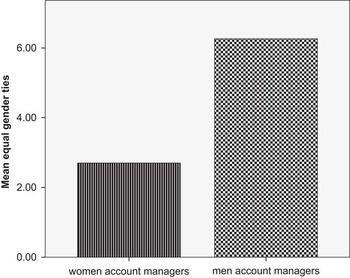
Figure 1 displays the amounts of equal gender ties that the women and men account managers in our study maintain. The striped (women) and blocked (men) bars show that the number of equal gender contacts is more than twice as high for the men account managers than it is for the women account managers. This difference appears to be significant (t-value = 5.1, p < .01). The men account managers have more than twice as many network contacts with men than the women account managers have with women.
Mean scores of men and women account managers on number of equal gender ties

Status ties
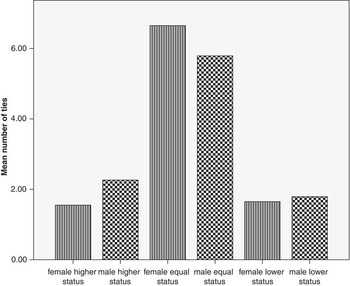
Figure 2 displays the status of alters relative to ego in the account managers’ networks. On average, the network structures of the men account managers show more higher status ties – ties with alters of higher status than ego – than the network structures of the women account managers. The women account managers have more equal status ties. However, these differences are not statistically significant. The same holds for the presence of lower status ties – ties to alters of lower status than ego. The modal scores do not differ between men and women either.
Mean scores of men and women account managers on ties to alters of various status

Density
The average density of the women account managers’ networks does not differ significantly from the average density of the men account managers’ networks. Both density figures are about 65%.
To summarize, our findings concerning the structures of the interviewees’ networks suggest that the women and men account managers’ networks do not differ with respect to density or with respect to the relative status of alters that the account managers foster contacts with. The network structures of the women and men account managers in our study do differ with respect to the number of equal gender ties: men account managers significantly more often have contacts with men alters, than women with women alters. Put differently: both men and women account managers have more ties to men than to women. This finding confirms earlier findings on equal gender ties (Ibarra, Reference Ibarra1992, Reference Ibarra1997). While pointing in the same direction, our findings concerning gender and network structure do not statistically confirm earlier suggestions and research findings (Kanter, Reference Kanter1977; Brass, Reference Brass1985; Ibarra, Reference Ibarra1992, Reference Ibarra1997; Scott, Reference Scott1996; Kumra & Vinnicombe, Reference Kumra and Vinnicombe2010; Durbin, Reference Durbin2011) that women have (or are granted) less access than men to higher status individuals in their organizations.
Gender and networking behavior
What similarities and differences in networking behavior can be found between the women and men account managers? In order to explore our third research question, we determined for each interviewee their dominant type of fostering network relations. Thus, each interviewee was assigned one networking behavior of the typology of networking behaviors that emerged from our qualitative analysis: (1) accountable, (2) authoritative, (3) motivational, (4) strategic personal, (5) loyal personal, (6) considerate or (7) co-operative.
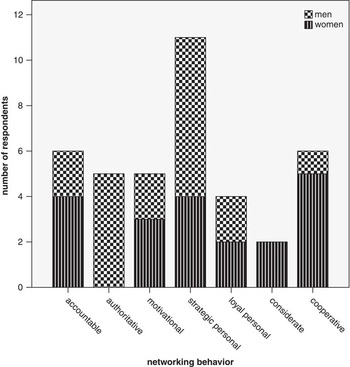
Figure 3 shows how the account managers are distributed across the seven networking behaviors. Strategic personal networking appears to be by far the most frequently employed networking behavior, whereas considerate networking is employed the least. The remaining five categories are approximately equally large.
Distribution of account managers across seven networking behaviors, by gender

The bars in Figure 3 also identify the gender of the respondents represented in the seven networking behaviors. The blocked parts of the bars represent men account managers and the striped parts represent women account managers. Figure 3 shows that a majority of five out of seven networking behaviors are employed by both women and men. Two networking behaviors are applied by account managers of one sex exclusively: considerate networking behavior is employed by women only, and authoritative networking behavior is only found in men.
We observe that the distribution of considerate and authoritative networking across women and men account managers reflects gender stereotypes as identified by Deaux (Reference Deaux1998: 206). Deaux explains that gender stereotypes for women almost always encompass warmth, gentleness and awareness of the feelings of others. Gender stereotypes for men amount to independence, dominance and assertiveness. From this perspective, we may characterize considerate networking behavior as ‘stereotypically feminine’ and authoritative networking behavior as ‘stereotypically masculine.’ It is important to note that a minority of the men account managers (n = 5, or 26%), and of the women account managers (n = 2, or 10%) fits into these gender stereotypes. The majority of the account managers does not. With this result our study, like other studies (Scott, Reference Scott1996; Ibarra, Reference Ibarra1997; Van Emmerik, Reference Van Emmerik2006), contributes to undermining stereotyped assumptions on women's and men's networking behavior.
In Figure 3 the distribution of women and men across the strategic personal and co-operative networking behaviors is notable, as well. Strategic personal behavior appears to be the favorite networking behavior for the men account managers. The women account managers apply strategic personal networking less often than their men counterparts do. In turn, co-operative networking is the most employed category by the women account managers. It is least applied by their men colleagues. In other words, the women account managers rely more on co-operative networking, while their male colleagues employ strategic personal behavior to a greater extent. These findings suggest that the women to a greater extent employ networking behaviors that focus on the other party (considerate, motivational) or on mutual exchange (accountable, co-operative) than the men account managers, who to a lager extent may employ networking behaviors that focus on achieving benefits that directly serve their business interests (strategic personal). In order to explore whether the gender differences described here are statistically significant, we combined the seven networking behaviors into three categoriesFootnote 1. The seven networking behaviors resonate with three categories of network relationships: authority relationships (such as hierarchical, relationships), exchange relationships, and relationships of benevolence-based or affect-based trust. Organizational network studies are familiar with these types of relationships (e.g., Cook & Whitmeyer, Reference Cook and Whitmeyer1992; McAllister, Reference McAllister1995; Lewicki, McAllister, & Bies, Reference Lewicki, McAllister and Bies1998; Abrams, Cross, Lesser, & Levinn, Reference Abrams, Cross, Lesser and Levinn2003; Levin & Cross, Reference Levin and Cross2004; Barrera, Reference Barrera2007; Chua, Ingram, & Morris, Reference Chua, Ingram and Morris2008). We took authoritative networking behavior as one networking behavior category and subsumed accountable, motivational, loyal personal and co-operative networking behaviors under the header of exchange networking behavior. Strategic personal and considerate networking behaviors came under the label of affect-based trust networking behavior.
Clustering the networking behaviors that emerged out of our qualitative analysis into the categories authoritative, exchange and affect-based trust, enabled us to explore our third and fourth research questions through quantitative analysis. We started out by statistically testing our third research question: What similarities and differences in networking behavior can be found between the women and men account managers?
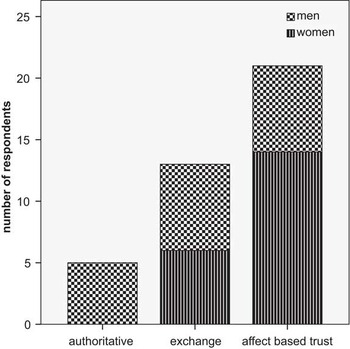
Figure 4 shows the distribution of the account managers across the three categories of networking behavior just distinguished. As noted earlier, authoritative networking is only applied by a minority of the account managers, who are all men. Exchange networking is more or less equally employed by women and men account managers. Affect-based trust networking appears to be the predominant networking behavior category. It is employed by both women and men account managers, and most popular with women. The unequal representation of women and men in the networking categories is statistically significant (χ2 = 7.4, df = 2, p < .05), indicating an association between gender and networking behavior.
Distribution of account managers across three networking behavior categories, by gender

We observe that the reduction from seven networking behaviors (Figure 3) to three networking behavior categories (Figure 4) results in a loss of diversity, that is even greater for the women account managers than for their men counterparts. As a consequence, the results presented in Figure 4 may inadvertently induce a more gender stereotyped interpretation than the results presented in Figure 3, namely that women account managers ‘typically’ employ affect-based trust networking behavior.
Networking behavior and network structure
In this subsection we explore our fourth and last research question: How do the account managers’ network structures differ from and resemble one another according to their networking behavior? In order to investigate this question, we relate the three networking behavior categories that we identified (authoritative, exchange and affect-based trust) to the network structure characteristics that we distinguished earlier: (1) the number of equal gender contacts in ego's network, (2) the status structure of ego's network (how many contacts with higher/equal/lower status alters does ego have); and (3) the density of ego's network (the number of actual ties relative to the possible ties). Below, we present the results for each of the three network structure characteristics.
Equal gender ties
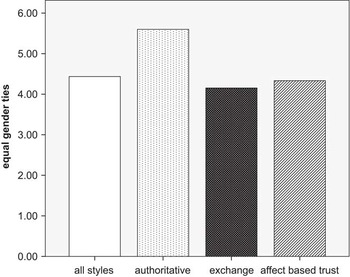
Figure 5 displays the three networking behavior categories by the number of equal gender ties. Account managers applying authoritative networking on average have more equal gender ties than account managers in the other networking behavior categories. As authoritative networking is exclusively employed by men account managers, this finding is coherent with our earlier finding (Figure 1) that the number of equal gender contacts is higher for the men account managers than it is for the women account managers. The findings displayed in Figure 5 suggest that the greater number of equal gender ties for the men account managers relative to the women account managers may in part be explained by networking behavior. However, the differences in the numbers of equal gender ties between the networking behavior categories are not statistically significant.
Equal gender ties by networking behavior categories

Status ties
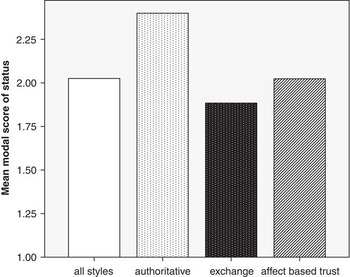
To facilitate the overall comparison between the networking behavior categories on the issue of status ties, we computed a single status variable on the basis of the modal scores of each respondentFootnote 2. Figure 6 shows the distribution of these mean modal scores across the three networking behavior categories.
Modal status ties by networking behavior categories

On average, authoritative networking shows more higher status ties than other status ties. Exchange networking entails maintaining more lower status ties than both other networking behavior categories, which is indicated by the lower mean score of this category on status ties. The status score of affect-based trust networking is somewhat higher than that of the exchange category. These findings show that authoritative networking pertains to higher status ties, exchange networking to lower status ties, and affect-based trust networking to equal status ties. When we compare the status ties measured by the modal score, the differences are sharper and significant (χ2 = 7, df = 2, p < .05)Footnote 3.
Density
The mean density of the ego networks in the various networking behavior categories ranges from 60 to 70, and is not statistically significant.
We observe that the networking behavior applied exclusively by the men account managers (authoritative) is related to the largest number of higher status ties, while the networking behavior employed most by the women account managers (affect-based trust) is related to a network structure of equal status ties (cf. Brass, Reference Brass1985; Ibarra, Reference Ibarra1992, Reference Ibarra1997; Scott, Reference Scott1996). While our investigation of gender in network structure did not indicate significant differences concerning status ties, networking behavior does show such differences. This suggests that the status structure of ties in networks may be related to networking behavior, rather than to gender.
CONCLUSION AND DISCUSSION
This study links up with the emergent stream of research in organizational network studies that looks at gender and networking behavior (Scott, Reference Scott1996; Forret & Dougherty, Reference Forret and Dougherty2001, Reference Forret and Dougherty2004; McGuire, Reference McGuire2002; Van Emmerik, Reference Van Emmerik2006). This stream of research implies more attention for network actors than is to be found in many organizational network studies, as these studies focus on network structures and outcomes. Employing a perspective on organizational network research that gives network actors, rather than structures, centre stage, has enabled us to introduce the relational process of fostering network relations as central to women's and men's networking behavior. From this perspective, we have explored the relations between gender, networking behavior and network structure in order to contribute to understanding the relevance of gender for organizational networks.
Our study's results confirm earlier research that shows gender differences in network structure concerning the number of equal gender ties (Ibarra, Reference Ibarra1992, Reference Ibarra1997). The findings of our study contest earlier studies that report differences in the status structure of women's and men's networks (Brass, Reference Brass1985, Ibarra, Reference Ibarra1992, Reference Ibarra1997; Kumra & Vinnicombe, Reference Kumra and Vinnicombe2010; Durbin, Reference Durbin2011), thus suggesting that gender (as a bivariate variable, i.e. woman or man) is not a sufficient explanation for women's and men's network structures.
Regarding gender differences in networking behavior, our results show that only the men account managers employ authoritative networking, while affect-based trust networking is most employed by women account managers. Yet, the men use multiple networking behaviors and use exchange and affect-based trust more than authority, whereas women employ affect-based trust but also use exchange. Thus, our study contributes to research into gender and networking behavior that contradicts stereotyped generalizations on women's and men's networking behavior (Scott, Reference Scott1996; Van Emmerik, Reference Van Emmerik2006).
On networking behavior and network structure our findings show that authoritative networking fosters higher status ties, exchange networking behavior fosters lower status ties and affect-based trust networking fosters equal status ties. As our study shows a statistically significant association between gender and these networking behavior categories, we suggest that earlier research findings indicating that men have more equal gender ties in their networks than women (Ibarra, Reference Ibarra1992, Reference Ibarra1997), and that women have less access than men to individuals of higher status in their organizations (Brass, Reference Brass1985; Ibarra, Reference Ibarra1992, Reference Ibarra1997; Kumra & Vinnicombe, Reference Kumra and Vinnicombe2010; Durbin, Reference Durbin2011) may be explained by networking behavior rather than by gender. For example, in addition to Ibarra's (Reference Ibarra1992) suggestion that the point of women's lesser access to higher status men in their organizations may be that these higher status men do not grant women access, our study suggests that the focal point should be these men's networking behavior, rather than their being men.
This study is limited by the size of our group of respondents (n = 39). This small sample size necessitated us to reduce the diversity of networking behaviors that emerged from our qualitative analysis in order to quantitatively investigate our research questions on the relations between gender, networking behavior and network structure. This has resulted in a loss of information, which may have induced more strongly gender stereotyped interpretations of networking behavior than our original data suggest. Furthermore, our study does not enable us to determine causal relationships, and its findings only apply to the population of account managers we investigated. However, our study does enable us to suggest that networking behavior has greater explanatory power with respect to the relations between gender and network structure, than gender as a demographic, bivariate variable (woman, man). As a consequence, we propose that further research explores the relations between networking behavior and network structures and outcomes in larger samples and various groups.
By providing insight into the relevance of gender and networking behavior for network structures, our study furthers gender-sensitive research in organizational network research. While our findings suggest that network structures may be explained by networking behavior rather than by gender as a bivariate variable, our study does not imply that gender is irrelevant to organizational network studies. Gender is clearly implicated in research findings that show differential outcomes of the same networking behavior for women and men (Ibarra, Reference Ibarra1992; Scott, Reference Scott1996; Forret & Dougherty, Reference Forret and Dougherty2004). Further research should investigate the role of ‘cultural beliefs’ and ‘myths’ concerning gender (Scott, Reference Scott1996; McGuire, Reference McGuire2002), and ‘bias, gender-typed expectations and contested legitimacy’ (Ibarra, Reference Ibarra1997: 99) in networking behavior and its outcomes in organizations. Such research requires going beyond gender as a bivariate variable (woman, man). It requires a conceptualization of gender as the dynamic social practice of distinguishing between women and men, and femininity and masculinity. From such a perspective, the meanings of gender are constantly redefined and negotiated in everyday social interactions and micro-political behavior (Benschop, 2009; Martin, Reference Martin2006; Poggio, Reference Poggio2006). Future research should further investigate how, and with what outcomes, organization members negotiate gender expectations and invoke, challenge or alter gender stereotypes in their ways of fostering network relations. Thus, organizational network research would gain insight into the complex dynamics of women's and men's fostering network relations at work and into the outcomes of these dynamics.
The practical implications of our study are that organization members may benefit from going beyond gender as a bivariate variable and conceiving of gender as negotiable in the dynamics of social practice. This would enable them to seek opportunities to address the implications of gender stereotypes, and it would enable managers to support both women and men employees to employ the diversity of networking behaviors necessary to generate optimal network structures and outcomes.
Acknowledgement
The authors wish to thank the anonymous reviewers for their useful comments and suggestions.