Introduction
Inflammatory cytokines are thought to contribute to depression, fatigue and other neuropsychiatric disturbances in both medically ill and medically healthy individuals (Bower et al. Reference Bower, Ganz, Aziz and Fahey2002; Evans et al. Reference Evans, Charney, Lewis, Golden, Gorman, Krishnan, Nemeroff, Bremner, Carney, Coyne, Delong, Frasure-Smith, Glassman, Gold, Grant, Gwyther, Ironson, Johnson, Kanner, Katon, Kaufmann, Keefe, Ketter, Laughren, Leserman, Lyketsos, McDonald, McEwen, Miller, Musselman, O'Connor, Petitto, Pollock, Robinson, Roose, Rowland, Sheline, Sheps, Simon, Spiegel, Stunkard, Sunderland, Tibbits and Valvo2005; Raison et al. Reference Raison, Capuron and Miller2006). For example, interferon-alpha (IFN-α), an inflammatory cytokine with antiviral and antiproliferative properties that is used to treat malignant melanoma and chronic hepatitis C virus (HCV) infection, produces clinically significant depression and/or fatigue in up to 80% of patients depending on the dose (Maddock et al. Reference Maddock, Baita, Orru, Sitzia, Costa, Muntoni, Farci, Carpiniello and Pariante2004; Raison et al. Reference Raison, Demetrashvili, Capuron and Miller2005; Lotrich Reference Lotrich2009; Miller Reference Miller2009). Therefore, patients undergoing treatment with IFN-α have been studied to explore immune and neurobiological pathways through which peripheral inflammatory cytokines can influence the brain and behavior.
Although the physiological consequences of IFN-α and their relationship to IFN-α-induced behavioral changes have been well studied, the molecular mechanisms involved have yet to be fully elucidated. Acutely, IFN-α binds to type-I IFN receptors expressed on immune cells to activate Janus kinase/signal transducers and activators of transcription (JAK/STAT) and tyrosine kinase signaling, which then increase the expression of cytokines and immunoregulatory genes (Darnell et al. Reference Darnell, Kerr and Stark1994; Haque & Williams, Reference Haque and Williams1998; Pfeffer et al. Reference Pfeffer, Dinarello, Herberman, Williams, Borden, Bordens, Walter, Nagabhushan, Trotta and Pestka1998). Following chronic exposure to IFN-α and to cytokines induced by IFN-α, it is likely that multiple inflammatory as well as regulatory genes and signaling pathways are recruited. However, a careful analysis of gene regulation within peripheral immune cells during chronic IFN-α administration in relation to behavior has not been reported. Identification of genes and gene-regulating transcription factors associated with chronic IFN-α may help to identify biomarkers or treatment targets for behavioral disorders associated with chronic inflammation, including major depression and chronic fatigue syndrome (CFS) (Yirmiya et al. Reference Yirmiya, Pollak, Morag, Reichenberg, Barak, Avitsur, Shavit, Ovadia, Weidenfeld, Morag, Newman and Pollmächer2000; Klimas & Koneru, Reference Klimas and Koneru2007; Raison et al. Reference Raison, Lin and Reeves2009b ).
This study sought to map functional genomic changes resulting from chronic IFN-α exposure in a genome-wide transcriptional survey of peripheral blood mononuclear cells (PBMCs) from HCV patients treated for 12 weeks with IFN-α plus ribavirin compared to HCV patients awaiting IFN-α/ribavirin therapy. Patterns of differentially regulated genes were investigated, and individual gene transcripts that correlated with IFN-α-induced depression and fatigue were assessed. Bioinformatics analysis of differentially expressed genes sought to identify specific transcription factors that might mediate such effects, and define specific leukocyte subsets within which those transcriptional alterations occurred. Of note, transcription factors can bind to closely related DNA promoter sequences, or transcription factor-binding motifs (TFBMs), in the promoter regions of multiple genes to drive gene expression. Therefore, examination of promoter sequences of large sets of differentially expressed genes can identify TFBMs selectively over-represented among those genes, thus providing information about transcriptional control pathways potentially mediating observed differences in gene expression (Cole et al. Reference Cole, Yan, Galic, Arevalo and Zack2005). It was hypothesized that TFBMs related to IFN-α signaling would be over-represented in promoter regions of genes up-regulated in IFN-α-treated patients, and that the same TFBMs would be further over-represented in promoter regions of genes that were specifically associated with IFN-α-induced depression and fatigue. Administration of IFN-α is associated with increases in monocyte chemotactic protein-1 (MCP-1/CCL2) and other innate immune, monocyte-related cytokines [e.g. interleukin (IL)-6, IL-1 and tumor necrosis factor (TNF)-α] (Taylor & Grossberg, Reference Taylor and Grossberg1998; Raison et al. Reference Raison, Borisov, Majer, Drake, Pagnoni, Woolwine, Vogt, Massung and Miller2009a ), and therefore the signaling pathways related to monocyte/macrophage differentiation were also hypothesized to exhibit up-regulation. Finally, to examine TFBMs relevant to signaling pathways involved in depression and catecholamine control of immune function (Chen et al. Reference Chen, Hasanat, Bebchuk, Moore, Glitz and Manji1999; Manji et al. Reference Manji, Bebchuk, Moore, Glitz, Hasanat and Chen1999; Sanders & Straub, Reference Sanders and Straub2002; Blendy, Reference Blendy2006; Lutgendorf et al. Reference Lutgendorf, DeGeest, Sung, Arevalo, Penedo, Lucci, Goodheart, Lubaroff, Farley, Sood and Cole2009), cAMP responsive element binding protein/activation transcription factor (CREB/ATF) and the activator protein-1 (AP1)/c-Fos family of TFBMs were analyzed.
Method
Subjects
Twenty-one HCV-positive subjects (12 males, nine females) were enrolled. Subjects were serum positive for anti-HCV antibodies or HCV-RNA positive by reverse transcription–polymerase chain reaction (RT–PCR). Exclusion criteria included decompensated liver disease; liver disease from any cause other than HCV; infection with human immunodeficiency virus (HIV) (as reported by the subjects' treating physician); unstable cardiovascular, endocrinologic, hematologic, renal or neurologic disease (determined by physical examination and laboratory testing); history of schizophrenia or bipolar disorder or a diagnosis of major depression or substance abuse/dependence within 6 months of study entry, as determined by the Structured Clinical Interview for DSM-IV (SCID; First et al. Reference First, Spitzer, Gibbon and Williams1997), and/or a score <28 on the Mini-Mental State Examination (MMSE; Folstein et al. Reference Folstein, Folstein and McHugh1975), indicating more than mild cognitive impairment. Patients were required to be off all antidepressant, antipsychotic or mood stabilizer medications for at least 4 months prior to blood sampling. Subjects were also required to discontinue other agents that might affect study results (i.e. narcotic analgesics, benzodiazepines and anti-inflammatory agents) at least 2 weeks prior to sample collection. In this study, the subjects reported on represent a subsample of subjects included in previous studies on effects of IFN-α on cognitive performance, neuroendocrine function and inflammatory responses (Majer et al. Reference Majer, Welberg, Capuron, Pagnoni, Raison and Miller2008; Raison et al. Reference Raison, Borisov, Majer, Drake, Pagnoni, Woolwine, Vogt, Massung and Miller2009a , Reference Raison, Borisov, Woolwine, Massung, Vogt and Miller2010a , Reference Raison, Dantzer, Kelley, Lawson, Woolwine, Vogt, Spivey, Saito and Miller b ; Felger et al. Reference Felger, Alagbe, Pace, Woolwine, Hu, Raison and Miller2011). All subjects provided written informed consent, and study procedures were approved by the Emory University Institutional Review Board. α
Study design
Study participants were enrolled in a longitudinal study examining immune, neuroendocrine and neuropsychiatric variables at baseline and 12 weeks of either no treatment or treatment with IFN-α/ribavirin. For purposes of this study, PBMCs were obtained at 12 weeks from HCV patients treated with IFN-α plus ribavirin (n=11) and untreated HCV patients awaiting IFN-α/ribavirin therapy (control subjects, n=10). All subjects who underwent IFN-α treatment received either pegylated IFN-α-2b (Pegintron, Schering Plough, USA; 1.5 μg/kg) (n=5) or pegylated IFN-α-2a (Pegasys, Roche-Genentech, USA; 180 mg) (n=6) administered subcutaneously and ribavirin (800–1400 mg/day). Participation in treatment versus control group was determined by patients and their physician based on scheduling constraints and personal preferences and was not based on standardized criteria or controlled by study protocol. Blood was collected at 10:00 hours into ethylenediaminetetraacetic acid (EDTA)-coated tubes through an indwelling catheter inserted at 08:00 hours. During blood sampling, subjects were asked to rest quietly for 30 min prior to blood withdrawal. PBMCs were isolated by centrifugation (400 g, 15 min at 22°C) on lymphocyte separation medium (Mediatech, USA). PBMCs were stored in freezing serum [heat-inactivated fetal bovine serum (FBS) with 10% dimethyl sulfoxide (DMSO)] at −80°C until RNA extraction. Urine drug screens were conducted at all visits to rule out substance abuse.
Behavioral assessments
Depression was evaluated using the Montgomery–Asberg Depression Rating Scale (MADRS; Montgomery & Asberg, Reference Montgomery and Asberg1979). The MADRS is a 10-item, clinician-administered scale that assesses severity of depressive symptoms. Fatigue was evaluated using the 20-item Multidimensional Fatigue Inventory (MFI-20; Smets et al. Reference Smets, Garssen, Bonke and De Haes1995). The MFI assesses five dimensions of fatigue, including general fatigue, physical fatigue, mental fatigue, reduced activity and reduced motivation. In addition to scores for each subscale, a total score was derived by summing the five-subscale scores (Wichers et al. Reference Wichers, Koek, Robaeys, Praamstra and Maes2005). Higher scores on the MADRS and MFI indicate greater symptom severity. The presence of IFN-α-induced depressive and fatigue symptoms after 12 weeks of treatment were defined as an MADRS score ⩾15 and an MFI score ⩾75 respectively. Of note, an MADRS score of 15 has been used as a cut-off for clinically significant depressive symptoms (Kearns et al. Reference Kearns, Cruickshank, McGuigan, Riley, Shaw and Snaith1982; Potter et al. Reference Potter, Kittinger, Wagner, Steffens and Krishnan2004; Felger et al. Reference Felger, Alagbe, Pace, Woolwine, Hu, Raison and Miller2011), and a total MFI score ⩾75 is similar to the mean score for patients diagnosed with CFS in a population-based study (Reeves et al. Reference Reeves, Wagner, Nisenbaum, Jones, Gurbaxani, Solomon, Papanicolaou, Unger, Vernon and Heim2005).
Gene expression profiling
Total RNA was isolated from approximately 10 million PBMCs using RNeasy kits (Qiagen, USA) according to the manufacturer's instructions. RNA sample concentrations and the A260/280 ratio were determined using the MBA 2000 System (PerkinElmer, USA). Each sample was linearly amplified by the WT-Ovation RNA amplification system (NuGEN) and then submitted to the Emory Cancer Genomics Core for microarray analysis. After hybridization to Illumina Human HT-12 Expression BeadChips (Illumina, USA), which target over 47000 probes, BeadChips were scanned on the Illumina BeadArray Reader to determine probe fluorescence intensity. Raw probe intensities were normalized by the quantile normalization algorithm (Bolstad et al. Reference Bolstad, Irizarry, Astrand and Speed2003) using GenomeStudio software from Illumina, and data were deposited in NCBI Gene Expression Omnibus as series GSE31187.
RT-PCR
Total RNA was isolated as described above and reverse-transcribed into cDNA using a High Capacity cDNA Reverse Transcription Kit (Applied Biosystems, USA). In brief, quantitative PCR was performed using Predesigned TaqMan Gene Expression Assay probes (Applied Biosystems) to target MCP-1/CCL2 (Hs00234140_m1), STAT1 (Hs00234829_m1), STAT2 (Hs01013126_g1), protein kinase R (PKR/EIF2AK2) (Hs00169345_m1) and 2′-5′-oligoadenylate synthetase 2 (OAS2) (Hs00942643_m1) using TaqMan Universal PCR Master Mix (Applied Biosystems) and ABI 7900HT Sequence Detection System instrument and software (Applied Biosystems). All samples were run in duplicate. Expression levels were assessed in arbitrary units and normalized relative to housekeeping genes 18S and POL2RA. Preliminary experiments confirmed that expression of housekeeping genes was not affected by 12 weeks of IFN-α (data not shown). Similar results were obtained using 18S or POL2RA, and 18S was used for the analysis presented here. Fold changes between control and IFN-α-treated patients were determined using the ▵▵Ct method.
Microarray data analysis and bioinformatics
To derive a refined list of genes most affected by IFN-α, and to determine which of those genes were significantly different between subjects with low versus high MADRS (⩾15) and MFI (⩾75) scores at 12 weeks of IFN-α administration, the stringency of Significance Analysis of Microarray (SAM; Tusher et al. Reference Tusher, Tibshirani and Chu2001) was used. SAM is bioinformatic strategy that uses a variety of statistical methods to identify genes that are differentially expressed between groups while correcting for multiple comparisons (see Supplementary Methods). To identify pathways affected by IFN-α compared to control and also genes for confirmation by RT–PCR, Ingenuity Pathway Analysis (Ingenuity Systems, USA) was used. Ingenuity Pathway Analysis evaluates changes in gene expression as they relate to known pathways associated with a variety of cellular functions and disease states. To determine the TFBMs and immune cell types associated with patterns of differential gene expression, the Transcription Element Listening System (TELiS; www.telis.ucla.edu) (Cole et al. Reference Cole, Yan, Galic, Arevalo and Zack2005) and transcript origin analysis (TOA; Cole et al. Reference Cole, Hawkley, Arevalo and Cacioppo2011) were used. TELiS searches promoters of differentially expressed genes to identify TFBMs that drive observed differences in gene expression. TOA examines specific patterns of gene expression that are associated with immune cell subtypes and generates a cell origin diagnosticity score, which provides information on which cell types contribute to changes in gene expression observed between groups. A comprehensive list of all genes with >50% expression difference (Cole et al. Reference Cole, Galic and Zack2003; Miller et al. Reference Miller, Chen, Sze, Marin, Arevalo, Doll, Ma and Cole2008; Bower et al. Reference Bower, Ganz, Irwin, Arevalo and Cole2011) was entered into these analyses. Details are presented in the online Supplementary material.
Statistical analysis
Differences between groups were assessed using t tests or χ2 or Fisher's tests (as appropriate) for categorical clinical variables. Differences in gene expression (fold change) between control and IFN-α-treated patients as measured by RT-PCR were assessed using Wilcoxon rank-sum tests. Pearson correlations were computed to evaluate associations between gene expression and MADRS/MFI scores. Where indicated, multivariate analyses (backward and forward multiple linear regression) were performed to assess the potential contribution of age, sex, type of IFN-α administered, body mass index (BMI), history of major depression or substance abuse. SPSS software (IBM, USA) was used for statistical analyses.
Results
Subject characteristics
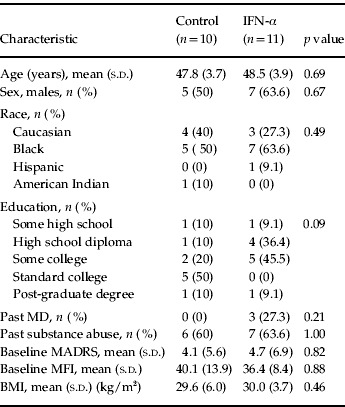
As shown in Table 1, no significant differences between IFN-α/ribavirin-treated subjects and controls were observed for relevant clinical characteristics including age, race, gender, BMI and past history of major depression or substance abuse.
Characteristics of study participants

IFN-α, Interferon-α; MD, major depression; MADRS, Montgomery–Asberg Depression Rating Scale; MFI, Multidimensional Fatigue Inventory; BMI, body mass index; s.d., standard deviation.
Differential gene expression after IFN-α administration
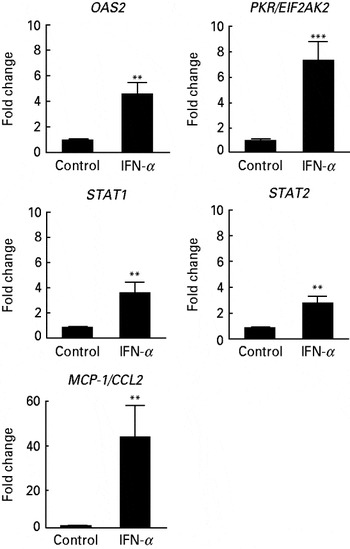
SAM revealed 252 up-regulated and 116 down-regulated gene transcripts out of 21244 detected probes (online Supplementary Table S1). Multiple probes representing a single gene were identified as significantly changed for some genes. Ingenuity Pathway Analysis demonstrated that 12 weeks of IFN-α administration significantly altered gene expression consistent with signaling involved in disease processes including systemic lupus erythematosus (SLE) and rheumatoid arthritis (RA). As expected, it also revealed that many genes increased by IFN-α were related to antiviral and inflammatory responses (online Supplementary Table S2). From these pathways, select genes were chosen for validation by RT–PCR, including OAS2, PKR/EIF2AK2, STAT1, STAT2 and MCP-1/CCL2. These genes were selected based on their role in IFN signaling (STAT1, STAT2), pattern recognition receptors in recognition of bacteria and viruses (OAS2, PKR/EIF2AK2), activation of interferon response factors (IRFs) by cytosolic pattern recognition receptors (STAT1, STAT2), dendritic cell maturation (STAT1, STAT2), the role of PKR in interferon induction and antiviral response (PKR/EIF2AK2, STAT1), and IL-17 signaling (MCP-1/CCL2), and for their association with IFN-α-induced behavioral alterations. Expression of these genes was significantly increased in samples from IFN-α-treated patients compared to controls at 12 weeks (T=35.0, df=7,11, p<0.01 for OAS2; T=28.0, df=7,11, p<0.001 for EIF2AK2/PKR; T=31.0, df=7,11, p<0.01 for STAT1; T=31.0, df=7,11, p<0.01 for STAT2; and T=31.0, df=7,11, p<0.01 for MCP-1/CCL2) (Fig. 1).
Verification of gene expression for 2′-5′-oligoadenylate synthetase 2 (OAS2), protein kinase R (PKR/EIF2AK2), signal transducers and activators of transcription (STAT)1, STAT2 and monocyte chemotactic protein-1 (MCP-1/CCL2). To verify altered mRNA expression in the context of interferon (IFN)-α administration, changes in gene expression were compared in hepatitis C virus (HCV) control subjects and HCV patients treated with IFN-α/ribavirin for 12 weeks. Expression of IFN-α/antiviral genes, including OAS2, PKR/EIF2AK2, STAT1 and STAT2, and the inflammatory transcript MCP-1/CCL2 were measured by reverse transcription polymerase chain reaction (RT-PCR). Expression of these genes was significantly increased after 12 weeks of IFN-α administration (n=11) compared to control (n=7). Data are summarized as mean±standard error (s.e.). ** p<0.01, *** p<0.001.

Genes associated with depressive symptoms and fatigue
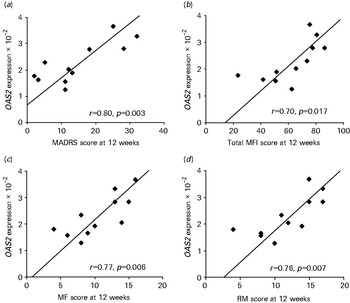
Of the 11 IFN-α-treated subjects, four demonstrated both clinically significant depressive symptoms (MADRS score ⩾15) and fatigue (total MFI ⩾75) at 12 weeks of IFN-α administration. Three of these subjects also met symptom criteria for major depression according to DSM-IV. To identify genes that were increased in subjects with high MADRS and MFI scores, gene expression profiles of these individuals were compared to IFN-α-treated subjects with low depression (MADRS <15) and fatigue (MFI <75). Examination of the 252 up-regulated and 116 down-regulated genes by SAM identified only two genes that were differentially expressed in high MADRS/MFI subjects: OAS2 (ILMN_2248970) was significantly up-regulated, and FCER1A (ILMN_1688423) was significantly down-regulated. Of interest, OAS2 expression values significantly correlated with 12-week MADRS and MFI scores in IFN-α-treated subjects (r=0.80, df=9, p=0.003 and r=0.70, df=9, p=0.017 respectively) (Fig. 2 a, b). Significant correlations with OAS2 expression were also observed for mental fatigue (MF) (r=0.77, df=9, p=0.006) and reduced motivation (RM) (r=0.76, df=9, p=0.007) (Fig. 1 c, d). Similar results were found with OAS2 as measured by RT–PCR (data not shown). Multivariate analyses including age, sex, race, BMI, type of IFN-α and past history of depression and substance abuse as covariates revealed a final model including only OAS2 for MADRS (F 1,9=14.25, p<0.01), MFI (F 1,9=5.95, p<0.05), MF (F 1,9=11.75, p<0.01) and RM (F 1,9=14.68, p<0.01) in separate analyses. To evaluate the contribution of baseline depression and IFN-α-induced fatigue (week 12) to the association between OAS2 expression and high MADRS scores at week 12, partial correlations were used. The analyses revealed that the relationship between OAS2 and week-12 MADRS scores persisted when controlling for baseline MADRS scores (r=0.80, df=8, p=0.005), and also for week-12 MFI scores (r=0.63, df=8, p=0.05). Decreased FCER1A was negatively correlated with MADRS scores at 12 weeks (r=−0.74, df=9, p=0.009), but this relationship was not significant when entered into multivariate analyses including clinical covariates.
Expression levels of the 2′-5′-oligoadenylate synthetase 2 (OAS2) gene correlated with Montgomery–Asberg Depression Rating Scale (MADRS) and Multidimensional Fatigue Inventory (MFI) scores at 12 weeks of interferon (IFN)-α administration. OAS2 expression was positively correlated with (a) MADRS and (b) total MFI scores at 12 weeks of IFN-α administration. Assessment of subsets of the MFI score that were related to OAS2 expression revealed significant positive correlations for (c) mental fatigue (MF) and (d) reduced motivation (RM).

Transcription control pathways
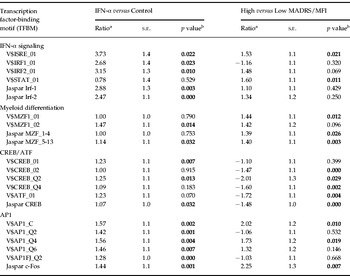
To examine transcriptional control pathways that might mediate observed differences in gene expression, a two-sample variant of TELiS bioinformatics analysis was used to assess the prevalence of TFBMs involved in IFN-α signaling, myeloid differentiation (myeloid zinc finger protein, MZF), CREB/ATF and AP1 signaling pathways in promoter regions of differentially expressed genes (see Supplementary Table S3 for gene lists analyzed). The prevalence of TFBMs of interest is summarized in Table 2 as the mean ratio (fold difference), standard error and p value. We observed highly consistent results between the two databases that the TELiS system queries, TRANFAC and JASPAR, for the TFBMs investigated. As anticipated, IFN-α administration was associated with an increase in genes regulated by interferon-sensitive response element V$ISRE_01 and IRFs (V$IRF1_01, V$IRF2_01, Jaspar Irf-1, and Jaspar Irf-2). V$ISRE_01 and V$STAT1_01 were over-represented in genes of high compared to low MADRS/MFI subjects. Genes with TFBMs associated with myeloid differentiation (V$MZF1_02 and Jaspar MZF_5-13) were increased in subjects treated with IFN-α compared to control. When comparing high and low MADRS/MFI groups, there was a significant increase in V$MZF1_01, Jaspar MZF_1-4 and Jaspar MZF_5-13 TFBM prevalence. Enrichment of CREB/ATF binding sites, V$CREB_01, V$CREB_Q2 and Jaspar CREB, was revealed in IFN-α compared to control subjects, yet a marked decrease in the prevalence of multiple CREB/ATF binding sites (V$CREB_02, V$CREB_Q2, V$CREB_Q4, V$ATF_01 and Jaspar CREB) was observed in differentially expressed genes from high compared to low MADRS/MFI subjects. The prevalence of AP1-related TFBMs was also found to be significantly increased in promoters of IFN-α-related genes compared to control (V$AP1_C, V$AP1_Q2, V$AP1_Q4, V$AP1_Q6, V$AP1FJ_Q2 and Jaspar c-Fos), and also in genes up-regulated in high versus low MADRS/MFI subjects (V$AP1_C, V$AP1_Q4 and Jaspar c-Fos).
Transcriptional activity of IFN-α, myeloid differentiation, CREB/ATF and AP1 signaling pathways as assessed by TELiS bioinformatics analysis of the prevalence of response elements in the promoters of genes differentially expressed by IFN-α compared to control, and in patients with high versus low depression and fatigue scores

IFN-α, Interferon-α; CREB/ATF, cAMP responsive element binding protein/activation transcription factor; AP1, activator protein-1; TELiS, Transcription Element Listening System; MADRS, Montgomery–Asberg Depression Rating Scale; MFI, Multidimensional Fatigue Inventory.
Bold values indicate statistical significance at p<0.05.
a Data represent the ratio (fold difference) and standard error (s.e.) of response element prevalence in promoter regions of genes differentially expressed in subjects at 12 weeks of IFN-α compared to controls, and in IFN-α-treated patients with high versus low MADRS and MFI scores.
b p values from single-sample t tests.
TOA
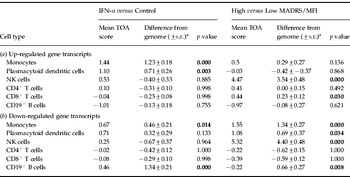
To investigate the cellular origin of differentially regulated transcripts, we conducted TOA (Cole et al. Reference Cole, Hawkley, Arevalo and Cacioppo2011) for differentially expressed genes in IFN-α compared to control, and high (n=4) versus low (n=7) MADRS/MFI subjects (Table 3). Transcripts that were up-regulated by IFN-α were derived primarily from monocytes and plasmacytoid dendritic cells. Whereas transcripts expressed by CD4+ T lymphocytes, CD8+ T lymphocytes and natural killer (NK) cells appeared at approximately the same rate among IFN-α-increased transcripts as they did across a random sample of all human genes, transcripts originating from monocytes and B cells were significantly more prevalent in genes down-regulated by IFN-α. Of note, cell origin analysis revealed a significant presence of monocyte and plasmacytoid dendritic cell-related genes in the down-regulated transcripts from high versus low MADRS/MFI subjects. Conversely, the up-regulated genes of high MADRS/MFI subjects were characteristic of CD8+ T lymphocytes, and NK cell-related genes were significantly present in both up- and down-regulated genes for these subjects. Similar to that of IFN-α compared to control, the down-regulated gene profile of high MADRS/MFI subjects was significantly represented by transcripts of B-cell origin.
Transcript origin analysis (TOA) of IFN-α-induced transcriptional alterations in isolated leukocyte subsets compared to control, and in patients with high versus low depression and fatigue scores

IFN-α, Interferon-α; MADRS, Montgomery–Asberg Depression Rating Scale; MFI, Multidimensional Fatigue Inventory; NK, natural killer.
Positive TOA diagnosticity scores indicate that differentially expressed genes originate predominately from the analyzed cell type. Negative values are uninformative, implying that transcripts originate from other cell types or from the analyzed cell type and also other cell types.
Bold values indicate statistical significance at p<0.05.
a Scores are presented as the difference from the genome mean and standard error (s.e.) of the difference.
Discussion
A systematic analysis of gene transcripts regulated by chronic IFN-α exposure using genome-wide profiling as it relates to IFN-α-induced depression and fatigue was performed. As expected, genes up-regulated at 12 weeks of IFN-α administration were predominantly related to IFN-α/antiviral and inflammatory signaling pathways. However, there was a striking specificity of transcriptional alterations associated with the onset of IFN-α-induced depression and fatigue. OAS2 mRNA emerged as the primary transcript associated with the advent of depression and fatigue symptoms within the IFN-α-treated group. Subsequent bioinformatic analyses suggested that cytokine-induced depression and fatigue were also linked to a relative reduction in activity of the CREB/ATF signaling pathway, and a substantial transcriptional shift toward genes originating from NK and CD8+ T lymphocytes. These depression and fatigue-related transcriptional alterations were distinctive relative to the more general pattern of transcriptional (TFBMs) changes associated with IFN-α treatment compared to controls, which involved a shift to predominately myeloid lineage monocytes and plasmacytoid dendritic cells, and activation of IRF and AP1 family transcription factors accompanied by a comparative increase in CREB/ATF activity. Thus, the present study identifies a distinctive pattern of leukocyte transcriptional alterations associated with the onset of clinically significant depression and fatigue during IFN-α administration that could serve as biomarkers and/or targets for diagnosis or intervention to reduce behavioral symptoms associated with chronic exposure to an inflammatory stimulus, as during medical illness or chronic stress.
Consistent with a role for IFN-α signaling in development of behavioral symptoms, functional clustering of genes using Ingenuity Pathways Analysis indicated patterns of differential gene expression consistent with SLE and RA, both of which have well-documented behavioral changes including depression and fatigue (Kozora et al. Reference Kozora, Ellison and West2006; Kojima et al. Reference Kojima, Kojima, Suzuki, Oguchi, Oba, Tsuchiya, Sugiura, Kanayama, Furukawa, Tokudome and Ishiguro2009). This analysis further classified genes related to IFN-α/antiviral and inflammatory responses, and increased mRNA expression of common and behaviorally relevant IFN-α-induced genes (STAT1, STAT2, PKR/EIF2AK2 and OAS2) and the inflammatory gene MCP-1/CCL2 (confirmed by RT–PCR). STAT1 and PKR are activated in the brain following peripheral IFN-α administration, and are thought to be related to IFN-α-induced behavioral alterations in rodents (Wang et al. Reference Wang, Campbell and Zhang2008, Reference Wang, Dunn, Roberts and Zhang2009). Furthermore, OAS2 and PKR are activated by IFN-α and have been associated with behavioral disturbances in patients with CFS (Suhadolnik et al. Reference Suhadolnik, Reichenbach, Hitzges, Sobol, Peterson, Henry, Ablashi, Muller, Schroder, Carter and Strayer1994b ; Vojdani et al. Reference Vojdani, Ghoneum, Choppa, Magtoto and Lapp1997; Vojdani & Lapp, Reference Vojdani and Lapp1999). Interestingly, we have previously reported increased MCP-1, an inflammatory chemokine released by monocytes, in the periphery and cerebrospinal fluid of IFN-α-treated patients (Raison et al. Reference Raison, Borisov, Majer, Drake, Pagnoni, Woolwine, Vogt, Massung and Miller2009a ), and this mRNA transcript was expressed at high levels in IFN-α-treated patients.
Of the genes identified with SAM as most affected by IFN-α, OAS2 was the only gene significantly increased in subjects that evinced high MADRS and MFI scores. Interestingly, OAS2 mRNA expression, as measured by both microarray and RT–PCR, was correlated with depression and fatigue scores in IFN-α-treated subjects at 12 weeks. Analysis of the MFI subscales indicated a significant association of OAS2 expression with subscales related to mental fatigue and reduced motivation. This relationship between OAS2 and IFN-α-induced fatigue is of particular relevance in the context of CFS, in which OAS2 activity has consistently been found to be elevated and is thought to indicate increased IFN-α-mediated antiviral activity in these subjects (Suhadolnik et al. Reference Suhadolnik, Reichenbach, Hitzges, Adelson, Peterson, Cheney, Salvato, Thompson, Loveless, Muller, Schröder, Strayer and Carter1994a , Reference Suhadolnik, Reichenbach, Hitzges, Sobol, Peterson, Henry, Ablashi, Muller, Schroder, Carter and Strayer b ; Vojdani & Lapp, Reference Vojdani and Lapp1999; Nijs & De Meirleir, Reference Nijs and De Meirleir2005). Although previous studies have reported increased OAS2 activity following IFN-α administration (Merritt et al. Reference Merritt, Borden and Ball1985; Okuno et al. Reference Okuno, Shindo, Arai, Matsumoto, Takeda, Kashima and Sokawa1991), this is the first study to directly link increased OAS2 expression with depression and fatigue in IFN-α-treated subjects. Further support for these findings were apparent when considering transcriptional control of differentially expressed genes. Not surprisingly, IFN-α signaling was increased in IFN-α patients compared to controls. However, IFN-α-related TFBMs were also over-represented in genes of high versus low MADRS/MFI subjects, indicating that these innate antiviral signaling pathways are, in fact, related to depression and fatigue. The relationship between IFN-α signaling and peripheral OAS2 activity in IFN-α-induced depression and fatigue supports the hypothesis that chronic exposure to antiviral and/or inflammatory cytokines such as IFN-α may contribute to the pathophysiology of diseases associated with chronic inflammation and/or viral infection, including CFS (Suhadolnik et al. Reference Suhadolnik, Reichenbach, Hitzges, Sobol, Peterson, Henry, Ablashi, Muller, Schroder, Carter and Strayer1994b ; Vojdani & Lapp, Reference Vojdani and Lapp1999). In terms of inflammation, OAS2 is involved in innate immune responses to viral infection. Although the role of OAS2 in the brain has not been characterized in relation to behavioral alterations, OAS family transcripts are activated in rodent brains in response to viral infections (Sandberg et al. Reference Sandberg, Eloranta and Campbell1994; Saha & Rangarajan, Reference Saha and Rangarajan2003) and to overexpression of IFN-α (Akwa et al. Reference Akwa, Hassett, Eloranta, Sandberg, Masliah, Powell, Whitton, Bloom and Campbell1998). Whether activation of this enzyme in the brain is sufficient to induce behavioral change remains to be determined. Nevertheless, increased peripheral OAS2 observed in CFS, and in this study during IFN-α-induced depression/fatigue, indicates that OAS2 or downstream pathways activated by OAS2 may precipitate behavioral alterations associated with innate immune activation.
Interestingly, transcriptional differences related to IFN-α-induced depression and fatigue were found in CREB/ATF and AP1/c-Fos signaling pathways. Although genes related to CREB transcriptional control were increased in IFN-α-treated subjects compared to controls, it was not surprising that patients with high MADRS/MFI scores displayed a marked decrease in genes controlled by CREB signaling. Unlike CREB, increased AP1/c-Fos transcriptional activity was apparent in genes differentially expressed by both IFN-α compared to control, and also high compared to low MADRS/MFI scores. In relation to decreased CREB signaling and IFN-α-induced depression/fatigue, CREB activity has been implicated in major depression and increases in PBMCs following response to antidepressant treatment (Koch et al. Reference Koch, Kell, Hinze-Selch and Aldenhoff2002; Lai et al. Reference Lai, Hong and Tsai2003; Yamada et al. Reference Yamada, Yamamoto, Ozawa, Riederer and Saito2003; Blendy Reference Blendy2006). Furthermore, CREB activity in PBMCs is under control of catecholamines, which may be reduced in both the peripheral and central nervous system during IFN-α-induced depression and fatigue (Trask et al. Reference Trask, Esper, Riba and Redman2000; Miller, Reference Miller2009). Moreover, alterations in CREB and AP1/c-Fos activity in specific brain regions are related to exposure to chronic stress and the development of depressive and anxiety-like behaviors in rodents (Morinobu et al. Reference Morinobu, Nibuya and Duman1995; Wallace et al. Reference Wallace, Stellitano, Neve and Duman2004; Kuipers et al. Reference Kuipers, Trentani, Westenbroek, Bramham, Korf, Kema, Ter Horst and Den Boer2006). In the brain, these transcription factors are thought to act as gene expression regulators that produce long-term modifications at the neuronal level. Transcriptional activity of chronic IFN-α in the periphery may mirror regulation of gene expression in brain, and represent transcriptional modifications that potentially underlie chronic cytokine-induced behavioral alterations. In relation to cytokine-induced depression, AP1/c-Fos is a downstream target of MAPK/ERK signaling pathways (Kyriakis & Avruch, Reference Kyriakis and Avruch2001; Zarubin & Han, Reference Zarubin and Han2005), and activation (phosphorylation) of p38-MAPK following the initial injection of IFN-α is associated with depression and fatigue during IFN-α treatment (Felger et al. Reference Felger, Alagbe, Pace, Woolwine, Hu, Raison and Miller2011). Therefore, over-representation of AP1-regulated genes associated with IFN-α-induced depressed and fatigue may reflect overactivity of MAPK/ERK signaling pathways at 12 weeks of IFN-α administration.
Monocyte and plasmacytoid dendritic cell-related genes were significantly represented in the genes up-regulated by IFN-α as determined by TOA. Further support for IFN-α-mediated increases in monocyte signaling is the finding that MCP-1/CCL2 was the inflammatory transcript demonstrating the greatest fold increase by IFN-α, and that genes differentially regulated by IFN-α demonstrated significant transcriptional control by MZF TFBMs related to monocyte/macrophage differentiation (Krishnaraju et al. Reference Krishnaraju, Nguyen, Liebermann and Hoffman1995; Moeenrezakhanlou et al. Reference Moeenrezakhanlou, Shephard, Lam and Reiner2008). Regarding plasmacytoid dendritic cells, these cells are a rich source of type-I IFNs, and are prominently activated in autoimmune disorders including SLE and Sjögren's syndrome (Ronnblom et al. Reference Ronnblom, Eloranta and Alm2003; Gottenberg et al. Reference Gottenberg, Cagnard, Lucchesi, Letourneur, Mistou, Lazure, Jacques, Ba, Ittah, Lepajolec, Labetoulle, Ardizzone, Sibilia, Fournier, Chiocchia and Mariette2006; Ng & Bowman, Reference Ng and Bowman2010). Another interesting preliminary finding from subjects with high MADRS/MFI was that up-regulated genes were derived primarily from cytotoxic CD8+ T cells and NK cells, and monocyte-related genes were more prevalent in the down-regulated genes. Nevertheless, a significant over-representation of genes under MZF transcriptional control was observed, indicating that increased myeloid-related signaling persisted in a background of cytotoxic lymphocyte transcriptional activity. Of note, NK cells contributed significantly to both up- and down-regulated genes associated with high MADRS/MFI, suggesting a shift in transcriptional activity within this cell type. Interestingly, alterations in NK cell activity have been frequently described in individuals with major depression (Irwin et al. Reference Irwin, Patterson, Smith, Caldwell, Brown, Gillin and Grant1990; Evans et al. Reference Evans, Folds, Petitto, Golden, Pedersen, Corrigan, Gilmore, Silva, Quade and Ozer1992; Pariante & Miller, Reference Pariante and Miller1995) and CFS (Klimas et al. Reference Klimas, Salvato, Morgan and Fletcher1990; Nijs & De Meirleir, Reference Nijs and De Meirleir2005). Future examination of PBMCs by flow cytometry after 12 weeks of IFN-α administration will determine whether transcriptional alterations in cytotoxic and monocytic cells translate into differences in cell number or activation state in patients with IFN-α-induced depression/fatigue.
In terms of limitations of this study, foremost is the small sample size. Thus, findings from genes differentially expressed in high compared to low MADRS/MFI subjects should be interpreted with caution. Furthermore, this study used a cross-sectional design that did not permit identification of gene expression at baseline, which might predict development of IFN-α-induced depression/fatigue. It should also be noted that all IFN-α-treated patients were concomitantly treated with ribavirin, and it is possible that some transcriptional dynamics observed were induced by ribavirin. However, an in vitro study comparing transcriptional activity of ribavirin to that of pegylated IFN-α in PBMCs found that ribavirin induced differential expression of a negligible number of genes compared to IFN-α alone (Taylor et al. Reference Taylor, Grosse, Schaley, Sanda, Wu, Chien, Smith, Wu, Stephens, Ferris, McClintick, Jerome and Edenberg2004). Additionally, the present study was not a randomized experiment in which patients were experimentally allocated to treatment and control groups. Although there does not seem to be any significant demographic or disease history-related condition confounded with IFN-α/ribavirin therapy in this sample, it remains possible that some other extraneous feature may differ between groups and potentially contribute to gene expression differences. However, the fact that IFN-α response genes dominated transcriptional signatures suggests that any confounding effects of ribavirin or other unmeasured variables probably contributed relatively little to the observed results. Furthermore, IFN-α mono-therapy for malignant melanoma has been associated with profound induction of depression and fatigue (Musselman et al. Reference Musselman, Lawson, Gumnick, Manatunga, Penna, Goodkin, Greiner, Nemeroff and Miller2001; Raison et al. Reference Raison, Demetrashvili, Capuron and Miller2005). Thus, the transcriptional activity associated with depression and fatigue in this study can most probably be attributed to specific effects of IFN-α.
In sum, this study affords a comprehensive examination of molecular alterations induced by chronic IFN-α exposure in a small sample of patients with HCV, and provides important clues and a theoretical framework for future studies examining changes in transcriptional activity related to cytokine-induced depression and fatigue.
Note
Supplementary material accompanies this paper on the Journal's website (http://journals.cambridge.org/psm).
Acknowledgments
This study was supported in part by grants from the National Institutes of Health to C.L.R. (K23 MH064619, R01 MH070553), A.H.M. (K05 MH069124, R01 HL073921, MHR01MH075102, T32 MH020018) and J.C.F. (F32 MH093054), and also from the Emory Center for AIDS Research (P30 AI050409) and the Cancer Genomics Shared Resource of the Emory University School of Medicine. In addition, the study was supported by PHS Grant UL1 RR025008 from the Clinical and Translational Science Award program and PHS Grant M01 RR0039 from the General Clinical Research Center program, National Institutes of Health, National Center for Research Resources.
Declaration of Interest
C. L. Raison serves as a consultant for Pamlab LLC and Biolex Therapeutics. A. H. Miller has served as a consultant for Abbott Laboratories, AstraZeneca, GlaxoSmithKline, Lundbeck Research USA, F. Hoffmann-La Roche Ltd, Schering-Plough Research Institute and Wyeth/Pfizer Inc. and has received research support from Centocor Inc., GlaxoSmithKline and Schering-Plough Research Institute.