Relations wither or flourish according to the properties seen to flow alongside them. The effectiveness of relationships thus depend on the form in which certain objects appear.Footnote 1
The Form In Which Certain Objects Appear
Within this article, I explore the shape of cultural property relations that are manifest in a particular type of form: photographs. I do so by discussing the productive potentials of engaging indigenous communities through looking at photographs and how these engagements unsettle European preconceptions about what photographs are, as well as what cultural property is, and perhaps can be. Photographs are promiscuous, with meanings that shift and blur depending on the viewer, context, and temporal field.Footnote 2 Their reproducibility and ability to capture a moment in particular artifact form that brings the there-then into the here-now makes them a particular type of object whose slipperiness is unique.Footnote 3 Analogies can be drawn between photography as a fragment-making technology, with the language of international cultural property that similarly tries to fix otherwise shifting states and fit things into a discourse that is often completely foreign to the communities from which photographs were obtained and now circulate in.Footnote 4 As discussed by other the contributors, the discourse of international cultural property reconceptualizes as distinct what are otherwise locally understood to be connected fluid entities (i.e., persons, environment, ancestors), and thus often masks the relations between these entities. Within the context of the Purari Delta of Papua New Guinea (PNG), what relations are given presence by historic photographs and the talk around and about these images? What is the effectiveness of these relations, and how do these relations and their effects complicate European notions of photographs as distinct forms and by extension European views of cultural property?
There is not just one model of cultural property, of course, but many diverse models bound up with the group's cultural engagement with the world. It is in exploring these diverse views, as the other contributors do within this special issue, that a reformulation of the international cultural property discourse can productively emerge. Whether bringing people into museum spaces or sending people out with images, museums are increasingly becoming important venues for this process.Footnote 5 My own work with historic photographs emerged out of the Cambridge University Museum of Archaeology and Anthropology's commitment to fund projects that reconnect their collections with communities.Footnote 6 Two interrelated things are occurring as museums are opening up and revisiting the legacies of the relations embodied in their collections. The first is that the entitlement to cultural resources is different once we let communities self-define what is and is not culturally salient for them.Footnote 7 Secondly, once engaged it becomes apparent that indigenous communities are grappling with European cultural property debates and are using their traditions to negotiate the terms of these developments.Footnote 8 A dialogue between multiple constituencies, this process often involves objects as pivots for these discussions.
Curious artifacts, photographs can take a variety of forms—such as a paper print or digital pixels illuminating a screen—all of which give otherwise transient moments a particular presence in the world. These forms can be placed in albums; stored within a museum; hang on walls in public and private places; sent as email attachments; and ripped, erased, lost, manipulated, and reproduced. These various materialities mediate our engagement with photographs and raise issues about what it means for these objects to circulate in and out of different property regimes. In the process photographs emerge as relational or distributed objects enmeshed within various networks of telling, seeing, and being, which extend beyond what a photograph's surface visually displays and incorporate what is embodied in their materiality.Footnote 9 Using photographs with communities, alternatively described as photo-elicitation or visual repatriation, creates space for an understanding of the locally situated and dynamic materialities that are often obscured by a photograph's life within a museum and with the preoccupation of what a photograph visually represents. What emerges in these encounters is how the random inclusiveness of photographs and their indiscriminate documentation of the quotidian allows for the smallest detail found within their frame to become prompts for dialogues. In freeing these objects from their immersion in European cultural expectations (whether personal or institution), visual repatriation allows other ways of seeing to emerge.Footnote 10
Through the examination of the “praxis through which people articulate their eyes and their bodies in relation to pictures,” researchers can engage with the relations by which photographs as image-objects are enmeshed within the ideological frames we label cultural property, which formulate the relationship between persons and things.Footnote 11 As historical situated frame of legitimacy, the discourse of cultural property helps define the limits and contents of ownership, and thus what can and does become heritage. Juxtaposing Melanesian and European formulations of the networks inhabited by persons and things, Strathern notes that for the latter ownership is about cutting relations or rather “that belonging divides and property disowns.”Footnote 12 Perspectives on Purari corporeality and kinship, as elsewhere in the Pacific, help provide alternative views of these networks and are productive foils to our cultural assumptions about cultural property.Footnote 13 But it would be a mistake to reify these heuristic divisions because, as other scholars have demonstrated, Pacific Islanders are engaging with European models of cultural property with various results. The transformations that result from the meshing of European law with the property regimes of PNG is productively explored by contributors to the volume Protection of Intellectual, Biological & Cultural Property in Papua New Guinea.Footnote 14 Collectively, these authors position property in PNG as something that cannot be confined within one category, but rather show how property extends outward within indigenous models meshing what is defined as biology, culture and the mind. As Geismar in her account of property relations in postcolonial Vanuatu argues, these networks “embody divergent concepts of entitlement and redefine the borders between ideas, places and regions of political authority.”Footnote 15 It is to a discussion of the networks that unfolded when viewing and talking about photographs in the Purari Delta that I now turn.
RELATIONS WITHIN AND OUTSIDE THE FRAME
The Purari Delta is a large tidal estuary in the middle of the Papuan Gulf on PNG's southern coast.Footnote 16 The region is home to three main ethnic groups: the Pawaiian, Kaura, and Purari. The Purari inhabit the middle and coastal areas of the Delta, whereas the Pawaiian and Kaura occupy the Delta's upper reaches. Numbering some 11,000, the Purari share a common language and a set of cultural traits. Divided into six self-described tribal groups—Baroi, I'ai, Kaimari, Koriki, Maipuan, Vaimuru—the Purari occupy 22 villages, which range in size from 600 to 30 people.Footnote 17 Villages are further divided into longhouse communities (ravi), who are host to various patrilineal descent groups (ava'i). The composition of these descent groups is the result of ancestral migration and more recent histories of fissions and fusions such that groups have connections both within a particular longhouse community and between them. These temporal and spatial relationships are spoken of as kapea (or paths), and are complicated by relations created and sustained by exogamous marriage practices. Since the 1950s these kapea have intensified as people have migrated to the capital city of Port Moresby and because they have married members of other ethnic groups. Although Purari living in towns have more ready access to cash and mass-produced commodities, those in the Delta remain largely subsistence hunters, fishers, and horticulturalists with limited access to cash earning activities.
Bound up with these kapea are local beliefs in Christianity (Seventh-Day Adventist, Pentecostal, and United Church) and the presence of spirit-beings known as imunu. Active Christians gloss imunu as being demons. They are also understood to be ancestors that animate the environment in a variety of shifting forms. These beliefs result in a twofold complication: The world is populated by various seen and unseen entities that have agency; nothing that one encounters may be at first what it seems to be. As a result people privately and publicly speculate about what lies concealed behind visible forms. For example, is a roving salt-water crocodile merely that or the canoe (vi'i) or covering (ruru) by which sorcerers travel and enact their revenge? Inert objects may also be deceptive in that they too may become or be the vessels of imunu, the spirit of the dead and sorcerers. Although transformed by political, social, and economic forces in the colonial (1880–1975) and postcolonial (1975–present) periods, the Purari's intertwined cosmology and social system, creates a network of relations such that persons, things, and the environment are understood to be interconnected as fluid forms within a spectrum of possibilities. This is not to argue that the Purari do not believe in the concrete; rather, it is to say that their cosmology and materiality is shaped by a view that it is porous, involving continuous flux. Large-scale industrial logging operations (1995–present) and oil exploration (2002–present) in the middle and upper Delta are the latest frames for these ongoing transformations. Moreover, because these operations need to locate customary owners of the land, communities have been pushed to redefine their relations and thus themselves as fixed entities.Footnote 18
Historic photographs taken in 1914, 1922, and 1954 to 1955 formed one means by which I engaged with groups and individuals to speak about the Delta's social transformations.Footnote 19 The most enduring of these transformations are the ongoing effects of the Tom Kabu Movement (1946–1969). A failed indigenous attempt at modernization, the Kabu Movement involved adherents urging the abandonment and destruction of a ritual and material forms to make way for business activities centered on the selling of cash crops.Footnote 20 As a result, with the exception of the photographs from 1954 to 1955, the photographs gave presence to a past that many Purari had never encountered, and about which they had ambivalent feelings and connections. As my research unfolded I learned that aspects of this discarded past had survived the purges of the Kabu Movement embodied in heirloom objects and ancestral migration narratives (airu omoro). These forms, alongside songs and names, are part of a group's inalienable possessions (airu aruku), which are the closest local analogy to cultural property. They help constitute corporate identity by situating descent groups within a network of kapea. Although the wider community knows the general shape of these forms, their specificities are closely kept secrets. Within the context of resource extraction, these forms are being marshalled by groups as proof of the legitimacy of their customary tenure of land and thus have become new tokens in the internal debates over the equity of royalty payments from the timber extraction. With the Kabu Movement's disruption of traditional means of knowledge transfer, only a dwindling number of male elders know the specificities of these forms. During my research photographs from 1914 and 1922 quickly became another means by which these relations were manifested. Rather then dwell on the methodology of these engagements, I wish to examine what relations unfolded from looking at these photographs and therefore explore the local constitution of cultural property.Footnote 21
Before examining what transpired when looking at two particular photographs, it is important to briefly delve into the local ontology of images to better situate these engagements. Photographs are understood to be akin to shadows, reflections and the soul.Footnote 22 Referred to by the same term, avaea, all these images are understood to be a part of the person. What this means is that a photograph is understood to quite literally extend the person's “social microcosm” by creating other physical-visual traces of the body.Footnote 23 These connections are part of the wider understanding in Melanesia by which the person is conceptualized to be composed by their relations with others, and that the products of one's actions are inalienable, such that in giving things one gives part of oneself. Among the Purari the person is conceptualized as being composed of bone, blood and stomach, as well as flesh. The first two substances are gendered and received respectively from one's father and mother to form one's interior. Acts of feeding create the person's body, and it is in this way that adoption is understand to work. These substances and actions coalesce over the course of the person's life and situate them within a network of obligations to their paternal and maternal kin as well as the environment and their ancestors.
Although it is unclear where the person's spirit originates, it is bound up with the corporal person and has its own distinctive materiality. A detachable part of the person, during sleep the experiences of one's spirit forms the basis for dreams. Sorcerers may also capture one's spirit resulting in sickness. Upon death spirit and body are decoupled; and depending on the relative's treatment of the deceased, the spirit may haunt or help the living. Photographs of the dead are looked after in albums or plastic folders. Not only objects of memory, these images may become vessels in which the deceased's spirit resides.
This capacity of photography to extend the subject is perhaps most explicitly raised in campaign posters. In the 1998 elections, I was told of how an incumbent politician wore a magic flower behind his ear when photographed so that his photograph would compel people to vote for him. A similar logic guided a candidate to wash with magical herbs before having his photograph taken. In each case these men relied on the perceived lasting indexical effects of photograph to replicate the magical effects believed to be temporarily part of their image. My dwelling on these aspects of images is to help situate how photographs are perceived to have the capacity to extend the person as well as reiterate people's dynamic relationships with photographs. These ways of connecting through images creates the potential for the Purari to develop important relationships to the holding institutions of these photographs, which locally possess more potency and poignancy then other regional artifacts in museums. For it is in these images that they can see, and thus in some sense be with, aspects of the previous generations.
During the second month of my stay within the village of Mapaio, I found myself within house of my principal host Ke'a Aukiri during an afternoon thundershower. As the cacophony of rain enveloped us, I asked Ke'a if we could talk about the images taken by F. E. Williams during his eight-month stay in the Delta in 1922.Footnote 24 The aging chief of the Peruava Orumako descent group of the Lavi Kaupara longhouse, Since my arrival Ke'a had been recounting a series of ancestral narratives that situated his chieftaincy, preeminence of his group, and their relationship with Europeans. Part of knowledgeable elders' autobiographies and although about events of the distant past, these narratives are tangibly imminent for those who know them and are an important part of any life history narration. Through the specification of particular places and ancestral names, the telling of these narratives reveal, just as travelling through the environment does visually and spatially, the teller's place within the constellation of paths between the environment, other descent groups, and ancestors. Abounding with metamorphosis, these narratives reveal the Delta to be a palimpsest of culturally significant places whose meanings are constituted through both past and present practices. As these narratives affirm the teller's sociality, they also confirm the resource tenure rights that derive from this affirmation. These narratives reveal how land is intimately bound up with a descent group's identity such that portions of the environment (i.e., a particular grove of bamboo or a whirlpool) are understood to be part of a group's cultural property as well as confirm wider associations.Footnote 25 As articulated by the elder Avae Vai'i, “Land is important because it is our source of life…. It is land that is in us.”Footnote 26 This mutuality informs the articulation of kinship, politics, economics, and cultural property.
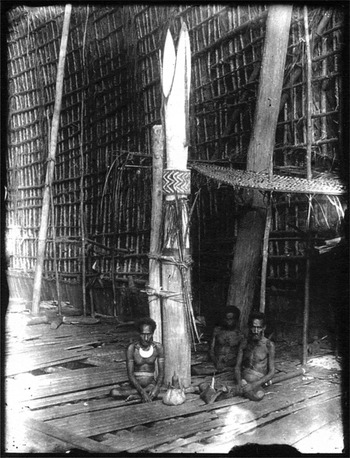
Speaking with his sister's son Kaia and I, Ke'a gave a forensic reading of the first three photographs.Footnote 27 Our discussion of “Aikava Ravi (Iari)” progressed in the same manner (Figure 1). Ke'a identified the building as the principal or father longhouse (mai ravi) of Aikavalavi, traditionally the first of the six I'ai longhouses. These buildings dominated communities with their 24-meter-high facades and roofs that tapered 34 meters to the buildings' low back. The centre of male-controlled ritual activity, these massive structures were where descent groups stored their ritual regalia, masks, and ancestral carvings. These various artifacts gave a visual and tangible form to the groups' imunu and were instrumental points of access to the ancestors and their kapea. Besides giving presence to this former ritual center, the photograph also gave a tangible presence to a landscape in which Ke'a had not been immersed since his departure from the village in 1949.
“Aikava Ravi (Iari).” Photograph credit: 1922 F. E. Williams, National Archives of Australia A63000, 41.3A.

Ke'a pointed out the breadfruit, rosewood, and coconuts, which framed the structure's open entrance, and named their various owners. He similarly noted the walkways, a colonial intervention, which gave access to the building above the frequently flooded ground. As with many initiated men, the sight of the now largely abandoned village and the absent longhouses and ritual system made him pause. Ke'a and some of other elders had enthusiastically joined the Kabu Movement, which led to the abandonment of these buildings. Ruminating on his own initiation within a similar building, Ke'a commented how it was in these structures that the law (vupu) was given to young male initiates. Commenting on his own status as a hereditary chief (amua), Ke'a remarked that to the left of the building just out of the photograph's frame was a creek where his grandmother, Ikoipie, used to catch fish and prawns.Footnote 28
After elaborating about this geographic feature, Ke'a put the photograph down and launched into a lengthy tale of how his descent group, Peruava Orumako, came to reside within the main longhouse of Lavi Kaupara. In brief, Ke'a told how following the unwanted sexual advances of the wife of his elder brother, who was the chief of Orumako, Ke'a's ancestor left Aikavalavi with several men and joined Lavi Kaupara. Upset with his wife for driving away his brother and supporters, the elder brother killed his wife, thereby setting of a bloody feud with the wife's brothers.Footnote 29 Ke'a explained that it was through these migrations that the previously weak Lavi Kaupara became the strong social force it now was among the I'ai. In addition to establishing a branch of Orumako in Lavi Kaupara, Ke'a's ancestor had brought fighting magic, which propelled Lavi Kaupara to new fame within the intervillage competition of killing their mutual enemies. Ke'a's ancestor was made chief of this segment and given land by other resident groups of Lavi Kaupara. The other men who came with his ancestor helped swelled the ranks of Lavi Kaupara's existing descent groups.
In many ways this narrative is an innocuous relation of the movement of men between longhouses and descent groups, and stripped of its details it largely is. Within the highly politicized climate of resource claims, Ke'a would only enunciate this narrative privately for fear that publicly revealing lineages' status as migrant or autochthonous would only exacerbate the already extensive infighting. But like his remark about his grandmother fishing in the unseen creek, both narratives were about situating himself and his relations to this now absent building and largely neglected area. Implicated in his narrative were his rights through these relations to speak and to claim the status he held within Lavi Kaupara. As I was to subsequently learn, his younger half-brother, Henao, was disputing his chieftancy of Peruava Orumako to gain power over the decisions regarding the group's land, and thus control the flow of the anticipated royalty money from the logging.
Later that month during a public meeting with initiated elders of Aikavalavi in Mapaio, this same image resulted in song.Footnote 30 Identifying the image as that of their abandoned longhouse, vocal male elders A'ape Arove Ivia and Mailau Aneane Ivia began spontaneously pounding the veranda's bark floor, in lieu of their drums, and sang the song men would sing as they lifted the building's central posts. Once they finished elder Makani I'ia elaborated how a dexterous young man hung the final ornament from the gable of the completed longhouse. The conversation turned to a discussion about the last time Aikavalavi was built (c. 1938) and their participation in the annual masking ceremony through which they negotiated village relations with each other and imunu. Through these actions and comments, which ranged from lamenting to praising the iconoclasm of the Kabu Movement, the assembled Aikavalavi elders enlivened these images for the assembled uninitiated men, women, and children. For the elders the image of Aikavalavi embodied the nexus of relations that such structures embodied. Doing so helped the elders reactivate and reaffirm these kapea, and by implication their rights to different things. The photographs helped remind the assembled villagers that despite the men's increasing age that they, and they alone, retained intimate knowledge of the I'ai's traditional past. In the wake of the Kabu Movement it has only been recently that such knowledge has been deemed important. With the need to draw on traditional knowledge to secure timber royalties, these men have enjoyed renewed but tenuous positions of importance in communities. Due to the men's conjoined concern about their loss of control of this knowledge, and the conflicts that publicly asserting individual kapea around images would provoke, their comments were generalized and discreet.
The meeting came to an end when we began discussing an image of one of a pair of posts, sculptural representations of large inverted drums, that stood in the entrance of Onopolavi, another longhouse that had its origins in Aikavalavi (Figure 2). As Navara Kairi remarked, “Those two posts had their own people who looked after them.”Footnote 31 Irritated at the veiled allusions made by his peers, Makani urged the men, “If your kapea links to these things, then stand up! Don't say everything of your history, but just bring yourself up to that ancestor.”Footnote 32 Afraid that this would quickly devolve into an intense fight that could later lead to illness or death by sorcery or ancestral wrath, the meeting was ended; and it was decided that subsequent meetings would be held privately.
“Kevaia, Ornamental Post at Onopo Ravi.” This photograph was identified by Ikoi as being Vai'i Kirave. Photograph credit: 1922 F. E. Williams, National Archives of Australia A63000, 61.1b.

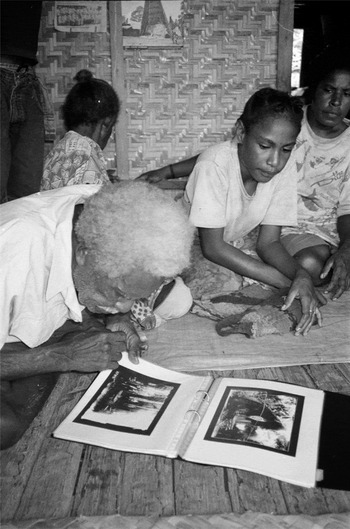
A later interview with the proper person, who through their kapea had the rights to speak about these posts, revealed the photograph to be a wellspring of commentary. This person was Ikoi Uiani, an initiated elder and chief of the Aiaronairu descent group that resided within Onopolavi (Figure 3). Viewed in the privacy of his home, Ikoi identified the sculptural posts as vessels for a pair of ancestral brothers—Vai'i Kirave and Akia Urau—who had a series of adventures as they migrated down the Purari River. Ikoi explained that these objects used to reside within Aikavalavi before the defection of the men who established Onopolavi as a separate longhouse. His ancestors took these sculptural forms with them when they defected, as well as the rights to various points on the Purari River that are part of these ancestors' legacies. Attached to each sculpture were bows, each of which had a custodian to handle and string the bow. These bows were used for hunting and were empowered by their proximity to these imunu.Footnote 33 More importantly for the transforming politics of resource extraction, these two sculptural forms are tangible manifestations of the kapea by which Aiaronairu are connected to groups living on the upper reaches of the Vailala River to the east. Although Ikoi had never followed up these connections, in 1991 a group of Vailala men had come to him asking about the brothers; from memory Ikoi had replicated the sculptures he saw in his youth for them. This photograph was the first time Ikoi had seen these sculptures since his youth; and now they were the only tangible manifestations of these imunu, their connections, and the rights bundled up in them. As such, should Aiaronairu seek to activate these kapea as part of their negotiation of land rights, the photograph was potentially a powerful new token of proof. At Ikoi's request I made a copy of the image for him.
Ikoi Uaini looking at binder of F. E. Williams' photographs while his wife Aea looks away and his granddaughter Rose and daughter-in-law Kathleen look on. Photograph credit: 2001 Bell.

THE UNFOLDING OF RELATIONS
In these and other encounters, photographs became centrifuges from which kapea quickly radiated out enfolding the living, the environment, the ancestral, the past, and the present in a network of relations. In this way photographs are analogous to Hagen dance plagues, and indeed other Melanesian artifacts, whose components are understood to be a materialization of the relations by which the object's owner secured the materials to make the object.Footnote 34 With the absence of traditional artifacts and rituals, for the I'ai telling ancestral histories helps make visible property relations that are otherwise hidden. To make these things visible is to elicit a response from listeners and viewers and actualize the assemblage of relationships that form the stuff of histories and cultural property, which help substantiate persons. These photographs gave orators a platform from which to ground these narratives. During this unfolding of relations, narrators were situating these images within a larger array of images—that is, condensations of social actions—that compose social life in the Delta; and through which relationships, and thus ownership, is maintained and understood.Footnote 35 As Demian argues, “property claims are communication technologies” that make visible the positions of people and things within the network of relations that compose sociality.Footnote 36 In this context, like regimes of ownerships, photographs “gather things momentarily to a point” creating an artifact of light etched onto glass, thereby fixing the flow of life as distinct portable thing and thus “effecting an identity.”Footnote 37
Taking this analysis a step further, one can argue that these objects gave viewers the opportunity to re-present themselves in light of a different ontological position. Drawing on the anthropologist Viveiros de Castro's elaboration of Amazonian perspectivism, Strathern has argued that Melanesia people's generative capacities—their ability to reproduce—is based on their position as a particular type of person: kin, initiate, heir, and so forth.Footnote 38 Although understood to have origins in a prior time in the Delta, photographs derive part of their power by having been detached from the past through the process of being turned into a glass plate negative that then circulated out and multiplied into several generative entities, such as prints in Williams' monograph or copies brought by myself. Similar to the potential shift in states that a son can have toward his father depending on which set of relations the son stands (as his father's son, or as his mother's brother's child), looking at these photographs provided the I'ai with the opportunity to actualize different states of being and thus relationships.Footnote 39
Photographs provided the pivot by which orators could invoke one of these different states. Looking at “Aikava Ravi” Ke'a reimagined himself through the subsistence activities of his grandmother in a particular creek, as well as through his father's ancestral connections to Aikavalavi. Ke'a was thus at one level situating himself through this image into a real but temporally and spatially removed landscape, and also situating the kapea of his present-day authority. Through the photographs, the Aikavalavi elders were able to reposition themselves as initiates with knowledgeable bodies of a way of being that today are effaced. By implication they reminded each other and their audiences what traditional knowledge they possess and will not publicly reveal. Similarly, Ikoi drawing on his kapea could reconfigure himself as being related to the imunu that resided within a set of sculptural drums, and thus the descendants of these spirit-beings who lived who river. In each case, the photographs, seemingly autonomous things, became enmeshed in a particular perspective that is rooted into a set of relations that depends on one's bodily being.
These men led me toward an understanding of the forest of relations by which artifacts, persons, and environment are intermeshed; and thus although objects (like photographs) are important, their true importance is in the ways they help foreground these relations. What unfolded through these engagements with the I'ai was how value, ownership, and cultural property are not invested in the objects themselves but rather in relationships that flow through and around these things. This is not to say that artifacts were and are not important for the Purari; rather it is to say that our own notions of what artifacts are more often then not obfuscate local notions of materiality, which are embedded in relations between and through different entities. Clutching objects as tightly as we often do, we tend to lose sight of the relations that constituted these forms; enlivened them; and, if engaged with, would help us rethink what we possess in historic photographs and can never hold. Discussing them with communities opens up ways to think about and with the indexical things we call photographs. The dialogues that these image-objects initiate can and do challenge our assumptions about what photographs are and thus, by implication, what cultural property is. As a result, museums and archives can better evaluate what they possess by having these collections, and how by engaging with them more nuanced understandings of the collections can emerge and relationships with the communities of whom these photographs were taken can be forged.
A recent otherwise traditional art-oriented exhibit at The Metropolitan Museum of Art, Coaxing the Spirits to Dance: Art of the Papuan Gulf, innovatively used historic photographs to help present the now-lost cultural contexts of the region. In doing so the show helps audiences better appreciate the artifacts on display. Although much more can be done with these images in terms of research and display, the show is an important step in the right direction. Many museums have vast photographic collections, and the potential for these collections to help rethink relationships they help embody is tremendous. As articulated by the artist Rosanne Raymond regarding museum artifacts, “If you let the objects dance they will.”Footnote 40 Engaging with communities through photographs, whether in Papua New Guinea or New York, is part of the process of letting these objects dance. What you make of this dance is up to you, but for me it is beautiful.