Implications
Tail lesions caused by biting are a major welfare problem in pigs. We found more tail lesions when looking at pictures from slaughter pigs than were recorded by meat inspectors (25.4% v. 0.22%). Therefore, tail lesion definitions need to be reviewed, if tail lesions are to be recorded for welfare rather than food safety reasons. Farms who enlisted for a tail biting management tool project were able to reduce their tail lesion prevalence scored at the abattoir to an average level within 6 months. Therefore, welfare improvements can be monitored at the abattoir.
Introduction
Tail biting is a behavioural disorder where biting of the tail of a pen mate inflicts skin wounds of different severity or even causes partial or full loss of the tail (Taylor et al., Reference Taylor, Main, Mendl and Edwards2010). It is one of the main welfare problems in pig production (European Food Safety Authority (EFSA), 2007). Tail biting also causes economic losses due to reduced weight gain (Wallgren and Lindahl, Reference Wallgren and Lindahl1996), increased medication and labour costs (Zonderland et al., Reference Zonderland, Bosma and Hoste2011) or partial or full carcase condemnations due to secondary infections associated with tail lesions (Huey, Reference Huey1996; Kritas and Morrison, Reference Kritas and Morrison2007). The latter have been estimated to reduce economic gain by 1.10 € per pig (Harley et al., Reference Harley, Boyle, O’Connell, More, Teixeira and Hanlon2014).
Most piglets in intensive husbandry systems are tail docked to prevent tail biting. Even though this intervention reduces the frequency of tail biting, it does not completely eliminate the problem, especially if husbandry deficiencies remain unresolved (EFSA, 2007). Data from farms and abattoirs suggest that 30% to 70% of farms in various European countries have some degree of tail biting problem despite tail docking (EFSA, 2007). Reports on tail lesion prevalences at the abattoir vary greatly, from below 10% (EFSA, 2007) over 20% to 30% (Carroll et al., Reference Carroll, Boyle, Teixeira, Van Staaveren, Hanlon and O’Connell2016; van Staaveren et al., Reference van Staaveren, Teixeira, Hanlon and Boyle2017) up to 72.5% (Harley et al., Reference Harley, Boyle, O’Connell, More, Teixeira and Hanlon2014). However, data on tail lesion prevalences in German pig farming are largely missing. Variation of prevalences can be caused by actual differences in prevalences, but also by the severity of lesions included in a certain assessment system as well as by different data collection points at the slaughter line. For example, results from meat inspection and from scientific studies may differ considerably (Keeling et al., 2012). There are no other studies which compared tail findings obtained from scientists with findings from meat inspectors. Therefore, data are needed in order to assess whether meat inspection methodology needs to be revised to increase reliability and validity.
Prevalences vary between farms because of the multifactorial causation of tail biting (Moinard et al., Reference Moinard, Mendl, Nicol and Green2003). Although many risk factors are well known (Taylor et al., Reference Taylor, Main, Mendl and Edwards2010), identifying the actual causes for tail biting is challenging as the combined effect of all factors triggers sporadic and unpredictable outbreaks (Edwards, Reference Edwards2006). We devised a software-supported management tool named ‘Schwanzbeiß-Interventions-Programm’ (SchwIP) meaning ‘tail biting intervention programme’, which aims to reduce tail biting. It was based on the husbandry advisory tool (HAT) developed by Taylor et al. (Reference Taylor, Parker, Mendl, Edwards and Main2012) and adapted through a survey amongst pig experts for husbandry conditions of fattening pigs in Germany (Madey, Reference Madey2014). Schwanzbeiß-Interventions-Programm was applied twice within a year and included scoring pigs for tail lesions (Brocke, Reference Brocke2014). However, as scoring tails during a farm visit provides only a snapshot of the situation, we additionally scored tails from pictures at the abattoir between the two farm visits and combined tail scores from pictures with meat inspection data. In this paper, we present results on (1) the prevalence of tail lesions in docked fattening pigs from SchwIP and control farms slaughtered at one German abattoir, (2) associations between meat inspection findings and tail lesions scored from pictures, (3) a comparison between tail necrosis based on meat inspection and pictures and (4) the effect of the management tool SchwIP on prevalence of tail lesions at slaughter.
Material and methods
Study population
Schwanzbeiß-Interventions-Programm farms had volunteered to participate in a study with the aim of reducing tail biting on their farms. They were visited during 1-day visits between June and November 2012 and again ~12 months later in 2013. During each visit, data on tail biting risk factors were collected through an interview, assessment of housing and management parameters, behaviour observations and clinical scoring of pigs. Results were presented in a farm-specific report to the farmer. The report and potential improvements were discussed, and the farmer then determined aims and measures for reducing tail biting risk on the farm (Brocke, Reference Brocke2014). Implemented measures varied from farm to farm and included, for example, drinker repairs, revised vaccination plans or ventilation system checks.
Tail pictures and meat inspection data were collected in one abattoir in North-Western Germany with a capacity of 20 000 pigs/day, which was chosen because 32 SchwIP farms regularly delivered pigs there. In order to test the effect of SchwIP, 32 control farms were selected from the abattoir database which matched SchwIP farms regarding location (based on farm trade identification number ‘Viehverkehrsverordnungs-Nummer’; trade-ID), numbers of batches (i.e. groups of pigs from one farm slaughtered on the same day) and total number of pigs delivered during the observation period. Farms were located in the federal states of Lower Saxony, North Rhine-Westphalia and Hesse. The mean number of fattening places per SchwIP farm was 1558 (ranging from 700 to 4000) but was not known for control farms. The percentage of tail docked pigs on either SchwIP or control farms could not exactly be determined but was estimated to be ~99% based on the scored pictures.
Data collection at the abattoir
Data were recorded from 02 July 2012 (SchwIP farms) to 02 November 2012 (control farms) until 29 November 2013. All batches with <10 pigs were discarded. Pigs were identified via trade-ID, slap mark, slaughter date and slaughter number. ID data were stored in a transponder on the carcase hook, which also stored results from meat inspection by veterinarians and veterinary inspectors. In total, 38 meat inspection findings were considered for testing associations with tail lesions at slaughter (Table 1). The only tail-related finding recorded during meat inspection was ‘tail necrosis’ which is referred to as ‘tail necrosis meat inspection’ (TNMI) (as opposed to ‘tail necrosis scored from pictures’, lesion score 3) below. There was no formalised definition available for TNMI. According to unpublished training material for meat inspectors TNMI was only recorded, if additional abscesses or inflammation were found in other parts of the carcase.
Meat inspection findings in pigs selected for analysis because of their potential association with tail lesions

1 The combination of all locations and severities was used for testing relationship with tail lesions.
Because direct scoring of tail lesions was impossible due to the large number of batches and the speed of the slaughterline (of up to 20 pigs/min), two RGB cameras automatically photographed tails from two dorsal angles after scalding (cameras: UI-5480RE-C-HQ rev.2, lenses: IDS 25 HB Tamron Focal Length 12 mm, casing: Videotec Type NXM; all by IDS Imaging Development Systems, Obersulm, Germany). Pictures were stored in a structured query language database together with meat inspection and ID data.
Tail lesion scoring from pictures
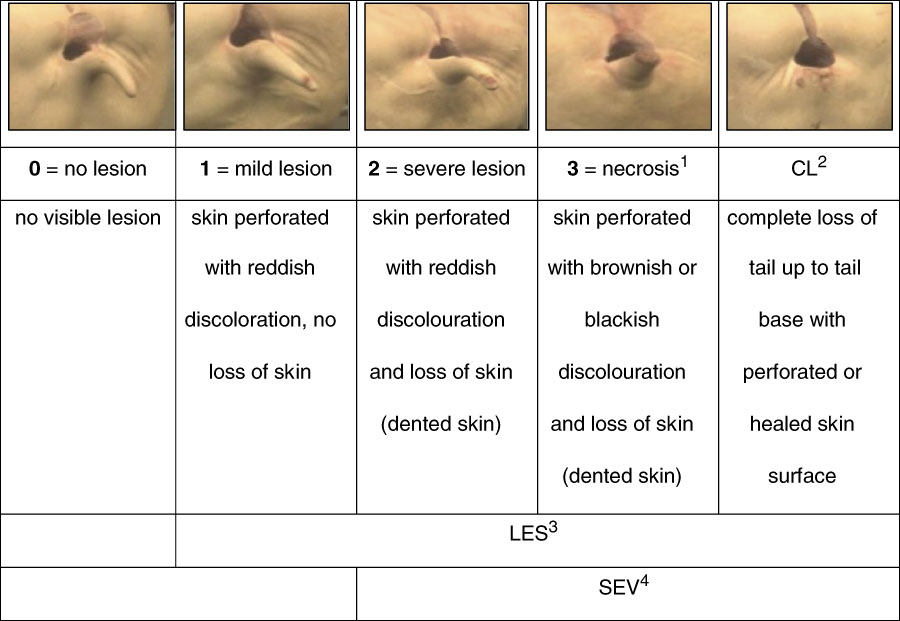
Tail lesions were scored on a scale from 0 to 3, with level 3 representing ‘tail necrosis scored from pictures’ (lesion score 3; Figure 1). Discolouration at the tail base was not considered because in direct observations it seemed to be associated with processing rather than with tail biting. Swelling of the tail was excluded from the scoring key after the first two rounds of observer agreement testing, because no sufficient agreement could be achieved due to difficulties of assessing tail circumference from the pictures. In addition to the lesion score, complete loss of tail (CL) was assessed as present or absent (Figure 1). Partial tail loss could not be assessed because of tail docking. For analysis, scores were summarised to a combined tail score (LES) with the categories ‘lesion’ (score >0 and/or CL present) or ‘no lesion’ (score 0 and CL absent), as well as to a score combining severe lesions, necrosis or complete loss (lesion score 2 or 3 and/or complete loss=SEV; Figure 1).
(Colour online) Pig tail lesion scoring key. Complete tail loss was scored independently of lesion score 0 to 3. 1Tail necrosis scored from pictures, includes any lesion with obvious brownish/blackish discolouration; 2complete tail loss; 3any lesion (lesion scores 1, 2 or 3 and/or complete loss of tail (CL) present); 4medium to severe lesion (lesion score 2 or 3 and/or CL).

Tail pictures were scored on screens calibrated with dccw.exe (Windows®) by three trained observers who were blind to treatment. Agreement between observers was assessed before and during data collection in a total of nine agreement tests (49 to 120 pictures per test; median lesion prevalence 37%, range 23% to 46%). Agreement was evaluated based on the exact agreement and the prevalence-adjusted bias-adjusted Kappa of observer pairs (PABAK; based on Byrt et al., Reference Byrt, Bishop and Carlin1993):
 $${\rm PABAK}{\equals}((k{\times}p_{0}^{{}} ){\minus}1)\,/\,(k{\minus}1)$$
where k is the number of categories and p 0 the proportion of observed agreement.
Exact agreement >80% was regarded as sufficient and PABAK ⩾0.75 was classified as very good agreement (Fleiss et al., Reference Fleiss, Levin and Paik2003, p. 604). Observer agreement for tail lesions was very good in all tests (median exact agreement 87%, range 80% to 94%; median PABAK 0.83, range 0.73 to 0.92).
Tail lesions were scored on samples drawn from each batch according to the following formula for estimating proportions (Dohoo et al., Reference Dohoo, Martin and Stryhn2012; eq. 2.4) with α=0.05 and a confidence level of 95%:
 $$n{\equals}{{1.96^{2} {\rm }{\times}p{\times}q} \over {0.05^{2} }}$$
where n is the sample size, p the expected prevalence and q=1−p. The expected prevalence was assumed to be 7.2% based on the abattoir data review in EFSA (2007). Sample sizes were adjusted for a finite population (batch size) using:
 $$n{\rm '}{\equals}{\rm }{1 \over {{1 \over n}{\plus}{1 \over N}}}$$
where
 $n{\rm '}$
is the adjusted sample size, n the sample size and N the batch size (Dohoo et al., Reference Dohoo, Martin and Stryhn2012; equation (2.8)). Samples were drawn randomly from each batch using PROC SURVEYSELECT.
Datasets
In total, tail pictures from 79 954 pigs in 1580 batches with 10 to 91 pigs per batch (mean=51) were assessed. Out of these, 43 328 pigs originated from 32 SchwIP farms (157 to 2541 pigs per farm, mean=1354) and 36 626 pigs originated from 32 control farms (135 to 2188 pigs per farm, mean=1145). The prevalence of tail lesions in German fattening pigs is based on 36 626 control farm pigs, which had been delivered from November 2012 until November 2013. All 79 954 pigs were used for comparing TNMI with lesion score 3, as well as for testing associations between meat inspection findings and LES.
Associations between carcase findings and TNMI were tested based on data from 408 519 pigs delivered by 126 farms in 2831 batches with 10 to 1012 pigs per batch (mean=144; 280 to 9649 pigs delivered per farm, mean=3169). This data set included the 79 954 SchwIP and control pigs described above, as well as pigs from farms which delivered pigs to the abattoir during the recording period but were neither SchwIP nor control farms.
The effect of SchwIP was tested using the 79 954 pigs described above. Data were divided into the seasons winter (December 2012 to February 2013), spring (March to May 2013), summer (June to August 2013) and autumn (September to November 2013). Before December 2012 there were nearly no tail lesion data for control farms, yet the period was kept to further illustrate the effect of the management tool SchwIP.
Statistical analysis
Logistic regression models were calculated to investigate the association between presence of meat inspection findings and LES, SEV or TNMI status, respectively (PROC GLIMMIX). Only findings with prevalences >0.2% were used for modelling, which were pleurisy (all severities combined), lung findings (all severities combined), signs of inflammation in a leg which was not arthritis (all locations combined), arthritis (all locations combined) and abscesses (all locations combined):
 $$logit\left( {p_{i} } \right){\equals}\mu {\plus}\beta X_{i} {\plus} u_{{farm(i)}} $$
where p is the probability of carcass finding being present; μ the intercept; β the estimate for CYS or TNMI; X=CTS or TNMI, respectively; u farm(i) the random bath effect.
Batch was included as random factor (n=1580 batches from 64 farms for LES, and 3361 batches from an unknown number of farms for TNMI).
In order to test the effect of the management tool SchwIP, prevalences of LES and of SEV in SchwIP pigs and control pigs were compared non-parametrically for each season (Kruskal–Wallis test, PROC NPAR1WAY) as linear model assumptions were not fulfilled even after data transformation.
All statistical analyses were carried out using SAS software version 9.4 for Windows (©2012 SAS Institute Inc., Cary, NC, USA). Differences with P<0.05 were regarded as significant.
Results
Tail lesion prevalence
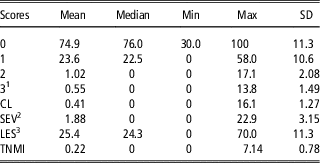
Tail lesions of any severity were observed in 25.4% out of 36 626 pigs from control farms, with 23.6% of pigs being affected by mild lesions (score 1; Table 2). Lesions of higher severity were much less prevalent, with 1.88% of pigs having a lesion score 2, lesion score 3 and/or CL. Overall mean prevalence of TNMI in the same pigs was 0.22% with a range of 0% to 7.14% per batch (Table 2).
Prevalence of tail lesions in 729 batches from 32 control farms (% per batch; 10 to 85 pigs per batch, 36 626 pigs in total; recorded from 22 November 2012 to 29 November 2013)

Min=minimum; max=maximum; SD = standard deviation; CL=complete tail loss; TNMI=tail necrosis meat inspection.
1 Tail necrosis scored from pictures.
2 Medium to severe lesion (lesion score 2 or 3 and/or CL).
3 Any lesion (lesion scores 1, 2 or 3 and/or CL present).
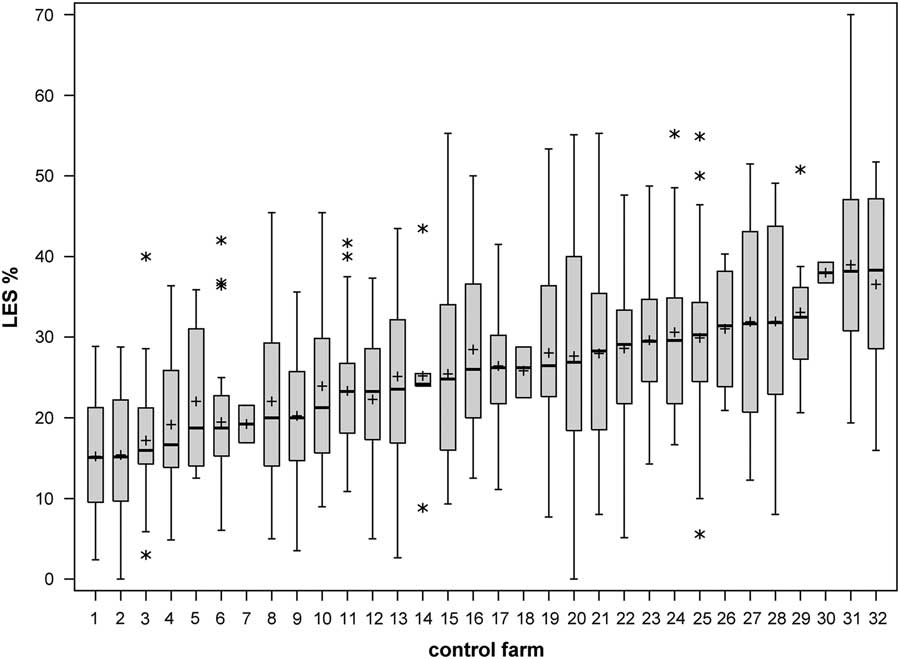
The mean prevalence of LES per control farm ranged from 15.4% to 39.5% with low to high variation between batches (n=2 to 41 batches per farm; Figure 2).
Prevalence of tail lesions (LES%) in pigs on 32 control farms sorted by median farm prevalence (n=2 to 41 batches per farm; farms 7, 14, 18, 26 and 30 delivered ⩽5 batches). Box=interquartile range (IQR), whiskers=values outside IQR but not more than 1.5 times, *=values more than 1.5 times IQR outside of IQR,+=mean, line inside box=median.

Relationship between tail lesions and meat inspection findings
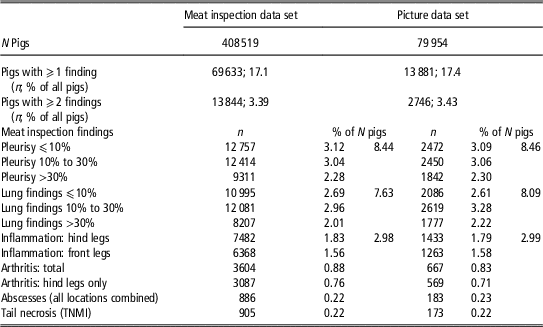
Of the meat inspection findings with prevalences >0.2%, pleurisy and lung findings were found most frequently, with 8.44% and 7.63%, respectively, of 408 519 pigs from SchwIP, control and other farms, or 8.46% and 8.09%, respectively, of the 79 954 sample pigs with tail pictures (SchwIP and control farms; Table 3). Inflammation of the legs was the next most prevalent at 2.98%, whereas prevalences of arthritis and abscesses were below 1%. The following findings had a prevalence of <0.2%: abscess in belly, ribs or spine, head or multiple, arthritis in front legs or polyarthritis, cachexia (emaciation), necrosis or scar in skin, peritonitis, severe colour/olfactory deviation and severe generalised lymphadenitis. A number of findings were never recorded (Table 1).
Frequencies and overall prevalences (%) of meat inspection findings in slaughter pigs with possible relation to tail lesions (findings with prevalence ⩾0.2% only)

TNMI=tail necrosis meat inspection.
The picture data set represents a random sample of the meat inspection data set which only includes records with meat inspection data as well as tail pictures (SchwIP and control farm pigs).
Meat inspection findings were more prevalent in pigs with than in pigs without LES lesion (18.1% v. 17.1%) and the same association was more pronounced when comparing pigs with and without SEV lesion (least square mean 17.2% v. 23.6%; both: logistic regression with random batch effect, 1580 batches with 79 954 pigs total, P<0.001; Table 4). The difference was largest between pigs with and without TNMI (63.7% v. 16.9%; logistic regression with random batch effect, 3361 batches with 408 519 pigs total, P<0.001; Table 4). Differences between pigs with and without LES lesion were larger regarding single findings, such as signs of inflammation in the legs (other than arthritis), as well as arthritis and abscesses (prevalence in pigs with LES ‘lesion’ being 1.2, 1.4 and 2.3 times, respectively, higher than in pigs with LES ‘no lesion’; Table 4). The same was true for pigs with and without SEV lesion. Prevalences of signs of inflammation in the legs, arthritis and abscesses were also higher in animals with TNMI findings yet at much greater scale. Prevalence of abscesses, for example, was 2.3 times higher in pigs with v. without a LES lesion but 106 times higher in pigs with v. without a TNMI lesion (Table 4). In addition, lung findings were 11.8 times more prevalent in pigs with SEV lesion while only 1.7 times higher in pigs with TNMI finding, whereas pleurisy was more prevalent in pigs with TNMI finding only (Table 4).
Least square mean prevalences (%) (95% confidence interval) of selected meat inspection findings in pigs with or without LES or SEV and pigs with or without TNMI (logistic regression models with random batch effect; LES and SEV: 79 954 pigs in 1580 batches, TNMI: 408 519 pigs in 3361 batches)

1 LES tail lesions of any degree.
2 SEV tail lesion score 2 or 3 and/or complete tail loss.
3 Tail necrosis recorded during meat inspection.
Comparison of tail necrosis assessed during meat inspection and from pictures
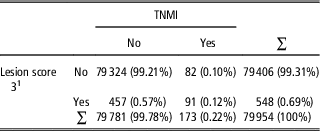
Meat inspection resulted in lower prevalences of tail necrosis compared with assessment from pictures (0.22% v. 0.69%; Table 5). Out of the total of 548 lesion score 3 cases, 16.6% were also recorded during meat inspection whereas 52.6% of TNMI cases were also scored from the pictures.
Number of pigs with or without lesion score 3 and with or without TNMIFootnote 1

TNMI=tail necrosis recorded during meat inspection.
Percentages inside table are cell percentages. (n=79 954 pigs; picture data set).
1 Tail necrosis recorded from pictures.
Effect of a management tool on tail lesions
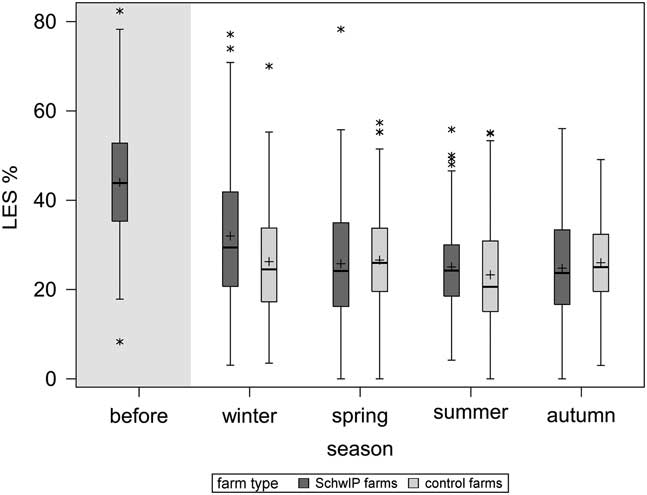
Before data collection for control farms started (July to November 2012), median LES prevalence in pigs from SchwIP farms was higher than during any later period in SchwIP or control farms (Figure 3). Out of the four seasons for which SchwIP and control farms could be compared, LES were significantly more prevalent in SchwIP farms during winter (32.2% v. 23.8%, P=0.015; Kruskal–Wallis test). During spring, summer and autumn, results for SchwIP and control farms were very similar regarding median, interquartile range or overall range of prevalences (Figure 3). Analysis of SEV yielded the same results as analysis of LES, only at a generally lower prevalence level (results nor presented for better clarity).
Prevalences of tail lesions (LES%) of SchwIP and control farms per season. Prevalences differed significantly in winter (P=0.011) but not in any other season (one Kruskal–Wallis test per season, unit of observation=median batch prevalence per farm and season). Before=July to November 2012. Number of farms delivering pigs ranged between seasons from 29 to 30 (SchwIP) and 25 to 32 (control), respectively (1 to 16 batches per farm and season). Box=IQR, whiskers=values outside IQR but not more than 1.5 times, *=values more than 1.5 times IQR outside of IQR, +=mean, line inside box=median.

Discussion
This study presents data on the prevalence of tail lesions in docked finisher pigs at a German abattoir, associations of tail lesions with meat inspection findings, agreement between tail necrosis recorded during meat inspection and from pictures and the effect of the management tool SchwIP on tail lesion prevalence. To the best of our knowledge, this is the first large scale assessment of tail lesions from pictures in addition to direct observations on the slaughter line. In addition, this paper presents the first large data set describing how the prevalence of carcase tail lesions changes over time on farms receiving advice on how to reduce tail biting.
Tail lesion prevalence
In our study, mean batch prevalence for tail lesions was 25.4% when taking all lesions into account (LES) and 1.88% when only including severe lesions, that is necrosis and/or tail loss. Both numbers rank in the middle of ranges reported from other studies. Many prevalences found in other studies were much lower than in our study (docked pigs: 3.1% to 9.4%; Guise and Penny, Reference Guise and Penny1998; Hunter et al., Reference Hunter, Jones, Guise, Penny and Hoste1999; undocked pigs: 7.1% to 11.6%; Penny and Hill, Reference Penny and Hill1974; Keeling et al., 2012; docked pigs, moderate and severe lesions only: 9.7%, van Staaveren et al., Reference van Staaveren, Vale, Manzanilla, Teixeira, Leonard, Hanlon and Boyle2016). Other studies found similar prevalences (30.8% and 34.6% in undocked Finish or docked Irish pigs; Valros et al., Reference Valros, Ahlstrom, Rintala, Hakkinen and Saloniemi2004; Carroll et al., Reference Carroll, Boyle, Teixeira, Van Staaveren, Hanlon and O’Connell2016), whereas some studies found considerably higher prevalences (docked Irish pigs: 63.0% to 72.5%; Harley et al., Reference Harley, More, O’Connell, Hanlon, Teixeira and Boyle2012; Harley et al., Reference Harley, Boyle, O’Connell, More, Teixeira and Hanlon2014; Teixeira et al., Reference Teixeira, Harley, Hanlon, O’Connell, More, Manzanilla and Boyle2016). Prevalence of severe lesions in our study also fell in the middle of ranges reported by others (below 1% to 3.7%; Penny and Hill, Reference Penny and Hill1974; Hunter et al., Reference Hunter, Jones, Guise, Penny and Hoste1999; Valros et al., Reference Valros, Ahlstrom, Rintala, Hakkinen and Saloniemi2004; Harley et al., Reference Harley, More, O’Connell, Hanlon, Teixeira and Boyle2012; Keeling et al., 2012; Harley et al., Reference Harley, Boyle, O’Connell, More, Teixeira and Hanlon2014; Carroll et al., Reference Carroll, Boyle, Teixeira, Van Staaveren, Hanlon and O’Connell2016; Teixeira et al., Reference Teixeira, Harley, Hanlon, O’Connell, More, Manzanilla and Boyle2016; van Staaveren et al., Reference van Staaveren, Vale, Manzanilla, Teixeira, Leonard, Hanlon and Boyle2016; van Staaveren et al., Reference van Staaveren, Teixeira, Hanlon and Boyle2017).
The notable variation of reported tail lesion prevalences can have several causes. First, scoring systems may differ between studies (e.g. Keeling et al., 2012 v. Harley et al., Reference Harley, Boyle, O’Connell, More, Teixeira and Hanlon2014) or none and mild lesions are combined for reporting prevalence (van Staaveren et al., Reference van Staaveren, Vale, Manzanilla, Teixeira, Leonard, Hanlon and Boyle2016). Second, especially lesions of lower severity may depend on the observer (Keeling et al., 2012) or location on the slaughter line (Carroll et al., Reference Carroll, Boyle, Teixeira, Van Staaveren, Hanlon and O’Connell2016). Finally, tail lesion prevalences may vary greatly between farms (van Staaveren et al., Reference van Staaveren, Teixeira, Hanlon and Boyle2017), abattoirs and regions (Harley et al., Reference Harley, More, O’Connell, Hanlon, Teixeira and Boyle2012).
Prevalence of meat inspection findings
The most prevalent findings in our study were pleurisy (8.44%), lung findings (7.63%), signs of inflammation in the legs other than arthritis (2.98), arthritis (0.88%) and abscesses (0.22%). Lung-related meat findings were also common in many other studies, which usually report higher prevalences for pleurisy (9.0% to 13.9%; Elbers et al., Reference Elbers, Tielen, Snijders, Cromwijk and Hunneman1992; Wallgren and Lindahl, Reference Wallgren and Lindahl1996; Teixeira et al., Reference Teixeira, Harley, Hanlon, O’Connell, More, Manzanilla and Boyle2016) and lung findings (6.6% to 10.9%; Elbers et al., Reference Elbers, Tielen, Snijders, Cromwijk and Hunneman1992; Wallgren and Lindahl, Reference Wallgren and Lindahl1996; Teixeira et al., Reference Teixeira, Harley, Hanlon, O’Connell, More, Manzanilla and Boyle2016). While mean prevalence for inflammation of the legs was 1.0% in the study of Elbers et al. (Reference Elbers, Tielen, Snijders, Cromwijk and Hunneman1992) and not assessed elsewhere, arthritis was more (1.7% to 2.9%; Wallgren and Lindahl, Reference Wallgren and Lindahl1996; Valros et al., Reference Valros, Ahlstrom, Rintala, Hakkinen and Saloniemi2004) or less (0.22% to 0.24%; Elbers et al., Reference Elbers, Tielen, Snijders, Cromwijk and Hunneman1992; Harley et al., Reference Harley, More, O’Connell, Hanlon, Teixeira and Boyle2012) prevalent in other studies. Prevalences of abscesses in other studies were higher throughout (0.6% to 1.2%; Wallgren and Lindahl, Reference Wallgren and Lindahl1996; Harley et al., Reference Harley, More, O’Connell, Hanlon, Teixeira and Boyle2012), even for abscesses in the lung only (0.18% to 0.8%; Elbers et al., Reference Elbers, Tielen, Snijders, Cromwijk and Hunneman1992; Teixeira et al., Reference Teixeira, Harley, Hanlon, O’Connell, More, Manzanilla and Boyle2016; van Staaveren et al., Reference van Staaveren, Vale, Manzanilla, Teixeira, Leonard, Hanlon and Boyle2016).
Meat inspection results are very difficult to compare. Besides true differences between pig populations delivered to different abattoirs (Harley et al., Reference Harley, More, O’Connell, Hanlon, Teixeira and Boyle2012), scoring keys often differ considerably (e.g. Valros et al., Reference Valros, Ahlstrom, Rintala, Hakkinen and Saloniemi2004 v. Teixeira et al., Reference Teixeira, Harley, Hanlon, O’Connell, More, Manzanilla and Boyle2016) or are not known. In addition, results may differ between meat inspectors (Hoischen-Taubner et al., Reference Hoischen-Taubner, Blaha, Werner and Sundrum2011; Teixeira et al., Reference Teixeira, Harley, Hanlon, O’Connell, More, Manzanilla and Boyle2016) or due to different points of assessment on the slaughter line (Carroll et al., Reference Carroll, Boyle, Teixeira, Van Staaveren, Hanlon and O’Connell2016). Assessment of severe meat inspection findings shows better validity and repeatability than assessment of minor findings (Stärk et al., Reference Stärk, Alonso, Dadios, Dupuy, Ellerbroek, Georgiev, Hardstaff, Huneau-Salaün, Laugier, Mateus, Nigsch, Afonso and Lindberg2014) and the same can be assumed for tail lesions. Similarly, prevalences might be higher if observers are not meat inspectors but record, for example, lung findings for a scientific study (van Staaveren et al., Reference van Staaveren, Vale, Manzanilla, Teixeira, Leonard, Hanlon and Boyle2016).
Relationship between tail lesions and meat inspection findings
In our study, prevalences of several meat inspection findings differed significantly between pigs with and without tail lesion of any degree (LES), but as the differences were <1% the biological relevance was only limited. The increase in prevalence between pigs with and without SEV (lesions 2 or 3 and/or complete loss), however, was considerable for all findings combined (⩾1 finding) or abscesses alone but also for arthritis and lung findings.
The most pronounced difference between pigs with and without tail lesion was between animals with different TNMI status. It can be assumed that TNMI recorded during meat inspection represented very severe tail lesions with widespread infection, hence the large difference regarding abscesses and inflammation.
Results from other studies who also found more meat inspection findings in pigs with (severe) tail lesions lie somewhere in between our SEV and TNMI results (Valros et al., Reference Valros, Ahlstrom, Rintala, Hakkinen and Saloniemi2004: 10.5% v. 5.1% for pigs with any v. pigs without lesions, Harley et al., Reference Harley, Boyle, O’Connell, More, Teixeira and Hanlon2014: odds ratio 5.07 for severe v. no lesions). The comparison of differences regarding single findings is not really possible, because scoring and calculation methods differ between studies. In general, authors report more abscesses in at least one location in pigs with (severe) tail lesions (Elbers et al., Reference Elbers, Tielen, Snijders, Cromwijk and Hunneman1992; Huey, Reference Huey1996; Valros et al., Reference Valros, Ahlstrom, Rintala, Hakkinen and Saloniemi2004; Kritas and Morrison, Reference Kritas and Morrison2007; Marques et al., Reference Marques, Bernardi, Coelho, Almeida, Morales, Mores, Borowski and Barcellos2012) whereas Harley et al. (Reference Harley, Boyle, O’Connell, More, Teixeira and Hanlon2014) found increased condemnation but not significantly more abscesses in pigs with tail lesions. In our study, the large difference regarding abscessation between TNMI positive and negative pigs can probably be explained by the meat inspection definition for TNMI. According to the meat inspector training material, TNMI was defined as necrosis on the tail associated with abscesses in other parts of the carcase as well as findings in other body regions. Although arthritis was repeatedly found to be more common in pigs with tail findings (Elbers et al., Reference Elbers, Tielen, Snijders, Cromwijk and Hunneman1992; Valros et al., Reference Valros, Ahlstrom, Rintala, Hakkinen and Saloniemi2004), inflammation of the leg was rarely recorded and only correlated weakly in the study of Elbers et al. (Reference Elbers, Tielen, Snijders, Cromwijk and Hunneman1992).
Whereas in our study lung findings and pleurisy were only more prevalent in pigs with more severe tail lesions (SEV and TNMI), other studies found more consistent associations between tail lesions and indicators of reduced lung health. Associations were present at the abattoir (Elbers et al., Reference Elbers, Tielen, Snijders, Cromwijk and Hunneman1992; Kritas and Morrison, Reference Kritas and Morrison2007; Marques et al., Reference Marques, Bernardi, Coelho, Almeida, Morales, Mores, Borowski and Barcellos2012), between farm and abattoir (Blocks et al., Reference Blocks, Vernooy and Verheijden1994), on farms (Moinard et al., Reference Moinard, Mendl, Nicol and Green2003) and at histological level (Munsterhjelm et al., Reference Munsterhjelm, Simola, Keeling, Valros and Heinonen2013). The reason for the somewhat inconsistent association between tail lesion and lung findings or especially pleurisy is not clear.
Only few studies did not find any associations between tail lesions and meat inspection findings. One of those studies only included findings in the form of condemnations (Harley et al., Reference Harley, More, O’Connell, Hanlon, Teixeira and Boyle2012). If findings without condemnations had been included, the results might have been different. Another study did not find any association even though it combined no with mild tail lesions for analysis (van Staaveren et al., Reference van Staaveren, Vale, Manzanilla, Teixeira, Leonard, Hanlon and Boyle2016), which in our study resulted in even stronger associations between tail lesions and meat inspection findings. Finding possible explanations is difficult because of the numerous differences between these and other studies. Due to the many different recordings, some associations reported from studies based on meat inspection data alone might have arisen from collinearity between findings (Sanchez-Vazquez et al., Reference Sanchez-Vazquez, Nielen, Edwards, Gunn and Lewis2012) rather than direct relationships.
Comparison of tail necrosis assessed during meat inspection and from pictures
The only tail-related finding recorded during meat inspection was necrosis (TNMI, 0.22% of pigs). Prevalence of tail necrosis based on pictures (lesion score 3) was higher (0.69%), with a positive agreement between TNMI and lesion score 3 of only 11% and a negative agreement of 99.21%. The latter is due to the generally low finding rate, which results in spuriously high agreement (Hoischen-Taubner et al., Reference Hoischen-Taubner, Blaha, Werner and Sundrum2011).
Meat inspection aims at detecting carcase and viscera findings which impair product quality and make the meat unfit for human consumption. In the present study, meat inspectors only scored tail necrosis if abscesses in other parts of the body were also present. As not every tail necrosis is associated with abscesses, this results in a much lower prevalence than recording tail necrosis independently.
Effect of the management tool Schwanzbeiß-Interventions-Programm on tail lesions
We assessed tail lesions in pigs from 32 farms where the tail biting management tool SchwIP had been used, as well as in pigs from 32 matched control farms where to our knowledge no advice on how to manage tail biting had been provided. Although recording pictures for SchwIP farms started within ~3 months after the SchwIP visit, recording for control farms started later because of data confidentiality and logistics reasons. The prevalence of tail lesions on SchwIP farms decreased from the start of data collection. It was significantly higher than in control farms during the first 3 months with data from both groups but did not significantly differ thereafter. Thus, the prevalence of tail lesions on SchwIP farms decreased from a higher level to the level of control farms within half a year. This indicates that interventions triggered by the SchwIP application reduced tail biting risk and thus prevalence of tail lesions.
An alternative explanation for the decreasing prevalence on SchwIP farms could be seasonal effects. However, the scientific evidence for seasonal variation of tail lesion prevalences is inconclusive (Penny and Hill, Reference Penny and Hill1974; Blackshaw, Reference Blackshaw1981; Kongsted and Sørensen, Reference Kongsted and Sørensen2017). This agrees with the multifactorial causation of tail biting (Taylor et al., Reference Taylor, Main, Mendl and Edwards2010), where seasonal changes might trigger tail biting outbreaks on some farms through interaction with farm-specific factors (EFSA, 2007), whereas on other farms seasonal effects do not add sufficient risk to cause outbreaks. There is no seasonal trend apparent in our study, yet our data collection period was too short to fully evaluate the seasonal effects.
Our study is the first to document reduction of the outcome tail lesion prevalence through farm advice for more than 30 farms. In Britain, the tail biting HAT has successfully been used to reduce risk for tail biting over a period of 2 years (Taylor et al., Reference Taylor, Parker, Mendl, Edwards and Main2012), but information on tail lesion prevalence is not available. Irish farms enlisted in the record keeping service Teagasc eProfit Monitor, which however does not explicitly address tail biting, had lower carcase tail lesion prevalence than non-enlisted farms (van Staaveren et al., Reference van Staaveren, Teixeira, Hanlon and Boyle2017). It is, however, not known, whether record keeping helped to reduce the prevalence or whether farms who enlisted to the programme which focusses on general farm performance already had lower prevalence when they enlisted.
Husbandry advisory tool as well as its derivative SchwIP centre around one-to-one adviser-to-farmer dialogue about farm-specific scientific information, which has been recommended by Benard et al. (Reference Benard, Schuitmaker and Cock Buning2014) as the best knowledge transfer strategy in order to reduce tail biting. Schwanzbeiß-Interventions-Programm farms volunteered for the visits and hence are no random sample but represent farms with perceived tail biting problems and proactive farmers. This agrees with the initially high tail lesion prevalence. At the time of the SchwIP study, tail docking and tail biting were high profile topics in farmer media which might have additionally influenced the situation on the farms due to increased awareness. This was, however, not apparent in the control farm data, where prevalence stayed more or less constant throughout the year.
Methodological implications
Due to technical restrictions in the abattoir, pictures were slightly blurry because of the speed of the slaughter line. This was noticeable during observer agreement tests which had slightly worse results when based on more blurry pictures. Future systems should therefore allow good adjustment of lighting and shutter speed to slaughter line speed in order to avoid blurring. The position of the camera on the line after scalding and dehairing is generally recommended because lesions can be seen more clearly (Carroll et al., Reference Carroll, Boyle, Teixeira, Van Staaveren, Hanlon and O’Connell2016), though scalding may leave marks which may either mask or mimic tail lesions (Taylor et al., Reference Taylor, Main, Mendl and Edwards2010; Keeling et al., 2012). A position between carcase cleaning and scalding would be optimal. Swelling was not included in our scoring key because satisfactory agreement could not be achieved. Automated picture analysis might solve this problem better than human observers because it can assess tail ‘size’ more exactly and thus identify small differences from an average size. What remains questionable is the scoring of tail length which is also problematic in scorings with palpation (own observations).
Conclusions
Tail lesions caused by tail biting can be a considerable problem in tail docked pigs. Meat inspection results in lower prevalence of tail necrosis than assessment from pictures. As tail lesions were associated with other meat inspection findings and can be reduced through improved management, more detailed tail lesion scoring at the abattoir would generate useful information for farm health and welfare management.
Acknowledgements
Thoralf Kobert and Hans-Jörg Eynck are gratefully acknowledged for their technical support in the abattoir and Stine Heindorff for her support during data collection and analysis. The authors would like to thank all SchwIP participants for their time and interest. This study was financially supported by ‘Gemeinnützige Gesellschaft zur Förderung der Forschung über die Zukunft des Tierschutzes in der Nutztierhaltung mbH’. The work was conducted as part of A. L. v. B.’s doctoral thesis and C. K.‘s master thesis.
Declaration of interest
The authors have no conflicts of interest to declare.
Ethics statement
Pig-related data in this study were collected without causing harm to the animals for the purpose of the study. All experimental work was conducted in accordance with the relevant national legislation. Farmers of SchwIP farms gave written consent to collecting data from their pigs at the abattoir. Data from control farms were completely anonymised by the abattoir before being passed on to the researchers.
Software and data repository resources
None of the data were deposited in an official repository.