


Introduction
Anxiety disorders are the most common type of psychiatric illness (Kessler et al., Reference Kessler, Berglund, Demier, Jin, Merikangas and Walters2005) and are associated with significant impairment and economic burden (Hoffman and Whittchen, Reference Hoffman and Wittchen2008). Effective treatments for anxiety exist, namely Selective Serotonin Reuptake Inhibitors (SSRI)/Serotonin-Norepinephrine Reuptake Inhibitors (SNRI) and Cognitive Behavioral Therapy (CBT). However, many patients do not access these treatments for a number of reasons, such as concerns over side effects (Weisberg, Dyck, Culpepper and Keller, Reference Weisberg, Dyck, Culpepper and Keller2007), patient or therapist unwillingness to engage in exposure therapy, lack of trained therapists (Gunter and Whittal, Reference Gunter and Whittal2010), and scheduling difficulties (Lovell and Richards, Reference Lovell and Richards2000). Moreover, many patients (e.g. 30% to 60%) do not achieve remission with current treatments (Blanco et al., Reference Blanco, Schneier, Schmidt, Blanco-Jerez, Marshall and Sánchez-Lacay2003; Hoffman and Mathew, Reference Hoffman and Mathew2008; Hofmann and Whittchen, Reference Hoffman and Wittchen2008; Mitte, Reference Mitte2005). Thus, new treatments that are efficacious, easily disseminated, and more acceptable are needed.
Cognitive Bias Modification (CBM) is a novel treatment for anxiety that is garnering increasing interest (Beard, Reference Beard2011). CBM treatment involves computer tasks that directly modify a specific cognitive vulnerability to anxiety via repeated practice on a cognitive task. To date, CBM protocols have most often targeted attention bias, i.e. the tendency to selectively attend to threat-relevant information (CBM-A) (e.g. MacLeod, Rutherford, Campbell, Ebsworthy and Holker, Reference MacLeod, Rutherford, Campbell, Ebsworthy and Holker2002), and interpretation bias, i.e. the tendency to interpret stimuli in a negative or threatening manner (CBM-I) (e.g. Mathews and Mackintosh, Reference Mathews and Mackintosh2000). Koster and colleagues (Koster, Fox and MacLeod, Reference Koster, Fox and MacLeod2009) provide an excellent working definition for the emerging field of CBM. They identify two key features of CBM: (1) “the direct target of change in each case is a cognitive bias known to characterize a clinical disorder, a clinically relevant symptom, or a personality trait associated with vulnerability to clinical dysfunction” and (2) “the method of manipulating the target cognitive bias has not principally relied on instruction but instead has involved extensive practice on a cognitive task designed to encourage and facilitate the desired cognitive change (p. 3).” Thus, CBM treatments may alter cognitive biases through a more implicit, experiential process compared to the explicit, verbal process of psychotherapy.
Studies testing CBM in non-anxious and analogue samples suggest that CBM protocols are efficacious in modifying cognitive biases associated with a wide range of psychopathology, e.g. general and social anxiety (see Beard, Reference Beard2011; Hakamata et al., Reference Hakamata, Lissek, Bar-Haim, Britton, Fox and Leibenluft2010 for reviews), obsessive-compulsive symptoms (Najmi and Amir, Reference Najmi and Amir2010), alcohol use (Field and Eastwood, Reference Field and Eastwood2005), and eating disorders (Smith and Rieger, Reference Smith and Rieger2009). Moreover, a number of clinical trials suggest that CBM may be an efficacious treatment for anxiety disorders. Specifically, randomized, placebo-controlled trials have demonstrated preliminary efficacy of CBM-A for Social Anxiety Disorder (SAD) (Amir, Beard, Taylor et al., Reference Amir, Beard, Burns and Bomyea2009; Schmidt, Richey, Buckner and Timpano, Reference Schmidt, Richey, Buckner and Timpano2009), Generalized Anxiety Disorder (GAD) (Amir, Beard, Burns and Bomyea, Reference Amir, Beard, Taylor, Klumpp, Elias and Burns2009), and pathological worry (Hazen, Vasey and Schmidt, Reference Hazen, Vasey and Schmidt2009). Between group effect sizes (0.35 to 1.59) for CBM were solidly in the range of existing treatments for these disorders. Similar promising findings have been obtained with initial trials of CBM-I in individuals with high trait anxiety (Mathews, Ridgeway, Cook and Yiend, Reference Mathews, Ridgeway, Cook and Yiend2007), socially anxious individuals (Beard and Amir, Reference Beard and Amir2008), and individuals with GAD or SAD (Beard, Weisberg and Amir, in press; Brosan, Hoppitt, Shelfer, Sillence and Mackintosh, Reference Brosan, Hoppitt, Shelfer, Sillence and Mackintosh2011).
CBM is a potentially easily disseminated treatment. First, CBM is computerized; thus, it can be delivered in most settings, including patients’ homes and on-line, and in a highly reliable manner across settings. Moreover, CBM has unique advantages. Administration of CBM is straightforward, requiring little to no technical knowledge or clinician assistance, making it an easy stepped care, adjunct, or stand-alone treatment that could be delivered via the internet, schools, and primary care settings. It also may be a more acceptable treatment as it requires less time investment than current psychotherapies and lacks side effects associated with medication.
However, CBM also possesses characteristics that may limit its acceptability and uptake. First, current protocols are extremely repetitive, requiring patients to complete hundreds of quick trials (e.g. lasting less than one second) per session. Additionally, CBM protocols have low face validity and thus may be less credible than existing treatments.
Given CBM's clinical potential, it is important to assess attitudes toward this new treatment. Such data may inform the way in which CBM is presented to consumers, as well as the refinement of CBM protocols. Attrition rates provide one source of data regarding CBM's acceptability. In the RCTs to date, drop outs ranged from 0% to 15%.
To our knowledge, only two CBM trials have administered quantitative measures of acceptability. The first examined CBM-A for children with anxiety disorders (Rozenman, Weersing and Amir, Reference Rozenman, Weersing and Amir2011), and the second examined a combined CBM-A/CBM-I treatment for adults with SAD (Beard et al., in press). Results from both studies suggest that CBM treatments were generally acceptable to patients. However, quantitative self-report measures do not provide in depth information about participants’ actual experience with CBM. Thus, Brosan and colleagues recently published an open trial of a combined CBM-A/CBM-I for adults with either SAD or GAD in which they informally asked participants about their experience. Participants reported that the CBM-A task was “boring”; however, they found the CBM-I task to be helpful in stopping them from jumping to negative conclusions. In depth understanding of patient experience was not the primary aim of the Brosan et al. study; thus they only presented these few informal comments.
Prior studies have examined acceptability and informal patient comments following CBM, which is crucial for refining future CBM protocols. To our knowledge, no published studies have systematically and qualitatively examined attitudes toward CBM, nor have any studies examined attitudes at the time of initial presentation of the treatment. As compared to post-treatment assessment, initial impressions may be more informative about potential consumer uptake of CBM. Thus the current study examined socially anxious primary care patients’ general impressions, perceived credibility, and perceived helpfulness of CBM after a brief explanation and demonstration. As CBM protocols targeting attention (CBM-A) and interpretation (CBM-I) biases have gained the most support to date, we focused on these two types of CBM.
We chose to examine this issue in socially anxious individuals because most of the existing CBM treatments were developed for SAD, and thus CBM's efficacy has to date been demonstrated most strongly for social anxiety. Moreover, an understanding of this population's attitudes toward CBM is important because SAD is among the most common psychiatric disorders (Kessler et al., Reference Kessler, Berglund, Demier, Jin, Merikangas and Walters2005), and many of these individuals do not access existing treatments (Olfson et al., Reference Olfson, Guardino, Struening, Schneier, Hellman and Klein2000). Finally, social anxiety may be associated with unique barriers to seeking treatment due to the nature of the disorder (e.g. fear of talking to authorities) that may be overcome by CBM, a computerized treatment that does not require clinician administration.
We chose to examine the primary care setting for a number of reasons. Anxiety disorders are highly prevalent in primary care (e.g. Stein, McQuaid, Laffaye and McCahill, Reference Stein, McQuaid, Laffaye and McCahill1999). Patients seek treatment first from primary care providers, and are more likely to receive treatment in primary care settings compared to mental health settings (Harman, Rollman, Hanusa, Lenze and Shear, Reference Harman, Rollman, Hanusa, Lenze and Shear2002). Additionally, when examining acceptability of mental health treatment, a primary care sample is less pre-selected than a mental health treatment sample (e.g. more heterogeneous in attitudes toward mental health treatment, ethnicity, income and resources). Finally, the computerized and standardized delivery of CBM makes it a potentially ideal treatment for primary care.
Method
Participants and recruitment
Participants were recruited through flyers in exam and waiting rooms and active waiting room recruitment in a medium-sized family medicine practice located in a mid-sized Northeastern US city. Recruitment materials advertised a study about “shyness and developing better treatments for social anxiety”. Waiting room recruitment involved approaching all adult patients in the waiting room and asking if they were interested in participating in a study about a new treatment for anxiety. Interested patients completed the Liebowitz Social Anxiety Scale (LSAS) either over the phone or in the waiting room, depending on their recruitment method.
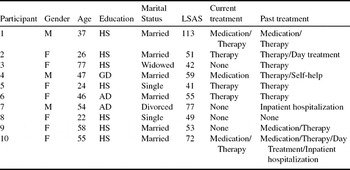
Inclusion criteria included: 18 or older; patient at the clinic; LSAS total score ≥ 30; no active psychosis or mania; and an ability to read and understand English well enough to complete study procedures. Of the 26 individuals who were screened for initial eligibility, seven were not socially anxious, and nine did not participate: unable to contact (n = 6), unable to schedule (n = 2), not interested (n = 1). The remaining 10 participants met the study inclusion criteria and completed the interview (see Table 1 for sample characteristics).
Sample characteristics

Notes: Education = highest degree attained; HS = High School or GED; GD = Graduate Degree; AD = Associate's Degree. We did not conduct chart reviews to determine for which diagnoses participants were receiving mental health treatment. Thus, participants may have been receiving treatment for disorders other than social anxiety.
Measures
Participants completed a demographic questionnaire and several screening measures to assess exclusion criteria. These included the Structured Clinical Interview for the DSM-IV B/C screener, manic episode module (First, Spitzer, Gibbon and Williams, Reference First, Spitzer, Gibbon and Williams1996), and the self-report version of the LSAS (Liebowitz, Reference Liebowitz1987). The LSAS is a 24-item scale that provides separate scores for fear and avoidance of social interaction and performance situations. The LSAS has strong psychometric properties (Fresco, Coles and Heimberg, Reference Fresco, Coles and Heimberg2001; Heimberg, Horner and Juster, Reference Heimberg, Horner and Juster1999) and a total score of 30 has shown good sensitivity and specificity for classifying participants with SAD (Rytwinski et al., Reference Rytwinski, Fresco, Heimberg, Coles, Liebowitz and Cissell2009).
Interviews and discussion guide
The semi-structured, individual qualitative interview prompted participants to discuss the following topics: anxiety treatment, computerized treatment, perceived helpfulness and credibility of CBM, and preferred format of treatment sessions. Interviews also obtained patient feedback about recruitment materials and procedures for a future study, which is not presented here. Participants also completed a brief version of both CBM tasks to get an overall “feel” for the programs. They then discussed their experience and impression of the programs. Open-ended questions (i.e. “What would make you interested in a treatment?”) were followed up to obtain more information and clarify responses. Interviews were audio-taped and transcribed verbatim. Interviews ranged in length from 37 to 57 minutes (M = 46.5, SD = 7.72).
CBM programs
During the interview, participants were asked to read a brief rationale for CBM and provide feedback. The rationale sheet included the following:
People with stress and anxiety tend to focus their attention on negative information and interpret situations negatively. This tendency is understandable given the life circumstances that may have caused this stress in the first place. However, this tendency to focus on the negative can also cause problems because it seems to be an automatic habit. It is very difficult to change this habit consciously by trying to focus your attention on neutral or positive information. The computer program is designed to combat this habit. The task itself is very repetitive and easy, but it may help you change the habit of focusing on negative information precisely because of the repeated presentations.
Of note, the rationale did not explain specifically how the tasks would change cognitive biases.
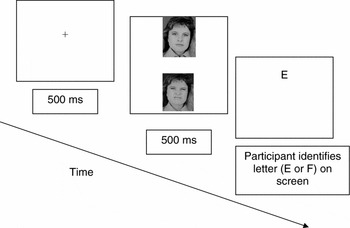
In order to obtain initial reactions to the CBM programs, participants completed a demonstration of two previously tested CBM tasks (Amir, Beard, Taylor et al., Reference Amir, Beard, Burns and Bomyea2009; Beard and Amir, Reference Beard and Amir2008; Schmidt et al., Reference Schmidt, Richey, Buckner and Timpano2009). Participants completed trials (i.e. approximately one to two minutes) until they reported that they had a feeling for the procedure of the computer tasks. The first CBM-A task comprised a dot probe task designed to facilitate an attention bias away from threat stimuli (see Figure 1). Each trial began with a fixation cross (“+”) presented in the center of the monitor for 500 ms. Immediately following termination of the fixation cue, the computer presented two faces of the same individual, one face on top and one on bottom. One face displayed a neutral expression and one displayed disgust. After presentation of the faces for 500 ms, a probe (either the letter E or F) appeared in the location of one of the two faces. Participants were instructed to decide whether the letter was an E or an F and press the corresponding button (left or right) on the computer mouse. The probe remained on the screen until participants responded, after which the next trial began. Participants were told that it was important that they perform the task as quickly as possible without sacrificing accuracy. In order to train attention bias away from threat, the probes always replaced the neutral faces.
Example CBM-A trial

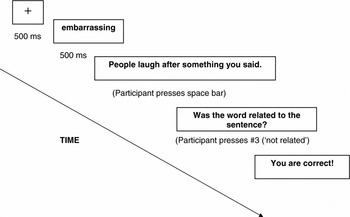
The CBM-I task was designed to extinguish threat interpretations and encourage benign interpretations of ambiguous situations (see Figure 2). A trial began with a fixation cross that appeared on the computer screen for 500 ms. Second, a word representing either the threat (embarrassing) or benign (funny) interpretation of a sentence (“people laugh after something you said”) that followed appeared in the center of the computer screen for 500 ms. Third, the ambiguous sentence appeared and remained on the screen until participants pressed a space bar. Participants were then asked by the computer whether the word and sentence were related. Participants pressed #1 on the number pad if the word and sentence were related or #3 if the word and sentence were not related. Finally, participants received feedback about their responses. Specifically, participants received positive feedback when they endorsed the benign interpretation or rejected the threat interpretation of the ambiguous sentence. Participants received negative feedback when they endorsed the threat interpretation or rejected the benign interpretation.
Example CBM-I trial

Procedure
All participants provided written consent, and all study procedures were approved by the Brown University Institutional Review Board. Participants completed the demographic questionnaire, screening measures, and qualitative interview in one meeting with the Principal Investigator (CB) at the family medicine clinic. Interviews took place in exam rooms. CBM programs were administered on a laptop. Participants received $20 in compensation for their time.
Coders
All three coders are clinical psychologists. CB has expertise in developing and testing CBM treatments for anxiety. Due to her extensive experience administering CBM protocols in previous studies, CB had a priori beliefs about participant attitudes. Specifically, she expected participants would find the tasks boring and unusual. RBW has expertise in treatment development for anxiety disorders in primary care settings, and has conducted and analyzed focus group qualitative data. JP has expertise in the treatment of depression in men and has extensive experience in qualitative methods. RBW and JP had no a priori expectations regarding participant attitudes.
Analyses
In order to ensure the scientific rigor and trustworthiness of the qualitative analysis, we conducted an iterative analysis guided by grounded theory (Glaser and Strauss, Reference Glaser and Strauss1967), encouraged extensive discussion of themes among coders, explored alternative codes, and conducted independent checks by each coder. Specifically, we independently printed and reviewed initial transcripts for overall comprehension and to identify preliminary coding categories. Open coding of transcripts generated an initial coding framework, which was added to and refined iteratively. We met together on several occasions, and discussed transcripts line by line and coded initial categories. Team consensus about the meaning of quotations reconciled any disagreements. One of the investigators (CB) then used the codes to review remaining transcripts and determined that saturation had been reached after 10 interviews. In our final meetings, we developed broader categories and identified overarching themes through comparison across transcripts. We continued this process until all raters agreed upon the final themes and quotations within each theme. Finally, we provide extensive quotes so that individual readers of this manuscript can formulate their own understanding of the themes.
Results
The coded transcripts revealed participant attitudes and expectations toward three overarching concepts: new treatment for anxiety, computerized treatment, and CBM. Responses generally reflected either facilitators or barriers to each treatment category.
Attitudes toward new treatment for anxiety
Facilitators. Table 2 presents themes related to treatment in general. Many participants stated that they would be more interested in a new treatment if they saw “evidence that the treatment works” (e.g. testimonials, graphs). One patient stated that “people have to have confidence in your method of helping them.” However, most participants believed that they would try a new treatment regardless of the evidence available because there is always a chance that it might work. For example, several participants’ comments reflected hope such as, “if there's any possibility that that could help, then that's worth looking into.” Others commented that “anything is worth a try” because “you have nothing to lose.”
Attitudes toward new treatment for anxiety

Most participants expressed interest in the availability of “new and different treatment options”. For example, one participant stated that “if what I'm doing now stops working, I'd love to have another option.” Some participants liked the idea of a new treatment that took a different approach from established therapies and expressed a desire for “non-pharmacologic interventions”. Participants disliked medications for various reasons, including: concern about side effects (“It's hard enough with side effects with medications”), feeling that medications were just masking a problem (“just short-circuiting how I really feel”), and not wanting to have to take medication forever (“hope that you don't have to take pills for the rest of your life for this stuff”).
Barriers. Interviews also generated a number of potential barriers to participants engaging in a new treatment. Participants believed that “anxiety symptoms” might prevent people from seeking treatment. Specifically, participants referred to experiencing anxiety in the waiting room and in anticipation of seeing a doctor, as well as anxiety about driving to appointments. Participants specifically identified social anxiety symptoms as a barrier. For example, one participant stated “when I have to call somewhere and ask questions. . . I already feel stupid and they don't understand me.” Related to this, many participants discussed feelings of being an “outcast or abnormal” in relation to seeking treatment. They stated that many people have difficulty admitting something is “wrong” or “negative” about themselves. These concerns may be especially relevant for socially anxious individuals.
Attitudes toward computerized treatment for anxiety
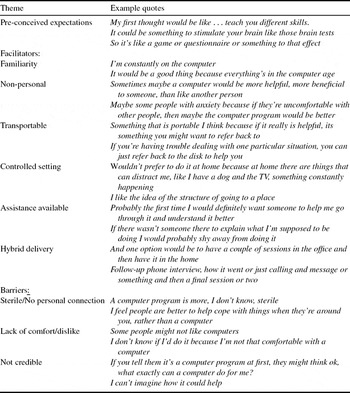
Prior to seeing the CBM programs, participants expressed assumptions about a computerized treatment. Specifically, they thought the program would be a question and answer format, skills training, or some kind of “brain game”. Eight participants reported regular computer use and familiarity, while two participants reported infrequent or limited computer use. Participants reported using computers for work, playing games, and looking up information, including medical information. Interviews revealed a number of facilitators and barriers specific to a computerized treatment (see Table 3).
Attitudes toward computer treatment for anxiety

Facilitators. The “familiarity” of computers in participants’ lives emerged as a facilitator. Participants stated that “it would be a good thing because everything's in the computer age” and “everyone's got one, everyone takes them where they need to be.” Participants liked the transportability of computers, specifically the ability to refer back to the treatment when desired. Some participants believed a computer would be helpful because they currently use computers to relax. Others stated that they currently use computers to seek medical information (e.g. “I was looking up everything, all kinds of mental health stuff”). Thus, a treatment delivered via a computer seemed intuitive. In addition to familiarity, participants thought “the lack of personal contact” may be a facilitator for some people. For example, participants stated that computerized treatments may be particularly helpful for people with social anxiety or who have “trouble talking or expressing themselves”.
Regarding the delivery location of a computer treatment, most participants cited advantages of a “controlled setting”. Specifically, participants believed that going to a provider's office gave structure and a quiet place that would not be possible at home. Participants believed that completing a treatment at home would be “a little stressful maybe with family”. Participants also believed that going to an office would prevent procrastination about completing the treatment and allow for better engagement (e.g. “if I make the effort to get up and go, I'll pay more attention and immerse myself more in it”). Finally, several participants believed that a “hybrid delivery” would be ideal, with initial session(s) taking place in an office with assistance and then transferring treatment to the home (e.g. “I'd rather have that in the beginning and then once I've got the hang of it, do it at home”).
Barriers. Participants also identified several potential disadvantages of a computerized treatment. First, whereas some participants believed the “lack of personal contact” was an advantage, many participants believed a computer may be “sterile” and unable to fulfill peoples’ desire for a personal connection. One participant stated that “it would be better if it was actual, someone you could actually talk to, like in your presence, to help you.” Of note, during most interviews, participants shared detailed, unsolicited information about their own personal struggle with anxiety. We interpreted this as a behavioral manifestation of participants’ desire to share their story with another person.
Participants also noted that a “dislike or discomfort with computers” may be a barrier. Most comments related to a hypothetical dislike (e.g. “some people aren't into computers”), but one participant expressed a personal discomfort with computers. Finally, a “lack of credibility” of a computer treatment emerged as a barrier. Some participants had not “really thought of a computer program helping out with that” and could not “imagine how it could help”.
Attitudes toward CBM
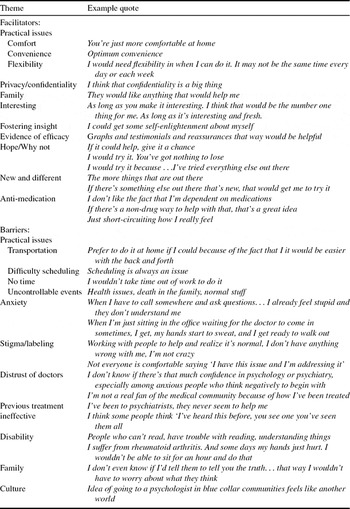
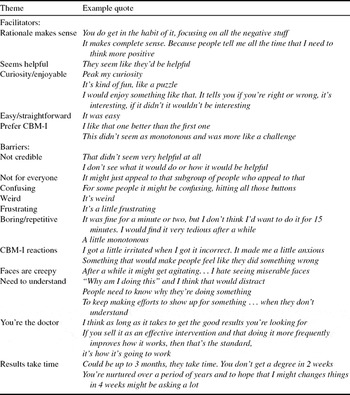
Facilitators. Table 4 presents a complete list of facilitators and barriers to CBM. Most participants felt that the “rationale provided made sense and seemed relevant” to their experience with anxiety. Many participants felt that the rationale sheet described them personally because they always think negatively. Most participants believed that a program that could help people think more positively would be beneficial. The description of cognitive biases as “habits” resonated with participants.
Attitudes toward CBM

After trying the CBM tasks, most participants described them as “easy” and “straightforward”. Participants found the tasks “enjoyable” and compared the program to a game or puzzle. The CBM tasks peaked the interest and curiosity of several participants to learn how the programs worked.
Participants spontaneously compared the CBM-A and CBM-I tasks. Participants preferred the CBM-I task because it was intuitive as to how it might help with anxiety. Compared to the CBM-A task, participants found CBM-I to be more fun and more engaging (e.g. “this didn't seem as monotonous”). Participants described “trying to get the right answers, it's a challenge”, and that “it was more like you had to use your brain and the other one was just E or F, E or F”. Additionally, some participants preferred the CBM-I task by default because the CBM-A task was “a little more strange”.
Barriers. A number of barriers emerged as participants discussed the CBM program. First, some participants stated that the programs, particularly the CBM-A task, “didn't seem very helpful at all”. Many participants thought the programs were “weird” and “repetitive and boring”. Of note, the rationale provided to participants stated that the tasks are repetitive. Participants found the CBM-A task to be “frustrating” and “aggravating”. Some participants experienced negative reactions to the CBM-I task. Participants thought the CBM-I task “was a little more stressful. . . wanting to be correct”. One participant noted that “you're really evaluated” by the CBM-I task. They noted that most people do not like to feel like they did something wrong. However, despite these negative reactions, most participants still preferred the CBM-I task.
Need to understand CBM. A significant theme emerged around participants’ need to understand CBM. Their lack of understanding about the purpose of the tasks and the relevance of the tasks to their anxiety significantly detracted from the programs’ perceived helpfulness. Several participants asked “what was the point of that?” or stated “I don't understand what it is doing.” Participants stated that “people need to know why they're doing something.” This theme emerged for most participants when they discussed the CBM-A task. Participants particularly did not understand the relevance of “clicking Es and Fs”.
Of note, one participant believed that naiveté about how CBM works may be critical. This participant thought that conscious awareness of the programs’ training contingencies might detract from its effect. Related to this, several participants noted the implicit nature of the programs. Participants thought the programs might work on an “unconscious level” to “reprogram” their brains.
You're the doctor. We asked participants about the ideal CBM protocol in terms of number, frequency, and duration of sessions. Overall, most participants deferred to the “doctor” to tell them what will be most effective. Participants also believed that they would engage in a treatment “for as long as it took” to achieve results. Most participants found the most commonly used protocol (i.e. eight sessions over 4 weeks) acceptable, but some participants also believed that more sessions would be needed to reverse longstanding habits.
Discussion
This study is the first to conduct a qualitative analysis of attitudes toward CBM. Participants experienced positive and negative aspects of CBM. For example, most participants found the program to be easy and amusing, but some found it boring and strange. While most participants understood the need for repetition to reverse a habit, many still did not think they would complete such a repetitive treatment. Additionally, while there were negative reactions to the CBM-I task, participants preferred this task because it was more intuitive and engaging. These findings converge with participant feedback in Brosan and colleagues’ study (Reference Brosan, Hoppitt, Shelfer, Sillence and Mackintosh2011), which also suggested that CBM is experienced as boring and that participants preferred the CBM-I task. Finally, although most participants wanted to understand specifically how CBM works, most stated that, due to curiosity and hope, they would still try CBM if they did not know the mechanism of action.
Our findings converge with previous examinations of computerized treatments. Similar facilitators emerged related to computerized CBT (CCBT), such as confidentiality and familiarity of computers (Mitchell and Gordon, Reference Mitchell and Gordon2007). Similar barriers also emerged, such as participants finding computerized treatments impersonal and boring, as well as participants having less confidence in the treatment (Mitchell and Gordon, Reference Mitchell and Gordon2007). Before seeing the CBM programs, participants found the rationale to be quite relevant and appealing. However, after a demonstration, participants’ beliefs about CBM's credibility decreased. This pattern is contrary to a study of CCBT for depression in which the credibility of CCBT was poor initially, but improved significantly after a demonstration (Mitchell and Gordon, Reference Mitchell and Gordon2007). Given that CBM and CCBT have similar dissemination potential (e.g. stepped care, self-help), comparing the credibility, acceptability, and uptake will be an important future direction.
A number of limitations should be noted. First, we conducted interviews with a modest number of primary care patients from one location. Although our sample was diverse in gender, age, and occupation, it lacked diversity in ethnicity. Second, our sample comprised primary care patients who volunteered to discuss treatment with a researcher. Moreover 9 of the 10 participants had received some form of mental health treatment in the past. Thus, current findings may not generalize to a subgroup of anxious primary care patients who avoid such interactions, a subgroup for which CBM may be ideally suited. Future studies might consider using on-line discussions or written feedback in order to reach this group. Third, we focused on socially anxious primary care patients attitudes toward CBM treatment for SAD. The current results may not generalize to other disorders targeted by CBM (e.g. alcohol dependence), and future studies with different populations may reveal different or additional themes. Finally, participants’ beliefs about what they may hypothetically desire should be interpreted with caution. Beliefs and attitudes do not always correlate with actual behavior. Related to this, the current findings can only speak to participants’ initial impressions of CBM after a brief demonstration, rather than to patient experiences after completing CBM as a treatment. So as to address this question, we recently completed qualitative interviews as part of a randomized controlled trial of CBM in order to examine acceptability.
These findings have clinical implications. Our findings may inform researchers and clinicians about how to present CBM to participants, including advertisement or recruitment methods and the treatment rationale. Several participants identified that social anxiety symptoms and negative labels (e.g. “abnormal”) would prevent them from seeking treatment. Thus, efforts to normalize anxiety and reduce anxiety provoking steps to seeking treatment (e.g. e-mailing for information versus phoning) may be needed. Additionally, previous CBM protocols have not informed participants about how CBM is designed to reduce anxiety. Based on the current finding that participants very much want to understand the purpose of a treatment, it is clear that clinicians or on-line services may need to provide a strong treatment rationale before uptake occurs. Perhaps more importantly, given CBM-A's low credibility, it may require continued reminders and encouragement early in treatment to keep participants engaged.
Based on these findings, we revised our rationale CBM in several ways. We now emphasize the speed at which participants process information in the real world and how what they focus on makes a difference for their anxiety. It also emphasizes that changing these habits will be like learning a new skill that requires practice. Additionally, it highlights that CBM is based on many years of research. Finally, we inform participants about potential reactions to CBM, such as confusion about the purpose of the task and boredom, and encourage them to continue with the program at several points in the protocol.
Our findings may also inform where CBM is delivered. We expected participants to prefer the convenience and privacy of receiving treatment at home. However, most participants recognized benefits of receiving treatment outside the home, such as the structure and reduced distraction. A hybrid delivery of starting treatment at an office with assistance before transitioning to home repeatedly emerged as an ideal protocol.
In sum, primary care patients’ quotes expressed both positive and negative attitudes toward CBM and suggest important areas for refinement. Participants were interested in new treatment options for anxiety, including computerized treatments. Whereas some participants found the CBM tasks to be boring and strange, others found them to be straightforward and engaging. Most participants desired to better understand the purpose of the CBM-A task. Thus, future CBM programs will need to address the lack of understanding and the monotonous and “weird” experience of CBM. It is important to continue efforts toward developing acceptable and easily disseminated treatments for anxiety, such as CBM.
Acknowledgements
This study and the first author's time and effort were supported by the NIMH (MH083330). The second author's time and effort were supported by NIMH (MH69595). We are grateful to the patients, physicians, and staff at University Family Medicine in East Greenwich, RI and to Paul Block, Ph.D., Director of Psychological Centers in Providence, RI for their assistance in completing this project.



Comments
No Comments have been published for this article.