Introduction—memory transformation and systems consolidation
The idea that memories take time to consolidate is at the core of our understanding of how memory operates at the neural level. Early in the history of research on consolidation, Burnham (Reference Burnham1904) recognized that this idea has two components: one physiological, that involves neurochemical changes at the cellular level, and the other psychological, in which new experiences interact with existing cognitive structures to create permanent memories. More recently researchers have distinguished between synaptic and systems consolidation. Synaptic consolidation, which is completed within minutes to hours, refers to the cascade of molecular and cellular mechanisms underlying the process of memory consolidation in single neurons. There is no disputing the idea of consolidation at the physiological, synaptic level, which operates in all neurons that support memory across all species. By contrast, systems consolidation is concerned with the reorganization of memory that takes place with time and experience across large neuronal networks. At the heart of systems consolidation is the interplay of psychological and physiological processes, which accounts for variation in its duration, from minutes in some cases to decades in others. This review will be concerned only with systems consolidation, which is most relevant to issues of memory disorders in the neuropsychological literature.
Systems Consolidation and Temporally Graded Retrograde Amnesia (TGRA)
In the memory literature on humans and other higher animals, the hippocampus has assumed a central role in systems consolidation. The traditional view, beginning with Scoville and Milner (Reference Scoville and Milner1957), and clearly articulated by Squire and colleagues (Squire, Reference Squire1992; Squire & Alvarez, Reference Squire and Alvarez1995; Squire & Zola, Reference Squire and Zola1998), is that hippocampal involvement is time-limited in the sense that the structure is needed to form those associations that are necessary to create a coherent memory and to maintain it for a relatively short period. With the passage of time, the memory reorganizes, or consolidates in extra-hippocampal (neocortical) structures and can now be retrieved without recourse to the hippocampus. Considerable evidence is consistent with this view, widely known as Standard Consolidation Theory (SCT), but the cornerstone of support derives from the frequent observation that patients with hippocampal damage exhibit, in addition to severe anterograde amnesia, a temporally graded retrograde amnesia (TGRA), in which recently acquired premorbid memories are forgotten more readily than older ones (Marslen-Wilson & Teuber, Reference Marslen-Wilson and Teuber1975; Rempel-Clower, Zola-Morgan, Squire, & Amaral, Reference Rempel-Clower, Zola-Morgan, Squire and Amaral1996; Squire & Bayley, Reference Squire and Bayley2007). According to SCT, a recent memory is vulnerable because the consolidation process is not yet complete and a large lesion to the hippocampus, where the memory is still represented, would wipe it out. When enough time is allowed for consolidation to run its course and the memory is represented within a distributed extra-hippocampal network that includes the neocortex and other structures, it is highly resistant to disruption and damage to the hippocampus has no effect. Over the years, research has shown that hippocampal involvement is restricted to declarative episodic or semantic memories that entail conscious recollection. SCT does not distinguish between types of declarative memory—the same process is said to apply to episodic memories that are detailed and context-dependent, as to semantic memories that are less tied to context and more generic, or schematic.
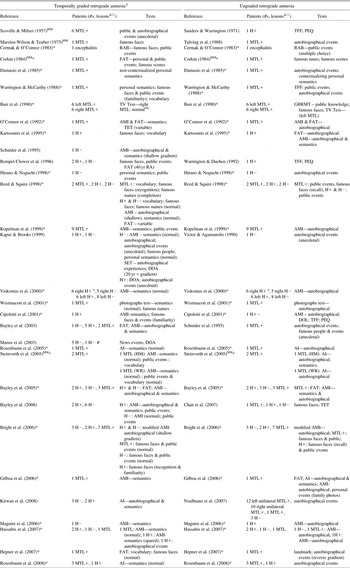
The frequent demonstration of TGRA in hippocampal amnesics is indeed strong support for SCT, but the theory is challenged by evidence that hippocampal damage does not necessarily produce this pattern of RA. In fact, a review of the literature, from Milner's first observation of TGRA in the classic medial temporal lobe (MTL) patient, HM, shows that there are as many reports of non-graded RA, in some cases dating back several decades before hippocampal damage, as there are reports of TGRA (Table 1). Moreover, in some of the studies represented in Table 1, the same patients exhibited both patterns of RA. In Table 1, we list studies of patients with lesions to the MTL, classify them according to the extent of damage, and indicate their performance on various retrograde memory tests.
Retrograde amnesia in humans with medial temporal lobe/hippocampal damage

Note. AI = Autobiographical Interview (Levine et al., Reference Levine, Svoboda, Hay, Winocur and Moscovitch2002); AMI = Autobiographical Memory Interview (Kopelman, Reference Kopelman1989); ARMT = Autobiographical Recall Memory Task (Piolino et al., Reference Piolino, Desgranges, Clarys, Guillery-Girard, Taconnat, Isingrini and Eustache2006); DOA = Dead or Alive Test (Kapur & Brooks, Reference Kapur and Brooks1999); Fx = fornix; FAT = Free Association Test (Crovitz & Schiffman, Reference Crovitz and Schiffman1974); GBRMT = Goldberg-Barnett Remote Memory Test (Unpublished); MB = mammillary bodies; PEQ = Public Events Questionnaire (Sanders & Warrington, Reference Sanders and Warrington1971); RA = Retrograde Amesia; RAB = Retrograde Amnesia Battery (Albert et al., Reference Albert, Butters and Levin1979); SET = Shared Experiences Test (Kapur & Brooks, Reference Kapur and Brooks1999); TET = Transient Events Test (O'Connor, M., Kaplan, E., & Cermak, L.S., unpublished); TFF = Transient Famous Faces (Sanders & Warrington, Reference Sanders and Warrington1971); TV Test = Television Programs Test (Squire et al., Reference Squire, Slater and Chace1975).
§Any sparing of remote memory was considered to be graded, even if the estimated duration of the gradient was decades long.
ΔPatients have bilateral damage unless otherwise stipulated.
□H−: damage restricted to hippocampus; H+: damage to hippocampus and adjacent medial temporal lobe MTL structures; MTL+: damage to MTL and adjacent neocortex.
This anoxix patient was identified as H− although the extent of the lesion was indeterminate.
*Denotes studies in which both patterns of retrograde amnesia are reported.
HM: Studies conducted on the patient, H.M. Other investigators also used the same patients or combinations of the same patients in different studies. For ease of presentation, these patients are not identified in the table. In general, this practice occurred when multiple studies originate from the same lab.
No: Normal performance by patients is indicated in the TGRA column.
aIn Viskontas et al. (Reference Viskontas, McAndrews and Moscovitch2000), 11 patients had right temporal lobe epilepsy (H−) and, of them, 6 had surgery (H+) and 5 were being considered for surgery (H−); 14 patients had left temporal lobe epilepsy and, of them, 6 had surgery (H+) and 8 were being considered for surgery (H−).
This contrary evidence encouraged alternative ways to think about the hippocampus and new theoretical formulations began to emerge. One of these, Multiple Trace Theory (MTT, Nadel & Moscovitch, Reference Nadel and Moscovitch1997), has, as its central premise, the view that the hippocampus is not only essential for registering episodic memories, but that it is always needed for their recall. According to MTT, each time a hippocampus-based memory is retrieved a new trace element is added and serves to reinforce and strengthen the memory. As the episodic memory becomes established, statistical regularities among its multiple representations can be abstracted and used to form a schematic version that captures essential features, or gist, of the original memory, but few of its details. The latter, semantic memory, is thought to be represented neocortically and is not affected by hippocampal damage (although it can be disrupted by lesions to the lateral temporal lobe).
This feature of MTT has received relatively little attention, but makes an important point about the relationship between episodic and semantic memory, and their neural representations. The transformation hypothesis, which we proposed in subsequent papers, based on supporting evidence, (e.g., Wiltgen & Silva, Reference Wiltgen and Silva2007; Wiltgen et al., Reference Wiltgen, Zhou, Cai, Balaji, Karlsson, Parivash and Silva2010; Winocur, Moscovitch, & Bontempi, Reference Winocur, Moscovitch and Bontempi2010; Winocur, Frankland, Sekeres, Fogel, & Moscovitch, Reference Winocur, Frankland, Sekeres, Fogel and Moscovitch2009; Winocur, Moscovitch, & Sekeres, Reference Winocur, Moscovitch and Sekeres2007) elaborates on this idea. The transformation hypothesis is explicit in proposing that the progression of memories from hippocampal to extra-hippocampal structures necessarily entails a loss of detailed, contextual features. In the process, the memories become schematized, or semanticized. As for memories that retain contextual details, they continue to be represented in the hippocampus. Importantly, the transformed memory need not replace the initial more detailed memory, but can co-exist and interact with it as the situation demands. In contrast, SCT takes a different view: both types of memory are regarded as separate, but subject to equivalent processes during their formation and inexorable progression with time from hippocampal to extra-hippocampal structures.
Our view, in other words, is that episodic memories undergo a transformation process, leading to the emergence of a less detailed schematic memory that can be accessed independently of the episodic memory, which, to the extent that it continues to survive, resides in the hippocampus. With respect to the two forms of RA, graded versus ungraded, the argument is that the pattern of RA exhibited by patients with extensive hippocampal lesions depends on the type of memory tested—tests of hippocampus-sensitive, episodic memory yield non-graded RA regardless of the age of the memoryFootnote 1, while tests of semantic memory result in a temporal gradient that reflects the time required to complete the transformation process. This position is consistent with numerous demonstrations that patients with known, or presumed hippocampal damage exhibit severely impaired episodic memory, but preserved semantic memory (e.g., Cermak & O'Connor, Reference Cermak and O'Connor1983; Kinsbourne & Wood, Reference Kinsbourne and Wood1975), and extends Cermak's (Reference Cermak1984) suggestion that, because of their inability to retrieve specific episodes, amnesics must rely on generalized semantic knowledge in recalling past events.
SCT has focused largely on TGRA as a fundamental characteristic of systems consolidation, but there are other essential features, which also characterize consolidation according to SCT. These are (1) Equivalence: Hippocampal lesions equally affect the consolidation of all declarative memories; (2) Duplication: Memories, consolidated in extra-hippocampal structures, are virtual reproductions that retain the same characteristics of memories that were represented in the hippocampus; (3) Resilience: Once consolidated, memories remain fixed and invulnerable to disruption. Beginning with the evidence that TGRA is not an invariant feature of remote memory loss, our position also takes issue with each of these premises regarding the nature of memory consolidation.
In a recent review, we focused primarily on the animal literature in assessing these points, in light of predictions based on SCT and MTT (Winocur, Moscovitch, & Bontempi, Reference Winocur, Moscovitch and Bontempi2010). On balance, we found that the evidence favors a transformation hypothesis to account for memory reorganization in systems consolidation. Here, we review the human neuropsychological literature and argue that, as with the animal literature, the transformation hypothesis provides the best account of systems consolidation.
Equivalence
As indicated above, and contrary to initial observations, hippocampal damage appears to produce two patterns of RA, one that is temporally graded and one that is not. Even for amnesia that is temporally graded, memory loss can extend for many years (e.g., Rempel-Clower et al., Reference Rempel-Clower, Zola-Morgan, Squire and Amaral1996). Proponents of SCT have argued that the variability in RA depends on whether the lesion is restricted to the hippocampus, in which case there is a limited TGRA. As shown in Table 1, if the lesion involves extra-hippocampal structures in the MTL and neocortex (MTL+), the predominant finding for autobiographical memory is a temporally extensive RA without a gradient. The case is less clear for autobiographical memory when the lesion is restricted to the MTL (H+), or hippocampus proper (H−) where both temporally graded and ungraded RA have been reported. For the three types of lesions, most investigators report that RA for semantic memory is graded or spared.
Thus, while lesion size and location are determining factors, it is also important to take into account the type of memory being tested, whether semantic or episodic, as well as the type of test used to assess those memories. An important point to emphasize is that neuropsychological tests of memory are rarely, if ever, process-pure. Semantic memory processes may contaminate tests of episodic memory (see Levine, Svoboda, Hay, Winocur, & Moscovitch, Reference Levine, Svoboda, Hay, Winocur and Moscovitch2002), just as episodic processes may contaminate tests of semantic memory (see Westmacott, Black, Freedman, & Moscovitch, Reference Westmacott, Black, Freedman and Moscovitch2004; Westmacott & Moscovitch, Reference Westmacott and Moscovitch2003). It is not possible in this review to evaluate all the commonly used tests in terms of how well they measure what they are designed to test. Many researchers, however, are cognizant of this problem and attempt to address it in one of two ways. In the “test-specific” approach, tests selectively target primarily one type of memory. Thus, for semantic memory, tests of famous people, public events, and personal facts are used to assess general knowledge and personal semantics, whereas episodic memory is assessed by having people recount autobiographical events and scoring them for their richness. The Autobiographical Memory Inventory (AMI), which has separate items that assess personal semantics and autobiographical episodes, is an example of a test that uses this approach (Kopelman, Wilson, & Baddeley, Reference Kopelman, Wilson and Baddeley1989). However, as noted above, each aspect of the test is not process-pure and may contain elements from the other memory domain. To mitigate this problem, some investigators have chosen a “memory-process” approach, in which a single test contains measures that distinguish between episodic and semantic processes, or components of the same memory. The Autobiographical Interview (AI—Levine et al., Reference Levine, Svoboda, Hay, Winocur and Moscovitch2002), for example, relies on this method by scoring the number of details used to relate an event. The AI distinguishes between those internal details that are unique to the event, and likely to be episodic, and external details, that do not relate directly to the event and likely tap semantic memory. A related technique, used by Piolino, Desgranges, and Eustache (Reference Piolino, Desgranges and Eustache2009), is to use other indices associated with reports of an event, such as observer and field viewpoint, ratings of recollection and familiarity, from which it is possible to derive an episodicity index for each event.
In our recent review (Winocur, Moscovitch, & Bontempi, Reference Winocur, Moscovitch and Bontempi2010), we noted that, in humans, damage to the hippocampus and adjacent MTL leads to extensive RA for episodic memories as revealed on tests of autobiographical memory, particularly on those that take the second approach, with relative preservation of semantic memories as revealed on tests of famous personalities, public events, and even personal semantics. However, in light of conflicting evidence (Rosenbaum et al., Reference Rosenbaum, Moscovitch, Foster, Schnyer, Gao, Kovacevic and Levine2008; for reviews, see Moscovitch, Nadel, Winocur, Gilboa, & Rosenbaum, Reference Moscovitch, Nadel, Winocur, Gilboa and Rosenbaum2006; Squire, Wixted, & Clark, Reference Squire, Wixted and Clark2007), the debate continues as to whether patients with hippocampal lesions exhibit TGRA for detailed, episodic memories.
Close scrutiny of the papers in Table 1 that involve patients with restricted MTL lesions and support SCT reveals results that sometimes are difficult to interpret. For example, Squire and colleagues (Bayley, Hopkins, & Squire, Reference Bayley, Hopkins and Squire2003, Reference Bayley, Hopkins and Squire2006; Kirwan, Bayley, Galvan, & Squire, Reference Kirwan, Bayley, Galvan and Squire2008; Manns, Hopkins, & Squire, Reference Manns, Hopkins and Squire2003; Reed & Squire, Reference Reed and Squire1998) used a variety of tests, based on both approaches, to examine remote semantic and episodic memory in patients with lesions that were restricted to the hippocampus, (H−) or extended to the adjacent MTL (H+). The results represent a complex pattern of lost and spared memory performance that is not always consistent with SCT or, for that matter, with any other theory. For example, in some cases, semantic memory loss for public events and famous personalities seems to be greater than for episodic autobiographical memory loss (Manns et al., Reference Manns, Hopkins and Squire2003; Reed & Squire, Reference Reed and Squire1998). In one study, patients with lesions to the MTL exhibited ungraded semantic RA that extended over their entire lifetime (Reed & Squire, Reference Reed and Squire1998). On some tests of autobiographical memory, patients with lesions restricted to the hippocampus showed no RA (Kirwan et al., Reference Kirwan, Bayley, Galvan and Squire2008; Reed & Squire, Reference Reed and Squire1998) and outperformed controls in the period immediately preceding the lesion (Kirwan et al., Reference Kirwan, Bayley, Galvan and Squire2008), as well as, in one study, for a period of 25 or more years before it (Bayley et al., Reference Bayley, Hopkins and Squire2006). When the lesion extended to the MTL and beyond, RA for autobiographical memory spanned 25 years in one case, and over 50 years in another (Kirwan et al., Reference Kirwan, Bayley, Galvan and Squire2008). Taken at face value, these results improbably suggest that damage restricted to the hippocampus causes no RA in episodic memory, and a temporally graded RA of approximately 10 years for semantic memory (see Manns et al., Reference Manns, Hopkins and Squire2003). Similar inconsistencies appear in Hepner, Mohamed, Fulhan, and Miller (2007) in which RA for semantic memory was more extensive than for episodic memory in a case in which the lesion extended beyond the MTL.
By contrast, Rosenbaum et al. (Reference Rosenbaum, Moscovitch, Foster, Schnyer, Gao, Kovacevic and Levine2008), like Kirwan et al. (Reference Kirwan, Bayley, Galvan and Squire2008), used Levine et al.'s (Reference Levine, Svoboda, Hay, Winocur and Moscovitch2002) AI to test autobiographical memory. Unlike Kirwan et al. (Reference Kirwan, Bayley, Galvan and Squire2008), however, they found that RA for internal (episodic) details varied with the amount of hippocampal, rather than extra-hippocampal, damage. In one patient with a bilateral hippocampal lesion that did not extend beyond the MTL, the RA spanned his entire life. Moreover, they found no RA for external (semantic) details even in patients with large hippocampal lesions. Bright et al. (Reference Bright, Buckman, Fradera, Yoshimasu, Colchester and Kopelman2006) used the AMI to examine patients with lesions restricted to the hippocampus, or to the hippocampus plus adjacent MTL regions. They also found, for both groups, limited RA for semantic memory on a variety of tests of public events and personalities, but, for autobiographical episodes, an RA that extended back to early childhood, although the deficit was only marginally significant. Memory for episodes during early adulthood, however, was preserved. Using the AMI, Maguire, Nannery, and Spiers (Reference Maguire, Nannery and Spiers2006) and Hassabis, Kumaran, Vann, and Maguire (Reference Hassabis, Kumaran, Vann and Maguire2007) showed an ungraded RA for autobiographical episodes in three of four patients with comparable lesions. These results are readily interpreted in terms of the MTT-transformation model, but pose difficulties for SCT.
It is difficult to reconcile the reported differences, in part, because the type of tests used, etiology of the patients, as well as the location and size of lesion vary between studies. The difficulties are compounded by the fact that, in humans, hippocampal damage invariably extends to neighboring structures, so that patients with damage restricted to the hippocampus are uncommon. In this regard, it can be instructive to examine patients with selective damage to the fornix, the major output pathway from the hippocampus to the rest of the brain. This type of lesion often occurs during surgery to remove a colloid cyst from the third ventricle, which produces little, if any damage to other structures. D'Esposito, Verfaille, Alexander, and Katz (Reference D'Esposito, Verfaille, Alexander and Katz1995) investigated a patient with bilateral fornix transection resulting from a penetrating head injury which necessarily damaged other structures. Their patient exhibited mild to moderate, but temporally ungraded, retrograde amnesia for famous people. Autobiographical memory was not tested formally, but deemed to be adequate on anecdotal observation. By comparison, we conducted a systematic examination of autobiographical and semantic memory in a patient in whom 75% of the fornix was severed bilaterally as a result of surgery to remove a colloid cyst (Gilboa et al., Reference Gilboa, Winocur, Rosenbaum, Poreh, Gao, Black and Moscovitch2006; Poreh et al., Reference Poreh, Winocur, Moscovitch, Backon, Goshen, Ram and Feldman2006)Footnote 2. We reported both patterns of remote memory loss as predicted by the transformation hypothesis: ungraded RA for detailed, episodic memories over the patient's entire lifetime, and TGRA for semantic memories about himself and the worldFootnote 3.
Whereas the neuropsychological literature is divided on the RA issue, evidence from functional neuroimaging studies of healthy adults has been quite consistent and supportive of MTT and the transformation hypothesis. Numerous studies have examined brain activation patterns during recall and recognition of detailed, remote episodic, and semantic memories using a wide range of tests for each type. Almost without exception, the results showed hippocampal activation associated with detailed, episodic memories, regardless of the memory's age, and variable temporal gradients with respect to semantic memories. One reason for the variability of the gradients is that although the tests, such as identifying famous faces, were ostensibly semantic, some were contaminated by episodic components. Furthermore, of the factors that modulate hippocampal activity in tests of remote memory, the age of the memory had no effect in most studies; by comparison, hippocampal activity was modulated by vividness, number of details, personal significance, and autonoetic consciousness associated with recollection, all factors associated with episodic memory (for reviews, see Moscovitch et al., Reference Moscovitch, Nadel, Winocur, Gilboa and Rosenbaum2006; Piolino et al., Reference Piolino, Desgranges and Eustache2009).
More recent evidence has indicated that there are differences in activation along the anterior–posterior axis of the hippocampus when retrieving autobiographical memories. The anterior hippocampus is activated most during the retrieval of more recent memories, whereas the posterior region is activated more during the retrieval of older memories (Gilboa, Winocur, Grady, Hevenor, & Moscovitch, Reference Gilboa, Winocur, Grady, Hevenor and Moscovitch2004; Piolino et al., Reference Piolino, Desgranges and Eustache2009; Rekkas & Constable, Reference Rekkas and Constable2005). It is important to note that the posterior hippocampus contributes the majority of efferent fibers to the fornix, which may account for the extensive RA for episodic memories observed in our patient with transection of this pathway. It is interesting to speculate whether the location of the lesion along the longitudinal axis of the hippocampus may be a factor in the type, severity, and temporal extent of memory loss in humans.
Based on the lesion and imaging studies on remote memory, and with the development of sensitive measures of autobiographical memory, researchers have investigated remote memory loss in various clinical populations from the perspective of the episodic/semantic distinction. The problems associated with studying patients with focal lesions are exacerbated in patients with neurodegenerative disorders. Because of the variability in the patients’ pathology and the likelihood that damage extends to structures beyond the MTL, thereby incurring loss in cognitive domains other than memory, the results must be interpreted cautiously. Nonetheless, MTT and the transformation hypothesis provide a useful framework for interpreting these findings. Murphy, Troyer, Levine, and Moscovitch (Reference Murphy, Troyer, Levine and Moscovitch2008) used the AI to test a group of patients with mild cognitive impairment (MCI), with presumably limited damage to the MTL. These patients, who had no cognitive impairment other than memory loss, showed ungraded RA for detailed, autobiographical memories, with no deficit in personal semantics. In patients diagnosed with Alzheimer's disease, the pathology encroaches on neocortical, semantic systems. Using tests similar to the AI on such patients, Ivanoiu, Cooper, Shanks, and Venneri (Reference Ivanoiu, Cooper, Shanks and Venneri2004), and Piolino et al. (Reference Piolino, Desgranges, Belliard, Matuszewski, Lalevee, De la Sayette and Eustache2003) found ungraded episodic memory loss combined with graded RA for semantic memory. As the disease progresses further, even the semantic gradient becomes shallower and RA more extensive (Westmacott, et al., Reference Westmacott, Black, Freedman and Moscovitch2004).
The pattern looks different when the test-specific approach is used. On the AMI, Leyhe, Muller, Milian, Eschweiler, and Saur (Reference Leyhe, Muller, Milian, Eschweiler and Saur2009) found that memory for both personal semantics and autobiographical episodes was temporally graded in patients with MCI who exhibited generalized cognitive loss and in patients in the early stages of Alzheimer's disease (see also Greene, Hodges, & Baddeley, Reference Greene, Hodges and Baddeley1995; Kopelman, Reference Kopelman1989). However, for public events sampled across 50 years, Leyhe, Muller, Eschweiler, and Saur (Reference Leyhe, Muller, Eschweiler and Saur2010) reported an ungraded RA for recognition of the event, estimation of the date of the event, and the context in which the event occurred. The authors suggested that more frequently retrieved memories, such as those related to autobiographical events, become independent of the hippocampus, whereas less frequently retrieved memories, such as those for public events, remain dependent on it. If one considers that the tests are not process-pure, from the vantage point of the MTT-transformation hypothesis, it is possible to argue that autobiographical memories become more semantic with repetition over long periods of time (Cermak, Reference Cermak1984), while less rehearsed memories of public events retain an episodic, recollective component that aids recognition (see also Petrican et al., Reference Petrican, Gopie, Leach, Chow, Richards and Moscovitch2010).
This trade-off between semantic and episodic contributions to remote memory is also observed in studies of patients with semantic dementia whose hippocampus is relatively spared. In these patients, episodic memory is less affected than semantic memory (McKinnon, Black, Miller, Moscovitch, & Levine, Reference McKinnon, Black, Miller, Moscovitch and Levine2006; Westmacott, Leach, Freedman, & Moscovitch, Reference Westmacott, Leach, Freedman and Moscovitch2001) and may contribute disproportionately to recent than to remote memory (Graham, Patterson, & Hodges, Reference Graham, Patterson and Hodges1999; Graham, Simons, Pratt, Patterson, & Hodges, Reference Graham, Simons, Pratt, Patterson and Hodges2000; Hou, Miller, & Kramer, Reference Hou, Miller and Kramer2005). Combining neuroimaging with extensive behavioral testing, investigators have shown that activity in the hippocampus of these patients correlated with their performance on tests of remote episodic memory. In a dramatic demonstration of this point, Maguire, Kumaran, Hassabis, and Kopelman (Reference Maguire, Kumaran, Hassabis and Kopelman2010) tracked the deterioration of a patient with semantic dementia for 3 years from initial diagnosis. Remote episodic memory was spared as long as hippocampal activation was detected in the first 2 years, after which remote memory loss was severe and ungraded. These investigators also found the same pattern of activation in frontal and right temporal lobe regions, consistent with the idea that the hippocampus, while central (Addis, Moscovitch, Crawley, & McAndrews, Reference Addis, Moscovitch, Crawley and McAndrews2004; Maguire et al., Reference Maguire, Kumaran, Hassabis and Kopelman2010), operates in concert with other structures to form an autobiographical memory network needed for retrieval of episodic events. This evidence is also in accord with the component process model (Moscovitch, Reference Moscovitch1992; Moscovitch & Winocur, Reference Moscovitch and Winocur2002), which emphasizes the coordinated function of the prefrontal cortex with the hippocampus in temporal ordering of extended complex events, such as detailed episodes (see also Gaffan & Wilson, Reference Gaffan and Wilson2008). In this regard, it is interesting to note that several investigators reported that the hippocampus is activated during the initial retrieval of an episode, with activity in other brain regions increasing during the maintenance and elaboration phases (Addis & Schacter, Reference Addis and Schacter2008; Conway & Pleydell-Pearce, Reference Conway and Pleydell-Pearce2000; Daselaar et al., Reference Daselaar, Rice, Greenberg, Cabeza, LaBar and Rubin2008).
Similar patterns of RA have been observed with respect to spatial memory. It is well established that damage to the hippocampus impairs the acquisition of spatial relationships and memory for locations in complex environments (Barrash, Reference Barrash1998; Maguire et al., Reference Maguire, Nannery and Spiers2006). The evidence with respect to premorbidly acquired spatial memory is more complex. On the one hand, map drawing and navigation in real-world and virtual environments are remarkably well-preserved. As well, it has been shown that patients can use allocentric (viewpoint independent) information to estimate distances and orientations, negotiate around road-blocks, and provide directions in a familiar environment in real life, in virtual reality, and in mental navigation. In the face of such preserved abilities, they are surprisingly poor at recognizing incidental features of their environment if they are not salient landmarks used for navigation. Such evidence led us to propose that the episodic-semantic distinction and the corresponding relationship between hippocampal and extra-hippocampal structures, discussed above, exist in an analogous form in spatial memory. Experience with an environment allows for abstraction of general features, such as salient landmarks and the approximate relations among them, resulting in a schematic representation that contains map-like, survey knowledge that can support navigation. This representation forms in extra-hippocampal structures in the same way as proposed for semantic memory. By contrast, detailed spatial memories that preserve the perceptual and spatial features of the environment and support re-instatement of the experience of traversing the environment, continue to depend on the hippocampus (see reviews by Moscovitch et al., Reference Moscovitch, Rosenbaum, Gilboa, Addis, Westmacott, Grady and Nadel2005; Rosenbaum, Winocur, & Moscovitch, Reference Rosenbaum, Winocur and Moscovitch2001; Winocur, Moscovitch, & Bontempi, Reference Winocur, Moscovitch and Bontempi2010).
We recently tested this hypothesis by having healthy young and old residents of Toronto provide a detailed description of a route that they habitually took and a route they traversed only once. The spatial coherence of the descriptions, and the number of perceptual and spatial details they contained, correlated highly with performance on tests sensitive to hippocampal integrity—a table-top test of spatial memory and a test of cued recall of randomly paired words. Importantly, there was no correlation between performance on any of these tests and performance on a test that required navigating through highly familiar routes in downtown Toronto (Hirshhorn, Newman, & Moscovitch, Reference Hirshhorn, Newman and Moscovitch2010).
A study by Maguire et al. (Reference Maguire, Nannery and Spiers2006) of a London (UK) taxi driver with bilateral hippocampal lesions suggests that there are limits on the extent to which extra-hippocampal representations can support navigation, and that detailed spatial representations are sometimes needed. Although the driver performed normally on tests of navigation on main thoroughfares (A-routes) that were frequently traveled, his performance was decidedly impaired in both accuracy and latency with respect to less familiar, smaller, winding side streets (B-routes) that entailed frequent changes in one-way direction.
There is a striking parallel to the results of Maguire et al. (Reference Maguire, Nannery and Spiers2006) in some of our animal research. In a series of experiments (Winocur, Moscovitch, Fogel, Rosenbaum, & Sekeres, Reference Winocur, Moscovitch, Fogel, Rosenbaum and Sekeres2005; Winocur, Moscovitch, Rosenbaum, & Sekeres, Reference Winocur, Moscovitch, Rosenbaum and Sekeres2010), we found that if, before surgery, rats with hippocampal lesions were allowed to become familiar with a complex environment, they showed excellent savings for spatial memories acquired in that environment. Without such pre-operative exposure, lesioned rats were severely impaired in learning new routes. However, when preferred routes to reward locations were blocked forcing rats to re-orient in relation to the goal area, those with hippocampal lesions took longer and followed less direct paths to the goal, although they continued to use spatial strategies.
As in non-spatial memory, the evidence points to two broad classes of remote spatial memory—one that is contextually rich, detailed, and dependent on the hippocampus, and a second that is more schematic, less flexible, and resistant to the effects of hippocampal lesions. This pattern argues against SCT's equivalence principle that remote memories are equally affected by hippocampal lesions, but is predicted by MTT and the transformation hypothesis.
Duplication
The question addressed in this section is whether the memories that do survive hippocampal damage are duplicates of those originally represented in the hippocampus. Studies involving animals, where there is greater opportunity to track a memory over long periods of time from its inception, suggest that they are not. Among other paradigms, investigators have used contextual fear conditioning, in which rodents learn to associate electric shock with contextual cues in the environment, to show that, when initially formed, learned fear responses are context-specific. When tested shortly after acquisition, rats exhibit a contextual fear response (freezing) in the conditioning environment, but not in a novel environment that only slightly resembles the original. At longer delays, the freezing response can be elicited in either environment, indicating that the memory has lost its context-specificity and has generalized to other environments. Hippocampal disruption impairs recall of the contextual fear response at short delays when it is context-specific, but not at long delays when the memory is more general (Wiltgen & Silva, Reference Wiltgen and Silva2007; Winocur et al., Reference Winocur, Frankland, Sekeres, Fogel and Moscovitch2007, Reference Winocur, Moscovitch and Sekeres2009). Corroborative evidence comes from a recent study by Wiltgen et al. (Reference Wiltgen, Zhou, Cai, Balaji, Karlsson, Parivash and Silva2010) that used gene-expression techniques and showed that the hippocampus is activated during retrieval of a contextual fear response when that response is context-specific. However, as the memory loses precision over time and can be elicited in other environments, there was a significant reduction in hippocampal activation.
Taken together, the animal evidence shows that as long as a memory retains its contextual specificity, it is hippocampus-dependent. However, once memories are transformed and represented extra-hippocampally in schematic form, they are not supported by hippocampal activation and lesions to the structure have no effect on their retrieval. Progress is being made in identifying the brain structures implicated in the extra-hippocampal memory network. Based on studies using brain-mapping (Maviel, Durkin, Menzaghi, & Bontempi, Reference Maviel, Durkin, Menzaghi and Bontempi2004), gene-expression and protein synthesis inhibition (Frankland & Bontempi, Reference Frankland and Bontempi2005), single-unit recordings (Takehara, Nakao, Kawahara, Matsuki, & Kirino, Reference Takehara, Nakao, Kawahara, Matsuki and Kirino2006), and lesions (Takehara, Kawahara, & Kirino, Reference Takehara, Kawahara and Kirino2003), prime candidates include structures in the prefrontal cortex and anterior cingulate, and retrosplenial cortex.
The evidence with regard to this issue in humans is more circumstantial because it is impractical to follow the progression of rich episodic memories over the long periods of time that systems consolidation can occur. Studies that tracked memories for associations between items, and between items and locations, over relatively short intervals of approximately an hour to a week, showed that memories become less hippocampus-dependent as revealed by diminished activation on functional magnetic resonance imaging, and more dependent on temporal and frontal structures. Equivalence of performance at these intervals does not necessarily suggest that the early and late memories are identical, and none of the studies probed the memories to ascertain whether they were, or not. One exception is a study by Viskontas, Carr, Engel, and Knowlton (Reference Viskontas, Carr, Engel and Knowlton2009) that examined recognition memory for single items at two time points, a week apart. As long as memories retained their recollective qualities over the interval, they were associated with greater activation in the subiculum, a sub-region of the hippocampus. Some memories, however, faded over this period. The transformation from recollected memories to memories that were merely familiar was accompanied by a reduction in subicular activation. In another study, Wolbers and Buchel (Reference Wolbers and Buchel2005) had participants learn to navigate in a small, virtual environment while being scanned. Hippocampal activation was evident during the early trials when navigation was dependent on detailed contextual memories of segments along the routes. As participants developed a schematic, map-like representation of the environment, hippocampal activation declined, while activation in other structures, including especially the retrosplenial cortex, became more prominent.
In a longitudinal study of spatial memory for a large and complex natural environment, we scanned healthy individuals during tests of mental navigation through downtown Toronto at two time points: when they were newly arrived in Toronto and approximately a year later (Hirshhorn et al., Reference Hirshhorn, Newman and Moscovitch2010). The results showed clear hippocampal activation in the initial tests, but not at the later ones when activation occurred in extra-hippocampal structures. Among these structures, some increased their activation from the initial time whereas other structures, such as caudate and retrosplenial cortex, became active only at the later time points. The fact that new structures were implicated in the later memory, suggests that the nature of the memory also changed between the two intervals.
Cross-sectional studies that examined autobiographical memories of different ages, but at one point in time are consistent with the transformation view. Using several measures of episodic memory for autobiographical events, Piolino and her collaborators found that the more recent memories were ranked much higher on an episodicity index than more remote memories, and the extent of episodicity correlated with hippocampal activation (Piolino et al., Reference Piolino, Desgranges and Eustache2009). The memories that were more semantic were dependent on extra-hippocampal structures, such as the lateral temporal and frontal cortices. In a study examining memory for public events over 5 decades, Petrican et al. (Reference Petrican, Gopie, Leach, Chow, Richards and Moscovitch2010) had participants rate their memory for them as “Remember,” if they could recollect the context in which the memory occurred, or a personal episode related to it, or “Know,” if the memory was merely familiar. Recent memories were associated with more Remember than Know responses, but the ratio of Remember to Know responses declined significantly over time, consistent with our hypothesis that memories transform from one type to the other. One patient with extensive MTL degeneration recognized as many public events as matched controls, but had very few detailed recollections at all time points. By contrast, another patient with probable semantic dementia and left lateral temporal degeneration with relative sparing of the hippocampus showed a much greater than normal proportion of Remember memories at all time points, suggesting that context-specific memories prevailed at the expense of semantic ones.
Taken together, the evidence reviewed in this section strongly suggests that memories that become independent of the hippocampus with time and experience are not mere duplicates of the ones from which they derive. In accord with our transformation hypothesis, memories that lose their hippocampal dependence do so because they change from ones that are episodic and context-specific to ones that are more semantic and context-general.
Resilience
The traditional view is that once memories are consolidated in extra-hippocampal structures they are permanent and resistant to disruption. Although central to SCT, this idea is difficult to reconcile with evidence that long-term memories are subject to numerous influences that cause them to be modified, such as emotional state, retrieval environment, conflicting memories, and goals (see review by Nadel, Reference Nadel2008). The standard response is that the consolidated memory can co-exist with its variations and compete with them for control of behavior. Although this position has support, the notion of immutability is challenged most seriously by evidence from animal studies in which reminder cues are used to help retrieve consolidated memories. When memories are reinstated in this way, they once again become susceptible to disruption by amnestic agents (e.g., hippocampal lesions, or protein synthesis inhibitors) applied shortly after retrieval. This evidence suggests that, upon retrieval, consolidated memories revert to a labile state, leading investigators to propose that consolidation is a recurring process that involves the reconsolidation of previously formed memories (see review by Nader & Hardt, Reference Nader and Hardt2009).
The transformation hypothesis takes issue with the notion of reconsolidation as regards systems consolidation, and offers a different interpretation of the reinstatement effect. As argued above, hippocampal and extra-hippocampal memories are fundamentally different from each other. According to our view, the effect of reminding the animal of the original context is to reactivate the context-specific hippocampal memory and re-assert its dominance over the more schematic extra-hippocampal memory. As a result, the context-specific memory is once again susceptible to hippocampal lesions. If the animal is reminded in a different environment, this process does not occur. Consistent with these predictions, in a contextual fear conditioning paradigm, we found that when the original learning environment served as a reminder after very long delays, the reactivated memory indeed was more context-specific compared with the non-activated memory, which remained schematic. Only the former was disrupted by hippocampal lesions. Conversely, when the reminder bore only a general resemblance to the original environment, the schematic memory was retrieved and there was no effect of hippocampal lesions (Winocur et al., Reference Winocur, Frankland, Sekeres, Fogel and Moscovitch2007, Reference Winocur, Moscovitch and Sekeres2009). This pattern of results is consistent with our transformation hypothesis.
For practical reasons, it is more difficult to conduct these types of experiments in humans, because of the requirement to administer powerful amnestic agents. There are at least two instances, however, in which this has been done and in both cases their effects were comparable to those in animals. In one study, presenting electroconvulsive therapy to participants after they had been reminded of a word list that they had recently learned, had a much more disruptive effect on memory for the list than when there was no reminder (Sackeim et al., Reference Sackeim, Prudic, Devanand, Nobler, Lisanby, Peyser and Clark2000). In another study, involving patients with post-traumatic stress disorder, the emotion accompanying a reactivated memory of the traumatic event was diminished following treatment with the beta-adrenergic blocker propanolol, whereas the drug had no effect if there had been no reminder (Brunet et al., Reference Brunet, Orr, Tremblay, Robertson, Nader and Pitman2008).
Another class of reconsolidation experiments relies on behavioral manipulations that affect memory by varying the amount of interference. Perhaps the most dramatic example of this effect is the classic work by Loftus and her colleagues on eye-witness testimony (Loftus, Reference Loftus2003). In those studies, presenting misleading information at retrieval distorted the original and more accurate memories of particular events (misinformation effect). Although those studies were not interpreted in terms of memory reconsolidation, a recent variation of this experiment by Chan, Thomas, and Bulevich (Reference Chan, Thomas and Bulevich2009) showed that the effect is dependent on reviving the initial memory at the time that misleading information is provided. Under these circumstances, the initial memory is weakened and superseded by the new memory.
Similar findings were reported by other investigators who used interference techniques to block memories (e.g., Forcato et al., Reference Forcato, Burgos, Argibay, Molina, Pedreira and Maldonado2007; Hupbach, Gomez, Hardt, & Nadel, Reference Hupbach, Gomez, Hardt and Nadel2007). In a particularly revealing comparison with the animal studies, Nadel and his colleagues (Hupbach et al., Reference Hupbach, Gomez, Hardt and Nadel2007; Hupbach, Hardt, Gomez, & Nadel, Reference Hupbach, Hardt, Gomez and Nadel2008) developed a paradigm in which participants learned a list of common objects. Two days later, half were reminded of their training experience and the other half were not. Then, the entire group learned a second list of objects, presented in a different manner. Following this learning experience, memory for both lists was tested, immediately, or 2 days later. The results showed that List 2 learning intruded on List 1 recall, but the effect was only observed in the 2-day test. Subsequent work involved systematic manipulation of the reminder experience and the results clearly showed that the response intrusion effect occurred only when the reminder contained features of the original context. These results demonstrate the reinstatement effect in humans and, importantly, show that the effect is related to the reactivation of context-dependent memories.
None of the human studies speaks to the role of the hippocampus and extra-hippocampal structures in the reactivation process, although all of them question the tenet that consolidated memories are immutable. Within this evidence, there is preliminary support for the transformation hypothesis, particularly from the Hupbach et al. (Reference Hupbach, Hardt, Gomez and Nadel2008) study on context-specificity. Evidence from functional neuroimaging, and other emerging technologies, is needed to identify the locus at which reconsolidation effects occur in humans, and whether the contextual-specificity of the memories interact with the structures that are implicated.
Summary
With the appreciation that TGRA is not an invariable result of hippocampal damage, evidence challenging other pillars of SCT has emerged, leading to other ways of thinking about the relationship between the hippocampus and other brain regions in long-term memory. In this study, we reviewed some of this evidence with an emphasis on the human neuropsychological literature, and proposed a transformation hypothesis, which we believe accounts for the current state of knowledge related to systems consolidation and can serve as a heuristic for future research. The essential premise of our view is that memories are dynamic and undergo changes in their function and neural representation. Moreover, in accord with long-standing neuroscientific principles, the two are inextricably linked so that a change in one necessarily suggests a change in the other. In contrast to the traditional view of systems consolidation, which holds that when a memory loses its hippocampal dependency an identical version forms in other structures (Squire & Alvarez, Reference Squire and Alvarez1995), we believe that such changes entail a transformation of the memory. Thus, with time and experience, some memories are transformed from ones that are episodic and context-specific to those that are semantic or schematic. In the process, the latter memories lose their hippocampal dependency and are represented in other structures. To the extent that context-specificity is retained, the memory will continue to be dependent on the hippocampus. We also maintain that both types of memory can co-exist and interact dynamically with each other. Thus, one can have general knowledge of an event while also retaining specific details associated with the original experience of the event, with each form being represented in its respective neural system.
While MTT and the transformation hypothesis are consistent with much of the evidence, several outstanding questions remain. Perhaps the most difficult relates to the role played by the hippocampus in the transformation process. One possibility is that by retaining multiple representations of an episode, it enables the abstraction, by the neocortex, of statistical regularities that form the basis of semantic memory. Through repeated reactivation of these memories, either by retrieving them consciously, or replaying them during sleep, synaptic changes in the neocortex are strengthened, forming the neural circuitry of semantic memories. While speculative, this proposal provides a mechanism whereby the contextual details that are peculiar to episodic memories are excluded from semantic/schematic memories, which capture common elements across different representations.
Another question is how MTT and the transformation hypothesis relate to other current theories of hippocampal function. Two prominent theories, the dual process (Yonelinas, Reference Yonelinas2002) and relational binding (Eichenbaum, Otto, & Cohen, Reference Eichenbaum, Otto and Cohen1994; Moses & Ryan, Reference Moses and Ryan2006) theories of memory, are closely linked. The dual process theory distinguishes between recollection and familiarity, with the former dependent on the hippocampus, and the latter on extra-hippocampal structures, particularly peri-rhinal cortex, in the MTL. Relational binding theory attributes a central role to the hippocampus in forming associations among unrelated events, or stimuli. Relational binding between item and context underlies recollection, whereas familiarity depends on item memory independent of context (Eichenbaum, Yonelinas, & Ranganath, Reference Eichenbaum, Yonelinas and Ranganath2007). In a third theory, derived from O'Keefe and Nadel's (Reference O'Keefe and Nadel1978) cognitive map theory, the hippocampus is considered critical for constructing and representing allocentric spatial relations, which provide the basis of detailed episodic memory and imagination (Bird & Burgess, Reference Bird and Burgess2008; Hassabis et al., Reference Hassabis, Kumaran, Vann and Maguire2007). All of these theories are compatible with our theoretical position regarding the role of the hippocampus in supporting and maintaining rich episodic memories. None, however, explicitly address the issue with which this review is concerned, namely the changes that memories undergo over time. For example, are relationally bound memories retained over time, or do they become unbound and split into their separate components? A hint is provided from the work we reviewed, which indicates that over time recollection is diminished while familiarity is preserved, suggesting that relationally bound memories lose their contextual aspects and only item memory survives. That familiarity is closely linked to item and semantic memory indicates that these theories can be accommodated by our transformation hypothesis. Insofar as rich episodic memories are retained over time, they will continue to depend on relational binding mediated by the hippocampus.
Another class of theories, strength theories, posits that hippocampal memories are distinguished from other memories by their strength, not their quality (Squire et al., Reference Squire, Wixted and Clark2007). With respect to changes of memories over time, these theories would argue that as memories become independent of the hippocampus, they lose their strength. Strength theories are incompatible with the transformation hypothesis, which emerged from demonstrated differences in quality between hippocampal and extra-hippocampal memories, as reviewed in this study.
We acknowledge that our present theoretical position is likely to be modified, or replaced as new evidence emerges. Whatever its long-term fate, it serves to recapture what has always been the foundation of neuropsychological theories of memory, namely that memory is a dynamic process not only at the neural level, as maintained by traditional views of systems consolidation, but also at the functional level. Advances, therefore, will depend as much on the development of psychological theory and careful behavioral observation in the laboratory and in the clinic, as on sophisticated technologies that reveal underlying neural mechanisms.
Acknowledgments
The preparation of this study, as well as some of the research reported therein was supported by a grant to the authors by the Canadian Institutes for Health Research (grant number: MGP 6694). Other research by the authors reported in this study was supported by grants from the Natural Sciences and Engineering Research Council to GW and MM. The authors gratefully acknowledge the support of Mr. Nick Hoang in preparing the manuscript. The authors declare that they have no conflicts of interest.