Introduction
In the last few years, a variety of energy-storage device applications have expanded from compact electronics to large-scale energy storage systems, including renewable energy storage and electric transportation [Reference Lim, Kim, Jo, Chun, Ku, Kim, Lee, Nam, Yoon, Kang and Lee1, Reference Augustyn, Simon and Dunn2]. To accomplish the energy and power density requirements for energy applications, many researchers have given attention to the synthesis of oxide-based nanomaterials because of their chemical, physical, optical, and electronic properties [Reference Lim, Kim, Jo, Chun, Ku, Kim, Lee, Nam, Yoon, Kang and Lee1, Reference Augustyn, Simon and Dunn2, Reference Kong, Zhang, Zhang, Wang, Cai, Lv, Qiao, Ling and Long3, Reference Cui, Zhu, Liu, Liu, Xie and Yang4]. Another concern is to investigate nontoxic and abundant materials to lower the costs and increase device safety in both consumer products and in stationary power [Reference Augustyn, Simon and Dunn2]. In this way, niobium pentoxide (Nb2O5) is a promising material because of its particular properties such as a ∼3.4 eV band gap, low toxicity, surface acidity, and good chemical and thermal stabilities [Reference Kong, Zhang, Zhang, Wang, Cai, Lv, Qiao, Ling and Long3, Reference Falk, Borlaf, López-Muñoz, Fariñas, Rodrigues Neto and Moreno5, Reference Lopes, Paris and Ribeiro6, Reference Rani, Zoolfakar, O’Mullane, Austin and Kalantar-Zadeh7], It has been demonstrated that Nb2O5 can deliver a high power through a mainly pseudocapacitive reaction of Li-ion (Li+), which could happen not only at the surface but also in the bulk of the Nb2O5 in nonaqueous Li+ electrolyte [Reference Augustyn, Simon and Dunn2, Reference Liu, Yan and Zhang8]. The intercalation pseudocapacitive depends on factors such as crystalline structure and specific surface area. Materials with high crystallinity can be achieved through thermal treatment process using high temperatures; however, they present larger particles size, agglomeration, and reduction in their surface area [Reference Kocjan, Logar and Shen9]. Specific surface area of the active materials in a capacitor or pseudocapacitor is an important property because both mechanisms take place on the surface for energy storage [Reference Taberna, Simon and Fauvarque10]. Previous studies demonstrated that the amorphous pseudohexagonal Nb2O5 (TT-phase) exhibited lower specific capacitance values than the crystalline orthorhombic Nb2O5 (T-phase) [Reference Luo, Li, Zhang, Gao and Lin11, Reference Wang, Li, Chen, Augustyn, Ma, Wang, Dunn and Lu12, Reference Li, Xu, Uchaker, Cao and Cao13, Reference Wang, Li, Tjandra, Fan, Xiao and Yu14, Reference Kong, Zhang, Wang, Qiao, Ling and Long15, Reference Come, Augustyn, Kim, Rozier, Taberna, Gogotsi, Long, Dunn and Simon16, Reference Wang, Yan, Yan, Sumboja and Lee17, Reference Yang, Xu, Wang, Zhang, Huang and Hu18].
Nonetheless, the application of Nb2O5 has been hampered by low bulk electrical conductivity (∼3.4 × 10⁻⁶ S/cm at 300 K) and by the difficult control of the ideal crystal structure [Reference Kong, Zhang, Zhang, Wang, Cai, Lv, Qiao, Ling and Long3, Reference Luo, Li, Zhang, Gao and Lin11, Reference Wang, Li, Chen, Augustyn, Ma, Wang, Dunn and Lu12]. Therefore, when T-Nb2O5 nanocrystals were fabricated into a relatively thick electrode, the power performance was limited because of the impaired mobility of electrons. A potential effective method to improve these adversities is through surface modifications (e.g., carbon coating), which could expose more redox active nanoparticles to the electrolyte and also boost the electronic conductivity [Reference Lim, Kim, Jo, Chun, Ku, Kim, Lee, Nam, Yoon, Kang and Lee1, Reference Kong, Zhang, Zhang, Wang, Cai, Lv, Qiao, Ling and Long3, Reference Luo, Li, Zhang, Gao and Lin11, Reference Wang, Li, Chen, Augustyn, Ma, Wang, Dunn and Lu12, Reference Li, Xu, Uchaker, Cao and Cao13]. The introduction of carbon nanotube (CNT) networks may improve electron transport of the Nb2O5 and the rate capability. Physical mixing of CNT and Nb2O5 nanoparticles can create a composite with improved conductivity, but this type of mixing fails to fulfill a good interfacial interaction between them [Reference Kong, Zhang, Zhang, Wang, Cai, Lv, Qiao, Ling and Long3]. On the other hand, soft chemistry methods such as oxidant peroxo heated by microwaves combined with hydrothermal treatment could be a promising alternative for niobium synthesis. Microwave-assisted hydrothermal synthesis (MHS) is a low-temperature process that avoids the elimination of functional groups on the as-formed surfaces. This results in a material with a higher surface area and a greater number of acid sites [Reference Falk, Borlaf, López-Muñoz, Fariñas, Rodrigues Neto and Moreno5, Reference Lopes, Paris and Ribeiro6, Reference Leite, Vila, Bettini and Longo19]. The heat up occurs through the interaction between charged particles and the electric field component of electromagnetic radiation. There are two different types of heat generated by microwaves energy, by permanent interaction or induced dipoles and by an induced current [Reference Menéndez, Arenillas, Fidalgo, Fernández, Zubizarreta, Calvo and Bermúdez20]. In addition, carbon materials have a good microwave radiation absorption that facilitates the interaction with other particles [Reference Wang, Zheng, Long, Zhang, Gao and Bai21].
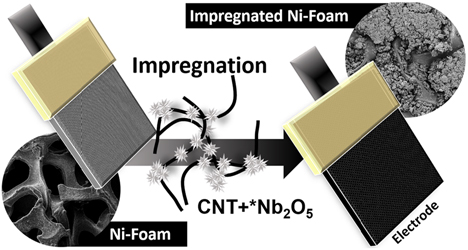
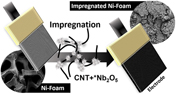
The use of niobium oxides for energy storage devices has been investigated [Reference Yan, Rui, Chen, Xu, Zou and Luo22, Reference Kim, Augustyn and Dunn23]; however, their best performance is obtained only by a hybrid supercapacitor based on lithium intercalation processes with which high values of energy and power density are obtained [Reference Yan, Rui, Chen, Xu, Zou and Luo22]. These intercalation processes require the application of potentials between 1 and 3 V versus Li/Li+, a careful and humidity-free assembly and nonaqueous electrolytes [Reference Wang, Yan, Yan, Sumboja and Lee17]. Because of these obstacles, different alternatives have been studied and tested to find an easier way to fabricate electrodes with good performance for supercapacitors application. Therefore, this study reported a simple process on electrodes fabrication of Nb2O5 and CNT. Nb2O5 nanoparticles with different phases (pseudohexagonal and orthorhombic) were grown onto CNT surface by MHS method followed by thermal treatment. The different nanocomposites were impregnated on Ni foam current collectors using a high active mass loading of 32 mg/cm2 in an area of 1 cm2 as illustrated in Fig. 1. The electrochemical properties were performed through a simple procedure using an aqueous electrolyte in three-electrode cells. In this way, it was possible to bring the material closer to real and practical applications.
Schematic illustrating the electrodes preparation.

Results
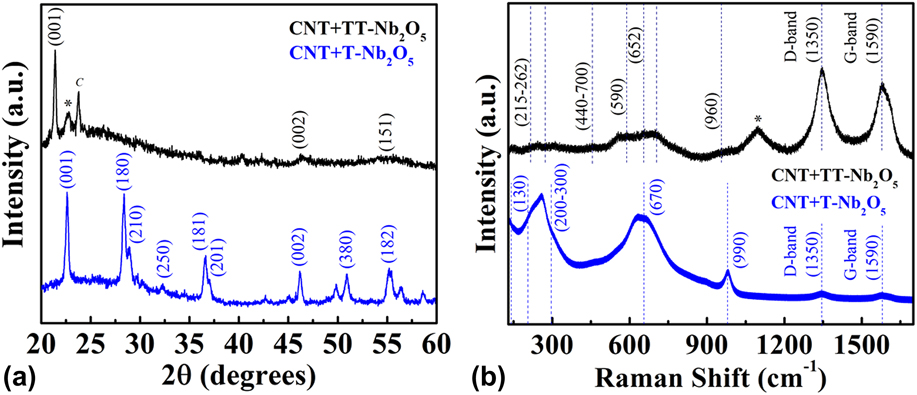
Figure 2(a) shows the XRD spectra of the composites as-obtained. The CNT + TT-Nb2O5 composite presents the pseudohexagonal phase (TT-Nb2O5) according to the Joint Committee on Powder Diffraction Standards (JCPDS) card No. 28-0317 with preferential orientation in the [001] direction [Reference Leite, Vila, Bettini and Longo19]. The weaker intensity of the peaks, when compared with the CNT + T-Nb2O5 composite, is due to the low temperature accomplished in the synthesis, which influenced its crystallinity [Reference Marins, Meereis, Silva, Ruas, Takimi, Carreño and Ogliari25, Reference Ata, Milne and Zhitomirsky26, Reference Ventura, Batalha, Fajardo, Taylor, Marins, Noremberg, Tański and Carreño27]. The formation of more crystalline materials can be obtained by increasing the synthesis temperature [Reference Lopes, Paris and Ribeiro6]. Thus, the orthorhombic phase (T-Nb2O5) was obtained after thermal treatment as revealed by CNT + T-Nb2O5 composite XRD spectrum [Reference Rani, Zoolfakar, O’Mullane, Austin and Kalantar-Zadeh7]. It is possible to observe the crystallization of the T-Nb2O5 according to JCPDS card No. 30-0873, matching with the main diffraction peaks [Reference Kong, Zhang, Wang, Qiao, Ling and Long15]. Figure 2(b) shows the Raman spectra of the composites as-obtained, which supports the XRD results obtained previously. For the CNT + TT-Nb2O5 composite, the bands between 440 and 700 cm−1 are associated to the asymmetric stretching of the Nb–O bending mode in the distorted polyhedra (NbO6, NbO7, and NbO8) [Reference Falk, Borlaf, López-Muñoz, Fariñas, Rodrigues Neto and Moreno5, Reference Lopes, Paris and Ribeiro6]. The specific band at 652 cm−1 is characteristic of hydrated niobium oxide (Nb2O5·nH2O) and the band at 590 cm−1 is attributed to the asymmetric and symmetric stretches of the NbO2 group. These bands are associated with the formation of a η2-peroxo system on the catalyst surface, which could be indicative of a large number of structural defects linked to NbO7 and NbO8 sites [Reference Leite, Vila, Bettini and Longo19]. The vibration mode between 215 and 262 cm−1 is attributed to the stretching of the Nb–O–Nb bonds [Reference Lopes, Paris and Ribeiro6, Reference Chan, Pu, Chen, James, Lee, Parise, Kim and Kim28]. The broad shoulder at ∼960 cm−1 is related to the asymmetric and symmetric stretches of the Nb=O bond of the oxo system, as well as the surface groups, in which the peak intensity indicates the amorphous degree and the presence of acid groups in the sample [Reference Lopes, Paris and Ribeiro6, Reference Paraguassú Cecchi, Cesarín-Sobrinho, Buarque Ferreira and Netto-Ferreira29]. In addition, Fig. 2(b) also shows the Raman spectrum of the CNT + TT-Nb2O5 composite that corroborates with XRD results. The band at 130 cm−1 is attributed to the vibrations of the overall octahedron [Reference Lopes, Paris and Ribeiro6]. The Raman bands between 200 and 300 cm−1 are characteristic of the angular deformation bending modes of the Nb–O–Nb linkages, which are associated to the T-Nb2O5 phase (orthorhombic structure) [Reference Lopes, Paris and Ribeiro6, Reference Yang, Xu, Wang, Zhang, Huang and Hu18]. The wide and intense band at ∼670 cm−1 is assigned to the strongest symmetric Nb–O stretching TO mode (phase orthorhombic) of the Nb2O5 polyhedra. This is associated with its bond and structure order, in which it had its intensity increased because of the thermal treatment [Reference Lopes, Paris and Ribeiro6, Reference Yang, Xu, Wang, Zhang, Huang and Hu18]. The band at 990 cm−1 is assigned to the vibration A1g(ν1) modes of NbO6 octahedra in Nb2O5, and also the small concentration of Nb=O surface groups is attributed to the sintering temperature [Reference Kong, Zhang, Zhang, Wang, Cai, Lv, Qiao, Ling and Long3, Reference Falk, Borlaf, López-Muñoz, Fariñas, Rodrigues Neto and Moreno5]. Both composites presented vibration modes at ∼1350 cm−1 and ∼1590 cm−1 assigned to the disordered carbon (D-band) and graphitic carbon (G-band), respectively. Bands intensity ratio of D and G bands (I D/I G) in the Raman spectra provides information about the structural evolution of CNT during the hydrothermal and thermal treatment process. In the present case, the I D/I G ratios are 1.16 and 1.31 for CNT + TT-Nb2O5 and CNT + T-Nb2O5, respectively. The intensity ratio (R = I D/I G) of the two first-order bands D and G are always higher in function on the burn offs. These modifications are relating to the structure of carbon materials, which became more disordered as the burn off proceeded to make the layers stacking imperfect [Reference Chan, Pu, Chen, James, Lee, Parise, Kim and Kim28, Reference Paraguassú Cecchi, Cesarín-Sobrinho, Buarque Ferreira and Netto-Ferreira29]. The oxygen-containing functional groups created by acid treatment such as C–O and C=O attached to the surface of CNTs play a key role in the enhancement of oxygen reduction reaction activity. Moreover, the introduction of oxygen-containing groups creates more defect sites, and these functional groups improve the wettability benefiting the electrolyte diffusion, as occured with nitrogen doping [Reference Falk, Borlaf, López-Muñoz, Fariñas, Rodrigues Neto and Moreno5].
(a) X-ray diffraction and (b) Raman spectroscopy of the composites. Nb2O5·nH2O is identified as (*) and carbon as (C).

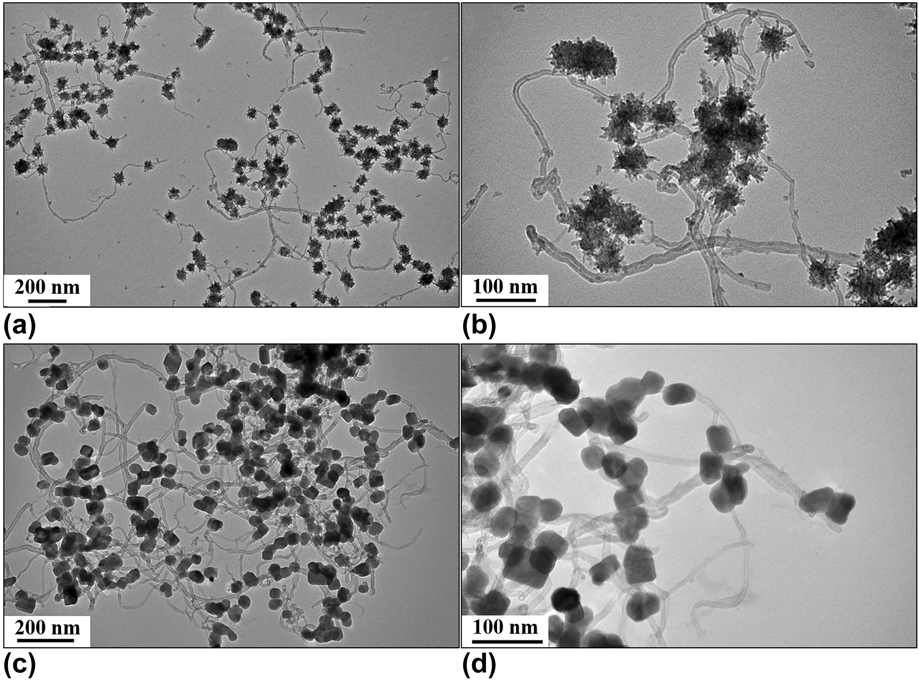
Figure 3 shows TEM micrographs of the nanocomposites (a and b) CNT + TT-Nb2O5 and (c and d) CNT + T-Nb2O5. In both syntheses, the Nb2O5 nanoparticles were grown on CNT surface of satisfactory. Also, the tubular multiwalled structure was maintained for both nanocomposites. In Figs. 3(a) and 3(b), it is possible to observe the disordered three-dimensional nanorods of Nb2O5. Different agglomeration degrees are noticed [Reference Leite, Vila, Bettini and Longo19]. According to Leite et al. [Reference Leite, Vila, Bettini and Longo19], the mechanism of assembly of nanorods is associated to the oriented attachment that occurs by collision, collision and rotation, and solid-state rotation between them. It is suggested that after nanorod growth, the rotation occurs to decrease the angle of misorientation resulting in a single larger crystalline nanocrystal. In Figs. 3(c) and 3(d), it is possible to notice that the Nb2O5 nanoparticles grown on CNT surface present a more ordered and spherical morphology. This specific crystalline phase changed because of the thermal treatment process under nitrogen, which led to the phase transformation from the pseudohexagonal to orthorhombic [Reference Luo, Li, Zhang, Gao and Lin11]. Therefore, after calcination, the oxygen-containing groups were removed and the nanocomposite CNT + T-Nb2O5 formed a tighter integration [Reference Luo, Li, Zhang, Gao and Lin11, Reference Wang, Li, Chen, Augustyn, Ma, Wang, Dunn and Lu12, Reference Wang, Li, Tjandra, Fan, Xiao and Yu14].
TEM images at different magnifications: (a and b) CNT + TT-Nb2O5 and (c and d) CNT + T-Nb2O5.

The as-prepared CNT + TT-Nb2O5 and thermal treated CNT + T-Nb2O5 presented an average particle size of 45 and 40 nm, respectively, differing from the large particle sizes of 1.5–4.0 µm from the ammonium niobium oxalate precursor [Reference Falk, Borlaf, López-Muñoz, Fariñas, Rodrigues Neto and Moreno5]. The drastic reduction of particle size arises from the fact that the microwave radiation is able to induce the peptization in few minutes. It is significant when in comparison to the conventional colloidal sol–gel process, which requires a long time [Reference Falk, Borlaf, López-Muñoz, Fariñas, Rodrigues Neto and Moreno5, Reference Yang, Xu, Wang, Zhang, Huang and Hu18]. The composites were evaluated by the BET method, and the CNT + TT-Nb2O5 presented a high S BET of 216 m2/g because of both the low-temperature synthesis and as-formed morphology. On the other hand, the composite CNT + T-Nb2O5 that underwent a thermal treatment process had its S BET reduced to 47 m2/g. The drastic S BET decrease occurred because of changes in the crystal phase, which was possible because of the higher calcination temperature. The high temperature led to a greater proportion of the rods coalescence because of the further crystallization of walls separating mesopores in their structure and the transformation of the morphology from nanorods to spherical shape [Reference Raba, Ruíz and Joya30].
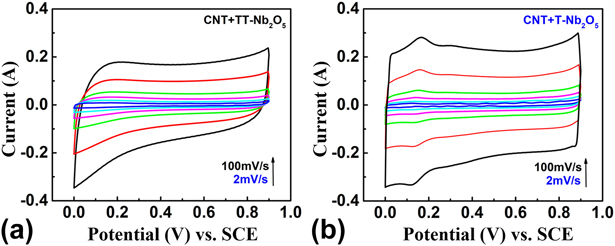
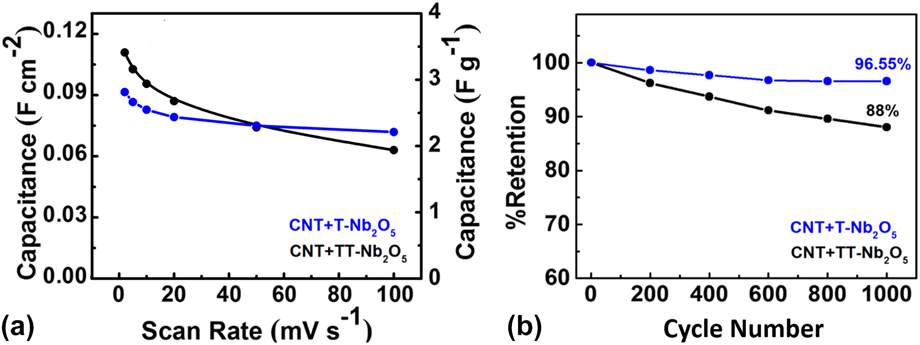
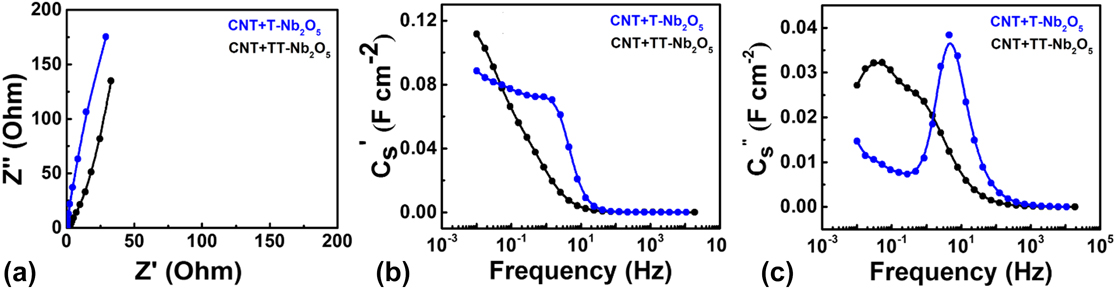
Figure 4(a) shows the cyclic voltammetry (CVs) obtained at different scanning rates (2, 5, 10, 20, 50, and 100 mV/s) for the CNT + TT-Nb2O5 electrode. This exhibited a capacitive behavior close to ideal because of the rectangular shape of the curve [Reference Cui, Zhu, Liu, Liu, Xie and Yang4]. A more rectangular profile can also be observed for the CNT + T-Nb2O5 electrode in Fig. 4(b). The difference found in the curves may be explained because of the structural advantages of T-Nb2O5 compared with TT-Nb2O5 which, when combined with CNT, allowed higher electronic mobility and enhanced electrochemical processes [Reference Yan, Rui, Chen, Xu, Zou and Luo22]. The specific capacitances (areal and gravimetric) for both composites are shown at different scan rates in Fig. 5(a). The high-rate behavior of T-Nb2O5 is neither limited to thin films nor does it rely exclusively on surface redox reactions, but it is because of ion intercalation into the orthorhombic crystal structure [Reference Zhao, Zhao, Zhu, Lin, Xu and Huang31]. However, Kim et al. [Reference Kim, Augustyn and Dunn23] found TT-Nb2O5 to have lower specific capacitance than T-Nb2O5 and the remarkably high surface area of the as-prepared TT-Nb2O5 sample is likely the reason for the similar capacitance values. As shown in Fig. 5(b), the T-Nb2O5 has a notably higher retention after 1000 cycles than TT-Nb2O5. This behavior can be attributed to the open and layered crystal structure for rapid diffusion of Li+, single phase reaction, and mainly insignificant lattice/unit cell volume changes during Li+ insertion and extraction [Reference Roh32]. The complex impedance data for the electrodes are presented in the Nyquist plot in Fig. 6(a), which shows a lower resistance R = Z′ of the T-Nb2O5. The low Z″ values of the TT-Nb2O5 resulted from high capacitance. Analysis of the differential capacitances, derived from the impedance data, presented a relaxation-type dispersion behavior. This behavior is demonstrated in Fig. 6(b), by the reduction of the real part of capacitance with frequency and a relaxation maximum in the frequency dependences of the imaginary components as shown in Fig. 6(c) [Reference Augustyn, Come, Lowe, Kim, Taberna, Tolbert, Abruña, Simon and Dunn33]. The comparatively high relaxation frequency of T-Nb2O5, corresponding to the C S″ maximum, illustrates a good capacitive behavior at a high charge–discharge rate. It must be mentioned that integral capacitance is dependent on scan rate, as shown in Table I, whereas the differential capacitance is a function of frequency. In this case, the low-frequency real capacitance (C S′), derived from the impedance data, is comparable with the capacitance obtained from the CV data at low scan rates. The electrode loaded with CNT + TT-Nb2O5 has exhibited relatively close capacitance values to CNT + T-Nb2O5. However, the electrode loaded with CNT + T-Nb2O5 sample exhibited a behavior closer to the ideal, reached lower retention after 1000 cycles, and a greater stability against different scanning rates, as shown in Table I.
CVs at scan rates of 2, 5, 10, 20, 50, and 100 mV/s in 1 M Li2SO4 electrolyte: (a) CNT + TT-Nb2O5 and (b) CNT + T-Nb2O5.

(a) Areal and gravimetric capacitances calculated from the CV data at different scan rates, (b) capacitance retention over 1000 cycles at 50 mV/s.

(a) Nyquist plot of complex impedance, (b) C S′, and (c) C S″ versus frequency for the two different electrodes.

Values of gravimetric and areal capacitances calculated from EIS and CV at 2, 5, 10, 20, 50, and 100 mV/s.

Conclusion
In summary, we demonstrated an efficient and simple process to produce electrodes for supercapacitors using Nb2O5 nanoparticles and CNT. The Nb2O5 nanoparticles were well controlled through microwave hydrothermal synthesis, which presented pseudohexagonal phase. When the composite was exposed by the thermal treatment, it was observed that the phase changed from pseudohexagonal to orthorhombic because of the high temperature used. Consequently, the nanocomposites displayed different morphologies of nanorods and spherical to pseudohexagonal and orthorhombic, respectively. It was possible to observe that the growth of Nb2O5 nanoparticles was onto the CNT, which maintained its structure of tube as revelated by TEM technique. Furthermore, we evaluated the electrochemical properties through characterization of the electrodes with high mass loading (32 mg) of the different nanocomposites (CNT + Nb2O5) that were loaded on Ni current collectors. The intimate contact between the Nb2O5 nanoparticles and the CNT networks enabled fast electron transport and effective current collection, showing considerable capacitance values and good cyclic stability under the tested conditions. The T-Nb2O5 showed better retention and cyclic reversibility because of its ideal crystal structure, whereas the TT-Nb2O5 showed unexpected higher capacitance than T-Nb2O5 most likely attributed to its notably high surface area. This study has demonstrated the effortless manufacturing of nanocomposites that may have a potential use in practical energy storage applications.
Materials and methods
Materials
The following materials were used: nitric acid (HNO3 70%, Aldrich, São Paulo, Brazil), sulfuric acid (H2SO4 99%, Aldrich, São Paulo, Brazil), sodium dodecyl sulfate (SDS, NaC12H25SO4, Aldrich, São Paulo, Brazil), ammonium niobium oxalate ((NH4[NbO(C2O4)2(H2O)2]·nH2O), CBMM, Araxá, Brazil), hydrogen peroxide (H2O2 30%, Aldrich, São Paulo, Brazil), poly(vinyl butyral-co-vinyl alcohol-co-vinyl acetate) (PVB, average Mw = 50,000–80,000) (Aldrich, São Paulo, Brazil), and multiwalled carbon nanotubes (CNT, OD 7–15 nm, length 0.5–10 µm, 99% carbon content, Aldrich, São Paulo, Brazil) were used. Ammonium niobium oxalate was kindly donated by CBMM. Ni foam with 95% porosity was provided by Vale Limited, Toronto, Canada.
Methods
By the CNT functionalization, functional groups were created/added through a controlled procedure, allowing the anchoring and growth of the Nb2O5 nanoparticles. This functionalization is accomplished by exposing the CNT in a concentrated HNO3/H2SO4 (1:3) solution as described by Goyanes et al. [Reference Goyanes, Rubiolo, Salazar, Jimeno, Corcuera and Mondragon24]. Nb2O5 nanoparticles were synthesized by the microwave-assisted hydrothermal method followed by a thermal treatment. The composite preparation started with the dispersion of 50 mg of functionalized CNT and 100 mg of SDS (1:2) in 100 mL of distilled H2O in an ultrasonic bath (25 kHz) for 120 min. After dispersing, 2 g of (NH4[NbO(C2O4)2(H2O)2]·nH2O) and 1.6 mL of H2O2 were added. The solution was ultrasonicated continuously for 30 min and then poured into a Teflon vessel reaching about 50% of its volume. Following, the autoclave was sealed and it was taken to the microwave equipment (Electrolux, MEF41, São Paulo, Brazil) and heated. The synthesis was accomplished with amendments according to Marins et al. [Reference Marins, Meereis, Silva, Ruas, Takimi, Carreño and Ogliari25]. The temperature was set up at 160 °C for 30 min, under constant pressure of 6 kgf/cm2, 2.45 GHz microwave radiation, and a maximum output power of 1500 W. Pressure and temperature were inspected and adjusted during synthesis using a shielded thermocouple inserted directly into the vessel with a connected pressure transducer sensor [Reference Falk, Borlaf, López-Muñoz, Fariñas, Rodrigues Neto and Moreno5]. After cooling at room temperature, the as-obtained powders were washed and centrifuged at 5000 rpm with distilled H2O to remove unreacted reagents and surfactant. The washed powder was oven dried with no air circulation at 50 °C for 48 h. This composite was identified as CNT + TT-Nb2O5. To obtain the composites under thermal treatment, part of the powder was calcinated in a furnace (FT-1200 1Z, Fortelab, São Carlos, Brazil) at 400 °C for 120 min and 650 °C for 180 min with a heating rate of 10 °C/min under nitrogen atmosphere to get the orthorhombic phase [Reference Wang, Li, Tjandra, Fan, Xiao and Yu14, Reference Yan, Rui, Chen, Xu, Zou and Luo22]. After cooling at room temperature, the obtained powders were stored in an oven with no air circulation at 50 °C and identified as CNT + T-Nb2O5.
For the electrode fabrication, a PVB binder solution containing 3 g/L in ethanol was prepared. Afterward, the composites were weighed and 3 wt% of the total PVB solution was added to each of the previously prepared composites followed by a physical mixture. Finally, the obtained slurries were used for the impregnation of Ni foam current collectors with a high active mass loading of 32 mg/cm2 in an area of 1 cm2.
The composites were characterized by X-ray diffraction (XRD-6100, Shimadzu, Kyoto, Japan) with monochromatized Cu Kα radiation (λ = 1.5418 Å, 40 kV, and 30 mA). Raman spectroscopy (InVia™, Renishaw, Wotton-under-Edge, U.K.) using a 25 mW argon ion laser (514 nm, 1800 L/mm grating) with 100% laser power. The micrographs were investigated by transmission electron microscope (TEM) using a microscope (JEM 1400, JEOL, Akishima, Japan). Nanoparticles sizes were measured using the ImageJ software (Version 6, Java-based, Oracle Corporation, Redwood City, California) based on the captured TEM micrographs. Specific surface area (S BET) was evaluated by the Brunauer–Emmett–Teller method (BET) under N2 adsorption–desorption analysis after outgassed at 120 °C for 24 h (Autosorb iQ, Quantachrome Instruments, Boynton Beach, Florida). Cyclic voltammetry (CV) and electrochemical impedance spectroscopy (EIS) investigations were performed using a potentiostat (PARSTAT 2273, Princeton Applied Research, Oak Ridge, Tennessee). The capacitive behavior of the electrodes was studied in three-electrode cells using 1 M Li2SO4 aqueous solution electrolyte because of its high solubility and good stability in the proposed potential window [Reference Kong, Zhang, Wang, Qiao, Ling and Long15]. The area of the working electrode was 1 cm2. The counter electrode was a platinum gauze and the reference electrode used was a standard calomel electrode. CV studies were performed at scan rates of 2–100 mV/s. The areal (C S) and gravimetric (C M) specific capacitances were calculated according to Eqs. (1) and (2), respectively, where Ia is the anodic current, dV is the potential window, ν is the scan rate, m is the mass of active material, and A is the geometrical area of the electrode:
 $${C_{\rm{M}}} = {{\int {Ia{\rm{d}}V} } \over {\nu \cdot m \cdot \Delta V}}\quad ,$$
 $${C_{\rm{S}}} = {{\int {Ia{\rm{d}}V} } \over {\nu \cdot A \cdot \Delta V}}\quad .$$
The alternating current measurements of complex impedance Z * = Z′ − iZ″ were performed in the frequency range of 10 MHz–100 kHz at the amplitude of the signal of 5 mV. The real areal capacitance (C S′) and imaginary specific capacitance (C S″) were calculated from the EIS data according to Eqs. (3)–(5) [Reference Ata, Milne and Zhitomirsky26], where ω = 2πf (f-frequency) and A is the electrode area:
 $${C_{\rm{S}}}^\prime = {{ - Z''} \over {\omega {{\left| {Z\left( \omega \right)} \right|}^2}A}}\quad ,$$
 $${C_{\rm{S}}}^{\prime \prime } = {{Z'} \over {\omega {{\left| {Z\left( \omega \right)} \right|}^2}A}}\quad ,$$
 $${\left| {Z\left( \omega \right)} \right|^2} = {Z'^2} + {Z''^2}\quad .$$
Acknowledgments
Ricardo Silva would like to acknowledge the financial support from the Government of Brazil in the form of a scholarship by PDSE/CAPES under number 88881.136010/2016-01 for the exchange Ph.D. at the McMaster University. This study was financed in part by the Coordenação de Aperfeiçoamento de Pessoal de Nível Superior—Brasil (CAPES)—Finance Code 001. Moreover, the authors acknowledge the CBMM (Companhia Brasileira de Metalurgia e Mineração) and FAPERGS/PqG foundation under number 17/2551-0001157-0.