Introduction
What claims can migrants have to welfare provisions in their reception countries? By what jurisdictions – national, supra-national or international – can such provisions be authorised and implemented? And what equality values are engaged in different welfare configurations for migrants?
The paper addresses aspects of these questions in the light of the recognition that migrants’ welfare rights are attendant on the immigration status they are given by their country of reception (Morris, Reference Morris2002); and that the allotted immigration statuses themselves form a ‘hierarchy of citizenship’ (Castles, Reference Castles and Bertossi2007), with the most secure status giving settlement and the least secure a form of temporary presence. In this selective process, migrants’ welfare rights are correspondingly differentiated, ranging from full rights to none. For the recipients, they may, at best, accompany inclusive forms of citizenship (Guiraudon, Reference Guiraudon, Bommes and Geddes2000; Soysal, Reference Soysal1996; Brubaker, Reference Brubaker1989: 147; Hammar, Reference Hammar1989). At worst, they may lead to migrants’ destitution.
The first section argues that current welfare and immigration policies have become increasingly ‘joined up’, with consequent problems that are due to a mismatch in their use of selectivity as a method of determining who should be entitled to welfare rights. It provides a small insight into the shifting relationship between these policies (see also Bommes and Geddes, Reference Bommes and Geddes2000), drawing on work in process based on developments in the UK. Theories of selectivity in welfare suggest that welfare is both inclusive and selective; that is, everyone has the same rights and avenues of access, but is subject to common eligibility criteria that determine allocations to welfare. However, the processes of serving the frontier orientations of immigration policies impede inclusiveness. An institutional take-over of welfare policy solidifies the impediments. Illustrations in this section are taken from UK policies.
The next section moves to a discussion of the role and scope of international law in the provision of welfare support for migrants, with some reference to European ‘supra-national’ law. Universal Human Rights law increasingly brings major challenges to the consequences of exclusionary, nation-embedded versions of welfare (Blake, Reference Blake and Dyzenhaus2004), but has not been able to ensure universal or inclusive welfare support for migrants. In contrast, international law, in the form of the Convention Relating to the Status of Refugees (Refugee Convention) (United Nations, 1951) is selective by definition; it has a target group and associated conditional welfare benefits but, perhaps true to its parentage in the United Nations 1948 Universal Declaration of Human Rights (United Nations, 1948), it also nods towards a concept of equal benefits for nationals and non-nationals.
The third section outlines an alternative approach in which access to migrants’ welfare provisions in their receiving country is regardless of immigration status. It discusses problems raised by this approach for substantive equality, but argues for non-discrimination using nationals as comparators.
The conclusion suggests that equal treatment of nationals and non-nationals constitutes a way forward that does not conflict with further developments of socio-economic and non-discrimination rights in Universal Human Rights legislation. At the same time, however, it leaves room for ‘attachment to the particular’ (Benhabib, Reference Benhabib2004: 16) that allows for national sovereignty in determining domestic welfare policies, including the non-discriminatory application of selective benefits and services according to welfare criteria.
Hierarchies of immigration status and welfare rights
In surveying migrants’ rights, Morris (Reference Morris2002), writing at a time of increasing claims for asylum in the UK, describes migration into Europe as taking:
a number of forms: the professional élite of technical and administrative experts, the families of the post-war labour reserve, growing numbers of asylum seekers granted either refugee status, or more commonly humanitarian leave to remain, the revival of a ‘guest worker’ system through a variety of bilateral agreements, and, not least, the persistence of undocumented workers. (Morris, Reference Morris2002: 5–6)
She notes that together they make up a complex system of stratification by status and attendant welfare rights, and that the increasing diversity of ‘outsider’ status is most in need of analysis. Although some of the details have changed, this is still the case.
The following descriptive summary gives examples of the attendance of welfare rights on hierarchically arranged immigration statuses as apparent in the UK at the time of writing in 2009.Footnote 1 A comprehensive and detailed analysis of the category-based distinctions made between migrants in European Union (EU) policy and their discriminatory effects are in Guild (Reference Guild, Bigo and Guild2005), and discussion of related EU policies in Thielemann and El-Enany (Reference Thielemann and El-Enany2009), Guild (Reference Guild2008) and Mourão Permoser (Reference Mourão Permoser2008).
Illustrations from the UK
People whose immigration status gives access to all mainstream benefits
Migrants with relatively firm footholds in the receiving country have a status that confers social security benefits and other health and welfare benefits. They include settled immigrants with ‘indefinite leave to remain’, and formally determined refugees under the Refugee Convention and other forced migrants whose stay has been permitted under ‘subsidiary’ or ‘complementary’ protection in the form of humanitarian protection (HP) (McAdam, Reference McAdam2007; Council of the European Union, 2004) or who have been given discretionary leave (DL).
People subject to immigration status that disallows access to ‘public funds’
Migrants whose stay is time limited (for example, students, visitors or workers) may be subject to benefit restrictions attached to their immigration status (see Phelan and Gillespie, Reference Phelan and Gillespie2007). They may not seek, or are not eligible for, or have not yet been granted, permanent residence/settlement in the receiving country and may be given a status that allows time-limited stays of varying durations that in some cases can be extended on application. It normally carries the condition that the person admitted can maintain him or herself and any dependants without recourse to ‘public funds’, by which are meant non-contributory, non-work-related social security benefits, including income-related job seekers’ allowance (JSA) and local authority housing. Time-limited migrants who are permitted to work are not, however, barred from work-related benefits.
Health care and education do not count as public funds (Home Office, UK Border Agency, n.d.), although charges for hospital treatment can be made for people who are not ‘ordinarily resident’ in the UK, including British citizens (Department of Health, n.d.; Department of Health and Social Security, 1989). Exceptions to the ‘no recourse to public funds’ can be made for people with limited leave to remain in the UK in an emergency when they may claim subsistence benefit (mainstream income support and possibly job seekers’ allowance) at a reduced rate if they are temporarily without funds because remittances from abroad have been disrupted, and provided that there is a reasonable expectation that the supply of funds will be resumed and that no previous such claim has been made (Fitzpatrick et al., Reference Fitzpatrick, Ripley and Singh2007; Hunter, Reference Hunter2006). This claim can only be made once and may affect a person's chances of renewing his/her leave to enter.
People seeking asylum and subject to ‘temporary admission’ status with no entitlement to mainstream social security benefits and accommodation
Forced migrants who are awaiting conferment of their immigration status as either a Convention refugee or as requiring HP or DL, or whose claim to asylum has been turned down, are referred to as ‘asylum seekers’.
In the UK, an asylum seeker currently has ‘temporary admission’, which does not constitute entry to the UK; it may be given to anyone who tries to enter the UK and is not a UK citizen, an EU citizen, or someone with leave to enter or remain. It is an alternative to detentionFootnote 2 that acts like a form of bailFootnote 3 and usually carries with it restrictions (for example, on residence, reporting to the authorities) while conferring no rights (Sawyer and Turpin, Reference Sawyer and Turpin2005). Currently, in the UK, forced migrants awaiting the outcome of their claim to asylum may not work, unless they have waited for more than 12 months for an initial decision by the Home Office and the delay was not their fault, which is the least that is required of Member States under the EU Reception Directive (Council of the European Union, 2003, Art. 11.2). Although not allowed to work, asylum seekers are entitled to claim only below subsistence level welfare support, subject to exclusions, from a system that is outside the mainstream provisions and, subject to exemptions, becomes conditional on the voluntary return to their home country if the claim has been refused.
The linking of benefits to conditions of behaviour has increasingly become a feature of UK domestic social security policies, and conditionality in the treatment of asylum seekers can be seen as part of a wider trend (Morris, Reference Morris2007). However, conditionality has other, potentially more sinister, aspects for asylum seekers. They have no political or other participatory voice, and the conditions attached to support can involve them in having to make choices between whether to manage without any subsistence or return to a country where they fear that they may lose their life or liberty, or be subjected to mistreatment.
Selectivity in immigration and welfare policies
The differentials between migrants as reflected in the immigration status and the corresponding welfare arrangements are a product of a selective process. Selectivity picks out an individual or a group of people in preference to others, for a purpose that may be in their or others’ interests. The concerns of immigration policies, which are required to take into account relevant international law, include security, national coherence and control over numbers, as evidenced, for example, in the UK's White Paper preceding legislation (Home Office, 2002). The function of status ascriptions is to select who may enter, under which conditions, and for how long, in order that these concerns are met.
Welfare policies require rules of entitlement that inevitably cause exclusions, but welfare selectivity is enveloped in principles of inclusion. In the UK, this is visible in the simultaneous adoption of comprehensive coverage for benefits and services for all, and the targeting of specific benefits and services on groups categorised as eligible. It is a combination that is inherited from Beveridge (Reference Beveridge1942), in whose report there is no mention of ‘selecting out’ foreigners, although, in step with the times in which he was writing, the Report's assumption is that recipients are ‘citizens’ and that eligibility and levels of some benefits will relate to periods worked and contributions paid over months or years.
The function of selectivity in welfare is to allocate resources to people who have special needs, or are especially meritorious or deserving. Selectivity as a tool in welfare is described and explained by Lockwood as involving ‘the fine-tuning of social rights’ that manages the balance between the ‘system-integrative’ need for efficiency in capitalist liberal democracy and its ‘social-integrative need to provide “acceptable” or “tolerable” levels of social welfare’ (Lockwood, Reference Lockwood1996: 535).
We argue that if welfare selectivity acts as a counterbalance to systemic problems, welfare policies need to be independent of other policies and that this is not the case when migrants’ welfare entitlements depend on status constructed by immigration policies. Welfare policies in such circumstances suffer loss of autonomy.
The concept of autonomy is borrowed from Walzer (Reference Walzer1983) who applies it to the individuality of different spheres of distribution. The spheres need autonomy on the grounds that ‘different social goods ought to be distributed for different reasons, in accordance with different procedures, by different agents’ (Walzer, Reference Walzer1983: 6). The different spheres are necessary in a pluralist society in order to prevent the tyranny of domination by one principle, and this means that ‘no citizen's standing in one sphere or with regard to one social good can be undercut by his standing in some other sphere, with regard to some other good’ (Walzer, Reference Walzer1983: 19). Applying this to our case of immigration status and welfare entitlement: if a person is unequal in one sphere (immigration), it does not follow that he or she is unequal in another sphere (welfare). Immigration and welfare policies each need to be judged respectively by principles internal to their sphere.
‘Autonomy’ is used in this paper to capture the idea of independence of internal principles of policies and is not intended to make any argument for theories of membership and/or state sovereignty. Our purpose in adopting this concept is two-fold: first, to give some theoretical support to the concern about the encroachment of one policy sphere on another, illustrated from a summary of UK experience given below; and, second, to explore the extent to which there can be compatibility between multiple principles of justice and universal human rights. Aspects of that conundrum are addressed later.
The shifting relationship between welfare and immigration policies
Archival historical work, undertaken at present by the author, concerns the relationship between immigration and welfare policies from 1905 onwards and hopes to provide convincing evidence, from the UK experience, of the increasing dominance of immigration policy. Most marked in this history is the shift from an inclusive approach, written into welfare policies from 1948, although not always put into practice, to the increasingly legislated exclusion from benefits of non-residents and non-nationals. It shows that a new ‘immigration–welfare nexus’ has been created in the UK in the past 20 years that makes welfare the handmaiden of immigration control policies. This development is exemplified by an institutional take-over in the UK in which the government department responsible for immigration policy has also become the agency that forms and delivers benefits and housing policies for forced migrants claiming asylum.
A detailed analysis of this period will form part of this work. It will include the steps leading up to 1996, when benefits from a sub-category of asylum seekers were withdrawn altogether (Asylum and Immigration Act, 1996, S.11 and Schedule 1). The 1996 reductions augured a major institutional shift that took place in 1999 when responsibility for asylum seekers’ welfare moved from the UK's Department of Health and Social Security (DHSS) to the Home Office. Legislation in 1999 (Immigration and Asylum Act 1999, Part VI, Support for Asylum Seekers, S. 94 (1)) prohibited all asylum seekers’ access to mainstream social security and housing. Their exclusion and the accompanying change of responsibility for their welfare to the Home Office constituted a major change in the control, function and delivery of welfare and its benefit levels.
The new Home Office provisions set up in 1999 consisted of vouchers and some cash, which together made up 70 per cent of the mainstream benefit level (for details see Geddes, Reference Geddes, Bommes and Geddes2000; Cholewinski, Reference Cholewinski1998). Later, there were further withdrawals of benefits altogether from asylum seekers whose claims had not been made more or less on arrival, often causing their destitution (Smart, Reference Smart2009; Bolderson, Reference Bolderson2006), and further reductions and changes are planned at the time of writing in 2009.Footnote 4
The withdrawals of benefits and the take-over of social security and other support provisions for asylum seekers have come about despite relevant international refugee and universal human rights law, as discussed below.
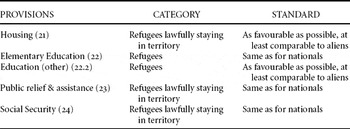
Welfare rights in Articles 21–24 of the Refugee Convention

Welfare rights in international and human rights law
The Refugee Convention
The Refugee Convention (UN, 1951, 1967, Arts. 21–24) stipulates welfare rights for refugees that are selectively allocated. Two sets of conditions, variably applied to different areas of welfare, are made. First, legality of a person's stay and his or her territorial presence may be required; second, the level or standard of the welfare provision for refugees is to be geared either to that made by the receiving country for other ‘aliens’ or equal to that provided for ‘nationals’. Together, they represent a mixture of selective and inclusive provisions, respectively reflecting their progeny in the earlier Convention of 1933 (League of Nations, 1933) that appears to have categorised refugees for welfare purposes according to their deemed attachment to the receiving country (Hathaway, Reference Hathaway2005) and in the 1948 Universal Declaration of Human Rights (United Nations, 1948).
The category distinctions that are made give rise to problems of interpretation. ‘Lawfully staying in the territory’ is one of several sub-categories referred to in the Convention. Another is ‘refugees lawfully in the territory’ (for example, in Article 18) which conveys legal presence regardless of any length of stay. The imprecision of these terms has led to disputes about, or constructions of, their meanings (Bolderson, Reference Bolderson2006, Reference Bolderson and Riedel2007a; Goodwin-Gill, Reference Goodwin-Gill1996: 309).
The category ‘asylum seeker’ was unknown by the framers of the Convention, and the obfuscation about what counts as a ‘lawful’ stay and ‘presence’ (see Sawyer, Reference Sawyer2007 for an analysis of the judiciary's deliberations) has made possible conflicting interpretations of the Convention rights. The UK's rendering is that it has an obligation to meet the Convention's requirements only for formally recognised refugees. This interpretation runs counter to the guidelines of the United Nations High Commissioner for Refugees (UNHCR, 1992, Par. 28) for whom a refugee is a refugee as soon as a person fulfils the criteria, even if he or she is still an ‘asylum seeker’. This is also the view of relevant Non-Governmental Organisations (House of Commons, Social Security Committee, 1996).
According to Sztuki (Reference Sztuki, Nicholson and Twomey1999), the first use of the term ‘asylum seeker’ was in 1977 in the Executive Committee of the Commissioner's Programme (EXCOM). In the UK, the language of ‘aliens seeking political asylum’ was replaced by 1981 by ‘asylum seekers’, a form of wording that then began to be used in the public, but strictly speaking non-statutory, Immigration Rules of that year (Joint Committee on Human Rights, 1981). It continued into subsidiary social security legislation (The Income Support (General) Amendment No. 3 Regulations, 1993) and into primary immigration and asylum legislation in 1993 (Asylum and Immigration Appeals Act, 1993, S.1). Legislation in 1999 (Immigration and Asylum Act 1999, Part VI, S. 94 (1)); in 2002 (Nationality, Immigration and Asylum Act, 2002, S. 18 (1) (3)); and in 2004 (Asylum and Immigration (Treatment of Claimants) Act 2004 S. 9) extended the term, encompassing those who were claiming protection but did not qualify as ‘convention refugees’ and those whose claims had been rejected, now referred to as ‘failed asylum seekers’. Details of these re-categorisations and re-constructions and their effects in distancing asylum seekers from refugees and linking them to ‘illegals’ are in Bolderson (Reference Bolderson2007b).
In summary, these UK re-constructions enabled policy changes that allowed the de-selection of asylum seekers from any mainstream benefits; the selection of asylum seekers for a less adequate at-the-margin ‘support service’; the refashioning of seekers of humanitarian protection as asylum seekers; and the category links between those seeking asylum and those awaiting removal, the latter popularly inferred as ‘illegal’. In the EU, the separation of asylum seekers from certified refugees has meant ‘that an exception to the logic of territorial integration [was] created’ (Guild, Reference Guild2006: 637). Immigration control policy has prevented non-certified refugees from crossing EU internal borders and claiming asylum in the country to which they have crossed. A harmonised European asylum policy has directed Member States to ensure that asylum seekers will have ‘a standard of living adequate for the health of applicants and capable of ensuring their subsistence’ (Council of the European Union, 2003, Preamble, 12, and Article 13, 2 & 5), but allows these provisions to be withdrawn and permits the use of vouchers when making them.
Bi-focal domestic policies and universal human rights
Compliance with Universal Human Rights concerning welfare support policies for asylum seekers has been mandatory in the UK since the requirement in legislation in 2002 (Nationality, Immigration and Asylum Act 2002, S.55(a)), following the UK Human Rights Act 1998 which incorporated the European Convention on Human Rights (ECHR) (Council of Europe, 2003). Article 3 of the ECHR which stipulates that ‘no one shall be subjected to torture or inhuman or degrading treatment’ has been engaged in challenges to Section 55 of the 2002 Act, which requires welfare support for asylum seekers to be withheld if a person's claim is not made as soon as reasonably practicable after the person's arrival in the United Kingdom. The conflicting messages in the 2002 legislation have led to the situation where decisions about the possibility of the domestic law being in breach of human rights have been taken to the Courts (whose decisions are highly influential, but who have no powers to overturn policies legislated by Parliament). A key case was Limbuela (R (Limbuela), 2005) in which the implementation of S 55, which caused destitution among an increasing number of asylum seekers, was judged to be in breach of Article 3. Because Article 3 grants a right that is ‘negative’ in the form of a prohibition, as are many human rights, a series of Courts had to consider whether the particular policy outcomes should be disallowed on the grounds that the imposition of destitution ‘was inhumane’ and whether its conferment constituted ‘treatment’.
Relativism in universal socio-economic rights
The International Covenant on Economic, Social and Cultural Rights (ICESCR) (UN, 1966b) has more scope for positive rights than its sister convention the International Covenant on Civil and Political Rights (ICCPR) (UN, 1966a). The separation of socio-economic from civil and political rights resulted from disagreements between Western and Socialist States at the time of drafting the conventions, the former favouring civil and political rights and the latter sponsoring economic, social and cultural rights (Singh, Reference Singh2005). However, the case continues to be made against what is seen as a politically driven separation of the conventions and their supervisory and enforcement provisions, and increasingly it is argued that socio-economic rights are no less capable of being universalised than are civil and political rights (Vizard, Reference Vizard2005).
Socio-economic rights are contained in the ICESCR. It requires states to ‘recognise’ that ‘everyone’ should have a right to social security, including ‘social insurance’ (UN, 1966b, Art. 9). It is not agreed whether social assistance is included by implication (Riedel, Reference Riedel2007: 129–43). In contrast to the non-binding European Social Charter (Council of Europe, 1966), which requires ‘anyone without adequate resources’ to have ‘the right to social and medical assistance’ (Arts. 12–14), and the European Charter of Fundamental Rights (European Council, European Parliament and European Commission, 2000, Art. 34 (3)), which entitles everyone residing and moving legally within the EU to social security benefits and social advantages, social assistance and medical care, are not specifically mentioned in the ICESCR. Instead, the ICESCR requires that ‘everyone has a right to an adequate standard of living for himself [sic] and his family, including adequate food, clothing and housing’ (Art. 11). However, the Convention provides no common standards of ‘adequacy’; the rights are based on progressive realisation rather than immediate guarantees (Art. 2.1); a concession is made to developing countries that are not resourced for social security by allowing them to exclude ‘non-nationals’ from economic rights (Art. 2.3); the Convention has a relatively weak enforcement structure; and, in the case of the UK, has not been incorporated into domestic law.
Universal prohibitions on discrimination and questions of scope
The prevention of unjustified distinctions being made in the treatment of people is fundamental to non-discrimination policies. The ICCPR prohibits discrimination on grounds that include nationality. Each contracting state ‘undertakes to respect and ensure to all individuals within its territory and subject to its jurisdiction the rights recognised in the present Covenant, without distinction of any kind, such as race, colour, sex, language, religion, political or other opinion, national or social origin, property or other status’ (Art. 2.1). Distinctions between people are therefore not allowed on irrelevant grounds. The scope of Article 2.1 is, however, limited by the proviso that it applies only to rights enumerated in the ICCPR, and these do not embrace socio-economic rights. The same kind of limitation appears in the prohibition of discrimination in the ECHR (Art. 14) and is also incorporated in Article 14 of the UK Human Rights Act (HRA) (Human Rights Act, 1998). Protocol 12 of the ECHR Article 1 contains a more general prohibition of discrimination, but the protocol is not ratified or signed by the UK (for a detailed account, see Arnardóttir, Reference Arnardóttir2003).
On one argument, the narrowness of the anti-discrimination articles can be overcome by reference to the ICCPR (Art. 26), which entitles equality before the law, and is not restricted to the rights contained in the Convention. It prohibits discrimination of any of the kinds listed in Article 2 and thus provides a general protection against discrimination. The Human Rights Committee that is responsible for the implementation of the Convention is seen to back the view that ‘if socio-economic measures are adopted, they must be applied in a non-discriminatory fashion’ (Cholewinski, Reference Cholewinski1998: 479).
The ICESCR similarly requires non-discrimination in the exercise of the rights contained in it (Art. 2.2), including the right to ‘social security’ (Art. 9). Cholewinski notes that the position of the non-citizen is more limited under this Covenant and that there are ‘differences of opinion whether the non-discrimination . . . in 2. (2) can be of assistance to non-nationals’, but he suggests that it should be, and that it should include asylum seekers (Cholewinski, Reference Cholewinski1998: 479, 487).
The extent and manner to which the Human Rights instruments cover discrimination is debated in A (FC) and Others (FC) (Appellants) v. The Secretary of State for the Home Department (Respondent) (2004). The case concerned the detention, without charge, in Belmarsh prison, of suspected terrorists who were not UK nationals and could not be deported. The human rights prohibitions on discrimination in Article 26 of the ICCPR and Article 14 of the ECHR were invoked (Bingham LJ, par. 68). (In so doing, it should be recognised that it would not be possible for Article 14 to be engaged in relation to welfare rights because, unlike prohibitions related to detention, they are not amongst rights enumerated in the Convention and Article 14 is not freestanding.)
A substantial part of the judgment in the Belmarsh case hinged on whether detainment without charge of non-nationals was discriminatory. There was objection to reserving detention without charge for non-nationals given that British nationals also had terrorists amongst them who could not be detained similarly. However, to establish that detainment was discriminatory, it was necessary to make a case that non-nationals could be compared with nationals.
The Attorney General submitted that the ‘position of the appellants should be compared with that of non-UK nationals who represented a threat to the security of the UK but who could be removed to their own or to safe third countries. The relevant difference between them and the appellants was that the appellants could not be removed. A difference of treatment of the two groups was accordingly justified and it was reasonable and necessary to detain the appellants.’ The appellants, however, argued that their comparators were indeed UK nationals who shared important characteristics with them as (a) suspected international terrorists and (b) irremovable from the United Kingdom. Since these were the relevant characteristics for purposes of the comparison, it was unlawfully discriminatory to detain non-UK nationals while leaving UK nationals at large (par. 52).
Taking a different view to that of the Attorney General, Bingham LJ responded: ‘the comparison contended for by the Attorney General might be reasonable and justified in an immigration context, but cannot in my opinion be so in a security context, since the threat presented by suspected international terrorists did not depend on their nationality or immigration status’. The question, he said, was ‘whether and to what extent states may differentiate outside the immigration context’ (par. 56) (our italics).
This view resonates with our claim that differentiation by immigration status is irrelevant when applied to non-nationals’ rights to welfare.
An alternative approach to migrants’ welfare rights based on equal treatment and non-discrimination
An alternative to current arrangements borrows the concept of equal treatment in the form of equal access to socio-economic rights, already present for immigrants with settled status, and extends it universally to all immigrants on the ground that the current criteria that determine distinctions between immigrants’ welfare rights are irrelevant to the purposes of welfare and consequently discriminatory. Equal treatment means that all immigrants will have the same rights to welfare of the country to which they have migrated. It encompasses welfare rights that are work-related and thus presupposes the inclusion of the right to work.
Implications for welfare policies: compatibility of pluralism and human rights
This approach requires the repositioning of welfare to enable its policies to return to their internal principles of justice as outlined earlier in the framework taken from Walzer (Reference Walzer1983). However, the inherent pluralism in this position raises the question of the compatibility of multiple spheres of justice with universal human rights. Pluralism requires that inequality in one sphere does not undercut equality in another. Walzer (Reference Walzer1983: 19) gives the example of the case of inequality caused when one person is chosen over another for political office. These two people will be unequal in the sphere of politics, but they will not be generally unequal if the chosen person's office gives no advantages in other spheres, such as better access to medical care, schools and so on.
Human rights, however, are based on the universal equality of humans, which must not be infringed and the rights granted are intended to prevent such infringements. They are not primarily concerned with the distribution of goods, although this may be necessary to prevent infringements, as in the case of Limbuela (R (Limbuela), 2005), discussed above. In that case an infringement of the right not to be subjected to inhuman or degrading treatment was engaged and the application of the policy judged to be a breach of Article 3 of the ECHR. The different domains of pluralism and universalism may thus connect, subject to the nature of the human right in question, such as the extent to which it is qualified or binding, and its interpretation.
Implications for equality
Equal treatment is central to non-discrimination which requires people to be treated the same as their comparators who, we claim, in this context, are the nationals of the receiving country. However, the concept of non-discrimination raises further ethical questions for egalitarians.
An egalitarian's position may hold that equal treatment offers only equality of opportunity but not equality of result (Mourão Permoser, Reference Mourão Permoser2008; Fredman, Reference Fredman1999). Thus distributive justice is seen to achieve equality of results better than equal treatment, for example, by compensatory, special or preferential rights for a selected minority. We can see examples of such rights in ‘exemption’ claims as well as ‘assistance’ claims that give ‘assistance to do those things the majority can do unassisted’ (Levy, Reference Levy, Shapiro and Kymlicka1997: 25).
Levy's ‘exemption’ claim can be illustrated by the special protection against refoulement, allowed to refugees under the Refugee Convention. The right to this exemption from immigration control is relevant to the special circumstances of refugees (forced flight, persecution, no protection from their country of origin). The selective treatment of refugees/potential refugees is justified by the distinctions between forced and voluntary migrants on the grounds that the need for protection experienced by forced migrants is caused by ‘their positioning in the structure of conflict which led them to flee from their homeland’ (Joly, Reference Joly1996: 191). It is this crucial positioning that clearly sets them apart from other migrants.
There is no comparison between this situation, which requires special and additional protection not otherwise available, and that of welfare support for migrants. In an inclusive approach, migrants’ special welfare needs can be met by the domestic arrangements for special needs made in the receiving country for their comparators, whereas in the case of protection offered by asylum there are no comparators. In countries that make welfare provisions for their nationals, there is no need, given equal treatment, for special, favourable benefits and services for migrants’ welfare services since the structure of the domestic benefits already allows selective provision for those who need help most: for example, in the case of disability. This is not to deny that benefits and services, designed for all, may contain conditions such as time-defined residence or waiting periods and that these may raise issues of indirect discrimination since it is not possible for new entrants to meet these requirements.
A further criticism of anti-discrimination policies that are based on equal treatment comes from Fredman (Reference Fredman1999) who argues that if the treatment of the comparators (in our case the ‘nationals’) is poor, then equality is satisfied by poor treatment of those who should not be discriminated against. There is no equality of result. There is no guarantee, for example, that asylum-seeking refugees will not suffer hardship, and she notes that for this reason equal treatment is potentially non-radical. This may be one reason why Nussbaum's proposal (Reference Nussbaum2000: 12; also discussed in Fredman, Reference Fredman, Goold and Lazarus2007) for a threshold of capabilities for everyone, below which no-one must fall, is more attractive. However, she has to settle for a threshold that is basic, and cannot (yet?) allow for full capability on the grounds that ‘the notion of full capability equality . . . already poses a taxing and nowhere realised standard . . .’. Nussbaum's theory is ‘consequently a partial, rather than a complete theory of just distribution’.
Conclusion
The paper has shown that selectivity, essential to welfare, nevertheless leads to inequality and poverty when applied, as currently, to welfare support for migrants on the basis of immigration status. In contrast, selectivity plays an important part within countries’ welfare systems, in determining criteria that make individuals eligible for different levels and types of support. The suggestion is made that all migrants should be entitled to welfare support that is at least equal to that available to nationals. It is prompted by the inadequacies and inequalities in the present arrangements detailed in the paper: the allocation of welfare by immigration status; the incompleteness of universal human rights in this area; the stratified welfare rights written into the Refugee Convention; and the outcomes of unequal domestic policies exemplified by current legislation in the UK which has used welfare arrangements to further immigration control interests. Its justification, however, is on ethical grounds.
Equal treatment recognises context inevitably more so than universal human rights law, but the argument that migrants and nationals should be treated as comparable for welfare purposes itself rests on the notion of common humanity. At the same time, equal treatment does not challenge the rights of national governments to exercise sovereignty in determining the shape of their welfare provisions. The configuration or level of the provisions is not imposed. The focus on non-discrimination may strengthen the pursuits of both human rights (non-contextual and general) and the sovereignty of states (particular and relative), thus taking a step towards lessening the paradoxical situation of ‘the deterritorialized expansion of rights despite the territorialized closure of polities’ (Soysal, Reference Soysal1994: 157). It represents a move towards bringing together rights for outsiders that arise from claims on common humanity, and are therefore in principle non-negotiable, with insiders’ rights that are transactional and negotiable within the polity.