Introduction
Corporate lawyers in emerging economies like Brazil, India, and China have recently attracted scholarly attention (Papa and Wilkins Reference Papa and Wilkins2011; Dezalay Reference Dezalay2015; Klaaren Reference Klaaren2015; Garth Reference Garth2016; Liu, Trubek, and Wilkins Reference Liu, Trubek and Wilkins2016; Wilkins, Khanna, and Trubek Reference Wilkins, Khanna and Trubek2017, Cunha et al. forthcoming), adding a new chapter to a longer history of investigations about transformations in institutional forms and models of law practice in the Global South.Footnote 1 Most of these groundbreaking studies stress the independent effects of changing economic structures on the social organization of lawyering. This article takes a different approach. Understanding that the economy requires a legal basis to operate, we explore how legal professionals helped construct new forms and processes of economic development. Instead of seeing the social organization of the law and lawyering as mere results of changes in the economy, we see them as forces that help to constitute these changes.
The article draws on a case study of lawyering in the telecom sector in Brazil, a sector whose trajectory resembles that of the country. Initially a full state monopoly, telecom was the first of many sectors to be privatized during Fernando Henrique Cardoso's first presidential term (1994–1998). Yet two decades later, like other parts of the economy, this sector has become an arena for civil society activism and renewed state intervention. In the 1990s, state telecoms policy favored a regime in which private companies were free to compete, subject only to limited regulation by an independent agency. Starting in the 2000s, however, the governments of Luiz Inácio Lula da Silva and Dilma Rousseff intervened more actively to align the sector with new industrial and social policies. How has this process taken place? What changes and continuities has it entailed? How have different forces, especially those in the corporate-law sector, dealt with it? What does this suggest about the political economy of lawyering?
The article contains five sections, including this introduction. The second section situates our inquiry amid debates about lawyers and capitalist development in the periphery. The third section details the research design. The fourth section describes lawyers' activities during three periods in the history of Brazilian telecom, beginning with the fall of state monopoly in the 1980s. The last section discusses these findings and presents final considerations.
Lawyers and Capitalist Development on the Periphery: The Literature and its Blind Spots
Our inquiry draws on two scholarly traditions: law, lawyers, and globalization (LLG) and law and development (L&D). We argue that each is important to understanding recent developments in law and political economy in countries like Brazil, but that to offer a full account of such changes, it is necessary to integrate insights from both traditions.
LLG, pioneered by Dezalay and Garth (Reference Dezalay and Garth2002, Reference Dezalay and Garth2002, Reference Dezalay and Garth2010, Reference Dezalay and Garth2011), looks at social processes starting in the 1990s in which law-like institutions of governance gained prominence and lawyers' professional power was reproduced on a global scale. LLG charts the role of lawyers in the diffusion of neoliberal ideas of political economy that led to calls for privatization, opening of markets, promotion of foreign investment, and limited regulation. It shows how liberalization and privatization set in motion processes that led to the creation of a powerful corporate bar in the periphery (Liu, Trubek, and Wilkins Reference Liu, Trubek and Wilkins2016; Wilkins, Khanna, and Trubek Reference Wilkins, Khanna and Trubek2017; Cunha et al. forthcoming). Dezalay and Garth (Reference Dezalay and Garth2010) see this as the construction of US hegemony post-Cold War, whose twin pillars of free markets and political liberalism find in corporate law firms and NGOs the outposts of a nonimperial empire.Footnote 2
Early accounts of the role of lawyers in this transformation treated it as a simple, one-way imposition of models from the center to the periphery. This would modernize the legal profession and replace a traditional legal elite––in the case of Brazil, jurists combining family capital with part-time positions in prestigious law schools and ties with the state––with a new one––lawyers with foreign education and stronger ties with global capital and philanthropy (Dezalay and Garth Reference Dezalay and Garth2002). LLG took a different approach, presenting lawyers both in the center and on the periphery as active participants in processes of diffusion. In LLG's account, lawyers on the periphery engage in collaborative initiatives that help disseminate law-like structures of governance globally. However, their collaboration is limited to the extent that it enhances their position in what might be called palace wars, that is, local struggles to shape the field of state power and rise to the top of the bar's hierarchy. The result is hybrid structures and what Dezalay and Garth (Reference Dezalay and Garth2002, 247) have called “half-successful, half-failed transplants,” such as law school reforms that empower a new intellectual elite, which, nonetheless, not only fails to uphold liberal values as reformers expect, but also builds on its new status to reproduce oligarchic practices locally.
While LLG helps us understand how lawyers relate to capitalist development in countries like Brazil, it focuses on a moment when neoliberal hegemony was relatively uncontested. It does not fully take account of resistance to neoliberalism within states that were going through these changes, and it did not anticipate that some economies might seek to reinvent state-led development, introducing innovations in industrial and social policy and promoting a new kind of state activism that challenged prevailing neoliberal discourse, as happened in Brazil in the 2000s.
To account fully for recent developments in Brazil, we turned to the L&D literature. L&D scholars have identified three historical moments in the interplay between law and late capitalist development: the developmental state, the neoliberal market, and a “third moment,” which they have explored in further detail (Trubek and Santos Reference Trubek and Santos2006; Trubek et al. Reference Trubek, Alviar-Garcia, Coutinho and Santos2014; Trubek, Coutinho, and Shapiro Reference Trubek, Coutinho, Shapiro, Trubek, Coutinho and Shapiro2014).
The original developmental state, generally correlated with authoritarian regimes, emphasized state-led industrialization and economic growth through protection of domestic industries and direct state participation in economic production via state-owned enterprises. Law organized state intervention and enhanced bureaucratic capacity. The neoliberal market, built in the wake of the Washington Consensus, emphasized private transactions and property rights. Now, legal developments were supposed to constrain state intervention and enable private businesses. Those who see a third moment believe that a new developmental state has emerged that shares some features of the classic developmental state and some of the neoliberal market. The theory of new developmentalism emphasizes concerns with social equality and democracy, absent in the former, as well as new forms of state-market collaboration, absent in the latter. Accordingly, legal developments are expected to enable public participation in state planning and decision making, as well as to articulate new (experimental) forms of economic production across the state-market divide. Whereas the L&D literature recognizes postneoliberal theories and practices of development (Deakin et al. Reference Deakin, Gindis, Hodgson, Kainan and Pistor2015) and links them to changes in the law, it has yet to analyze how they impact—and are impacted by—the transformations in the legal profession that had been documented by LLG.
This article combines insights from these two traditions to look at the role of legal professionals in recent developments of a core sector of the Brazilian economy. In doing so, we show how Brazilian lawyers helped create a neoliberal regime for telecoms through laws on privatization and regulation. We note that these processes created new demands for lawyering and fostered a strong telecoms bar. We then trace the complex role played by this sector of the bar and the effect of its actions on state policy as telecoms lawyers dealt with new demands made on the sector by the state. We show how the emergence of new forms of state practice and discourse affected the tactics and possible motivations of this new corporate legal elite, while at the same time the presence of this new legal elite affected the nature and scope of new developmentalist policies by restricting what could be proposed and implemented.
Research Design: A Case Study on Telecom in Brazil
We draw on an exploratory case study of the transformation of the telecom sector in Brazil. Besides reviewing the literature and collecting secondary data from official reports and media accounts, all of which document in great detail the transformations of this sector,Footnote 3 we conducted in-depth interviews with lawyers and nonlawyers in Brazil in a variety of settings, including law firms, general counsel's offices, government agencies, NGOs, and academia. We chose telecoms because we had access to the sector and because, as we have anticipated and explained in the introduction, it represents a microcosm of the changes occurring in many sectors in Brazil.
We conducted the interviews in three steps. First, we selected key individuals for preliminary conversations. Second, we developed, tested, and updated our interview protocol. Questions in this protocol were twofold. We wanted interviewees to narrate their experience with telecom and the changes they had seen in it over time. We also wanted them to place legal professionals, practices, and ideologies within that overarching narrative.Footnote 4 Finally, we conducted successive rounds of data collection with additional participants. In our sampling, we used a combination of convenience and purposeful strategies (Marshall Reference Marshall1996), reaching out to individuals and organizations referred in the literature and the documents we had consulted, as well as to contacts that we collected via snowball and similar techniques. At the same time, we made sure to observe variation/representativeness along crucial attributes (Trost Reference Trost1986), like experience in the sector and workplace setting.Footnote 5
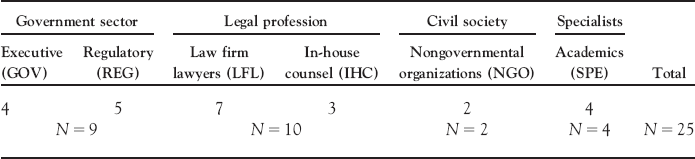
In total, we conducted twenty-five interviews (Table 1, which also shows the coding scheme used throughout our text: e.g., law firm lawyers appear as LFL-1 … LFL-7). These conversations took about two hours each, and in the rare cases in which they were not audiotaped, we took extensive notes. Following the standards of case studies, our analysis involved qualitative coding of transcripts and triangulation of interviews, scholarly works, professional reports, and media accounts. Moreover, we presented and discussed our findings in at least two occasions before audiences that included scholars and practitioners in telecom law: in light of the feedback we then received, we continuously sought to refine our conclusions. We found empirical confirmation for the three stylized moments proposed by L&D, with telecom in Brazil moving from a state monopoly to a regulated market to a third moment.Footnote 6 Moreover, we mapped the ways corporate lawyers have participated in each moment. We report these findings below.
Sample for In-Depth Interviews

| Government sector | Legal profession | Civil society | Specialists | |||||
|---|---|---|---|---|---|---|---|---|
| Executive (GOV) | Regulatory (REG) | Law firm lawyers (LFL) | In-house counsel (IHC) | Nongovernmental organizations (NGO) | Academics (SPE) | Total | ||
| 4 | 5 | 7 | 3 | 2 | 4 | |||
| N = 9 | N = 10 | N = 2 | N = 4 | N = 25 | ||||
Corporate Lawyers in the Construction of the Modern Telecom Sector in Brazil: Four Stages of Engagement
We found four stages of corporate lawyers' participation in the construction of the modern telecom sector in Brazil from the late 1980s to the present. The first two occurred during the transition between state monopoly and a regulated market (late 1980s–1997). In this period, corporate lawyers sought to provide legal legitimacy and tools in an effort to open up the sector. They engaged in creative interpretation of existing laws and produced drafts of administrative norms that could enable private participation in the sector. Yet, none of these efforts was sufficient to produce an atmosphere favorable to private investment.
When the government made a more decisive move to open up the sector and seek foreign investment, corporate lawyers renewed their efforts. The regulated-market period of telecoms history began with the government allowing the private sector to offer cellular phone services and lawyers intervening to ensure that demands of foreign investors were met. It soon became clear that major changes in Brazilian law were needed to make the sector more attractive to such investors, and the government turned to corporate lawyers to identify experts who could get the job done. These experts helped create a competitive market system governed by a US-style regulatory agency.
The third stage of lawyer engagement occurred during the initial operation of the sector as a regulated market under a new legal structure (1998–2007). This time, corporate lawyers ensured that legal reforms were administered as intended. Initially, the new legal forms conflicted with an enduring technocratic ethos among regulators socialized in the state-owned Telebras system. Using opaque and idiosyncratic regulatory practices and making demands companies saw as excessive, these old-style technocrats tried to pour the old wine of state developmentalism into the new bottle of the regulatory state. However, corporate lawyers curbed their powers by imposing legal constraints on regulatory discretion. By the end of the second period, with regulation operating under stricter legal constraints and regulators placing more value on the law and legal reasoning, corporate lawyers had acquired considerable professional power and could drive the sector toward the original aspiration of a regulated market in which private companies enjoyed significant freedom.
The fourth stage of lawyer engagement involved the emergence of new state activism in the late 2000s. Concerns for social inclusion, industrial development, and democracy placed new demands on the companies, producing conflicts and ushering in the fourth stage of lawyer engagement. In complex efforts to protect clients while accommodating the government, corporate lawyers mediating these conflicts oscillated between resisting to government intrusion and negotiating engagement with regulators who sought to align the sector with industrial and social policy.
From “Muddling Through” to the Need for a New Legal Infrastructure: Corporate Lawyers and the Opening of the Brazilian Telecom Market (Late 1980s–1995)
When telecom services in Brazil were a state monopoly, most things in the sector took place within a single complex informed by a state-driven rationale. When monopoly began to wither, the sector was exposed to a new array of interests and perspectives. Tensions emerged, new and old, between policy and business, public and private, national and foreign.
Within Brazil's state-owned telecom sector,Footnote 7 tensions were initially managed through a technically informed culture of legality. Although state-owned companies were subject to numerous laws and regulations, they had discretion to organize their internal proceedings. Technical decisions were translated with little or no mediation into normative commands, the so-called Telebras norms or patterns. These governed a myriad of operations in the sector, treated like formal legal obligations.
This overlap between technical solutions and normative commands—or, ultimately, subordination of a legal order to a technical order—gave engineers much power in the sector. Telebras officials paid little if any heed to strictly legal issues, caring only for technical matters (interview with LFL-4).
In the late 1980s, the government began to explore ways to attract private capital in the telecoms sector. Although the constitution gave the state what amounted to a monopoly in the sector, it granted a limited role to private enterprise.
For a small group of early career lawyers with elite degrees who had ventured into the then-nascent field of telecom corporate law, this scenario presented both opportunities and challenges. Although there was an obvious need for mediation between the interests and expectations of incoming foreign investors and local rules and practices, rules and practices were neither produced nor organized in a coherent fashion. Amid the resulting uncertainty, lawyers had to muddle through both existing normative systems and established social hierarchies: not only did they have to sort out what laws could be applicable to specific transactions and operations, but they also had to build legitimacy for their reasoning relative to that of engineers and foreign businessmen (interviews with LFL-3 and LFL-4).Footnote 8
Simple iterations of such ad hoc proceedings would not provide a comfortable legal basis for investors. With the market opening at a fast pace, a more autonomous and comprehensive legal order would be necessary.
From Interpreting Existing Laws to Legitimizing New Laws and Their Draftsmen: Corporate Lawyers and the Construction of a New Legal Regime for Telecom (1995–1997)
The growing telecom corporate bar already had experience in trying to shape the law and carve out legal space for investors within this state-dominated regime. In the mid-1980s, when government officials were looking for ways to hand some telecom services to the private sector, corporate lawyers sought to contribute by creatively interpreting the existing legal infrastructure set up in the 1962 Code. As disagreements about these legal interpretations impeded progress (interview with LFL-4),Footnote 9 corporate lawyers took another tack by suggesting administrative norms to operationalize the opening. LFL-4 mentions that, at the time:
There was no such a thing as a public consultation, but they asked for suggestions. So, we took part [in] that process. … This was how I established myself in this sector; I was part of a small group of corporate lawyers whose primary mission was to draft suggestive norms to govern the opening process. We would read materials, gather, discuss, and attempt to produce those suggestions.
Nevertheless, uncertainties typical of transitional moments prevailed. LFL-4 recalls that in the wake of all these meetings and drafting work, “the government enacted … three different norms,” none of which could attract companies: “Without a constitutional amendment breaking state monopoly, no one felt safe to invest.”Footnote 10
Passage of that amendment in 1995 (Emenda Constitucional n. 8 1995), and a law regulating private provision of B-Band cellular phone services in 1996 (Lei n. 9.295 1996), provided the safety private investors demanded (Almeida Reference Almeida1994; Dalmazo Reference Dalmazo2002; Bolaño Reference Bolaño2003; Aranha Reference Aranha2005; Pieranti Reference Pieranti2011; Braz Reference Braz2014; interviews with SPE 2 and SPE 3) and gave corporate lawyers an opportunity to seek further changes favoring the companies. Since not all the terms of these transitional regulations met the demands of foreign investors, corporate lawyers were called on to perform critical interventions. LFL-4 details:
There was a rule that more than 50 percent of the shares in the investing companies ought to be in the hands of Brazilians. So, foreign businesspersons and [we] their lawyers went to the ministry and said, “Do you think we are going to invest billions and not be able to control the companies in which we are investing, even if sharing control with a local partner?” The minister interpreted the law in a way that Brazilians meant either legal residents in Brazil or companies incorporated according to Brazilian laws. It was not explicit, but we all assumed that companies could have all their shares in the hands of foreigners if these were “incorporated according to Brazilian laws.” And this later informed the rules adopted for Telebras's privatization.
This was just the beginning of a much broader restructuring process involving the splitting and selling of the Telebras system and the move from state monopoly to a market-based regime. This time, legal professionals would be hired to work full time with the authorities in charge of the process. These professionals had a complex task. Business consultants had advised the government that its success in attracting foreign investors would depend on emulation of foreign models of telecoms regulation and governance.Footnote 11 LFL-2 explains:
There were many doubts about the extension of the reform, but there was a lot of international pressure. It was meaningful that legal counsel was hired through ITU: everywhere in the world ITU was “supporting” telecom reforms, meaning pushing for reforms. And ITU had a certain menu of ideas that I assume had been discussed with the government, as there was consensus among MINICOM officials about the need for a regulatory agency, independent regulation, competition, things much in line with reforms taking place internationally.Footnote 12
These reforms called for legal institutions unknown in Brazilian law and for a major redefinition of the relation between state and market. Corporate lawyers who had pioneered telecoms legislation were asked to help government officials identify professionals who could carry out such changes. Interestingly, the professionals they referred to government officials bore a jurist-like set of political, social, and cultural capitals: they had practical experience in both the public and the private sectors and were well-established administrative law professors at a leading São Paulo law school (interview with LFL-2). As the restructuring process evolved, these credentials would prove their importance. After much back and forth with business consultants and government officials, these jurists started a revolution in Brazilian public law. Their proposed draft for a Lei Geral das Telecomunicações (General Telecommunications Act, henceforth LGT, approved by Congress as Lei n. 9.472 1997) included substantial legal innovation.
A key aspect of this revolution was the construction of an independent regulatory agency called ANATEL. Independent agencies were not part of Brazil's public law repertoire. Yet, business consultants determined that the independent agency solution would be more attractive to foreign investors, yielding higher returns in privatization auctions.Footnote 13
LFL-2 and others initially proposed an entirely new institutional form, the Ofício Brasil de Telecomunicações (Brasil Reference Brasil1997; Prata, Beirão, and Tomioka Reference Prata, Beirão and Tomioka1999; Braz Reference Braz2014). The Ofício would be a completely independent agency with the ability to raise operating funds and not have to rely on government budgets. Fearing that this form would be deemed unconstitutional, however, LFL-2 and others took another approach. This involved tweaking an existing legal form, the autarquia.Footnote 14 The LGT draft (Lei n° 9.472) conceived ANATEL as a special autarquia linked to MINICOM. As such, ANATEL would have administrative independence, directors with fixed terms and stability in the office, financial autonomy, and not be subordinate to any other entity (Articles 8 and 9). ANATEL was given power to produce and enforce norms governing corporate conduct in the sector (Article 19).
These innovations produced immediate and “violent” reactions in the legal field and beyond (interview with LFL-2). Jurists criticized the status of a special autarquia and the norm-making power assigned to ANATEL. Maria Sylvia Z. Di Pietro (Reference Di Pietro2010) argued that autarquias could not serve the purposes the LGT was giving them, since in Brazilian administrative law autarquias were prohibited from creating norms. Celso A. Bandeira de Mello agreed and reasoned that, by conceiving ANATEL as a special autarquia, reformers sought “to give a new flavor to an old concept, building on the putative prestige of a US terminology” (Reference Bandeira de Mello2009, 157).Footnote 15 He predicted:
These “agencies” are likely to trespass their power. Based on the label they were given, they will believe—and so will all the naive—that they are invested with the same power as US “agencies,” which would be totally inconsistent with Brazilian law. (158)
As the changes brought about by the LGT survived these and other tests,Footnote 16 the corporate bar came out of the restructuring process considerably more empowered. The reform introduced new ideas, more attuned to corporate clients' interests and expectations, while creating a unique, specialized body of law that required new forms of expertise and lawyering styles––all at a time when the entire corporate-law sector in Brazil was growing, with new law firms being created and general counsel offices expanded to deal with these and other changes in Brazilian law (Cunha et al. forthcoming). The result was the creation of a strong telecoms-law sector within the emerging private firms and growing company GC offices. LFL-2 himself would not escape this fate: in 1998, when Telebras was privatized, he finished his contract with MINICOM and ITU and “went to work for the private companies, obviously.”
Legalizing Regulation: Making Legal Claims to Uphold Market-Friendly Institutions (1998–2007)
While the passing of the constitutional amendment and the LGT formally made the telecom sector more market-friendly,Footnote 17 institutional memories from the Telebras era continued to affect theories and practices of regulation and governance within the new agency ANATEL.
The first board of ANATEL directors was recruited from among the same people who used to draft and implement Telebras norms. REG-5 recalls that “the board was exclusively of engineers … as the agency was originally staffed with former Telebras workers and the commanders of the system were normally engineers.”Footnote 18
With this continuous professional dominance, old characteristics survived in new structures. One was the relative disregard for a law-like reasoning. LFL-2 recalls that one of his tasks after privatization was to help ANATEL draft its first regulatory package. This allowed him to do “fascinating things”:
For example, the first bylaw of the agency [he drafted] had a code of administrative procedure embedded in it. At that time, there were no laws governing administrative procedures. At the first meeting of the board of directors, I brought a draft of that bylaw. And I said, “The first challenge of this agency is to have its bylaw. According to the LGT, bylaws need to go through public consultation before being enacted. Here is a draft we have prepared; you need to read it carefully.” They looked at me, all engineers, and replied, “We have to read this all? That's impossible.” And I said, “Well, this is about how the agency is going to work; you need to read it, raise questions, make suggestions. …” We had this deadlock and they ended up submitting the draft to public consultation without having read it.
Obviously, the passing of that bylaw was not enough to make ANATEL directors more aware and respectful of law and legal reasoning in their everyday work. They routinely disdained legal opinions and memoranda—even when produced internally—while asserting their expert knowledge and technical rationale as the primary basis of legitimacy for regulatory practices.Footnote 19 LFL-4 recalls that in this period:
From a lawyer's perspective, it was hard to understand … that ANATEL directors would say to ANATEL lawyers that their memoranda were wrong. Imagine having your legal memorandum rejected by five engineers. They were in good faith … but we had what we called the “rubber ball” memorandum, which would “bounce back” from the board of directors because it was written in terms that did not match their reasoning and ought to be redrafted. I had a case in which, probably by mistake of ANATEL staff, I retrieved a case docket that had two legal memoranda with the same number, same date, same signatory; the difference was that one was for [something] and the other against [it].Footnote 20
This ethos had a clear impact on the interests and expectations of private companies: norm making and implementation by ANATEL was far more opaque and idiosyncratic than anticipated, which made their relationship with the agency far more conflictual than they preferred.
Oversight and sanctioning activities by ANATEL made these conflicts escalate. ANATEL began to launch a flood of administrative proceedings to assess regulatory compliance in issues like universal access and quality of services (interviews with REG-1, LFL-1, and LFL-4). LFL-1 suggested this was meant to scare companies, but noted that heavy fines were levied and some companies “went bankrupt.”Footnote 21
While lawyers are known for their ability to challenge power based on norm-based systems, making legal claims in telecom was not easy. ANATEL's regulatory culture had made the administrative domain averse to legal arguments and law-like reasoning. LFL-1 details how ANATEL proceeded when companies filed grievances about fines that had been imposed:
Companies would receive by mail what ANATEL understood was necessary for their defense. Generally, this would not include the technical reports, let alone internal legal memoranda. Later, companies began to raise legal issues in their defenses, like lack of due process and motivation. But the board of directors liked to issue concise decisions, no more than three pages long, which obviously limited the room for those issues to be dealt with.
Going to court against this regulatory culture and its products was risky in many ways. First, corporate lawyers wanted to keep the courts out of the regulatory business. The theory of regulatory agencies, actively and widely disseminated in the wake of privatization, held that courts should limit their review of regulatory measures to formal aspects, like limitation of discretion and due process. Corporate lawyers were not sure the Brazilian bench would embrace that theory in full and leave the substance of regulation to regulators.
Second, corporate lawyers were doubtful that courts would be able to handle or even understand the complex issues that telecom regulation involved. LFL-5 “felt that whenever [he] needed to take anything to court, [he] had to explain the very basics. So [his] attitude was much more reactive.”
Third, the corporate lawyers and ANATEL were facing common antagonists in the courts: the Ministerio Público, the Brazilian prosecutorial agency, and NGOs were beginning to file lawsuits to address regulations acceptable to the companies but seen as threats to the public interest and the interests of consumer groups. LFL-5 continues his account:
We wouldn't fight against ANATEL; sometimes we would line up with ANATEL in lawsuits filed by the Ministerio Público. One example is in prepaid cellular phone credits: ANATEL established a ninety-day limit for use of these credits, after which they would expire and users would have to refill their phones. The Ministerio Público said this was outrageous, but this is what allowed prepaid phones to exist and get disseminated. And we had to explain to the court the economics of prepaid phones … and we worked closely with ANATEL to explain to courts and prosecutors these services' regulations, which were then being interpreted simply through the eyes of consumer laws.
Finally, going to court could produce consequences directly adverse to the corporate clientele. The plain reason is that technocratic ANATEL would not hesitate in retaliating against companies that chose litigation. LFL-1 explains:
In the first ten years, these disagreements were dealt with mostly at an administrative level, for … I don't know how to put this, but the fact is that ANATEL would retaliate. So, if you went to court, ANATEL would not give you the annual tariff increase, you know what I mean? So, companies had a fear of going to court against ANATEL, for they would not remain unpunished: if they filed a lawsuit discussing interconnection, the agency would impose obligations or would not give the company something it needed in another area that had nothing to do with interconnection.
Yet, this was a story in which corporate lawyers were not willing to play a peripheral role. Since dealing with administrators was hopeless and going to court on behalf of clients was too risky, some of them ended up filing lawsuits on their own behalf. They claimed that as citizens, they had been denied due process rights within the agency.Footnote 22 Little by little, this creative insurgence helped generate a body of judicial decisions setting higher standards for administrative proceedings in ANATEL and other regulatory agencies.
As fines imposed by ANATEL reached seven-figure amounts, companies began to change their minds about lawsuits. LFL-1 explains:
Companies began to see that, in some cases, there were real chances that they could avoid a multimillion-dollar fine just by arguing that some due process rights had been violated. This was risky pursuing, but the benefits could outweigh the risks. And they became more tolerant with the risks and more concerned with the benefits.
At the same time, changes occurred in government legal services, which helped unsettle the relationship among technocracy, law, and lawyers. These (1) made it mandatory for regulatory agencies to recruit their legal counsel from among career government lawyers and (2) required these agencies' general counsel to report to the advogado-geral da união, the chief lawyer for the executive branch, instead of to the agencies' presidents. This gave lawyers internal to ANATEL considerable leverage and independence vis-à-vis the board of directors.
Hence, ten years after ANATEL was established, its lawyers began to issue legal memoranda that called for much higher procedural standards for regulatory practices (interviews with LFL-1 and REG-5). Although the board was not required to meet the majority of these standards, written as mere legal recommendations, rejecting them would help corporate lawyers to make even more robust cases in court. The result was a substantial shift in the sector. As regulatory activities within ANATEL became more considerate of internal legal procedures and, eventually, of court decisions, the old technocratic ethos at the agency had to make room for more law-like institutional practices and professional expertise. For instance, REG-1 reports:
Given the number of proceedings, we began to hire lawyers and more lawyers; the agency began to look like a mini-court. This was even reflected in our bylaws: if you compare them over time, you will see that we now have much more regulation over internal proceedings, much more procedural rules. These bind the way the board of directors operates with much of a law or judicial look. The board decisions were called acts; now they are opinions of the board. So, let's face it: this is becoming a court. It's hell.
SPE-2 adds:
The presence of lawyers in the ANATEL board of directors increased significantly; initially they were all engineers, sometimes economists. Now I'd say there was a shift—there are more lawyers than economists and engineers…. And there are changes in administrative proceedings. Last month … ANATEL allowed parties in their proceedings to make oral arguments. Who's that for? Lawyers, of course: they are pushing for greater participation in decision-making processes within the agency.
This had a significant effect on the telecom corporate bar. From actors with limited means and significance maneuvering between ANATEL engineers and corporate managers, corporate lawyers became necessary resources for companies trying to navigate a regulatory web that was itself becoming ever more legalized.Footnote 23
Having achieved such a privileged position, corporate lawyers could expect to complete the transformational process initiated with the LGT. Facing continuous legal questions and claims, ANATEL would have to meet a much higher legal burden to exercise its regulatory power. This could drive telecom regulation back toward the original goal of a market-friendly regime, with minimum, rationally conceived, and impersonal state intervention into private affairs. Except that, with Lula da Silva's election as president in 2002, a new impulse of state activism was on its way.
Resistance, Negotiated Engagement, and New Institutional Constraints: Corporate Lawyers and the Emergence of an NDS in Telecom (2007–2014)
Lula's first years in office caused much political malaise and institutional tension in telecom.Footnote 24 Lula inherited a market-based system (Bolaño and Massae Reference Bolaño and Massae2000; Mattos and Coutinho Reference Mattos and Coutinho2005). Private companies were the sole service providers, ANATEL oversaw and adjudicated issues related to these services, and the laws governing the sector stressed minimum constraints to competition. The federal executive had a very limited capacity to redefine the objectives for the sector.
Lula and his cabinet were openly critical of this institutional structure. While referring to ANATEL, Lula once said that Cardoso had “subcontracted the business of governing” (Folha de São Paulo 2003, A1, A4). In 2003, there was fierce debate about rates for landline phone service contracts (Mattos Reference Mattos2003; Prado Reference Prado2008). ANATEL had authorized rate increases, but consumer protection groups and federal policy makers deemed them too high and argued they would contribute to inflation. ANATEL stuck to the rates previously agreed upon with the companies. Miro Teixeira, Lula's first Minister of Communications, declared there was nothing he could do, but ANATEL was wrong and consumers should go to court to have the rates reviewed. The Ministerio Público followed Teixeira and filed a lawsuit. Federal courts gave a preliminary injunction, preventing ANATEL from applying higher rates.
ANATEL defended its position in court and eventually was successful. Yet, this episode left extreme mistrust between ANATEL and the federal executive. Lula sent a draft bill to Congress seeking to reduce the power of regulatory agencies vis-à-vis the executive. Although this draft bill never went to floor deliberation, in June 2003 Lula signed Executive Decree (Decreto) No. 4.733, through which he began to reestablish government control of the telecom sector. The decree defined “social inclusion” and “industrial development” as key objectives for telecom policies and required ANATEL to implement cost-based methods to assess tariffs in landline phone services. In January 2004, ANATEL's president resigned and left the agency, even though he was entitled by the law to keep a position on the board of directors until November 2005.
Although Lula appointed another ANATEL president, initially he was unable to fully overcome existing constraints and to change the course of the sector. Initial signals of change appeared only in 2006. Under a new board of directors, ANATEL began to ask for counterpart obligations when examining requests from companies in areas other than landline phones. These obligations, presented by the agency as preconditions to grant the requests, generally related to social inclusion goals, such as making coverage or technologies available to poor communities. Companies did not like this new regulatory rationale, but ANATEL continued to use it. Says IHC-3 about these changes:
Previously, we would file requests before ANATEL and they would check whether our requests were in accord with the law. Then they began to introduce counterpart obligations. For example, we wanted to provide satellite TV services. We filed the related request for authorization. They said, “We approve it if you accept a counterpart obligation in the benefit of society that involves installing satellite TV antennas in schools, poor communities, etc.” We thought, “No way can we do this. If we accept, they will place these preconditions in all our requests. We have a right to obtain these authorizations.” But we did.
In 2007, new events led to further changes (Peixoto Reference Peixoto2010; Pena, Abdalla-Junior, and Pereira-Filho Reference Pena, Abdalla-Junior and Pereira-Filho2012; Aranha Reference Aranha2015). Lula reached out to one of his closest advisors for ideas on how to connect public schools to the Internet. Says this former official (GOV-2):
Lula thought it was unacceptable that we were entering the 21st century and kids in public schools were growing digitally illiterate. He had discussed that with his ministers of communications and education, but thought this was not going to go further without coordination from the presidency. … I didn't work with anything related to that, but he asked me to take the lead and I said I would.Footnote 25
To understand what comes next and how it furthered changes in telecom regulation and governance, we must bear in mind that the concession contracts companies had signed with the government to operate landline services imposed certain obligations. One of these was to work toward universal citizen access, as defined in periodic universalization plans issued by the government after public discussions led by ANATEL. Initially, these plans called on the companies to install payphones throughout the country. Lula expanded this obligation to include multiservice stations that added fax and dial-up Internet (interview with GOV-2).
By 2008, multiservice stations were proving both expensive and technically obsolete. Companies approached ANATEL and offered to replace them with backhaul, an infrastructure for Internet connection.Footnote 26 ANATEL appreciated this proposal, as it would make broadband Internet available to 3,439 municipalities by December 2010 (Duarte and Silva Reference Duarte and Silva2009), but Lula's advisor and his aides seized an opportunity to get more. They approached ANATEL and the companies and demanded that the exchange also involve an obligation to provide free broadband Internet to 56,865 public schools by that same deadline. Companies initially resisted this solution, dubbed the Banda Larga nas Escolas (Broadband Internet in Schools, henceforth BLNE) project, but ultimately agreed to it.Footnote 27
In 2009, Lula built on this momentum to strengthen the authority of the executive vis-à-vis ANATEL and the companies. He signed Executive Decree (Decreto) No. 6.948, establishing the presidential Comitê Gestor do Programa de Inclusão Digital (Managing Committee for Digital Inclusion, henceforth CGPID) and reinforcing cabinet leadership in telecom-related issues. In 2009–2010, ANATEL and MINICOM began to draft a new universalization plan for landline phone services. Influenced by CGPID, they decided to require that companies install and run backhaul in all Brazilian municipalities. They also wanted this expanded Internet infrastructure to have greater capacity than that required in 2008 and be available for use by governmental agencies for public businesses.Footnote 28
Companies and their lawyers reacted aggressively to this proposal, raising legal and economic arguments and filing lawsuits to deter it. To move beyond this deadlock, the government began to work on a more comprehensive policy, once again under CGPID's leadership. This was called Plano Nacional de Banda Larga (National Plan for Broadband Internet, henceforth PNBL). In 2010, after extensive backstage meetings and public debates, Lula signed Executive Decree (Decreto) No. 7.175/2010, making the PNBL official.
The PNBL reflected a new compromise between the state and the market: the plan relied on private companies, which committed to provide cheaper broadband Internet services,Footnote 29 while also signaling a reinvigoration of state activism. The government reestablished Telebras, assigned with two tasks: first, to ensure technological infrastructure for federal policies and administration, including a separate network for the federal public sector; second, to “regulate the market” by providing broadband Internet services to private parties at the wholesale level, with the chance to operate at the retail level “in places where there is no adequate offer of such services” by private companies.
The federal government urged state governments to give tax breaks to telecom services to bring the prices of broadband Internet down to R$29.90 (±US$10.00) a month. It also announced investments of R$14 billion (±US$5 billion) in infrastructure and industrial development related to broadband Internet for the 2011–2015 period.Footnote 30 Finally, the PNBL brought civil society into the discussions: the government launched the Forum Brasil Conectado, a permanent advisory panel for PNBL managers with participation of NGOs and activist groups, in addition to business and government representatives, and in 2010, Brazil convened a Conferência Nacional de Comunicações (National Conference on Communications or CONFECOM), a participatory process gathering multiple constituents to debate communications policy, including broadband Internet.
Amid these events, Dilma Rousseff was elected president for her first term. Even before she took office, her appointed minister of communications, Paulo Bernardo, met with CEOs from telecom companies. When Bernardo agreed to discuss and perhaps review the backhaul obligations, the companies withdrew the lawsuits they had filed challenging such obligations. In 2011, the new government decided to make the PNBL its core instrument to expand broadband Internet and relaxed the backhaul obligations. In 2014, Rousseff was reelected with the promise to transform the PNBL into an even larger program, dubbed Banda Larga para Todos (Broadband Internet for All). It was unclear what this program would entail, but as the PNBL had produced limited results, she might need to look for alternative policy solutions.Footnote 31 These might include new backhaul obligations, reinstating conflicts with the market and civil society.Footnote 32
While it is tempting to discuss the merits and results of these policies, we are more interested in the changes they represent in theories and practices of development over time in Brazil. Lula ushered in a new era of state activism in telecoms with aspects of what the L&D literature calls the “new developmental state” (Trubek, Coutinho, and Shapiro Reference Trubek, Coutinho, Shapiro, Trubek, Coutinho and Shapiro2014). While policies like BLNE and the PNBL represent active state efforts to structure the sector to meet developmental goals, this occurs in partnership with private entities, unlike the practices of the classic developmental state. While in this phase of new state activism the government continues to seek economic growth and industrialization, it also shows concern with equity, social justice, and even political liberties;Footnote 33 and while the state now intervenes more than it did in the early ANATEL era, it is more concerned with legitimacy for its intervention than it was in the old days of state monopoly.Footnote 34
For us, the key questions are: How have corporate lawyers participated in this moment? What kind of mediation have they provided? Which of their skills have been more decisive? We address these questions in the next section.
NDS in Telecom and the Challenges to Law and Lawyers
The legal issues created by the emergence of new state activism in telecom and the questions it posed to corporate lawyers stem from the structure of the basic law (LGT). The law divides telecom services into two regimes: public and private. Public services are those deemed to be essential, that affect a wide range of interests, and that require continuous provision. Private services are any services not meeting those tests. The regulatory process is varied: for public services, providers must be selected through pubic bids and regulated by a detailed concession contract; for private services, a simple authorization is all that is required. The law requires that prices for public services must be controlled and companies are obliged to provide universal access; no such requirements are mentioned for private services. Infrastructure created for public services reverts to the government at the end of the concession; this is not required for private services.Footnote 35 When telecom was privatized in the 1990s, the only services included in the public regime were landline phones. All other services, including cellular phones, came under the much looser private regime.
This system was challenged by both BLNE and PNBL. These policies depart from the logic of the basic law in two ways. On a more general level, they embody a new philosophy of governance. Strict rules and limited state regulation of businesses, while never completely implemented in the sector, gave way to open-ended bargaining across the state-market divide, as the government seeks to engage private parties in attempts to meet developmental goals. Hence, when we pushed LFL-6 to articulate a vision of the current moment of telecom regulation and governance, he said:
It is a time of “I will help you deal with the problem you are facing if you make an investment here or there.” This is what telecom regulation has become. The government is looking for what to put on the table to push companies to do what it wants, like invest in broadband Internet. It is a time where the president's chief of staff is drafting regulation and we engage in political negotiations about issues of the highest interest to companies in the sector.Footnote 36
On a more specific and contentious level, these policies challenged the reigning spirit of the LGT. In BLNE, companies providing landline services in the public regime had an obligation to make these services universal. Installing and running backhaul became a means to do that. However, the same could not be said for the obligation to provide Internet to schools, which was not really related to landline services and could not be formalized as part of concession contracts.Footnote 37 As a way around this, this obligation was included in addendums to authorizations the same companies had to provide other services under the private regime, like cellular phone services. However, such obligations were not supposed to exist in the private regime at all. LFL-7 shows his discomfort with this solution. He says:
The biggest surprise we had in this negotiation [over backhaul] was Internet to schools. Because for me exchanging multiservice stations for backhaul was mathematical—what the former was worth against what the latter was worth. Then they said, “We want something extra, since we are exchanging things anyway.” And Internet to schools appeared as this “something extra.” Then it came this addendum to authorizations for companies to provide services under the private regime, establishing obligations that were not in exchange for anything, stating that companies are voluntarily assuming an obligation to deliver broadband Internet to schools.… This creates a lot of uncertainty.
The PNBL appeared more beneficial to companies than BLNE, but it followed the same pattern. Instead of installing and running backhaul, companies were selling Internet plans at cheaper prices. Prices and other conditions were established in “terms of commitment” that companies “voluntarily” signed with MINICOM. However, such terms created formal legal obligations for services in the private regime. The bright line between the public and private regimes had been breached yet again, with regulatory requirements being introduced in areas thought to be strictly governed by market mechanisms.Footnote 38 Needless to say, corporate lawyers and their clientele were critical of this approach. IHC-2 argued that:
ANATEL is including some obligations that mark a clear attempt to make public policies through private providers, that is, in the context of service authorizations.… It is one thing to do it in concession contracts, where you sort of expect to see greater state presence and legal obligations to universalization exist … but I'm talking about authorizations … and we see ANATEL imposing some obligations with universalization that I believe are much closer to or make much more sense in concession contracts.
The corporate bar's reaction to this approach has been quite complex. A two-sided account of professional identity, involving resistance and negotiated engagement, has emerged.
Resistance and Negotiated Engagement: Variation in the Meaning of Corporate Law Practice in the Rise of an NDS in Brazil's Telecom
As new state activism in telecom emerged in Brazil, new forms of professional engagement developed and corporate law practice has taken what appear to be two paths. The first we call resistance. It includes skepticism toward the state's authority to drive the sector (vis-à-vis the market), a belief that policy solutions like BLNE or the PNBL are illegitimate in view of the law, and a willingness to resist them.
One expression of resistance is in legal scholarship. Corporate lawyers have written articles and opinions denouncing the recent moves by the state as inconsistent with the existing legal structure. Authors seek to sustain the aspiration of a market-based regime for telecom services and reclaim the original intent of the LGT against the activist measures. For example, in a leading peer-reviewed journal in telecom law, Marques-Neto (Reference Marques-Neto2010) argues that policies like the PNBL show “disregard for … mechanisms” that exist in the LGT, while “seeking alternatives aside from or against the LGT.” He concludes that this “may ultimately lead to an increase in the offer of broadband Internet to Brazilians … but will result in the dismantling of a successful model and a throwback in the institutional robustness of the sector” (2010).Footnote 39
Resistance also appears in legal mobilization. Building on capital and expertise accumulated though years of struggle to legalize regulation, corporate lawyers have taken measures to resist new policy solutions. In a lawsuit challenging BLNE, lawyers for the companies claimed the program violated formal consultation rules and temporarily halted the universalization plan in which the government wanted to include more aggressive backhaul obligations (Aranha Reference Aranha2015, 83–84).Footnote 40 This move may have influenced government decisions to modify its demands.
Yet, resistance coexists and seems potentially to conflict with negotiated engagement. The latter involves recognition of state authority to drive the sector, belief that the solutions it has produced are contestable but legitimate, and a willingness to examine how clients can take the most benefit from this new context. Thus, when LFL-4 describes his more recent experience in dealing with those new demands, he claims:
In many cases, it continues to be that old-days practical advocacy; so, when a public consultation is released––now there are public consultations before norms and other kinds of administrative actions are enacted; sometimes there are also public hearings––we take the chance to make our comments and engage in public discussions about the issue. Sometimes we set meetings with ANATEL directors or superintendents to understand what they are seeking to accomplish and see what we can do about it. Now there is much less fear to sue ANATEL, but I think these debates and meetings are the most efficient ways we can do our job.
Likewise, when IHC-3 was addressing the most recent developments in telecoms regulation and governance, she said:
BLNE and the PNBL involved extensive negotiations … endless meetings with the ministry, the president's chief of staff; we had to move to Brasilia for a few weeks. And we've been learning how to deal with this world of negotiation. For example, the LGT says that concession contracts must [ensure] economic equilibrium. We have studies showing that by 2018 contracts will have become unprofitable.… But we know that notwithstanding that provision, if we approach the government to discuss these issues they will say, “We are willing to do what it takes, but you need to give me something in exchange, namely broadband.” The government is now discussing how to improve telecom laws and regulations and this is what we are going to put on the table.Footnote 41
As lawyers “learn how to deal with … negotiation,” they also face the need to develop and deploy a different set of skills. Beyond handling transactional services and litigating, they are increasingly required to give input to ongoing conversations between companies and the government. This means assessing risks of suggested operations vis-à-vis the existing laws, but also imagining institutional arrangements that could better reconcile the interests of companies and the government, thus acting again like drafters of a new, hybrid legal regime. As LFL-6 was describing his current work, he said: “Sometimes we are called upon to say what can be possibly done; whether this or that component could be included [in the deals] and in what terms. If the government opens the door for some discussions, we are called upon to work on more concrete issues.”
While one can see resistance and negotiated engagement as alternative strategies for which lawyers might opt, they can also be seen as two sides of the same coin, each playing a role in effective advocacy. Resistance challenges the legitimacy of some aspects of state activism, giving lawyers some leverage when they challenge state demands. Negotiated engagement is a tool to find the best possible outcome within the space thus delimited. By participating in negotiations, corporate lawyers implicitly accept the legitimacy of state activism while they seek to channel its demands in ways that benefit clients. In this complex and contradictory space, the lawyers must both challenge state activism while accepting it and constrain state demands while legitimating them.
Final Considerations
This article has pursued a different objective than much of the available literature on lawyers and capitalist transformation. Instead of examining how changes in the economy impact corporate lawyering in the periphery, we have tried to understand how corporate lawyers have participated in making these changes.
Our empirical study has revealed how professional power and economic development strategy complemented one another over three stages of telecom policies. As telecom lawyers helped build, sustain, and enforce a norm-based system that favored corporate power at a global scale, they increased their own power and importance, and as this norm-based system has been challenged by the revival of state activism, the methods and meanings of telecom law practice have become diversified. Resistance has appeared in the use of expert opinion and mobilization of expert knowledge to curtail state action deemed illegitimate, but this has coexisted with negotiated engagement, which entails recognition of state activism, requires the ability to operate in a more flexible legal regime that involves continual negotiation, and demands the use of practical advocacy to influence its outcomes and better meet the needs of the corporate clientele.Footnote 42
These findings have multiple implications for theory. From the perspective of LLG, they deepen our understanding of the construction and subversion of hierarchies in the profession during rapid economic change and globalization. Rather than a full replacement of elites, the stories we have told look more like a light and mirrors game. The emerging telecom corporate bar relied on––and empowered––traditional jurists when major legal reforms were needed to allow privatization. These reforms expanded the role of corporate law practice in telecoms, building a strong sector and eventually dragging some of those jurists into the world of corporate law: LFL-1 is the best example. At the same time, members of the modern telecom bar have taken paths consistent with those of more traditional jurists, investing in academic careers and part-time professorships at prestigious law schools. Marques-Neto is but one example.
Yet this symbiosis of the modern and traditional might well be affected by Brazil's return to state activism and the corresponding emphasis on practical advocacy and institutional imagination. Should these become more important for advocacy, lawyers with new skills and habitus, formed by a mixture of policy, business, and legal reasoning combined with negotiating skills, may become more important within the profession, reducing the role played by the more traditional rule-of-law and doctrinally-oriented practitioners. In such a context, it is conceivable that lawyers with closer ties to the state could prove to be more effective than those more ideologically aligned with global capital.
From the perspective of L&D, our findings deepen our understanding about the conditions for the emergence and sustainability of state activism and for the theory of a new developmental state. Key features of new developmentalism include greater participation in policy making, more experimentation, and more reliance on the private sector. However, those who stress these features never fully explain their origins.
By focusing on lawyers and their participation in the transition from a neoliberal market to state activism, we may have found one factor that helps explain the emergence of this new form of developmentalism. Although the neoliberal moment valued the regulatory state and civil society––both seen as tools to constrain state action––state activism in the third moment built on the established regulatory machinery and civil society participation increasingly to impose obligations on companies and to pursue new developmental goals.Footnote 43
Yet, unlike technocrats behind the old developmental state, the new state activists faced a challenge unknown to state officials in the past. The neoliberal phase created a legal framework that puts the private sector at the center of the industry. As officials looked for ways around some of the constraints from this framework, the newly empowered corporate law professionals we studied mobilized new skills and arguments to check state activity and confront it when it went too far, thus encouraging the state to seek (by way of path dependence) more democratic, participatory, collaborative, and even experimental solutions. In this sense, resistance and negotiated engagement are two expressions of a larger phenomenon: the interdependence between legal legitimacy and state power that marks the new version of developmentalism and the resulting power of corporate lawyers to operate as brokers between private interests and state activist policies, negotiating in the shadow of the law.Footnote 44
It is, of course, hard to say how deep these changes will go or how sustainable they might be. Brazil is at a liminal moment and the conflict in telecom policy and lawyering is caught up in a much larger national debate about state, market, and law.Footnote 45 Errors by Rousseff's administration and a rising corruption scandal have raised doubts about developmentalism and there are calls for a return to more market-oriented policies.Footnote 46 Some think state activism is waning and the era of the new developmental state in Brazil is over (Singer forthcoming). In any event, contestation between hegemonic powers and the periphery and the search for alternative development models are recurring events in world history, as we can see with the Asian Tigers, Brazil, the BRICS more generally, and some African countries nowadays. For those venturing in these processes, whether as their architects or as researchers, the lessons learned from Brazil about the interrelation between legal professions and development policies are sure to be useful.