Introduction
Introduced, invasive species are a worldwide threat to economies, environments and human health (Pimentel et al., Reference Pimentel, Zuniga and Morrison2005). With respect to invasive agricultural pests, the threat results in part from the high mobility of the organisms and from the opening of new markets for agricultural products.
The Tephritidae family of fruit flies contains more than 5000 species, one-third of which develop in fresh fruits and are important invasive pests (White & Elson-Harris, Reference White and Elson-Harris1992). In spite of quarantine procedures, several Bactrocera species have been accidentally introduced in parts of the world with established fruit industries, and such introductions have often had major economic consequences (Clarke et al., Reference Clarke, Armstrong, Carmichael, Milne, Raghu, Roderick and Yeates2005; De Meyer et al., Reference De Meyer, Robertson, Mansell, Ekesi, Tsuruta, Mwaiko, Vayssières and Peterson2010). In most cases, invaded areas were previously occupied by resident species of fruit flies (Duyck et al., Reference Duyck, David and Quilici2004). In Africa, for example, the fruit fly Bactrocera dorsalis Hendel has invaded areas where many fruit flies in the genus Ceratitis are endemic (Mwatawala et al., Reference Mwatawala, De Meyer, Makundi and Maerere2009).
Tephritid distribution and abundance depend on various abiotic factors and especially on temperature and rainfall (Vera et al., Reference Vera, Rodriguez, Segura, Cladera and Sutherst2002; Duyck et al., Reference Duyck, David and Quilici2006b). According to De Meyer et al. (Reference De Meyer, Robertson, Mansell, Ekesi, Tsuruta, Mwaiko, Vayssières and Peterson2010), temperature and rainfall play a major role in regulating populations of B. dorsalis and Ceratitis species.
The Comoros Archipelago in the Mozambique Channel is composed of four main islands, one of which, Mayotte, is under French administration. The remaining three islands (Grande Comore, Anjouan, and Mohéli) form the Union of the Comoros (or Comoros). Comoros has a total land area of 1660 km2 and is located 300 km from the East African Coast and 700 km from Madagascar.
The tephritid fauna in Comoros are poorly known. Many frugivorous fruit flies of economic significance to horticulture and agriculture have dispersed widely across continental Africa, Madagascar, and other archipelagos of the Southwestern Indian Ocean (De Meyer et al., Reference De Meyer, Quilici, Franck, Chadhouliati, Issimaila, Youssoufa, Abdoul-Karime, Barbet, Attié and White2012). In their review of tephritids in the Afrotropical region, Cogan & Munro (Reference Cogan and Munro1980) did not specifically mention the occurrence of any species of African Tephritidae in Comoros (although the authors did indicate that tephritids were widespread in the region). Aubert (Reference Aubert1984) noted that the paucity of fruit flies was a notable characteristic of fruit production in the Comoros archipelago. On strawberry guava (Psidium cattleyanum Sabine), for example, Aubert (Reference Aubert1984) observed only Drosophila and no tephritids on ripe fruit. For vegetable crops, Norrbom et al. (Reference Norrbom, Carroll, Thompson, White and Freidberg1999) recorded only two species of fruit flies on the islands: Dacus etiennellus Munro and Trirhithrum nigerrimum (Bezzi). Kassim et al. (Reference Kassim, Soilihi, Price and Seewooruthun2000) listed Zeugodacus cucurbitae (Coquillett), previously described as Bactrocera cucurbitae (Coquillett) (Virgilio et al., Reference Virgilio, Jordaens, Verwimp, White and De Meyer2015), Ceratitis capitata (Wiedemann), Neoceratitis cyanescens (Bezzi), and two unidentified Dacus species. To date, the most complete study of fruit flies in Comoros was carried out by De Meyer et al. (Reference De Meyer, Quilici, Franck, Chadhouliati, Issimaila, Youssoufa, Abdoul-Karime, Barbet, Attié and White2012), who reported ten species of Tephritidae. Most of these species are widespread throughout the Afrotropical region; only one species, D. etiennellus Munro, is endemic to the archipelago, while two other species, N. cyanescens (Bezzi) and Ceratitis malgassa Munro, are endemic to the islands of the Western Indian Ocean (De Meyer et al., Reference De Meyer, Quilici, Franck, Chadhouliati, Issimaila, Youssoufa, Abdoul-Karime, Barbet, Attié and White2012).
Bactrocera dorsalis was found in 2005 on the island of Grande Comore and in 2007 on Mayotte Island in Comoros (De Meyer et al., Reference De Meyer, Quilici, Franck, Chadhouliati, Issimaila, Youssoufa, Abdoul-Karime, Barbet, Attié and White2012). Bactrocera dorsalis was not found, however, in sampling conducted in 2004 and 2005 on Anjouan and Mohéli islands in Comoros (De Meyer et al., Reference De Meyer, Quilici, Franck, Chadhouliati, Issimaila, Youssoufa, Abdoul-Karime, Barbet, Attié and White2012).
Bactrocera dorsalis originated in Asia (Clarke et al., Reference Clarke, Armstrong, Carmichael, Milne, Raghu, Roderick and Yeates2005) and was first detected in East Africa in 2003 (Lux et al., Reference Lux, Copeland, White, Manrakhan and Billah2003). This invasive population of B. dorsalis was initially described as Bactrocera invadens Drew, Tsuruta & White (Diptera: Tephritidae) (Drew et al., Reference Drew, Tsuruta and White2005). Bactrocera invadens was recently synonymized with B. dorsalis based on similarities in morphology, molecular genetics, and chemoecology, as well as on sexual compatibility (Schutze et al., Reference Schutze, Aketarawong, Amornsak, Armstrong, Augustinos, Barr, Bo, Bourtzis, Boykin, CÁCeres, Cameron, Chapman, Chinvinijkul, ChomiČ, De Meyer, Drosopoulou, Englezou, Ekesi, Gariou-Papalexiou, Geib, Hailstones, Hasanuzzaman, Haymer, Hee, Hendrichs, Jessup, Ji, Khamis, Krosch, Leblanc, Mahmood, Malacrida, Mavragani-Tsipidou, Mwatawala, Nishida, Ono, Reyes, Rubinoff, San Jose, Shelly, Srikachar, Tan, Thanaphum, Haq, Vijaysegaran, Wee, Yesmin, Zacharopoulou and Clarke2015). Since its first report in Kenya in 2003, B. dorsalis has rapidly spread across the African continent and is now known from 20 other countries (Vayssières et al., Reference Vayssières, Goergen, Lokossou, Dossa and Akponon2005; Ekesi et al., Reference Ekesi, Nderitu and womushana2006; Manrakhan et al., Reference Manrakhan, Venter and Hattingh2015). When B. dorsalis has been introduced into an area already occupied by other polyphagous tephritids, interspecific competition has resulted in population decreases for C. capitata, C. cosyra, and C. rosa (Mwatawala et al., Reference Mwatawala, De Meyer, Makundi and Maerere2006a).
The main objective of this study was to describe the population dynamics of tephritids in Comoros during the invasion of B. dorsalis. We first characterize the tephritid species and the population dynamics of B. dorsalis and other important tephritid species in relation to season and host fruit availability. We then describe the geographic distribution of these tephritids in relation to temperature and rainfall. Finally, we discuss climatic niche partitioning among the main invasive species.
Materials and Methods
Study sites
This research was carried out on the three island of Comoros between August 2013 and August 2015. Grande Comore is about 80 km from Anjouan, while Mohéli is about 40 km from the other two islands (fig. 1). The maximum altitude is 2361, 1575, and 860 m for Grande Comore, Anjouan, and Mohéli, respectively. Although these three volcanic islands have very different climatic conditions, all three have a hot and rainy season from November to April (28–32°C in the lowlands) and a cool and dry season from May to October (24–27°C in the lowlands).
Map showing the 11 study sites on the three islands of Union of the Comoros: Grande Comore, Anjouan, and Mohéli. Topographic contours of 200 m are indicated.

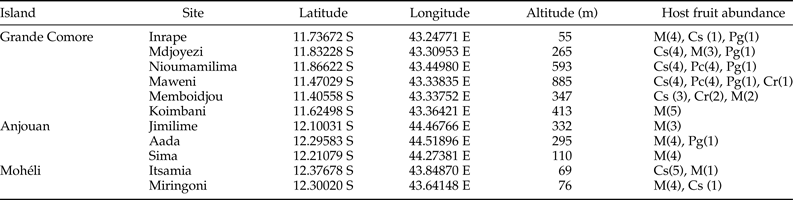
Samples of fruit flies were collected from 11 study sites, with six sites on Grande Comore, three on Anjouan, and two on Mohéli (table 1, fig. 1). The altitude of these sites ranged from 55 to 885 m a.s.l., and the area of each site ranged from 1200 to 3000 m2. The sites were orchards of mainly orange (Citrus sinensis (L.) Osbeck), mango (Mangifera indica L.), guava (Psidium guajava L.), strawberry guava, or mandarin (Citrus reticulata Blanco). No pesticides were applied in these orchards during the study.
Site descriptions and main host fruits present.

M, Mangifera indica; Cs, Citrus sinensis; Cr, Citrus reticulata; Pc, Psidium cattleyanum; Pg, Psidium guajava, host fruit abundance noted from 1 to 5 in brackets.
Trapping and species identification
Fruit flies were trapped in Maxitrap-type traps (Sociedad Española de Desarrollos Químicos, Barcelona, Spain) containing sexual attractants and in McPhail-type traps (Suterra Bend; Barcelona, Spain) containing a liquid food attractant. Each Maxitrap-type trap contained one of the following three parapheromones: methyl eugenol, which attracts males of B. dorsalis; Trimedlure, which attracts males of Ceratitis species; and Cue-lure, which attracts males of Dacus species and other Bactrocera species (Vayssières et al., Reference Vayssières, Goergen, Lokossou, Dossa and Akponon2005; Ekesi et al., Reference Ekesi, Nderitu and womushana2006; De Meyer et al., Reference De Meyer, Quilici, Franck, Chadhouliati, Issimaila, Youssoufa, Abdoul-Karime, Barbet, Attié and White2012). Sexual attractants (Biosystèmes, France) were renewed every 2 months and insecticides were renewed every 4 months.
The McPhail-type trap consists of a transparent cover and a yellow base containing 200 ml of water plus two torula yeast tablets. The torula yeast attracts both sexes of most species of Tephritidae. Yeast is less attractive than sexual attractants, but it enables the collection of a wider range of species. The liquid containing the yeast tablets was changed weekly.
The four kinds of traps (Maxitrap-type traps with three kinds of lures and McPhail-type traps with one kind of lure) were deployed at each site, and each kind of trap was represented by two replicates, so that eight traps were randomly deployed per site. The traps were at least 30 m apart. The trapped tephritids were collected weekly and were counted and identified to species in the laboratory.
The presence of host fruits suitable for tephritid infestation was noted each week. For each site, climate data were provided by the Agence Nationale de l'Aviation Civile et de la Météorologie (ANACM, Moroni).
Statistical analysis
Generalized linear mixed-effects models (GLMMs (Bolker et al., Reference Bolker, Brooks, Clark, Geange, Poulsen, Stevens and White2009)) with a Poisson error were used to analyze B. dorsalis and C. capitata abundances as a function of island and presence of host fruits suitable for infestation by tephritids treated as fixed effects and site treated as random effects. The cumulative abundance of B. dorsalis and C. capitata over the two years for each of the 88 traps was analyzed by GLMMs; the fixed effects were mean annual temperature, mean annual rainfall, and the quadratic effects of these two continuous variables; in addition, island was treated as a random effect. Analyses were performed using R software (R Development Core Team, 2014).
Results
Tephritid diversity
A total of five tephritid species were detected: B. dorsalis, C. capitata, D. bivitattus Bigot, D. punctatifrons Karsch, and D. ciliatus Loew. The total number of flies captured was 878,849 on Grande Comore, 92,731 on Anjouan, and 17,926 on Mohéli. Bactrocera dorsalis was the dominant species, with 860,010 individuals trapped on Grande Comore, 91,946 on Anjouan, and 17,606 on Mohéli. Ceratitis capitata was the next most abundant species, with 8093, 507, and 206 individuals captured on Grande Comore, Anjouan, and Mohéli, respectively. For D. bivitattus, 8600, 308, and 112 individuals were captured on Grande Comore, Anjouan, and Mohéli, respectively. Dacus ciliatus was only trapped on Anjouan (61 individuals), while D. punctatifrons was only trapped on Grande Comore (2141 individuals) and on Anjouan (18 individuals).
Population dynamics and influence of host fruits and season
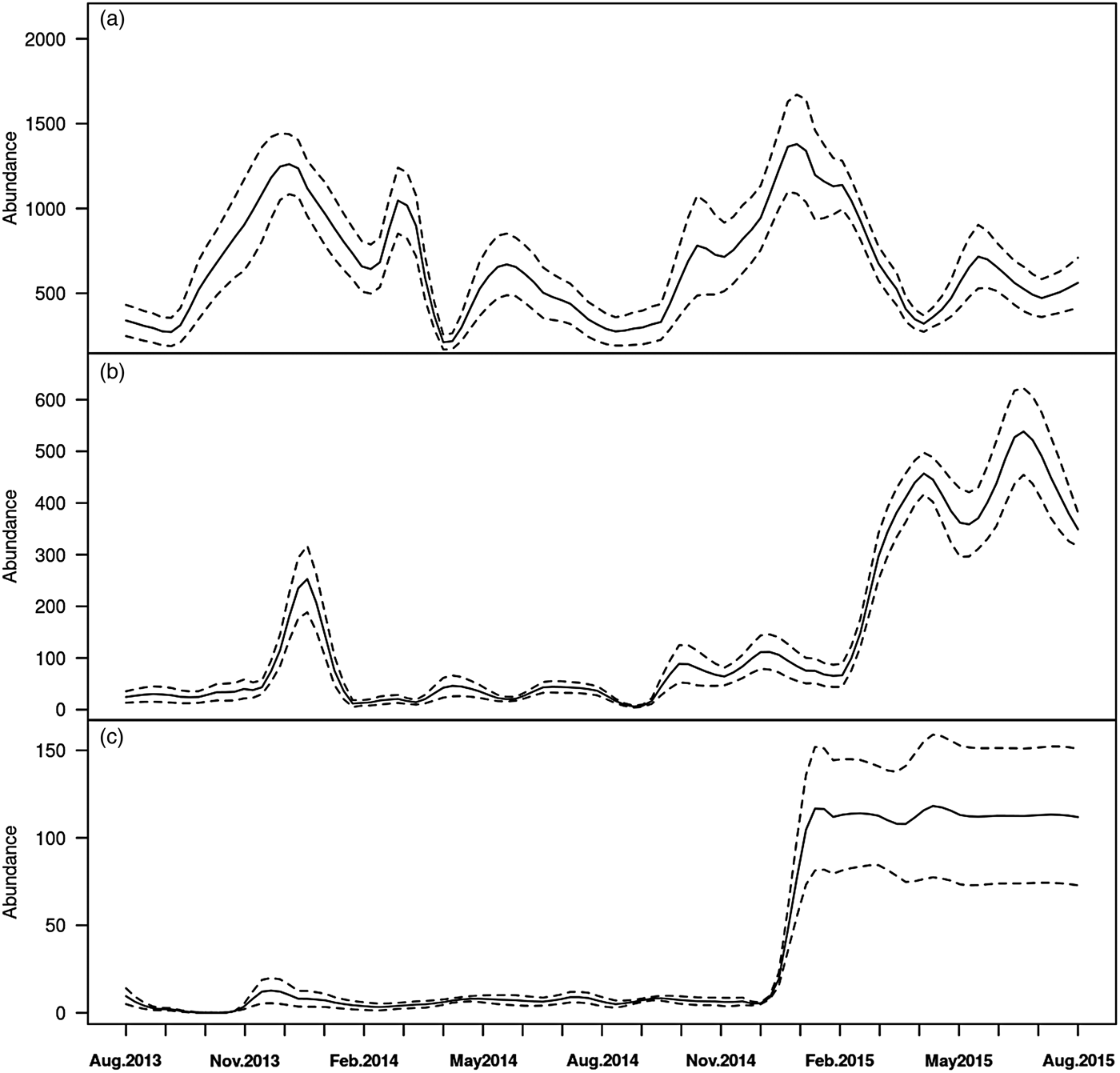
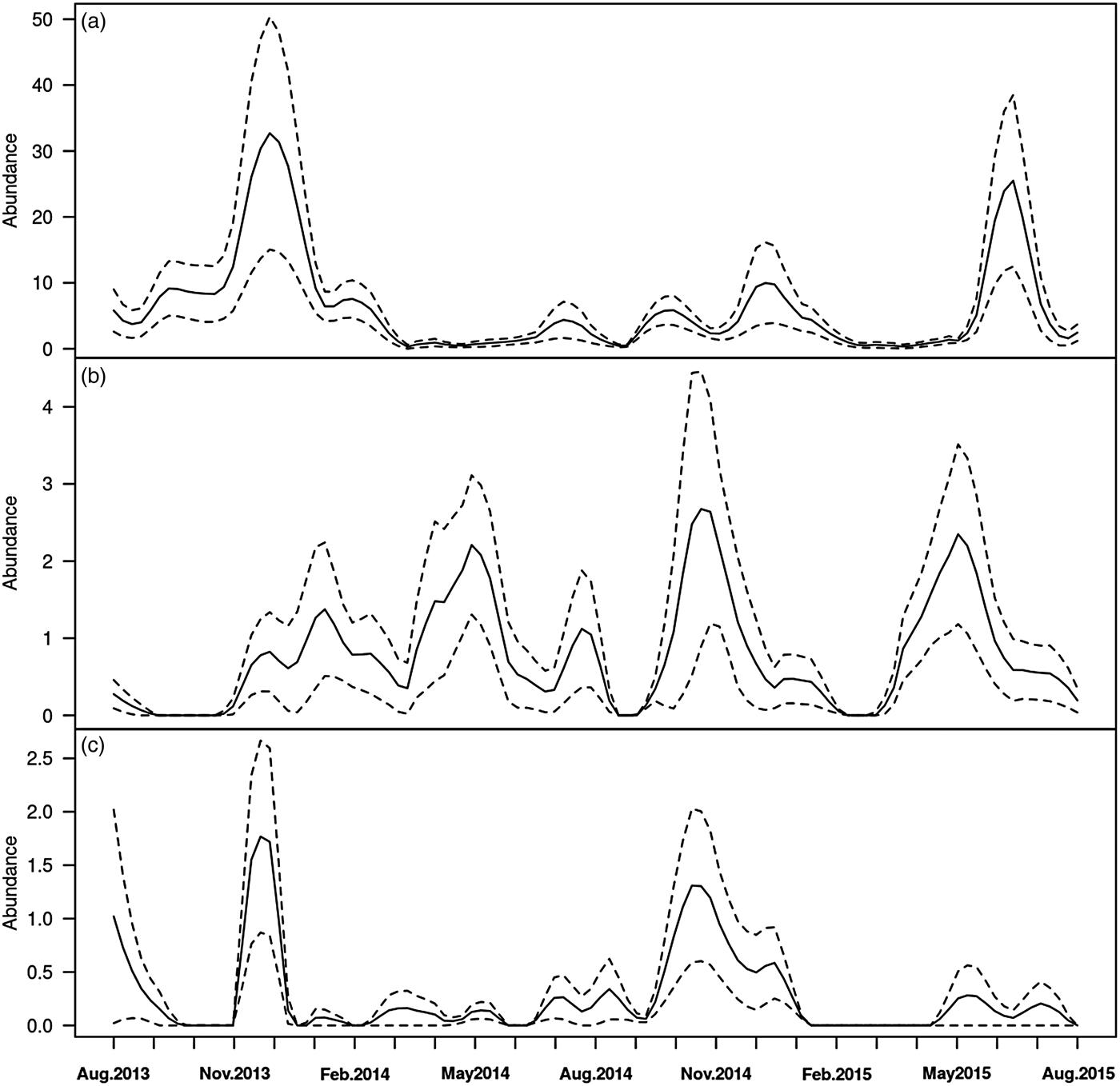
On the three islands, the numbers of trapped flies were high during the hot and rainy season (December–April). On Grande Comore, the mean abundance of B. dorsalis per site was higher during the hot and rainy season than during the cold and dry season (fig. 2a); the same was true for the mean abundance of C. capitata per site (fig. 3a). Regardless of sampling time, B. dorsalis was the dominant species. On Anjouan Island, B. dorsalis abundance was also highest during the hot and rainy season (fig. 2b). Numbers of B. dorsalis on Anjouan increased sharply in 2015 (fig. 2b). On Mohéli, B. dorsalis and C. capitata were also more abundant during the hot and rainy season (figs 2c and 3c), and B. dorsalis numbers increased sharply in 2015 (fig. 2c).
Number of flies of Bactrocera dorsalis collected per site and per week on (a) Grande Comore, (b) Anjouan, and (c) Mohéli. The solid line indicates the mean, and the dashed lines indicate ± SE. Note the change in scale between the three graphs.

Number of flies of Ceratitis capitata collected per site and per week on (a) Grande Comore, (b) Anjouan, and (c) Mohéli. The solid line indicates the mean, and the dashed lines indicate ± SE. Note the change in scale between the three graphs.

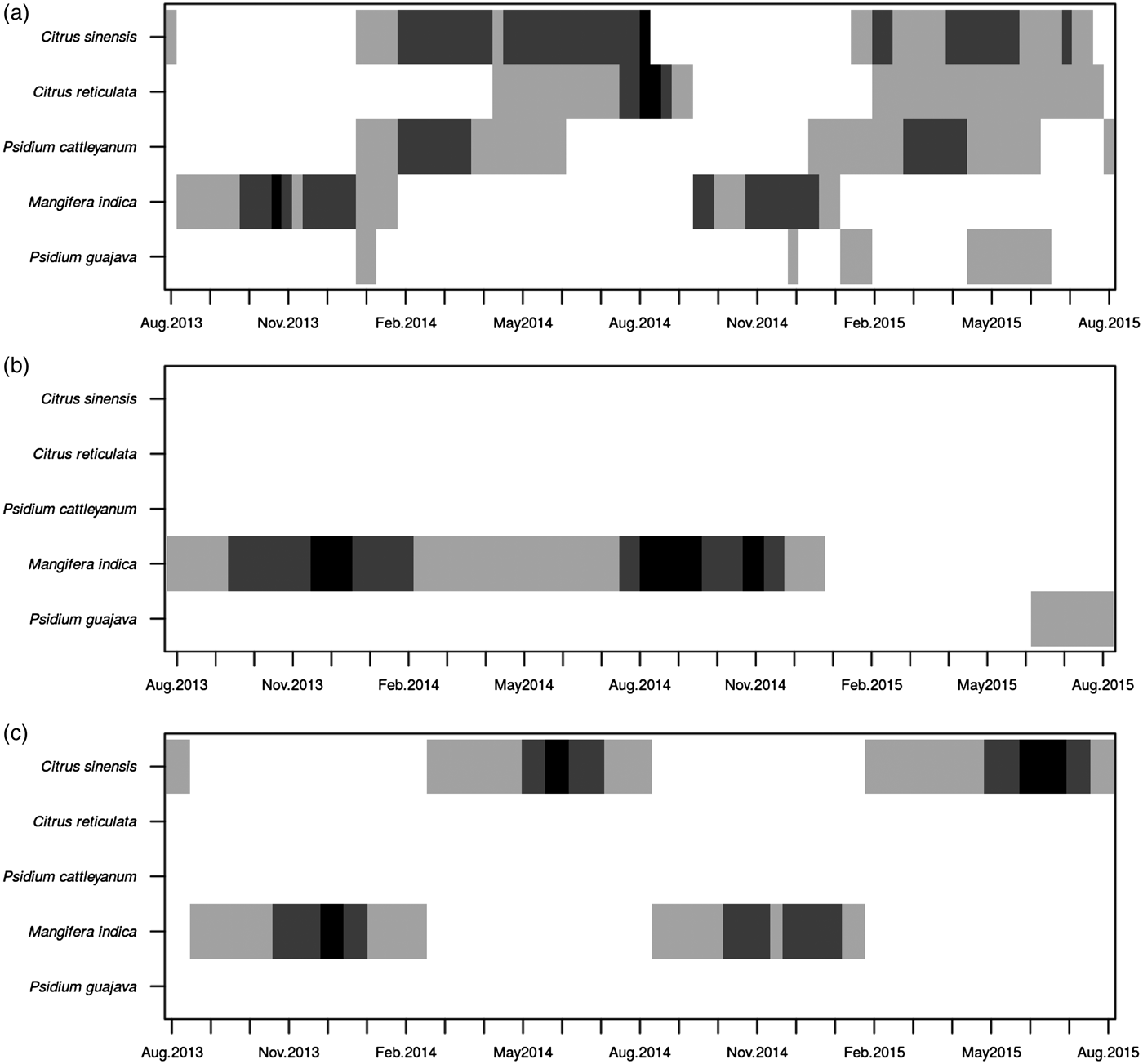
In addition to being related to season, tephritid numbers were related to the presence of host fruits suitable for tephritid infestation at each site. On Grande Comore, two large peaks in B. dorsalis abundance occurred in December, and two small peaks occurred in June during both years (fig. 2a). The large peaks coincided with the presence of mango fruits, while small peaks coincided with the presence of orange fruits and mandarin fruits (fig. 4a). In 2014, a peak was observed in March, which coincided with the presence of guava and other host fruits (fig. 4a). For C. capitata on Grande Comore, two peaks in June coincided with presence of orange and tangerine fruits (fig. 4a).
The presence of host fruit suitable for infestation by tephritids at the study sites during the sampling period on (a) Grande Comore, (b) Anjouan, and (c) Mohéli. The abundance of the fruit of each host (independent of other hosts) was rated weekly on a scale from 0 (no suitable fruit present) to 3 (fruit at maximum abundance). Ratings of 0 and 3 are indicated by white and black bars, respectively, and intermediate ratings are indicated by intermediate colors.

On Anjouan, the peak in B. dorsalis numbers in December coincided with the presence of mango fruits, while the increase in numbers beginning in March 2015 was unrelated to the presence of host fruit at the study sites. Although C. capitata numbers were low on Anjouan, peaks in numbers of this species in December coincided with the presence of mango fruits (fig. 4b). Peaks in numbers of C. capitata in May might be related to the presence of fruits outside the sites that were not recorded in the study.
On Mohéli, B. dorsalis and C. capitata numbers were very low but peaks in the numbers of these two species coincided with the presence of mango fruits (fig. 4c).
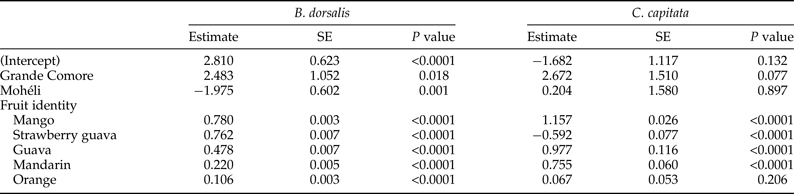
Results from GLMMs with Poisson error showed that once the effects of island were accounted for, B. dorsalis abundance was significantly related to the presence of the main host fruits for each site and each week (P < 0.0001); the estimates were highest for mango followed by strawberry guava and guava (table 2). Ceratitis capitata abundance was also significantly related to the presence of main host fruits; the estimates were highest for mango followed by guava and mandarin (table 2). Ceratitis capitata abundance was negatively related to the presence of strawberry guava and was unrelated to the presence of orange fruit (P > 0.05, table 2).
Analyses of the abundance of Bactrocera dorsalis and Ceratitis capitata by generalized mixed-effect models with Poisson error as a function of the presence of host fruits suitable for infestation by tephritids.

Influence of climatic variables
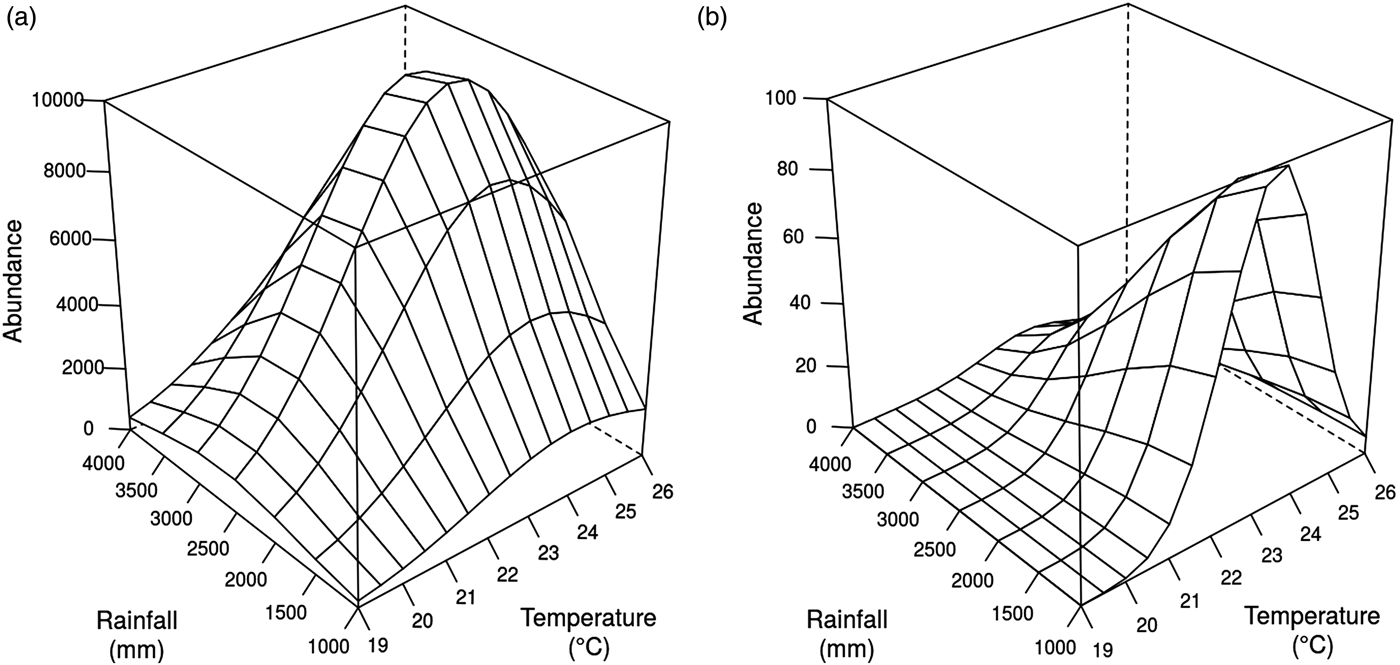
Mixed-effects models indicated significant effects of temperature and rainfall and of quadratic terms of temperature on C. capitata abundance (P < 0.0001), and significant effects of temperature and quadratic terms of temperature and rainfall on B. dorsalis abundance (P < 0.0001). Bactrocera dorsalis abundance strongly increased with temperature up to a mean temperature of 25°C and was highest with a mean annual rainfall of about 3000 mm (fig. 5). Bactrocera dorsalis abundance decreased sharply when mean annual rainfall was <2500 mm or >3500 mm. Ceratitis capitata abundance was highest with an annual mean temperature of about 23°C and with an annual mean rainfall between 1000 and 1500 mm (fig. 5). Ceratitis capitata abundance decreased sharply as annual rainfall exceeded 2000 mm. Overall, B. dorsalis abundance was highest with high temperatures and medium rainfall, while C. capitata abundance was highest with medium temperatures and low rainfall.
Mean cumulative abundance per trap of (a) Bactrocera dorsalis adults and (b) Ceratitis capitata adults as a function of temperature and rainfall (fitted from the model). Results of analysis of deviance are presented in the Results section. Note the change in scale between the two graphs.

Discussion
Tephritid diversity in Comoros
From 2013 to 2015, traps containing methyl eugenol, Trimedlure, Cue-lure, or torula yeast captured five tephritid species on the three islands of the Comoros archipelago: B. dorsalis, C. capitata, D. bivitattus, D. punctatifrons, and D. ciliatus. These five species are among the ten species observed in the archipelago by De Meyer et al. (Reference De Meyer, Quilici, Franck, Chadhouliati, Issimaila, Youssoufa, Abdoul-Karime, Barbet, Attié and White2012). In the current study, the dominant species on all three islands was B. dorsalis.
We did not find Z. cucurbitae, a species detected in Comoros by Kassim et al. (Reference Kassim, Soilihi, Price and Seewooruthun2000) but not detected by De Meyer et al. (Reference De Meyer, Quilici, Franck, Chadhouliati, Issimaila, Youssoufa, Abdoul-Karime, Barbet, Attié and White2012). Because Z. cucurbitae is strongly attracted to Cue-lure and is generally highly invasive, we suggest that it was absent from Comoros at the time of our study. The endemic species D. etiennellus was not detected in our study by either Cue-lure or torula yeast. De Meyer et al. (Reference De Meyer, Quilici, Franck, Chadhouliati, Issimaila, Youssoufa, Abdoul-Karime, Barbet, Attié and White2012) were uncertain whether this species is attracted to Cue-lure. Dacus vertebratus, which was not detected in our study, is not attracted to Cue-lure but is attracted to Vert lure (White & Elson-Harris, Reference White and Elson-Harris1992; Ekesi et al., Reference Ekesi, Nderitu and womushana2006). In a previous study, one female of this species was captured in a Cue-lure trap (De Meyer et al., Reference De Meyer, Quilici, Franck, Chadhouliati, Issimaila, Youssoufa, Abdoul-Karime, Barbet, Attié and White2012). In the current study, D. ciliatus was only detected on Anjouan and only in traps containing torula yeast. The presence of D. ciliatus on Anjouan can probably be explained by the presence near the study sites of many cucurbit hosts such as chayote (Sechium edule), cucumber (Cucumus sativus), and pumpkin (Cucurbita maxima). Dacus ciliatus males are not attracted to Cue-lure or Vert lure (De Meyer et al., Reference De Meyer, Quilici, Franck, Chadhouliati, Issimaila, Youssoufa, Abdoul-Karime, Barbet, Attié and White2012). Ceratitis malgassa was identified for the first time in Comoros on Anjouan in 2004; it was captured in traps containing torula yeast (De Meyer et al., Reference De Meyer, Quilici, Franck, Chadhouliati, Issimaila, Youssoufa, Abdoul-Karime, Barbet, Attié and White2012). Even though torula yeast was used, C. malgassa was not detected in the current study. Ceratitis malgassa males are attracted to Trimedlure (De Meyer et al., Reference De Meyer, Quilici, Franck, Chadhouliati, Issimaila, Youssoufa, Abdoul-Karime, Barbet, Attié and White2012) and have some preferred host fruit such as strawberry guava and Citrus spp. (Dubois, Reference Dubois1965). The latter two kinds of fruit were common at our study sites, suggesting that if C. malgassa is still present in Comoros, its numbers are probably very low.
Ceratitis capitata was more abundant at low than at high altitudes. This species was previously observed in Comoros (Kassim et al., Reference Kassim, Soilihi, Price and Seewooruthun2000) and was considered the most damaging fruit fly in the archipelago before 2005. Since the introduction of B. dorsalis in 2005, however, almost all fruit losses in Comoros have been caused by this invasive species. We suspect that invasion of Comoros by the polyphagous species B. dorsalis has modified the tephritid species community and may lead to local extinction of some species.
Population dynamics as related to the presence of host fruit and season
The population dynamics of tephritids in Comoros differed among species and depended on climatic conditions and the presence of host fruit. The results of this study demonstrate that tephritid abundance also differed greatly among the three islands. All species except D. ciliatus, which was detected only on Anjouan, were more abundant on Grande Comore than on Mohéli and Anjouan. Bactrocera dorsalis was the dominant species, and its numbers increased from late 2014 into early 2015 on Mohéli and Anjouan. In the first collections, the numbers of B. dorsalis trapped in methyl eugenol were low on Anjouan and very low on Mohéli. The increase of this species on these two islands but not on Grande Comore in 2015 may be explained by time of invasion, i.e. B. dorsalis may have invaded Anjouan and Mohéli after it invaded Grande Comore. According to De Meyer et al. (Reference De Meyer, Quilici, Franck, Chadhouliati, Issimaila, Youssoufa, Abdoul-Karime, Barbet, Attié and White2012), the traps containing methyl eugenol that were used in 2004–2005 during the Regional Plant Protection Network (PRPV) program failed to detect B. dorsalis on Anjouan and Mohéli. Cunningham (1989) considered methyl eugenol to be one of the most powerful lures of B. dorsalis males, and Shelly et al. (Reference Shelly, Nishimoto, Diaz, Leathers, War, Shoemaker, Al-Zubaidy and Joseph2010) suggested that two methyl eugenol-baited traps per km2 would be able to detect small numbers of B. dorsalis. These reports overall suggest that B. dorsalis was absent on Mohéli and Anjouan in 2004–2005. The presumed subsequent invasion of these two islands may be due to their proximity to Grande Comore, to the substantial exchange of fruits and vegetables among the islands, and to the weakness of phytosanitary surveillance and control measures in the archipelago.
The presence of host fruits clearly influenced the abundance of tephritids in Comoros. The presence of mango, strawberry guava, and guava fruits was linked to increases in B. dorsalis abundance, while the presence of mango, guava, and mandarin fruits was linked to increases in C. capitata abundance. These fruits seem to be the main hosts for these two tephritid species in Comoros. These findings are consistent with studies in other locations. Thus, mango and guava were found to be good hosts for B. dorsalis in Tanzania (Mwatawala et al., Reference Mwatawala, De Meyer, Makundi and Maerere2006b). In Kenya, B. dorsalis infests a wide range of fruit species and causes substantial damage to mangos and citrus (Rwomushana et al., Reference Rwomushana, Ekesi, Gordon and Ogol2008). The latter authors also reported, however, that B. dorsalis infestation rates were low on all citrus species, indicating that these fruits are unfavorable hosts for B. dorsalis in Tanzania (Mwatawala et al., Reference Mwatawala, De Meyer, Makundi and Maerere2009). Increasing numbers of B. dorsalis appear to be directly linked to the presence of mango and guava (Vayssières et al., Reference Vayssières, Goergen, Lokossou, Dossa and Akponon2005; Mwatawala et al., Reference Mwatawala, De Meyer, Makundi and Maerere2006a). Peaks in numbers of C. capitata were previously found to be associated with mango, guava, and mandarin, which are recognized as important hosts of this species (Liquido et al., Reference Liquido, Shinoda and Cunningham1991). Although orange and strawberry guava are recognized as hosts of C. capitata in other parts of the world (Duyck et al., Reference Duyck, David, Pavoine and Quilici2008), their presence was either unrelated to or was negatively related to C. capitata abundance in the current study. Because strawberry guava seems to be a major host of B. dorsalis on Grande Comore, we hypothesize that C. capitata is displaced by B. dorsalis during the strawberry guava fruiting season.
Our study shows that climatic variables may affect the distribution of tephritid species in Comoros. The mean abundance of B. dorsalis increased during the hot and rainy season. A relationship between the start of the rainy season and increase in B. dorsalis numbers and damage to mango was previously observed in both Eastern and Western Africa (Vayssières et al., Reference Vayssières, Goergen, Lokossou, Dossa and Akponon2005; Mwatawala et al., Reference Mwatawala, De Meyer, Makundi and Maerere2006a).
Species invasion, interspecific competition, and niche partitioning
Some of the tephritid species previously detected in Comoros but not captured in the baited traps in this study may have been present in very small numbers or may have been absent. Some Bactrocera species are highly competitive and able to displace indigenous Ceratitis species from host fruits (Mwatawala et al., Reference Mwatawala, De Meyer, Makundi and Maerere2006a; Duyck et al., Reference Duyck, David, Pavoine and Quilici2008). Following the arrival of B. dorsalis and its increase in Comoros, strong competition may have occurred with Ceratitis species. Even though C. capitata and C. malgassa are attracted to Trimedlure (De Meyer et al., Reference De Meyer, Quilici, Franck, Chadhouliati, Issimaila, Youssoufa, Abdoul-Karime, Barbet, Attié and White2012), few C. capitata and no C. malgassa were captured on the three islands in the current study. These results suggest that the invasion of B. dorsalis may have led to a substantial decline in C. capitata abundance and to the local extinction of C. malgassa. This is only an inference, however, because data are lacking for C. capitata and C. malgassa numbers before the establishment of B. dorsalis on these islands.
The classification along the r–K gradient is a good indicator of the invasiveness of tephritid species (Duyck et al., Reference Duyck, David, Junod, Brunel, Dupont and Quilici2006a). Ceratitis capitata is a relatively r-selected species, while B. dorsalis is a relatively K-selected species (Rwomushana et al., Reference Rwomushana, Ekesi, Gordon and Ogol2008). According to Ekesi et al. (Reference Ekesi, Nderitu and womushana2006), B. dorsalis possesses some K-strategy characteristics and also an important r-strategy characteristic. Besides being a good disperser, B. dorsalis also appears to be an aggressive invader that dominates several indigenous pest species (Mwatawala et al., Reference Mwatawala, De Meyer, Makundi and Maerere2006a).
The results indicate that niche partitioning occurs between the invasive species B. dorsalis and C. capitata. Bactrocera dorsalis numbers strongly increased with temperature and remained high with average annual rainfall up to 3000 mm; as annual rainfall exceeded 3000 mm, B. dorsalis numbers declined. Ceratitis capitata numbers also increased with temperature but decreased with annual rainfall >1500 mm. This agrees with other studies showing that C. capitata pupae are harmed by immersion (Duyck et al., Reference Duyck, David and Quilici2006b), while C. capitata adults are tolerant to desiccation (Weldon et al., Reference Weldon, Boardman, Marlin and Terblanche2016). Previous results suggest that B. dorsalis prefers a hot and humid environment (De Meyer et al., Reference De Meyer, Robertson, Mansell, Ekesi, Tsuruta, Mwaiko, Vayssières and Peterson2010, De Villiers et al., Reference De Villiers, Hattingh, Kriticos, Brunel, Vayssières, Sinzogan, Billah, Mohamed, Mwatawala, Abdelgader, Salah and De Meyer2016). The distribution and population dynamics of tephritids is closely related to temperature, rainfall, and other abiotic factors (Vera et al., Reference Vera, Rodriguez, Segura, Cladera and Sutherst2002; Duyck et al., Reference Duyck, David and Quilici2006b). Interspecific competition and climatic niche partitioning was documented in Hawaii in 1945, when B. dorsalis largely displaced C. capitata from coastal zones. Ceratitis capitata had itself been introduced in 1910 and had become a major pest throughout Hawaii. Following the invasion of Hawaii by B. dorsalis, C. capitata has generally been restricted to cooler locations at high altitudes where B. dorsalis is not found (Vargas et al., Reference Vargas, Walsh and Nishida1995).
Conclusion
In conclusion, a total of five tephritid species were detected during 2 years of trapping in the Comoros archipelago. Bactrocera dorsalis was the dominant species at most sites and in all seasons. The average number of B. dorsalis trapped was higher during the hot and rainy season than during the cool and dry season. Increases in numbers of tephritid specimens were associated with the presence of main fruits of hosts such as mango, guava, and citrus. The results suggest possible interspecific competition between B. dorsalis and C. capitata and C. malgassa. Invasion by B. dorsalis may have caused the local extinction of C. malgassa and the displacement of C. capitata to higher altitudes. Invasion by B. dorsalis seems to have occurred more recently on Mohéli and Anjouan than on Grande Comore, as indicated by the sharp increase in B. dorsalis abundance in 2015.
Acknowledgements
We thank Ibrahim Abdou Ahmed (INRAPE Technician on Mohéli), Ali Ahamadi Combo, and Nassimoudine Ali Ben Cheik (Phytosanitary Inspectors on Anjouan) for their help with the field work. We thank B. Jaffee for revising the English. We thank the Institut National de Recherche pour l'Agriculture, la Pêche et l'Environnement (INRAPE Union of the Comoros). for welcoming us to their laboratories. This work was funded by the Regional Program of Crops Protection (ePRPV), European Union: European regional development fund (ERDF), by the Conseil Régional de la Réunion and by the Centre de coopération Internationale en Recherche Agronomique pour le Développement (CIRAD). IMH was funded by the CIRAD/AIRD scholarship. Special thanks to Serge Quilici, who initiated this study and who died on 1 March 2015.