

1. Introduction
In the nineteenth century, the neogrammarians looked upon sound change as a phonetically gradual process, affecting all words at the same time. Although some early linguists, such as Schuchardt (Reference Schuchardt, Vennemann and Wilbur1885), Sturtevant (Reference Sturtevant1917), and Kloeke (Reference Kloeke1927) discussed data that challenged this position, the neogrammarian conviction remained authoritative until the advent of the “lexical diffusionists” (beginning with Wang Reference Wang1969). These linguists reported several cases of sound changes that gradually spread through the lexicon, affecting one word after another, and sometimes coming to an end after having affected only part of the lexicon. These changes seemed to be phonetically abrupt. From then on, it was generally assumed that all sound changes are of two types. Either they are in accordance with the neogrammarian regularity hypothesis, that is, they are phonetically gradual and lexically abrupt, or they are phonetically abrupt and lexically diffused. At the same time, however, this division of sound change into two types, which Labov (Reference Labov1981, Reference Labov1994) discussed as the “neogrammarian controversy,” was criticized since several studies showed that phonetically gradual changes may exhibit gradual lexical diffusion as well (Bybee Reference Bybee2001, Reference Bybee2002; Hansen Reference Hansen2001; Krishnamurti Reference Krishnamurti1998; Oliveira Reference Oliveira1991; Phillips Reference Phillips1994, Reference Phillips2006; Vennemann Reference Vennemann, Vennemann and Wilbur1972). Some authors even hypothesize that all sound changes eventually may prove to be lexically diffused (Bybee Reference Bybee2002; Ogura Reference Ogura1995; Oliveira Reference Oliveira1991; Phillips Reference Phillips2006).
This article contributes to this discussion by examining the diffusion of an ongoing sound change that is phonetically gradual and, as we see below, lexically diffused. Importantly, we focus on the roles of two factors that are believed to condition the diffusion: the frequency of occurrence of the word and phonetic analogy. Even though several studies have been devoted to frequency effects in language change, the precise role of frequency in sound change is still far from clear. The same is true for the role of phonetic analogy. The view of analogy has changed drastically in recent years, and our knowledge of the role of phonetic analogy in sound change is limited and rather impressionistic.
We present an experiment investigating the ongoing devoicing of the fricatives /z/ and /v/ in Dutch, which is observed mainly in the northern part of the Dutch-speaking area (the Netherlands) and to a much lesser extent in the south (Flanders). The two varieties, Netherlandic Dutch and Flemish Dutch, appear to represent two phases of the change, and this provides us with the possibility of investigating the change's diachronic dimension.
We first briefly discuss the literature on the roles of analogy and frequency in language change (sections 2 & 3), and the devoicing of fricatives in general (section 4) and in Dutch in particular (section 5). We then explain how we have operationalized analogy and frequency in our experiment (sections 6 & 7) and present the actual experiment (section 8). The results show an interaction of analogy and frequency for which we provide additional evidence on the basis of an analysis of a lexical database (section 9). We then discuss the implications of the combined results of the experiment and the lexical analysis for a theory of language change (section 10). Finally, we show how a dynamic model of sound change can account for our findings (section 11).
2. Analogy
Classical grammarians like Aristarchus and Varro applied the mathematical concept of proportional analogy (Aristotle) to the description of language primarily to establish morphological paradigms: they “classified nouns and verbs according to similarities and differences in inflection, and the regularities they showed were interpreted as complexes of mathematical proportions and hence analogy” (Lahiri Reference Lahiri and Lahiri2000:4; see also Anttila Reference Anttila1977 and Hock Reference Hock, Joseph and Janda2003:441–445). In time, the meaning of “analogy” paled into “inflectional regularity” (Lahiri Reference Lahiri and Lahiri2000:4), thus referring to a linguistic ideal. In this spirit, the Dutch linguist Adriaan Verwer noticed in 1707 that the Middle Dutch period was an era of “perfect analogy,” the seculum analogum (Jongeneelen [undated]). In the nineteenth century, this association of analogy with ideal regularity became obscured by the neogrammarian conviction that analogy, conceived of as a force countering sound change, caused irregularity. According to the neogrammarians, every sound change was completely regular. If sound a in a certain language evolved into sound b, this happened in every word in which the sound occurred. If a sound law did not affect a certain word, this was seen as the result of analogy or borrowing. Analogy was thus considered as a process that disrupted the regularity of sound laws. An example is the Middle Dutch shift of /ft/ to /χt/ in word final position, for example, loft> locht ‘air’, graft> gracht ‘canal, ditch’, kraft> kracht ‘power’. The word helft ‘half (noun)’, which in accordance with this pattern should have become *helcht, did not change. It was argued that in this word the /f/ was maintained because it also occurs in half (adj.) from which helft is derived (van Bree Reference Bree1996:103). In the neogrammarian tradition, the term analogy referred to non-phonetically conditioned phonological adjustments in paradigms or in morphosyntactically and/or semantically related words.
Although this approach to analogy remained dominant in the historical linguistics of the nineteenth and twentieth centuries, dissident noises could be heard already at an early stage. For example, Schuchardt (Reference Schuchardt, Vennemann and Wilbur1885:46) claimed that sound change could be conditioned by “purely phonetic analogy.” Vennemann (Reference Vennemann, Vennemann and Wilbur1972:185) illustrated Schuchardt's idea with the following example. At a certain point someone starts to pronounce the name Noam as [nowəm] instead of [nowm]. This speaker then applies the innovation to roam and home, pronouncing [rowəm] and [howəm], and then to words with final /n/, for instance, known as [nowən], etc. In this view, analogy does not lead to lack of regularity, but it is the organizing principle behind sound changes. Thus, Schuchardt was probably the first to challenge the division between (irregular) analogy and (regular) sound change. One of the first linguists to follow Schuchardt was Sturtevant (Reference Sturtevant1917:80) who, however, did not use the term “analogy” when referring to cases of phonetic analogy, because in his view analogy required not only formal similarity but also a semantic relation with the model. It was only later that authors such as Weijnen (Reference Weijnen1966:46), Vennemann (Reference Vennemann, Vennemann and Wilbur1972:185, 1978:260), Benware (Reference Benware1996), and van Bree (Reference Bree1996:212), once again used the term “analogy” in Schuchardt's sense of phonetic analogy.
At present, the extension of the term “analogy” to purely phonetically conditioned analogy is still far from general practice (Hock Reference Hock1986: 167). Bybee (Reference Bybee2001), for instance, for whose network model phonetic analogy is crucial and who recognizes its regularizing role in sound change, only applies the term “analogy” to lexically conditioned analogy (restricted to one word or a group of words, such as helft in Dutch) or morphologically conditioned analogy (as in paradigm leveling). Similarly, in his standard handbook of historical linguistics, Lehmann (Reference Lehmann1992) only discusses analogy in the chapter about morphological change.
Since phonetic analogy has rarely been studied so far as a determinant of sound change, a detailed insight into the exact nature of the process is lacking. An author who tried to make the process explicit is Benware (Reference Benware1996), who examined the change of word initial /s/ to /ʃ/ before /r/, /l/, /n/, /m/, and /w/ in Early New High German. This change was lexically diffused and it affected one environment after another: first before /r/, then before /l/, and then before /n/, /m/, and /w/ respectively. To explain this order, Benware invokes phonetic analogy and Ohala's (Reference Ohala and MacNeilage1983) theory of parser malfunction causing sound change: listeners misinterpret the (perturbated) incoming signal and attribute it to the “wrong” phoneme, which leads to a change of norms if repeated and not corrected. The Germanic /s/ that changed to /ʃ/ is believed to be a more palatal variant of the dental or alveolar /s/ and therefore easily misinterpreted as /ʃ/. For some reason or other, this misinterpretation occurred first in front of /r/ in a small set of words, but from then on the words with the cluster /ʃr/ could provide the analogical model to words with /sl/. The perceptual similarity of /l/ and /r/ led to the reinterpretation of /sl/ as /ʃl/, creating the model of subsequent analogical extension to other words and to words with the minimally differing /sn/. Subsequently, the environment for the change was extended to /sm/ and eventually to /sw/. For Benware, it is the degree of acoustic similarity that guides the process of phonetic analogical extension.
Whereas only a few studies have investigated the role of phonetic analogy in language change, numerous recent studies show that phonetic analogy guides (synchronic) language production and perception (for example, Bybee Reference Bybee2001; Chandler Reference Chandler, Skousen, Lonsdale and Parkinson2002; Eddington Reference Eddington2000; Ernestus & Baayen Reference Ernestus, Baayen, Wouden and Hoop2001, Reference Ernestus and Baayen2004; Krott Reference Krott2001; Skousen Reference Chandler, Skousen, Lonsdale and Parkinson2002; Wulf Reference Wulf, Skousen, Lonsdale and Parkinson2002). Priming experiments have shown that masked words are recognized better if they are preceded by phonetically similar primes (Goldinger, Luce, Pisoni, & Marcario Reference Goldinger, Luce, Pisoni and Marcario1992). This suggests that the activation of one word in the lexicon activates phonetically similar words and that, accordingly, phonetic similarity is a crucial principle of lexical organization (Bybee Reference Bybee2001:21). Furthermore, phonetic similarity between existing words and nonce words influences people's judgments of the acceptability of nonce words (for example, Pierrehumbert Reference Pierrehumbert and Keating1994; Vitevitch et al. Reference Vitevitch, Luce, Charles-Luce and Kemmerer1997).
Whereas analogy in general typically functions as a post-hoc explanation in the research on language change and variation, the research on language processing formulates explicit and detailed hypotheses on the role of phonetic analogy, which are subsequently tested empirically. We have adapted this research method in our present study on fricative devoicing, as we believe that it is crucial for obtaining principled and detailed insights into the role of analogy in sound change. In section 6, we discuss in detail how we have operationalized phonetic analogy for fricative devoicing.
In this article the term analogy will always refer to “phonetic analogy,” unless we explicitly state that we refer to the traditional morphosemantic analogy.
3. Frequency
In addition to analogy, a word's frequency of occurrence has been identified as a major factor conditioning language change. Many historical linguists have been convinced for a long time that sound changes affect the most frequent words first, as originally stated by Schuchardt (Reference Schuchardt, Vennemann and Wilbur1885:57–59) and supported by, among others, Kloeke (Reference Kloeke1927), Weijnen (Reference Weijnen1969), Fidelholz (Reference Fidelholz, Grossman, San and Vance1975), Hooper (Reference Hooper and Christie1976), Gerritsen & Jansen (Reference Gerritsen, Jansen, Zonneveld, Coetsem and Robinson1980), and van Bergem (Reference Bergem1995). Schuchardt's hypothesis, however, needs refinement since some phonological changes favor infrequent words, instead of frequent ones.
Hooper (Reference Hooper and Christie1976)/Bybee (Reference Bybee2001, Reference Bybee2002) argues that only sound changes that are articulatorily motivated affect high frequency words first. Such sound changes result from articulatory compression (increase of the degree of overlap of muscular activity) or from articulatory reduction (reduction of the duration or magnitude of muscular activity) (Bybee Reference Bybee2001:58–59, 199–200). These processes affect frequent words first as these words have more opportunities to undergo the compression and reduction (Bybee Reference Bybee2001:58, Reference Bybee2002:271). Other mechanisms, such as generalizations of morphological or phonological patterns in the lexicon (that is, analogical changes), affect infrequent words first (Bybee Reference Bybee2002: 269–271).
Phillips refined Bybee's theory by formulating the Frequency Actuation Hypothesis, which states that sound changes requiring analysis of lexical entries, whether syntactic, morphological, or phonological, affect the least frequent words first, whereas “changes that ignore the phonological integrity of the segments and the morphological composition of words affect the most frequent words first” (Phillips Reference Phillips, Bybee and Hopper2001:134). Frequent derivations with –ate, for instance, are no longer analyzed as complex: “the suffixal nature of –ate is being ignored, the words are treated like monomorphemic verbs, allowing the stress rules of English to apply automatically.” As a consequence, main stress has shifted in some varieties of English to the last syllable in the frequent word frustrate, but not in the less frequent words lactate and filtrate. In contrast, the stress shift in verb-noun pairs such as convíct and cónvict has affected the least frequent words first, as it requires analysis of the grammatical status (verb or noun) of the lexical entries (Phillips Reference Phillips, Bybee and Hopper2001:124–125).
Phillips' hypothesis is not only supported by phonetically abrupt changes, such as the ones just mentioned, but also by gradual sound changes: those changes that affect the most frequent words first do not require a deep level of analysis during their production and often (not always) they are physiologically motivated. According to Phillips (Reference Phillips2006: 93–94):
Phonetically gradual changes that affect the most frequent words first […] often have their basis in the articulatory limitations of the vocal tract—overlapping gestures and tendencies of vowels and consonants under certain situations to reduce. But they can also include changes with acoustic/perceptual bases, such as glide optimization, as long as those changes do not require for their implementation/production access to other components of the phonological system.
Phillips (Reference Phillips1984, Reference Phillips, Bybee and Hopper2001, Reference Phillips, Stockwell and Minkova2002, Reference Phillips2006) documented four examples of gradient changes that favor(ed) the least frequent words, all requiring a deeper level of analysis. An example is glide deletion in Southern American English, as in duke /dju:k/ > /du:k/, motivated by a tendency towards phonotactic leveling:
The implemention of postalveolar /j/-loss in the English of south Georgia seems most likely related to the language's phonotactic constraints, which are abstractions drawn from the surface phonetics of the language. For them to affect, in turn, the surface phonetics requires a level of lexical analysis on the part of the speakers. Hence /j/-dropping behaves like analogical changes (Phillips Reference Phillips2006:81).
Just like /j/-deletion, the devoicing of fricatives is physiologically motivated and hence a reductive change (see next section, and also Borden, Harris, & Raphael Reference Borden, Harris and Raphael2003:77). As there is no reason to assume the need of a deep level of analysis, we hypothesize in section 8, following Phillips (Reference Phillips2006), that devoicing of fricatives (in word medial position) will affect the most frequent words first.
In concluding this section, we point out that Bybee and Phillips do not take into account the role of orthography in language change, even though orthography plays an important role in speech processing (for example, Dijkstra et al. Reference Dijkstra, Roelofs and Fieuws1995; Hallé et al. Reference Hallé, Chéreau and Segui2000; Seidenberg & Tanenhaus Reference Seidenberg and Tanenhaus1979; Taft & Hambly Reference Taft and Hambly1985). Especially shallow standardized spellings, that is, orthographic systems with almost perfect phoneme-to-grapheme mappings, may inhibit sound changes. Speakers know the orthographic representations of especially high frequency words and therefore the standard pronunciations of these words, even though they often hear and produce non-standard pronunciations. This suggests that spelling may delay sound changes especially for high frequency words. As a consequence, the effect of frequency on physiologically motivated and reductive changes in languages with shallow spellings is in the end difficult to predict.
4. Devoicing of Fricatives
We now focus the roles of analogy and frequency in an ongoing sound change in Dutch: the devoicing of fricatives. In order to formulate precise predictions about the devoicing process, we need to determine whether devoicing is a gradual phenomenon (which is crucial with reference to the Regularity Hypothesis) and whether it may be conceived of as a reductive change (which determines predictions with respect to potential frequency effects).
The phonetic literature makes clear that devoicing is gradient and that fricatives can be partly devoiced, that is to say, for part of their duration (McMahon Reference McMahon1994:48, 56). Archambault & Maneva (Reference Archambault and Maneva1996) observed partial devoicing of /z/ and /v/ in Canadian French: on average /z/ is produced without vocal fold vibration for 56% of its full duration and /v/ for 44%. Of the 500 voiced word final obstruents that they analyzed, 236 were completely voiced, 31 were completely voiceless, and 213 were voiceless for at least 50% of their duration. Similar results have also been obtained for English, French, and Portuguese.Footnote 1
The gradience of devoicing has two implications. First, according to the Regularity Hypothesis, devoicing should not exhibit lexical diffusion. Second, we have to conclude that devoicing does not always signal a sound change. The extensive speaker-internal variation as observed by the above named authors indicates relatively stable free variation. It occurs in many languages (Laver Reference Laver1994:345) and is conditioned by external factors, for instance, speech rate (Jesus & Shadle Reference Jesus and Shadle2002:450) and internal factors, of which segmental context is the most influential. Thus, in English /z/ is devoiced least in intervocalic positions (Haggard Reference Haggard1978; Smith Reference Smith1997), while it is often partially devoiced in word initial position (Laver Reference Laver1994:341–342, 345).
Devoicing of fricatives is generally believed to be reductive. According to Ohala (Reference Ohala and MacNeilage1983), Smith (Reference Smith1997), and Borden et al. (Reference Borden, Harris and Raphael2003), the problematic articulation of voiced fricatives and speakers' tendency to reduce articulatory effort explain the strong tendency to devoice. Phonation requires greater subglottal than supraglottal air pressure. Only by means of this transglottal difference in pressure, the air current can press the vocal cords apart. The production of voiced fricatives also requires a strong air current above the glottis that is pressed through a constriction, causing the turbulence of the aerial particles that we perceive as noise. Thus, in order to produce voiced fricatives, on the one hand the air current must not be too strong, because then the supraglottal pressure will be too high too quickly and, as the transglottal difference in air pressure will be too low, phonation will stop. On the other hand, in order to produce frication noise, the air current must not be too weak. According to Ohala, this articulatory conflict explains why voiced fricatives are relatively rare in the various languages of the world and why they are devoiced so easily. This conclusion is shared by Smith (Reference Smith1997:495–496), who points out that the problem of the transglottal difference in pressure is also much larger for fricatives than for plosives since the glottis is more open for the production of voiced fricatives than for the production of voiced plosives. Due to the larger glottal abduction, a greater air current is needed from the lungs to tear the vocal folds apart and hence a minimum reduction in the pressure of the air from the lungs can be sufficient to stop phonation.
In rapid speech, however, the reduction in articulatory effort may lead to obstruent voicing instead of devoicing, but only in intervocalic position and especially in the case of plosives. The realization of a voiceless obstruent between voiced segments involves the interruption of glottal vibration. The shorter this obstruent, the more difficult the interruption is to realize (Borden et al. Reference Borden, Harris and Raphael2003:77). Thus in conversational Netherlandic Dutch, 6% of intervocalic realizations of /p/ and /t/ are voiced, whereas only 1% of intervocalic realizations of /b/ and /d/ are voiceless (Ernestus Reference Ernestus2000:232). Fricatives are less often realized as voiced, however, since, as mentionded above, it is more difficult to maintain vocal fold vibration during the realization of frication. Accordingly, devoicing of fricatives is a natural reductive process, even in intervocalic position.
In short, fricative devoicing is reductive as it reduces articulatory effort. As a diachronic phenomenon it is therefore most likely physiolo-gically motivated. If Bybee's hypothesis holds, it should thus affect high frequency words before low frequency words. We tested this prediction in our experiment.
5. Devoicing in Dutch
In our experiment, we contrasted speakers from the Netherlands with speakers from Flanders, the Dutch speaking part of Belgium. It is generally assumed that the Dutch fricatives (/ɣ/, /v/, and /z/) are being devoiced in abundance in the Netherlands, whereas they are not in Flanders.Footnote 2
As for the Netherlands, the strong devoicing is confirmed by several empirical studies. Van de Velde & van Hout (Reference Krott2001), for instance, found that the velar fricative /ɣ/ is almost completely devoiced, while the other fricatives show a high degree of devoicing. In their corpus, 43 to 48% of the realizations of /v/ and /z/ were voiced, 27% voiceless, and 24 to 30% partially voiced. The degree of devoicing in Dutch appears to be determined by linguistic factors (see section 4), but above all by region, since fricatives are predominantly devoiced in the central and northern part of the Netherlands. Some regional differences are quite striking. For example, in the northern part 90% of /v/-realizations are completely voiceless, in the southern part only 20%. Furthermore, Netherlandic devoicing is supported by neutralization at the level of perceptual cues: Kissine et al. (Reference Kissine, Velde, Hout, Cornips and Fikkert2003) found that duration and noise intensity are losing their discriminatory value in the Netherlands.
At the same time, recent data challenge the general conviction that fricative devoicing is restricted to the Netherlands.Footnote 3 Van de Velde et al. (Reference Velde1996) demonstrated a slight tendency to devoice /z/ and /v/ in Flemish Dutch, which was confirmed by van de Velde & van Hout (Reference Krott2001) and Kissine et al. (Reference Kissine, Velde, Hout, Cornips and Fikkert2003, Reference Kissine, Velde, Hout, Baranowski, Hall, Horesh, Sanchez and Wagner2005), both using the same data set. An extreme result of the latter studies concerns the devoicing of /z/ in the province of Brabant, where this fricative was fully devoiced in 20% of cases, and partially in 35% of cases.
Contrary to all previous studies and general conviction, Verhoeven and Hageman (Reference Verhoeven and Hageman2007) hold the extreme point of view that voiced fricatives are abundantly devoicing in Flanders as well. They measured vocal fold vibration by means of electrolaryngography (whereas previous studies are based on phonetic transcriptions and acoustic measurements) and showed that up to 80 to 89% of word initial and word medial /v/, /z/ and /ɣ/ realized by 40 young Flemish speakers were fully or partially devoiced, which yields a devoicing degree that would even exceed that of the Netherlands if we take the data of van de Velde & van Hout (Reference Krott2001) and Kissine et al. (Reference Kissine, Velde, Hout, Cornips and Fikkert2003, Reference Kissine, Velde, Hout, Baranowski, Hall, Horesh, Sanchez and Wagner2005) as a reference.Footnote 4
No electrolaryngographic data are availabe for vocal fold vibration in Netherlandic fricatives. Moreover, vocal fold vibration is but one of the factors contributing to a speaker's perception of voice, and we do not know its precise relevance. In Flanders, for instance, the phonological opposition is still supported by differences in friction duration and noise intensity, considerably more so than in the Netherlands (Kissine et al. Reference Kissine, Velde, Hout, Cornips and Fikkert2003). In the absence of detailed insight into the exact role of all contributional factors and of comparable electrolaryngographic data for Netherlandic fricatives, it seems premature to wave aside the results of all other studies. We therefore cautiously conclude that fricatives are believed to devoice to some extent in Flanders as well.
The devoicing in Flanders found in above studies may indicate that devoicing is an incipient sound change here as well. An alternative hypothesis is that Flemish devoicing is just natural synchronic variation that is also occurring in other languages, such as English, French, and Portuguese (see above), and which probably results from the speaker's tendency to reduce articulatory effort. The Flemish devoicing degrees (except the ones observed by Verhoeven & Hageman Reference Verhoeven and Hageman2007) are in general lower than or comparable to those observed by Archambault & Maneva (Reference Archambault and Maneva1996), Jesus & Shadle (Reference Jesus and Shadle2002), Pirello et al. (Reference Pirello, Blumstein and Kurowski1997), and Smith (Reference Smith1997). The latter author, for instance, observed for English 47% fully devoiced and 36% partially devoiced realizations of /z/, and still claimed that this devoicing should be viewed as “a complex example of the kind of constrained variability that is typical of speech production” (p. 498). For Flemish Dutch, this hypothesis of synchronic variation is even more plausible if we take into account that the studies by van de Velde & van Hout (Reference Krott2001) and Kissine et al. (Reference Kissine, Velde, Hout, Cornips and Fikkert2003, Reference Kissine, Velde, Hout, Baranowski, Hall, Horesh, Sanchez and Wagner2005), which showed devoicing in Flanders, are limited to word initial fricatives, which are particularly prone to devoicing. To conclude, it is as yet unclear whether the recently observed devoicing should be taken as (the beginning of) a sound change or as the manifestation of natural synchronic variation.
In either case, Flanders and the Netherlands will reflect two phases of the same sound change. Flemish either represents an early stage in which the sound change has just started, or it represents the synchronic variation typically forming the natural starting point of sound changes. In the Netherlands, the change is advanced and appears to be moving toward a complete merger of /z/ and /s/ and of /v/ and /f/.
Note that this does not imply that only voiced fricatives show variation in their realization. The sound change in the Netherlands may cause uncertainty, which may result in the hypercorrect voicing of voiceless fricatives. Typical Dutch pronunciations such as [dezεmbər] (‘December’) and [zεntral] (‘central’), instead of the standard pronunciations [desεmbər] and [sεntral], illustrate this point. This voicing may be modulated by the same factors as devoicing, that is, phonetic analogy and a word's token frequency.
6. The Operationalization of Analogy for Dutch Devoicing
In contrast to earlier research on the role of analogy in language change and variation, we have quantified its expected force so that our hypotheses can be tested directly and objectively. We did so following Ernestus & Baayen (Reference Ernestus and Baayen2003, Reference Ernestus and Baayen2004), who studied the voicing of morpheme-final obstruents in Dutch. These obstruents are always realized as voice-less in syllable final position (final devoicing), but the obstruents of some morphemes are voiced before vowel-initial suffixes. Ernestus & Baayen investigated whether the voicing of morpheme-final obstruents before such suffixes is predictable on the basis of other characteristics of the words. They analyzed all monomorphemic adjectives, nouns, and verbs (about 1700) of the CELEX lexical database (Baayen et al. Reference Baayen, Piepenbrock and Gullikers1995), and found that the segments in the final rhymes are important predictors. A Classification Tree Analysis (Breiman et al. Reference Breiman, Friedman, Olshen and Stone1984) classified the words into eleven analogical gangs, such that rhymes with a similar preference for a voiced final obstruent before word internal vowels are grouped together.
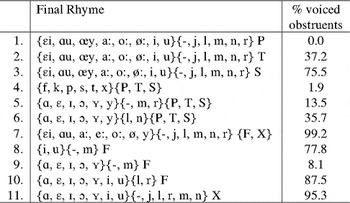
Table 1 presents these analogical gangs, characterized by the final rhymes of their stems as realized in isolation. The segments enclosed by the first pair of brackets represent the possible vowels in the final rhymes of that gang, while the segments enclosed by the second pair of brackets represent the possible pre-final consonants, with a hyphen indicating the possibility of the absence of a pre-final consonant. Finally, F, S, X, T, and P refer to place of articulation of the final obstruents, which are necessarily voiceless when the stems are presented in isolation. The rightmost column in the table shows the percentages of words with final obstruents that are voiced before vowel-initial suffixes. These percent-ages thus represent the chance that the final obstruent of a word in a given gang is voiced.
The eleven analogical gangs (Ernestus & Baayen Reference Ernestus and Baayen2004:880).Footnote 5

On the basis of the classification tree, the presence versus absence of voice alternation could be predicted accurately for 83.2% of the morpheme final obstruents in the database. In a production experiment, Ernestus & Baayen (Reference Ernestus and Baayen2003) tested whether speakers can also predict final voicing. Their participants listened to the stems of 192 nonce verbs. The final obstruents were all realized as voiceless, as they were in word final positions (final devoicing). Participants were asked to write down the past tenses for the nonce verbs. In Dutch, the choice of the past tense suffix is determined by the voice specification of the stem final phoneme before vowel-initial suffixes: -te is added if this final phoneme is voice-less and -de if the final phoneme is voiced. Accordingly, slibde is the past tense of slibben‘to silt up’, consisting of the stem slib and the infinitive suffix -en, and slipte is the past tense of slippen ‘to slip’, with the stem slip. Ernestus & Baayen observed a strong correlation between the percentage of participants that interpreted the final obstruent of a particular nonce word as voiced before vowel-initial affixes (and thus added -de) and the percentage of existing words with a voiced obstruent in the gang of the nonce word, that is, the analogical support for voicing. To give an example, on the basis of its phonological structure, the nonce verb form /bɔp/ belongs to analogical set 5 (see table 1). Most of the verbs in that set have a voiceless final obstruent before vowel-initial suffixes (an analogical support of 86.5%), and 90% of the participants chose the form bopte (and not bobde).
Table 1 also indicates the analogical probability to a non-standard form (henceforth APN) for existing morphemes. For morphemes with voiceless final obstruents before vowel-initial suffixes, the APN is the chance that they are considered as ending in voiced obstruents. These chances equal the percentages of words with voiced obstruents in these morphemes' gangs, as listed in table 1. For morphemes with voiced final obstruents, the “inverse” chances apply as APN values (100 minus the percentages from table 1). For instance, the above mentioned verbs slibben and slippen belong to analogical set 5, of which only 13.5% of the words have a voiced final obstruent before vowel-initial suffixes. Hence, while the APN value of slippen is 13.5, the APN value of slibben is 86.5 (= 100-13.5). Ernestus & Baayen (Reference Ernestus and Baayen2004) have shown that the APN is indeed a good predictor for the probability that a speaker produces non-standard past tense forms for existing verbs. In addition, the APN predicts reading times for standard and non-standard past tense forms (Ernestus & Mak Reference Ernestus and Mak2005).
If devoicing in Dutch is lexically diffused and if this diffusion is affected by analogy, we may expect that words with higher APNs are affected more and earlier than words with low APNs. By operationalizing analogy in terms of APN values that can be calculated objectively, we can further investigate and make explicit the relationship between phonetic analogy and sound change that was suggested by Schuchardt (Reference Schuchardt, Vennemann and Wilbur1885), Sturtevant (Reference Sturtevant1917), and others.
7. The Operationalization of Frequency of Occurrence
Some of the words in our experiment occur with different frequencies of occurrence in the Dutch spoken in the Netherlands and in Flanders. In order to obtain reliable objective frequency estimates of all words in these two language varieties, we need large text corpora in which also less frequent words occur several times. Unfortunately, such corpora are not available.
We therefore collected speakers' intuitions of the frequency of occurrence of the words in an online rating experiment. The 98 items of the experiment (described in the next section) were presented one by one on the computer screen, and participants indicated on a scale of one to seven their impression of the frequency of the items; 1: never, 2: once a year, 3: once a month, 4: once a week, 5: once every two days, 6: once a day, 7: several times a day (see Balota et al. Reference Balota, Pilotti and Cortese2001). The test items were randomized for each participant, and 108 university students between the ages of eighteen and twenty-five participated in the experiment: 64 from Flanders (17 males, 47 females) and 44 from the Netherlands (16 males, 28 females). The experiment was self-paced. The appendix lists the mean frequency scores for each word as rated by the Dutch and Flemish students.
8. The Experiment
8.1. Method
The sound change of fricative devoicing can be investigated following different methods. At first sight, measuring the duration of vocal vibration may appear an appropriate method—for instance by laryngography, following Verhoeven & Hageman (Reference Verhoeven and Hageman2007). As mentioned above, however, vocal fold vibration is just one of the many acoustic cues to the perceptional value of the “voicedness” of Dutch fricatives. Moreover, we do not know the relative contributions of the different cues in Flanders and the Netherlands, now or in the past.
Perceptual methods offer an alternative. We may ask listeners to classify fricatives as voiced or voiceless. This research method is probably highly conservative, since participants not trained in discriminating between voiced and voiceless sounds, may tend to choose the voice specification dictated by the standard spelling.
Both methods suffer from an additional problem. They need fricatives produced in clear speech. Clear speech can only be obtained when speakers are in a quiet room and speak directly into the microphone. Under such conditions, speakers tend to speak very carefully and pay attention to their own pronunciation. Their speech tends to be influenced by the words' orthography, especially in shallow writing systems. Hence, both research methods will produce results that are not only determined by the speakers' lexical representations of the words' sound structures, but also by their spelling. The effect of orthography will result in an underestimation of the exact stage of the sound change of fricative devoicing. For our purpose, this is not problematic since we do not wish to study the precise degree of devoicing, but rather the effects of frequency and analogy on the devoicing process.
Because the standard spellings of the words will probably codetermine the results anyway, independently of whether the participants' attention is explicitly drawn towards orthography, and because we wanted to avoid as much as possible random answers by phonetically untrained listeners, we decided to rely on a written mode. We asked the participants to indicate for a series of words which of two orthographic representations they thought was standard. In one spelling the fricative was represented with the standard voice specification, and in the other spelling with the non-standard specification. For instance, participants were asked to choose between standard pluizen and non-standard pluisen ‘to fluff’.
Though the orthographic approach to the study of sound change has a long and productive tradition in historical linguistics, its disadvantages are obvious. The results concern primarily orthography and only indirectly pronunciation. The relevance for production depends amongst other things on the shallowness of the orthographic system. Note that the Dutch spelling system is a fairly shallow one in general and that the spelling of prevocalic coronal and labiodental fricatives in endogenous Dutch words, which form our test items, is genuinely shallow: [z] is always (supposed to be) written as <z>, <z> is always (supposed to be) pronounced as [z], etc. As a consequence, systematic deviations from a word's standard spelling by experienced writers typically result from phonetic deviations or changes.
8.2. Hypotheses
We tested the following hypotheses:
(i) /z/ and /v/ are more easily devoiced in words with a high APN value than in words with a low APN value.
(ii) By hypercorrection, /s/ and /f/ are more easily voiced in words with a high APN value than in words with a low APN value.
(iii) Highly frequent (morphologically simplex) words are affected first.
8.3. Participants
Sixty-two native speakers of Dutch participated in the experiment. Thirty-one were recruited from the University of Amsterdam: eighteen male and thirteen female students. They were all born and raised in the northern part of the Netherlands (north of the “Great Rivers”), where devoicing is most advanced. The other thirty-one participants studied at the University of Leuven: thirteen male and eighteen female students. They came from all Flemish provinces. All participants were between eighteen and twenty-three years old.
8.4. Materials
For two reasons, we chose infinitives consisting of the verbal stem and the vowel-initial suffix -en as our test items. First, we needed words with stem final obstruents as we have the APN values for these obstruents (see table 1). Second, we preferred word internal fricatives to word initial ones as they show the weakest tendency to devoicing. Obviously, word final fricatives, being consistently devoiced (final devoicing), did not qualify for selection.
We selected 98 infinitives: 38 with stems ending in /z/, 32 with stems ending in /v/, 27 infinitives with stems ending in /s/, and 1 infinitive with a stem ending in /f/ (see the appendix; this distribution is in line with the distribution of these fricatives in Dutch in general). Stems with the velar fricatives /ɣ/ and /χ/ were not included in the stimuli set as these fricatives have merged more or less completely in the Netherlandic Dutch variety we are studying. In addition, we did not select infinitives that occurred exclusively in either the Netherlands or Flanders, or infinitives that formed minimal word pairs (for example, briefen ‘to brief’, (over)brieven ‘to blab’ and golfen ‘to play golf’, golven ‘to wave’). The test items spanned the whole subjective frequency range (from 1 to 7).
All stems were monomorphemic, except the 10 words of which the stems do not occur by themselves (for instance ver+poz ‘to repose’). Hence, if devoicing turns out to be more common among the low frequency words than among the high frequency words, this frequency effect cannot be due to morphological reanalysis (see Phillips Reference Phillips1984, Reference Phillips, Bybee and Hopper2001, Reference Phillips2006).
To avoid list effects, the selected infinitives were pseudo-randomized four times, giving rise to four lists with different orders. We subsequently created booklets, each containing the infinitives of one list. Every infinitive was presented on a different page of a booklet, to minimize the influence of adjacent test items. Each page showed two variants of the infinitive: one with a voiceless fricative, the other with a voiced fricative, for example, bonsen and bonzen (‘to bang’).
8.5. Procedure
Participants were instructed to indicate on each page of the booklet which of the two variants they thought was the standard form. They received the explicit instruction not to leaf backward in the books. The experiment was self-paced and participants were paid.
8.6. Results
We analyzed the number of standard and non-standard spelling choices for each infinitive by means of a logistic regression. The infinitives represented a limited set of APN values, and APN did not approximate a normal distribution. We therefore transformed APN into a factor and classified the infinitive as having a high APN (higher than 50% according to table 1) or as having a low APN (lower than 50%). We entered as predictors in the model the APN (high versus low), the frequency (average subjective frequency rating) of the word, which was different for speakers from the Netherlands and Flanders, region (the Netherlands versus Flanders), standard voice specification (voiced versus voiceless), and type of fricative (coronal versus labiodental). In addition, we entered the square of the subjective frequency rating, since we noticed a non-linear relationship between the frequency ratings and the percentages of non-standard forms.
All predictors emerged as significant. Verbs with a high APN elicited more non-standard forms than verbs with a low APN (25.6% versus 11.4%, F(1, 192) = 165.49, p < 0.001), and a higher frequency in general implied fewer non-standard forms (simple effect: F(1,194) = 113.62, p < 0.001; quadratic term: F(1,193) = 25.02, p < 0.001). Flemish participants chose non-standard forms less often than their counterparts from the Netherlands (8.2% versus 21.6%, F(1, 191) = 220.57, p < 0.001), and they all chose non-standard forms more often if the standard specification was voiced (16.1% versus 11.8%, F(1, 190) = 62.83, p < 0.001). Finally, verb stems ending in /s/ or /z/ elicited more non-standard forms than those ending on /f/ or /v/ (16.9% versus 10.9%, F(1, 189) = 10.63, p < 0.001).
These main effects were modulated by several interactions. APN interacted with region: The effect of APN was stronger in the Netherlands (difference in percentages of non-standard forms between high and low APN verbs: 16.1%) than in Flanders (12.2%, F(1, 188) = 6.51, p < 0.05). Region also interacted with type of fricative (F(1, 182) = 23.94, p < 0.001): the coronal fricatives elicited more non-standard responses than the labiodental fricatives, especially from the Flemish participants (Flemish: 11.0% non-standard forms for the coronal fricatives and 2.6% for the labiodental fricatives; Dutch: 22.8% and 19.2%, respectively).
There were several interactions with frequency. To begin with, frequency interacted with the standard voice specification (F(1, 183) = 35.56, p < 0.001). Frequency had a stronger effect on voiced fricatives, that is, it was a better predictor for devoicing than for hypercorrect voicing. In addition, frequency interacted with APN (simple effect F < 1; quadratic term: F(1, 185) = 6.26, p < 0.05) and with region (simple effect F(1, 186) = 29.78, p < 0.001; quadratic term: F(1, 184) = 9.98, p < 0.01). The three-way interaction between frequency, APN, and region was marginally significant (F(1, 181) = 3.55, p = 0.06). Figure 1 illustrates these interactions.
The two upper panels show the relation between the subjective frequency ratings and the percentages of non-standard forms for the Flemish participants and the lower panels for the Dutch participants. The left plots show the relation for the verbs with a high APN, the right plots for the verbs with a low APN. The lines in the plot represent non-parametric scatter plot smoothers (Cleveland Reference Cleveland1979). Non-standard forms were chosen above all for infrequent verbs, but frequency affected the Dutch responses to a higher degree than the Flemish responses. Moreover, the frequency effect was stronger for verbs with a high APN. Note that the Dutch responses for verbs with a high APN suggest that a higher frequency only decreases the percentages of non-standard forms from a frequency score of 3 onwards. We conclude that frequency has a stronger effect if APN (high) or region (the Netherlands) already leads to more non-standard forms.

9. Lexical Analysis
The participants in our experiment chose non-standard forms especially for low frequency words with high APN values. Apparently, words resist the analogical force from the similarity patterns in the lexicon (high APN values) better if they are of a higher frequency. This suggests an interesting hypothesis for the Modern Dutch lexicon. Many low frequency words with high APN values possibly have changed in the past according to the patterns in the lexicon, or these patterns have prevented such words from arising at all. Hence, the words with a high APN value in the lexicon may tend to be highly frequent words.
Evidence for this hypothesis would constitute support for our experimental results. We therefore tested this hypothesis on the basis of the data set analyzed by Ernestus & Baayen (Reference Ernestus and Baayen2003). This dataset consists of all 1,697 words attested in the Dutch section of the CELEX lexical database (Baayen et al. Reference Baayen, Piepenbrock and Gullikers1995) that a) consist of a nominal, verbal, or adjectival base morpheme ending in an obstruent of which both the voiced and the voiceless variants are phonemes in Dutch, and b) can be followed by the comparative suffix -er, the infinitive suffix ‑en, or the plural suffix -en. Note that this database contains not only fricative final but also plosive final words. We determined for these words the APN values and their lemma frequencies as listed in CELEX. After removing three outliers, we found a linear relationship between the APN and the log of the frequencies (F(4, 4521) = 7.1877, p < 0.01). As expected, given the results of our experiment, high APN values are mainly found among frequent words (coefficient: 0.7287).
10. Discussion of the Experimental and Lexical Data
10.1. The Transmission of Sound Change
In the Labovian view, a sound change proceeds according to neogram-marian principles (affecting all words simultaneously) if it is gradual, whereas a change obeys the principles of lexical diffusion (irregular change) if it is phonetically abrupt. As devoicing is a gradient process (Smith Reference Smith1997), which is gradually proceeding in Dutch (van de Velde & van Hout Reference Krott2001), the process should not be lexically diffused. Nevertheless, we found that it is—a voiced fricative is considered as voiceless more often in some words than in others.
As expected, the sound change not only results in devoiced fricatives, but also in hypercorrect voicing. Speakers are aware of the ongoing change of devoicing, and as a consequence feel uncertain about the voice values of fricatives. This results in the hypercorrect voicing of voiceless fricatives, especially in situations in which speakers' attention is drawn to voicing. Note that in Netherlandic Dutch no less than 11.8% of the voiceless fricatives were incorrectly voiced.
The lexical diffusion appeared to be affected by phonetic analogy. The APN that we used to gauge phonetic analogy effects is based on the idea that a word is changed not in analogy to a single other word, but in analogy to the majority pattern in the phonological gang to which the word belongs. We found that words with high APN values, that is, words belonging to the phonological minority, change first and more easily. In other words, the analogy effects that we found do not result in irregularity, but in regularity. Our findings are thus in line with the spirit of the neogrammarian theory, and they make explicit and confirm the intuitions of Schuchardt (Reference Schuchardt, Vennemann and Wilbur1885), Sturtevant (Reference Sturtevant1917), Phillips (Reference Phillips, Bybee and Hopper2001, Reference Phillips2006), Bybee (Reference Bybee2002), van Bree (Reference Bree1996), and others about the role of phonetic analogy. Since the APN affects both the scores for the voiced and voiceless fricatives (there was no interaction of APN and voicing), the data confirm hypotheses i and ii, which assume analogy effects in Dutch fricative devoicing and hypercorrect voicing.
In addition, frequency affects the devoicing process. In the experiment, fricatives were more often assigned a non-standard voice specification the lower the word's frequency of occurrence, contra hypothesis iii. This finding suggests that high frequency words resist strong phonetic analogical forces, as reflected by high APN values, better than low frequency words. If so, the Modern Dutch lexicon is expected to contain especially high frequency, rather than low frequency, words with high APN values. Many low frequency words with high APN values have probably already changed or have not emerged at all. We showed that this is indeed the case. High frequency words resist strong phonetic analogical forces.
This result may be unexpected given that devoicing is a reductive process, and Bybee (Reference Bybee2002) showed that reductive changes tend to favor frequent words. Apparently, we should differentiate between different types of reductive changes. The changes on which Bybee (Reference Bybee2002:264–268) based her position, with one exception, are all cases of deletion that imply a substantial loss of information, which a speaker can only afford if the listener can easily reconstruct the unreduced form (see van Son & Pols Reference Son and Pols2003; van Son & van Santen Reference Son and Santen2005). This may explain why these changes preferentially affect highly frequent words. The sound change that we studied, in contrast, involves hardly any information loss as it concerns the abolition of a very weak phonological opposition. In Dutch, the voice feature of coronal and labiodental fricatives is hardly distinctive, as shown by the very small number of minimal word pairs (Ernestus Reference Ernestus2000:50–51; van Reenen & Jongkind Reference Reenen, Jongkind, Kawaguchi, Zaima, Takagaki, Shibano and Usami2005). The oppositions /z/-/s/ and /v/-/f/ are therefore unimportant for the transfer of information, and the devoicing of these fricatives hardly hinders communication. As a consequence, devoicing, leading to reduced articulatory effort, may affect all words to some degree, and speakers may easily forget the voice specification of fricatives in infrequent words. For more frequent words, the frequent repetition of the standard realization in speech as well as in spelling may leave strong traces in the speakers' mental lexicons.
Phillips (Reference Phillips1984, Reference Phillips, Stockwell and Minkova2002, Reference Phillips2006) predicts that sound changes preferentially affect the low frequency words in case of reanalysis. Changes that affect the high frequency words first are changes that “require no access to more sophisticated structures than surface phonetic forms” (Phillips Reference Phillips2006:76). Morphological reanalysis is unlikely for the infinitives in our experiment since most of these contain monomorphemic stems. In addition, phonological reanalysis cannot explain our results. According to Phillips, phonological reanalysis depends on neighborhood density, which she defines as “the number of words that are phonologically similar to a given word” (definition from Vitevitch et al. 1998, quoted by Phillips Reference Phillips, Bybee and Hopper2001:133). Previous research referred to by Phillips (Reference Phillips, Bybee and Hopper2001:133) has shown that words in a dense neighborhood are more carefully articulated than words in a sparse neighborhood:
This careful articulation implies phonological analysis. The implication for sound change is clearly that lexical analysis may include analysis by neighborhood similarity: words in such a phonological subset can resist the direction of a sound change because they are being analyzed phonologically as well as grammatically. They are first recognized as members of a particular grammatical category […], but they are also analyzed by neighborhood similarity, allowing them to behave independently even within their word class.
The careful pronunciation, however, appears to be restricted to those segments that disambiguate a word from its phonological neighbors (for example, van Son & Pols Reference Son and Pols2003; van Son & van Santen Reference Son and Santen2005). The APN is a measure for the informativeness of the voice specification of stem final fricatives. Words with a high APN differ from the majority of phonological neighbors in the voicing of their stem final obstruents and hence voicing is more informative for words with a high APN. As a consequence, we expect the stem final fricatives especially of words with high APN values to be pronounced carefully and to resist non-standard realizations. This is, however, exactly the opposite of what we found.
Frequency affected both words with voiced and words with voiceless fricatives, and thus affected both the degree of devoicing and the degree of hypercorrect voicing. In other words, the direction of the frequency effect was not strongly determined by the nature of the variation. This may suggest that orthography played an important role in this experimental task, especially since participants had to choose between different spellings. Note, however, that reference to participants' memory of the words' spellings cannot explain all results, since the frequency effect was stronger for words with voiced fricatives. Participants made errors not just because they could not remember the correct spelling for words with weak representations. As argued above, they also, and possibly mainly, based their responses on their knowledge of the words' pronunciations.
10.2. The Actuation of Sound Change
Thus far, we have commented on the transmission process of the sound change, which we have shown to be directed by analogy and frequency. Our data allow us to sharpen our understanding of the actuation of the change as well. In section 5, we argued that in Flemish Dutch, devoicing could be a manifestation of synchronic variation, as it is in English and French. The results of our experiment confirm this claim for /v/, since infinitives with /v/ elicited only 2.6% of non-standard responses in Flanders (compare Netherlandic Dutch with 19%).
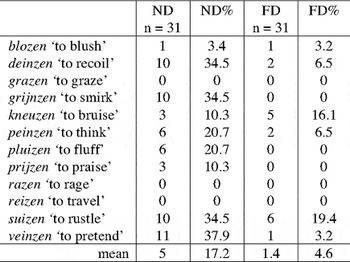
By contrast, for /z/ we cannot ignore some high percentages of Flemish non-standard choices. For eleven verbs, the percentage is above 20%. Nine of these words have very low frequencies (< 2.5 on a scale of 1–7). The two other verbs, plonzen ‘to splash’ and omhelzen ‘to embrace’, have high APN values (64.3%). To ascertain whether the Flemish Dutch devoicing of /z/ might constitute a sound change, it is useful to determine the degree of devoicing for those verbs which analogy and frequency protect against devoicing. We considered only those 12 verbs with /z/ that have a subjective-frequency score higher than 3 (average 3.5, median 3.3) and an APN value lower than 50%. Table 2 shows that, compared to the Dutch participants, the Flemish devoiced very infrequently for these verbs (in only 4.6% of responses), primarily limited to two verbs (kneuzen ‘to bruise’, 16.1% and suizen ‘to rustle’, 19.4%).
Numbers and percentages of non-standard choices for infinitives with /z/ with a low APN value (< 50) and an average or high frequency (≥ 3). ND = Netherlandic Dutch, FD = Flemish Dutch.

We conclude that high percentages of devoicing in Flemish Dutch are almost entirely limited to a small number of verbs, namely, those with low frequencies of occurrence and high APN values. These verbs are thus not protected by a high frequency or by a large group of phonologically similar words with the same voice specification for the fricative and therefore supporting this voice specification. In Netherlandic Dutch, in contrast, practically all verbs are prone to substantial devoicing, even highly frequent verbs belonging to phonological majority groups (low APN values). Hence, we consider the hypothesis of devoicing as syn-chronic variation in Flanders as realistic.
Under the assumption that Flemish displays only synchronic variation, our data suggest that there are no principled differences between synchronic and diachronic devoicing. They are both conditioned by analogy and frequency (but to different degrees).
Contrary to the general assumption that any sound change starts as a synchronic substitution initiated by one or two speakers (Luschützky Reference Luschützky2004:161, Sturtevant, 1917:81–82), our data confirm Ohala's (Reference Ohala, Breivik and Håkon1989:173) idea that “sound change is drawn from a pool of synchronic variation.” At the same time, while Ohala (Reference Ohala, Joseph and Janda2003:686) claims “that listeners' errors constitute the main and the essential factor in the sound change,” we see no need to bring in perception errors to account for the devoicing of Dutch fricatives (though it may contribute to the degree of variation). In our opinion, a sound change can depart from an existing, synchronic variation, which itself may result from articulatory reduction.
This could also (at least partially) explain our observation that coronal fricatives are devoiced more often than labiodental fricatives, which follows a tendency observed for other languages. Archambault & Maneva (Reference Archambault and Maneva1996:1535) explain this resistance of /v/ to devoicing on the basis of the lower noise component of /v/, creating “less pressure on the vocal cords allowing them to vibrate more efficiently.” Also, in line with Smith's (Reference Smith1997) reduction theory, we can add that the production of /v/ implies a larger supralaryngeal cavity—the tongue being lowered and the constriction at the extreme end of the vocal tract—than the production of /z/. This larger cavity makes the greater resistance of /v/ against devoicing quite natural, since it facilitates the upholding of the transglottal pressure difference necessary for phonation.
11. Frequency, Analogy, and a Dynamic Model of Sound Change
Our results support the hypothesis that language changes can find their source in synchronic variation and that this variation, as well as the change process itself, is conditioned by frequency and analogy. How can these facts be accounted for in a linguistic model?
Importantly, the data do not confirm the traditional view current in historical linguistics that “a sound change has occurred whenever the value of a distinctive feature in the representation of a lexical or morphological element has changed without any semantic or morphological alteration” (Luschützky Reference Luschützky2004:161, denouncing the tradition). A static view of the lexicon with symbolic representations and binary or privative features cannot easily account for the variable and ever changing reality. Luschützky (p. 158) therefore criticizes existing phonological models as most of them lack the means to incorporate the dynamic dimension of variation and the stochastic dimension of speech.
Over the past decades, alternative models of lexical memory have been developed that assume episodic representations (exemplars) and do incorporate factors such as analogy and frequency (see Lachs et al. Reference Lachs, McMichael, Pisoni, Bowers and Marsolek2003). Though our results are compatible with many of such theories, we confine our discussion here to the application of a specific model that not only accounts for perception and production, but explicitly for sound change as well, namely, Bybee's (Reference Bybee2001) usage-based phonology, which we slightly amended in terms of the role of frequency.
Bybee's model is an exemplar-based network approach, which posits that all perceived manifestations of a word (tokens) are stored in detail in the mental lexicon, with (phonetic and semantic) analogy being the principle of organization. Sufficiently similar tokens are stored together, yielding strengthened representations, which come close to prototypes in other models. One word can have several prototype-like representations. In the case of Dutch fricatives, a word could have the standard voiced representation, a devoiced one, and one or more partially voiced representations, all strengthening and weakening in accordance with the ever changing input.
Linguistic patterns emerge from the representations in the lexicon and therefore change continually as the representations change. These gradient patterns encompass sets of phonologically similar tokens (gangs). Stronger patterns are based on more items and are more likely to affect new forms (Bybee Reference Bybee2001:28). In addition, we may expect them to extend to linguistic forms speakers feel uncertain about. If a language user is in doubt about two variants—both their representations are weak, equally strong, or non-existent (in the case where the word is unknown to speaker)—the variant tends to be chosen that conforms to the strongest pattern, emerging from the largest gang or subset of a gang.
This mechanism explains why infrequent words are affected first by analogical force. By contrast, frequent words, having strong representations, are not “endangered” by regularization. These words may be subject to automation processes such as deletion or other kinds of radical reduction that may cause information loss. Highly frequent words can afford this loss since they are easily accessed and all their variants, being frequent, also have strong lexical representations.
Both regularization and automation can lead to language change. The automation processes gradually favor the reduced words, since they are more and more preferred, especially in fast casual speech and in extremely frequent words. The representations of the reduced items grow stronger, while those of the full forms weaken and ultimately disappear, as has been the case for English God be with you > goodbye, or Dutch het mach des gescien ‘it may happen’ > misschien ‘maybe’. These changes are lexically specific, as opposed to regularizing sound changes, which may affect all words (of a category), but the infrequent and analogically endangered ones first, as is the case for irregular past tense forms, among others.
Bybee's model of speech processing and language change can well account for fricative devoicing in Dutch discussed in the present paper. We consider it very probable that the devoicing process in Netherlandic Dutch departed from synchronic “constrained variation,” which still appears present in Flanders. The problematic articulation of voiced fricatives tends to give rise to voiceless or partly voiceless realizations of voiced fricatives in all words and those voiceless realizations build up (as yet weak) representations in the lexicon. The strength of these alternative representations is largely determined by the frequency and the APN value of the words.
Generally, the need for successful communication as well as various social factors constrain the voiced/voiceless alternation, so that the standard representation with the voiced fricative may remain the stronger one, as in Flanders. In Netherlandic Dutch, however, the conserving restraints have been loosened (actuation) and the voiced/voiceless alternation has expanded, determined by phonetic analogy and frequency.
The more the lexical diffusion progresses, the stronger becomes the regularizing tendency to devoice /v/ or /z/ also in frequent words and words with a lower APN. At the present time, practically all items with a standard voiced fricative have voiceless or partly voiceless representations as their strongest form in Netherlandic Dutch. However, due to uncertainty on the part of the speaker in this transitional phase and due to the influence of analogy, there is an increased presence of weaker, hypercorrect representations as well.
12. Conclusion
Since the nineteenth century, linguists have studied the relation between phonetic and lexical gradience in language change and the factors driving lexical diffusion. In the present paper, we discussed fricative devoicing in Dutch, a process that is generally believed to be phonetically gradual. We have shown it is lexically diffused as well and therefore presents a combination of characteristics that should not occur according to many linguists.
The devoicing process has affected nearly all words in Netherlandic Dutch, whereas it is much more constrained in Flemish Dutch where it may represent no more than free, synchronic variation. Importantly, both the synchronic and the diachronic variation are conditioned by the frequency of occurrence of the word as well as by the analogical patterns based on phonetic similarity in the mental lexicon. The devoicing especially affects fricatives in less frequent words that are supported by only minor analogical lexical patterns. These facts require a dynamic, stochastic model of sound change, as is provided for in Bybee's (Reference Bybee2001) usage-based phonology. Sound changes appear to be systematically governed by mechanisms of language use.
Appendix
Words used in both experiments as stimuli. Each word is followed by its English translation, its APN value, the absolute number of non-standard choices and the subjective frequency score for Netherlandic Dutch (ND), and the absolute number of non-standard choices and the subjective frequency score for Flemish Dutch (FD). For instance:
azen ‘to prey on’ 24.5 ND: 6 3.120 FD: 2 2.800
APN value: 24.5
Netherlandic Dutch—the absolute number of non-standard choices: 6
Netherlandic Dutch—the subjective frequency score: 3.120
Flemish Dutch—the absolute number of non-standard choices: 2
Flemish Dutch—the subjective frequency score: 2.800
azen ‘to prey on’ 24.5 ND: 6 3.120 FD: 2 2.800 / bazen ‘to domineer’ 24.5 ND: 4 1.970 FD: 0 1.600 / bedroeven ‘to sadden’ 22.2 ND: 1 3.880 FD: 0 3.130 / behelzen ‘to include’ 64.3 ND: 11 3.320 FD: 7 2.130 / biezen ‘to braid’ 24.5 ND: 3 1.470 FD: 7 1.330 / blozen ‘to blush’ 24.5 ND: 1 4.210 FD: 1 4.100 / bonzen ‘to bang’ 64.3 ND: 8 3.820 FD: 4 3.170 / briesen ‘to snort’ 75.5 ND: 14 2.240 FD: 7 2.330 / bronzen ‘to bronze’ 64.3 ND: 14 1.970 FD: 12 1.830 / bruisen ‘to foam’ 75.5 ND: 6 3.530 FD: 0 3.400 / dansen ‘to dance’ 35.7 ND: 0 4.680 FD: 0 4.870 / deinzen ‘to recoil’ 24.5 ND: 10 3.850 FD: 2 3.330 / doven ‘to extinguish’ 0.8 ND: 2 3.940 FD: 0 4.430 / draven ‘to trott’ 0.8 ND: 3 3.410 FD: 0 3.000 / druisen ‘to roar’ 75.5 ND: 10 2.560 FD: 4 2.570 / durven ‘to dare’ 12.5 ND: 3 5.710 FD: 0 5.370 / eisen ‘to demand’ 75.5 ND: 1 4.290 FD: 0 4.430 / erven ‘to inherit’ 12.5 ND: 16 3.880 FD: 2 3.670 / flansen ‘to knock together’ 35.7 ND: 5 2.650 FD: 5 2.230 / forenzen ‘to commute’ 64.3 ND: 17 2.150 FD: 11 1.270 / frezen ‘to mill’ 24.5 ND: 10 2.470 FD: 5 1.730 / fronsen ‘to frown’ 35.7 ND: 11 4.060 FD: 3 3.930 / fuiven ‘to party’ 0.8 ND: 15 2.590 FD: 0 5.170 / glanzen ‘to gleam’ 64.3 ND: 7 3.940 FD: 1 3.500 / gonzen ‘to buzz’ 64.3 ND: 8 3.180 FD: 2 3.000 / grazen ‘to graze’ 24.5 ND: 0 3.360 FD: 0 3.100 / grenzen ‘to border’ 64.3 ND: 6 3.820 FD: 2 3.670 / grieven ‘to hurt’ 22.2 ND: 4 2.120 FD: 5 1.700 / grijnzen ‘to smirk’ 24.5 ND: 10 4.150 FD: 0 3.900 / groeven ‘to groove’ 22.2 ND: 2 2.210 FD: 1 2.030 / hozen ‘to bale’ 24.5 ND: 4 3.150 FD: 3 1.500 / huizen ‘to be housed’ 24.5 ND: 5 2.380 FD: 0 2.300 / kalven ‘to calve’ 12.5 ND: 10 1.880 FD: 2 2.270 / kansen ‘to give it a try’ 35.7 ND: 3 1.640 FD: 1 1.430 / kapseizen ‘to capsize’ 75.5 ND: 7 2.290 FD: 4 2.630 / kerven ‘to gouge’ 12.5 ND: 11 2.560 FD: 0 3.100 / kloven ‘to split’ 0.8 ND: 3 2.560 FD: 0 2.100 / kluiven ‘to gnaw’ 0.8 ND: 4 2.790 FD: 1 1.770 / klunzen ‘to bungle’ 64.3 ND: 14 2.090 FD: 11 2.000 / knarsen ‘to crunch’ 13.5 ND: 2 3.410 FD: 0 3.030 / kneuzen ‘to bruise’ 24.5 ND: 3 3.410 FD: 5 3.230 / kransen ‘to wreathe’ 35.7 ND: 2 1.910 FD: 1 1.670 / krijsen ‘to shriek’ 75.5 ND: 1 3.880 FD: 1 3.470 / kruisen ‘to cross’ 75.5 ND: 7 3.710 FD: 0 3.970 / kuisen ‘to expurgate’ 75.5 ND: 10 1.710 FD: 0 4.200 / laven ‘to slake’ 0.8 ND: 1.620 FD: 0 1.800 / leven ‘to live’ 0.8 ND: 0 5.710 FD: 0 5.300 / liefkozen ‘to caress’ 24.5 ND: 0 3.120 FD: 0 2.930 / loven ‘to praise’ 0.8 6 ND: 3.260 FD: 0 3.070 / morsen ‘to spill’ 13.5 ND: 0 4.120 FD: 0 4.600 / neuzen ‘to nose around’ 24.5 ND: 2 2.650 FD: 0 2.300 / omhelzen to embrace' 64.3 ND: 13 4.410 FD: 9 4.500 / peinzen ‘to reflect on’ 24.5 ND: 6 4.090 FD: 2 3.870 / persen ‘to press’ 13.5 ND: 0 3.530 FD: 0 3.630 / plenzen ‘to pour’ 64.3 ND: 18 3.850 FD: 20 2.330 / plonzen ‘to splash’ 64.3 ND: 23 3.650 FD: 17 3.430 / pluizen ‘to fluff’ 24.5 ND: 6 3.120 FD: 0 3.070 / polsen ‘to sound out’ 35.7 ND: 3 3.000 FD: 0 3.870 / ponsen ‘to punch’ 35.7 ND: 10 1.880 FD: 14 1.430 / prijzen ‘to praise’ 24.5 ND: 3 3.760 FD: 0 3.270 / proeven ‘to taste’ 22.2 ND: 3 5.380 FD: 0 4.830 / razen ‘to rage’ 24.5 ND: 0 3.970 FD: 0 3.770 / reizen ‘to travel’ 24.5 ND: 0 4.180 FD: 0 4.430 / roezen ‘to make a din’ 24.5 ND: 10 1.560 FD: 8 1.530 / ruisen ‘to rustle’ 75.5 ND: 15 2.850 FD: 3 2.800 / ruiven ‘to moult’ 0.8 ND: 9 1.290 FD: 3 2.830 / schorsen ‘to suspend’ ND: 13.5 1 3.150 FD: 1 3.230 / schroeven ‘to screw’ 22.2 ND: 3 3.740 FD: 1 3.530 / sjezen ‘to drop out’ 24.5 ND: 15 3.520 FD: 5 2.630 / slaven ‘to slave’ 0.8 ND: 4 1.530 FD: 0 1.530 / slonzen ‘to skimp’ 64.3 ND: 8 2.440 FD: 7 1.800 / sluizen ‘to channel’ 24.5 ND: 9 2.650 FD: 5 1.830 / smoezen ‘to invent excuses’ 24.5 ND: 6 3.030 FD: 7 1.700 / snoeven ‘to swagger’ 22.2 ND: 2 1.440 FD: 2 1.600 / soezen ‘to doze’ 24.5 ND: 4 2.120 FD: 0 2.270 / spijzen ‘to feed’ 24.5 ND: 7 1.850 FD: 0 2.600 / staven ‘to substantiate’ 0.8 3 2.260 FD: 0 2.930 / stijven ‘to starch’ 0.8 ND: 7 2.150 FD: 0 2.130 / stoven ‘to stew’ 0.8 ND: 6 2.910 FD: 0 3.570 / streven ‘to strive’ 0.8 ND: 0 4.500 FD: 0 4.730 / suizen ‘to rustle’ 24.5 ND: 10 3.240 FD: 6 3.300 / surfen ‘to surf’ 87.5 ND: 0 3.620 FD: 0 4.300 / toeven ‘to abide’ 22.2 ND: 6 2.000 FD: 0 1.730 / torsen ‘to haul’ 13.5 ND: 2 1.850 FD: 0 1.930 / troeven ‘to trump’ 22.2 ND: 5 2.740 FD: 1 2.130 / turven ‘to tally’ 12.5 ND: 13 3.350 FD: 6 2.130 / veinzen ‘to pretend’ 24.5 ND: 11 2.540 FD: 1 3.040 / vereuropesen ‘to become Europeanized’ 75.5 ND: 13 2.560 FD: 6 1.730 / verfransen ‘to gallicize’ 35.7 ND: 5 3.910 FD: 1 3.970 / verpozen ‘to repose’ 24.5 ND: 8 1.710 FD: 5 2.430 / verschansen ‘to entrench’ 35.7 ND: 3 3.060 FD: 2 2.870 / verven ‘to paint’ 12.5 ND: 18 1.740 FD: 2 2.270 / vervalsen ‘to forge’ 35.7 ND: 0 4.090 FD: 0 4.170 / vervlaamsen ‘to become Flemish’ 75.5 ND: 4 1.620 FD: 1 2.500 / vorsen ‘to research’ 13.5 ND: 5 1.440 FD: 1 1.500 / welven ‘to curve’ 12.5 ND: 3 1.680 FD: 1 1.670 / wuiven ‘to wave’ 0.8 ND: 8 3.530 FD: 0 4.130 / zeven ‘to sieve’ 0.8 ND: 6 3.330 FD: 0 2.870 / zweven ‘to hover’ 0.8 ND: 1 3.910 FD: 0 3.630.