Introduction
There has been renewed concern about the universal coverage of social protection because of restricted livelihood opportunities and high levels of poverty under globalisation and labour market segmentation (Canagarajah and Sethuraman, Reference Canagarajah and Sethuraman2001; United Nations Research Institute for Social Development [UNRISD], 2012; International Labour Organization [ILO], 2014). The recent joint statement on the universal social protection initiative by the World Bank Group and ILO indicated that universal social protection refers to ‘the integrated set of policies designed to ensure income security and support to people across the life cycle by paying particular attention to the poor and the vulnerable’ (ILO, 2015). Therefore, two conditions must be fulfilled for universal coverage: (1) everyone should enrol in a social programme and (2) sufficient financial protection must be provided for each enrollee.
Many developed and developing countries adopt social insurance programmes to secure protection from income insecurity caused by sickness, maternity, employment injury, unemployment and old age (Kim, Reference Kim2001; ILO, 2014; Kim, Reference Kim2016). The outcomes of the interaction between social insurance and labour market policies in developed countries have long been heatedly debated. These debates have highlighted the role of institutional constraints, particularly labour market structure and policy regulation, in restricting universal access to social protection. For example, discussions on increasing conditionalities on contributions and work requirements for social insurance are ongoing (Sjöberg, Reference Sjöberg1999; Shutes, Reference Shutes2016). Other discussions on institutional constraints in this context include liberalisation or dualisation of pension and unemployment policy reforms and their impacts on an insider–outsider social division (Erlinghagen and Knuth, Reference Erlinghagen and Knuth2010; Clasen and Goerne, Reference Clasen and Goerne2011; Bridgen and Meyer, Reference Bridgen and Meyer2014).
China adopts the social insurance approach to protect its citizens. Since the mid-1980s, the Chinese government has initiated various types of social insurance to settle the social unrest of millions of laid-off urban workers and facilitate the reform of state-owned enterprises (Wong and Ngok, Reference Wong and Ngok2006; Hu, Reference Hu2015). However, the social protection for the labour force of the urban informal sector generally lags significantly behind in China (Kumar and Li, Reference Kumar, Li and Wu2007; Rickne, Reference Rickne2013; Guo et al., Reference Guo, Tian, Han, Johnson and Zhao2016). Following the literature, the current study defines the informal sector labour force as working people who are either outside the formal sector enterprises (e.g. urban-registered private enterprises, most of which are small scale, or individual businesses), or who are without a written contract, flexibly employed or self-employed. The number in the urban labour force that work outside formal sector enterprises has accounted for over half of the total urban labour force in recent years. Given the large size of this sector, social protection for its members has a significant impact on social and economic developments for three reasons. First, it is important to achieve universal coverage by protecting people at high risk in health and employment (Wang et al., Reference Wang and Wang2015). Furthermore, a broad enrolment of social insurance is pivotal when ageing becomes a serious concern in China. Continuous contributions from a majority of the working-age population is crucial for the financial sustainability of social insurance. The third reason is that China has highlighted the economic strategy as an innovation-driven economy in the 13th Five-Year Plan (2016–20). The broad coverage of the social safety net beyond the urban formal sector encourages risk-taking innovation, entrepreneurship and the formation of a flexible labour market (Guo and Wang, Reference Guo and Wang2016).
Compared with the formal sector counterparts, the informal sector labour force is less likely to enrol in social insurance for two possible reasons. First, the institutional discrimination of hukou (household registration status) and the occupation-based welfare regime persist (Ringen and Ngok, Reference Ringen and Ngok2013). Some informal sector workers are not fully eligible to enrol for social insurance programmes if they do not have a local hukou or written labour contract. Second, given the weak enforcement of labour inspection, the informal labour force (e.g. self-employed and flexibly employed workers) possesses considerably more discretion in determining their enrolment than do those working in the formal sector. Members of the informal labour force may voluntarily opt out of social insurance. Since 2003, the Chinese government has begun to shift its governance priority to social policy, including the provision of universal social protection coverage (Wang, Reference Wang2008). Two main developments may encourage the labour force of the informal sector to enrol in social insurance. First, new social programmes have been initiated to cover social groups that were previously excluded from social insurances. In the 2000s, the government initiated pension schemes and health insurances for urban and rural residents, the flexibly employed, peasants and migrant workers (Gao et al., Reference Gao, Yang and Li2013; Giles et al., Reference Giles, Wang, Park, Giulietti, Tatsiramos and Zimmermann2013; Huang, Reference Huang2014; Ngok, Reference Ngok, Ngok and Chan2016).
Second, the hukou constraint was relaxed in 2002 in terms of public service access. One of the signature initiatives in local policy experiments is to grant migrant workers (workers without local hukou) equal access to social insurance programmes. Migrant workers who have local residence status and labour contracts can access social insurance programmes that were previously accessible to local urban workers only. Accordingly, the insider–outsider boundary is shifting from a rigid urban–rural division to a within–without criterion (Shi, Reference Shi2012; Cheng et al., Reference Cheng, Nielsen and Smyth2014).
Overall, social insurance programmes have been reconfigured to become more inclusive and universal; however, questions exist regarding these two recent moves in achieving universal coverage. Hukou and occupation-based elements may remain pervasive after the expansion of social protection because social insurance is managed by the local government, and most social benefits are not portable across cities and regions (Ringen and Ngok, Reference Ringen and Ngok2013).
The current research investigates the determinants of enrolment in social insurance for the informal sector labour force in urban China in light of the preceding discussion. This study draws on the nationally representative survey data collected in 2012, and determines that the labour force of the informal sector has significant disadvantages in social protection. The non-local and rural hukou and the intergovernmental fiscal system are major institutional constraints in achieving a universal coverage of social protection. The present study suggests that the informal sector workers who have urban and local hukou and reside in a city with large fiscal capacity are likely to enrol in social insurances. Also, employers of the urban informal sector, who have more discretion than employees over their enrolment status, are likely to self-select to opt out of social insurances. In addition, the self-selection behaviour is constrained by institutions, such as hukou. Employers in the urban informal sector without local or urban hukou are more likely to opt out of social insurances than those with hukou.
The contributions of this research are threefold. First, this study provides a comprehensive view of social insurance coverage based on nationally representative individual- and city-level data. Furthermore, this study is the first thorough investigation of the disadvantages facing the informal sector labour force in terms of social protection in urban China. Institutional constraints and self-selection behaviour are highlighted as reasons for the under-coverage of social programmes for the labour force of the urban informal sector. Last but not least, this research reveals the interaction between self-selection behaviour and institutional constraints. The integrative explanation of institutional arrangement and individual behaviour provides new insights into understanding the under-coverage of social protection for the informal sector labour force.
Informal sector labour force and fragmented social insurance in China
The definition of informal sector is extensively discussed in the literature. The ILO has adopted the concept of an informal sector as one whose profit-making activities are ‘small in scale and limited by simple technologies, little capital and lack of links with the other “formal” sector’ (Bangasser, Reference Bangasser2000). In 2003, the 17th International Conference of Labour Statisticians endorsed the complementarity of the enterprise-based definition of the informal sector with an extensive, labour-based concept of informal employment. ILO supported the measurement adjustment to include both ‘employment in the informal sector’ and ‘informal employment’ within the formal sector (Hussmanns, Reference Hussmanns2004).
The current research follows the literature to include two non-exclusive groups as the labour force of the urban informal sector. The first group is defined by the registration status of enterprises. The urban informal sector includes registered private enterprises and individual businesses. In China, the majority of private enterprises are small-scale. The average number of employees in a private enterprise in 2013 was approximately 10.4 (National Bureau of Statistics [NBS], 2013). A nationwide survey indicated that only 1.1 per cent of private enterprises had over 100 employees in 2005 (Huang, Reference Huang2013). In this context, private enterprises are generally considered the informal sector in the literature (Ghose, Reference Ghose2005; Hu and Zhao, Reference Hu and Zhao2006). The second group is defined by the type of employment relation. Individuals without a written employment contract or flexibly employed (non-full-time job) are categorised under informal employment (Kumar and Li, Reference Kumar, Li and Wu2007; Park and Cai, Reference Park, Cai, Kuruvilla, Lee and Gallagher2011). The informal sector labour force for both groups can be employees or (self) employers.
The current fragmented social insurance regime in China exacerbates the under-coverage of the informal sector labour force. The fragmentation has two dimensions, namely, rural–urban/regional division and occupation-based programmes (Ngok, Reference Ngok, Ngok and Chan2016). The first type of fragmentation is based on the hukou status and locality. Chinese people under the hukou system are divided into two categories, namely, rural and urban residents. Hukou also divides people based on their residence location. Significant differences are identified between rural and urban residents, as well as amongst residents across different regions, in terms of the scope, coverage and benefit levels of social insurance programmes (Gao et al., Reference Gao, Yang and Li2013; Ngok, Reference Ngok, Ngok and Chan2016).
The second fragmentation type is based on occupations and employment sectors. Public servants and urban workers belong to different social insurance programmes (Ringen and Ngok, Reference Ringen and Ngok2013; Ngok, Reference Ngok, Ngok and Chan2016). In recent years, new programmes that target local residents without formal employment have been initiated in several metropolises.Footnote 1 This two-dimensional fragmentation currently makes inter-regional and cross-category transfers nearly impossible. These institutional settings decrease the effectiveness of risk pooling and financial protection.
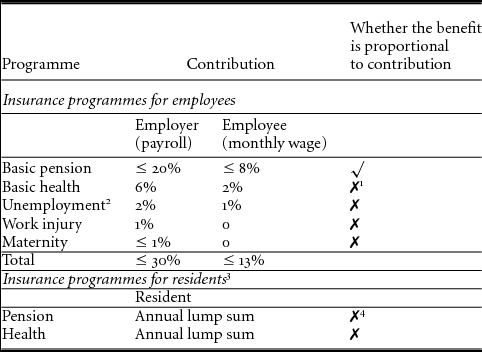
Against the institutional context, the loose enforcement of labour inspection means that the enrolment onto social insurance programmes for the urban informal sector is generally dependent on the decision of employers and employees. In the current research, ‘employers’ in the informal sector refer to the self-employed and small business owners. Employers can decide for themselves whether or not to enrol on social insurance programmes. ‘Employees’ in the informal sector include workers with informal employment and workers hired by small businesses. For employees, enrolment in social insurance requires that contributions be paid by employers and employees in proportion to their payrolls and wages. Table 1 summarises the contribution rates to each social insurance programme. Contributions and benefits vary across social insurances. With regard to urban basic employee programmes, the contributions are proportional to the payroll and the wages of individuals. The benefits (except for the pension programme) are not contribution-related and are often based on the economic conditions of a particular city. In terms of the pension and health insurance for urban residents, the contributions and benefits are paid as a lump sum decided by the local government.
Rates of contributions to social insurance programmes in urban China, 2012

Sources: Adapted from Giles et al., Reference Giles, Wang, Park, Giulietti, Tatsiramos and Zimmermann2013.
Note:
1. The benefits from a social pooling account are not contribution-related. Reimbursement from an individual account is contribution-related.
2. Since 2015, the contribution rate of unemployment insurance for employers has decreased from 3 per cent to 2 per cent. See http://news.xinhuanet.com/fortune/2015-03/04/c_1114523421.htm, accessed July 21, 2016.
3. Both the contributions and benefits of resident insurance programmes are paid as a lump sum decided by local government.
4. Only those residents who have made at least 15-years worth of contributions are entitled to claim pension benefit.
The decision of employers in the informal sector about whether or not to contribute to the social insurance account of their employees can have an impact on the enrolment status of the latter (Guo et al., Reference Guo, Tian, Han, Johnson and Zhao2016). Although employers in the informal sector can opt not to contribute to their employees’ accounts in pension or health insurance plans, employees can always register for urban resident plans for pension and health insurance, for which a contribution from employers is unnecessary. Hence, employers and employees in the informal sector can make enrolment decisions. Nevertheless, employers in the informal sector have more substantial discretion regarding their enrolment in social insurance than do employees.
Institutional constraints and self-selection behaviour
Enrolment onto social programmes is the result of interaction between institutions and actors. Studies into labour market segmentation and social protection for the labour force of the informal sector (van Ginneken, Reference van Ginneken1999; Pellissery and Walker, Reference Pellissery and Walker2007; Shaefer, Reference Shaefer2010) have identified the following main pervasive factors that contribute to inadequate coverage:
-
(1) Government's institutional settings: extent of the benefits, institutional restrictions on enrolment eligibility, and administrative barriers to re-enrolment and portability of social benefits.
-
(2) Employers and employees’ resistance: low financial and policy literacy, distrust of public institutions and insurance programmes, unattractive programme design and additional financial costs.
The current study suggests that institutional constraints and self-selection are crucial determinants of enrolment in social insurance programmes by the labour force of the urban informal sector. Institutional constraints in this study refer to specific rules, procedures and practices that are treated as given for individuals who create patterned behaviour and interactions (Lowndes and Roberts, Reference Lowndes and Roberts2013). Hukou is a major institutional constraint on programme enrolment in China. The labour market in China is dichotomised between rural and urban areas, as well as varying across regions. Rural and non-local hukou may be institutional barriers that create higher enrolment costs for social insurance programmes for the informal sector labour force than those created by local urban hukou. For example, the unemployment insurance benefits in Beijing can only be claimed from the place where the hukou of the beneficiary is registered. Accordingly, claiming benefits is difficult for those whose hukou is not registered in Beijing.Footnote 2 Thus, the informal sector workers with rural and non-local hukou are unlikely to enrol in social insurance programmes. In 2014, only 16.4 per cent of rural migrant workers contributed to a basic pension scheme; 18.2 per cent and 9.8 per cent registered for health and unemployment insurances, respectively (NBS, 2015). These figures are significantly below the average in urban China.
Hukou has been discussed as an institutional constraint on social insurance participation in several empirical studies. Moreover, various studies based on city-level surveys and national panel data showed that the members of the informal sector labour force who are employed by private enterprises or who are self-employed, particularly migrant workers without local hukou, are unlikely to be covered by employment-based social insurance programmes in urban China (Gao et al., Reference Gao, Yang and Li2012; Park et al., Reference Park, Wu and Du2012; Chen and Gallagher, Reference Chen, Gallagher, Besharov and Baehler2013; Giles et al., Reference Giles, Wang, Park, Giulietti, Tatsiramos and Zimmermann2013; Gao and Rickne, Reference Gao and Rickne2015). These findings are consistent with those of other similar household surveys in Shanghai (Nyland et al., Reference Nyland, Smyth and Zhu2006) and Jiangsu Province (Nielsen et al., Reference Nielsen, Nyland, Smyth, Zhang and Zhu2005).
The inter-governmental fiscal system which determines the local fiscal capacity is another major institutional constraint. Sufficient local fiscal capacity is pivotal to expand the coverage and improve the benefits of social insurance. From 2003 to 2009, the coverage for rural residents under the New Rural Cooperative Health Scheme increased from 13 per cent to 94 per cent because of government subsidies that accounted for nearly 90 per cent of contributions (Barber and Yao, Reference Barber and Yao2010). The majority share of government subsidy has been financed by the local government. For example, the local government provided approximately 56 per cent of the subsidy for urban resident health insurance in 2012Footnote 3 . However, the current intergovernmental fiscal system mandates that major tax revenue is assigned to central government, whereas responsibilities for financing and providing public services have been delegated to local government (Wong and Bird, Reference Wong and Bird2008). In 2015, local government accounted for over 86 per cent of total government expenditure but approximately 54 per cent of total government revenueFootnote 4 . In this context, local governments with limited fiscal capacity may provide social insurance only for residents with local and urban hukou, and may lack strong incentives to implement universal coverage and improve the benefit level. This situation is the spatial injustice outcome of territorial fragmentation which localises and regionalises social protection (Shi, Reference Shi2012; Ngok, Reference Ngok, Ngok and Chan2016).
Self-selection in the current study refers to the purposeful actions of people in response to a state policy. The self-selection behaviour of the informal sector labour force for social insurance enrolment is based on the assumption of self-interest of individuals and their rational analysis of risks, costs and benefits (Rueda, Reference Rueda2005; Blekesaune, Reference Blekesaune2007). A few members of the urban informal sector may opt to forego enrolling in social programmes if the benefits are trivial.
Employers in the informal sector are likely to forego enrolling with social insurance; they have considerable discretion over their own enrolment status. The regressive effect of social insurance (Liu et al., Reference Liu, Liu and Huang2015) and limited portability of social benefits under the decentralised and regionalised social insurance (Shi, Reference Shi2012) may discourage the informal sector employers from enrolling in social insurance in two ways. First, if informal sector employers believe that the benefit of social insurance programmes is not good enough, they are more likely to opt out compared to employees. Second, informal sector employers who lack a local or urban hukou are likely to opt out of social insurance programmes because they are unlikely to enjoy the benefits of social insurance.
In short, the labour force of the urban informal sector is constrained from enrolling in social insurance by institutional constraints (e.g. hukou). The labour force of the informal sector, particularly employers, may also opt out of social insurance programmes if the financial benefits are insufficient. Employers with rural or non-local hukou are even more likely to opt out of social insurance programmes compared to other employers.
Methods
Data
This study draws on individual- and city-level data. Individual-level data are sourced from the China Labour-force Dynamics Survey (CLDS) 2012, a nationally representative household survey conducted by Sun Yat-sen University, China.Footnote 5 CLDS 2012 focused on labour dynamics in China and included detailed information about individuals that related to the labour market. CLDS respondents were labourers aged 15 to 64 and selected from the 29 provinces of mainland China, excluding Tibet and Hainan (see details on the CLDS 2012 in the Appendix).
The analysis is restricted to a sample of urban individuals who are engaged in non-farming work. A total of 3,160 individuals from 57 city-level units are extracted from CLDS 2012. Individual-level data are merged with contextual data for 57 city-level units in 2011. The data are drawn from the China Premium DatabaseFootnote 6 which provides city-level statistics.
The combined data sets have three main advantages when analysing social insurance for the labour force of the informal sector. To start with, the data set that comprises the official statistics of 57 cities and individual-level observations in China considers regional variations. Prior studies suggested substantial regional variations in social insurance enrolment. For example, the coverage rate of health insurance for all individuals aged 16 to 60 in Shanghai (89 per cent) is more than twice the rate in Wuhan (39 per cent) (Giles et al., Reference Giles, Park and Cai2006, Reference Giles, Wang, Park, Giulietti, Tatsiramos and Zimmermann2013). CLDS 2012 with city-level statistics prompted a critical analysis of the national development of social insurance programmes whilst considering the city-level variations. Large variations in the contextual variables across cities provide adequate statistical power to analyse the influence of city-level characteristics on the programme enrolment of individuals.
In addition, the CLDS data set included a large number of observations of migrant workers which are crucial for analysing the social protection of the urban labour force. China has witnessed a significant increase in the number of migrant workers with the rural hukou working in urban areas. However, the inclusion of migrant workers in household surveys is a challenge because they cannot be identified in official registrations (Gustafsson et al., Reference Gustafsson, Shi and Sato2014). The current study draws on an inclusive sample from CLDS 2012 with migrants and non-migrants, as well as providing accurate estimations of the social protection for the entire labour force of the informal sector.
Last but not least, the data reflect the updated policy outcomes amidst social protection expansion. In the era of social reform, the Labour Contract Law and Social Insurance Law were implemented in 2008 and 2011, respectively. CLDS 2012 precisely covered the social protection expansion and the enactment of policy regulation in China since 2003 (Shi, Reference Shi2012; Gao et al., Reference Gao, Yang and Li2013; Ringen and Ngok, Reference Ringen and Ngok2013; Huang, Reference Huang2014).
Measures
The dependent variables are enrolments in three types of social insurance programmes: (1) basic employee/resident pension schemes, (2) urban employee/resident basic health insurance and (3) other types of social insurance, including unemployment, work-related injury and maternity insurance. To avoid underestimating the social insurance coverage in urban areas, the enrolment status is considered positive if individuals enrol with any social insurance programmes for urban workers or residents. Data analysis also includes the enrolment status of private commercial pension and health insurance as dependent variables for robustness checks.
Informal Sector Employment (formal = 0) refers to people who work in private enterprises and individual businesses, as well as individuals in informal employment (i.e. working without a written contract or flexibly employed). (See details in the Appendix).
Institutional constraints are measured as the hukou status of individuals and the fiscal revenue per capita of a city. The hukou status is classified into urban/rural and local/non-local. The city-level fiscal revenue is measured per capita for 2011 and in Chinese Yuan (CNY) is 1,000 (approximately USD 145). The fiscal revenue and other city-level controls are measured in their lagged value to avoid endogeneity problems in regression analysis (i.e. 2011 statistics).
Self-selection behaviour is measured by employment status. Employers in the informal sector have considerable discretion over their own enrolment status. If employers are able to opt out or to enrol in social insurance programmes, then the finding implies the self-selection behaviour of employers.
Individual-level characteristics are controlled, including three dummy variables (i.e. gender (male = 0), work status (employed = 0) and employment status (employee = 0)) and three continuous variables (i.e. education (years of schooling), age and income). The income variable is considered in the logarithm.
City-level contextual measures are also included as controls, including gross domestic product (GDP) per capita, social security and employment expenditure and government health expenditure for 2011; these measures are measured per capita. Social security and employment expenditure includes government expenditure under the Minimum Livelihood Guarantee Scheme (Dibao), as well as basic social assistance government expenditures on social security subsidies and expenditures for retired government employees. Social security and employment expenditures cover programme benefits. These benefits mainly target people who are not working in the formal sector, such as retirees and beneficiaries of social assistance programmes. Social security and employment expenditure per capita is a relevant variable because the benefits of social assistance programmes may affect the enrolment rate of social insurance types. For example, medical assistance is a social assistance programme that provides financial coverage for the health care of the urban poor. Similarly, the Dibao programme provides financial coverage for the urban poor who may be unemployed as well. A few urban workers in the informal sector may want to claim benefits from social assistance and not enrol in social insurance, such as unemployment or health insurance. Thus, the enrolment rate onto social insurance may be decreased if the benefit level of social assistance is sufficiently high (Qian and Mok, Reference Qian and Mok2016).
Moreover, the enrolment rate is affected by the benefit level of social insurance; such benefit level is increased with local social expenditure. The official statistics of the city-level government budget allocated for social insurance is unavailable. Thus, government health expenditure is used as a proxy to measure the benefit of social insurance.
Analytic strategy
A multilevel mixed-effect binary logistic regression model is employed to analyse the data. The first set of analyses evaluates the advantages of the informal sector labour force in terms of enrolment in social insurance programmes. Individual-level control variables include gender, employment status, education, age and income. The vectors of city-level variables, including GDP per capita, fiscal revenue per capita, social security and employment expenditure per capita and government health expenditure per capita, are also controlled.
The second set of analyses focuses on the labour force of the urban informal sector and analyses the determinants of their programme enrolments. The effects of the two types of hukou status (i.e. basic control and city-level contextual variables) are analysed.
Results
Descriptive statistics
In the analysis sample of 3,160 individuals, 2,067 are in the informal sector labour force, thereby accounting for 65.4 per cent of the total working sample (see Table A1 in the online supplementary material for the descriptive statistics of the individual variables). On the basis of the registration status of enterprises, a few scholars used data in statistical yearbooks to estimate that the share of the urban informal sector workers was 56.8 per cent in 2002 (Ghose, Reference Ghose2005: 27) and 58.7 per cent by 2004 (Hu and Zhao, Reference Hu and Zhao2006). In the sample of the current study, the number of workers in the informal sector enterprises is 1,635 (51.7 per cent of the total observations in 2012) which is consistent with the yearbook data cited in the literature. However, the definition of the informal sector in the present study is broader than that in the yearbook because the former also includes workers in informal employment (i.e. without a formal labour contract) but working in the formal sector enterprisesFootnote 7 . The percentage of informal employment in the formal sector in 2012 was 13.7 per cent of the analysis sample (see Table A2 in the Appendix). This ratio is also consistent with findings in other studies. Xue and Gao (Reference Xue and Gao2012) estimated that informal employment in the formal sector accounted for approximately 11.1 per cent of the total urban labour force based on the 2005 China One Percent Population Sample Survey, which was conducted by the National Bureau of Statistics. The relatively high proportion of the informal labour force reported in the current study is therefore conceivable because informal employment in the formal sector is also included.
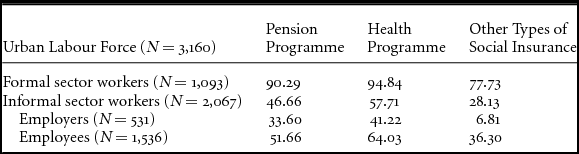
The descriptive statistics also show that enrolment in social insurance programmes is not universal. The figures in Table 2 suggest that the enrolment rate of the formal labour force ranges from 78 per cent to 95 per cent which is nearly twice that of the labour force of the informal sector. The labour force of the informal sector comprises employees and employers (including self-employed and small business owners). In our sample, over 70 per cent of the employers are reported as self-employed (see Figure A1 in the Appendix for details). For the informal labour sector, the programme enrolment rates of employers are lower than those of employees. Table A3 summarises the descriptive statistics of the contextual variables for the 57 city-level divisions (see online supplementary material).
Enrolment rates of different groups in social insurance programmes (in percentages)

Note: Sampling weights from CLDS 2012 are applied to the enrolment rates.
Disadvantage of the informal sector in the programme enrolments
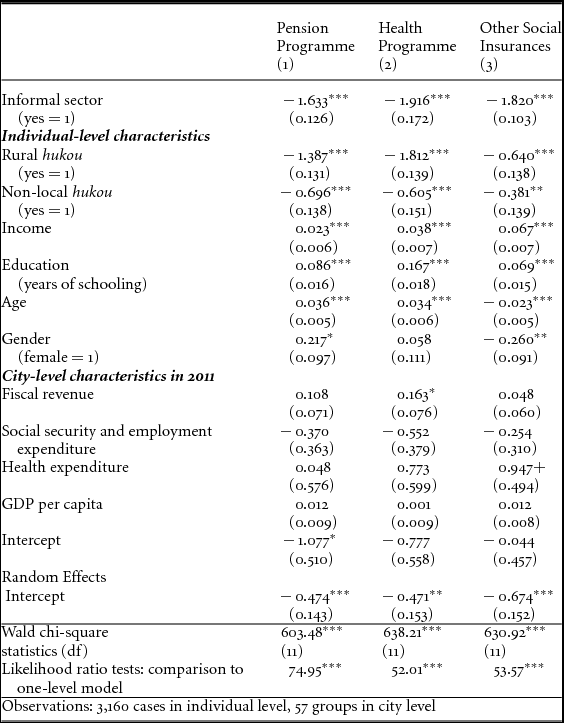
Table 3 presents the results of the mixed-effect logistic regression models that predict the likelihood of enrolment in three types of social insurance programmes, namely, pension, health insurance and other social insurance programmes. The differences between the labour force of the formal and informal sectors are compared in terms of their accessibility to the three types of social insurance programmes which are conditional on the individual- and city-level characteristics. The results reported in Table 3 suggest that the social protection of the informal sector labour force is less than that of the formal sector labour force. For the labour force of the formal and informal sectors, the rural hukou, non-local hukou, fiscal capacity, income and education are positively correlated with the likelihood of programme enrolment.
Disadvantages of informal sector in programme enrolment, mixed-effects logistic regression models, random effects clustered at city levels

Note: The city-level characteristics in 2011 (i.e. GDP per capita, fiscal revenue, social security and employment expenditure, and (government) health expenditure) are determined per capita and in CNY 1,000. Income was transformed by adding 0.001 and the natural logarithm of income was taken because the original variable includes zero with a skewness of 3.8. ‘Other types of social insurance’ include work injury, maternity, and unemployment insurance programmes. Standard errors are in parentheses. ***p < 0.001, **p < 0.01, *p < 0.05, + p < 0.1.
Determinants of programme enrolment: institutional constraints
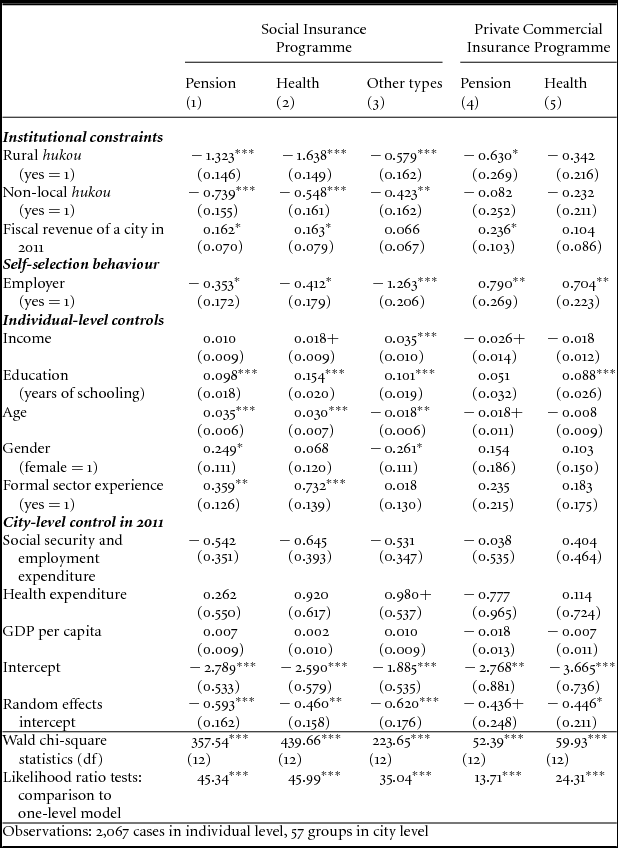
Table 4 shows the estimated multilevel mixed-effect logistic regression models that predict the probability of insurance programme enrolment for the labour force of the informal sector. The results reveal that the rural and non-local hukou statuses are significant institutional constraints on achieving universal coverage of social insurance, particularly for enrolment in Models 1, 2 and 3. The findings support the argument that the labour force of the informal sector with non-local and rural hukou is less likely to enrol in social insurance programmes. The significance of the urban/rural hukou and local/non-local hukou differs across programmes. Rural hukou is a larger constraint than non-local hukou in health insurance enrolment which includes urban employee and resident health insurance.
Determinants of programme enrolment for informal sector workers, mixed-effects logistic regression models, random effects clustered at city levels

Note: Refer to Table 3 of the main text for notes of GDP per capita, fiscal revenue, social security and employment expenditure, health expenditure, income, and other types of social insurance. Standard errors are in parentheses. ***p < 0.001, **p < 0.01, *p < 0.05, + p < 0.1.
City fiscal revenue has positive and significant effects on enrolment in social health insurance and basic pension schemes (i.e. Models 1 and 2). Thus, the inter-governmental fiscal system which defines local fiscal capacity is another critical institutional constraint. These results suggest that the labour force of the informal sector in a city with large fiscal capacity is likely to enrol in social programmes. Social security and employment expenditure is negatively associated with the enrolment rate of pension and social health insurance but is insignificant.
Determinants of programme enrolment: self-selection
The results reveal the self-selection behaviour in programme enrolment. Employers often have discretionary power to decide their programme enrolment. They are likely to self-select to enrol in programmes. Table 4 shows that employers in the informal sector are more likely than employees to opt out of social insurance programmes (i.e. Models 1, 2 and 3). However, employers are more likely to purchase private commercial pension and health insurance (i.e. Models 4 and 5). The results suggest that the benefits of social insurance programmes may not be attractive to employers in the informal sector. Rather, employers will opt for private commercial programmes.
Income is positively and statistically significant in Model 3. The income effect is positive in ‘other’ types of insurance reported in Model 3 because the amount of contribution for employees is not income related for maternity and injury insurance (see Table 1). In this case, high-income workers are more likely than those on low incomes to be able to enrol in ‘other insurance’. By contrast, income is statistically insignificant in Model 1 and only marginally significant in Model 2. For basic employee pension and health insurance, the contribution is income-related particularly for employees. High-income workers may lack a strong incentive to enrol because they need to contribute substantially.
Determinants of programme enrolment: interaction between institutional constraints and self-selection
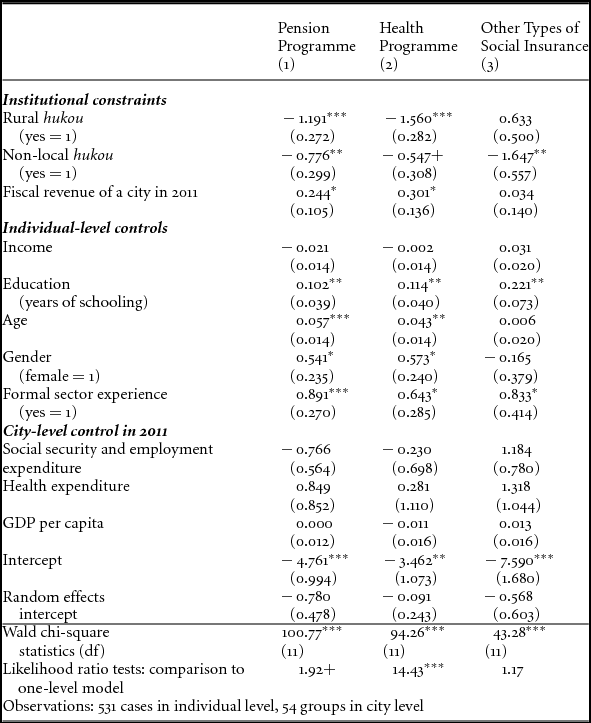
The self-selection behaviour of employers in the informal sector is constrained by institutions, such as hukou. Table 5 shows the effects of institutional constraints on employers in the informal sector. Compared with the informal sector employers with urban/local hukou, employers with rural/non-local hukou in the informal sector are less likely to enrol in pension and health insurance programmes (i.e. Models 1 and 2 in Table 5). The findings suggest that the degree of self-selection is affected by the hukou constraints. Employers with rural or non-local hukou in the informal sector are likely to opt out of social programmes because the benefits of these programmes are often non-transferable across cities or from urban to rural areas. Accordingly, the institutional constraints from hukou magnify this self-selection effect. Fiscal revenue remains a significant determinant of programme enrolment in the analysis in Table 5, thereby suggesting that governments with strong fiscal capacity may be able to provide good social benefits that are attractive to employers in the informal sector.
Determinants of programme enrolments for employers, mixed-effects logistic regression models, random effects clustered at city levels

Note: Refer to Table 3 of the main text for notes on GDP per capita, fiscal revenue, social security and employment expenditure, health expenditure, income, and other types of social insurance. Standard errors are in parentheses. ***p < 0.001, **p < 0.01, *p < 0.05, + p < 0.1.
Table 5 shows that the coefficient of income is insignificant. That is, no significant difference is obtained in enrolment decisions amongst employers with different income levels. High-income employers may want to enrol in the urban resident pension and health insurance, in which the amount of contribution is not income-related. In this case, the income effect is insignificant because the resident and basic employee insurances are considered social insurance in the current research. Amongst the employers in the data sample, 138 are enrolled with urban resident health insurance, whereas only 71 are enrolled with basic urban employee health insurance.
Discussion and conclusion
This research comprehensively analyses the participation of the urban informal sector labour force in all social insurance programmes after the proactive expansion of social protection in the past decade in China. This study uses the nationally representative household survey and city-level statistics as bases to reveal that the labour force of the informal sector remains significantly disadvantaged in social insurance participation, and the social protection in urban China has yet to become universal.
This research empirically proves that institutional constraints, self-selection behaviour and their interactive effects are the main determinants of the under-coverage of social protection of the informal sector labour force in urban China. The effects of self-selection and the institutional constraints of hukou on social insurance can be supported by a recent report from official media. Migrant workers who are subject to the institutional constraint of hukou are more likely than other urban labour forces to ‘voluntarily’ undercontribute to social insurance programmes.Footnote 8
The labour force of the informal sector is subject to certain institutional constraints (e.g. hukou status and intergovernmental fiscal system) that determine the fiscal capacity of the city of residence. Workers who have urban and local hukou and reside in a city with large fiscal capacity are likely to enrol in social insurances. Urban and local hukou statuses remain significant determinants of social insurance enrolment in urban China, even within the informal sector, where the occupation-based welfare system is at its weakest. The findings on institutional constraints suggest that the resource distribution function of the hukou system prevails.
Self-selection behaviour is another significant determinant of social insurance enrolment. Employers of the urban informal sector have more substantial discretionary power than employees in deciding on their enrolment in social insurance programmes. Compared to employees, these employers are more unlikely to enrol in social insurance. Instead, they are more likely to enrol in private commercial insurance programmes compared to employees.
In addition, the self-selection behaviour varies based on the hukou status. Employers without urban/local hukou are more likely than those with urban/local hukou to opt out of social programmes. That is, the former may expect that the benefit levels of social insurance programmes are limited for people without urban/local hukou. Self-selection in the income dimension may not be completely ruled out, although the enrolment status of employers does not vary significantly with income level. High-income employers in the informal sector are likely to opt out of the basic employee insurance and instead enrol with the urban resident social insurance, under which the amount of contributions is fixed and not income related.
The results are substantially consistent across the pension and health insurance programmes which are two key social insurance programmes with similar contribution and benefit structures. By contrast, the results are slightly different for the ‘other’ insurance (i.e. unemployment, work injury and maternity). First, the effect of institutional constraints is not as strong for ‘other’ insurances as that for pension and health insurance programmes. A substantially smaller amount of government subsidy has been allocated to ‘other’ insurances compared to the cases of pension or health insurance. For example, the government subsidy for ‘other’ insurances in 2013 only amounted to approximately 0.3 per cent and 0.4 per cent of the subsidy for pension and health insurance respectivelyFootnote 9 . In this case, local fiscal capacity is much less relevant for ‘other’ insurances than it is for pension/health insurance. Second, the self-selection effect is higher for ‘other’ social insurances than for pension and health insurance programmes. The differences could be due to the different regulatory requirements of the insurance enrolment. The Social Insurance Law states that the insurances of unemployment, work injury and maternity (these three insurances are defined as ‘other insurance’ in this study) are only compulsory for workers with written labour contracts.
This research is embedded in a broad literature that discusses the institutional constraints on social protection, including labour market structure and policy regulation. The research contribution to the literature is threefold. First, this research is pioneering in presenting the degree of, and reason for, the under-enrolment in social insurance of the labour force in the urban informal sector. Although social protection becomes further inclusive, integrated, generous and progressive in certain administrative jurisdictions (Shi, Reference Shi2012; Gao et al., Reference Gao, Yang and Li2013), the current research shows that the divisions of social insurance in regions and hukou status remain persistent and nationwide.
Second, this research contributes to the literature on the political and economic dynamics of the current programme design (Wong et al., Reference Wong, Tang and Lo2007; Huang, Reference Huang2014, Reference Huang2015; Liu et al., Reference Liu, Liu and Huang2015). Moreover, the current study provides micro-level evidence of the self-selection behaviour of employers in the informal sector who opt out of the social programmes because of insufficient benefit level. These findings in China are not unique. Similar self-selection behaviour had been observed in other developing countries, such as Latin American countries (Berens, Reference Berens2015).
Third, the present research reveals that the under-coverage of social insurance programmes for the informal sector labour force is a result of the interplay between institutional constraints and selection behaviour. This finding contributes to understanding the effect of the interplay of enrolment eligibility rules, benefit levels and individual conditions on the participation in social insurance. For example, this research implies that the interaction between self-selection and hukou status can explain why the social insurance enrolment rate of urban migrants is higher than that of rural migrants. By contrast, Cheng et al. (Reference Cheng, Nielsen and Smyth2014) emphasised the role of human resource management on performance reward and labour retention. The present research also provides a concrete case of the interaction between actors and institutions in social policy (UNRISD, 2012; Lowndes and Roberts, Reference Lowndes and Roberts2013). Another concern about self-selection in programme enrolment is that people may opt to enter the informal sector or migrate to a particular city with high benefits from social insurance before they consider opting out of social insurance programmes. For example, an increasing number of skilled workers opt to work in the informal sector in developed regions to enjoy high wages, considerable autonomy and dignity (Huang, Reference Huang2012). With these additional selections related to locations and sectors, the real magnitude of the self-selection effect on programme enrolment may be even larger than the current estimation.
The findings on the effects of hukou and local fiscal capacity on the universal coverage of the informal sector labour force imply that the fragmented social insurance regimes in China have significant effects on the urban–rural and spatial fragmentations based on the hukou system and the territorial inequality of economic development, respectively (Shi, Reference Shi2012; Ngok, Reference Ngok, Ngok and Chan2016). These findings also suggest that institutional constraints, such as the fragmentation of governance (e.g. hukou in China) and intergovernmental fiscal system (e.g. the fiscal capacity of a city), are generally crucial to achieve a universal coverage of social programmes in developing countries.
Acknowledgements
The individual-level data used in this paper are sourced from the China Labor-force Dynamics Survey (CLDS) conducted by the Center for Social Science Survey at Sun Yat-sen University, Guangzhou, China. We express our sincere gratitude to the Center.
Supplementary material
To view supplementary material for this article, please visit https://doi.org/10.1017/S0047279417000563