Somatic cell count (SCC) is used worldwide as a hygienic parameter of milk. Low SCC is a reliable indicator of healthy mammary gland quarters because increasing SCC is mostly the result of pathogen invasion (Schukken et al. Reference Schukken, Bennet, Green and Van Werven2001). In dairy production exceeding a fixed SCC limit invokes penalties. Thus, it is economically advantageous to reduce SCC to very low levels, and a goal in dairy practice can be the breeding of cows that produce milk with very low SCC (Shook, Reference Shook1989).
The cells in milk are, however, predominantly immune cells. These somatic cells play, evidently, important roles in the defence of the mammary gland. They recognize invading pathogens and initiate the innate immune reaction through liberation of immunomodulators (Rainard & Riollet, Reference Rainard and Riollet2006). Each cell type (macrophages, neutrophils, lymphocytes, and epithelial cells) has a vital role in the immunity of the mammary gland e.g. phagocytosis, antigen presentation, secretion of antibacterial factors, immunological memory, or regulation of the immune response (Sordillo & Streicher, Reference Sordillo and Streicher2002). An excessive reduction of SCC might therefore have a negative effect on the mammary immune competence.
There are numerous reports concerning low SCC and clinical mastitis incidence. Green et al. (Reference Green, Green and Cripps1996) and Suriyasathaporn et al. (Reference Suriyasathaporn, Schukken, Nielen and Brand2000) showed an association between low herd SCC and increasing mastitis incidence. Beaudeau et al. (Reference Beaudeau, Fourichon, Seegers and Bareille2002) found a greater risk of clinical mastitis in herds containing a high proportion of cows with low SCC (<50×103 cells/ml). In addition, Deluyker et al. (Reference Deluyker, Gay and Weaver1993) showed that in a low-SCC herd, cows with clinical mastitis had a higher SCC (>245×103 cells/ml) prior to mastitis than control cows (<90×103 cells/ml). Furthermore, Sarikaya et al. (Reference Sarikaya, Werner-Misof, Atzkern and Bruckmaier2005) found that cells from milk with very low SCC (<12×103 cells/ml) had lower mRNA expression levels of inflammatory factors compared with cells from milk with higher SCC. No previous investigation had, to our knowledge, the specific focus of studying the immune competence of mammary gland quarters with very low SCC (VLS) and with normal SCC (NS) in response to a defined challenge of the mammary immune system.
With intramammary injections of the Escherichia coli lipopolysaccharide (LPS), it is possible to mimic bacterial invasion and to induce a mammary inflammation very similar to natural mastitis (Schmitz et al. Reference Schmitz, Pfaffl, Meyer and Bruckmaier2004). In contrast to a bacterial infection, the intensity of the inflammatory stimulus is exactly defined by the LPS dose, and the immune response can be compared between animal groups. SCC augmentation following stimulation with pathogen or endotoxin is due to the release of immunomodulators from resident somatic cells and mammary epithelial cells after recognition of the antigen (Sordillo & Streicher, Reference Sordillo and Streicher2002). TNF-α is a rapidly responding mediator of inflammatory reactions that increases in milk after an immune stimulation with LPS (Paape et al. Reference Paape, Rautiainen, Lilius, Malstrom and Elsasser2002). IL-1β is a cytokine that is rapidly up-regulated in milk cells during infection to initiate the immune response (Lee et al. Reference Lee, Bannerman, Paape, Huang and Zhao2006). IL-8 is an important chemokine that is involved in the further recruitment of immune cells into the milk during the immune response (Persson-Waller et al. Reference Persson-Waller, Colditz, Lun and Ostensson2003). Lactoferrin is known to have antibacterial effects and during acute mastitis neutrophil leucocytes are besides the epithelial cells an important source (Harmon & Newbould, Reference Harmon and Newbould1980). Therefore, the production of the factors TNF-α, IL-1β, IL-8 and lactoferrin indicates the immune activity of the cells. Parallel to the release of these factors and the induced immune response, an increased recruitment of new leucocytes from blood into the milk is induced. Finally the enhanced population of young leucocytes increases the viability of the total milk cell population (Mehrzad et al. Reference Mehrzad, Duchateau and Burvenich2004).
The present study was performed to compare the response to LPS of udder quarters with NS and VLS milk in relation to the SCC increase, changes of TNF-α and LDH in milk and the mRNA expression of TNF-α, IL-1β, IL-8 and lactoferrin in milk cells. This could give an idea of whether the immune protection of udder quarters differs where the SCC is below 20×103 cells/ml compared with the quarters with SCC of (40–100)×103 cells/ml.
Materials and Methods
Experiment 1
Thirty-three quarters of 19 lactating dairy cows (8 Holstein, 11 Red Holstein×Simmental) from udders free of clinical signs of mastitis were used for this experiment. All cows were chosen randomly and were in months 2–15 of lactations 1–7. Cows were kept in a tethered barn and were fed twice daily with hay, corn and concentrate. Water was available ad libitum. Milking was performed routinely twice daily.
One or two quarters of each cow were randomly selected based on foremilk SCC determined with the DeLaval cell counter (DCC, DeLaval, Tumba, Sweden). Quarters were divided into two groups: very low SCC (VLS; SCC <20×103 cells/ml; SCC=16·2±3·0×103 cells/ml; n=16) and normal SCC [NS; (40–100)×103 cells/ml; SCC=56·3±4·4×103 cells/ml; n=17). The other quarters of each used udder did not show SCC above 300 000 cells/ml. The number of lactations of the cows was normally distributed between the two groups (5, 8, 2 and one quarter of cows in the 1st, 2nd, 3rd and 6th lactation in VL group, and 6, 7, 3, and one quarter of cows in the 1st, 2nd, 3rd and 7th lactation, respectively). In each group, 7 control quarters (C quarters) were randomly chosen and all other quarters were treated with LPS (LPS quarters).
Cows were milked during routine milking procedures using a quarter milking device for separate quarter milk collection (Sarikaya et al. Reference Sarikaya, Werner-Misof, Atzkern and Bruckmaier2005). Immediately after morning milking LPS, isolated from a mastitis-inducing Esch. coli strain by the University of Constance group (Prof. Hartung and Dr von Aulock), dissolved in sterile saline solution (9 g/l), was intramammarily infused into LPS quarters (50 ng/10 ml saline solution). Into the C quarters 10 ml saline solution was infused. Before injection teat openings were carefully disinfected with 70% alcohol. To measure the change of SCC after treatment, strict foremilk samples (first 3 squirts) were collected hourly from all quarters until the evening milking and daily (except day 6) before morning milking until day 7 post challenge (p.c.). Samples were obtained by hand milking without udder preparation to prevent any milk ejection, and therefore alveolar milk, in the samples (Bruckmaier & Hilger, Reference Bruckmaier and Hilger2001). SCC was measured with the DCC. From 26 of the quarters (6 C and 6 LPS for VLS and 7 C and 7 LPS for NS group) 1 l of milk at the morning milking (0 h) and at the evening milking (10 h p.c.) was collected and filtered (Ø 100 μm). Milk samples were diluted 1:1 with cold (4°C) sterile PBS and centrifuged at 1000 g at 4°C for 15 min. Fat layer and supernatant were removed (aspiration) and cell pellets resuspended and centrifuged twice in 50 ml PBS at (400 g and 300 g at 4°C for 10 min). Pellets were resuspended in cold PBS (2–10 ml, depending on SCC). Cell suspension (25 μl) of the cell suspension was used for Trypan Blue staining (0·25%) for determination of viability in Neubauer's counting chamber (Brand, Wertheim, Germany) with direct light microscopy.
Experiment 2
Thirty-two udder quarters from 17 lactating dairy cows (6 Holstein and 11 Red Holstein×Simmental) were grouped into a VLS group (n=10) or into a NS group (n=22). Udders from experimental cows did not show clinical signs of mastitis. One day before the experiment sterile milk samples were collected from all quarters and cultured over night at 37°C on blood agar plates to assure that all quarters were free of bacterial infections.
Immediately after the morning milking 5 VLS quarters and 15 NS quarters were infused intramammarily with 100 μg Esch. coli LPS (SIGMA; O26:B6; # L8274) dissolved in 10 ml saline solution, as described in Experiment 1.
Milk samples (~5 ml) were taken within 40 s before the start of milk ejection after 0 h, 3 h, 6 h, 9 h, 12 h, 24 h and 36 h p.c. and frozen at −20°C until analyses. The protein content of TNF-α was measured by radioimmunoassay according to Blum et al. (Reference Blum, Dosogne, Hoeben, Vangroenweghe, Hammon, Bruckmaier and Burvenich2000). In addition, LDH activity in milk was measured using a commercial kit (Roche, Rotkreuz, Switzerland).
Milking was performed immediately before LPS challenge and at 12 h, 24 h and 36 h p.c. with a special milking device for collection of quarter milk. One litre of the removed milk of each quarter was centrifuged in 500-ml flasks at 2000 g at 4°C for 20 min. The pellet was redissolved by up-and-down pipetting with 200 ml ice cold PBS and centrifuged again at 2000 g at 4°C for 10 min. The final pellet was redissolved in 1 ml of Trifast (Peqlab), transferred into 1·5-ml microtubes and frozen at −80°C until the extraction of total RNA according to manufacturer's protocol.
Final RNA concentration was quantified by spectrophotometry (Biophotometer, Vaudaux-Eppendorf, Basel, Switzerland) by measuring optical density (OD) at 260 nm. cDNA was produced using 50 ng RNA with 200 U Moleney Murine Leukemia Virus Reverse Transcriptase RNAse H minus, Point Mutant (MMLV-RT, Promega, Madison WI, USA) and 100 pmol random hexamer primers (Invitrogen, Leek, The Netherlands).
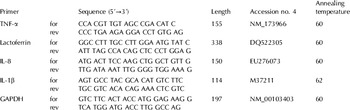
Quantitative PCR analysis was carried out on Rotor Gene 6000 (Corbett Research, Sydney, Australia) using Sensimix DNA Kit (Quantace, Biolabo, Châtel St Denis, Switzerland). Primers for housekeeping (GAPDH) and the target genes TNF-α, IL-8, IL-1β and lactoferrin were synthesized commercially (Microsynth, Balgach, Switzerland) (Table 1). The following 3-step programme was used: 10 min at 95°C, 40 cycles of 95°C for 15 s, primer specific annealing temperature for 30 s, and 20 s 72°C, ending with a melting curve programme (60–99°C, heating rate of 0·1°C/s, continuous measurement). Take-off values (second derivative maximum; CP) were achieved by Rotor Gene software version 1.7.40. mRNA expression is given in ΔΔCP values: to calculate the impact of treatment the gene expression was normalized to the expression of the housekeeping gene GAPDH. Then the gene expression values of non-treated control cells [ΔCP (control cells)] and treated cells [ΔCP (treated cells)] were set in relation, according to following equation:

Experiment 2: Sequences of PCR Primers [forward (for) and reverse (rev)], PCR product length (bp), accession number, annealing temperature (°C)

Statistical analyses
Data are presented as means±sem. SCC are presented and statistically evaluated at a logarithmic scale (log10) to ensure normal distribution. Differences of SCC, cell viability and mRNA expression of immunomodulators between groups (VLS and NS group, C and LPS quarters) were tested by analysis of variance using the PROC MIXED procedure of SAS (1999–2001). The model included time, group, and their interaction as fixed effects. Differences between means were considered significant if P<0·05.
Results
Experiment 1
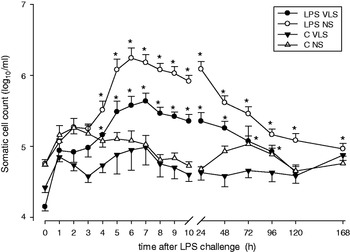
Milk SCC data from LPS and C quarters at each time point are shown in Fig. 1. Before LPS challenge (0 h) SCC of VLS (14·1±1·5×103 cells/ml) and NS group (56·7±4·2×103 cells/ml) were significantly different. SCC of C quarters from both groups did not change significantly throughout the entire experiment. At 4 h p.c. SCC began to increase (P<0·05) in both LPS-treated groups to reach a maximum at 6 h p.c. for NS group (1747±696×103 cells/ml) and at 7 h p.c. for VLS group (432±130×103 cells/ml).
Experiment 1: SCC (in log10/ml) after intramammary injection of 0 (C) and 50 ng LPS (LPS) dissolved in 10 ml saline solution into quarters of very low SCC (VL; SCC <20 000 ells/ml) and normal SCC (NS; 40 000–100 000 cells/ml). • LPS VL (n=9), ○ LPS NS (n=10), ▾ C VL (n=7), Δ C NS (n=7). Data are represented as mean±sem. *: Significant differences between LPS challenge and control within each group (P<0·05). SCC between groups were significantly different (P<0·05). SCC increased in response to LPS in both groups, whereas the maximum was reached 1 h earlier in the NS group.

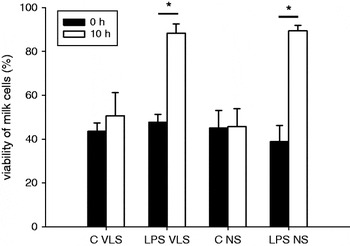
Cell viability (Fig. 2) of all groups at time 0 h was 43·7±3%. There was no difference between groups. At 10 h p.c. viability did not change in both C groups (48±6·3%) but increased significantly in LPS-treated quarters with no differences between VLS and NS groups (88·9±2·3%).
Experiment 1: Proportion of viable cells (%) in the milk at 0 h (▪) and 10 h (□) after LPS challenge in C (control without LPS challenge) and LPS quarters of very low SCC (VLS; SCC <20 000 cells/ml) and normal SCC group (NS; SCC=40 000–100 000 cells/ml). Data are represented as mean±sem (n=5–7). *: Significant differences between before and after LPS challenge within each group (P<0·05). Cell viability increased after LPS challenge with no differences between the groups.

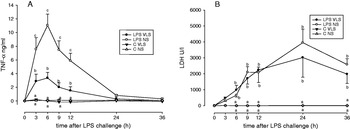
TNF-α concentrations in milk (Fig. 3A) increased within 3 h after LPS treatments in both groups and stayed elevated until 12 h p.c. Significant differences between VLS and NS groups was found from 3 h until 12 h p.c. with higher TNF-α concentrations in the NS group. In controls TNF-α concentrations did not increase.
Experiment 1: TNF-α concentration (A) and LDH activity (B) in milk after LPS challenge in C quarters (control without LPS challenge) and LPS quarters of very low SCC (VL; SCC <20 000 cells/ml) (n=5 for LPS- and C quarters, respectively) and normal SCC (NS; 40 000–100 000 cells/ml) (n=15 and 7 for LPS- and C quarters, respectively). Data are represented as mean±sem. a,b,c: Different letters indicate significant differences between groups and treatments within one time point (P<0·05). If there were no differences between groups and treatments within that time point no letters are given. TNF-α concentration and LDH activity were not different between groups at 0 h and increased in both groups in response to LPS challenge. TNF-α concentration increase in response to LPS was higher in NS compared with VLS. No group differences in LDH activity increase in response to LPS were detected.

LDH activity in milk (Fig. 3B) increased after 6 h p.c. in LPS quarters with no differences between groups and stayed elevated until the end of the experiment. In C quarters no increase of LDH activity was detectable.
Experiment 2
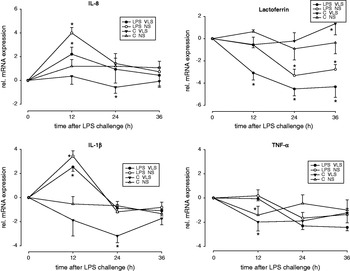
At time 0 h no differences within relative mRNA expression of milk cells of all measured genes were found between the controls and treatments and between groups. At 12 h p.c. an increased mRNA expression of IL-8 (Fig. 4 IL-8) and IL-1β (Fig. 4 IL-1β) in LPS quarters from both groups was observed. In C quarters IL-8 and IL-1β mRNA expression was decreased at 24 h p.c. in VLS and was not changed at other time points. Lactoferrin mRNA expression (Fig. 4 Lactoferrin) was increased at 36 h p.c. in VLS and C quarters. A decrease of lactoferrin mRNA expression could be detected in LPS-treated quarters at 24 h and 36 h p.c. of the NS group and in LPS-treated quarters at 12, 24 and 36 h p.c. of the VLS group. TNF-α relative mRNA expression (Fig. 4 TNF-α) of milk cells was decreased at 12 h in C quarters of both groups and was not changed at all time points in all treatments.
Experiment 2: Relative mRNA expression (ΔΔCP) of IL-8, lactoferrin, IL-1β, and TNF-α in milk cells in C (control without LPS challenge) and LPS quarters of very low SCC (VL; SCC <20 000 cells/ml) (n=5 for LPS and C quarters, respectively) and normal SCC group (NS; 40 000–100 000 cells/ml) (n=15 and 7 for LPS and C quarters, respectively). Data are represented as mean±sem. *: Significant differences within groups between LPS treatment and controls (P<0·05). There were no considerable differences in mRNA expression of measured immune factors in response to LPS in the cells between both groups.

Discussion
In the present study the immune competence of udder quarters with very low SCC (<20×103 cells/ml; VLS) was compared with quarters with normal SCC (NS) of (40–100)×103 cells/ml. Previous investigations already compared low SCC and high SCC but definitions of low SCC varied: 200×103 cells/ml (Vangroenweghe et al. Reference Vangroenweghe, Rainard, Paape, Duchateau and Burvenich2004; Kauf et al. Reference Kauf, Vinyard and Bannerman2006; Olde Riekerink et al. Reference Olde Riekerink, Barkema, Veenstra, Berg, Stryhn and Zadoks2007), 150×103 cells/ml (Schukken et al. Reference Schukken, Grommers, Van de Geer, Erb and Brand1991; Barkema et al. Reference Barkema, Schukken, Lam, Beiboer, Wilmink, Benedictus and Brand1998; Schmitz et al. Reference Schmitz, Pfaffl, Meyer and Bruckmaier2004; Werner-Misof et al. Reference Werner-Misof, Pfaffl and Bruckmaier2007), 100×103 cells/ml (Paape et al. Reference Paape, Pearson, Wergin and Guidry1977; Boutet et al. Reference Boutet, Boulanger, Gillet, Vanderplasschen, Closset, Bureau and Lekeux2004; Koess & Hamman, Reference Koess and Hamann2008), 50×103 cells/ml (Beaudeau et al. Reference Beaudeau, Fourichon, Seegers and Bareille2002), 18×103 cells/ml (Cheng et al. Reference Cheng, Wang, Bu, Liu, Zhang, Wei, Zhou and Wang2008) or 12×103 cells/ml (Sarikaya et al. Reference Sarikaya, Schlamberger, Meyer and Bruckmaier2006). However, a direct comparison of very low SCC levels below 20×103 cells/ml with normal SCC levels of (40–100)×103 cells/ml that are found very often in dairy practice, in regard to the immune response of the cells, had not been done before as far as we were aware.
The quarters for the experiments were selected based on their SCC of <20×103 cells/ml for VLS group and (40–100)×103 cells/ml for NS group. The selected quarters were of experimental cows with a broad range of lactational stage and number of lactation because other cows were not available. However, all quarters were from udders without any signs of mastitis and they were grouped with normal distribution of number of lactation and lactational stages. If two quarters from one cow were used the treatments of the two quarters within this cow were randomly chosen (control and control, control and LPS treatment, or LPS and LPS treatment). Therefore, results were not influenced by a potential crosstalk between quarters.
For the measurement of responses of SCC and cell viability during an immune response in VLS and NS groups, quarters were stimulated with 50 ng LPS in 10 ml saline solution to induce a clear but not too strong immune response so as to be able to detect possible differences in cell count and viability. To investigate the immune response of the milk cells by mRNA expression of immune factors, a strong immune response is necessary to be able to detect possible differences. Therefore, it was not possible to use the same treatment for the measurements of all factors and two experiments had to be performed with a lower LPS dose for the measurement of SCC, cell viability, and TNF-α concentration and LDH activity in milk, and a higher LPS dose for mRNA expression of immune factors in milk cells. According to Bannerman et al. (Reference Bannerman, Paape, Lee, Zhao, Hope and Rainard2004), Didier & Bruckmaier (Reference Didier and Bruckmaier2004) and Werner-Misof et al. (Reference Werner-Misof, Pfaffl and Bruckmaier2007) SCC of C quarters were stable over the time of the experiment. Therefore, comparisons between C and LPS quarters were possible. SCC started to increase simultaneously in both groups 4 h after the challenge with LPS. NS group reached higher SCC levels, although the highest level of SCC was reached 1 h earlier than in VLS group. The time required for SCC increase is the time needed for the recruitment of new cells from blood into milk (Harmon & Heald, Reference Harmon and Heald1982; Nickerson & Pankey, Reference Nickerson and Pankey1984; Kehrli & Schuster, Reference Kehrli and Schuster1994). This recruitment of cells was faster in NS quarters than in VLS quarters, which can indicate a more effective immune response.
Like SCC, milk cell viability is crucially involved in the outcome of mammary gland infection. In the present study cell viability was stable during the time of the experiment in quarters that were not stimulated. According to Mehrzad et al. (Reference Mehrzad, Dosogne, Meyer and Burvenich2001, Reference Mehrzad, Duchateau and Burvenich2004) the viability in LPS-treated quarters increased from 42·9±4·3% to 88·9±2·3%. This is due to the increased presence of young leucocytes that migrate from blood into milk and these cells undergo slower apoptosis than older cells (Van Merris et al. Reference Van Merris, Meyer and Burvenich2002). Moreover, LPS stimulation prolongs cell survival (Burvenich et al. Reference Burvenich, Van Merris, Mehrzad, Diez-Fraile and Duchateau2003). Without stimulation and, therefore, without this entry of new leucocytes, resident somatic cells have a long storage period (milking interval) in the cisternal cavities. During this time striking changes occur in the morphology of somatic cells owing to the ingestion of fat globules and casein (Paape et al. Reference Paape, Guidry, Kirk and Bolt1975; Paape & Guidry, Reference Paape and Guidry1977). Owing to these morphological and physiological changes, phagocytic and bactericidal activities, as well as cell viability are decreasing and, therefore, the mammary gland defence will be impaired (Burvenich et al. Reference Burvenich, Bannerman, Lippolis, Peelman, Nonnecke, Kehrli and Paape2007; Rainard & Riollet, Reference Rainard and Riollet2006). However, no difference in the cell viability between VLS and NS groups was observed after LPS challenge, because at 10 h p.c. the viability of the cells was already nearly 90%. Differentiation of cell populations was for technical reasons not possible in these experiments; however, it is known that the increase of SCC is due mainly to the increase of polymorphonuclear neutrophils (Sarikaya et al. Reference Sarikaya, Schlamberger, Meyer and Bruckmaier2006).
LDH activity increased after LPS challenge in NS quarters and in VLS quarters as expected in response to intramammary LPS administration (Bogin & Ziv, Reference Bogin and Ziv1973). LDH is a ubiquitous enzyme that is found in all cells and is an indicator of inflammation as it is released into the extracellular fluid during cell damage and cell death (Glick, Reference Glick1969). The increase of milk cells after LPS challenge led to a greater number of cells contributing to the LDH activity besides cells from the tissue. The differences in SCC increase between the NS and VLS groups were most likely not great enough to induce differences in LDH increase.
Cytokines and other pro-inflammatory factors produced after pathogen invasion or intramammary stimulation initiate the immune reaction (Rainard & Riollet, Reference Rainard and Riollet2006). Some of the most important factors were analysed in this study. TNF-α is a cytokine, which serves as a rapidly responding central mediator of inflammatory functions known to play an important role in mastitis and increases in milk after LPS challenge (Paape et al. Reference Paape, Rautiainen, Lilius, Malstrom and Elsasser2002). It is also involved in the endotoxin shock during an acute phase of coliform mastitis (Sordillo & Streicher, Reference Sordillo and Streicher2002). However, TNF-α mRNA expression in milk cells was not changed at 12 h p.c. TNF-α is a cytokine which is expressed in the early immune response and important for the initiation of the innate immune response. It is likely that the milk cells responded immediately within the first hours after LPS challenge with an increase of TNF-α transcription. Measurement of mRNA expression 12 h p.c., however, could not detect a TNF-α mRNA expression increase because it was already normalized to levels before stimulation. Unfortunately RNA of milk cells earlier than 12 h p.c. was not available because of an insufficient amount of milk. The protein accumulates in the milk and, therefore, an increase 12 h after LPS challenge was detectable although the increased synthesis had already stopped after 12 h. The increase of TNF-α concentration in milk after LPS challenge was significantly higher in NS than in VLS group. This is because more cells could contribute to the production of TNF-α as the SCC was higher in NS group. It is possible that the increased TNF-α concentration in milk could elicit the cure of a potential infection due to a faster and more effective immune response in udder quarters with slightly higher SCC.
IL-8 and IL-1β mRNA expression of milk cells was increased 12 h p.c. in response to LPS treatment with no differences between the groups. This increase was expected as it is known that after intramammary injection of LPS the expression of IL-8 and IL-1β increases (Schmitz et al. Reference Schmitz, Pfaffl, Meyer and Bruckmaier2004; Werner-Misof et al. Reference Werner-Misof, Pfaffl and Bruckmaier2007) in mammary tissue. In addition, Lee et al. (Reference Lee, Bannerman, Paape, Huang and Zhao2006) found increasing expression of cytokines in milk cells after intramammary Esch. coli stimulation. After 12 h the milk cells that had direct contact with the LPS are removed by milking and, for this reason milk cells at 24 h p.c. did not show an increased cytokine mRNA expression.
Surprisingly, unlike the other factors, relative mRNA expression of lactoferrin in milk cells decreased. Pfaffl et al. (Reference Pfaffl, Wittmann, Meyer and Bruckmaier2003) found a lower lactoferrin expression in quarters with SCC >150×103 cells/ml than in quarters with SCC <150×103 cells/ml. The difference between high-SCC quarters and low-SCC quarters in Pfaffl et al. (Reference Pfaffl, Wittmann, Meyer and Bruckmaier2003) might be compared to the difference between LPS and C quarters of both groups in the present study. Thus, quarters with elevated SCC (with or without stimulation) have similar or lower lactoferrin expression in milk cells than quarters with low SCC. Why lactoferrin mRNA expression in VLS decreased earlier (12 h) than in NS group remains unclear. The increasing lactoferrin expression after intramammary injection of 100 μg LPS in mammary tissue that was found by Schmitz et al. (Reference Schmitz, Pfaffl, Meyer and Bruckmaier2004) is due to the increased expression of lactoferrin by mammary epithelial cells, the main source of lactoferrin in milk. These cells represent only a very small population of the somatic cells.
In conclusion, the results of the present study showed differences in the immune response between quarters with normal and very low SCC. The time until SCC started to increase after LPS challenge was approximately equal in quarters with normal and with very low SCC. However, quarters with very low SCC did not reach SCC levels as high as quarters with normal SCC. Although increasing less, maximum SCC in response to LPS challenge was reached slightly later in quarters with very low SCC compared with those with normal SCC. The immune response of the milk cells themselves, based on the mRNA expression of the immune factors TNF-α, IL-1β, IL-8 and lactoferrin, was not different between cells of normal and very low SCC groups. Although the selection of experimental quarters was limited, the results suggest that the immune response of udders with slightly higher SCC might be more efficient, as more cells can contribute to the production of immune factors like TNF-α. It is possible that this effect can impair the immune response of udder quarters with very low SCC.
We thank the H. Wilhelm Schaumann-Stiftung, Hamburg, Germany, for financial support of Mrs A Baumert and Mrs Machabbat Saudenowa.