- WPI
whey protein isolate
- SMP
skim milk powder
- wPRP
whey proline rich peptide
Thermal processing is essential for microbial stabilisation of milk but also induces chemical and physical interactions leading to protein aggregation and precipitation, that may produce either favourable or undesirable functional properties (Singh, Reference Singh2004). Manipulation of heating conditions continues to represent the key industrial processing parameter used to control the functional properties of milk proteins (Yuksel & Erdem, Reference Yuksel and Erdem2005; Raikos, Reference Raikos2010). The effects of heating conditions including time, temperature, pH, additives that react or interact with proteins, and manipulation of the protein and non-protein fractions of milk, have been extensively studied, with a view to understanding the mechanistic nature of interactions (Relkin & Mulvihill, Reference Relkin and Mulvihill1996; Singh, Reference Singh2004; Donato & Guyomarch, Reference Donato and Guyomarch2009) and importantly, the consequences for dairy product quality (Guyomarc'h et al. Reference Guyomarc'h, Law and Dalgleish2003; Anema, Reference Anema, Thompson, Boland and Singh2008; Morand et al. Reference Morand, Guyomarc'h and Famelart2011).
In skimmed milk, interactions between whey proteins and caseins are accelerated as a function of temperature and heating time (Anema & Li, Reference Anema and Li2003) and intermolecular aggregation is observed at and above temperatures that invoke denaturation of whey proteins (>60 °C), (Parris, Reference Parris1993; Relkin & Mulvihill, Reference Relkin and Mulvihill1996; Parris et al. Reference Parris, Hollar, Hsieh and Cockley1997). However, following whey to casein protein cross-linking induced during pre-heating, progressive destabilisation of micellar and non-micellar protein aggregates involving both whey proteins and caseins, can lead to undesirable protein sedimentation and eventually phase separation in ultra-high temperature (UHT)-treated milk (Datta & Deeth, Reference Datta and Deeth2001), concentrated milk (Muir & Sweetsur, Reference Muir and Sweetsur1978), homogenised milk (McCrae & Muir, Reference McCrae and Muir1992) and reconstituted milk (Chandrapala et al. Reference Chandrapala, Augustin, McKinnon and Udabage2010).
In situations where protein aggregation and precipitation is undesirable, numerous approaches have been trialled to maintain milk protein solubility. One approach has been to manipulate the mineral balance in milk with calcium-chelating agents such as sodium or potassium salts of phosphate (Williams et al. Reference Williams, D'Ath and Augustin2005) and citrate (Augustin & Clarke, Reference Augustin and Clarke1990), so as to maintain stability of the colloidal calcium phosphate (CCP)-casein micelle phase (Chandrapala et al. Reference Chandrapala, Augustin, McKinnon and Udabage2010). Alternative approaches for improving heat stability of homogenised milk include the addition of urea (Muir & Sweetsur, Reference Muir and Sweetsur1977), phospholipid-based emulsifiers (McCrae, Reference McCrae1999), such as soy or egg lecithin (Le et al. 2011), polysaccharides such as carrageenan, alginate and gum arabic (Ye, Reference Ye2008), and products generated by phospholipases increased the heat-stability of β-lactoglobulin (β-lg) in whey protein concentrate (Havn et al. Reference Havn, Ipsen, Nielsen and Lilbaek2006). Stabilising effects against thermal aggregation have also been achieved using phenolic compounds (O'Connell & Fox, Reference O'Connell and Fox1999a, Reference O'Connell and Foxb).
Isolated whey proteins exhibit particular tendency for thermal instability due to their globular nature. However, the solubility of whey proteins can be maintained during and after thermal processing by removal of salts (de Rham & Chanton, Reference de Rham and Chanton1984), addition of agents to complex free mineral ions (Anand & Ward, Reference Anand and Ward2005) or by stabilising whey proteins against thermal denaturation (Kulmyrzaev et al. Reference Kulmyrzaev, Bryant and McClements2000). Other approaches include adopting heating conditions favouring assembly of small aggregates that can be physically redispersed using shear (APV LeanCream™ process, SPX). Thermal stability of whey proteins was also regulated by controlling protein denaturation using addition of minerals optimised to the concentration of total solids, forming a soluble concentrate of whey proteins (Gao et al. Reference Gao, Havea and Singh2008). Modification of whey proteins by hydrolysis has also been used to make them suitable for several purposes including heat stability (Foegeding et al. Reference Foegeding, Davis, Doucet and McGuffey2002).
Conversely, milk caseins have been applied to regulate aggregation of a wide range of proteins which is attributed to their ‘molecular chaperone’ properties and capacity to function like small heat shock proteins (Thorn et al. Reference Thorn, Meehan, Sunde, Rekas, Gras, MacPhee, Dobson, Wilson and Carver2005, Reference Thorn, Ecroyd, Sunde, Poon and Carver2008, Reference Thorn, Ecroyd and Carver2009). Subsequently, a selection of dairy protein hydrolysates were reported to inhibit self-assembly of both reduced, carboxymethylated kappa casein (RCM-κ-Cn) and human amyloid beta peptide into fibrils, presumably by a similar mechanism (Bennett et al. Reference Bennett, Williams, Ecroyd, Liu, Sudharmarajan and Carver2009). We have recently shown that the proline-rich peptide (PRP) product prepared from whey proteins (wPRP), as used in the present study, prevented assembly of beta amyloid, as implicated in Alzheimer's Disease, into either oligomers or fibrils and thereby modulated its toxic effects on cells (Bharadwaj et al. Reference Bharadwaj, Head, Martins, Raussens, Sarroukh, Jegasothy, Waddington and Bennett2012). While the manipulation of ratios of proteins can alter extents of thermal aggregation (Yong & Forgeding, Reference Yong and Forgeding2010), the usefulness of specific proteins or hydrolysates for assisting in thermal processing of milk and dairy products has yet to be systematically applied and we therefore sought to investigate the efficacy of wPRP in this novel application.
In this study, we report efficacy of wPRP on regulating the solubility of milk proteins either without or with heating at 75 and 100 °C, and subsequent effects of ambient temperature and refrigerated storage. We substantiate effects of wPRP on milk protein solubility by total protein solubility assay, particle size analysis and identify specific proteins affected by wPRP, using capillary electrophoresis. We interpret the effects of wPRP in terms of ‘chaperone-like’, reversible binding interactions that can inhibit and reverse physical aggregation processes and thereby promote solubility of milk proteins. The results suggest that this novel approach to dairy protein stabilisation may be useful for industrial applications.
Materials and methods
Materials
Whey protein isolate (WPI, containing 90% protein, 3·7% ash, 0·7% Na, 0·3% P and 0·15% Ca, w/w) was obtained from Murray Goulburn, (Natrapro, MG Nutritionals, Brunswick, Australia). Fresh skimmed milk, purchased from a local supermarket (Woolworths Dairy Fresh Skim Milk, NSW, Australia), was freeze-dried and stored at 4 °C. The skimmed milk powder (SMP) contained 37·1% (w/w) true protein (calculated as total nitrogen minus non-protein nitrogen×6·38). Citric acid, DL-dithiothreitol (DTT), 2-[N-Morpholino] ethanesulfonic acid (MES), glycil-L-tyrosine, trypsin (for tryptic digestion), trifluoroacetic acid (TFA, spectrophotometric grade ⩾99%) and urea (Electrophoresis grade) were obtained from Sigma-Aldrich, St. Louis, MO, USA. Tri-sodium citrate (Analar) was obtained from B.D.H. Ltd, Dorset, UK. Acetonitrile and ethanol were from Ajax Fine Chemicals, NSW, Australia and methyl hydroxyethyl cellulose was from TCI Development Co. Ltd, Shanghai, China.
Preparation of whey protein hydrolysate and C18 solid phase extract
Whey protein hydrolysate was prepared from WPI as described previously (Bharadwaj et al. Reference Bharadwaj, Head, Martins, Raussens, Sarroukh, Jegasothy, Waddington and Bennett2012) before isolation of the wPRP product by C18 solid phase extraction as follows. The non-binding peptide mixture (containing 12·2% nitrogen) recovered after preparative ion-exchange chromatography, was dissolved in de-ionised water at 40 mg/ml (‘crude’ wPRP) before loading onto a pre-conditioned C18 solid phase cartridge (Strata-X 33 μm Polymeric Reverse Phase cartridges, 500 mg/6 ml, Phenomenex, CA, USA). The cartridges were washed, equilibrated and then loaded with 5·0 ml each of methanol, water and ‘crude’ wPRP solution, respectively. Non-binding solids were eluted in a further 5·0 ml water and the bound fraction containing wPRP's was eluted with 5·0 ml 100% acetonitrile. The wPRP product was dried by centrifugal evaporator under vacuum (Genevac, Thermo Fisher Scientific, Waltham, MA, USA) and stored at −20 °C.
Milk protein solubility assay
The effects of added wPRP on milk protein solubility following experimental heat treatments were measured as follows. SMP and wPRP were reconstituted in 10 mm MES buffer pH 6·5 (MES buffer), at stock concentrations of 100 and 20 mg/ml, respectively, and incubated at ambient temperature for 1 h with occasional gentle mixing. SMP and wPRP mixtures, at final concentrations of 10 and 0 to 5 mg/ml, respectively, were prepared in MES buffer and cooled on ice immediately following thermal treatment. Replicates of SMP±wPRP were tested either immediately (ambient temperature) or after 1 or 7 d storage at 4 °C.
Soluble protein and other species remaining soluble after centrifugation (25 000 g at 4 °C for 15 min, Model 5417R, Eppendorf AG, Hamburg, Germany) were measured by absorbance at 280 nm (UV-1650 PC spectrophotometer, Shimadzu, Kyoto, Japan), adapted from the method of Laleye et al. (Reference Laleye, Jobe and Wasesa2008). Supernatants were diluted by ½ in 10 mm MES buffer, pH 6·5 before measuring absorbance at 280 nm. The contribution of light scatter to the measured absorbance at 280 nm was corrected using the absorbance at 340 nm, and the relationship that light scatter, at wavelength λ, is proportional to 1/λ4 (Xu, Reference Xu2001). ‘True’ absorbance was thereby calculated from the measured absorbance at 280 nm using Equation 1:
 $$A_{280} \,_{{\rm true}} = A_{280} \,_{{\rm measured}} - \left\{ {\displaystyle{{340^4} \over {280^4}}} \right\} \times A_{340} $$
A calibration profile of unheated wPRP was included in each experiment to account for the contribution of wPRP to the absorbance at 280 nm, over the experimental concentration range of wPRP (0–5 mg/ml). ‘True’ wPRP (calculated by linear regression) was subtracted from ‘True’ SMP+wPRP according to Equation 2:
 $$A_{280} \,_{{\rm true(SMP)}} = A_{280} \,_{{\rm true(SMP + wPRP)}} - A_{280} \,_{{\rm true(wPRP)}} $$
Standardised changes in SMP protein solubility (%smpsol) were expressed using light scatter and wPRP-corrected data, according to Equation 3:
 $$\% {\rm smpsol} = \displaystyle{{{\rm A}_{{\rm 280}} \,_{{\rm (SMP + wPRP}\,{\rm at}\,T{\rm )}} - A_{280({\rm SMP \,at} \,T)} \over {A_{280({\rm SMP \,at} \,T)}}}} \times 100$$
where %smpsol is the change in solubility of SMP proteins in the presence (A 280 (SMP+wPRP at T)) and absence of wPRP (A 280 (SMP at T)), treated at temperature T. All data points represent the mean of sample preparations in triplicate.
Particle size analysis
Sample sets of reconstituted SMP at a final concentration of 20 mg/ml in the absence or presence of wPRP at 7 mg/ml and suitable controls, were prepared in MES buffer. The samples were analysed after 15 min (Day 0, stored at 22 °C), 1 d (Day 1, stored at 22 °C) and 15 d (Day 15, stored at 4 °C, no evidence of microbial spoilage was detected in these samples by visual inspection). Samples were placed on ice pending analysis and suitable dilutions of the whole samples were prepared prior to measurement. Particle size analysis was conducted by dynamic light scattering using a Zetasizer Nanoseries Nano-ZS (Malvern, Worcestershire, UK) detecting particles from 0·3 nm to 10 μm diameter at a scattering angle of 173°, with temperature controlled at 25 °C. Results are expressed as the mean of duplicate acquisitions of at least 5 replicates of each sample.
Tryptic digestion and peptide profiling by reversed phase-HPLC
The Day 0 sample (22 °C for 15 min) prepared for particle size analysis was diluted by ½ in MES buffer (10 mg/ml SMP, 3·5 mg/ml wPRP) and digested with trypsin. Trypsin stock solution was freshly prepared in MES buffer and added to samples at a final concentration of 2% (w/w) before incubating at 37 °C for 3 h. Trypsin activity was stopped by addition of TFA to 1% (v/v). Samples were prepared and analysed in triplicate.
The tryptic digests of wPRP and SMP and suitable controls were analysed by C18 reverse phase high performance liquid chromatography (RP-HPLC) using a Vydac 238EV52 monomeric Everest™ C18 column (250 mm×2·1 mm, 5 μm particle size, 300 Å pore size with guard column, 10 mm×2·1 mm, Grace Davidson Discovery Sciences, Rowville, Australia) and automated ThermoFinnigan Surveyor Plus HPLC system (Thermo Fisher Scientific Australia Pty Ltd, Scoresby, Australia). The column temperature was 35 °C and separation was conducted with a linear gradient of 5 to 40% solvent A (0·08% TFA in acetonitrile) in solvent B (0·1% TFA in de-ionised water) over 40 min, then Solvent A was increased linearly to 60% over 10 min and maintained for a further 10 min. The flow rate was constant at 150 μl/min and monitoring was at 214 nm by photodiode array detector (Thermo Fisher Scientific Australia).
Capillary electrophoresis
Selected samples prepared at the same ratio of SMP to wPRP as used for particle size analysis were analysed by capillary electrophporesis (CE), after diluting the complete sample in MES buffer (1/2), then centrifuging (25 000 g, at 4 °C for 15 min) and further diluting the supernatant in MES buffer (1/2). Samples were prepared after 15 min at 22 °C (Day 0) and 24 h at 4 °C (Day 1). Samples and milk protein standards (5 mg/ml protein) were mixed in CE sample buffer (5·0 mm tri-sodium citrate, 9·9 mm DTT and 6·0 m urea, pH 8·0) at 1 : 5 (total volume 720 μl) plus 40 μl of internal standard (42 mm glycil-L-tyrosine in de-ionised water) before incubating for 1·5 h at 22 °C and then filtering (0·22 μm, Acrodisc syringe filters, Pall Corporation, Ann Arbor, MI, USA).
Analysis was conducted using a Beckman Coulter P/ACE MDQ CE system (Beckman Coulter, CA, USA) using a 50 μm i.d. uncoated fused silica capillary with an effective length of 30 cm (Beckman Coulter, Fullerton, California, USA) and UV detection at 214 nm, based on the method of Kanning et al. (Reference Kanning, Casella and Olieman1993). Prior to sample injection, the capillary was rinsed under pressure at 138 kPa for 1·0 min each with the following sequence of reagents: 0·5% sodium dodecyl sulphate; deionised water; 0·1 m sodium hydroxide; deionised water and run buffer (containing 20 mm tri-sodium citrate, 0·5 mg/ml methyl hydroxyethyl cellulose, 6·0 m urea, adjusted to pH 3·0 with citric acid). Standards and samples were pressure injected for 10 s at 7 kPa, and separated under normal polarity at 20 kV and 35 °C. Peak identifications were made by comparing mobilities with protein standards and referring to Kanning et al. (Reference Kanning, Casella and Olieman1993) but substituting reference to αS0 casein (αS0-Cn) for ‘αS1-P-Cn’, representing the phosphorylated form of αS1-Cn at serine position 41.
Statistical analysis
Analysis of variance was conducted by Dunnett method to determine if the addition of wPRP resulted in a significant change in SMP protein solubility compared with the control (no wPRP) at the same heat treatment. Peak area results of milk proteins obtained from CE analysis were subjected to Tukey's test with α=5%. MiniTab Pro 16.1.0.0. (Minitab Inc., State College, PA, USA) was used for all statistical analyses.
Results and discussion
Effects of wPRP on solubility of milk proteins
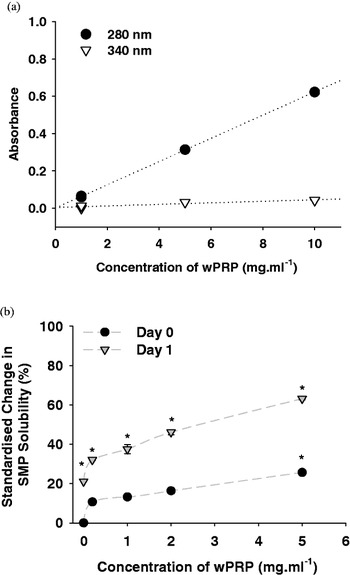
The effects of wPRP on solubility of milk proteins as a function of heating temperature and time was measured by the milk protein solubility assay. Non-aggregating proteins dissolved at appropriate concentrations (absorbance at 280 nm ≲0·5) do not absorb at 340 nm, as supported by the response shown for wPRP (Fig. 1a). This justifies the previously reported approach (see Methods) of using the absorbance at 340 nm as a means of correcting for (i.e., subtracting) the contribution of light scatter (due to the presence of soluble aggregates), to the total absorbance at 280 nm. The low absorbance at 340 nm after incubation of wPRP alone also indicated that the tendency for self-aggregation of wPRP was negligible at 22 °C (Fig. 1a). Self-aggregation of wPRP alone at elevated temperatures was not considered as wPRP was always tested in the presence of SMP protein in the solubility assay.
(a) Standard curves for whey proline-rich peptide product (wPRP) monitored at 280 and 340 nm. (b) Effects of wPRP on standardised change in milk protein solubility following treatment at 22 °C for 15 min (Day 0) and of samples analysed after storage for 1 d at 4 °C (Day 1). Data points labelled ‘*’ are significantly different from 0 (P < 0·05, ANOVA test, Dunnett Method). Results represent the mean of sample analysis in triplicate and error bars represent standard error of the mean.

In general the presence of wPRP during heating increased milk protein solubility in a concentration-dependent manner to an extent that depended on the heat treatment and the subsequent storage time at 4 °C. For samples held at 22 °C for 15 min (Fig. 1b), the immediate change in milk protein solubility (Day 0) reached approximately 20% at the maximum level of wPRP of 5 mg/ml. After storage at 4 °C for 1 d, the presence of wPRP at 5 mg/ml further increased SMP protein solubility by >63% (Fig. 1b). These effects of wPRP demonstrated the capacity for further dissolution of SMP proteins after the standard sample preparation method. The relationship between Day 0 and Day 1 data (diverging from parallel lines) suggested that the combination of low temperature and the presence of wPRP favoured increased solubility of SMP protein to a greater extent than temperature alone.
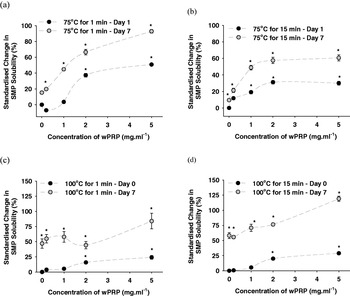
Under heating conditions at 75 °C for 1 min, where whey protein denaturation and limited protein-protein cross-linking are expected, the presence of wPRP at 5 mg/ml increased protein solubility to a maximum of 51 and 93% at Day 1 and Day 7, respectively (Fig. 2a). The presence of wPRP at 5 mg/ml was more effective at maintaining SMP protein solubility after treatment for 1 min (Fig. 2a) vs. 15 min, where the maximum increase in protein solubility was 30 and 60% at Day 1 and Day 7, respectively (Fig. 2b). As for studies at 22 °C, SMP protein solubility was significantly improved after incubation at 4 °C for 7 d. wPRP was more effective at preventing loss of solubility of SMP heated for 1 min vs. 15 min at either storage time, suggesting that wPRP was relatively less effective at preventing thermo-chemical protein association compared with physical aggregation processes.
Effects of whey proline-rich peptide product (wPRP) on standardised change in milk protein solubility following treatment at (a) 75 °C for 1 min; (b) 75 °C for 15 min; (c) 100 °C for 1 min and (d) 100 °C for 15 min. Results are shown either immediately after heat treatment (Day 0), after storage at 4 °C for 1 d (Day 1) or 7 d (Day 7), as labelled. The concentration of SMP was 10 mg/ml. Data points labelled ‘*’ are significantly different from 0 (P < 0·05, ANOVA test, Dunnett Method). Results represent the mean of sample analysis in triplicate and error bars represent standard error of the mean.

At 100 °C and above 2 mg/ml wPRP, SMP protein solubility was improved at both at Day 0 and Day 7 for heating at either 1 min (Fig. 2c) or 15 min (Fig. 2d). Further increase in protein solubility was evident following 7 d storage at 4 °C, with increases in solubility of >75% at 5 mg/ml wPRP (Fig. 2c, d, Day 7). These results further support that wPRP was not as effective in preventing covalent reactions associated with milk protein heating, namely, κ-Cn and β-lg sulphydryl-disulphide cross-linking (Anema & Li, Reference Anema and Li2003), isopeptide bond formation and dehydroalanine-mediated cross-links (O'Connell & Fox, Reference O'Connell, Fox, Roginski, Fuquay and Fox2003), but could disperse physical aggregates during refrigerated storage.
Dispersion of milk protein physical aggregates by wPRP
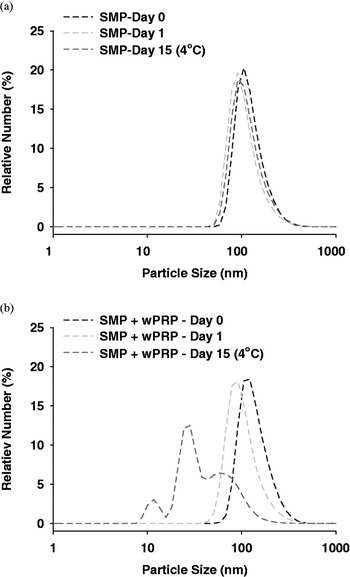
Particle size analysis was conducted to independently verify the effects of wPRP on aggregation behaviour of SMP proteins as observed in the SMP solubility assay at 22 °C (Fig. 1b). The ratios of wPRP to SMP in samples corresponded to mixtures at 3·5 mg/ml wPRP shown in Fig. 1b. In the absence of wPRP, the mean particle size increased slightly from 169·9±0·6 to 175·5±0·5 nm after 15 d storage at 4 °C (z-average value, Fig. 3a). However, in the presence of wPRP, the mean particle size decreased significantly (P < 0·05) from 185·0±0·6 to 140·7±1·8 nm (z-average values, Fig. 3b). This supported that wPRP was able to disperse physical aggregates present in unheated SMP and thereby promoted solubility of reconstituted milk proteins.
Particle size distribution of (a) SMP alone and (b) SMP incubated with whey proline-rich peptide product (wPRP), expressed as changes in particle size relative abundance as a percentage. The concentrations of SMP and wPRP were 20 and 7·0 mg/ml respectively and incubation conditions were: 22 °C for 15 min (Day 0); 22 °C for 24 h (Day 1, 22 °C), followed by 4 °C for 15 d (Day 15). Results represent the mean of duplicate acquisitions of at least 5 replicates of each sample.

These results collectively suggested that the presence of wPRP had a positive effect on maintaining or increasing the solubility of milk proteins either at room temperature or following heating at 75 and 100 °C, and that solubility was further enhanced by storage at 4 °C. The changes in solubility that occurred post-storage indicated that wPRP was able to dynamically disperse physical protein aggregates. The weakening of hydrophobic interactions as a function of temperature (Baldwin, Reference Baldwin1986) would be expected to increase the solubility of SMP proteins even in the absence of wPRP, however, the divergence from parallel of solubility curves measured pre – and post-storage (Fig. 2a, c, d), inferred a positive interactive effect of wPRP and low temperature storage.
Proposed role of proline-rich peptides in regulating milk protein solubility
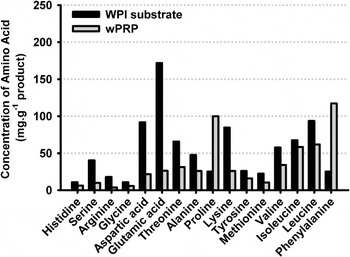
As a result of the method of processing, wPRP was compositionally distinct from the WPI substrate according to its amino acid profile (Fig. 4). The wPRP product was relatively enriched with respect to the hydrophobic amino acids proline and phenylalanine compared with WPI, and the effects of this product on regulating self-assembly of beta amyloid peptide was recently described (Bharadwaj et al. Reference Bharadwaj, Head, Martins, Raussens, Sarroukh, Jegasothy, Waddington and Bennett2012).
Comparison of amino acid profiles of whey protein isolate substrate and whey proline-rich peptide (wPRP) product. Analysis by Pearson Product Moment Correlation indicated there were no significant relationships between any pair of variables (P>0·050).

PRPs have been previously isolated from caseins rather than whey proteins as β-casein (β-Cn) represents a particularly rich source of proline (35/209 residues or 17%, w/w) compared with 2·5% (w/w) found in WPI. However, the process described for preparation of wPRP was successful in producing a proline-rich peptide fraction from whey, enriched to 100·1 mg/g or 10·0% w/w (Fig. 4) and we hypothesise that the properties of wPRP are strongly linked with the elevated proline content.
The term ‘proline-rich peptide’ has been used to describe peptides containing a high proportion of proline and hydrophobic amino acids. The level of enrichment of proline, phenylanlanine and other hydrophobic amino acids justifies its characterisation as a proline-rich peptide (Janusz et al. Reference Janusz, Staroscik, Zimecki, Wieczorek and Lisowski1981). A number of biological effects of PRPs have been reported with potential for nutritional and therapeutic uses but as yet, PRPs do not appear to have been tested or exploited for technological uses such as in processing of milk or other food proteins. Regulation of the assembly of fibrillar structures displayed by specific purified milk casein proteins by other specific milk caseins shows the potential for co-operative interactions between this particular group of proteins. For example, the studies of Thorn et al showed that in purified form, while the caseins: κ-Cn and αS2 casein (αS2-Cn) can self-assemble into β-sheet-rich fibrillar structures, in contrast, β-Cn and αS1-Cn prevent formation of these fibrillar structures (Thorn et al. Reference Thorn, Meehan, Sunde, Rekas, Gras, MacPhee, Dobson, Wilson and Carver2005, Reference Thorn, Ecroyd, Sunde, Poon and Carver2008, 2009). Furthermore, we have recently shown that hydrolysates prepared from either whey or casein proteins can also inhibit assembly of fibrils of both RCM-κ-Cn and amyloid beta peptide, associated with Alzheimer's Disease (Bharadwaj et al. Reference Bharadwaj, Head, Martins, Raussens, Sarroukh, Jegasothy, Waddington and Bennett2012). The previous authors use the term ‘molecular chaperone’ to describe these phenomena, and we have likewise adopted this descriptive term even though the ratios of substrate to ‘chaperone’ are not strictly analogous to true chaperone-substrate interactions.
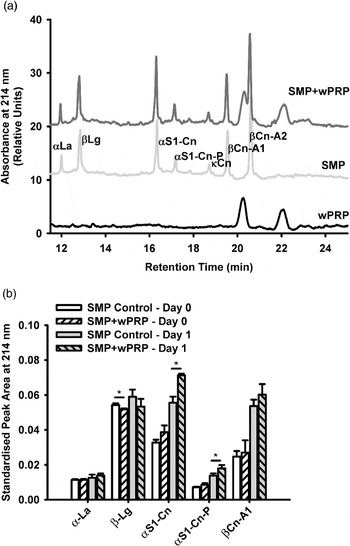
‘Colostrinin’ (CLN) is a mixture of low molecular weight PRPs derived from ovine colostrum (Zimecki, Reference Zimecki2008), containing non-polar amino acids and proline contents of 40 and 25%, respectively. The extensive research characterising properties of CLN suggests that the proline-rich nature of this peptide extract is important in its functional and bioactive properties (Janusz & Zablocka, Reference Janusz and Zablocka2010). In addition to biological effects, the effects of CLN on structure of the fibrillogenic peptide in Alzheimer's disease, beta amyloid 1–42 (Aβ42), have been demonstrated. It has been reported that CLN not only inhibited the aggregation of Aβ42 into cross β-sheet-rich fibrils but also dissolved pre-existing fibrils of Aβ42 in vitro (Schuster et al. Reference Schuster, Rajendran, Hui, Nicotera, Srikrishnan and Kruzel2005). Likewise, we have recently shown that wPRP can regulate oligomer and fibril assembly of Aβ42 (Bharadwaj et al. Reference Bharadwaj, Head, Martins, Raussens, Sarroukh, Jegasothy, Waddington and Bennett2012), and propose that the prevention of physical aggregation of milk proteins by wPRP is related to effects exerted on Aβ42. We suggest that hydrophobic binding interactions between wPRP and milk proteins, specifically αS caseins (Fig. 5a, b), and storage effects similarly reflect progressive disruption of α- and β-sheet secondary structures, as shown for CLN (Boldogh et al. Reference Boldogh, Aguilera-Aguirre, Bacsi, Choudhury, Saavedra-Molina and Kruzel2008).
Analysis of soluble proteins detected following incubation of SMP (10 mg/ml) in the absence or presence of whey proline-rich peptide product (wPRP, 3·5 mg/ml) following incubation at 22 °C for 15 min (Day 0) or 4 °C for 24 h at (Day 1, 4 °C), by capillary electrophoresis. (a) representative electropherograms from triplicate analysis. (b) Mean peak areas of proteins standard detectable without interference from wPRP's at Day 0 and Day 1. Results represent the mean of sample analysis in triplicate after correction of peak areas for the internal standard and error bars represent standard error of the mean. Significant effects of wPRP on enhancing solubility are shown (*, P < 0·05, Tukey's test). αLa: α-lactalbumin; βLg: β-lactoglobulin; αS1-Cn: αS1-casein; αS1-P-Cn: αS1-casein with serine 41 phosphorylated; κ-Cn: κ-casein; β-Cn-A1: β-casein A1; β-Cn-A2.

Specific interactions of wPRP and milk proteins
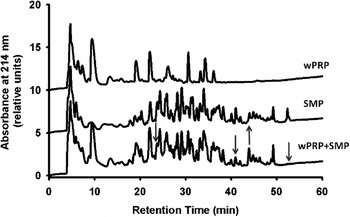
Replicates of samples prepared as for particle size analysis were subjected to digestion with trypsin in order to determine if binding interactions between wPRP and milk proteins were strong enough to alter accessibility to tryptic cleavage sites. After accounting for the presence of wPRP itself, there were at least 4 peaks that appeared to be altered by the presence of wPRP: 3 with decreased abundance and 1 with increased abundance (Fig. 6). Considering the high number of unaffected peptides, this suggested that interactions between wPRP and milk proteins exerted only limited interference to hydrolysis by trypsin. This is supported by the fast dissociation kinetics reported to take place between proline-rich domains of proteins, that prevents the formation of structurally-defined complexes (Kay et al. Reference Kay, Williamson and Sudol2000).
Representative HPLC profiles of tryptic digests of SMP alone, SMP incubated with whey proline-rich peptide product (wPRP) and wPRP alone, following incubation of SMP (10 mg/ml) at 22 °C for 15 min (‘Day 0’) in the absence or presence of wPRP (3·5 mg/ml).

The effects of wPRP on solubility of individual milk proteins detected in supernatants after 15 min at 22 °C (Day 0) and 24 h at 4 °C (Day 1), were studied by CE. This experiment detected both the earliest interactions of wPRP peptides with milk proteins (15 min) and effects after extended storage 4 °C (Fig. 5a, b). The changes in concentrations of individual proteins in the supernatant suggested that initial interactions involved the major αS1 and αS1-P caseins (Fig. 5b) with solubility significantly elevated by ∼30% after storage for 1 d. A similar trend was present but not significant at 15 min. wPRP also appeared to initially promote decreased solubility of β-lg but the effect was not significant after storage.
The preferential interaction of wPRP with αS1-Cn, the major casein protein accounting for ∼40% of milk proteins by mass, can account for the bulk solubilisation effects by wPRP. Weakening of hydrophobic interactions at low temperature is known to cause release of β-Cn and κ-Cn from casein micelles (Kumosinski et al. Reference Kumosinski, Brown and Farrell1993). However, the apparent effect of wPRP on αS-caseins supports that effects of wPRP on milk proteins are complimentary and additive to temperature-mediated relaxation of hydrophobic interactions, and further support observed synergistic effects of wPRP in combination with extended storage time, on increasing milk protein solubility.
The selective promotion of solubility of αS-caseins by wPRP can also be explained by the lower relative content of hydrophobic residues (Ala, Ile, Leu, Phe, Trp, Val) in αS-caseins (∼30–32 mole %) compared with other caseins and major whey proteins (ranging from 33 to 40 mole %), and the consequently greater ease with which wPRP might disperse physical aggregates involving αS-caseins. By analogy that CLN interferes with β-sheet folding of Aβ42 into fibrils, (Williamson, Reference Williamson1994; Kay et al. Reference Kay, Williamson and Sudol2000), and that wPRP does likewise (Bharadwaj et al. Reference Bharadwaj, Head, Martins, Raussens, Sarroukh, Jegasothy, Waddington and Bennett2012), it is proposed that wPRP selectively binds to β-sheet rich structures of milk proteins via proline-mediated interactions. Furthermore, proline binding to non-polar regions of proteins is known to reduce hydrophobicity resulting in partial dissociation of casein micelles (McMahon & Brown, Reference McMahon and Brown1984). In summary, we hypothesise that wPRP binds to the major milk protein, αS-caseins, via weak hydrophobic interactions probably β-sheet-rich domains, and acts like a ‘strip bandage’ that subsequently prevents hydrophobic associations, and possibly covalent reactivity, between milk proteins during and after heat treatment.
Potential applications of wPRP in dairy processing
In the context of dairy processing, potential applications for this novel wPRP product appear to be in stabilisation of protein concentrates or UHT products during shelf storage, to prevent or reverse progressive thickening and gelation. However, practical usefulness of wPRP for regulating protein aggregation in dairy products requires efficacy at the lowest ratio of wPRP to SMP. Heat stability of concentrated forms of milk proteins have been previously regulated by the addition of either phosphate or citrate salts. For concentrated forms of recombined milk products, phosphates are typically added at a concentration of 0·04 mol per kg skimmed milk solids (Augustin & Clarke, Reference Augustin and Clarke1990). In comparison, inhibition of thermal aggregation of caseins (80 °C for 1 min), was achieved using 1 part hydrolysed lecithin to 18 parts casein (w/w) (Le et al. Reference Le, El-Bakry, Neirynck, Bogus, Hoa and Van der Meeren2007). In the present study, the concentration of milk solids in the protein solubility assay was 10 mg/ml (or 3·7 mg/ml protein), representing approximately 1/10 of standard skimmed milk. In dose-response studies (Figs. 1b & 2), the ratio of wPRP to SMP solids required for moderate effect was approximately 1 part wPRP to 4 parts milk solids (w/w). However, the ongoing dispersion of physical aggregates by wPRP during storage could allow for lowering the initial concentration of wPRP required to achieve longer-term stabilisation, particularly with refrigeration. Further studies are needed to optimise the concentration ratio of wPRP required for stabilisation of protein solubility and to evaluate commercial feasibility of wPRP for this purpose.
Financial support from CSIRO Food and Nutritional Sciences and the Melbourne School of Land and Environment, University of Melbourne, and assistance with experimental procedures by Li Jiang Cheng and Katherine Robinson, are gratefully acknowledged.