INTRODUCTION
The idea that many parasitic species have the ability to control and change host phenotype in a way that is a fitness benefit to the parasite arose more than four decades ago and now is a well-established phenomenon (Poulin, Reference Poulin2010). Following the pioneering work of Bethel and Holmes (Reference Bethel and Holmes1973), many spectacular examples of parasitic manipulations were discovered. Such manipulations are suggested to be parasitic adaptations for increasing transmission success, and this has been demonstrated in many host–parasite systems (e.g. Bethel and Holmes, Reference Bethel and Holmes1977; Lafferty and Morris, Reference Lafferty and Morris1996; Maure et al. Reference Maure, Brodeur, Ponlet, Doyon, Firlej, Elguero and Thomas2011; reviewed in Poulin, Reference Poulin2010). For instance, immature (not-ready-to-transmit) parasites can manipulate their host's behaviour. For immature larvae the host is a resource, which can be utilized in the future. Therefore, a beneficial approach for the non-infective stages of the parasite would be to make their host less vulnerable to predation, until reaching infectivity (Parker et al. Reference Parker, Ball, Chubb, Hammerschmidt and Milinski2009; see also Anderson et al. Reference Anderson, Koella and Hurd1999; Hammerschmidt et al. Reference Hammerschmidt, Koch, Milinski, Chubb and Parker2009; Dianne et al. Reference Dianne, Perrot-Minnot, Bauer, Gaillard, Léger and Rigaud2011; Weinreich et al. Reference Weinreich, Benesh and Milinski2013; Hafer and Milinski, Reference Hafer and Milinski2015, Reference Hafer and Milinski2016).
However, evolutionary adaptations (e.g. manipulations) are almost always costly (Dawkins, Reference Dawkins1982). Therefore a trade-off between parasitic manipulation and other functions of the parasite, such as growth, can be expected (Poulin, Reference Poulin1994, Reference Poulin2010). Despite the prediction of manipulation costs in the literature and a strong theoretical background (e.g. Poulin, Reference Poulin1994, Reference Poulin2010; Brown, Reference Brown1999; Poulin et al. Reference Poulin, Fredensborg, Hansen and Leung2005; Thomas et al. Reference Thomas, Adamo and Moore2005; Seppälä et al. Reference Seppälä, Karvonen and Valtonen2008a , Reference Seppälä, Valtonen and Benesh b ; Vickery and Poulin, Reference Vickery and Poulin2010; Adamo, Reference Adamo2013), there have been no experimental studies demonstrating these costs (Weinersmith et al. Reference Weinersmith, Warinner, Tan, Harris, Mora, Kuris, Lafferty and Hechinger2014; Hafer and Benesh, Reference Hafer and Benesh2015). However earlier, Maure, et al. (Reference Maure, Brodeur, Ponlet, Doyon, Firlej, Elguero and Thomas2011) suggested manipulation costs as a possible explanation for the decrease in the fecundity of parasitic wasp larvae with increasing duration of the manipulation of host lady beetle behaviour.
In a strict evolutionary sense costs should be measured in terms of fitness (Poulin et al. Reference Poulin, Fredensborg, Hansen and Leung2005). However in practice, fitness costs can be evaluated by the measuring fitness related traits i.e. individual's phenotypic traits, which are of primary importance to the survival or reproductive success (e.g. Kingsolver and Huey, Reference Kingsolver and Huey2008; Maure et al. Reference Maure, Brodeur, Ponlet, Doyon, Firlej, Elguero and Thomas2011). A measurable proxy of fitness cost of host manipulation could be growth or fecundity of the parasite. For instance, energy invested in synthesizing of molecules needed for manipulation (e.g. neurotransmitters) can be alternatively invested in growth of parasitic larvae. The size of the larvae is typically positively correlated with the fitness of the adult stage, when other things are equal (De Block and Stoks, Reference De Block and Stoks2005; Benesh, Reference Benesh2010).
Physiological costs of manipulation are hard to measure directly (Poulin et al. Reference Poulin, Fredensborg, Hansen and Leung2005; Poulin, Reference Poulin2010). A promising indirect approach is based on the notion that manipulation costs of individual parasite decrease with increase in the parasite's infrapopulation (parasite population within a host individual) size due to cost sharing by conspecifics, a notion that is also predicted by theoretical models (Poulin, Reference Poulin1994; Brown, Reference Brown1999; Vickery and Poulin, Reference Vickery and Poulin2010). Therefore, costs of manipulation could be evaluated by comparing parasite growth rates (or sizes, if all parasites infected their host simultaneously) among host individuals with differing numbers of manipulating parasites, because individual parasites in larger infrapopulations are expected to spend less energy on manipulation and invest more resources in growth due to cost sharing (Poulin, Reference Poulin1994). However the cost sharing hypothesis has rarely been tested purposefully. Brown, et al. (Reference Brown, De Lorgeril, Joly and Thomas2003) was unable to find traits of cost sharing in a trematode–gammarid study system. Later, Weinersmith, et al. (Reference Weinersmith, Warinner, Tan, Harris, Mora, Kuris, Lafferty and Hechinger2014) demonstrated using the field data zero or even small positive influence of the trematode Euhaplorchis californiensis density on the metacercariae growth. The experimental confirmation of these findings is necessary (Weinersmith et al. Reference Weinersmith, Warinner, Tan, Harris, Mora, Kuris, Lafferty and Hechinger2014).
In many parasitic populations cost sharing may be masked by the cost of group living (Brown et al. Reference Brown, De Lorgeril, Joly and Thomas2003). In macroparasites resources depletion or space shortage usually outweighs benefits from cooperation (Brown et al. Reference Brown, De Lorgeril, Joly and Thomas2003). Thus, in natural populations the size and development rate of parasites commonly decrease with increasing population density (e.g. Sandland and Goater, Reference Sandland and Goater2000; Dezfuli et al. Reference Dezfuli, Giari and Poulin2001; Brown et al. Reference Brown, De Lorgeril, Joly and Thomas2003; Saldanha et al. Reference Saldanha, Leung and Poulin2009; Cornet, Reference Cornet2011; Dianne et al. Reference Dianne, Bollache, Lagrue, Franceschi and Rigaud2012). Therefore, there is no reliable experimental evidence of such cost sharing among macroparasites, although there are bacterial (see Ng and Bassler, Reference Ng and Bassler2009) and viral (Turner and Chao, Reference Turner and Chao1999) examples of this phenomenon.
Assuming that parasites within the infrapopulation are sharing their manipulation costs, another important question is how individual parasites assess infrapopulation size and adjust their levels of manipulation and cost sharing. We suggest that parasites may adjust their investment in host manipulation based on information about the physiological state of their host or by using cues from conspecifics to adjust their manipulation efforts. However, it is likely that information from the conspecifics often differs in its quality. When parasites are aggregated inside the host, signals from nearest neighbours are more reliable than from distant individuals either because of transmission interference or the possibility of cheating. For instance, in bilateral two-eyed hosts, parasites inhabiting eyes are forming two distinct aggregations. Since information transfer between two eyes is limited compared with within an eye, we suggest that in this case parasites adjust their manipulation effort mainly basing on the parasite abundance in the same aggregation (eye). In this study we used eye flukes, Diplostomum pseudospathaceum, localized in eye lenses of the rainbow trout (Oncorhynchus mykiss) to investigate costs sharing and infrapopulation size sensing in manipulative parasites. Rainbow trout is commonly parasitized by Diplostomum under natural conditions (e.g. Sokolov, Reference Sokolov2010).
Trematode Diplostomum pseudospathaceum has a complex life-cycle including fresh-water snails as the first intermediate host, a number of fish species as the second intermediate host and fish-eating birds as the final host (Seppälä et al. Reference Seppälä, Karvonen and Valtonen2004). Cercariae emerge from the infected snail, penetrate fish and migrate to the host eye lens. Metacercaria, the stage localized in host eye lenses, needs about a month to reach the maturity (readiness to infect the next host) (Sweeting, Reference Sweeting1974). Immature larvae of D. pseudospathaceum manipulate the behaviour of rainbow trout in accordance with the ‘predation suppression’ hypothesis, increasing anti-predatory behaviours of the parasitized fish (Mikheev et al. Reference Mikheev, Pasternak, Taskinen and Valtonen2010; Gopko et al. Reference Gopko, Mikheev and Taskinen2015).
Manipulations by eye fluke metacercariae may be explained by the vision deterioration because of the cataract formation (Karvonen et al. Reference Karvonen, Seppälä and Valtonen2004; Seppälä et al. Reference Seppälä, Karvonen and Valtonen2012). However behaviour changes caused by the immature larvae develop much earlier than the cataract formation begins (Karvonen et al. Reference Karvonen, Seppälä and Valtonen2004; Seppälä et al. Reference Seppälä, Karvonen and Valtonen2005), making a chemical mechanism of manipulation (reviewed in Adamo, Reference Adamo, Hughes, Brodeur and Thomas2012) more plausible (Gopko et al. Reference Gopko, Mikheev and Taskinen2015). Although eye lenses lack blood vessels, they are not totally separated from the rest of the body. For instance, glucose molecules ordinarily enter eye lenses (Chylack and Cheng, Reference Chylack and Cheng1978; Candia, Reference Candia2004). It is, therefore, possible for small molecules (such as neurotransmitters) to leave eye lenses freely.
Resource competition between immature parasites should be low relative to the benefit of manipulation since immature parasites are often much smaller than their infective conspecifics, and their ability to obtain nutrients is limited by the small body surface area (Bibby and Rees, Reference Bibby and Rees1971). Since manipulations are supposed to be costly (Thomas et al. Reference Thomas, Adamo and Moore2005; Adamo, Reference Adamo2013), a decrease in the cost of manipulation for the immature parasites with infrapopulation growth is likely to be considerable compared with resources competition.
Another way to reveal parasitic manipulation costs is to estimate differences in manipulation investment under different environmental conditions, because a parasite's benefits from the manipulation may be context-dependent (Parker et al. Reference Parker, Ball, Chubb, Hammerschmidt and Milinski2009; Poulin, Reference Poulin2010). For instance, when the next host in the life cycle of the parasite is absent in the habitat, investment in host manipulation does not pay off. Although possibility to adjust investment regarding manipulation based on environmental conditions represents an obvious adaptation for parasites, investigations addressing this possibility are few. Vyas, et al. (Reference Vyas, Kim and Sapolsky2007) demonstrated that changes in rodents’ behaviour caused by Toxoplasma gondii depends on the strength of predator-related stimuli, lending some credence to the hypothesis that parasites can change the manipulation investment to minimize the manipulation cost/benefit ratio.
In this study we experimentally investigated the trade-offs between the proposed manipulation costs and growth among immature manipulative parasites. We hypothesized that (i) an immature parasite's investment in the manipulation decreases (and growth increases) with the size of the parasite infrapopulation due to shared manipulation costs; (ii) parasites adjust their investment toward manipulation based on the quality of information they get from conspecifics. In our host–parasite study system (eye dwelling parasites of fish) this should mean that within a host, parasites would grow faster in the eye that has the higher number of parasites. (iii) In the environment where manipulation is unnecessary (predators are absent) immature parasites invest less in the host manipulation and thus grow faster than when predators are present.
MATERIALS AND METHODS
Experimental design and study subjects
All experiments were conducted at the Konnevesi research station, University of Jyväskylä, in June–August 2014. Young-of-the-year rainbow trout was obtained from a commercial fish farm, where they had been reared using ground water and were free of macroparasites. For acclimation, fish were maintained for a month in 1350 L tanks supplied with water from the lake Konnevesi. The experiments were conducted with permission of the Centre for Economic Development, Transport and Environment of South Finland (license number ESAVI/6759/04.10.03/2011).
A group of 52 fish were exposed in 120 L tanks (at 14·4 °C) to cercariae obtained from ten freshwater snails Lymnaea stagnalis collected from the Lake Konnevesi. Cercariae used for infection were not older than 3 h. The estimated infection dose was 80 cercariae per fish, with 30 min exposure time. Fish were mass-exposed to cercariae following Seppälä et al. (Reference Seppälä, Karvonen and Valtonen2004, Reference Seppälä, Karvonen and Valtonen2005). After the exposure, rainbow trout were placed in four identical 20 L (40 × 25× height 20 cm) aquaria with water flow. In two randomly selected aquaria (predation treatment) predator conditioned water was added (a mixture of the adult rainbow trout kairomones and rainbow trout alarm substances). Predator conditioned water was obtained as follows: 2 L of water from the flow-through tank with several dozens of adult rainbow trout (predator) were blended with the rainbow trout alarm substance acquired by making numerous cuts in the skin of the freshly killed rainbow trout of the similar size with the fish used in the experiment. Conspecific skin extracts induce antipredator behavioural responses in rainbow trout juveniles (Brown and Smith, Reference Brown and Smith1997; Mirza and Chivers, Reference Mirza and Chivers2001; Sovová et al. Reference Sovová, Boyle, Sloman, Pérez and Handy2014). We did not find any data concerning the influence of adult conspecifics’ kairomones on the behaviour of rainbow trout. However cannibalism is a very common phenomenon among salmonids (e.g. Vik et al. Reference Vik, Borgstrom and Skaala2001) and enhanced defensive responses on adult conspecifics’ odours are common in cannibalistic species (Ferrari et al. Reference Ferrari, Wisenden and Chivers2010). Predator conditioned water (500 mL) was added twice a day to each aquarium from the predation treatment immediately after preparation. Water flow in the aquaria was turned off for 30 min after addition of predator conditioned water. Control fish were sham exposed to the same amount of clean lake water. Rainbow trout were fed daily ad libitum with commercial food pellets (1·5 mm size, Nutra Parr LB, Norway). After 16 days of maintenance at 13·6–14·2 °C fish were killed with an overdose of 0·01% MS 222 (Sigma Chemical Co., St Louis, USA) and weighed. Then their eye lenses were dissected and the number of D. pseudospathaceum metacercariae was counted microscopically in each eye. The length of the first five metacercariae in each eye beginning from the left edge of the microscopic field was measured using eyepiece micrometer under 32× magnification, when possible. However in five cases metacercariae were hidden by the eye lens debris and we were able to measure only three or four metacercariae (one and four eye lenses respectively) per eye (see datafile at http://doi.org/10.6084/m9.figshare.4874870 for details).
All dissections were done by the same investigator, who was unaware whether fish originated from the predation or control treatment.
Data analysis
We used general linear mixed model to determine, whether parasite growth depends on the total infection intensity in the host or on the infection intensity in the eye lens, where parasite is localized. Eye (left/right) and fish identity were random effects and random effects for eyes were nested within the fish identity factor. Treatment (predation vs control) was a fixed effect, while intensities of infection in fish and in certain eyes were continuous predictors. However these two continuous predictors were correlated and we aimed to assess the influence of both overall and within-eye infection intensity on metacercariae growth. To avoid multicollinearity problems and separate the effect of these two predictors, we used group mean centering of the covariate (see Bafumi and Gelman, Reference Bafumi and Gelman2006; Bell and Jones, Reference Bell and Jones2015 for details). In brief, we calculated mean within-eye infection intensity for each fish (i.e. averaged infection intensities in the left and right eye for each fish) and subtracted these values from the infection intensity in the fish eye. These group-mean-centreed infection intensities were used in the subsequent analysis. Our null-model included only random factors. Then we successively added overall within-fish infection intensity, mean centred within-eye infection intensity, treatment (predation/control), all double interactions, all triple interactions etc. to the null model. Obtained nested models were compared using likelihood-ratio tests (LRT). Estimate values were presented only for the model with the lowest value of the Akaike criterion.
To give a more demonstrative presentation of the results we also fit two regression models (identity link function, Gaussian errors structure), where the dependent variable is the mean length of parasites in the right eye (RE) and left eye (LE), respectively and infection intensities in both eyes taken separately were predictors.
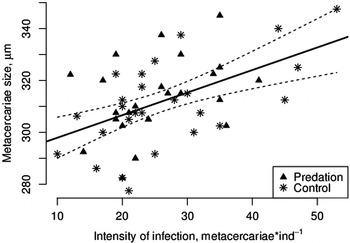
To visualize the data we used the following approach. Mean metacercariae size in the predation and control treatment were compared using ANCOVA with metacercariae size as a response variable, treatment as a categorical predictor, and intensity of the infection as a continuous predictor. Since the interaction term and treatment effect were not significant (P > 0·28 in both cases), they were sequentially excluded from the model. Two datasets (predation and control treatments) were merged and a simple regression (mean metacercariae size vs intensity) was plotted.
R software was used for all statistical analyses (R Core Team, 2015). Generalized linear mixed models were constructed using ‘lme4’ package (Bates et al. Reference Bates, Maechler, Bolker and Walker2015) for R.
Residuals were checked for normality and homoscedasticity on Q-Q plots.
RESULTS
All fish in both treatments were infected with D. pseudospathaceum metacercariae. One fish from the predation treatment died for unknown reasons, and the eye lens of another fish from this treatment was lost during dissection. Therefore, 24 fish from the predation and 26 fish from the control treatment were considered in the subsequent analysis (mean mass ± s.d. = 7·3 ± 3·7 g). Mean ± s.d. immature metacercariae numbers were 26·6 ± 10·7 and 25·3 ± 7·6 for the control and predation groups, respectively. There was no difference in infection intensities between control and predation treatments (t-test, t N=50 = 0·52, P = 0·61).
There was no significant effect of predation threat on the mean metacercariae size in rainbow trout, while the influence of the infection intensity was highly significant (Table 1; Fig. 1). Metacercariae tend to be bigger in fish with higher infection intensity. They adjusted their growth not only to the overall infection intensity, but also to the infection intensity in the eye, where parasite is localized.
Diplostomum pseudospathaceum metacercariae mean size in rainbow trout positively correlated with infection intensity (r = 0·51, t N=50 = 4·07, P = 0·0002). The regression line with 95% confidence intervals is plotted.

Outcome of LRT for GLMM of metacercariae size

AIC, Akaike criterion; GLMM, generalized linear mixed model; LRT, likelihood-ratio tests.
494 metacercariae measurements (observations) on 100 eye lenses in 50 fish.
Diplostomum pseudospathaceum metacercariae size was a response variable. Fish identity was used to construct random effects. Estimates are presented only for the models with the lowest AIC values. Significant LRT are indicated in bold. Null model was metacercariae size ~ (1|Fish ID). Then we subsequently added fish mass, treatment, overall infection intensity in fish, centred (see the section Methods) within-eye infection intensity and interactions. Only double interactions are presented. Higher order interactions were also non-significant (not presented here).
When left and right eyes were considered separately, there was clear positive and significant association between the mean size and the number of meatacercariae in the same eye, while the effect of the metacercariae number in the opposite eye was not significant (Table 2). There was a moderate, but significant correlation (r = 0·33, P = 0·02) between the predictors (parasites number in the right and left eye) in the models. However variance inflation factor was low (VIF = 1·10); therefore multicollinearity was not an issue in our model.
Association between the mean metacercariae size eye in right eye (left eye) and the intensity of the infection of both eyes taken separately

P-values less than 0.05 are marked with bold.
DISCUSSION
Results of this study indicate that immature D. pseudospathaceum metacercariae display positive density-dependent growth in the first 2·5 weeks of their development – the higher the number of metacercariae the bigger they were, which implied the quicker growth rate of metacercariae in more infected individuals, because all parasites infected their hosts simultaneously (within 30 min interval). The relationship was strong in the farm reared rainbow trout, which were naïve to the Diplostomum infection and free of other macroparasites. Since immature Diplostomum metacercariae are manipulative parasites (e.g., Mikheev et al. Reference Mikheev, Pasternak, Taskinen and Valtonen2010; Gopko et al. Reference Gopko, Mikheev and Taskinen2015), one probable explanation for the results in rainbow trout is sharing of manipulation costs. It is necessary to mention that the extent of the manipulation of immature eye fluke larvae does not depend on the intensity of the infection (Mikheev et al. Reference Mikheev, Pasternak, Taskinen and Valtonen2010; Gopko et al. Reference Gopko, Mikheev and Taskinen2015). It suggests that overall investment in manipulation of host behaviour stays constant with parasite's infrapopulation growth (i.e. parasites invest the same amount of resources in the manipulation jointly, while a share of individual parasite decreases with the increase of the infrapopulation size). Therefore, with the increase in the infection intensity parasites may simply decrease their manipulation investment, while behavioural changes will stay at the same level rather than grow (see Poulin, Reference Poulin1994; Poulin et al. Reference Poulin, Fredensborg, Hansen and Leung2005 for the theoretical discussion).
However we should acknowledge that though the influence of immature D. pseudospathaceum metacercariae on the host behaviour (predation suppression) has been demonstrated earlier (Mikheev et al. Reference Mikheev, Pasternak, Taskinen and Valtonen2010; Gopko et al. Reference Gopko, Mikheev and Taskinen2015) we are unaware of studies where the positive effect of these behavioural changes on parasites’ fitness was directly shown. Therefore, the suggestion that behavioural changes caused by the eye flukes were a pathological side effect cannot be fully disregarded. However a switch from the predation suppression to the predation enhancement in this host–parasite system coincides with the maturity of the parasite (Mikheev et al. Reference Mikheev, Pasternak, Taskinen and Valtonen2010; Gopko et al. Reference Gopko, Mikheev and Taskinen2015, Reference Gopko, Mikheev and Taskinen2017), which is strong evidence supporting the idea that eye flukes actively and purposefully manipulate the behaviour of their host.
There are alternative explanations for positive density-dependent growth. For example, eye fluke metacercariae may accelerate their growth and development to outcompete their conspecifics and get as much resources as possible until the competition will become too fierce. In other words, parasites would accelerate their development at a cost of future reproductive success (or other fitness related traits) to reach the maturity earlier than their conspecifics. In addition, mature and immature eye fluke larvae manipulate their hosts’ behaviour in different directions (Gopko et al. Reference Gopko, Mikheev and Taskinen2015, Reference Gopko, Mikheev and Taskinen2017), which can lead to an intraspecific conflict between the parasites (Cézilly et al. Reference Cézilly, Perrot-Minnot and Rigaud2014; Hafer, Reference Hafer2016). In such conflicts mature parasites usually get the upper hand and, therefore, early maturation can be beneficial for the parasite, even if it reduces its manipulation ability. Similar phenomenon was found in free living animals hatching sooner in the presence of the threat (Warkentin, Reference Warkentin1995; Wedekind, Reference Wedekind2002), and in parasites adjusting their life-cycle to the presence/absence of suitable hosts in the environment (Lagrue and Poulin, Reference Lagrue and Poulin2007). However, it is unlikely that at moderate infrapopulation sizes observed in our study the competition for resources between eye fluke metacercariae is substantial, since much higher infection intensities are commonly found in natural and experimental infections (Mikheev et al. Reference Mikheev, Pasternak, Taskinen and Valtonen2010). In addition, the size of mature D. pseudospathaceum metacercariae does not decrease with the infrapopulation growth (Gopko, unpublished data).
Fish, which are more susceptible to the infection, can also be more suitable for parasite growth (Weinersmith et al. Reference Weinersmith, Warinner, Tan, Harris, Mora, Kuris, Lafferty and Hechinger2014). However in our study we found that parasites adjust their growth rate not only to the total amount of parasites in the host, but to the number of parasites in the eye lens that they occupy. Such a relationship can hardly be explained by the influence of the host quality on the early stages of the infection, since it is unlikely that eye lenses within the host can differ in susceptibility to infection and suitability for parasite growth. In addition, Diplostomum metacercariae are unprocurable to the host immune system in their final localization – host eye lens (Höglund and Thuvander, Reference Höglund and Thuvander1990; Wegner et al. Reference Wegner, Kalbe and Reusch2007). Therefore it is unclear, how some fish can be more suitable for the parasite growth than others, if immune mechanisms are inapplicable. On the other hand, the parasites are susceptible to the host immune system when moving from the site of penetration to the eye lens, i.e. only for a short period of time (hours) (Wegner et al. Reference Wegner, Kalbe and Reusch2007), which suggests another possible explanation for the observed positive density-dependence. If many parasites simultaneously penetrate and migrate through a fish to reach the eyes, it may ‘dilute’ the host's immune responses, such that individual parasites expend less energy on resisting the host immunity. However in our study we used very moderate amount of parasites for infection, which is unlikely to cause host immune system overload. Moreover, previous study on Arctic charr demonstrated that the relative success of Diplostomum infection (the share of parasites established in eye lenses) have a tendency to decrease with an increase in the number of cercariae that penetrated the fish skin (Voutilainen et al. Reference Voutilainen, Huuskonen and Taskinen2010). This result suggests that the strength of innate fish immune response to Diplostomum may be proportional to the intensity of the parasite challenge. Therefore it highly unlikely that parasite may benefit from the host immune system overload and ‘dilution’ of the immune response.
Another possible explanation is that higher parasitic density in the eye lenses may increase the flux of nutrients into the eye or the availability of nutrients. This could explain why, within a fish, the eye with more metacercariae tends to have bigger metacercariae. It seems that this explanation cannot be fully disregarded. However early metacercariae are feeding absorbing small molecules, such as glucose (Bibby and Rees, Reference Bibby and Rees1971), which ordinarily enter host eye lenses (Chylack and Cheng, Reference Chylack and Cheng1978; Candia, Reference Candia2004), and it is unlikely that the parasitic growth on early stages is limited by the flux of the low-molecular compounds. Since parasite abundances were low and hosts were much bigger when compared with the parasites, competition for resources should not be substantial in this host–parasite system (see also Weinersmith et al. Reference Weinersmith, Warinner, Tan, Harris, Mora, Kuris, Lafferty and Hechinger2014 for the discussion). In addition, even if the increased nutrients flux is the mechanism underlying positive density-dependence observed in our study, this relationship is still noteworthy, because implies a sort of by-product cooperation between parasites.
The intensities of infection in our study were rather low and were comparable both with other experimental studies (e.g. Seppälä et al. Reference Seppälä, Karvonen and Valtonen2004; Mikheev et al. Reference Mikheev, Pasternak, Taskinen and Valtonen2010) and reports of natural intensities (e.g. Valtonen and Gibson, Reference Valtonen and Gibson1997; Marcogliese et al. Reference Marcogliese, Dumont, Gendron, Mailhot, Bergeron and McLaughlin2001; Sokolov, Reference Sokolov2010; Désilets et al. Reference Désilets, Locke, McLaughlin and Marcogliese2013). Therefore a positive density-dependence of the metacercariae size found in our study can be also met in natural environments. It should be mentioned, however, that in natural environments fish are likely to be exposed to the parasites over longer time span compared with the simultaneous experimental exposure. Therefore in natural conditions parasites belonging to a different age cohorts often co-occur in the same host. When the age of the parasitic larvae inhabiting the same host strongly differs (e.g. some parasites are closer to infective stage than others), the picture becomes more complicated, because of the conflict over the host manipulation between infective and not yet infective individuals (Cézilly et al. Reference Cézilly, Perrot-Minnot and Rigaud2014; Hafer, Reference Hafer2016).
In this study, we did not control for kinship relations between metacercariae inhabiting the same host. In a parasitic infrapopulation consisting of the closely related individuals, cost sharing is likely to be closer to optimal compared with populations consisting of more distantly related strains (Poulin, Reference Poulin1994) and therefore may have more influence on parasite growth and development. Since cercariae used for the experimental infection in our study were obtained from limited pool of snails, our results may not fully reflect natural situation, in which the meeting of parasites from the same strain in the same host is unlikely.
The aforementioned adjustment of manipulative investment by parasites suggests that there are mechanisms by which parasites estimate how much they should invest. Parasites can be capable of evaluating infrapopulation density (i.e. number of conspecifics) in the host organism by direct contact with other parasite individuals, or by receiving signals (e.g. chemical) from their conspecifics, in a manner similar to quorum sensing in bacteria (see Ng and Bassler, Reference Ng and Bassler2009 for review).
Since eye lenses are separated and lack blood vessels the quality of signal, which parasite obtain from the conspecifics, is unequal. For instance, metacercariae in the left eye may be unable to receive signals from the opposite eye or the signals may be unreliable. We found that when infection intensity in a rainbow trout's right (or left) eye was higher, the size of the metacercariae in that eye was in general also bigger, and vice versa. These results support the hypotheses that metacercariae are able to adjust their growth/manipulation investment ratio based on the number of conspecifics in the eye lens, i.e. estimate infrapopulation density of the particular lens that they occupy. Further investigations would be needed to determine the mechanism used by the parasites to assess the group size.
The presence of predatory fish may lead to behavioural, physiological and even morphological changes in the prey fish (Langerhans, Reference Langerhans and Elewa2006; Ferrari et al. Reference Ferrari, Wisenden and Chivers2010), which could be detected by the parasite. Parasites are able to adjust their life cycle and the extent of their manipulation activity according to the environmental conditions (Lagrue and Poulin, Reference Lagrue and Poulin2007; Vyas et al. Reference Vyas, Kim and Sapolsky2007). However in our study we could not find any evidence of the influence of the predation threat on the metacercariae growth in host eye lenses.
Although the mechanisms by which metacercariae detect the presence of the conspecifics in host organisms will require further investigation, our experimental study suggests that immature parasites adjust their investment in growth and manipulation of host behaviour according to the infrapopulation size using some kind of conspecifics’ presence sensing. When resources are abundant, parasites may even benefit from infrapopulation growth by sharing manipulation costs, which leads to increase growth rates for parasites. However we should acknowledge that other explanations of the presented results may exist (see above) and without data about parasites’ fitness estimates other than growth rate (e.g. fecundity at the adult stage) we must be cautious in the interpretation of our data.
ACKNOWLEDGEMENTS
We are grateful to Dale Edwards (University of Evansville) for editing the draft of the manuscript and his suggestions on improving it, Timo Marjomäki (University of Jyväskylä – JYU) for his help with statistical issues and members of the ecological parasitology group at JYU (Anssi Karvonen, Ines Klemme and Katja Pulkkinen) for their advices on the improvement of the ms. In addition, we are extremely thankful to the anonymous Reviewer for the extremely valuable comments on improving our manuscript, and to the staff of Konnevesi research station of JYU.
FINANCIAL SUPPORT
The work was supported by Academy of Finland mobility grants 279220/2014 and 311033/2016 to JT, CIMO Fellowship grant TM-14-9506 to JT and RFBR grants 14-04-00090a and 17-04-00247a to VM. The authors declare that there are no conflicts of interest.