Urban landscapes in the Roman world were covered in written text, from monumental building inscriptions to smaller, more personal texts of individual accomplishment and commemoration. In the East, Greek dominated these written landscapes, but Latin also appeared with some frequency, especially in places where a larger Roman audience was expected, such as major cities and Roman colonies.Footnote 1 When Latin and Greek appear alongside each other, whether in the same inscription or across a single monumental space, we might ask what benefits the sponsor of the monument hoped to gain from such a bilingual presentation, and whether each language was serving the same function. This paper considers the monumental entrance to the Pamphylian city of Perge as a case study for exploring this relationship between bilingual inscriptions and civic space. By surveying the display of both Greek and Latin on this entrance, examining how the entrance interacted with the broader linguistic landscape of Perge, and considering the effects that each language would have had on the viewer, I show that the use of language, and the variation between the languages, served not only to communicate membership in both Greek and Roman societies but also to delineate civic space from imperial space, both physically and symbolically.
Built in a.d. 121 by Plancia Magna,Footnote 2 the south entryway of Perge consisted of two distinct structures: a horseshoe-shaped courtyard and a large triple arch which enclosed it on the inside. Scholars of provincial society have discussed the gate complex as an important example of elite female benefaction and civic pride in second-century Asia Minor,Footnote 3 but little attention has focussed on the use of language within this monumental space. For one passing through this bilingual gate complex, the linguistic division between the Greek-language courtyard and the bilingual arch would have been apparent. Eck has shown that the juxtaposition of these languages emphasized Plancia's ‘split allegiance’ between her city and her membership in the Roman aristocracy,Footnote 4 but it is worth examining more deeply why Plancia Magna employed such a bilingual display within this single space and what role this gate complex played in the larger linguistic landscape of Perge. This paper argues that within the gate complex, language was an essential tool for signalling to Pergeans and to visitors Plancia Magna's status and group membership within the city. The languages complemented the content of the inscriptions and the accompanying statuary to make clear the display's primary interest in her Hellenic identity and Pergean citizenship rather than her aristocratic Roman status. Furthermore, the physical arrangement of the languages across the landscape of the complex demarcated the Greek space of the city proper from the broader Roman (and Latin) world.
In the following pages, I will first set the scene by describing the physical layout of Plancia's gate complex and the position of the inscriptions within that space. I will then discuss the relationship between language, identity and space, as seen in this physical arrangement of the texts. I will conclude by offering some comparisons to other bilingual monuments in Asia Minor and by discussing the implications for studying bilingualism within monumental displays.
THE MONUMENTAL SPACE
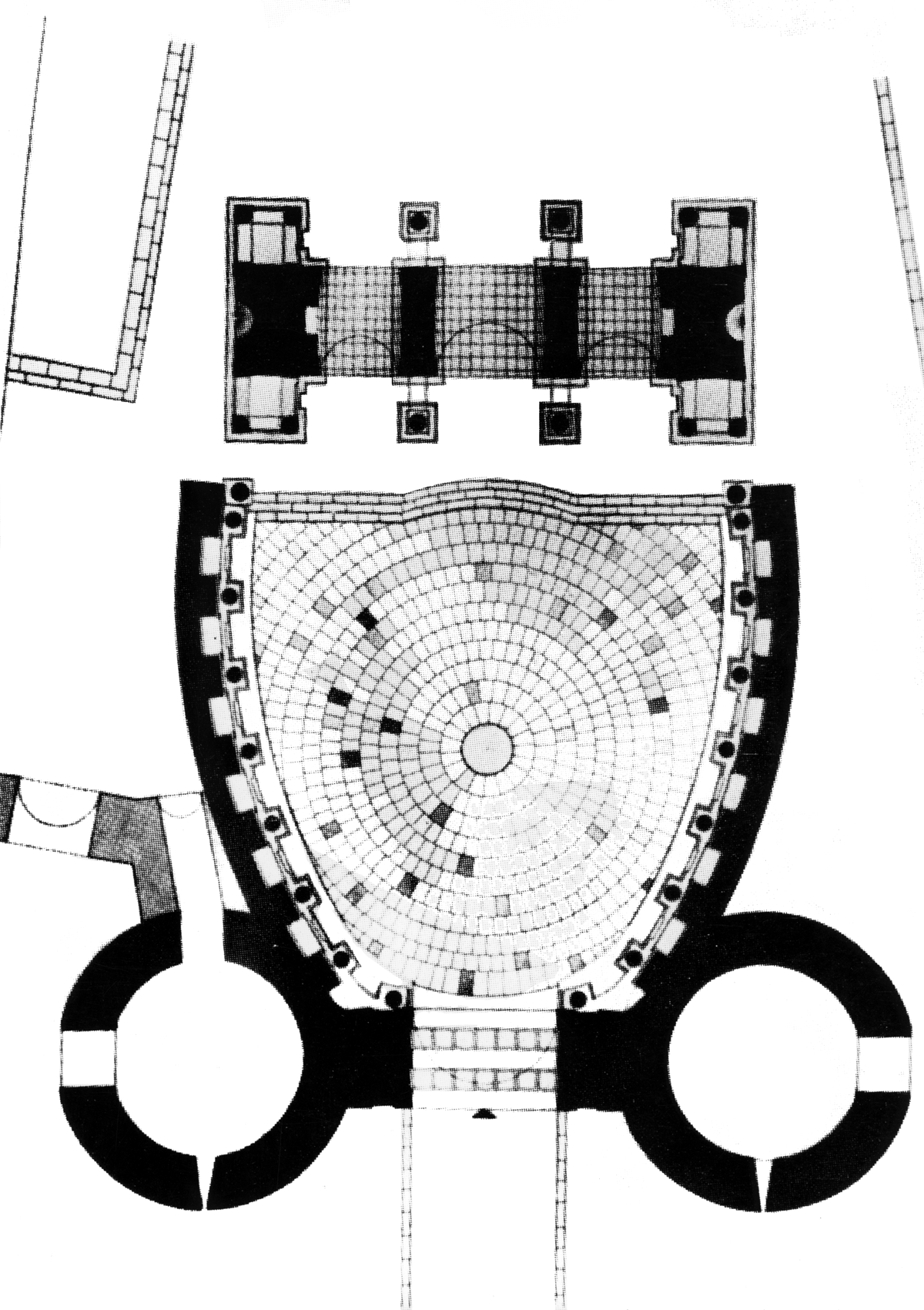
In order to examine the visual and symbolic impact of a bilingual landscape, it is essential to have a sense of how someone passing through it would experience the space. Plancia's gate complex was located just inside the round Hellenistic towers of the city's main southern gate.Footnote 5 The towers opened up into a courtyard with curved walls on either side and a triple arch at the far end (see Figure 1).
Perge, Pianta della Porta ellenistica meridionale. Fototeca Unione, 27361. American Academy in Rome – Photographic Archive.

Each wall had a series of fourteen niches arranged on two levels, seven on each level. Across the entire lower course on both sides, the fourteen niches displayed statues of Greek gods, all labelled with Greek inscriptions on their bases; eight of these statues survive, depicting Apollo, Aphrodite, Hermes, the Dioscuri, Heracles, Pan and an unidentified youth.Footnote 6 The upper niches displayed statues of the city's founders (each called κτίστης). The nine surviving base inscriptions show that on one side of the courtyard the κτίσται were Perge's mythological founders, including well-known Greek heroes, such as Mopsus and Calchas, and otherwise unknown heroes named Rixus and Labus,Footnote 7 and that on the other side they were recent Pergean citizens. The two surviving bases from this latter group give the names of Plancia's father, M. Plancius Varus, and her brother, C. Plancius Varus:

The Founder, Marcus Plancius Varus, father of Plancia Magna. A Pergean.

The Founder, Gaius Plancius Varus, brother of Plancia Magna. A Pergean.
The five missing statues likely depicted other prominent relatives of Plancia, such as her son C. Iulius Plancius Varus Cornutus, her husband C. Iulius Cornutus Tertullus, or possibly even Plancia herself. This would create a display of seven contemporary civic benefactors to mirror the seven mythological founders opposite them.Footnote 8
The monumental triple arch enclosed the courtyard and functioned almost like a window, framing the city beyond.Footnote 9 At its top, a large dedicatory inscription inlaid with bronze letters adorned both sides of the arch. The inscription was unusual for this type of structure, since it named the city alone as the recipient rather than the emperor and the city, which was more typical for gates and arches in Asia Minor erected in this period.Footnote 10 Though the dedication was bilingual, the two languages were separated on each side of the arch, with the Latin on the south side, facing out into the courtyard, and the Greek facing north toward the city:Footnote 11
a) (south side)
[Plancia M(arci) f.] Magna
[pat]riae [--- ]o
Plancia Magna, daughter of Marcus, for her fatherland
b) (north side)
Πλα[νκία Μάγν]α θυγάτηρ Μ.
Πλα[νκίου Οὐάρο]υ τῆ πατρίδι
Plancia Magna, daughter of Marcus Plancius Varus, for her fatherland.
The arch contained a series of free-standing columns and pedestals,Footnote 12 as well as a series of statues. Some depicted the city's deities, Artemis Pergaia and Tyche of the City, who probably crowned the top of the arch; others depicted various imperial personages, including the deified Augustus, Nerva, Trajan, Matidia and Marciana, as well as the still-living Hadrian, Sabina and Plotina.Footnote 13 Each statue was accompanied by a bilingual text identifying the statue and naming Plancia Magna as the dedicator. As the formulae for all of these are consistent, one example should suffice:

To Pergean Diana / Artemis. Plancia Magna, daughter of Marcus (dedicated this).
This monumental display by Plancia Magna was a presentation of personages of both local and imperial importance, accompanied by Greek and bilingual inscriptions.
EXPLORING THE RELATIONSHIP BETWEEN LANGUAGE AND SPACE
The use of language within Plancia's gate complex certainly allows us to better understand the social function of both Greek and Latin,Footnote 14 but studies on the two structures have paid little attention to the spatial aspect of this linguistic interaction. Sociolinguistic studies have provided tools for interpreting the positioning of language within a space as signalling the presence, power and / or limits of certain language communities within a given location.Footnote 15 If bilingualism is the ‘realization of social structure’,Footnote 16 then the visual presentation of it in public space is the practice of imposing organization and hierarchization in that space.Footnote 17 Even in ancient cities, we can observe how the employment or suppression of certain languages helped to shape boundaries and interactions between different ethnolinguistic groups within a multilingual community. The use of more than one language in a single space might reflect an attempt by the text's author to appeal to different ethnolinguistic groups, or possibly to signal the author's membership in both language groups, but it could just as easily be used to communicate the subordination of one language group to another, as is the case today in Québec, where French-English bilingual commercial signage is allowed so long as French remains the dominant language on the sign. Although the subtleties of the author's intentions when engaging in a bilingual landscape may never be fully understood by the viewer, that does not detract from the real intentions or motives of the monument's creator.Footnote 18
The dynamic between Plancia's linguistically distinct monuments and their interaction with the broader linguistic landscape of Perge provides essential evidence for how Plancia aligned herself and her city with Greek and Roman culture. As the cult centre of Pamphylia and one of the chief cities of the province Lycia-Pamphylia, Perge would have seen the regular movement of people—both Greek and Roman—through its gates.Footnote 19 These viewers would have experienced both structures, with their distinct language landscapes, simultaneously. Plancia Magna was aware of the significance of language on her monuments, and intentionally planned a variation in language in this transitional space in order to draw viewers’ attention to her wealth, erudition and, most importantly, civic devotion.
Plancia's exclusive use of Greek within the horseshoe-shaped courtyard was an essential component of the courtyard's emphasis on civic space and membership in the local community. Greek was the dominant language in Perge, including in its epigraphy, comprising over ninety percent of the city's inscriptions,Footnote 20 and it made sense in a courtyard filled with Greek gods and Homeric hero-founders. These statues tied the history of Perge directly to the world of Greek myth and one of its oldest and most defining events—the Trojan War. Mopsus and Calchas were especially useful since they were also associated with early Greek presence in Pamphylia.Footnote 21 The display thus testified to the antiquity of Perge's Hellenic identity, and using anything other than Greek for the inscriptions would have been inconsistent with this message.
At the same time, Plancia Magna's use of Greek here is at variance with her family background and her epigraphic practices elsewhere in the city. She was a member of a prominent local family of Italian descent, which had reached senatorial rank by the mid first century a.d.Footnote 22 By Plancia's time, her family's influence extended beyond Perge into other parts of Asia Minor and to Rome. Her marriage to the Roman senator C. Iulius Cornutus Tertullus, who also belonged to a powerful Pergean family, would have further established her senatorial credentials.Footnote 23 Latin was a natural and preferred choice for her and members of her family,Footnote 24 showing that her use of Greek here was highly intentional and strategic. The only Greek inscription set up by a member of the family was a gate set up by her father in Nicaea. Although the reasoning for this Greek text is also unclear, Plancius may have been deferring to local epigraphic convention,Footnote 25 or the language may have been chosen by the local Greek agent, C. Cassius Chrestus, who was responsible for the actual construction of the gate. Beyond this gate and Plancia's courtyard, any Greek inscriptions commemorating the Plancii were set up by individuals for whom Greek would have been a more natural choice, such as their freedmen or the local dēmos. Footnote 26
Plancia's use of Greek in the courtyard should therefore be understood as an intentional use of the local language in order to emphasize the Hellenic identity of herself and her family. This interpretation of the Greek complements the choice to include her father and brother among the city's founders. Some have argued that the Plancii statues served to emphasize Perge's status as a Roman city or the high position of the Plancii within Rome's administration,Footnote 27 yet nothing about the presentation in the courtyard suggests that their Roman identities were intended to play a role in this display. No mention is made of their imperial posts, which are known from other inscriptions, or of their senatorial status. On the contrary, beyond their names, their Roman status was completely ignored. Plancia's father and brother were cast instead as members of and contributors to the local Greek community. Both were called simply Περγαῖος (‘Pergean’). Also significantly, Plancia did not identify them as ‘new’ or ‘second’ founders, as was sometimes the case for Roman benefactors of Greek cities, but rather grouped them together with the city's mythological Greek founders.Footnote 28 By placing her family members alongside and equating them with these Greek hero-founders, identifying them as Pergeans, and using only Greek to do so, Plancia created a display that highlighted the virtues of her family as progenitors and benefactors of the contemporary Greek city. Their Romanitas had no place here. Unfortunately, we have not yet identified any of the sculptures that would have accompanied these texts, and it will be interesting to see how the Plancii were depicted physically if such evidence ever does surface. It is possible that the statues wore the Roman toga, which would have then betrayed their Roman citizenship, but they may just as likely have been styled in a more classical Greek form, a real possibility since the statues of Hadrian and his family members on the adjacent triple arch reflect more classical Greek forms than traditional Roman ones,Footnote 29 and a Greek style would have further helped concentrate the focus on their Pergean identity.
The courtyard's emphasis on Perge's heroic past fit in with larger trends of the Second Sophistic, during which members of the Greek elite manipulated their city's past—both real and imagined—in order to articulate their Hellenism and membership in the community. By doing so, they not only asserted their community's Greek credentials, but also positioned themselves as the stewards and revivers of that Greek heritage.Footnote 30 The heroes honoured in Plancia's courtyard are otherwise unattested in the city's archaeological, numismatic and literary record, suggesting that they were not actually part of the city's cultural memory but rather tools to help Plancia position herself via her family members as integral to the city's past and present.Footnote 31 What is interesting in this case is that, though Plancia and her family were not actually Greek, the consistent presentation of Greek pride within the courtyard shows that she still considered it beneficial to situate her family and herself in the Greek past of the city and to emphasize their centrality to Perge's cultural and civic vitality.Footnote 32
In contrast to the glorification of Greek heritage in Plancia's courtyard, the bilingual inscriptions and the imperial statuary of the arch would have created an imperial landscape where Plancia could display her Romanitas that was conspicuously absent in the courtyard. The use of Latin is common in monuments celebrating the imperial house, though it certainly was not standard, especially in the cities of the Greek East. It was also a key method of signalling one's Roman identity, whether on its own or with an accompanying Greek inscription.Footnote 33 In Perge, where Latin was rare on the epigraphic landscape, and bilingual inscriptions even more so, the large Latin text at the top of the arch and the series of bilingual statue bases would have made quite an impression on the viewer.Footnote 34 In fact, the thirteen bilingual texts on this monument—as well as one additional text set up to her son in the vicinityFootnote 35—account for over eighty percent of the known bilingual texts in the entire city. Plancia was almost single-handedly responsible for the display of bilingualism in this Pamphylian city. The use of bilingual inscriptions must have maximized the visual impact of the Roman arch within the overwhelmingly Greek landscape, and brought great attention to their benefactress, her generosity to the city, and her Romanness.
The exact intent behind Plancia's arch is less clear than her courtyard. The statuary and the architectural form make it look like a monument to the imperial family,Footnote 36 but the dedicatory inscription omits Rome and the emperor from the dedication, gifting the arch instead to Plancia's home city. The prominent position of the city's deities on top of the arch would have further emphasized the dedication to Perge. It seems that here, even in the midst of Latin texts and statuary of Roman rulers, Plancia was exhibiting her connection to the local community, except this time as a prominent and educated member of the Roman elite. Furthermore, by accompanying this dedication with statues of the imperial family, Plancia seems to be highlighting the place of Perge within the broader Roman imperial realm, or possibly even including the Roman rulers in the local Pergean community.
The positioning of the dedicatory inscription on the top of the arch helps to support the interpretation of the structure as a negotiation between imperial and civic space. With Latin facing south into the courtyard and out toward the city's gate, and Greek facing into the heart of the city, the text effectively distinguished the local Greek space from the wider Roman world. Each language was positioned to be read from a particular location, standing either outside of the city or inside it, and the language choice corresponded with the intended audiences and the linguistic identities of these respective spaces. In other words, from inside the city, where the Greek residents of Perge spoke Greek, Plancia's dedication to her city could be read in the local tongue. It harmonized with the broader epigraphic landscape inside the city and, through its arches, framed Plancia's courtyard beyond. Within the city, the Greek text implied, the populace—and Plancia—was thoroughly and unapologetically Greek. Outside of the city, however, the arch inscription gave a different impression. Here, Latin served to reflect Perge's status as a city of the Roman empire and to greet any Roman (or imperial) visitors in the official imperial language. And just as the Greek inscription on the interior marked the interior civic space as Greek, the Latin text accordingly marked the land beyond the city as Roman. Through this spatial arrangement of the Greek and the Latin, Plancia's arch effectively defined the local Greek civic sphere inside the gate as separate from the imperial sphere outside. In doing so, Plancia successfully presented the city (and herself) to the outside world as a loyal participant in the imperial system, but to her fellow citizens showed herself and Perge to be thoroughly and proudly Greek.
COMPARISONS AND CONCLUSIONS
The architectural forms of Plancia's display, especially the arch, seem to have influenced other structures in Pamphylia.Footnote 37 However, these similarities did not extend to the inscriptions, as these later structures employed only Greek inscriptions, which dedicated them to the emperor.Footnote 38 Elsewhere in Asia Minor, however, we can find better parallels for the utility of bilingualism on monumental landscapes to help define urban space and individuals’ relationships to both their Greek and their Roman identities.
Two monuments in Ephesus used both Greek and Latin texts as was necessary for the content and audience of the inscriptions. The inscriptions on the Library of Celsus, which was built only a few years before Plancia's gate as a funerary monument for Ti. Iulius Celsus Polemaeanus,Footnote 39 were almost exclusively Greek despite the honorand's high rank at Rome, suggesting that, in death, Celsus’ Greek identity trumped his Roman rank.Footnote 40 Latin appears only once, on a base that likely held an equestrian statue depicting Celsus in Roman military dress, with the Latin underscoring his Roman military rank. A second equestrian base inscribed in Greek would have displayed a matching Greek-style statue.Footnote 41 Right next to the Library, the triple-arched Gate of Mazaeus and Mithridates likewise matched language choice with the intended audience. The Latin text, inscribed over the left and right arches, directed the dedication only to Mazaeus and Mithridates’ imperial patrons, Augustus and Agrippa, but the Greek simply dedicated their benefaction to ‘their patrons and to the city’ without any mention of who the patrons were.Footnote 42 The inclusion of the city in the Greek alone and the identification of the patrons in the Latin alone underscores the differential intention of this bilingual monument.
The demarcation of space seen on Plancia's arch also has parallels in Asia Minor. Plancia's arch used Latin and Greek on either side to mark the spaces in front of them as belonging to a particular language group. The Propylon (also known as Hadrian's Gate) in Ephesus provides corroborating evidence that inscriptions on passageways and other portals were meant to reflect the space in front of the text, from which the audience would view it, rather than the space beyond or through the passageway.Footnote 43 A more interesting comparison for our purposes here is the so-called ‘Syrian’ gate at Laodicea ad Lycum, which not only defined the city's limits but, like Plancia's arch, used bilingualism to differentiate between internal civic and external imperial concerns and spaces. A Greek dedication adorned both sides of the gate, naming the city's main deity, Zeus Megistus Sōtēr, the Emperor Domitian and the dēmos as recipients, the Roman proconsul Sex. Iulius FrontinusFootnote 44 as dedicator, and the Greek freedman Tryphon as the local agent of the arch's construction. On one side, the Greek text was preceded by an additional Latin dedication that was a partial translation of the Greek.Footnote 45 It still named the emperor as recipient and Frontinus as the proconsul, but it omitted any mention of Tryphon, Zeus or the dēmos, all of whom were of interest primarily to the local population. Apparently, despite their localized importance, they were deemed non-essential for imperial purposes, and so were left out of the Latin. It is clear that the Laodicean gate reflected two different linguistic spaces, and, based on the evidence of Plancia's arch, it seems likely that the Greek inscription would have faced inward toward the city, and the Latin-Greek bilingual inscription outward toward the larger Roman imperial space.
These comparative structures from elsewhere in Asia Minor show that Plancia Magna's gate complex was part of a larger pattern of using language and monumental landscapes to define civic space and group membership. While these linguistic landscapes could reflect the power dynamics of Roman rule in the Greek East, they could also be bold displays of local pride within the context of empire, giving priority to the dominant sociolinguistic group despite their subordination to Rome. The shift from Greek to bilingual space in this complex has been described as a division or tension between the benefactress’ Greek and Roman identities, or a ‘refusal to fully merge with the Greek world’.Footnote 46 But closer analysis and consideration of the linguistic messages suggest that the complex openly acknowledges the political realities of the Greek cities and members of the provincial elite—and particularly elite women—in the second century. Plancia used both Greek and Latin to mark the literal and symbolic distinction between what was Greek—the city itself, its residents—and what was Roman—the world beyond the city's walls. Plancia herself served as the bridge between these two worlds. The symbolic meaning of the two languages would have been understood, at least to some degree, by local Greeks as well as by visiting Romans regardless of how fluent they were in both languages.Footnote 47
Looking at the courtyard and the arch together, the complex served to bring honour to Plancia Magna by associating her and her family first and foremost with the city's gods and founders.Footnote 48 The courtyard in particular emphasized her ties to Perge, but so also did the arch, which she gave to her city alone. Like so many elite women of the period, Plancia was probably the chief representative of the family in the city, responsible for maintaining the family's ties to the home community, as the men would have been posted elsewhere as part of their imperial service.Footnote 49 Since women could not hold positions in the Roman administration, but they could do so locally, Plancia relied on her local community more than most men would have to gain power and influence. At the time of the gate's construction, Plancia had likely already attained a high status within Perge,Footnote 50 as evinced by her various civic and religious offices.Footnote 51 The complex puts Plancia and her local ties centre stage. Her name appears repeatedly across the complex—twelve times in Latin and as many as thirty-three times in GreekFootnote 52—and, when her male relatives do appear, they are identified in relation to her (‘father of Plancia’ and ‘brother of Plancia’). Although it is unknown whether her husband had a presence in this monument as well,Footnote 53 if he did, he would likely have been identified with relation to her as well. Furthermore, by connecting herself and her family to the mythological founders of the city, she appealed to a wide base of the local citizenry who would have had at least a general understanding of Greek history.Footnote 54
Plancia's southern gate complex in Perge reveals the many ways in which benefactors used language to help distinguish between their roles and responsibilities as Roman citizens and as Greek citizens and, in the case of Plancia, to emphasize one identity over the other. Furthermore, the physical separation of the two languages could serve to distinguish the physical space of the Greek city from the larger imperial world. Such monumental displays show the important role that language choice played within public monuments, not only to allow Roman provincials to express their different group memberships but also to help underscore and clarify other symbols of group membership.