I. INTRODUCTION
A foundational ambition in the field of materials science and metallurgy is alloy development aimed at the improvement of their properties, e.g., mechanical properties. Such a concept features so prominently in our culture that human history is commonly divided into ages named after key materials that revolutionized technology in the corresponding age. Early periods include stone, bronze, and steel ages, with the latter two named after alloys with a principal element containing additions to improve their properties. Modern periods include the industrial age, where production was facilitated by the advent of machinery and organized labor. High-entropy alloys (HEAs) may actually challenge both concepts as their development is predicated on the basis of several principal elements (usually five or more) with none featuring prominentlyReference Yeh, Chen, Lin, Gan, Chin, Shun, Tsau and Chang1; moreover, recent production technologies such as additive layer manufacturing (ALM)Reference Brif, Thomas and Todd2 allow the selected melting and deposition of such compositionally complex alloys on substrates of reduced complexity and cost.Reference Ocelík, Janssen, Smith and De Hosson3 ALM techniques such as selective laser melting allow the remote control of laser and machine production variables such as the laser power, spot size, scanning speed, and hatch distance; this permits the remote (internet) control of production and machine interconnectivity, consistent with cognitive computingReference Meier4 and the so-called fourth industrial revolution.Reference Meier4 The attractive properties of HEAs combined with their affinity with highly automatized production technologies can lead to a technological breakthrough of broad implications.
The most attractive aspect of HEAs lies on their combination of mechanical properties. As reviewed by Zhang et al.,Reference Zhang, Ting Zuo, Tang, Gao, Dahmen, Liaw and Ping Lu5 the alloy improvement of HEAs in comparison with regular systems is significant. The combination of properties, especially at high temperatures, has no counterpart in present alloying systems. HEAs exceed regular systems with one principal element in terms of their fatigue, high temperature strength, ductility, corrosion, and irradiation resistance properties.Reference Zhang, Ting Zuo, Tang, Gao, Dahmen, Liaw and Ping Lu5 As opposed to the original ambition of displaying a single phase, they show often several phases, but still a certain microstructural simplicity not expected in systems where the Gibbs phase rule would dictate the appearance of several phases. The associated hardening mechanisms include grain refinement, solid solution, precipitation, and dynamic Hall–Petch effect (wherein twinning is increasingly formed upon deformation). For instance, AlCuCrFeNiCo grain refinement has led to superplastic behavior in the 800–1000 °C temperature range after hot working and grain size reduction,Reference Kuznetsov, Shaysultanov, Stepanov, Salishchev and Senkov7 and this alloy has been characterized in detail by Shaysultanov et al.Reference Shaysultanov, Stepanov, Kuznetsov, Salishchev and Senkov8 A behavioral transition between CoCrFeNi, CoCrFeNiV, and CoCrFeNiMnV has been reported by Salishchev et al.Reference Salishchev, Tikhonovsky, Shaysultanov, Stepanov, Kuznetsov, Kolodiy, Tortika and Senkov9; the V-containing alloy showed significant embrittlement due to lattice distortions and σ-phase formation. However, Al in AlNbTiVZr0.5 showed significant solid solution and second phase strengtheningReference Stepanov, Yurchenko, Sokolovsky, Tikhonovsky and Salishchev10–Reference Yurchenko, Stepanov, Zherebtsov, Tikhonovsky and Salishchev12; but when removing Zr, remarkable specific strength and ductility are observed in AlNbTiVReference Stepanov, Shaysultanov, Salishchev and Tikhonovsky13; or by changing Al content in AlxNbTiVZr (x = 0, 0.5, 1, 1.5), the second phase Zr2Al and Laves phases (C15 and C14) are controlledReference Yurchenko, Stepanov, Zherebtsov, Tikhonovsky and Salishchev12,Reference Yurchenko, Stepanov, Tikhonovsky and Salishchev14 ; or by precipitation strengthening in Al0.5CrNbTi2V0.5.Reference Stepanov, Yurchenko, Panina, Tikhonovsky and Zherebtsov15 Similarly, second phase formation has been observed in the classic CoCrFeNiMn alloy,Reference Stepanov, Shaysultanov, Ozerov, Zherebtsov and Salishchev16 and its properties can be significantly changed via grain size control as a result of dynamic recrystallization,Reference Stepanov, Shaysultanov, Yurchenko, Zherebtsov, Ladygin, Salishchev and Tikhonovsky17 or by adding carbon,Reference Stepanov, Shaysultanov, Chernichenko, Yurchenko, Zherebtsov, Tikhonovsky and Salishchev18 retarding the twinning-induced plasticity (TWIP) effect. The system Fe40Mn28Ni(32−x)Crx (x = 4, 12, 18, 24) shows significant transitions in mechanical properties for the different values of x due to a competition between grain boundary and solid solution strengthening,Reference Stepanov, Shaysultanov, Tikhonovsky and Salishchev19 although brittleness was shown for x = 24 due to σ phase formation. In the system CoCrFeMnNiVx (x = 0, 0.25, 0.5, 0.75, 1), the addition of V produced σ phase which upon increasing its volume fraction increased alloy strength.Reference Stepanov, Shaysultanov, Salishchev, Tikhonovsky, Oleynik, Tortika and Senkov20,Reference Shaysultanov, Stepanov, Salishchev and Tikhonovsky21
Shaysultanov et al. have demonstrated the importance of BCC/B2 phase formation in strength decrease for Fe36Mn21Cr18Ni15Al10. Precipitate size was observed to play a crucial role in HfNbTaTiZr hardening.Reference Stepanov, Yurchenko, Zherebtsov, Tikhonovsky and Salishchev22 Similar concepts in grain size and solid solution hardening have been observed in HEA coatings, with one of them remarkably reaching 47 GPa hardness.Reference Grigoriev, Sobol, Beresnev, Serdyuk, Pogrebnyak, Kolesnikov and Nemchenko23,Reference Pogrebnjak, Beresnev, Smyrnova, Kravchenko, Zukowski and Bon-darenko24
The rich collection of hardening and embrittlement mechanisms displays a compromise between phase evolution and microstructure control. Similar complexity is found in steel technology where the concept of materials by design was first proposed by Olson.Reference Olson6 Such an approach adopts a system’s engineering framework to establish the relationships between processing, microstructure, properties, and performance of components fabricated from metallic systems. Some of these interactions are described in this paper with an aim to find opportunities to enhance the mechanical properties of HEAs. The main purpose of this paper is to provide a review of hardening mechanisms in HEAs, how they relate to microstructure, and how these can be quantitatively described to design improved HEAs.
This paper is divided into sections; the effects of key alloying elements altering mechanical behavior is first discussed, the variations in the resulting microstructures are then discussed, and modeling approaches to describe these are then presented followed by changes in mechanical properties typically expected. The reported attempts to adopt ALM in HEA production are discussed followed by an overall design approach for HEAs, a discussion and summary is then presented. Rather than attempting to provide a detailed review on HEAs’ mechanical properties, this paper presents a framework to interpret existing results in terms of modeling approaches to conceive new HEAs of improved mechanical properties.
II. ALLOYING ELEMENTS
Although many alloying attempts have been tried in HEAs to improve their mechanical properties, only a few have led to clear improvements. Hereby some of them are listed. Tang et al.Reference Tang, Gao, Diao, Yang, Liu, Zuo, Zhang, Lu, Cheng, Dahmen, Liaw and Egami25 have studied the effects of Al alloying on a variety of systems: AlxCoCrCuFeNi, AlxCoCrFeNi, AlxCrFe1.5MnNi0.5, AlxCoCrFeNiTi, and AlxCrCuFeNi2. They realized that Al has a strong effect on strengthening, with it being maximum with x = 1 in AlxCoCrCuFeNi, where it reaches a compressive strength and elastic modulus of 2.28 GPa and 147.6 GPa, respectively, in the as-cast condition. Furthermore, upon annealing the x = 0.5 alloy, the compressive strength is further increased to 2.59 GPa with a strain of 7.2%. Nevertheless, the strength drops to 1.54 GPa for x ≥ 1.0. They concluded that optimization of the heat treatment is one of the most influential factors to enhance mechanical behavior, and a variety of nanoprecipitates were reported for the different aluminum contents.
Stepanov et al.Reference Stepanov, Yurchenko, Skibin, Tikhonovsky and Salishev26 studied the system AlCrxNbTiV (x = 0, 0.5, 1, 1.5). They demonstrated that the variation in Cr content has a dramatic effect on the resulting properties and microstructures. With x = 0, the base system does show some ductility at room temperature, but when deformation is carried out at 600 and 800 °C, this is increased although strength remains lower than x = 0.5, 1, and 1.5 counterparts. This situation is reverted at 1000 °C, when the base system AlNbTiV is strongest, and the ductility of Cr additions is preserved.
The interesting paper by Yurchenko et al.Reference Yurchenko, Stepanov, Shaysultanov, Tikhonovsky and Salishchev27 demonstrates that, upon addition of Al to the system CrNbTiVZr, there is a dramatic change in mechanical properties and phase constitution. In the resulting systems AlxCrNbTiVZr (x = 0; 0.25; 0.5; 1), just the addition of x = 0.25 already promotes the C15 laves decomposition into two C14 phases with and without Cr. Upon increasing Al content, there is a corresponding increase in yield strength and tensile strength, which appears promptly after yielding, followed by strong recovery, reaching compressive strains in excess of 50% but for temperatures of 800 and 1000 °C. At 800 °C, the specific strength is amongst the highest reported in the literature. Phase separation from C14 to the C15 counterparts seems to be strongly related to the electron to atom ratio. At 600 °C and below, no ductility is observed.
Other studies demonstrate the influence of Cr on preventing environmental cracking, e.g., by adding an excess of 2 wt% Cr in Fe30Ni20Mn35Al15.Reference Meng, Bauer, Liao and Baker28 Wang and BakerReference Wang and Baker29 have added C to Fe36Ni18Mn33Al13 effectively showing hardening and ductility improvement. Interestingly, not only precipitation but also martensite formation occurs.
Alloying effects are here interpreted in terms of their influence in mechanical properties. Critical additions of Al, Cr, and C lead to fine nanoprecipitate dispersions, martensitic transformations, and to altering the stacking fault energy (SFE), promoting twinning and enhancing alloy ductility. Such improvements can only be understood in light of their associated microstructures as discussed in the following.
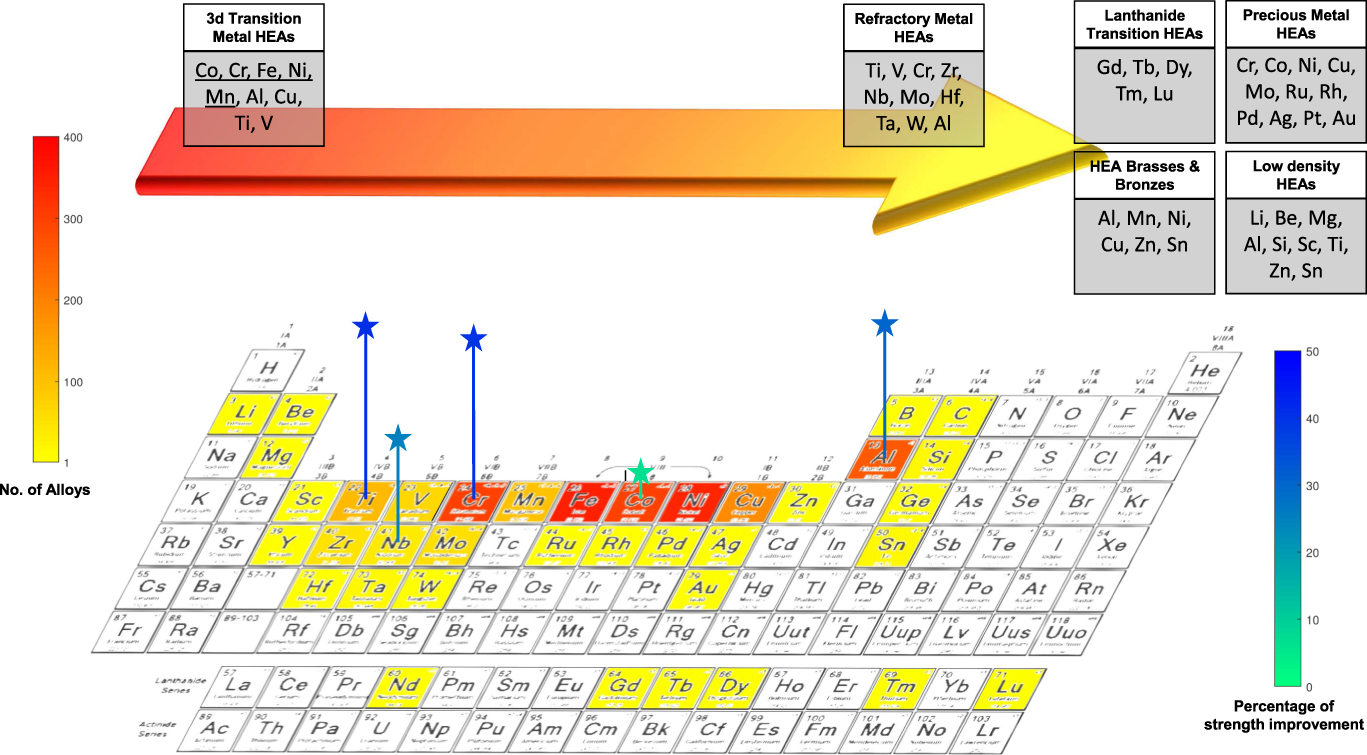
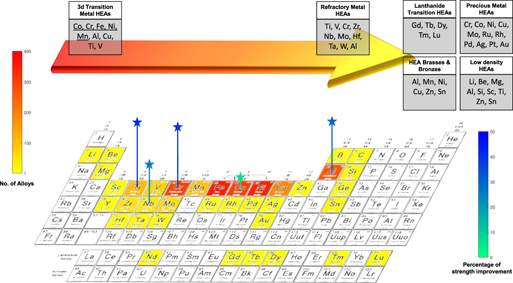
Elemental additions to HEAs are highlighted in the periodic table in Fig. 1. Ranging from yellow to red, the color code of each highlighted element measures the number of HEAs containing such an element.Reference Miracle and Senkov30 It can be seen that the most frequently studied HEAs contain Co, Cr, Fe, and Ni with the addition of Mn (‘Cantor alloy’Reference Cantor, Chang, Knight and Vincent31), Al, Ti, Cu, and V; this family is also referred to as 3d transition metal HEAs, as indicated by the HEA family arrow in Fig. 1. The yellow–red color code also applies to the arrow. The second largest family is refractory metal HEAs containing the elements listed in the corresponding box. Besides, other minor families, such as Lanthanide transition HEAs,Reference Takeuchi, Amiya, Wada, Yubuta and Zhang32 precious metal HEAs,Reference Miracle and Senkov30 HEA brasses and bronzes,Reference Laws, Crosby, Sridhar, Conway, Koloadin, Zhao, Aron-Dine and Bassman33 and low density HEAs,Reference Yang, Chen, Cotton and Zhang34,Reference Hammond, Atwater, Darling, Nguyen and Kecskes35 have been developed as well. In terms of mechanical properties of HEAs, the strengthening effects stemming from different elements with the ‘Cantor alloy’ as a reference is illustrated by the stars above the periodic table (Fig. 1). The height of the stars is proportional to the percentage of strength improvement, and the green–blue color bar applies to the color levels of the stars. Cr outperforms Co by a large margin in strengthening CrCoFeNi-based quinaries,Reference Wu, Troparevsky, Gao, Morris, Stocks and Bei36 while TiReference Zhou, Zhang, Wang and Chen37 and AlReference Yurchenko, Stepanov, Shaysultanov, Tikhonovsky and Salishchev27 are also excellent strength contributors followed by Nb.Reference Ma and Zhang38
Summary of elements used in HEAs and grouping of elements for different HEA families. The yellow–red color bar measures the number of alloys for the elements and HEA families and the green–blue color measures the percentage of strength improvement. Color figure found online. The periodic table image is provided courtesy of Sciencenotes.org at http://sciencenotes.org/printable-periodic-table/.

III. MICROSTRUCTURES
The review by Zhang et al.Reference Zhang, Ting Zuo, Tang, Gao, Dahmen, Liaw and Ping Lu5 provides a comprehensive study to relate the microstructure of HEAs with their properties, including mechanical properties. With focus on AlCoCrFeNi and NbMoTaV systems, they attempt to establish the origin of their excellent mechanical properties. These include the severe lattice distortion effect, as well as the ‘cocktail effect’, which is related to a large variety of lattice spacings so that glide systems cannot be easily established. They can even be easily changed (e.g., with variation of x in the CoCrCuNiAlx system). The variety of microstructural features such as disordered crystal lattices, chemical disorder, twins, and stacking faults are responsible for the rich behavior of such systems, especially at high temperatures. Two major conclusions drawn in this work are the ability to control phase constitution by precipitation, e.g., in coatings such as (AlCrTaTiZr)Nx, or by nanoprecipitation, such as in the CuCoNiCrAlFe system. Of central importance, in both cases are the inhomogeneous lattice distortions, which may promote nucleation and retard phase growth. They state that “heat treatment will have the most impact on mechanical properties, especially at elevated temperature” and demonstrate that fatigue is particularly remarkable in HEAs, but its mechanisms remain poorly understood.
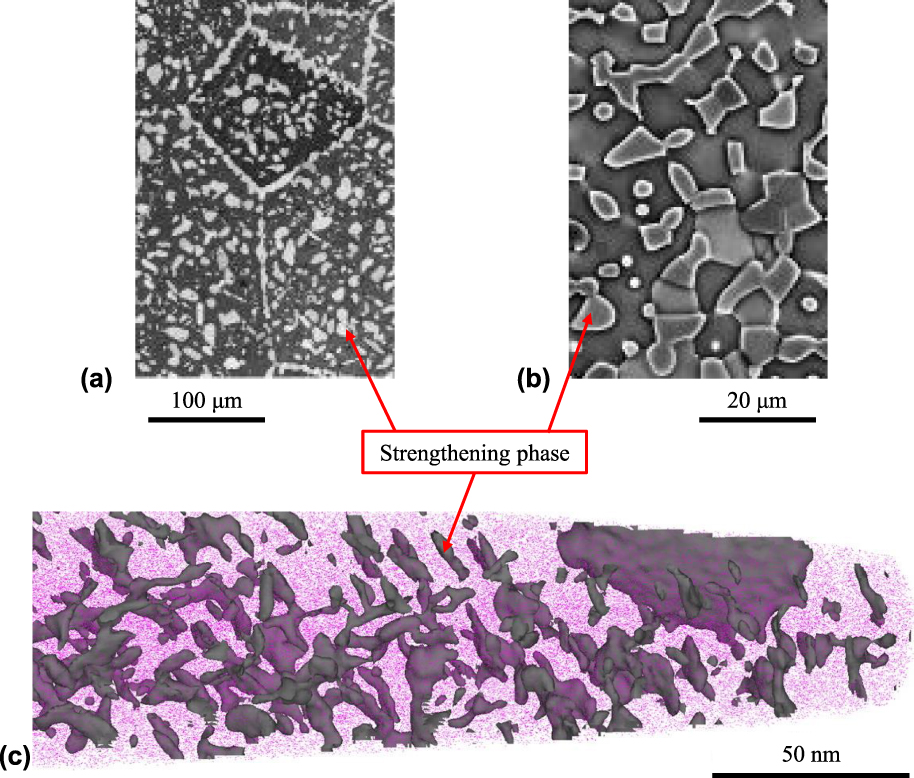
Stepanov et al.Reference Stepanov, Yurchenko, Skibin, Tikhonovsky and Salishev26 demonstrate that with increasing Cr content, the system tends to form more Laves phase, in which precipitation is considered responsible for the strength improvement. There is a striking microstructural similarity between some HEAs and multiprecipitate advanced high-strength steels. The system AlxCrNbTiVZr (x = 0.25; 0.5; 1)Reference Yurchenko, Stepanov, Shaysultanov, Tikhonovsky and Salishchev27 shows complex multiscale precipitate structures very similar to those of M50 steel (Fe–0.8C–0.3Mn–0.4Si–4.25Cr–1V–4.5Mo).Reference Guetard, André, Bellus, Sherif, Rivera-Díaz-del Castillo and Beswick39,Reference Hopkin, Danaie, Guetard, del Castillo, Bagot and Moody40 The key difference between the work of Stepanov et al.Reference Stepanov, Yurchenko, Skibin, Tikhonovsky and Salishev26 and Guetard et al.Reference Hopkin, Danaie, Guetard, del Castillo, Bagot and Moody40 is that the Laves phase is responsible for strengthening, whereas in M50, there is a collection of very hard precipitates (with hardness reaching 3000 HV) responsible for strengthening (Fig. 2).
Strengthening phase in different alloys. (a) and (b) SEM images of the AlCr1.5NbTiV alloy (reprinted with permission from Ref. Reference Stepanov, Yurchenko, Skibin, Tikhonovsky and Salishev26) and Al0.5CrNbTiVZr (reprinted with permission from Ref. Reference Yurchenko, Stepanov, Shaysultanov, Tikhonovsky and Salishchev27), respectively, and (c) APT image of M50 bearing steel (reprinted with permission from Ref. Reference Hopkin, Danaie, Guetard, del Castillo, Bagot and Moody40).

A system often associated with twinning is CoCrFeNiMn,Reference Wu, Troparevsky, Gao, Morris, Stocks and Bei36 and it is illustrated in Fig. 3, which indicates how upon application of strain there is an increase in primary and secondary twins associated with a significant improvement in mechanical properties, as will be discussed in a later section. In summary, from the point of view of strengthening, twinning, precipitation, and a highly concentrated matrix are the key microstructures to consider for a strengthening standpoint.
Comparison of tensile behavior between a CoCrFeNiMn HEA (reprinted with permission from Ref. Reference Laplanche, Kostka, Horst, Eggeler and George41) and a Fe–25Mn–3Si–3Al TWIP steel (reprinted with permission from Ref. Reference Grässel, Krüger, Frommeyer and Meyer42). (a) and (b) TEM images showing twinning in the HEA and in the TWIP steel, respectively.

IV. PROPERTIES
The recent review by Diao et al.Reference Diao, Feng, Dahmen and Liaw43 presents a general overview of the competition between different strengthening mechanisms in HEAs. They have divided HEA families into four groups including 3d transition metal-based alloys, systems containing larger elements (e.g., Ti, Al, V, and Mo), those containing refractory elements, and the rest. They have spotted a characteristic different behavior between the first two types, with the former displaying a lower yield strength and the latter a much higher yield strength that decreases with temperature. Refractory systems instead display much higher yield strength up to very high temperatures. A remarkable aspect of their research is the review on the transformation-induced plasticity/twinning-induced plasticity (TRIP/TWIP) effect, where stress-induced significant transitions which are strongly related to stacking fault energies. They have interestingly pointed out how the number of serrations is increased with the number of elements in the system. The origin of such behavior remains, nevertheless, unclear. They spot the need for further research in areas such as fatigue and crack growth understanding.
Wang et al.Reference Wang, Liu, Liu, Wang, Cao, Li and Zhou44 effectively demonstrated the ability to control grain size in CrFeCoNiMo0.2 HEA by adding Mo, which induces large lattice distortions, and upon deforming between 700 and 1100 °C promotes DRX. This controls grain size increasing room temperature strength and displays good values of fracture toughness. Mo also induces the precipitation of the σ phase, which aids in pinning grains controlling their size.
The paper by Wu et al.Reference Wu, Troparevsky, Gao, Morris, Stocks and Bei36 contains an excellent summary of the mechanical properties potentially achieved by HEAs, in combination with methods to predict the potential to predict their formation. The latter is performed by recognizing that Bloch symmetry is not obeyed by HEAs, stating that Bloch functions, magnons, and phonons are no longer eigenstates of the electronic, magnetic, and vibrational subsystems due to atomic disorder. They adopt a theory for disordered systems, the virtual crystal approximation, which considers the average of the electron-ion potentials of the pure elements, a pseudopotential. With this, an effective medium is created by incorporating an infinite array of scattering centers characterized by a scattering matrix, containing the effects of all elements. This can be used to understand not only equilibrium but also some of the peculiar mechanical properties of HEAs which demand that a dislocation moving through the solvent matrix interacts with multiple solute atoms. This requires the description of a distinct state that incorporates such a disordered state. The complex nanotwinning behavior of several HEAs such as CoCrFeNiMn is observed both undissociated  ${1 \over 2}\left\langle {110} \right\rangle$ dislocations and the dissociation of some perfect dislocations into
 ${1 \over 6}\left\langle {112} \right\rangle$ Shockley partials. This produces a large population of nanotwins, which interact with dislocations causing the accumulation of a high density of sessile dislocations, leading to increased twin strength with deformation. The very good strength and toughness may result from this. Metastability engineering is thus essential to reach this effect.
The mechanical property decay in alloys subjected to irradiation has been reviewed by Zhang et al. Reference Zhang, Zhao, Weber, Nordlund, Granberg and Djurabekova45 In their review, they demonstrate how by increasing the number of elements in Ni-based alloys, damage due to irradiation is decreased as the number of elements in the system is increased. The key concept is that swelling and the association of defects is decreased with increasing the chemical complexity of the system, as the characteristic site to site variations in lattice distortions prevent damage evolution. They state that there are currently no theoretical tools capable to predict such evolution.
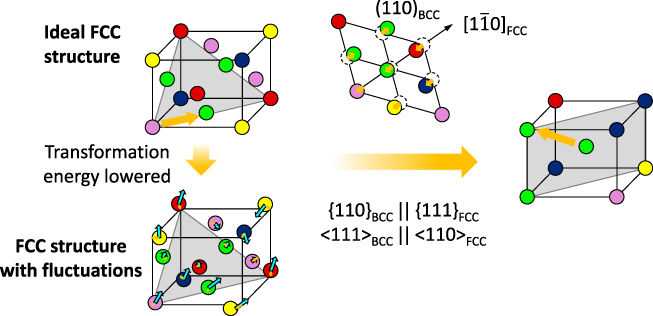
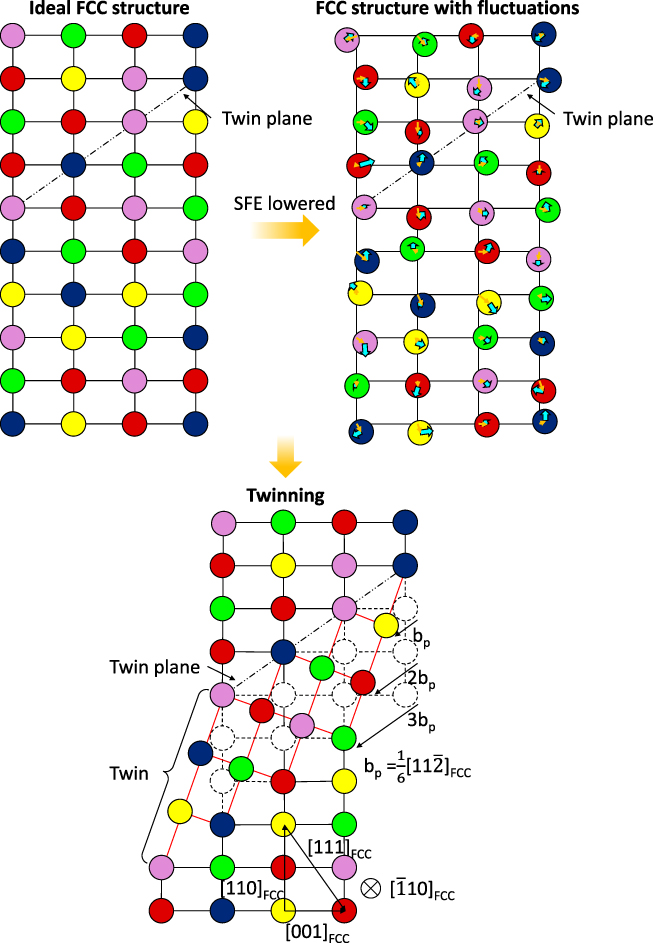
The chemical environment of each atom in HEAs is unique due to its disordered arrangement of surrounding alloying atoms. Displacement fluctuations as a result of various atomic radii along with collinear/noncollinear magnetic moment fluctuations may locally alter the transformation energy for the TRIP process (Fig. 4) and the SFE for TWIP occurrence (Fig. 5). The γ–α′ transformation follows the orientation relationship: {110}BCC‖{111}FCC, 〈111〉BCC‖〈110〉FCC; the twinning in γ phase follows the dislocation reaction:  ${{{a_\gamma }} \over 2}\left[ {110} \right]$ →
 ${{{a_\gamma }} \over 6}\left[ {121} \right]$ +
 ${{{a_\gamma }} \over 6}\left[ {21\bar{1}} \right]$, where a γ denotes the lattice parameter.
Schematic of the TRIP process in HEAs promoted by displacement and magnetic moment fluctuations.

Schematic of the TWIP process in HEAs promoted by displacement and magnetic moment fluctuations.
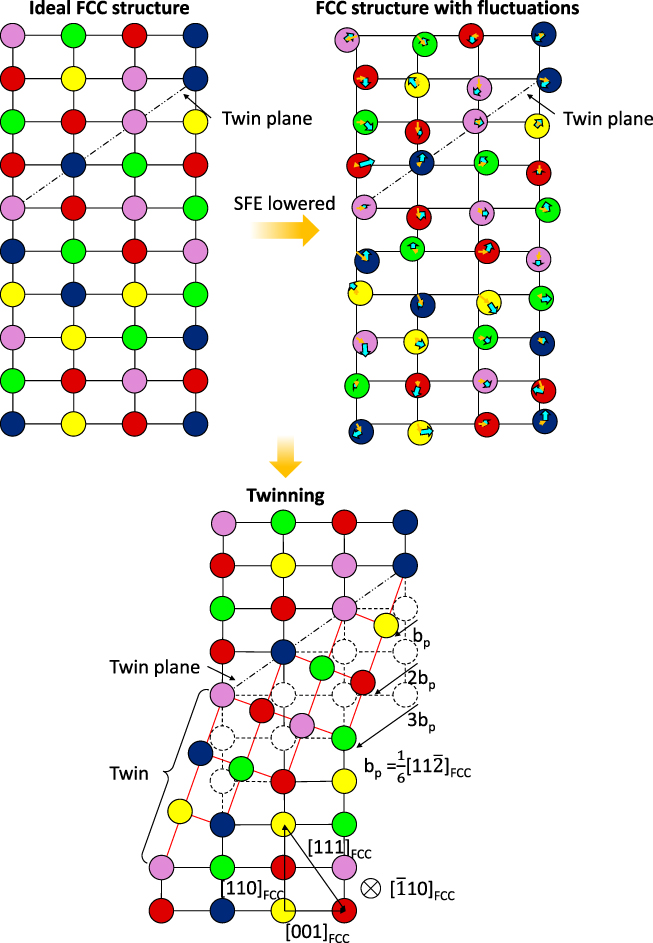
The key factors controlling mechanical properties are therefore summarized as follows:
(i) Recrystallization, allowing grain control influencing strength.
(ii) TWIN/TRIP effects, increasing ductility and strength via promoting coordinated dislocation glide and dissolution into partials.
(iii) Precipitation, with a profound influence on strength.
(iv) Interatomic spacing variation, which influence strongly solid solution strengthening and all the above.
Each of the above requires theory to quantify their effects as will be discussed later.
V. MODELING
A. Previous work
Stepanov et al.Reference Stepanov, Yurchenko, Skibin, Tikhonovsky and Salishev26 proposed the equation
 $$\matrix{ {{\sigma _{{\rm{alloy}}}} = {\sigma _{{\rm{bcc}}}} \times {V_{{\rm{Laves}}}} + {\sigma _{{\rm{Laves}}}} \times {V_{{\rm{Laves}}}}\quad ,} \cr}$$
to measure the contributions on the strength (σalloy) due to the volume fraction of the matrix (V bcc) and the Laves phase (V Laves). It is noted that the matrix strength varies with the solute content. They proposed that thermodynamic modeling could be used to optimize strengthening but point out the limitation in thermodynamic databases to correctly predict phase formation as a function of composition. The validation of Eq. (1) was performed on the AlCrxNbTiV system.
Patriarca et al.Reference Patriarca, Ojha, Sehitoglu and Chumlyakov46 have been the first in computing the critical resolved shear stress for slip and the intrinsic SFE for the FeNiCoCrMn system. The calculations were performed with density functional theory calculations and the ‘modified’ Peierls–Nabarro stress equation. Their results are in agreement with experimental observations. It is worth noting that they found that Co atoms near the fault reduce the intrinsic SFE by almost 55% to describe the experimental values, highlighting the importance of solute segregation in HEAs deformation mechanisms.
Suarez Anzorena et al.Reference Anzorena, Bertolo, Gagetti, Kreiner, Mosca, Bozzolo and del Grosso47 have demonstrated that it is possible to model the stability of HEAs adopting the Bozzolo–Ferrante–Smith method, which adopts atomic simulations combining the strain and chemical energy contribution per atom. Their calculations, which were performed on the MoTaVWZr system, provide high accuracy in comparison with first principles calculations, describing well experimental results.
The excellent overview by Gao et al.Reference Gao, Zhang, Gao, Zhang, Ouyang, Widom and Hawk48 presents a comparison of the various methods to predict the occurrence of HEAs. They demonstrate that the several criteria to predict the occurrence of HEAs fail to establish whether there is phase separation, and the occurrence of precipitates. They indicate that, at the most, there are ranges within which such predictions can be made. They claim that calculation of phase diagrams (CALPHAD) is seemingly the best methodology available so far for the prediction of HEAs, but state that this is limited to values around which experimental values exist. They establish that a mixture of empirical and modeling approaches have to be combined, including “a combination of phase diagram inspection, empirical parameter screening, CALPHAD screening, first-principles DFT calculations, and ab initio molecular dynamics simulations. In fact, using this strategy, GaoReference Shaysultanov, Stepanov, Kuznetsov, Salishchev and Senkov8 predicted hundreds of quaternary and higher-order equimolar compositions.
The work by Yao et al.Reference Yao, Qiao, Hawk, Zhou, Chen and Gao49 demonstrates the possibility to design an HEA employing CALPHAD methods. MoNbTaTiV was cast and mechanically tested, with strengthening modeling performed adopting mainly solid solution hardening approaches. Additionally, DFT calculated the associated lattice parameter, enthalpy of formation, and elastic properties. This exercise demonstrates the capacity to design such alloys by tailoring their desired strength, although plasticity modeling and prediction still remain a challenge.
In summary, HEA modeling reports in the literature have focused on the following topics:
(i) CALPHAD prediction of composition and temperature fields within which HEAs are more likely.
(ii) Estimation of mechanical properties via semi-empirical determination of its constituents.
(iii) HEA design for enhanced mechanical properties by adjusting to known phase constitutional behavior.
(iv) First principles calculations to compare HEAs stability with other phases.
B. Proposed approaches
Based upon the review of microstructures, their associated properties and current modeling approaches, the following computational methods may be further applied or developed.
1. Dynamic recrystallization
Dynamic recrystallization is the result of a moving interface which velocity can be predicted via the equation
 $$\matrix{ {{v_{{\rm{gb}}}} = {M_{{\rm{gb}}}}P} \cr} \quad ,$$
where M gb is the grain boundary mobility and  $P = {1 \over 2}\mu {b^2}$, where μ is the shear modulus, b is the magnitude of the Burgers vector; P is the elastic energy accumulated in the form of dislocation strain, which is thermally activated increasing the mobility via
 $$\matrix{ {{M_{{\rm{gb}}}} = {{\delta {D_{{\rm{gb}}}}{V_{\rm{m}}}} \over {{b^2}RT}}\quad ,} \cr}$$
where D gb is the grain boundary thickness, V m is the molar volume, D gb is the grain boundary self-diffusion coefficient which can be expressed by an Arrhenius relationship in terms of the activation energy for grain boundary diffusion, U gb. This approach has been extensively used in the literature in classicalReference Humphreys and Hatherly50 and irreversible thermodynamics formulations.Reference Huang, Rivera-Díaz-del-Castillo, Bouaziz and van der Zwaag51 A major limitation is the need to fit U gb to the specific metallic system in question, a situation especially challenging in HEAs where the variations in lattice parameters are known to significantly decrease diffusion.
An alternative formulation for computing the kinetics of dynamic recrystallization is by Galindo-Nava and Rivera-Díaz-del-Castillo.Reference Galindo-Nava and Rivera-Díaz-del-Castillo52 Such formulation explicitly accounts for the effects of highly concentrated solutions and was applied to Ni30Fe, Ni21Cr, Fe30Ni, Fe18Cr8Ni, Fe25Cr20Ni, and Ni21Cr8Mo3Nb, reproducing the stress–strain evolution with great precision as a function of temperature and strain rate via the evolution of dislocation density ρ with shear strain γ:
 $${{{\rm{d}}\rho \left( \gamma \right)} \over {{\rm{d}}\gamma }} = {{{\rm{d}}{\rho ^ + }\left( \gamma \right)} \over {{\rm{d}}\gamma }} - {{{\rm{d}}{\rho ^ - }\left( \gamma \right)} \over {{\rm{d}}\gamma }} - {{{\rm{d}}\rho _{{\rm{DRX}}}^ - \left( \gamma \right)} \over {{\rm{d}}\gamma }}\quad ,$$
 $$\matrix{ {{{{\rm{d}}\rho \left( \gamma \right)} \over {{\rm{d}}\gamma }} = {{{k_1} + {k_{{\rm{SS}}}}} \over b}\sqrt {\rho \left( \gamma \right)} - {f_{{\rm{DRV}}}}\rho \left( \gamma \right) - {f_{{\rm{DRX}}}}\left( {\gamma - \gamma _{{\rm{DRX}}}^ * } \right)\quad ,} \cr}$$
where
(i)
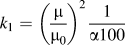
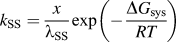
 ${{{\rm{d}}{\rho ^ + }\left( \gamma \right)} \over {{\rm{d}}\gamma }}$ is the dislocation storage, expressed in terms of ${k_1} = {\left( {{\mu \over {{\mu _0}}}} \right)^2}{1 \over {\alpha 100}}$, μ0 is the shear modulus at 0 K, and α = 0.3 is a constant; ${k_{{\rm{SS}}}} = {x \over {{\lambda _{{\rm{SS}}}}}}\exp \left( { - {{\Delta {G_{{\rm{sys}}}}} \over {RT}}} \right)$ with ΔG sys representing the chemical (binding) barrier for dislocations to interact with solute and solvent atoms, in which effect is reduced to solute–dislocation interactions by incorporating the term 1/x. 0 ≤ x < 0.5 is the solute concentration when x is expressed in molar fraction; the 1/x term accounts for the solute spacing per unit volume.Reference Hull and Bacon53
(ii) The dislocation annihilation rate
${{{\rm{d}}{\rho ^ - }\left( \gamma \right)} \over {{\rm{d}}\gamma }}$ is expressed in terms of the function f DRV which incorporates temperature and strain rate, and also dislocation–solute interactions via ΔG sys.(iii) f DRX is the dynamic recrystallization coefficient. Note that the last term in Eq. (4) is active only when
$\gamma \ge \gamma _{{\rm{DRX}}}^ *$. This implies that newly recrystallized grains display a dislocation density equal to that present at the undeformed state, ρ0, beyond which the dislocation density in the recrystallized grain grows as prescribed by the Kocks–Mecking equation.



From the dislocation density evolution, the axial stress can be readily obtained by employing the Taylor relation without the friction stress contribution, as for pure FCC metals, it can be neglectedReference Kocks and Mecking54:  $\sigma = \alpha M\mu b\sqrt \rho$, where M = 3 is the Taylor factor, whereas in concentrated multicomponent systems, the expression
 $\sigma = {\sigma _{\rm{Y}}} + \alpha Mb\mu \sqrt \rho$ can be used, where σY accounts for the onset of plastic deformation (friction stress present due to solid solution strengthening).Reference Dieter55 Equation (4) can therefore be used to track dislocation density evolution and from it stress-strength evolution via the Taylor equation. An estimation of the yield stress is required, which depends on factors such as solid solution strengthening and precipitation hardening as will be described in the following subsections.
2. Solid solution hardening
A model by GypenReference Gypen and Deruyttere56,Reference Gypen and Deruyttere57 incorporates the effects of multicomponent solute concentrations X i, where i stands for each component in the system. The effects on alloy strength are expressed by the equation
 $$\matrix{ {\Delta {\sigma _{\rm{s}}} = {{\left( {\sum\limits_i {B_i^{3{\rm{/}}2}{X_i}} } \right)}^{2{\rm{/}}3}}} \cr} \quad ,$$
where B i incorporates the strengthening potency of each element. B i = 3με4/3Z, where Z is a fitting parameter and ε is dependent on the atomic size misfit δ and elastic misfit η:
 $$\matrix{ {\eta = {{{\rm{d}}\mu } \over {{\rm{d}}X}}{1 \over \mu };\quad \delta = {{{\rm{d}}a} \over {{\rm{d}}X}}{1 \over a}} \cr} \quad .$$
This formulation has successfully described a large number of HEA systems,Reference Toda-Caraballo and Rivera-Díaz-del-Castillo58 including AlCoCrFeNiTix, Al0.5CoCrCuFeNiTix, CoCrFeNiMnx, CrNiTiVxZr, Al0.3CoCrFeNi, AlxCoCrCuFeNi, AlxCrCu(1−x)FeNi, AlxCoxCrxFexNix, HfNbTiZr, AlxCoCrFeNi, CoCrFeMn, MoNbTaVxW, and Al0.5CoCrCuFeNi. However, such approach cannot describe by itself the overall strengthening when other effects such as grain size refinement and precipitation hardening are present.
3. Precipitation kinetics and hardening
The precipitation strengthening contribution can be expressed in terms of the average precipitate radius R and the precipitate volume fraction f v. An expression for such contribution isReference Gerold59
 $$\matrix{ {{\sigma _{\rm{p}}} \cong 0.6M\mu b{{\sqrt {{f_{\rm{v}}}} } \over R}\quad .} \cr}$$
This expression assumes dislocation Orowan bowing. Precipitate shearing, however, occurs at precipitate sizes tens of nanometers and increases strengthening with a reduction of grain size.Reference Xu, Rivera-Díaz-del-Castillo, Yan, Yang, San Martín, Kestens and van der Zwaag60,Reference Xu, Rivera-Díaz-del-Castillo, Wang, Yang, Bliznuk, Kestens and van der Zwaag61 In HEAs, precipitates can grow to very large scales, and display very large volume fractions. The matrix/precipitate distinction disappears when the precipitates grow to an extent such that their strength is equivalent to that of the matrix, in such case Eq. (1) can be adopted. A similar form to Eq. (7) has been adopted by Stepanov et al.Reference Stepanov, Yurchenko, Tikhonovsky and Salishchev62 to describe the strengthening contributions of fine precipitate dispersions in CoCrFeNiMn-based alloys with different C contents.
4. TWIP
Kocks–Mecking formalism can be adapted to include TRIP effects. HEA systems undergoing TWIP can be described by adding a term to dislocation multiplication once a critical strain for twin nucleation and growth is reached:
 $$\matrix{ {{{{\rm{d}}{\rho ^ + }\left( \gamma \right)} \over {{\rm{d}}\gamma }} = {1 \over b}\left( {{1 \over {{\Lambda _{{\rm{dis}}}}}} + {1 \over {{\Lambda _{\rm{T}}}}}} \right)\quad ,} \cr}$$
where  $\Lambda _{{\rm{dis}}}^{ - 1}$ is the inverse dislocation mean free path accounting for dislocation–dislocation interactions and
 $\Lambda _{\rm{T}}^{ - 1}$ is the inverse twin mean free path as twin boundaries act as obstacles for dislocation slip.Reference Estrin and Mecking63 The dislocation mean free path reduces the form originally proposed by Kocks and Mecking
 $$\matrix{ {{1 \over {{\Lambda _{{\rm{dis}}}}}} = {{{k_1}} \over l} = k\sqrt {\rho \left( \gamma \right)} \quad ,} \cr}$$
and ΛT is proportional to the average dislocation spacing once the critical strain for twin nucleation occurs.
 $$\matrix{ {{1 \over {{\Lambda _{\rm{T}}}}} = {{{k_{\rm{T}}}} \over l} = {k_{\rm{T}}}\sqrt {\rho \left( {\gamma - {\gamma _{\rm{T}}}} \right)} \quad .} \cr}$$
The formation and distribution of twins depend on dislocation pile-up necessary to reach a critical strain for the formation of dislocation partials.Reference Liang, McDermind, Bouaziz, Wang, Embury and Zurob64,Reference Bouaziz, Allain, Scott, Cugy and Barbier65 k T is a constant related to the material, SFE, and deformation conditions. ΛT features when γ ≥ γT, delaying the dislocation evolution equation displaying a large straining capacity and a nearly constant hardening rate.
The formulations for describing TWIP outlined in Eqs. (8)–(10), as well as those to be presented in the following section on TRIP, to the best of the authors’ knowledge, have never been applied to HEAs. Nevertheless the effects are present in a number of systems. The application will be outlined in the alloy design section in this paper.
5. TRIP
Marteniste formation under stress can be treated like a new phase, in which contribution to strength can be tracked via the approach in Eq. (1). In such a case, the volume fraction of marteniste can be expressed as a function of strain via the equation
 $$\matrix{ {{V_{\rm{M}}} = 1 - \exp \left[ { - {\beta _{{\rm{OC}}}}{{\left( {1 - \exp \left( {{\alpha _{{\rm{OC}}}}\gamma } \right)} \right)}^n}} \right]} \cr} \quad ,$$
where αOC is related to the formation rate of shear bands. βOC determines the probability of martensite nucleating at shear-band intersections; n defines the probability of the shear bands to intersect each other, the value n = 4.5 has been suggested by Olson and Cohen.Reference Olson and Cohen66 βOC depends strongly on the SFE which can be estimated from the alloy thermodynamic, as outlined in Ref. Reference Li, Honarmandi, Arroyave and Rivera-Díaz-del-Castillo67.
6. HEA occurrence
The occurrence of HEAs, as argued by Gao et al.,Reference Gao, Zhang, Gao, Zhang, Ouyang, Widom and Hawk48 is better predicted by CALPHAD methods. Although density functional theory-based methods may definitely make a positive contribution as to predicting phase stability, they are unfeasible when dealing with sufficiently large methods and when trying a great variety of alloy formulations. Recent thermochemical databases may aid in finding regions in space where HEAs are likely. This is especially true when several of the criteria to predict HEAs’ occurrence are taken simultaneously. These include prescribed rangesReference Toda-Caraballo and Rivera-Díaz-del-Castillo68 of values on the following:
(i) The atomic-size difference (δ) and the enthalpy of mixing (H mix).Reference Takeuchi and Inoue69,Reference Takeuchi and Inoue70
 $$\matrix{ {\delta = \sqrt {\sum\limits_{i = 1}^N {{x_i}} {{\left( {1 - {{{r_i}} \over {\bar{r}}}} \right)}^2}} ;\quad \bar{r} = \sum\limits_{j = 1}^N {{x_j}{r_j}} ,\quad <$$><$$>\Delta {H_{{\rm{mix}}}} = 4\sum\limits_{i = 1,i \ne j}^N {\Delta H_{ij}^{{\rm{mix}}}{x_i}{x_j}} \quad ,} \cr}$$
where x i is the content, in atomic fraction, of element i, and r i is its atomic radius.  $H_{ij}^{{\rm{mix}}}$ is the enthalpy of mixing of elements i and j.
(ii) Electronegativity (χi) as analyzed by Guo.Reference Guo and Liu71
 $$\matrix{ {\Delta \chi = \sqrt {\sum\limits_{i = 1}^N {{x_i}} {{\left( {1 - {{{\chi _i}} \over {\bar{\chi }}}} \right)}^2}} ;\quad \bar{\chi } = \sum\limits_{j = 1}^N {{x_j}{\chi _j}} } \cr} \quad ,$$
where χi is the Allen electronegativity of element i.
(iii) The balance between the entropic and enthalpic contributions to the formation of a solid solution (Ω).Reference Yang and Zhang72
 $$\matrix{ {\Omega = {{{T_{\rm{m}}}\Delta {S_{{\rm{mix}}}}} \over {\left| {\Delta {H_{{\rm{mix}}}}} \right|}}} \cr} \quad ,$$
where ΔS mix is the entropy of mixing and T m is the melting temperature, which can be approximated from the following equationReference Poletti and Battezzati73:
 $$\matrix{ {{T_{\rm{m}}} = {{\sum\limits_{i = 1}^N {{x_i}} \Delta H_i^{{\rm{fusion}}}} \over {\sum\limits_{i = 1}^N {{x_i}} \Delta S_i^{{\rm{fusion}}}}}} \cr} \quad ,$$
where  $\Delta H_i^{{\rm{fusion}}}$ and
 $\Delta S_i^{{\rm{fusion}}}$ denote the enthalpy and entropy of fusion of element i, respectively.
(iv) The thermodynamic parameter μ is defined by Poletti and Battezzati.Reference Poletti and Battezzati73
 $$\matrix{ {\mu = {{{T_{\rm{m}}}} \over {{T_{{\rm{SC}}}}}}\quad ,} \cr}$$
where T SC is the critical spinodal decomposition temperature.
(v) The valence electron concentration (VEC), as described by Guo,Reference Guo, Ng, Lu and Liu74 and the itinerant electron (e/a).Reference Poletti and Battezzati73,Reference Guo, Ng, Lu and Liu74 They are not intended for identifying solid solutions, but their combination shows a particular efficiency to identify the crystal structure of the existing solid solutions in the database. These parameters are calculated as follows:
 $$\matrix{ {{\rm{VEC}} = \sum\limits_{i = 1}^N {{x_i}{\rm{VE}}{{\rm{C}}_i}} ;\quad {a / e} = \sum\limits_{i - 1}^N {{x_i}} {a / {{e_i}}}\quad ,} \cr}$$
where VECi and a/e i are the VEC and a/e of element i.
(vi) The interatomic spacing mismatch s m and bulk modulus mismatch K m.Reference Toda-Caraballo and Rivera-Díaz-del-Castillo68
 $$\matrix{ {{s_{\rm{m}}} = \sum\limits_i^n {\sum\limits_j^n {{x_i}{x_j}} } \left| {1 - {{s_{ij}^{\rm{d}}} \over {{s_{{\rm{lat}}}}}}} \right|;\quad {K_{\rm{m}}} = \sum\limits_i^n {\sum\limits_j^n {{x_i}{x_j}} } \left| {1 - {{K_{ij}^{\rm{d}}} \over {{K_{{\rm{lat}}}}}}} \right|\quad ,} \cr}$$
where s lat and K lat, respectively, represent the lattice average spacing and the overall lattice bulk modulus.
Recent efforts have focused in combining some of the criteria above with models to predict mechanical behavior as a means to devise HEAs of improved behavior.Reference Menou, Toda-Caraballo, Rivera-Díaz-del-Castillo, Pineau, Bertrand, Ramstein and Tancret75
VI. ADDITIVE LAYER MANUFACTURING
The use of HEAs in adopting AM technologies offers clear advantages in a variety of ways. One of the most appealing aspects is the slow diffusion in HEAs, the tendency to stabilize a relatively low number of phases; this would help in providing relatively simple microstructures free of defects displaying improved performance. One of the first reports combining HEA–AM technologies is by Brif et al.,Reference Brif, Thomas and Todd2 who showed that FeCoCrNi HEA subjected to selective laser melting exhibits strength and ductility comparable to stainless steels. Such early work already identified the need for controlling the melt pool depth via adjusting the thermal conductivity. The layer thickness and thermal treatment were seen to strongly influence tensile properties such as proof strength and ductility, but one significant discovery was that enhanced properties resulted from the AM refined structure, strongly influencing grain size. This point was further elaborated by Gorsse et al.,Reference Gorsse, Hutchinson, Gouné and Banerjee76 who reported a very fine cellular structure in the as-built 316L alloy prepared using selective laser melting. They correctly pointed out that the cellular structure must be the result of a mechanism to conceal the large thermal strains upon solidification, which were estimated from the relationship
 $$\matrix{ {\sqrt \rho \cdot b = {\alpha _{\rm{T}}} \cdot \Delta T = 1.7\% \quad ,} \cr}$$
where αT is the linear thermal expansion coefficient for cooling from the melting point K = 1700 K. The resulting dislocation density of 1015 m−2 is very close to the density in martensite.Reference Galindo-Nava and Rivera-Díaz-del Castillo77 Gorsse et al. have identified the ability to reach so high dislocation densities as a cause for improvement in fatigue properties, and a variable that is amenable to tailoring to further improve ALM products, in addition to other interesting variables such as controlling the build atmosphere and producing a form of case hardening or a richer carbon or nitrogen alloy. They have highlighted how the possibilities to produce enhanced HEAs via ALM (e.g., laser-cladded HEA coatings) offer a great spectrum of possibilities yet to be explored. For instance, the relative wear resistance of Al2CoCrCuFeNi(Ti) coatings is three times higher than that of the Q235 substrate.
Another interesting trial is by Ocelík et al.,Reference Ocelík, Janssen, Smith and De Hosson3 who produced coatings with direct laser deposition from AlCoCrFeNi and AlCrFeNiTa powders; they compared cast and ALM alloys, observing the interesting dispersion of fine Ta particles in top layers, reaching remarkable hardness values of 860 HV in comparison to AlCoCrFeNi, demonstrating again the importance of cooling rate and melt control. Another case of fine particle control in HEAs is by Fujieda et al.,Reference Fujieda, Shiratori, Kuwabara, Hirota, Kato, Yamanaka, Koizumi, Chiba and Watanabe78 who demonstrated the formation of Ni3Ti nanoprecipitates producing a remarkable improvement in tensile properties of selective electron beam melted samples of Co1.5CrFeNi1.5Ti0.5Mo0.1.
An attempt by Haase et al.Reference Haase, Tang, Wilms, Weisheit and Hallstedt79 to produce a general methodology for HEAs design has been proposed. This combines thermodynamic modeling employing the CALPHAD technique with rapid sample production (via laser metal deposition) and further characterization. Although still at early stages, the technique was adopted to produce a CoCrFeMnNi with full density and avoiding macrosegregation.
VII. ALLOY DESIGN
Recent alloy design efforts have concentrated on experiment-inspired advances on HEA design. The majority of the efforts have adopted the criteria expressed by Eqs. (12)–(18) for HEA occurrence, then improvements on mechanical properties have been tried by observing experimental trends such as those outlined in Sec. II, leading to the property improvements listed in Sec. IV. A method to predict new alloys of improved properties had not been tried until recently.Reference Menou, Toda-Caraballo, Rivera-Díaz-del-Castillo, Pineau, Bertrand, Ramstein and Tancret75 The work by Menou et al. has shown that the criteria in Eqs. (12)–(18) can all be taken together, combined with CALPHAD methods to predict the most likely compositional domains for HEAs, and for improvement properties such as specific strength. Statistical techniques can be adopted to determine the most likely compositional spaces within which mechanical properties can be improved. A recent successful attempt to maximize such properties has been reported by Menou et al.Reference Menou, Tancret, Toda-Caraballo, Ramstein, Castany, Bertrand, Gautier and Rivera-Díaz-del Castillo80 Those approaches combine optimization algorithms with criteria to maximize a certain property. In such a case, specific strength (via solid solution hardening) is maximized in compositional space.
There are several paths to optimize alloys that have never been tried, but that now become possible through the theories outlined in this paper. As reviewed in this paper, examples of great relevance to the HEAs optimization realm include the following:
(i) Solid solution and precipitation hardening, by combining precipitation criteria embodied in Eqs. (12)–(18) with CALPHAD and Eqs. (1) and (5)–(7).
(ii) Solid solution and Hall–Petch strengthening by combining Eqs. (1)–(6) with Eqs. (12)–(18) and CALPHAD.
(iii) Strengthening and ductility improvement by combining the strengthening phenomena above with TWIP or TRIP effects, adopting previous equations plus Eqs. (8)–(11).
(iv) Combining all previous criteria with alloys prone to ALM [Eq. (19)] to produce components with localized products.
Each of the combinations above would constitute a technological breakthrough provided that the combined properties are optimized. The authors are not aware of any fully computational approach for HEA mechanical property optimization apart from those outlined in Refs. Reference Menou, Toda-Caraballo, Rivera-Díaz-del-Castillo, Pineau, Bertrand, Ramstein and Tancret75 and Reference Menou, Tancret, Toda-Caraballo, Ramstein, Castany, Bertrand, Gautier and Rivera-Díaz-del Castillo80. The results of combining such techniques can be compared with recent experimental and modeling efforts in combining some of those mechanical effects.Reference Li and Raabe81–Reference Li, Tasan, Springer, Gault and Raabe85 It therefore follows that HEAs constitute an excellent opportunity for design and optimization adopting such techniques.
VIII. SUMMARY
This work has shown that HEAs are a class of materials displaying a complex mixture of extraordinary properties. A mixture of strength, ductility, fatigue, corrosion, and resistance to irradiation is present. Ti, Cr, Al, and Nb additions appear to be the most popular elements enhancing the mechanical properties of HEAs. The microstructures observed in HEAs include precipitates at a variety of scales, twinning, strain-induced martensite, and recrystallization; these dictate the prevalent strengthening mechanisms such as precipitation hardening, TWIP, martensite formation, and dynamic recrystallization, much beyond the original solid solution strengthening mechanisms. It has been shown how a generalized Kocks–Mecking approach can be adopted to optimize plasticity and combined with alloy design to conceive new alloys. CALPHAD method may be the most effective method at present to conceive the new alloys which find great application adopting ALM technologies, which are especially effective in refining grain size and increasing dislocation density in the as-deposited form.
ACKNOWLEDGMENTS
The authors are grateful to the Engineering and Physical Sciences Research Council U.K. for the provision of funding via grants EP/L025213/1 (Designing Alloys for Resource Efficiency) and EP/L014742/1 (Hydrogen in Metals). PEJRDC is grateful to Prof Franck Tancret for discussions leading to this paper.