INTRODUCTION
There is a growing consensus among scholars that the structure of local inter-organizational networks helps drive an industrial cluster's economic performance (Giuliani, Reference Giuliani2013; Huggins & Thompson, Reference Huggins and Thompson2013; Ter Wal & Boschma, Reference Ter Wal and Boschma2009). Extant research identifies inter-organizational networks as a fundamental channel for the transmission of tacit knowledge among co-located firms, generating localized knowledge spillovers that spur economic growth (Owen-Smith & Powell, Reference Owen-Smith and Powell2004). In addition, recent studies show that inter-organizational networks are the key conduits through which external knowledge is diffused to local cluster firms, helping to embed a cluster in the global knowledge system (Bathelt, Malmberg, & Maskell, Reference Bathelt, Malmberg and Maskell2004; Lorenzen & Mudambi, Reference Lorenzen and Mudambi2012; Wolfe & Gertler, Reference Wolfe and Gertler2004).
It is thus surprising that research on the ‘New Silicon Valleys’ in India have paid little attention to the role of local inter-firm networks on their economic success. Studies that have analyzed the rise of ICT service clusters in Bengaluru and Mumbai have almost exclusively focused on the importance of these locations’ external connectivity to developed countries through MNE-subsidiary linkages and diaspora-based relationships (Lorenzen & Mudambi, Reference Lorenzen and Mudambi2012; Lorenzen, Reference Lorenzen2018; Manning, Reference Manning2013). Several studies have attributed the inception of India's ICT clusters to the founding of foreign subsidiaries such as Texas Instruments in Bengaluru, which became key sources of foreign knowledge and skills to the clusters (Basant, Reference Basant, Yusuf, Nabeshima and Yamashita2008; Karna, Täube, & Sonderegger, Reference Karna, Täube and Sonderegger2013; Patibandla & Petersen, Reference Patibandla and Petersen2002). Other studies have highlighted the role that Indian diaspora networks have played to strengthen the clusters’ formal and informal networks with the rest of the world (Saxenian, Reference Saxenian2006; Sonderegger & Taübe, Reference Sonderegger and Täube2010).
The few studies that have looked at local inter-organizational networks within Indian ICT clusters have only provided anecdotal evidence that is increasingly outdated. Lema and Hesbjerg (Reference Lema and Hesbjerg2003) suggest that, in the 1990s, the efforts of local Bengaluru companies to compete for global consumers left them with limited organizational resources to connect locally, leading to poor local networking and cooperative behavior. Along the same lines, Vijayabaskar and Krishnaswamy (Reference Vijayabaskar, Krishnaswamy, Mani and Romijn2004) argue that the excessive focus on export markets has prevented local Bengaluru firms from interacting closely with users, which has impeded their ability to upgrade. These findings, if still true today, would raise the concern that local inter-organizational networks in Indian ICT clusters are fragile and disconnected, limiting the clusters’ ability to generate agglomeration externalities and thus impeding their potential to turn into true Silicon Valleys.
Against this background, we believe it is timely to conduct a systematic anatomy of the structure and properties of inter-organizational networks in India's largest ICT cluster: Bengaluru. Questions of particular interest are the way the network linkages between different firms are distributed, what this tells about Bengaluru's knowledge ecosystem, and how this affects the cluster's growth potential.
To study these issues, we, in this article, rely on a social network technique – community detection analysis – to investigate the structure of Bengaluru's inter-organizational network during the period 2015–2017. Community detection analysis is widely used in the field of physics and informatics to explain, among others, the structure of inter-personal networks in mobile phone communications (Blondel, Guillaume, Lambiotte, & Lefebvre, Reference Blondel, Guillaume, Lambiotte and Lefebvre2008) and scientific collaboration (Newman, Reference Newman2001). Using complex algorithms, researchers first partition the network into topological communities where nodes within a community are more densely connected with each other than with nodes outside of the community. Next, researchers evaluate the properties that nodes within the same community have in common. This approach can be considered more advanced than earlier methods to study the structure of inter-organizational networks (e.g., core-periphery analysis) since it not only allows a delineation of the hierarchical structure of the network, but also a differentiation between multiple topological communities and an analysis of the factors that define them. To date, this approach has made little inroads in the field of management and economics (Turkina, Van Assche, & Kali, Reference Turkina and Van Assche2016 is a notable exception), and we thus consider our analysis not only as a useful tool to gain a better understanding of Bengaluru's inter-organizational network, but also as a powerful methodological approach that can serve as the foundation for further empirical research on knowledge ecosystems.
Building on the knowledge sourcing literature (Boschma, Reference Boschma2005; Nooteboom, Reference Nooteboom1999), the crux of our theoretical argument is that the formation of topological communities in Bengaluru's ICT cluster depends on both the type of inter-organizational linkages and the similarity of firms’ technological bases. In the network of horizontal linkages, which are built for knowledge recombination purposes, we conjecture that firms within the same topological community are technologically more similar than those in separate communities. In other words, technological proximity explains the formation of topological communities in the network of horizontal inter-firm linkages, effectively transforming an industrial cluster into a set of co-located ‘technological communities’ that are weakly connected to each other. We argue that there is no such relation between technological similarity and community formation in the network of vertical buyer-supplier linkages, which are built to operationalize value chain disaggregation. We discuss how the composition and relatedness of technological communities in the horizontal inter-organizational network can provide insights into an industrial cluster's development opportunities.
We empirically test our theoretical framework by carefully matching two separate databases: (1) a hand-collected database on local inter-firm linkages in the Bengaluru ICT cluster separated by linkage type during the period 2015–2017, and (2) data on Bengaluru ICT firms’ technological profiles using patent data. The first database allows us to, for each linkage type separately, partition firms in Bengaluru's ICT cluster into topological communities. The second permits us to situate each firm in technological space, where companies that are closer in technological space have a larger degree of technological relatedness (see also Rigby, Reference Rigby2015; Boschma, Minondo, & Navarro, Reference Boschma, Minondo and Navarro2013). Overlaying our inter-organizational linkage networks onto the technological space map allows us to evaluate the role that technological proximity plays in the formation of topological communities in Bengaluru's ICT cluster.
Our article is structured as follows. Section 2 presents an overview of the literature and presents our research hypotheses. Section 3 describes our data collection procedure and methodology. Section 4 contains the empirical analysis and discusses the results. Section 5 outlines the implications for our understanding of the Bengaluru ICT cluster, and provides concluding remarks.
THEORETICAL BACKGROUD AND HYPOTHESES
The importance of agglomeration economies and the advantages of industrial clusters have been a widely studied area of research in the field of economic geography. Numerous theories have been developed to explain why closely related firms co-locate geographically and how this can improve firm performance (Bresnahan & Gambardella, Reference Bresnahan and Gambardella2004; Porter, Reference Porter1998). This has been supported by empirical studies which show that industrial clusters matter for regional performance, including entrepreneurship, innovation, and job creation (Delgado, Porter, & Stern, Reference Delgado, Porter and Stern2014; Feldman & Audretsch, Reference Feldman and Audretsch1999; Porter, Reference Porter2003).
A central argument in the industrial cluster literature is that spatially mediated knowledge externalities are a principal driver of agglomeration economies. Localized knowledge spillovers refer to the advantage that a firm accrues in obtaining knowledge that spills over from other co-located actors which undertake similar or related activities (Malmberg & Maskell, Reference Malmberg and Maskell2006). The conventional rationale is that tacit knowledge creation processes are spatially sticky, and thus require repeated face-to-face contact for their exchange (Storper & Venables, Reference Storper and Venables2004). For firms, co-locating with other companies in the same industry therefore has the benefit that it boosts collective learning processes through frequent opportunities for formal and informal exchanges (Maskell & Malmberg, Reference Maskell and Malmberg1999).
Subsequent studies have shown, however, that geographical proximity is not a sufficient condition for localized knowledge externalities, but that it also depends on a firm's ability to build network linkages and embed itself in local knowledge networks (Boschma, Reference Boschma2005). While geographic proximity facilitates interactive learning, knowledge spillovers do not automatically spring from unplanned interactions between co-located players. Instead they emerge from purposeful network connections that firms develop with other co-located firms (Owen-Smith & Powell, Reference Owen-Smith and Powell2004; Singh, Reference Singh2005), and particularly with those that are cognitively, socially, organizationally, and institutionally close (Boschma, Reference Boschma2005). Firms vary in their knowledge bases and absorptive capacities (Giuliani & Bell, Reference Giuliani and Bell2005; Giuliani, Reference Giuliani2007), and so an industrial cluster effectively consists of both insider and outsider firms (Cantwell & Mudambi, Reference Cantwell and Mudambi2011). Firms that successfully embed themselves into local knowledge networks are insiders with a high degree of access to local knowledge (Giuliani & Bell, Reference Giuliani and Bell2005). Companies that are peripheral in the local network are outsiders with limited access to locally available knowledge, hampering their learning and innovation opportunities.
These findings suggest that the structure of local inter-organizational networks matters for an industrial cluster's aggregate economic performance (Giuliani, Reference Giuliani2013; Giuliani, Balland, & Matta, Reference Giuliani, Balland and Matta2018; Huggins & Thompson, Reference Huggins and Thompson2013; Ter Wal & Boschma, Reference Ter Wal and Boschma2009). If an industrial cluster has a decentralized and tightly-knit network, new knowledge is able to diffuse to a large set of firms, inducing broad-based knowledge spillovers that spur economic growth. In contrast, if networks are centralized and hierarchical, new knowledge only gets transmitted to a few well-connected firms, limiting the amount of knowledge spillovers in the cluster.
The growing consensus about the importance of network structure for aggregate cluster performance has spurred several studies to identify the structural properties of the network that catalyze or impede local knowledge transmission. The most popular approach has been to study core-periphery networks. Boschma and Ter Wal (Reference Boschma and Ter Wal2007), Morrison (Reference Morrison2008), Morrison and Rabellotti (Reference Morrison and Rabellotti2009), and Giuliani et al. (Reference Giuliani, Balland and Matta2018) show that inter-firm networks in clusters are systematically more fragmented and hierarchically structured than described by conventional cluster research, with a cohesive subgroup of insider firms that constitute the core of the network and a set of outsider companies in the periphery that are only loosely connected with the core and with each other. Other studies have analyzed the factors that affect the degree of knowledge circulation between the core and periphery by studying a network's small-world properties (Fleming, King III, & Juda, Reference Fleming, King and Juda2007; Kogut & Walker, Reference Kogut and Walker2001; Schilling & Phelps, Reference Schilling and Phelps2007) or by studying the degree of hierarchy and assortativity of local networks (Crespo, Suire, & Vicente, Reference Crespo, Suire and Vicente2014, Reference Crespo, Suire and Vicente2016).[Footnote 1]
This article adds to this literature in three respects. First, we focus on a different structural property of inter-organizational networks that to date has received little attention in cluster studies: community structure formation. That is, instead of portraying the network as a single core of tightly-knit insider firms that are loosely connected to a set of peripheral outsider firms, we conjecture that it consists of multiple topological communities (i.e., multiple cores) within which firms are densely connected with each other, but between which connections are sparse. This approach reorients us towards a new set of theoretical questions: which type of firms are more likely to form tightly-knit topological network communities with each other? What type of companies are most likely to build linkages that span topological communities? And how does all this matter for the aggregate performance of the industrial cluster?
Second, we evaluate if the structural properties of the network vary across different types of inter-firm networks (Giuliani, Reference Giuliani2007; Turkina, Van Assche, & Kali, Reference Turkina, Van Assche and Kali2016). Localized learning studies distinguish between two types of inter-firm connections: horizontal versus vertical linkages (Malmberg & Maskell, Reference Malmberg and Maskell2006; Mesquita & Lazzarini, Reference Mesquita and Lazzarini2008). Horizontal linkages such as alliances are lateral relations between firms specialized in similar value chain stages that are constructed with the primary purpose of obtaining complementary know-how (Li, Reference Li2014). Vertical linkages are buyer-supplier relations between firms specializing in different value chain stages with the main goal to improve efficiency. Little is known whether the formation of topological network communities in the sub-networks of horizontal versus vertical linkages are driven by the same micro-level factors. Obtaining an answer to this question is important for deepening our understanding how industrial clusters are organized and how this affects their performance and upgrading potential.
Third, we build on the theoretical construct of technological proximity to study the formation of topological network communities in both horizontal and vertical networks. Technological proximity is the extent to which firms share the same technological knowledge base and expertise (Boschma, Reference Boschma2005; Nooteboom, Reference Nooteboom1999).[Footnote 2] In the remainder of this section, we will first study if technological proximity can explain community structure formation in the horizontal inter-firm network. Next, we will explore if it can describe community structure formation in the vertical network. Finally, we will investigate what our analysis means for the emergence of new technologies in an industrial cluster.
Network of Horizontal Inter-Firm Linkages
To study the role of technological proximity on community structure formation in horizontal networks, we build on the alliance network literature. Building on March (1991), firms have two distinct motivations to form lateral inter-organizational alliances: exploitation and exploration (Hagedoorn & Duysters, Reference Hagedoorn and Duysters2002; Koza & Lewin, Reference Koza and Lewin1998). Under exploitation, firms build a relation with a partner to obtain the complementary know-how needed to strengthen its existing competences and technologies. Collaboration here is attractive since the alliance enables rapid diffusion of existing knowledge among partners that leads to relatively predictable and incremental innovation based on knowledge exploitation (Gilsing & Nooteboom, Reference Gilsing and Nooteboom2006). Exploration, then again, engages organizations to collaborate in the pursuit of new knowledge and technology. The raison d’être for cooperation here is to catalyze radical innovation by searching for new ideas that can create novel knowledge recombination opportunities (Galunic & Rodan, Reference Galunic and Rodan1998; Gilsing, Nooteboom, Vanhaverbeke, Duysters, & van den Oord, Reference Gilsing, Nooteboom, Vanhaverbeke, Duysters and van den Oord2008).
Both types of alliances share the common characteristic that there is an inverse u-shaped link between technological proximity and linkage formation. The reason is that technological proximity provides companies with both an opportunity and a problem when forming alliances for exploitation and exploration purposes (Gilsing et al., Reference Gilsing, Nooteboom, Vanhaverbeke, Duysters and van den Oord2008; Nooteboom, Reference Nooteboom1999). On the opportunity side, a firm's capacity to collaborate with an external partner increases with technological proximity. This follows from Cohen and Levinthal's (Reference Cohen and Levinthal1990) concept of absorptive capacity, which suggests that a company's ability to learn external knowledge depends on the similarity of the partners’ knowledge bases. Only when firms have a sufficiently similar technological base do they have adequate mutual understanding for efficient communication and learning. This is in line with the empirical findings of various studies that a firm's learning potential increases with similarity of knowledge stocks (Lane & Lubatkin, Reference Lane and Lubatkin1998; Mowery, Oxley, & Silverman, Reference Mowery, Oxley and Silverman1996).
On the problem side, then again, too much technological familiarity makes the creation of horizontal inter-firm linkages unappealing since there are few opportunities for developing complementary know-how with the partner firm. Under exploitation, the alliance provides a firm little knowledge that can strengthen its existing competences and might even provide knowledge to its competitor. Under exploration, the partner has limited ideas to offer the focal firm that can be used for novel knowledge recombination purposes.
In both exploitation-driven and exploration-driven alliances, firms are thus most likely to develop links with partners that are at sufficient technological distance for something new to be learned, but not too distant as to preclude mutual understanding. Focusing on a non-cluster setting, Wuyts, Colombo, Dutta, and Nooteboom (Reference Wuyts, Colombo, Dutta and Nooteboom2005) and Nooteboom, Van Haverbeke, Duysters, and Gilsing (Reference Nooteboom, Van Haverbeke, Duysters, Gilsing and Van den Oord2007) provide empirical evidence that there is an inverse U-shaped relation between technological proximity and innovation performance in inter-firm R&D alliances.
This is not to say that technological proximity has the same role on linkage formation in both exploitation and exploration-driven alliances. Precisely because exploration focuses on obtaining new and different knowledge for knowledge recombination purposes, exploration-driven alliances benefit more from technological diversity between a firm and its partner than exploitation-driven alliances. As a consequence, we can expect that the optimal level of technological distance between a firm and its partner is systematically larger for exploration-driven alliances than for exploitation-driven alliances (Gilsing et al., Reference Gilsing, Nooteboom, Vanhaverbeke, Duysters and van den Oord2008; Nooteboom, Reference Nooteboom1999). In other words, technological proximity is more important in exploitation-driven alliances than in exploration-driven alliances.
These observations have a number of implications for our understanding of community structure formation in horizontal inter-firm networks. First, it entails that, within the network of horizontal linkages, there is significantly more technological overlap between firms that are part of the same topological network community than those in separate communities. Inside a ‘technological’ community, the existence of limited absorptive capacity ensures that the technological bases of firms are sufficiently similar so that a tightly knit network of horizontal linkages can be formed. Between ‘technological’ communities, technological distances become so large so that only few pairs of firms have the absorptive capacity to build community-spanning horizontal linkages. This leads to our first hypothesis:
Hypothesis 1:
In the horizontal inter-firm network, firms that form a topological community will be technologically closer to each other than to companies in other communities.
Second, the fact that both exploitation and exploration-driven alliances require a minimum level of technological diversity between a firm and its partner suggests that firms which are too technologically similar do not form topological communities with each other in the horizontal inter-firm network. This leads to our corollary 1:
Corollary 1:
In the horizontal inter-firm network, firms that are technologically too close to each other will not form a topological community.
Third, the few community-spanning firms which build horizontal linkages with partners in other ‘technological’ communities are more likely to conduct radical innovation than other companies. There are two reasons for this (Gilsing et al., Reference Gilsing, Nooteboom, Vanhaverbeke, Duysters and van den Oord2008). First of all, these firms’ abilities to build cross-community linkages across greater technological distance implies that they have a disproportionately high absorptive capacity to develop exploration-driven linkages, which ultimately drives radical innovation. Furthermore, spanning across topological communities allows these firms to bridge structural holes in the inter-organizational network, providing them with access to non-redundant information that further catalyzes their options for creating new knowledge combinations (Burt, Reference Burt1992; Burt & Burzynska, Reference Burt and Burzynska2017). Innovation is often considered radical if it leads to new technologies that are new in the market (e.g., Laursen & Salter, Reference Laursen and Salter2006), and so we propose the following hypothesis:
Hypothesis 2:
Community-spanning firms which create horizontal linkages that bridge topological communities will be more likely to develop technologies that are new in the industrial cluster than non-community-spanning firms.
A final implication is that a cluster's aggregate development opportunities depends on the composition and relatedness of its ‘technological’ communities (Frenken, Van Oort, & Verburg, Reference Frenken, Van Oort and Verburg2007). An industrial cluster that consists of multiple topological communities that are located at great technological distance from each other only has a limited potential to catalyze radical innovation since there are only few opportunities for the development of community-spanning linkages. In that case, there is a danger that cognitive myopia may emerge in the industrial cluster as firms only obtain knowledge from within their isolated communities, leading to cognitive homogenization and eventually technological lock-in (Awate & Mudambi, Reference Awate and Mudambi2018). In contrast, if technological communities are sufficiently close to each other in technological space (but not so close that they form integrated communities), this increases the likelihood of ‘regional branching’ where new technologies emerge that are rooted in technologically diverse communities in the region through community-spanning linkages, allowing an industrial cluster to technologically reinvent itself over time (Frenken & Boschma, Reference Frenken and Boschma2007).
For regional branching to occur in an industrial cluster, it needs to be the case that emerging technologies disproportionately benefit from knowledge that comes from multiple distinct technological communities. That is, compared to prevalent technologies in an industrial cluster, new technologies are more likely to be developed by firms that are rooted in distinct technological communities. This leads to our third hypothesis:
Hypothesis 3:
Technologies that are new in an industrial cluster will be more likely to be developed by firms from distinct topological communities than prevalent technologies.
Network of Vertical Inter-Firm Linkages
We can conduct a similar analysis of the role of technological proximity on community structure formation in vertical networks. Firms build vertical linkages for different purposes than horizontal connections, and this has important implications for the effect of technological proximity on community structure formation. Nowadays, companies are rarely responsible for the entire production process of a good or service that they sell. Rather, they specialize in parts of the value chain and construct vertical buyer-supplier relations to value chain partners that undertake the remaining activities (Mudambi, Reference Mudambi2008). The primary motive for creating these linkages is to improve efficiency by purchasing products and services from firms that have different fields of expertise, even though they may also lead to the transfer of value chain-specific technical knowledge that can improve a firm's market knowledge and productivity (Alcácer & Oxley, Reference Alcácer and Oxley2014; Malmberg & Maskell, Reference Malmberg and Maskell2006; Pietrobelli & Rabellotti, Reference Pietrobelli and Rabellotti2011).
The arguments are at best mixed that technological proximity increases a pair of firms’ ability to efficiently coordinate its supply chain activities. First, it is unclear that a firm's capacity to collaborate with a supplier increases with technological proximity. Several scholars have argued that cognition-based trust improves the success of buyer-supplier cooperation since it saves transaction costs and motivates both sides to share private information (Dyer & Chu, Reference Dyer and Chu2000). However, cognition-based trust does not necessarily increase with technological proximity. According to McAllister (Reference McAllister1995), cognition-based trust is grounded in beliefs about a peer's technological abilities and reliability. That is, it is related to the confidence that one has that a partner has the required technological base to carry out its value chain task. This type of trust has been shown to depend on the success of past interactions, the extent of social similarity, and the ability to codify the interfaces between supply chain partners (Zucker, Reference Zucker1986), but not necessarily on technological proximity.
Second, it is unclear that the novelty value of a relation is related to technological proximity. The usefulness of a buyer-supplier relation critically depends on the type of complementary activities that a focal firm needs. A computer producer, for example, may need a specific type of semiconductor that works best in the hardware system it is developing. The value of this buyer-supplier relation does not depend as much on the technological proximity between the buyer and supplier, but rather on the supplier's ability to customize the semiconductor to the buyer's required specifications. In other words, the value of a vertical relation depends on the proximity between a supplier's technological base and the buyer's needs (Van Assche, Reference Van Assche2008), not on the technological proximity between the buyer and supplier.
Taken together, this implies that, in the vertical sub-network, we should not expect more technological overlap between firms that are part of the same topological network community than those in separate communities. Rather, tightly-knit topological communities in the vertical network are more likely to be formed between technologically dissimilar firms that collaborate within the same value chain, and that compete against other vertical communities of tightly knit value chain partners. This leads to our final hypothesis:
Hypothesis 4:
In the vertical inter-firm network, firms that form a topological community will not be technologically closer to each other than to companies in other communities.
Co-Located Community View of Industrial Clusters
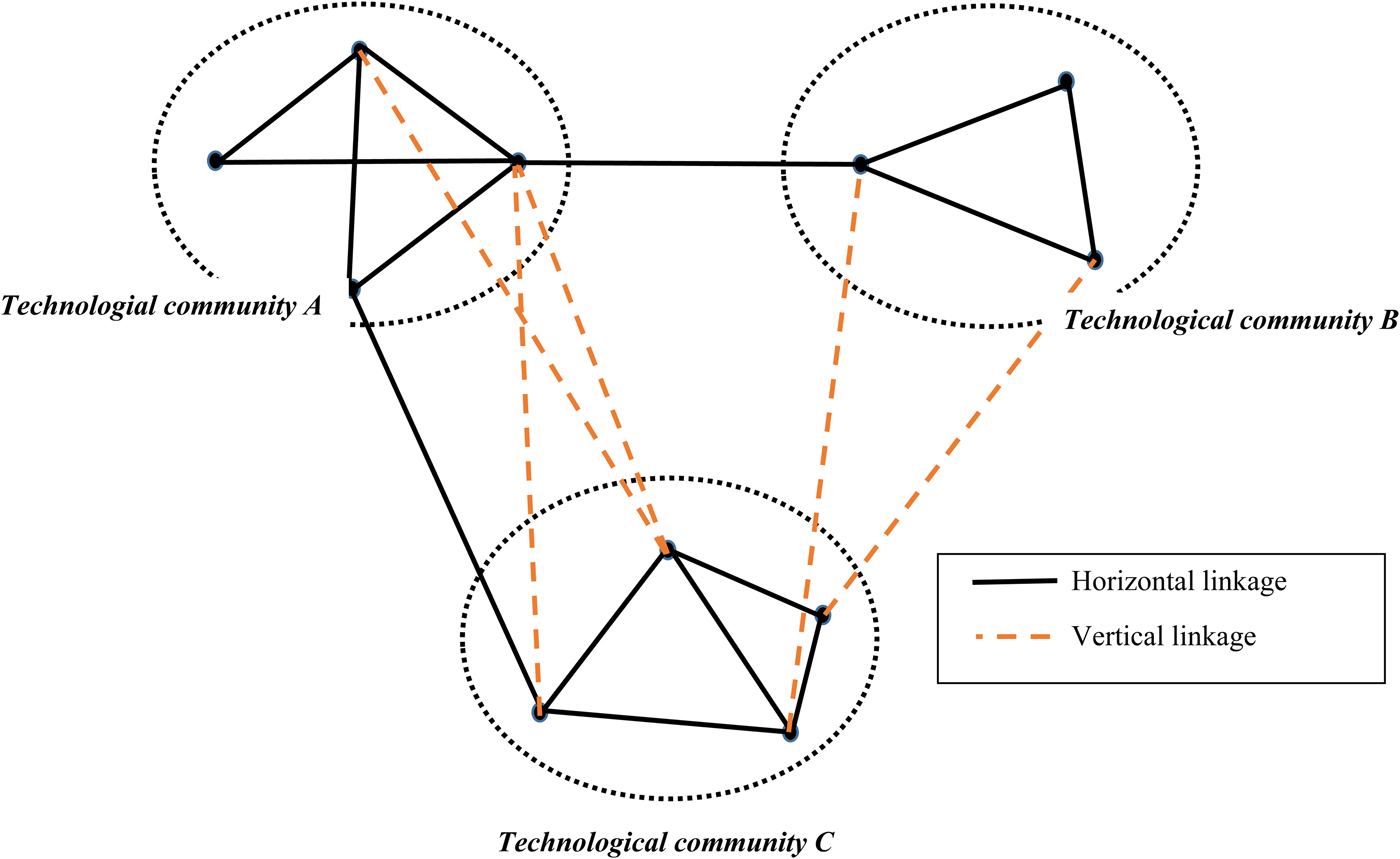
Our previous discussion provides a different view of industrial clusters than is described in the traditional cluster research: we portray an industrial cluster as a grouping of multiple co-located technological communities within which firms have tightly knit horizontal linkages among each other, mostly for exploitation purposes, but between which there are few horizontal connections that are primarily set up for exploration reasons (see Figure 1). These technological communities may also be linked through vertical linkages if a technological community acts as a supplier to another technological community (e.g., computer hardware versus semiconductor).
Technological proximity and community structure formation in industrial clusters
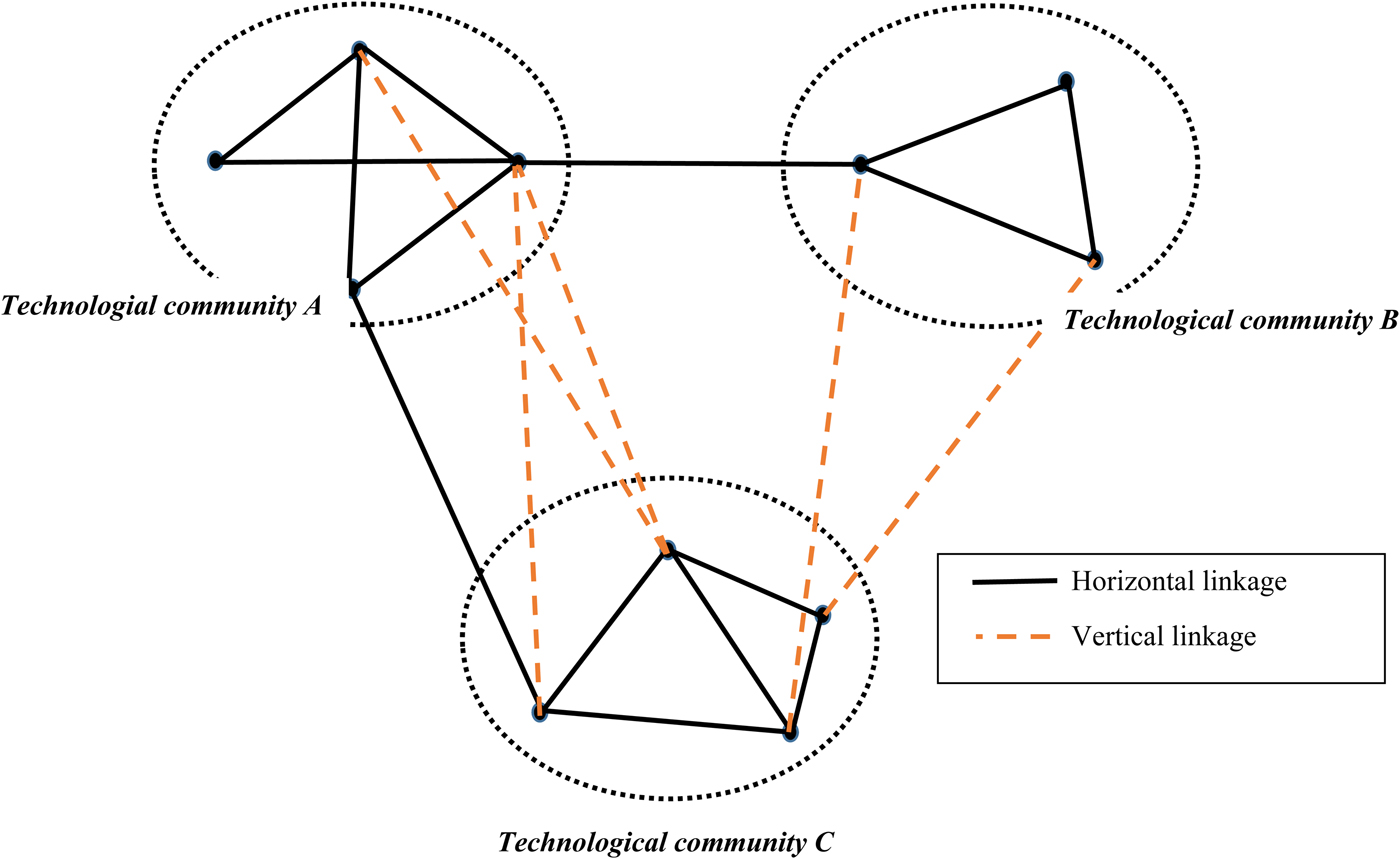
The composition and relatedness of these technological communities matter for the cluster's aggregate performance in two ways. First, it affects the industrial cluster's ability to reinvent itself over time by moving into new technological areas. If technological communities are sufficiently close in technological space, this can entice some firms to develop community-spanning linkages for knowledge exploration purposes, thus triggering radical innovation in technological areas that are relatively scarce in the industrial cluster. Then again, if technological communities are located too far apart in technological space this limits opportunities for regional branching and can lead to technological lock-in.
Second, it affects the industrial cluster's ability to develop streamlined supply chains. If firms in one technological community heavily rely on inputs that are produced by firms in a co-located technological community, this can generate the development of strong buyer-supplier linkages between the two communities, leading to vertical knowledge spillovers and transaction cost savings.
DATA AND METHODS
Bengaluru ICT Cluster
To investigate our hypotheses, we use data that we have collected from Bengaluru's ICT cluster. Bengaluru emerged as one of the largest and fastest growing ICT clusters outside of the developed world in the 1990s and is often called the ‘Silicon Valley of India’ (Arora & Gambardella, Reference Arora and Gambardella2005). Starting with the decision of Texas Instruments to set up of an offshore facility in 1984, many leading multinational ICT firms such as Microsoft, IBM, Apple, Adobe, and Intel have moved their information-technology enabled back-office operations such as call centers to Bengaluru (Basant, Reference Basant, Yusuf, Nabeshima and Yamashita2008; Manimala, Reference Manimala, Carayannis and Formica2008). In the ensuing decade, many of India's business process outsourcing giants such as Infosys, Mindtree, and Wipro have emerged from this cluster. These trends have gradually led to the emergence of Bengaluru as an ICT cluster that specializes in ICT software, earning it the nickname ‘outsourcing capital of the world’ (Tholons, Reference Tholons2010).
It has been argued that the growing presence of subsidiaries from both foreign and Indian-based multinational firms has led to a steady rise in inter-organizational connections with smaller local firms (D'Costa, Reference D'Costa2006; Taübe, Karna, & Sonderegger, Reference Täube, Karna and Sonderegger2018), even though there is limited recent empirical evidence that formally documents this. A lingering question concerning the Bengaluru ICT cluster is therefore whether the local inter-organizational network remains fragile and disconnected (Vijayabaskar & Krishnaswamy, Reference Vijayabaskar, Krishnaswamy, Mani and Romijn2004), or whether it increasingly features structural network characteristics that are similar to ICT cluster in developed countries, and therefore in line with the theoretical framework.
Network Data
We have hand-collected a cross-sectional dataset that maps the network of formal inter-firm connections in Bengaluru's ICT cluster using a two-step procedure. In a first step, we compiled a list of domestic and foreign firms that were active in the Bengaluru ICT cluster during the period 2015–2017. Since there is no single data source that provides a comprehensive list of companies, we used and cross-referenced a variety of data sources: Orbis, Fundoodata, NASSCOM, the list of IESA members (Indian Electronics and Semiconductor Association), and Companiesinbangalore. We complemented this information with data from Crunchbase (which gives exhaustive information on the companies including management and acquisitions), Yourstory (for start-ups and small companies), and Jobseekersindia (which gives information on company description, company websites and contact phone numbers). In total, we identified 1823 relevant firms.
In a second step, we mapped the linkages between the companies in our sample. As is common in social network analysis, we measured linkages on a binary scale: 0 for the absence and 1 for the presence of a formal relationship (Dyer & Singh, Reference Dyer and Singh1998). Following Turkina et al. (Reference Turkina, Van Assche and Kali2016) and Turkina and Van Assche (Reference Turkina and Van Assche2018), we distinguished between two linkage types: ‘horizontal’ partnership and ‘vertical’ buyer-supplier linkages. A linkage was categorized as a horizontal linkage if two firms had formed a strategic alliance, joint venture, joint R&D projects or a tentative cooperation. A connection was considered to be a vertical linkage if a firm supplied a product or service to another company. To compile the linkage data, we started off by consulting the Thompson Eikon and Bloomberg databases. We then complemented these data with information from Spiderbook which gives references to the sources from where the relationship was established. This effort covered around 90% of network linkages. The remaining 10% of linkages were collected from NASSCOM, IESA, and Yourstory resources such as information on events and projects. These resources were helpful to establish smaller-scale partnerships and cooperation between smaller companies and start-ups. To increase our confidence in the validity of the trans-local linkages in our dataset, we included only those ties that appeared in at least two distinct data sources.
Although the literature emphasizes the importance of both formal and informal ties between firms for knowledge spillovers and innovation (e.g., Giuliani, Reference Giuliani2007), we only focus on formal linkages as collecting data on informal linkages would need a careful surveying on the field.
Technological Profile Data
The focus of this article is on the role of technological distance in community structure formation, with a particular focus on new technology development and innovation. In this context, we follow Nooteboom et al. (Reference Nooteboom, Van Haverbeke, Duysters, Gilsing and Van den Oord2007) and Wuyts et al. (Reference Wuyts, Colombo, Dutta and Nooteboom2005) by focusing on firms’ technological capability.
To measure a Bengaluru ICT firm's technological capabilities, we use patent application data from India's Patent Advanced Research System. Numerous previous studies have used patent data to develop indicators of a firm's technological profile (e.g., Jaffe, Reference Jaffe1986). The fact that a firm applies for a patent in a given technological field means that such a firm is at, or close to, the technological frontier and has advanced technological competencies in that field. For each Bengaluru ICT firm in our sample, we thus triaged information on the location of first inventor (Bengaluru) and the company name to match our network data with patent data.
For each matched firm, we collected information on their ICT patents using the International Patent Classification (IPC). IPC is a standard taxonomy developed and administered by the World Intellectual Property Organization (WIPO) for classifying patents. For search purposes, IPC codes are assigned to patents by the examiners of the issuing patent office according to strict WIPO guidelines. In a recent study, Inaba and Squicciarini (Reference Inaba and Squicciarini2017) compiled an exhaustive list of IPC codes that are associated with the ICT sector, which we use in this paper.
We used the firm-level patent data to construct a mapping of the Bengaluru ICT cluster's technological space. Technological space was first addressed empirically by Jaffe (Reference Jaffe1986, Reference Jaffe1989) who calculated relatedness among two given technologies by looking at how often they were used in combination with a third technology. In a similar manner, we constructed technological space following the product space framework developed by Hidalgo, Klinger, Barabási, and Hausmann (Reference Hidalgo, Klinger, Barabási and Hausmann2007). Technological space can be seen as a network-based representation of technological production, where nodes define technologies and links among them indicate their degree of relatedness (see also Rigby, Reference Rigby2015; Boschma et al., Reference Boschma, Minondo and Navarro2013). We identified technology fields in the ICT sector using the IPC classification and OECD definition of codes for the ICT industry. Two patent codes are related if they have high probability of co-occurrence within the same firms: first, we calculate how often two patent codes occur together in a given firm. This allows us to build a code-firm matrix from which we can calculate co-occurrence probabilities for codes by aggregating over firms.
The combination of inter-firm network data and information on technological space allows us to evaluate if technological proximity can help explain the existence of community structures in the horizontal and vertical network.
Community Detection Analysis
The topological property of community structure means the existence of some natural division of the network such that nodes within a group are tightly knit among themselves, while having relatively looser connections with the rest of the network (Girvan & Newman, Reference Girvan and Newman2002). In our analysis, we will use community structure detection techniques to evaluate our research hypotheses.
Recent advances in network science have provided tractable alternatives for detecting communities in complex large-scale networks (Girvan & Newman, Reference Girvan and Newman2002; Newman & Girvan, Reference Newman and Girvan2004). These new algorithms range from hierarchical clustering such as the betweenness-centrality-based Girvan and Newman (Reference Girvan and Newman2002) algorithm, to those based on finding non-overlapping communities (Fortunato, Reference Fortunato2010). The latter group includes modularity-based algorithms, which assigns modularity values to communities based on the value of the fraction of the edges that fall within the discovered communities, after deducting the expected number of such edges in case the edges of the network were randomly chosen. More important for our purposes, it also includes the recent voltage-based algorithm which is able to divide the network much faster and is considered to be very efficient with large scale and dense networks (Arya & Mitra, Reference Arya and Mitra2013; Xu & Yan, Reference Xu and Yan2008). In this approach, a network is modeled as an electrical circuit by allocating one unit resistor on each link. Then, the algorithm selects the nodes from two distinct communities as the positive and negative poles. The resistance within communities is much less than between communities, because within-community links are much denser, and thus the voltage difference of distinct communities is more significant. In this article, we will rely on the voltage-based algorithm to define communities in our networks.
RESULTS
We present our empirical results in three steps. First, we provide descriptive statistics about the structure of Bengaluru's inter-organizational network. Second, we present a snapshot of Bengaluru's technological profile in the ICT sector and develop a technological heat map which allows us to evaluate which technological fields are closer to each other in technological space. Finally, we then combine both datasets and use community detection analysis to test our hypotheses.
Inter-Organizational Network
We start our analysis by conducting a standard investigation of the network's core-periphery structure in Bengaluru's ICT cluster's inter-firm network. Figure 2 depicts the network using a combination of advanced social network techniques. First, it uses a voltage-based clustering algorithm to partition the firms into topological clusters (different topological clusters are colored differently) (Arya & Mitra, Reference Arya and Mitra2013; Xu & Yan, Reference Xu and Yan2008). Second, for better visualization, it uses a Barnes-Hat force-directed layout algorithm to place those firms which are more central in the overall network closer to the center of the diagram (Barnes & Hut, Reference Barnes and Hut1986). Third, we use an eigenvector algorithm to depict the size of the nodes, portraying firms with a higher eigenvector centrality to be larger than other firms. Since the network is rather dense, we overlaid the circular forms matching the colors of the network clusters on top of the network to help better identify network clusters.
Network of local inter-firm linkages in Bengaluru's ICT cluster
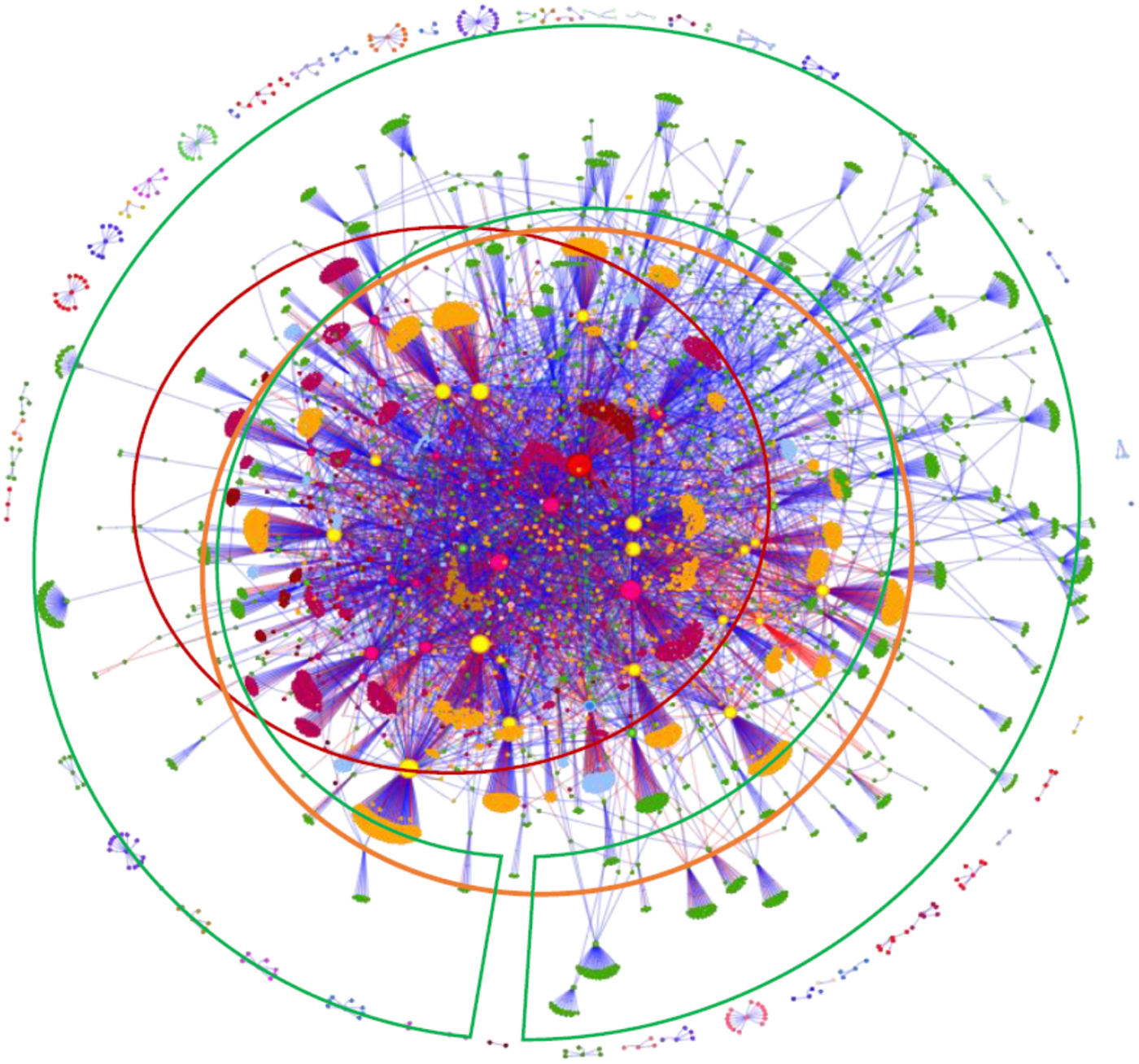
Figure 2 suggests that Bengaluru's overall network in the ICT industry is clearly organized into two segments: a tightly-knit network of ‘insider’ firms in the core and an outer ring of ‘outsider’ firms that are not connected with the main body of the network and are only loosely connected with themselves. Case-by-case analysis of the outsider firms indicates that those are mostly Indian companies that specialize in the relationships with international actors and have little joint business with the local companies.
A closer examination of the fully connected segment of the network using the voltage-based clustering algorithm reveals two topological clusters in the core of the network interacting with each other through dense system of connections which in figure 2 are depicted with red and yellow nodes (encircled by red and yellow overlays). There is also a green cluster of linkages a bit outside the core of the network (encircled in green form), as well as some smaller clusters at the periphery (e.g., light blue). We will analyze below what may explain this topological clustering in the network.
Further examination of these topological clusters indicates that they themselves are organized along core-periphery structures, characterized by a densely connected core of firms and a set of peripheral players that are only loosely connected among themselves. This is important since core-periphery structures tend to signal the presence of an elite group of firms (the core), which exchanges knowledge and resources with great frequency. This enables the circulation of high-quality and constructive knowledge among the densely connected core firms that have considerable potential to upgrade the knowledge base. At the same time, firms in the periphery do not benefit as much from the knowledge base in the core.
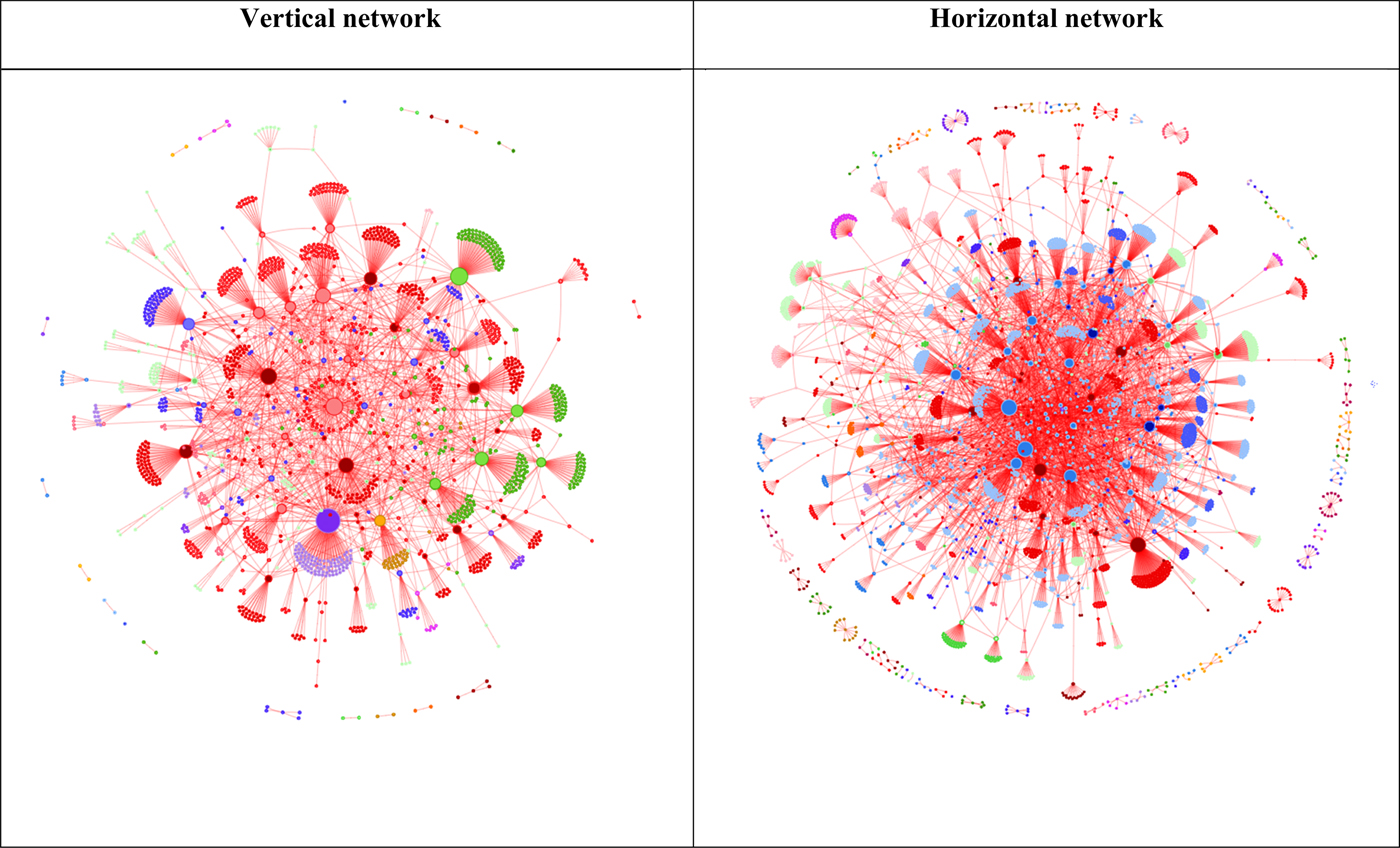
We next decomposed the multiplex network and analyze the horizontal and vertical networks separately. Figure 3 demonstrates important differences in the structural properties of the two networks. First, a comparison of the core-periphery structures of both networks show that the horizontal network is denser and more decentralized than the vertical network. Second, the horizontal network contains a larger number of distinct topological clusters (multiple colors indicate the presence of multiple clusters) with some principal clusters closer to the core of the network and many clusters further away from the core implying that cooperative effort in the horizontal network is organized into a variety of distinct topological communities. In the vertical network, then again, the linkages are more centralized around some key firms and a few key topological clusters.
Network of local inter-firm linkages in Bengaluru's ICT cluster, vertical versus horizontal network
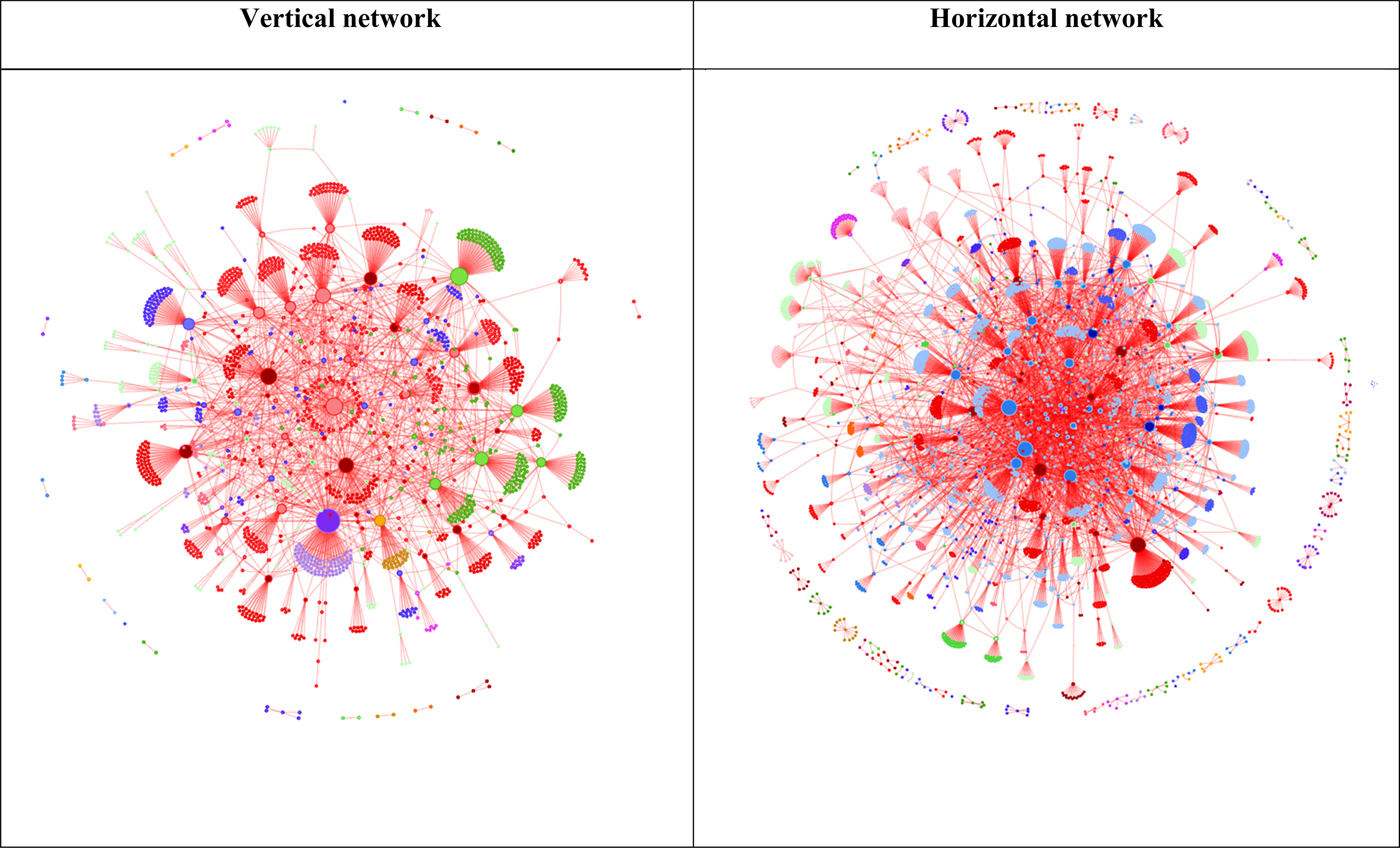
We conducted transitivity analysis that gives the density of transitive (or interconnected) triples in a network. The analysis indicates that in the vertical network the percent of transitive triples is 3.19%, while in the horizontal network it is 28.5%. This suggests that the horizontal network is significantly more cohesive than the vertical network and that the pattern of link formation in the vertical network resembles a star-shape pattern, whereas horizontal linkages form cohesive clusters with interconnected members.
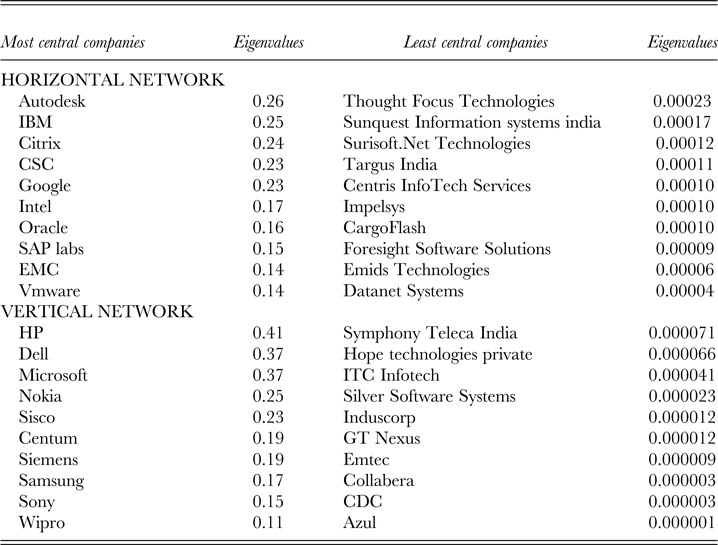
Table 1 presents the firms that are most and least eigenvector-central in the horizontal and vertical networks. It is clear that the core firms in both the horizontal (Autodesk, IBM) and vertical networks (HP, Dell) are large, global technology leaders. In contrast, peripheral companies tend to be local Indian firms.
Most and least eigenvector-central firms in the Bangalore ICT cluster

A closer look at the technological leaders and laggards (by number of patents) provides further insights into the type of linkages that leaders and laggards develop locally. In the vertical network, technological leaders have a central position in the network and develop a multitude of linkages to other firms, whereas laggards only develop few linkages. At the same time, in the horizontal network, leaders tend to form large groups with structural holes, whereas laggards form very small groups with high degrees of closure.
Bengaluru's Technological Space
This subsection describes Bengaluru's technological profile and develops a technological heat map that determines which technological fields are closer to each other in technological space.
As far as the distribution of technological codes in our dataset is concerned (major 3-digit categories, percentage values, 2011–2016), unsurprisingly, the software field of Computing, Calculating, Counting (G06) contains 39% of ICT firms which generate patents. Nonetheless, the non-software fields Electric Communications Techniques (H04) and Basic Electric Elements (H01) are second and third with 17% and 9% of all ICT firms, respectively.
As far as the distribution of patents is concerned, 34% of patents in the dataset are in the field of Computing, Calculating, Counting (G06). Electric Communications Techniques (H04) and Basic Electric Elements (H01) are second and third with 15% and 11% of all ICT firms, respectively. The slightly higher weights of the technological fields Basic Electric Elements (H01) and Measuring, Testing (G01) when patents are used instead of firms suggests that these industries consists of a number of large firms that generate a big amount of patents.
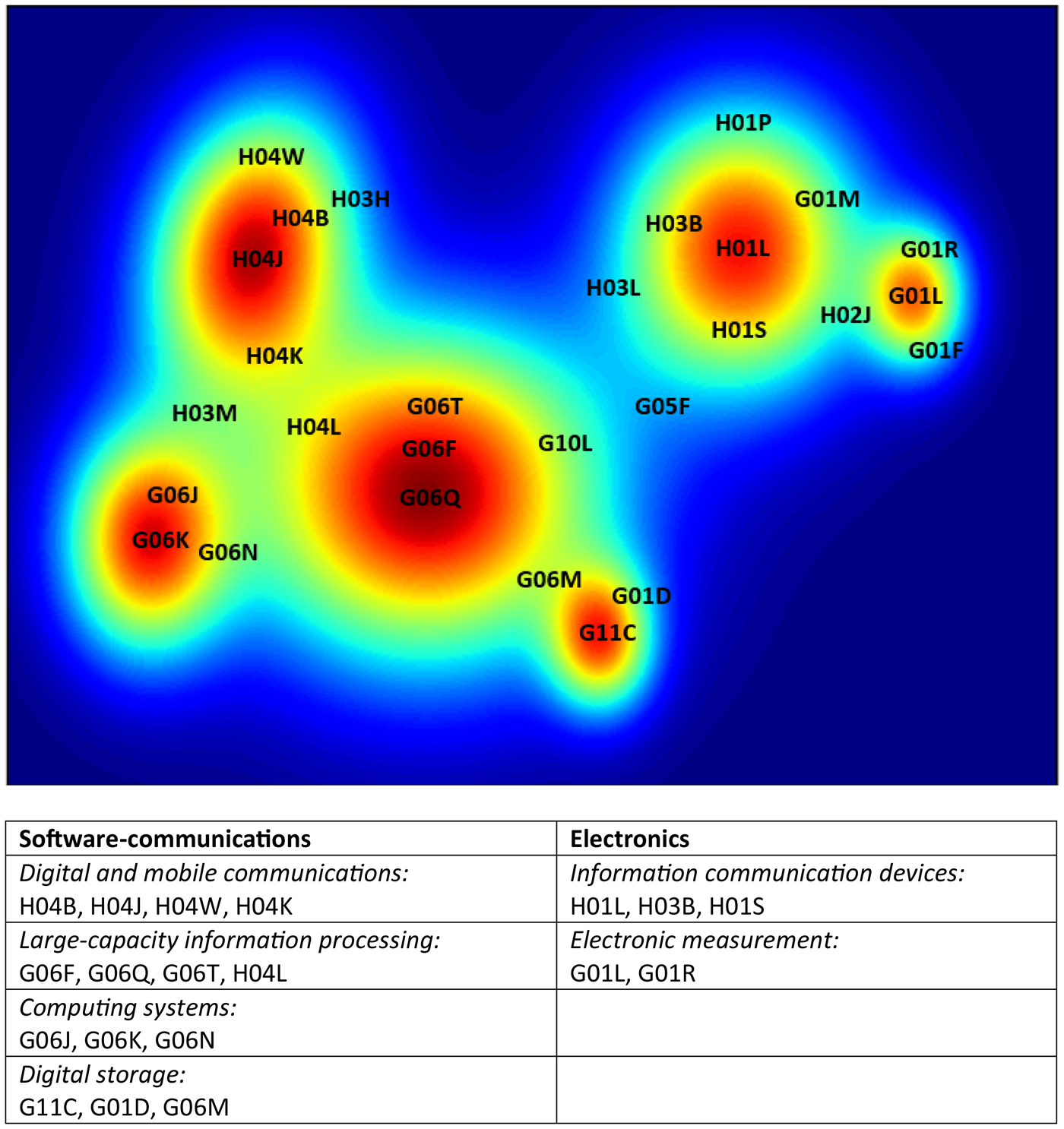
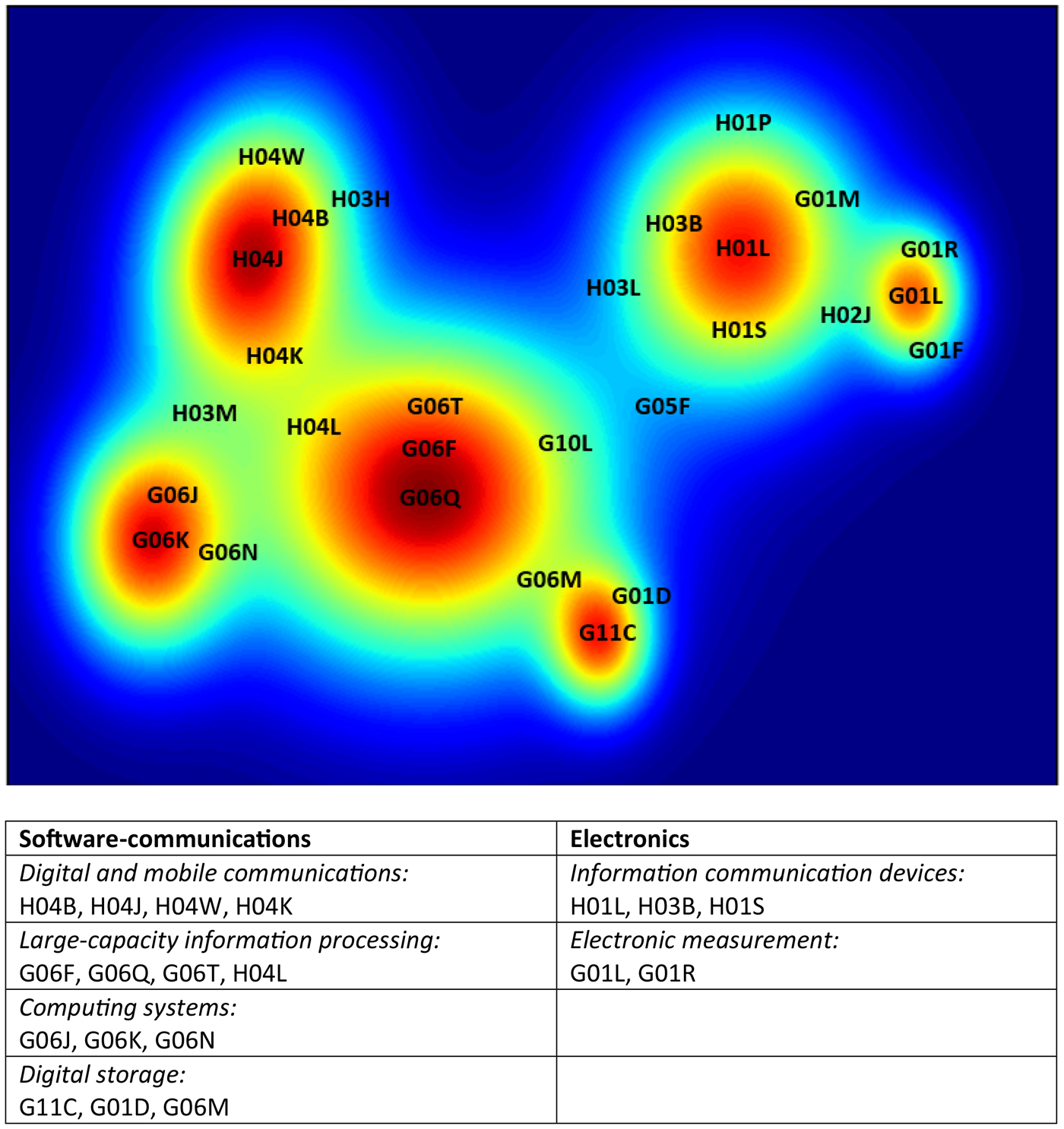
To construct our measure of technological space, we analyze patent IPC classifications and construct a heat map based on the frequency of co-occurrence of patent categories for the firms in our sample. After an overview of the broad technological fields, we conduct a more refined and sophisticated analysis at the four-digit level of the patent codes. Figure 4 presents the results of the analysis where we see associations between different families of patents. Moreover, we see that the technological field of Computing, Calculating, Counting (G06) splits into two clusters. Figure 4 shows several topological clusters of patents and relationships among them. The core consists of four software-communications clusters: the central cluster with an epicenter composed of Large-capacity information processing, the adjacent cluster to the left on Computing systems, the adjacent cluster to the right on Digital storage;[Footnote 3] and a cluster focusing on Digital and mobile communications at the top. There is also a second topological cluster of patents which focuses on Electronics and does not have a tight connection with the software-communications group. It consists of a sub-cluster on Information Communication Devices and an adjacent sub-cluster on different types of Electronic measurement.
Patent heat map in Bengaluru's ICT cluster
Community Detection Analysis
To test whether technological space is a significant predictor of community structure formation in the core of Bengaluru's horizontal and vertical networks, we use a maximum likelihood approach (Jackson, Reference Jackson2008). We use four-order technology-based partitioning to conduct this analysis in increasing order of disaggregation. The first-order partitioning investigates whether the division between the two major technological fields software-communications and electronics is a significant predictor of community structure in the core of the inter-organizational network. The second-order partitioning conducts a similar analysis using the six technological bubbles that we identified on the heat map in Figure 4 (the epicenter and its surrounding layers). The third-order partitioning separates the 19 four-digit IPC patent categories that are described in Figure 4. The fourth-order partitioning separates technological fields at the highest disaggregation of the IPC patenting codes, the full technological code.
The results in Table 2 suggest that technological proximity is a significant predictor of community structure formation in the core of Bengaluru's horizontal network. That is, our analysis provides evidence that firms in the horizontal network are more likely to form a topological community with other ICT firms that operate in the same technological category. In the second-order partitioning (6 technological groupings), this result is significant at the 10% level. In the third-order partitioning (4-digit IPC code, matching the technological epicenters with cluster cores), it is significant at the 1% level.
Statistical significance of different partitioning schemes (p-value of the fitness test)

Interestingly, our results become insignificant when we conduct our analysis at both the most aggregated first-order partitioning (two technological groupings) and the most disaggregated fourth-order partitioning (full IPC code). For the former, this is likely because the partitioning into two highly aggregated technological groups is too rudimentary to explain community structure formation. Indeed, the empirical test simply asks if the distinction between the broad categories software-communications versus electronics can explain the formation of topological communities. For the latter, then again, it is in line with Corollary 1 which states that at too small technological distances firms have little reason to form horizontal linkages since they have technological profiles that are too similar.
In sum, we can overall conclude that our results provide supporting evidence for Hypothesis 1 and Corollary 1: in the horizontal inter-firm network, firms that form a topological community are technologically closer to each other than to companies in other communities, but they are not technologically too close.
In line with Hypothesis 4, we do not find any evidence that technological proximity is a predictor of community structure formation in the vertical network. At all four levels of partitioning, the findings in column 3 of Table 2 suggest that the results are insignificant at the 10% level.
Unsurprisingly, our results for the overall network – which combines the horizontal and vertical networks – is mixed. For the second to fourth-order partitionings, the results in Table 2 show little evidence that technological proximity helps explain community structure formation with none of them significant at the 10% level. Only at the first-order partitioning do we find that the result becomes significant at the 10% level.
Taking these results together, we can conclude that our results support our Hypothesis 1, Corollary 1, and Hypothesis 4. That is, we find evidence that technological proximity is a predictor of community structure formation in the horizontal network, suggesting that firms which form a topological community are technologically closer (but not too close) to each other than to companies in other topological communities (Hypothesis 1 & Corollary 1). We do not find such evidence in the vertical network, confirming Hypothesis 4.
Community-Spanning Firms and Radical Innovation
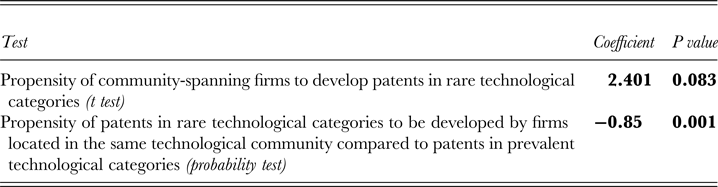
We next test Hypothesis 2 by investigating if community-spanning firms which create horizontal linkages that bridge topological communities are more likely to develop patents in rare technological categories (in the industrial cluster) than non-community-spanning firms. We conducted this analysis in three steps. First, we identified the community-spanning firms in the horizontal network by selecting those firms that have an above-average number of connections to other topological communities. A closer look at these community spanners indicates that it is a mix of global technological leaders from advanced countries like Microsoft, Nokia, Intel, Samsung, and some established Indian companies like HCL Technologies or Wipro. Second, we identified rare 4-digit patent codes as those that are on the light and dark blue areas of the heat map (e.g., secret communication & jamming of communication (H04K) or impedance networks (H03H)). Finally, we conducted a t-test to verify if these community-spanning firms disproportionately develop patents in rare technological categories compared to non-community-spanning firms. Table 3 presents the results of the analysis.
Community spanning firms and patents in rare technological categories

The result of the test (positive and significant) confirms Hypothesis 2. The following three examples illustrate community-spanning firms that have developed patents in technological fields that are relatively rare in Bengaluru. Microsoft is located in a topological community that specializes in large-scale information processing (the company specializes in H04L). We consider Microsoft a community-spanning firm since it has an above-average number of connections to different topological communities, particularly those surrounding the technological hotspots of computing systems, digital storage, and digital and mobile communications (see Figure 4). In 2016–2017, the company published a disproportionate number of patents in locally rare technological field (outside of the hotspots in Bengaluru's technological space), including a patent in category H04M3 titled Automated data transfer from mobile application solos to authorized third-party applications.
Wipro is another example of a community spanner. It is located in a topological community around the technological field large-scale information processing (G06F), and it has an above-average number of community spanning linkages, including horizontal connections with firms that specialize in the technologically distant areas of Electronic measurement and Information communication devices. Compared to its non-community spanning peers, Wipro has created a disproportionate number of patents in locally rare technological fields such as G05B and G05D, which are in dark areas on Bengaluru's technological space map. For example, in 2016 it has published a patent in the G05D category titled System and methods for creating on-demand robotic process automation. Such robotics-related patents are quite typical of the Boston cluster, for instance, but remain relatively rare in Bengaluru.
As a final example, and in line with Lorenzen (Reference Lorenzen2018), we, in 2016–2017, notice a substantial increase in the number of animation and video-related patents created in Bengaluru, which nonetheless remain relatively rare in India's most famous cluster. One of the firms that is responsible for this rise in animation-based patents is Samsung. In 2016, for example, it published a patent in the rare technological field H04N called Method of fast video reverse recording that develops a new method of encoding frames to create a reverse video while recording multimedia content. Samsung is a clear example of a community-spanning firm since it is located in a topological cluster around the technological field, but it laterally connects to very distinct topological communities around the fields Digital and mobile communications and Large capacity information processing, among others.
We finally test Hypothesis 3 by investigating if technologies in those 4-digit patent codes that are relatively rare in the Bengaluru ICT cluster are more likely to be developed by firms rooted in distinct topological communities. We conducted this analysis in two steps. First, we identified rare 4-digit patent codes as those that are on the light and dark blue areas of the heat map. Next, we tested if patents in these rare technological categories are more likely to be developed by firms located in the same technological community than patents in prevalent technological categories (Table 3). Highly significant and negative result of the test confirms Hypothesis 3.
DISCUSSION
The mushrooming of knowledge-intensive industrial clusters in developing countries such as India has generated a renewed urgency to better understand how the knowledge ecosystem of such clusters is configured, and to what degree these local environments are able to spur home-based technological innovation. In this article, we have contributed to this discussion by conducting an in-depth community detection analysis of the structure of Bengaluru ICT cluster's inter-organizational network, by overlaying it onto the cluster's technological space, and by discussing how it harnesses the cluster's ability to move into new technological fields.
Our study has allowed us to unearth a new set of stylized facts about India's most famous industrial cluster. First, our technological space mapping has shown that the Bengaluru ICT cluster is no longer an agglomeration of firms that innovate in a relatively limited scope of software-related technological fields. Rather, while the software domain of Information processing remains the most important hotspot in terms of patent numbers, the cluster has also gained significant expertise in the technological fields of Communications technology and Electronics devices, transforming Bengaluru into a more advanced and broad-based ICT cluster.
Second, our analysis of the inter-organizational network has uncovered significant inter-firm collaboration between local cluster firms, generating a cohesive network of both horizontal alliance linkages and vertical buyer-supplier connections among cluster firms. At the same time, we have shown that specific groups of firms are particularly well-connected with one another through horizontal linkages, thus transforming the Bengaluru ICT cluster into an open network of multiple co-located topological communities within which firms form tightly knit horizontal linkages among each other, but between which horizontal connections are scarce. Phrased differently, within the geographical boundaries of the ICT cluster, there are several ‘islands’ of firms that intensively collaborate laterally with one another, but that have few horizontal connections with firms on other ‘islands’.
We have investigated to what extent technological proximity may explain topological clustering in Bengaluru's ICT eco-system. Using a voltage-based community structure detection algorithm, we have found that proximity of technology subfields is a key predictor of topological clustering in the network of horizontal inter-firm linkages. This suggests that it is primarily firms with similar (but not too related) technological profiles that form tightly-knit topological communities, mostly for knowledge exploitation purposes. In contrast, and as predicted, we do not find that technological proximity matters for community formation in the vertical network.
It is important to point out that the relatively low statistical dependencies between the two independent systems – patent space and inter-organizational network - that we found in some more aggregate iterations (but certainly not all) is not surprising. First, previous research has shown that it is common in social network analysis to find low dependencies between independent large-scale networks (Jackson, Reference Jackson2008). Second, there are other potential drivers of community formation in the Bengaluru ICT cluster that we have not been able to control for in our empirical analysis. For example, Bengaluru firms may also be more likely to form communities with companies that share the same country of origin (local versus foreign), that are located in the same geographical district of Bengaluru or have a common cultural background. A fruitful avenue for future research is to control for these factors and compare the importance of different types of homophily (geographical, cultural, technological) on community structure formation within clusters (Ter Wal & Boschma, Reference Ter Wal and Boschma2009).
We have finally investigated if the composition and relatedness of Bengaluru's technological communities are important for the development of new technologies in the industrial cluster. We have shown that patents in (locally) rare technology categories are more likely to be developed by firms that are rooted in distinct technological communities. We have also found that those community-spanning firms which build horizontal bridges between technological communities stand out from their peers in that they are more likely to develop patents in rare technology categories. The effect sizes of these tests are strong, indicating that radical innovations indeed demand a combination of diverse knowledge pools. These results suggest that Bengaluru's ability to upgrade into new technological fields at least partially depends on the willingness and ability of its firms to build exploration-driven alliances with local companies in other technological communities. These findings are consistent with other empirical evidence in this journal that a firm's achievement is associated with large open networks (Burt & Burzynska, Reference Burt and Burzynska2017; Burt & Opper, Reference Burt and Opper2017; Zhao & Burt, Reference Zhao and Burt2018). These findings are also in line with broader sociological studies arguing for the importance of social connections (DiTomaso & Bian, Reference DiTomaso and Bian2018) and social capital generated by linking different communities within the social fabric of societies (Lin, Cook, & Burt, Reference Lin, Cook and Burt2001).
Taken together, these results confirm that the local inter-organizational network in Bengaluru's ICT cluster is not fragile and disconnected as was suggested in previous research, but rather features structural characteristics that are common in mature ICT clusters in developed countries: technological homophily helps explain the formation of cohesive sub-groups in the network, but radical innovation depends on the development of linkages between sub-groups.
Our analysis highlights the usefulness of community detection analysis in uncovering patterns in the data which are difficult to both see and interpret using conventional methods. While we have only focused on one industrial cluster in this paper, we believe that its approach is likely to be fruitful for the study of organizational and industrial dynamics across both space and time at various levels of aggregation.
Limitations and Future Research Implications
Our analysis provides new insights into Bengaluru's innovation eco-system, yet it also raises a number of questions that need to be taken up in future research. Our exclusive focus on the Bengaluru ICT cluster allows us to only anecdotally compare and contrast the Indian cluster's technological space to that of leading ICT clusters across the world. That is, we cannot conclusively state that Bengaluru has a different composition of technological communities than their developed-country counterparts. Future studies that conduct a comparative research of technological fields across industrial clusters would allow us to obtain a better grasp how technological space differs from cluster to cluster, and what may explain these variations in both geographical and technological space.
A cross-cluster comparison of Bengaluru's local network configuration to that of other clusters can also provide further insights into its long-term development opportunities. Several scholars have pointed out that a large closely tied core of technologically similar companies in an industrial cluster carries the risk of a technological ‘lock-in’ which can negatively affect the cluster's long-term performance (e.g., Crespo et al., Reference Crespo, Suire and Vicente2014; Narula, Reference Narula2002). Indeed, a too large concentration of similar firms can install path dependence and starve the cluster from the required knowledge diversity to spur new paths of innovation. To determine if Bengaluru's ICT cluster is overly locked in technologically, more research is needed that compares its local network topology with that of other industrial clusters, or that documents dynamic changes in Bengaluru's local network structure over time.
Finally, multiple studies have pointed out that technological lock-in may be counter-balanced by the inflow of diverse knowledge through non-local connections (Bathelt et al., Reference Bathelt, Malmberg and Maskell2004; Boschma & Iammarino, Reference Boschma and Iammarino2009), yet our exclusion of non-local linkages from the analysis refrains us from assessing the degree to which Bengaluru is linked to the outside world. A fruitful future research direction would be to develop a ‘global cluster network’ database for the ICT sector that documents both the local and non-local linkages of firms in multiple industrial clusters.