Introduction
Anxiety disorders, including panic, are among the most common psychiatric problems in older populations (Hybels and Blazer, Reference Hybels, Blazer, Tsuang and Tohen2002) and are a source of disability in overall mental and role functioning (Horwath et al., Reference Horwath, Cohen, Weissman, Tsuang and Tohen2002). Panic disorder (PD) is characterized by recurrent, unexpected panic attacks, followed by at least one month of persistent concern about having another attack, concern about the implications of the panic attacks, or a significant change in behavior that is directly related to the attacks (American Psychiatric Association, 2000). Definitions of panic disorder have changed somewhat in recent decades. The primacy of agoraphobia and PD, where they occur together, was reversed in DSM-IIIR (“agoraphobia with panic attacks” in DSM-III was replaced by “panic disorder with agoraphobia”), and the requirement of a minimum frequency of panic attacks (three attacks in three weeks in DSM-III, four in four weeks in DSM-IIIR) was removed in DSM-IV. The list of potential symptoms was also expanded in DSM-IIIR to include nausea or abdominal distress (Horwath et al., Reference Horwath, Cohen, Weissman, Tsuang and Tohen2002).
At present, there are limited data on the prevalence of 12-month and lifetime PD using DSM-IV criteria among older adults. Published estimates of 12-month PD in the general adult population range from 0.7% to 2.3%, and 6-month prevalence estimates from 0.6% to 1.0% (Myers et al., Reference Myers1984; Bland et al., Reference Bland, Newman and Orn1988a; Kessler et al., Reference Kessler1994). A number of studies have excluded older adults altogether or not provided prevalence estimates by age group (Eaton et al., Reference Eaton, Kessler, Wittchen and Magee1994; Kessler et al., Reference Kessler1994; Carlbring et al., Reference Carlbring, Gustafsson, Ekselius and Andersson2002; Goodwin et al., Reference Goodwin2005). Using DSM-III criteria, Beekman et al. (Reference Beekman1998) reported 12-month estimates for the youngest (55–64 years: 0.8%), middle (65–74 years: 1.7%) and oldest old (75–85 years: 0.5%) in their survey of adults from the Netherlands. Six-month and lifetime estimates of 0.3% and 1.2% respectively, were reported in a sample of adults aged 65 years and older in Edmonton, Canada (Bland et al., Reference Bland, Newman and Orn1988b). Estimates from the ECA study sites using DSM-III criteria reported six-month prevalences of PD of 0.1% to 0.4% among adults aged 65 years and older (Myers et al., Reference Myers1984). Finally, using DSM-IV criteria, Kessler et al. (Reference Kessler, Wai Tat Chiu, Demler and Walters2005) estimated lifetime prevalence for adults aged 60 and older at 2.0%, but did not provide estimates for any shorter time periods.
With regard to social and demographic risk markers, the prevalence of PD is frequently higher among females in population samples (Flint, Reference Flint1994; Weissman et al., Reference Weissman1997; Beekman et al., Reference Beekman1998; Carlbring et al., Reference Carlbring, Gustafsson, Ekselius and Andersson2002; Horwath et al., Reference Horwath, Cohen, Weissman, Tsuang and Tohen2002). While some studies indicate that low education and low income are risk markers for PD or anxiety disorders in general (Eaton et al., Reference Eaton, Kessler, Wittchen and Magee1994; Beekman et al., Reference Beekman1998), many studies have not assessed measures of socioeconomic position as predictors of PD (Wittchen and Essau, Reference Wittchen and Essau1993). Finally, PD is associated with a number of other psychiatric disorders, including agoraphobia and depression (Beekman et al., Reference Beekman, de Beurs, van Balkom, Deeg, van Dyck and Tilburg2000; Goodwin et al., Reference Goodwin2005). However, our present understanding of these and other potential risk markers in later life is limited because many epidemiological studies either do not examine a full range of sociodemographic variables (Eaton et al., Reference Eaton, Kessler, Wittchen and Magee1994; Offord et al., Reference Offord1996) or, as we have noted, exclude older adults altogether.
To our knowledge, there is no published work that assesses the prevalence and risk markers of both 12-month and lifetime PD using DSM-IV criteria in a large, general population sample of older adults. There are a number of reasons for undertaking such an investigation. First, providing measures of prevalence that reflect current or recent disorder is important because lifetime estimates do not necessarily measure the current burden of illness among older adults. Second, there is some evidence that the prevalence of current PD declines with age (Bland et al., Reference Bland, Newman and Orn1988b; Krasucki et al., Reference Krasucki, Howard and Mann1998), but this has not been confirmed using DSM-IV criteria. Third, given the changes in the diagnostic criteria between DSM-III and DSM-IV, contemporary data are necessary to assess the prevalence of PD as it is currently understood. Finally, the paucity of data on risk markers related to PD in later life needs to be redressed. Since previous epidemiological work has not consistently examined a full range of sociodemographic risk markers for PD, our understanding of the social distribution of the disorder among older adults is limited. This is important for understanding whether PD differentially burdens some groups of older adults more than others.
Method
The data come from the Canadian Community Health Survey – Mental Health and Well-being (CCHS 1.2), a nationally representative community mental health survey conducted by Statistics Canada (the national statistical agency) between May and December 2002 (Gravel and Béland, Reference Gravel and Béland2005). In this investigation, we focused on respondents aged 55 and older (n = 12,792). Following a listwise deletion of cases with missing values, the resulting sample used in all analyses reported here was n = 10,690.
The decision to choose age 55 rather than the more traditional cut-off point of 65 was made for a number of reasons. First, many recent, large-scale surveys of psychiatric disorders in the general population exclude individuals over the age of 54 and we wanted to capture that segment of the population that is often excluded in these surveys. Second, as individuals increasingly elect to retire earlier than 65 or to stay in the labour force well past this age, the use of 65 to define entry to “old age” is becoming much less relevant. Third, since 55 years of age has been used before as the lower bound to define old age (e.g. Beekman et al., Reference Beekman, de Beurs, van Balkom, Deeg, van Dyck and Tilburg2000), this work will be comparable with other studies in the field. Finally, it was necessary to use a broader age range to ensure that enough positive cases of PD were available for analysis.
Twelve-month and lifetime prevalence of panic disorder
In the CCHS 1.2, the presence or absence of five common psychiatric disorders (major depressive episodes, manic episodes, agoraphobia, social phobia, and panic disorder) was ascertained with a set of diagnostic interviews based on the World Mental Health Composite International Diagnostic Interview (WMH-CIDI) administered by trained lay interviewers (Kessler et al., Reference Kessler1994; Kessler et al., Reference Kessler2004). For individuals to be screened into the PD module, a positive response was required to either of the following two questions: “During your life, have you ever had an attack of fear or panic when all of a sudden you felt very frightened, anxious or uneasy?”; and “Have you ever had an attack when all of a sudden, you became very uncomfortable, you either became short of breath, dizzy, nauseous or your heart pounded, or you thought that you might lose control, die or go crazy?”. Following DSM-IV, the diagnostic module then determined lifetime caseness according to the following criteria: a respondent (1) reported four or more unexpected panic attacks; and (2) reported that at least one of the attacks was followed by one month or more of worry about the attacks or significant changes in behavior related to the attacks. Respondents were positive for 12-month disorder if they (1) met the criteria for lifetime PD; (2) had a panic attack in the 12 months prior to the interview; and (3) experienced significant emotional distress during a panic attack over the same period.
Psychiatric and physical health comorbidities
PD is found to be frequently comorbid with other physical and psychiatric conditions, including affective, anxiety, and substance use disorders (Beekman et al., Reference Beekman, de Beurs, van Balkom, Deeg, van Dyck and Tilburg2000; Birchall et al., Reference Birchall, Brandon and Taub2000; Goodwin et al., Reference Goodwin2005). For this reason, we included 12-month major depression, social phobia, mania, and agoraphobia in this analysis; there were not enough cases of substance use disorders to include this variable. Respondents were also asked if they had ever been diagnosed by a physician with any of 22 chronic health conditions (e.g. asthma, diabetes, epilepsy, heart disease, cancer) and whether they required assistance with activities of daily living (e.g. personal care, grocery shopping) and instrumental activities of daily living. For example, respondents were asked “Do you have diabetes diagnosed by a health professional?” and “Do you require assistance with meal preparation?” We created a dummy variable to identify respondents who reported one or more chronic health conditions and another to identify respondents who reported one or more limitations in activities of daily living. These variables were coded as the presence or absence of any chronic conditions or limitations in daily activities because of the highly skewed distribution of the responses.
Sociodemographic risk markers
Several sociodemographic risk markers were selected based on previous work on PD in the general population (Eaton et al., Reference Eaton, Kessler, Wittchen and Magee1994; Kessler et al., Reference Kessler1994; Wang et al., Reference Wang, Berglund and Kessler2000; Carlbring et al., Reference Carlbring, Gustafsson, Ekselius and Andersson2002; Goodwin et al., Reference Goodwin2005). These included age, sex, marital status, education, income adequacy and language spoken (defined here as the first language learned and still understood). Income adequacy is a measure of economic status that accounts for the number of household residents. Low-income adequacy is defined as a household income of <$15,000 for 1–2 residents, <$20,000 for 3–4 residents, or <$30,000 for 5+ residents; middle-income adequacy as income <$30,000 for 1–2 residents, <$40,000 for 3–4 residents and <$60,000 for 5+ residents. Education was divided into three categories: less than high school, high school completed, and at least some post-secondary education. Language spoken was analyzed by creating three language categories: English only, French only, and other, the last including both bilingual respondents and those speaking a third language. While it would have been preferable to consider respondents not speaking an official language separately, this was precluded by sample size limitations. Marital status categories included married (reference category), single (never married), divorced or separated, and widowed. Age was kept as a continuous variable and in these analyses, females were compared to males.
Statistical analysis
In the first part of the analysis, we calculated 12-month and lifetime estimates of PD in the total sample and by age groups (55 to 64, 65 to 74; 75+). To obtain independent associations between risk markers and 12-month PD, we used logistic regression. We first reported unadjusted ORs for each of the predicted risk markers, then fit two additional models, the first adjusting for socioeconomic and demographic variables and the second incorporating measures of psychiatric and physical comorbidity.
CCHS 1.2 used a multistage, stratified cluster design to select eligible households. To correct the potential bias resulting from this complex survey design, Statistics Canada recommends bootstrapping of all tests using a set of replicate weights that they supply. All results presented here were produced with this approach. STATA 8.0 was used to bootstrap all results. Data for this study were obtained from the CCHS 1.2 Master File maintained at the Statistics Canada Research Data Centre, Toronto, Canada.
Results
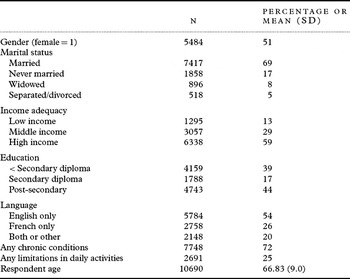
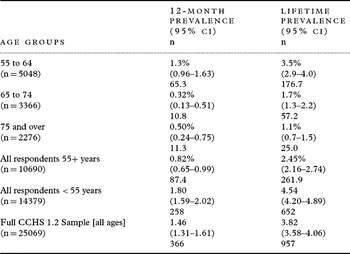
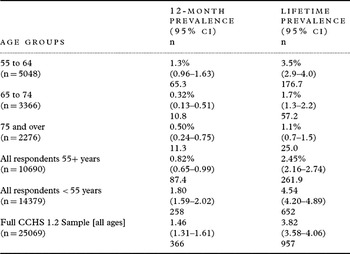
Sample characteristics are presented in Table 1. Twelve-month and lifetime prevalence estimates among adults 55 and older were 0.82% (95% CI = 0.65–0.99) and 2.45% (95% CI = 2.16–2.74) respectively (Table 2) and 23% of respondents with PD reported onset after the age of 55. Comorbid mood and anxiety disorders were common in this population, with 39% of respondents with 12-month panic disorder also meeting criteria for at least one of the other disorders assessed over the same period. Depression was most prevalent, at 27.5% (95% CI = 20.26–42.74), followed by social phobia (19.1%, 95% CI = 9.6–28.6) and agoraphobia (6.2%, 95% CI = 0.4–2.1%).
Sample characteristics (N = 10,690)

Twelve-month and lifetime prevalence estimates of PD in a sample of adults aged 55 and over
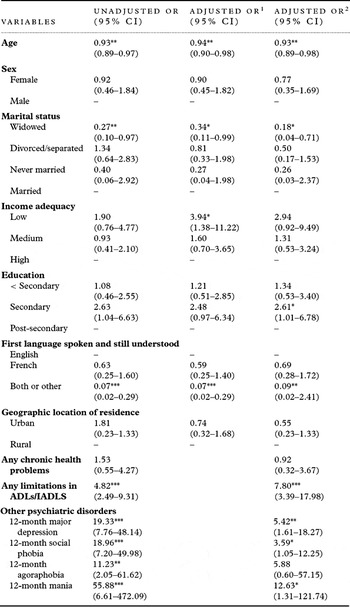
The unadjusted ORs for potential risk markers are presented in the first column of Table 3. The odds of reporting PD decreased with age and were lower among widowed respondents and those speaking either both or neither official language. Adjusted ORs are presented in the second column of Table 3. One notable difference among the adjusted ORs was that low-income respondents reported nearly a four-fold risk of being diagnosed with PD compared to those in the high-income group. When the odds ratios were further adjusted for psychiatric and physical health comorbidity (column 3 in Table 3), we observed strong associations between 12-month PD and 12-month major depression, social phobia, and mania. Reporting any limitations in daily activities was also associated with increased odds of reporting PD, while the effect of chronic health problems was not significant. Following adjustment for other physical and mental health problems in this model, the effect of being in the low-income group was no longer significant, although having a secondary school diploma was significantly associated with an increased risk of PD relative to those in the highest education group. In both the unadjusted and adjusted analyses, gender was not significantly associated with PD in this population.
Unadjusted and Adjusted Logistic Regression of 12-Month Panic Disorder on Risk Markers, Physical Health and Psychiatric Comorbidities in a sample of adults aged 55 and over (N = 10690)

1ORs adjusted for risk markers.
2ORs adjusted for risk markers and psychiatric/physical health co morbidity.
Discussion
With nearly 1% of older adults qualifying for a diagnosis of PD, and its potential to influence mental well-being and role function among older adults, investigation into the distribution of the disorder and its associated risk markers is important. Direct comparison of our findings with other contemporary data is problematic for the reasons outlined in the beginning of the paper. Nonetheless, our 12-month estimate of 0.82% is consistent with DSM-III estimates of between 0.6 and 1.0%. However, our lifetime prevalence estimate of 2.45% was slightly higher than the 2% for this same time period reported by Kessler et al. (Reference Kessler, Wai Tat Chiu, Demler and Walters2005) using DSM-IV criteria for adults aged 60 years and older. Since the measure used to assess PD in this sample is the same as that employed by Kessler and his colleagues, it is doubtful that the difference in lifetime prevalence is the result of measurement. Whether our higher estimate is due to differences between populations requires further investigation.
With respect to risk markers associated with PD, consistent with previous work, we found that younger respondents were more likely to report PD (Regier et al., Reference Regier1988). In contrast to previous work with samples of older adults (Myers et al., Reference Myers1984; Bland et al., Reference Bland, Newman and Orn1988a), however, the prevalence of PD was not higher among women than men. It is noteworthy that one study (Bland et al., Reference Bland, Newman and Orn1988a) that did find a higher prevalence of PD among older women did not include a test of the statistical significance of this difference. Gender differences have been reported more consistently among young adults (Carlbring et al., Reference Carlbring, Gustafsson, Ekselius and Andersson2002), however; it may be that these diminish with age. While low income was associated with a four-fold increase in likelihood of PD in Model 2, this effect was reduced and became non-significant when comorbid psychiatric conditions were included. This suggests that low income is a risk marker for multiple psychiatric disorders, and that this effect partially mediates its association with PD specifically.
Relative to those currently married, widowed respondents had a lower likelihood of PD, while differences for single and separated or divorced respondents were not significant. This finding is somewhat difficult to interpret given the lack of comparative data with this age group. In the general population, rates for most lifetime disorders are highest among widowed and separated or divorced respondents (e.g. Bland et al., Reference Bland, Newman and Orn1988b). It is possible that elderly widowed individuals with PD are more likely than their married counterparts to be institutionalized or selected out of the sample. The disorder is associated with substantial impairment, and respondents with PD may be less likely than others to adapt successfully to life without a spouse, particularly considering the substantial impairment associated with the condition. Since few studies have considered marital status as a risk marker for PD in this population, replication of this finding with other data is necessary.
As we have noted, our results indicate that the prevalence of both current (12-month) and lifetime PD declines with increasing age, and here we discuss potential explanations for both prevalence periods in turn. That 12-month estimates are lower in older age groups is consistent with results reported in a number of community surveys dating back at least to the Epidemiologic Catchment Area (ECA) studies of 1980s (Myers et al., Reference Myers1984; Regier et al., Reference Regier1988). These results have been the subject of considerable debate (e.g. Hybels and Blazer, 2000). A cohort effect was initially favored – it was argued that, perhaps because of exposure to unique historical life experiences such as World War II and the Great Depression, the older generation of that time had developed superior coping skills and consequently enjoyed superior mental health (a position arguably not entirely consistent with what was known or suspected about the effects of traumatic events at the individual level). However, since age effects in CCHS 1.2 (Streiner et al., Reference Streiner, Cairney and Veldhuizen2006) and in the recently released NCS-R data (Kessler et al., Reference Kessler, Wai Tat Chiu, Demler and Walters2005) are quite similar to those reported in the ECA, despite the intervening 30 years, it appears that a cohort effect is less likely to be responsible.
Other possible explanations include differences in respondent recall, selection effects due to institutionalization and premature mortality, as well as biological explanations for a genuine decrease in the occurrence of panic attacks with age. Although the failure to recall the occurrence of panic attacks over the recent 12-month period is possible, it is a less compelling explanation given the intensely unpleasant nature of a panic attack and the relatively short recall period. While older adults with PD may be more likely to be institutionalized, and thus not represented in community samples, large numbers of older adults would have to be institutionalized for selection effects to account for the prevalence differences in age. Premature mortality is yet another potential explanation. In particular, PD is associated with cardiovascular events (Alvarenga et al., Reference Alvarenga, Richards, Lambert and Esler2006), and longitudinal studies have indicated that PD is a precursor for cardio-vascular disease, thus reducing the expected lifespan for older adults with PD (Coryell et al., Reference Coryell, Noyes and House1986; Kawachi et al., Reference Kawachi1994). However, mortality would have to be very high among individuals with PD for this to fully account for the observed decline in prevalence. Finally, biological explanations offer some support for the view that lower prevalence among older adults is due to increased remission or lower incidence. Previous work has demonstrated age-related changes in neurotransmitter system structure and function, which could contribute to the lower rates of panic in older populations. For example, Flint et al. (Reference Flint, Koszycki, Vaccarino, Cadieux, Boulenger and Bradwejn1998) compared the behavioral and cardiovascular effects of a panicogenic agent (CCK-4) in a young and older group of adults (20–35 years and 65 + years) in a double-blind, placebo controlled design. Among the participants who received the CCK-4, the older adults reported significantly fewer symptoms, lower intensity, and shorter duration of symptoms. There were no differences across the age groups among those participants who received the placebo saline solution. It is likely that several of the factors discussed contribute to some degree, and determining the contribution of each will require careful analysis of longitudinal data, with detailed event histories (Flint et al., Reference Flint, Cook and Rabins1996; Krasucki et al., Reference Krasucki, Howard and Mann1998).
With respect to the observed declines in the lifetime prevalence of PD across successively older age groups, it is likely that recall bias and selection effects are operative here as well. For respondents who experienced panic attacks much earlier in life, accurate recall of the frequency and intensity of these events may be problematic, especially among the oldest in the sample. It may also be the case, however, that we observed lower lifetime prevalence estimates with age because older individuals with a history of PD are simply less likely to be in the sample, either because of institutionalization or because of premature mortality.
As expected, the risk for PD was higher among respondents who also reported depression, social phobia and mania. In particular, the high rate of comorbidity between PD and major depression (27.5%) is noteworthy and consistent with previous work (Beekman et al., Reference Beekman, de Beurs, van Balkom, Deeg, van Dyck and Tilburg2000). This finding underlines the importance of assessing patients for comorbid disorders. It may be particularly useful to screen for PD in older patients who present with depression, since the latter condition may be more readily detected in this population. Moreover, we found more late-onset (after age 55) cases in this study than is generally reported (Flint, Reference Flint1994), although the estimate is still quite low (23%). Late-onset is also commonly associated with depression or medical illness (Flint and Rifat, Reference Flint and Rifat1997), further reinforcing the need to screen for PD in patients who present with depression and/or serious chronic health problems. Finally, it is interesting that PD was not significantly associated with agoraphobia in this sample. Typically, PD is thought to be a precursor to agoraphobia. The low prevalence of agoraphobia in these data (McCabe et al., Reference McCabe, Cairney, Veldhuizen, Herrmann and Streiner2006), however, suggests that the association between PD and agoraphobia may be more complex in old age.
Limitations
There are a number of limitations with the present study that merit consideration. Since information was collected from respondents at only one point in time, we cannot establish precedence of risk markers and PD. Data collection also relied on self-report and used lay interviewers to conduct the structured diagnostic interview. Finally, information on some prevalent psychiatric disorders, such as generalized anxiety disorder and dysthymia, was not collected.
It is also important to note that older adults who were included in the survey were all community-dwelling respondents. It may be that older adults with mental health problems are more likely to be institutionalized or less likely to respond to a national survey, thereby underestimating the true prevalence of PD. Moreover, despite our large sample size, the number of respondents classified as having PD was small and this limited our ability to identify significant sociodemographic risk markers. Finally, since the survey was only able to distinguish symptoms caused by a medical illness from panic attacks through self-report, it is possible that physical health (e.g. thyroid, cardiac or hypoglycaemic) complications may have been mistakenly classified as panic attacks or conversely, that the manifestation of certain chronic illnesses may have masked the recognition of panic attacks in the medical encounter.
Despite these limitations, this is the only study to our knowledge that provides contemporary 12-month and lifetime prevalence estimates of PD in a representative sample of community-dwelling older adults and which examines sociodemographic risk markers and patterns of comorbidity associated with PD in this population.
Conflict of interest
None.
Description of authors’ roles
L. M. Corna was responsible for the design of the paper, the analysis and the writing of the final manuscript. J. Cairney contributed to the design of the paper and assisted with the writing of the manuscript. N. Herrmann assisted with the interpretation of the results and the writing of the introduction and discussion. S. Veldhuizen assisted with the writing of the introduction and discussion. D. L. Streiner assisted with the interpretation and writing of the results. L. McCabe assisted with the interpretation of the findings and clinical implications.
Acknowledgments
This study was funded by the Canadian Institute for Health Research (CIHR) and a career scientist award (Canada Research Chair in Psychiatric Epidemiology) to Dr. John Cairney.