Introduction
Commercial use of entomopathogenic nematodes since the beginning of the 1980s was possible due to the dynamic development of mass cultures on artificial media. Now, biological products containing nematodes of the genera Steinernema and Heterorhabditis are commonly produced worldwide (Bedding, Reference Bedding1981; Wouts, Reference Wouts1981; Steyn et al., Reference Steyn, Malan and Addison2019).
In nematodes of the family Heterorhabditidae, the first generation is hermaphroditic, and though the next is amphimictic, males and females are not able to copulate in liquid media (Strauch et al., Reference Strauch, Stoessel and Ehlers1994). Optimization of culture conditions in these species should concentrate on the yield of the larvae from the first hermaphroditic generation. Maximization of hermaphroditic individuals in liquid medium is associated with the number of infective juveniles (IJs) that undergo further growth (Jessen et al., Reference Jessen, Strauch, Wyss, Luttman and Ehlers2000). Percentage recovery of these larvae remains near 100% under in vivo conditions (Strauch & Ehlers, Reference Strauch and Ehlers1998), while in liquid media the output from the stage of invasive larvae is unstable and ranges from 0 to 86% (Strauch & Ehlers, Reference Strauch and Ehlers1998, Reference Strauch and Ehlers2000; Jessen et al., Reference Jessen, Strauch, Wyss, Luttman and Ehlers2000; Yoo et al., Reference Yoo, Brown and Gaugler2000; Ehlers, Reference Ehlers2001). Differences in the number of larvae initiating further growth are often found in experiments even at the same culture conditions. Hence, the gaps in our knowledge of the physiological aspects of nematodes and bacteria, and interactions between the two under stress often present in fermenters should clarified (De la Torre, Reference De la Torre2003).
Food signals are not well understood in liquid media, and may play a key role in the initiation of further growth of IJs in liquid habitats (Strauch & Ehlers, Reference Strauch and Ehlers1998; Dunn et al., Reference Dunn, Belur and Malan2000; Hirao & Ehlers, Reference Hirao and Ehlers2009). It was found that Photorhabdus luminescens (Thomas & Poinar, 1979) Boemare, Akhurst & Mourant, 1993 added to liquid medium in bioreactors produce a signal that controls nematode growth and may be excreted as a food signal, stimulating the initiation of further growth of invasive larvae in artificial habitats (Strauch & Ehlers, Reference Strauch and Ehlers1998). Aeration parameters may additionally affect this process (Strauch & Ehlers, Reference Strauch and Ehlers2000).
The objective of this study was to determine the effect of agitation on the population dynamics of Heterorhabditis megidis, as well as the growth characteristics of the associated symbiotic bacterium P. luminescens, followed throughout its culture period.
Materials and methods
Nematode strain and growth medium
Monoxenic cultures (Lunau et al., Reference Lunau, Stoessel, Schmidt-Peisker and Ehlers1993) of the nematode H. megidis strain KV – 136 were obtained from Koppert Biological Systems B.V. (Holland), and delivered in a tissue culture flask with Wouts agar, transported on ice in insulated shipping boxes.
For the nematode liquid culture, a growth medium was prepared from 3 g of nematode medium from Koppert Biological Systems B.V. (Holland), 3 ml of corn oil and 75 ml of distilled water, and was sterilized by autoclaving. Bacteria P. luminescens isolated from the NBTA medium (37 g of nutrient agar, 25 mg of bromothymol blue, 1,000 ml of distilled water, 4 ml of 1% 2,3,5 – triphenyltetrazolium chloride) and identified as pure phase I were also received from Koppert Biological Systems B.V.
Microbiological substrates
The following substrates were used for the cultivation and proliferation of the bacteria in the experiments:
• For liquid cultures: YSE (0.5 g yeast extract, 0.5 g ammonium dihydrogen phosphate, 0.5 g dipotassium phosphate, 0.2 g of magnesium sulphate heptahydrate; 5 g of sodium chloride, 1.0 g of lecithin, 5.0 g of vegetable oil, 1000 ml distilled water).
• Solid medium for colony-forming unit (CFU) count: NBTA medium (37 g of nutrient agar, 25 mg of bromothymol blue, 1,000 ml of distilled water, 4 ml of 1% 2,3,5 – triphenyltetrazolium chloride) for the culture of bacteria P. luminescens. Petri dishes (diameter 90 mm) with NBTA medium were used in the examination of the number of bacteria CFUs.
Methods
Symbiotic bacteria were stored in vials, in 25% (v/v) glycerol at −72°C and used to inoculate 250 ml YSE medium in an Erlenmeyer 500-ml flask. The cultures were then incubated in a shaker (25°C, 121 rpm, in the dark). After 24 h, 75 ml of the bacterial culture were added to the tissue culture flask with monoxenic culture of nematodes and shaken to dissolve the solid medium with the nematodes. Next, the content was transferred to a 500-ml Erlenmeyer flask with 78 ml medium for the nematode culture. After thorough mixing, 25 ml of the suspension was added to 300-ml Erlenmeyer flasks with 78 ml medium for the nematode culture – these suspensions were used for the experiments.
Parameters used in the experiments
Throughout the experiments, the following parameters were constant: (1) the dose of nematodes introduced to culture (2300 IJs/ml), (2) the temperature (25°C) and (3) the number of bacteria CFUs used for inoculation (0.3 × 10⁷/ml). The variable parameter was the agitation speed expressed in revolutions of the shaker (160 rpm and 200 rpm). For the control cultures, Wouts agar without nematodes was used and inoculated with the bacteria as described below. Bacteria (0.3 × 10⁷/ml) were introduced to cultures (and control samples) on day ‘0’. Erlenmeyer 300-ml flasks with nematode cultures and control were placed in a water bath shaker (Elan, type 357, JW Electronic (Warsaw, Poland)). Three flasks with entomopathogenic nematodes and two with control were used on two shakers (160 rpm, 200 rpm). The experiment lasted 26 days, and was replicated twice.
The dynamics of H. megidis populations were assessed by estimating their number and growth stages alternately every third and second day (i.e. on days 3, 5, 8, 10, 13, 15, 18, 21, 23 and 26). The method of successive dilutions was used to determine the number and developmental stages of nematodes. Then, 0.1 ml of the diluted culture was spotted on a glass slide and nematodes were counted; developmental stages were also determined with a microscope Reichert (Vienna, Austria), magnification 100×). In each of the samples there were 20 repetitions. Recovery of inoculated IJs was assessed by counting IJs that recovered and developed beyond the IJ stage, which included the number of hermaphrodites.
The dynamics of the bacteria of P. luminescens populations were assessed in samples from days 5, 10, 15, 21, and 26 of the culture.
The number of viable bacterial cells (CFUs) was determined by standard Koch's dilution method on the cast plates (0.1 ml of diluted culture on NBTA medium, 90 mm Petri dishes). The plates were incubated at 25°C for 3–5 days, then the colonies were counted (three repetitions for each dilution). The bacteria phases were identified in Petri dishes on NBTA medium, based on the morphology of colonies.
Based on the colony count, the number of CFUs was calculated as follows:

where b is the number of colonies in the Petri dish and 10z is the dilution coefficient.
Statistical analyses
The results were statistically analysed using STATISTICA 9.0 (data analysis software system, version 13.5.0.17; TIBCO Software Inc., Palo Alto, California, USA). The effect of agitation speed on the dynamic of nematode population, and on a pure culture of bacteria, were calculated using the non-parametric Mann–Whitney U-test and one-way analysis of variance.
Results
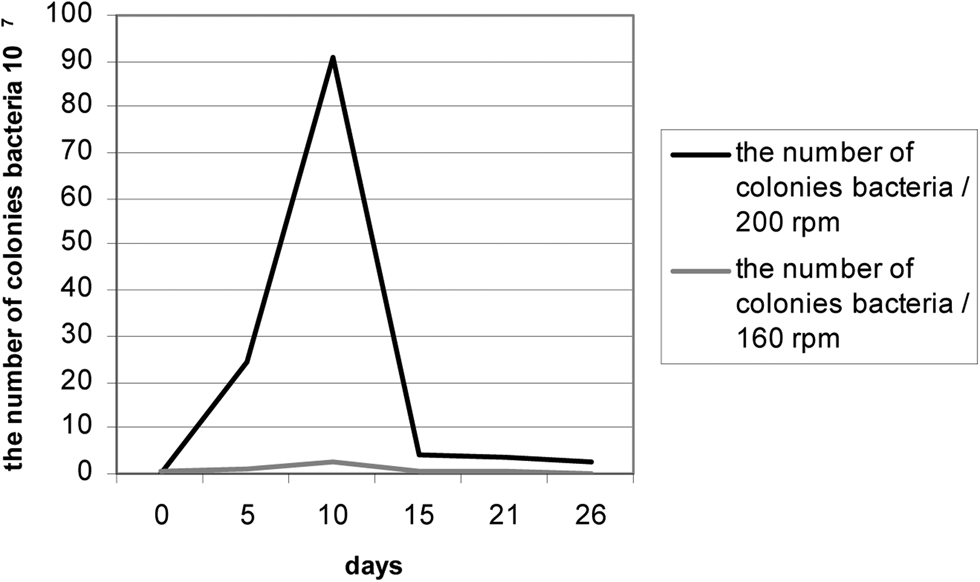
Agitation speed significantly (P < 0.05) affected the density of bacteria in pure cultures of P. luminescens (fig. 1). In all cultures, the number of CFUs on day 0 was 0.3 × 10⁷/ml. When the cultures were at an agitation speed of 200 rpm, the number of bacteria rapidly increased to 24.14 × 10⁷/ml CFUs on day 5. On the tenth day, the number of CFUs achieved a maximum of 90.64 × 10⁷/ml. From the 15th day, the number of CFUs gradually decreased but still remained high >2.50 × 10⁷/ml. Bacterial growth at an agitation speed of 160 rpm was smoother. The number of CFUs on day 5 was 1.2 × 10⁷/ml. On the tenth day, the number of CFUs achieved a maximum of 2.5 × 10⁷/ml. From the 15th day of the culture, the number of CFUs gradually decreased and reached 0.2 × 10⁷/ml on the last day of the experiment.
The growth of colonies of P. luminescens.

Correlation between the growth of H. megidis (strain KV – 136) and the density of bacteria P. luminescens
The statistical analysis did not show any correlation between the speed of agitation and the number of hermaphrodites (P = 0.541, F = 0.430) or on the number of males (P = 0.547, F = 0.395). However, the impact of agitation speed on the number of females (P = 0.031, F = 5.95) and the bacterial density in the nematode cultures (P = 0.023, F = 7.192) was statistically significant.
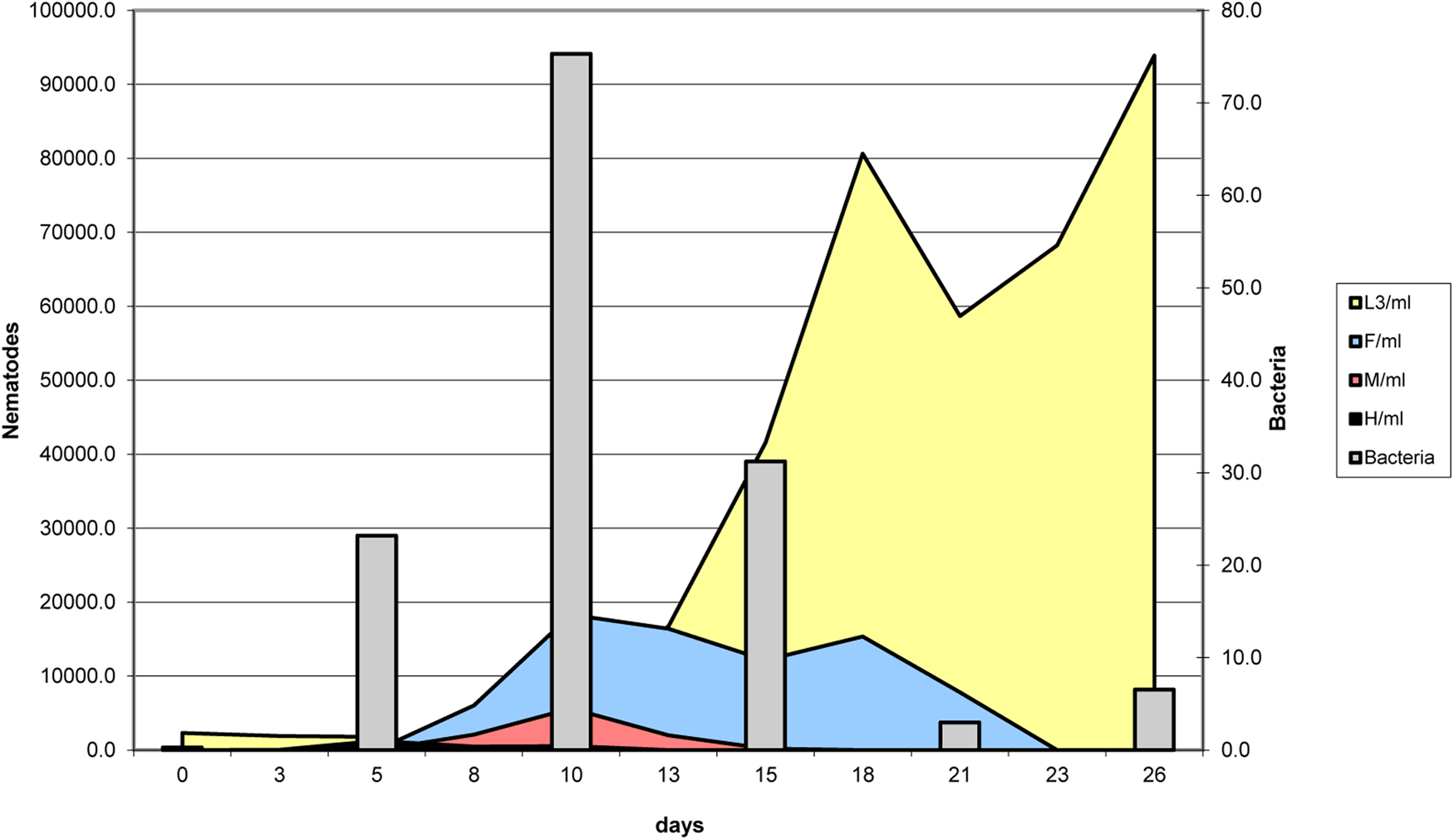
At an agitation speed of 200 rpm, the first hermaphroditic (H) individuals appeared on the third day of the culture. They attained the maximum number of 1.239 H/ml on day 5 (recovery 53.7%). On the same day, the number of CFUs was high and equal to 23.2 × 10⁷/ml. The number of CFUs was highest on the tenth day (75.32 × 10⁷/ml) and then decreased to 6.54 × 10⁷/ml on day 26. Females were first observed around the sixth day; their maximum number (7.819 F/ml) was noted on the tenth day. Males (M) first appeared on day 7 and achieved the maximum number of 5.626 M/ml on the tenth day (fig. 2).
The dynamics of population growth of H. megidis (strain KV – 136) in liquid medium (parameters of the culture: 200 rpm, 25°C, 2300 IJs/ml).

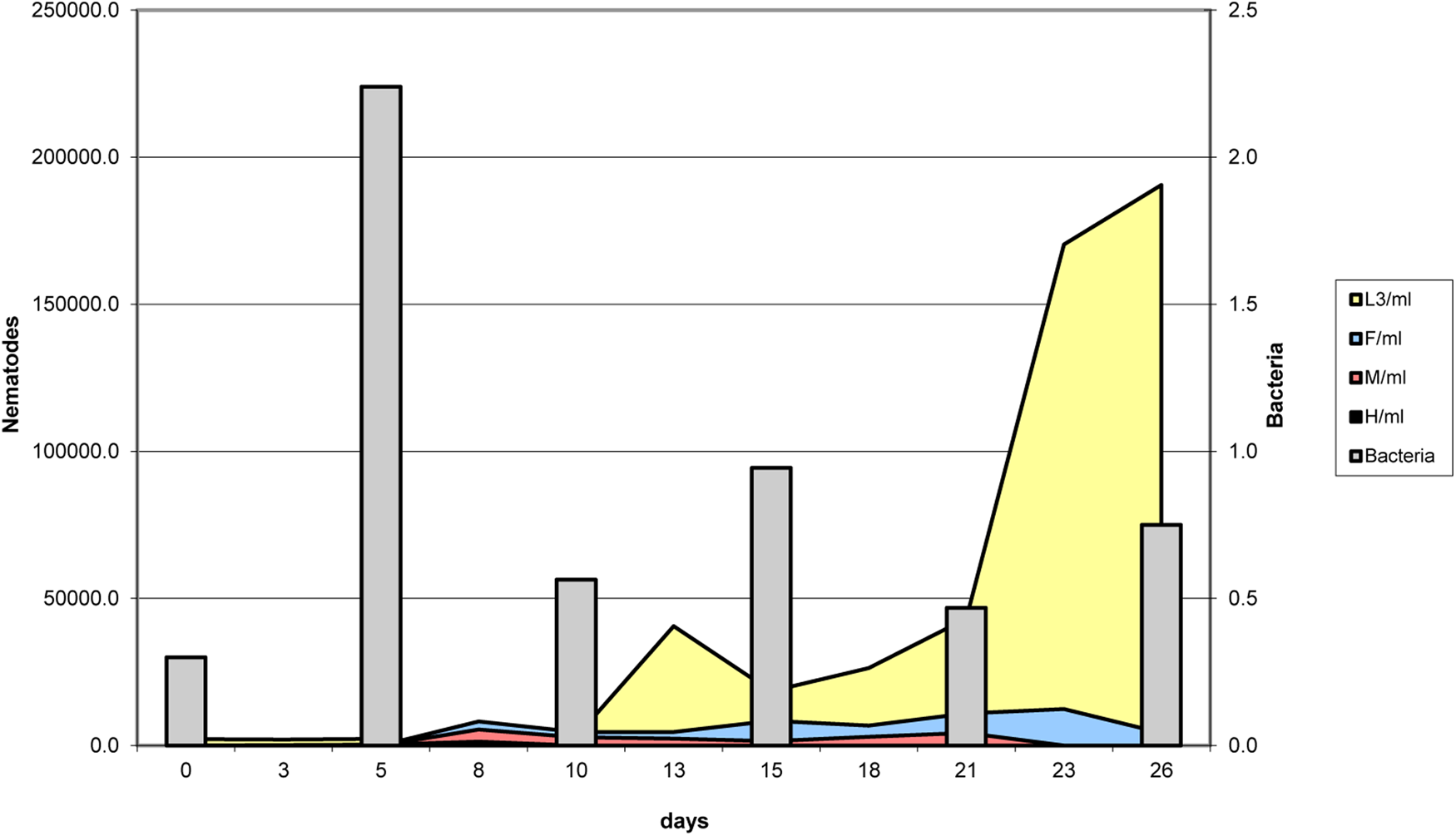
At an agitation speed of 160 rpm, the first hermaphroditic individuals appeared on the third day and achieved a maximum number of 1.306 H/ml on the eighth day of the culture (recovery 61.1%). Three days before (day 5), the number of CFUs was highest and equal to 2.24 × 10⁷/ml. Subsequently, the number of CFUs gradually decreased to 0.75 × 10⁷/ml on the 26th day. The first females were observed on the eighth day and their maximum number of 12.393 F/ml was noted on day 23. Similarly, males first appeared on day 8 and on the same day they reached a maximum density of 5.433 M/ml (fig. 3).
The dynamics of population growth of H. megidis (strain KV – 136) in liquid medium (parameters of the culture: 160 rpm, 25°C, 2300 IJs/ml).

Discussion
The main reason for failures in culturing H. megidis in liquid media is the unstable recovery of IJs and no possibility to control population dynamics, the resultant of which is a highly variable final yield of IJs. Detailed knowledge of the biology of this species, understanding the relationships between bacteria and nematodes, and the effects of physical parameters are needed to recognize critical moments in the culture to improve its final yield (Ehlers, Reference Ehlers2000). To improve the culture dynamics of H. megidis, one should obtain synchronized growth and an optimum number of hermaphroditic individuals (Ehlers, Reference Ehlers2000).
The results of our study showed that agitation speed is a parameter which accelerates the appearance of hermaphrodites in cultures. Ehlers & Hokkanen (Reference Ehlers and Hokkanen1996) noted the first appearance of hermaphroditic individuals on the sixth day of the process. In our cultures, at an agitation speed of 200 rpm, the first hermaphrodites appeared as soon as on the third day, and their maximum number was found on the fifth day. In cultures at an agitation speed of 160 rpm, the first appearance of these individuals was also noted on the third day, but their maximum number was achieved on the eighth day of the culture. Ferreira et al. (Reference Ferreira, Addison and Malan2014) tested Heterorhabditis zealandica Poinar, 1990 at an agitation speed of 180 rpm and also observed the development of hermaphrodites on day 3. However, females were developing from day 6 and males from day 7, similar to this study at 200 rpm. Some differences were noted in the number and the time of appearance of hermaphroditic individuals when the effect of bacterial density on the dynamics of nematode populations was analysed. Growth rate and the density of bacteria are two of the factors affecting the dynamics of nematode population in liquid culture. Being a source of food, bacteria may control nematode growth in such culture (Ehlers et al., Reference Ehlers, Lunau, Krasomil-Osterfeld and Osterfeld1998; Gaugler & Han, Reference Gaugler, Han and Gaugler2002). The performed studies demonstrated that a rapid increase in bacterial density significantly affected the dynamics of nematode population. Our experiments showed that the maximum increase of bacterial density at 160 rpm and the first increase of bacterial abundance at 200 rpm coincided with the day of the first appearance of hermaphrodites or with the day of maximum increase in the number of these individuals. Similar observations may be found in papers by Ehlers et al. (Reference Ehlers, Lunau, Krasomil-Osterfeld and Osterfeld1998) and Strauch et al. (Reference Strauch, Stoessel and Ehlers1994).
This study shows a high recovery of IJs (61.1% at 160 rpm on day 8, and 53.7% at 200 rpm on day 5), which is comparable with the recovery reported by Ehlers et al. (Reference Ehlers, Lunau, Krasomil-Osterfeld and Osterfeld1998) – from 55% to 74% (on days 5 and 8, respectively; inoculum 2700 IJs/ml). On the contrary, Ferreira et al. (Reference Ferreira, Addison and Malan2014) reported a relatively low recovery of 24% on day 5.
This study shows a clear difference in the dynamics of bacterial density in the cultures depending on the agitation speed parameters; however, in both settings the percentage of recovery is comparable. One of the factors impacting recovery might be the inoculum of the nematodes, which is supported by the result obtained by Ehlers et al. (Reference Ehlers, Lunau, Krasomil-Osterfeld and Osterfeld1998); under the same culture conditions, using variable dosages of inoculum, Ehlers et al. (Reference Ehlers, Lunau, Krasomil-Osterfeld and Osterfeld1998) observed different recovery levels, with the increased inoculum dosage of 3300 IJs/ml resulting in a decreased recovery at 23%.
A number of other potentially undermining factors can impact on the stress of population of nematodes in liquid culture. Culture broth rheological properties, viscosity and shearing were evaluated by Chavarría-Hernández et al. (Reference Chavarría-Hernández, Rodríguez-Hernández, Pérez-Guevara and de la Torre2003) in a nematode–bacterium complex culture. It was found that the death of second-generation adult nematodes and subsequent corpse destruction, and change in biomass concentration, appeared to be significant in defining the rheological properties of culture broths. Among the different developmental stages of nematodes, the authors noted that only juveniles at the first stage (J1) were highly susceptible to the shearing conditions, resulting in a viability loss of 85%.
In addition, changes in fluid mechanics and resistance can cause hydrodynamic-related entomopathogenic nematode damage, as described by Fife et al. (Reference Fife, Derksen, Ozkan, Grewal, Chalmers and Krause2004). In this case, a specific type of damage was occurring in investigated nematode species related to different elasticity of the structural membrane during the process of stretching and relaxation.
An important factor is food abundance under in vivo conditions induces individuals of the first generation to produce amphimictic generation; smaller amount of food is a signal that triggers the IJs of the first generation to again develop into hermaphroditic individuals (Ehlers, Reference Ehlers2000). The study by Johnikg & Ehlers (Reference Johnikg and Ehlers1999) looked at the nematode population dynamics in liquid cultures over the period of 210 h. The authors concluded that 57.6% of eggs developed into amphimictic generation and 42.4% of eggs progressed to IJs, from which second-generation hermaphrodites can develop. Performed experiments revealed similar tendencies. In cultures of the lower bacterial densities (160 rpm), mass appearance of IJ larvae (from the first generation of hermaphroditic individuals) was observed between the 13th and 15th day. Two days later, bacterial density decreased to a low level of 0.8 × 10⁷ CFUs/ml, but food conditions enabled further growth and induced some of the IJs to develop into hermaphroditic individuals of the second generation. An observed increase in the numbers of individuals of amphimictic and hermaphroditic generation on days 18–23 (at low food availability) and a rapid increase in the number of IJ larvae on days 23–26 suggests that the final yield was IJs obtained from hermaphrodites of the first and second generation. Strauch et al. (Reference Strauch, Stoessel and Ehlers1994) indicated that the appearance of hermaphrodites of the second generation was usually observed two days after the appearance of females. Based on the performed experiments, we may conclude that the second moment of mass appearance of IJs was caused by hermaphroditic individuals of the second generation.
A recently published review by Cortés-Martínez & Chavarría-Hernández (Reference Cortés-Martínez and Chavarría-Hernández2020) discusses the impact of physical variables on intricate solid–liquid–gas systems. These impact on the production of entomopathogenic nematodes as well as bacteria–nematode complexes. Both are vulnerable to stress injuries caused by poorly understood physical mechanisms. Appropriate liquid media composition for the co-growth of the bacteria–nematode complex is vital. This also includes aeration rate, agitation, percentage of dissolved oxygen and rheological properties of the culture medium.
In this paper, we have addressed the call for an increased understanding of liquid media conditions and agitation, specifically leading towards progress in the successful mass production of entomopathogenic nematodes.
The following conclusions can be made:
(1) More intensive agitation speed (200 rpm) favourably affected the density of bacteria of P. luminescens (24.14 × 10⁷/ml).
(2) Differences in the density of the bacteria population did not impact the percentage of recovery.
(3) Substantial increase of bacterial density at more intensive agitation speed was the reason for earlier appearance (on the fifth day of experiment) of the maximum number of the hermaphrodites (1.239 H/ml) in liquid cultures.
Financial support
This study was funded by the Warsaw University of Life Sciences in Poland. The research was financed from own sources of SGGW.
Conflicts of interest
None.
Ethical standards
Not applicable.
Author contributions
Conceptualization, D.T. and A.M.; methodology, D.T.; writing – original draft preparation, D.T., A.M. and I.S.; writing – review and editing, D.T., A.M. All authors have read and agreed to the published version of the manuscript.