




No CrossRef data available.
Article contents
Comparison of the 6-minute walk test with established parameters for assessment of cardiopulmonary capacity in adults with complex congenital cardiac disease
Published online by Cambridge University Press: 13 July 2005
Abstract
Background: Objective assessment of the cardiopulmonary capacity in patients with complex congenital cardiac disease often remains difficult in clinical practice. The cardiopulmonary exercise test and determination of the levels of brain natriuretic peptide in the plasma are established tests, but expensive. The 6-minute walk test is also validated, but has not often been used in patients with heart failure due to congenital heart disease, nor compared with other tests. We sought to compare its value with the results of cardiopulmonary exercise testing and measuring the levels of brain natriuretic peptide in the plasma. Methods: We carried out a standardized 6-minute walk test in 31 patients with complex congenital cardiac disease on the same day that they underwent cardiopulmonary exercise testing and determination of levels of brain natriuretic peptide in the plasma. Of the patients, 7 had functionally univentricular hearts, 9 had transposition, 9 had tetralogy of Fallot, 3 had common arterial trunk, and 3 had pulmonary atresia with intact interventricular septum. Uptakes of oxygen at peak exercise, and at the anaerobic threshold, were determined using cardiopulmonary exercise testing, and classified as suggested by Weber. The 6-minute walk test was performed according to a standard protocol. Results: There was a significant correlation between brain natriuretic peptide, oxygen uptakes at peak exercise and 6-minute walk. The correlation between the 6-minute walk test and oxygen uptakes at the anaerobic threshold, however, was not significant. Conclusions: The 6-minute walk test can be performed easily, is inexpensive, widely available, and correlates well with measurements of brain natriuretic peptide and cardiopulmonary exercise testing, even in patients with corrected or palliated congenital cardiac malformations. A cut-off value of 450 metres in the 6-minute walk test allows a semi-quantitative classification in analogy to the classification suggested by Weber for cardiopulmonary exercise testing, and to a level of brain natriuretic peptide in the plasma of less or more than 100 picograms per millilitre.
Information
- Type
- Original Article
- Information
- Copyright
- © 2005 Cambridge University Press
Due to improvements in surgical techniques, more and more children with complex congenital cardiac malformations survive to adulthood, and experience the sequels of correction. The growth of this population is linear, and rates of mortality, at least in the early adult years, are relatively low.1–3 Limitations in exercise capacity are frequent, and interventions are often necessary during the course of disease. Against the background of increasing economical problems, markers, and tests are needed which are effective in determining both the severity and prognosis of the congenital cardiac malformation in the individual patient. A variety of tests of exercise capacity have been described over the years.
The determination of uptakes of oxygen at peak exercise by cardiopulmonary exercise testing is an established method of evaluating not only exercise capacity, but also prognosis.4–7 Measurement of the brain natriuretic peptide, a neurohormone secreted by cardiac ventricles in response to expansion of volume and pressure overloading, has also been established as a new and reliable laboratory marker of congestive heart failure, with a high sensitivity and specificity for diagnosis of chronic heart failure,8–12 also in patients with right ventricular systolic dysfunction,13 or heart failure due to congenital cardiac malformations.14, 15
The 6-minute walk test is known to be a safe submaximal exercise test.16 It has been validated for patients with congestive heart failure, and for children with primary pulmonary hypertension.17, 18 Like cardiopulmonary exercise testing, the 6-minute walk test permits control of the efficacy of specific treatments, monitoring the course of congestive heart failure, and estimation of the prognosis of the disease.19, 20 Kuster et al.21 were able to show a significant correlation between the level of brain natriuretic peptide in the plasma and the distance achieved using the 6-minute walk test in patients with congestive cardiac failure.
The intention of our study was to evaluate a possible correlation between these different techniques in measuring exercise capacity in adults with complex congenitally malformed hearts.
Patients and methods
Between June 2003 and May 2004, we recruited prospectively 31 selected patients, aged 29.2 plus or minus 11.9 years, and with complex congenital cardiac disease, from a specialist outpatient clinic of the University Hospital of Aachen. Demographic data including functional class, clinical, biochemical, and haematological characteristics, main diagnosis, and postoperative sequels are shown in Table 1. There was no patient with decompensation of heart failure or chronic renal insufficiency, all having levels of creatinine in the serum of less than 2 milligrams per decilitre. All patients were receiving the optimal medical treatment, such as inhibitors of angiotensin-converting enzyme, beta-blockers, diuretics, spironolactone, and digoxin.
Table 1. Clinical characteristics of the subjects studied.

Measurement of levels of brain natriuretic peptide in the plasma
Blood samples were taken within 2 hours before beginning the cardiopulmonary exercise test and the 6-minute walk test, using the rapid test known as Triage BNP, developed by Biosite Diagnostics, San Diego, California. The test22 is an immunofluorometric assay for quantitative determination of brain natriuretic peptide in ethylenediaminetetraacetic acid anticoagulated whole blood or plasma. The cut-off of 100 picograms per millilitre is validated for the diagnosis of congestive heart failure in adults.23
Cardiopulmonary exercise test
We used a standard bicycle exercise protocol. After an unloading phase of 2 minutes, exercise started at 25 watts followed by a ramped protocol with increments of 15 watts per minute. Uptake of oxygen, production of carbon dioxide, and ventilation per minute were measured using a breath-by-breath gas analysis from Jaeger Oxycon Alpha, Würzburg, Germany. 12-lead electrocardiogram was continuously registered, and blood pressure was recorded every minute using a cuff sphygmomanometer. The uptakes of oxygen at peak exercise were determined as the highest value in the terminal phase of exercise. The uptake at the anaerobic threshold was determined by the V-slope method, as developed by Beaver et al.24 We classified the results as proposed by Weber et al.25 (Table 2).
Table 2. Performance within the classification of Weber et al.25

The 6-minute walk test
The 6-minute walk test was performed indoors following a standard protocol along a flat corridor.26 The patients were instructed to walk back and forth along a course of 30 metres as swiftly as possible for a period of 6 minutes. We measured the total distance walked.
Statistics
Values are presented as mean values and standard deviation. Correlation analysis was performed using linear and square correlation. Results are presented as coefficients of correlation. All statistical tests were two-tailed, and p values of less than 0.05 were considered statistically significant. We used the Mann–Whitney U-test for unpaired samples to assess the selectivity for the mean valves of the 6-minute walk distance compared to levels of brain natriuretic peptide and uptakes of oxygen at peak exercise. Data were analysed using SPSS 11.0, as developed by SPSS Incorporated, Chicago, Illinois. The correlation of the semi-quantitative classification between levels of brain natriuretic peptide, uptakes of oxygen at peak exercise, and the 6-minute walk test was performed by Fisher's exact test, using software developed by MedCalc, Mariakerke, Belgium.
Results
All 31 patients underwent both the 6-minute walk test and the cardiopulmonary exercise test without any problems, but only 18 patients were able to reach the anaerobic threshold. There was a significant correlation between distance covered during the 6-minute walk test and levels of brain natriuretic peptide in the plasma and uptakes of oxygen at peak exercise. The linear correlation coefficient was 0.751 for levels of brain natriuretic peptide versus the 6-minute walk test (p less than 0.001), and 0.741 for uptakes of oxygen at peak exercise versus the 6-minute walk test (p less than 0.001). The square correlation coefficient was 0.8 for levels of brain natriuretic peptide versus the 6-minute walk test (p less than 0.001), and 0.86 for uptakes of oxygen at peak exercise versus the 6-minute walk test (p less than 0.001 – Figs 1a and 2a). The correlation between the uptakes of oxygen at the anaerobic threshold and the 6-minute walk test was not significant, with the coefficient equalling 0.318, this being insignificant.

Figure 1. Correlation between levels of brain natriuretic peptide versus the 6-minute walk test (6MWT) (a), and grouped with a cut-off value of 450 metres covered in the 6-minute walk test according to the cut-off for brain natriuretic peptide (BNP) of 100 picograms per millilitres for the diagnoses of congestive heart failure with significances selectivity in the Mann–Whitney U-test (b).

Figure 2. Correlation between uptakes of oxygen at peak exercise versus 6-minute walk test (a), and grouped with a cut-off value of 450 metres in the 6-minute walk test according to the Weber classification (A/B versus C) with significance selectivity in the Mann–Whitney U-test (b).
Using the previously cut-off for levels of brain natriuretic peptide in adults, we divided our patients into groups with levels of the peptide above and below 100 picograms per millilitre. The mean value of the distance covered during the 6-minute test for those with levels greater than 100 picograms per millilitre was 440 plus or minus 108 metres, while those with levels less than 100 picograms per millilitre covered 600 plus or minus 67 metres (Fig. 1b). When making comparison to the standing in the classification of Weber for uptakes of oxygen at peak exercise, those falling into the A and B categories covered a mean distance of 608 plus or minus 72 metres, while those in the C category covered 441 plus or minus 90 metres (Fig. 2b). The Mann–Whitney U-test for unpaired samples of these groupings shows a significant selectivity for the mean distances covered during the 6-minute walk test with both levels of brain natriuretic peptide in the plasma and the uptakes of oxygen at peak exercise (p less than 0.05).
Using Fisher's exact test, our results show a significant correlation for patients with congenital cardiac disease between the cut-off of 450 metres for the distance covered during the 6-minute walk test, the difference between categories A and B as opposed to C in the classification of Weber et al.25 for the cardiopulmonary exercise test, and levels of brain natriuretic peptide in the plasma of less or more than 100 picograms per millilitre (Fig. 3).

Figure 3. Correlation using Fisher's exact test of a semi-quantitative classification with a cut-off value of 450 metres in analogy to the Weber classification in cardiopulmonary exercise test (Weber A/B versus C), and to levels of brain natriuretic peptide (less or more than 100 picograms per millilitre).
Discussion
Patients with congenital heart disease can have heterogeneous malformations, varying from simple holes between the atrial chambers to very complex lesions as seen, for example, in those with the Fontan circulation. The assessment of systemic ventricular function by echocardiography is often difficult in these patients, not least because of the markedly varied anatomical findings. For example, in patients with transposition corrected by atrial redirection, it is the morphologically right ventricle which is the systemic ventricle, and this is known to be difficult to assess.27, 28 Beyond that, it is inadequate to use the quantification of systemic ventricular function in order objectively to assess exercise capacity. On the other hand, determination of the uptakes of oxygen at peak exercise by cardiopulmonary exercise testing does permit objective assessment of the exercise capacity in patients with congenital heart disease, and can be used as a predictor of deterioration of the functional cardiac state.5–7 The cardiopulmonary exercise test is used routinely in adults with congenital heart disease. The test, however, is time-consuming and cost-intensive, requiring sophisticated equipment and specially trained personnel. Furthermore, as shown by our study, a relevant number of patients with congenital heart disease was not able to reach the anaerobic threshold. Of our cohort, 18 patients terminated the exercise test prematurely because of dyspnoea and fatigue.
In addition, handicapped patients, such as many of those with Down's syndrome, cannot perform a bicycle or treadmill exercise test.
Levels of brain natriuretic peptide in the plasma correlate well both with the systemic ventricular function, and expansion of volume or pressure overload of the right ventricle in patients with congenital heart disease.13, 14 Elevated levels of the peptide have been established as a marker of diagnosis, and as a predictor of prognosis in patients with chronic heart failure, being shown to have high sensitivity and specificity.10, 12, 21 A significant correlation has been shown between levels of brain natriuretic peptide in the plasma and uptakes of oxygen at peak exercise, both for patients with congestive heart failure and for those with congenital heart disease.8, 14 It is difficult, however, only to monitor the levels of the peptide in the plasma, because a wide variation of levels is reported in patients with symptomatic heart failure. It should also be remembered that levels of the peptide rise with age, and are affected by gender, comorbidity, and drug therapy.29
In contrast, the 6-minute walk test can easily be performed, is very cost-effective, and has been validated in patients with congestive heart failure.30, 31 Also, handicapped patients, who cannot be tested with standard maximal bicycle or treadmill exercise tests, can perform the 6-minute walk test. It is considered safe because the patients will be self-limited.17 Furthermore, distances covered during the test show good reproducibility in patients with congestive heart failure.30–32 We have now demonstrated a significant correlation between the distance covered during the 6-minute walk test and both levels of brain natriuretic peptide in the plasma and uptakes of oxygen at peak exercise during cardiopulmonary exercise testing in adults with complex congenital cardiac disease.
In addition, the distance covered during the 6-minute walk test was shown to be an excellent independent predictor of morbidity and mortality after 1 year in older patients with congestive heart failure.19 In these patients, an estimation of the prognosis of mortality is provided by using a cut-off of less than 300 metres covered as opposed to greater than 450 metres.20 In similar fashion, our data showed that a cut-off of 450 metres covered provided a semi-quantitative classification comparable to Grade C in the classification of Weber et al.,25 and to a level of 100 picograms per millilitre of brain natriuretic peptide in the plasma. Studies using larger numbers of these patients should examine if an estimation of morbidity or mortality can be established for patients with congenital heart disease using this cut-off.
We conclude that the 6-minute walk test can be performed easily, is inexpensive, widely available, and correlates well with levels of brain natriuretic peptide in the plasma and cardiopulmonary exercise testing even in patients with repaired or unrepaired congenital cardiac malformations. Using the cut-off of 450 metres distance covered during the test provided a semi-quantitative classification comparable to the classification developed by Weber et al.25 for use in cardiopulmonary exercise testing, and to levels of brain natriuretic peptide in the plasma.
References
Bolger A, Coats A, Gatzoulis M. Congenital heart disease: the original heart failure syndrome. Eur Heart J 2003; 24: 970–976.Google Scholar
Brickner ME, Hillis LD, Lange RA. Congenital heart disease in adults. First of two parts. N Engl J Med 2000; 342: 256–263.Google Scholar
Webb CL, Jenkins KJ, Karpawich PP, et al. Collaborative care for adults with congenital heart disease. Circulation 2002; 105: 2318–2323.Google Scholar
Fredriksen PM, Chen A, Veldtman G, Hechter S, Therrien J, Webb G. Exercise capacity in adult patients with congenitally corrected transposition of the great arteries. Heart 2001; 85: 191–195.Google Scholar
Fredriksen P, Veldtman G, Hechter S, et al. Aerobic capacity in adults with various congenital heart diseases. Am J Cardiol 2001; 87: 310–314.Google Scholar
Fritsch J, Winter U, Kaemmerer H, Hilger H. Cardiopulmonary capacity of patients with congenital heart defects in childhood, adolescence and adulthood. Z Kardiol 1994; 83: 131–139.Google Scholar
Hechter S, Webb G, Fredriksen P, et al. Cardiopulmonary exercise performance in adult survivors of Mustard procedure. Cardiol Young 2001; 11: 407–414.Google Scholar
Kruger S, Graf J, Kunz D, Stickel T, Hanrath P, Janssens U. Brain natriuretic peptide levels predict functional capacity in patients with chronic heart failure. J Am Coll Cardiol 2002; 40: 718.Google Scholar
Kruger S, Hoffmann R, Graf J, Janssens U, Hanrath P. Brain natriuretic peptide: Diagnostische und prognostische Bedeutung bei chronischer Herzinsuffizienz. Med Klin 2003; 98: 562–567.Google Scholar
Mulders F, Kromer E, Griese D, et al. Evaluation of plasma natriuretic peptides as markers for left ventricular dysfunction. Am Heart J 2004; 134: 442–449.Google Scholar
Sinha A, Filzmaier K, Breithardt O, et al. Usefulness of brain natriuretic peptide release as a surrogate marker of the efficacy of long-term cardiac resynchronization therapy in patient with heart failure. Am J Cardiol 2003; 91: 755–758.Google Scholar
Tsutamoto T, Wada A, Madea K. Plasma brain natriuretic peptide level as a biochemical marker of morbidity and mortality in patients with asymptomatic or minimally symptomatic left ventricular dysfunction – comparison with plasma angiotensin II and endothelin-1. Eur J Echocardiogr 1999; 20: 1799–1807.Google Scholar
Tulevski I, Groenink M, van der Wall E, et al. Increased brain and atrial natriuretic peptides in patients with chronic right ventricular pressure overload: correlation between plasma neurohormones and right ventricular dysfunction. Heart 2001; 86: 27–30.Google Scholar
Bolger AP, Sharma R, Li W, et al. Neurohormonal activation and the chronic heart failure syndrome in adults with congenital heart disease. Circulation 2002; 106: 92–99.Google Scholar
Hjortdal VE, Stenbog EV, Ravn HB, et al. Neurohormonal activation late after cavopulmonary connection. Heart 2000; 83: 439–443.Google Scholar
Solway S, Brooks D, Lacasse Y, Thomas S. A qualitative systematic overview of the measurement properties of functional walk tests used in the cardiorespiratory domain. Chest 2001; 119: 256–270.Google Scholar
Garofano R, Barst R. Exercise testing in children with primary pulmonary hypertension. Pediatr Cardiol 1999; 20: 61–64.Google Scholar
Bittner V, Weiner DH, Yusuf S, et al. Prediction of mortality and morbidity with a 6-minute walk test in patients with left ventricular dysfunction. SOLVD Investigators. JAMA 1993; 270: 1702–1707.Google Scholar
Haass M, Zugck C, Kübler W. The 6 minute walk test: a cost effective alternative to cardiopulmonary exercise testing in patients with congestive heart failure? Z Kardiol 2000; 89: 72–80.Google Scholar
Kuster G, Tanner H, Printzen G, Suter T, Mohacsi P, Hess O. B-type natriuretic peptide for diagnosis and treatment of congestive heart failure. Schweiz Med Wochenschr 2003; 133: 623–628.Google Scholar
Fischer Y, Filzmaier K, Stiegler S. Evaluation of a new rapid bedside test for quantitative determination of B-type natriuretic peptide. Clin Chem 2001; 47: 591–594.Google Scholar
Logeart D, Saudubray C, Beyne P, et al. Comparative value of Doppler echocardiography and B-type natriuretic peptide assay in the etiologic diagnosis of acute dyspnea. J Am Coll Cardiol 2002; 40: 1794–1800.Google Scholar
Beaver W, Wassermann K, Whipp B. A new method for detecting anaerobic threshold by gas exchange. J Appl Physiol 1986; 60: 2020–2027.Google Scholar
Weber K, Janicki J, McElroy P. Determination of aerobic capacity and the severity of chronic cardiac and circulatory failure. Circulation 1987; 76: VI40–VI45.Google Scholar
ATS Statement: Guidelines for the six-minute walk test. Am J Respir Crit Care Med 2002; 166: 111–117.
Helbing WA, Bosch HG, Maliepaard C, et al. Comparison of echocardiographic methods with magnetic resonance imaging for assessment of right ventricular function in children. Am J Cardiol 1995; 76: 589–594.Google Scholar
Wilson NJ, Neutze JM, Rutland MD, Ramage MC. Transthoracic echocardiography for right ventricular function late after the Mustard operation. Am Heart J 1996; 131: 360–367.Google Scholar
Cowie MR, Jourdain P, Maisel A, et al. Clinical applications of B-type natriuretic peptide (BNP) testing. Eur Heart J 2003; 24: 1710–1718.Google Scholar
Guyatt GH, Sullivan MJ, Thompson PJ, et al. The 6-minute walk: a new measure of exercise capacity in patients with chronic heart failure. Can Med Assoc J 1985; 132: 919–923.Google Scholar
Zugck C, Kruger C, Durr S, et al. Is the 6-minute walk test a reliable substitute for peak oxygen uptake in patients with dilated cardiomyopathy? Eur Heart J 2000; 21: 540–549.Google Scholar
Pinna DG, Opasich C, Mazza A, Tangenti A, Maestri R, Sanarico M. Reproducibility of the six-minute walking test in chronic heart failure patients. Stat Med 2000; 19: 3087–3094.Google Scholar
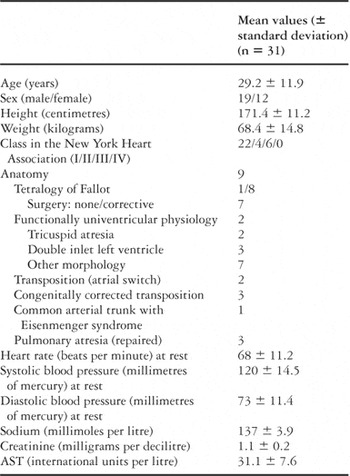
Table 1.
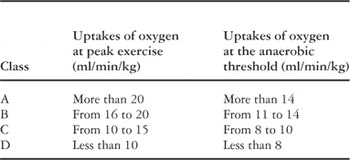
Table 2.

Correlation between levels of brain natriuretic peptide versus the 6-minute walk test (6MWT) (a), and grouped with a cut-off value of 450 metres covered in the 6-minute walk test according to the cut-off for brain natriuretic peptide (BNP) of 100 picograms per millilitres for the diagnoses of congestive heart failure with significances selectivity in the Mann–Whitney U-test (b).

Correlation between uptakes of oxygen at peak exercise versus 6-minute walk test (a), and grouped with a cut-off value of 450 metres in the 6-minute walk test according to the Weber classification (A/B versus C) with significance selectivity in the Mann–Whitney U-test (b).

Correlation using Fisher's exact test of a semi-quantitative classification with a cut-off value of 450 metres in analogy to the Weber classification in cardiopulmonary exercise test (Weber A/B versus C), and to levels of brain natriuretic peptide (less or more than 100 picograms per millilitre).
 You have
Access
- 22
- Cited by