Introduction
Individuals with neurological illness have increased rates of mental disorder (Lloyd Reference Lloyd2000). Individuals with epilepsy, for example, are at increased risk of depression, anxiety and suicidal thoughts (Tellez-Zenteno et al. Reference Tellez-Zenteno, Patten, Jetté, Williams and Wiebe2007). Almost 50% of individuals referred to neurology clinics have diagnoses of depressive or anxiety disorder (Carson et al. Reference Carson, Ringbauer, MacKenzie, Warlow and Sharpe2000). We studied all individuals referred for psychiatric assessment through a tertiary neurology service over a 2-year period.
Subjects and methods
We (T.L., J.S.) set up a specialised neuropsychiatry clinic to address the needs of the multiple comorbidities of patients attending a busy tertiary referral neurology department at the Dublin Neurological Institute at the Mater Misericordiae University Hospital (DNI). The referral population to the neuropsychiatry clinic is highly select, reflecting the multiple specialised clinics at the DNI including clinics focusing on Parkinson’s disease and other movement disorders, multiple sclerosis, epilepsy, stroke, deep brain stimulation, headache and other neurological conditions.
We completed a questionnaire for each patient referred for psychiatric assessment. The questionnaire included the following:
∙ Date of birth
∙ Age at time of psychiatric referral
∙ Neurological diagnosis (multiple sclerosis, Parkinson’s disease, Parkinsonian syndrome, epilepsy, miscellaneous, including fibromyalgia and functional or psychogenic disease)
∙ Pre-existing psychiatric diagnosis (yes/no)
∙ Reason for referral (low mood, medically unexplained symptoms, behavioural disturbances, issues related to medication, other reasons, reason unclear)
∙ Psychiatric diagnosis following psychiatric assessment, using the ICD-10 Classification of Mental and Behavioural Disorders (World Health Organisation 1992:
F00–F09: Organic, including symptomatic, mental disorders
F10–F19: Mental and behavioural disorders due to psychoactive substance use
F20–F29: Schizophrenia, schizotypal and delusional disorders
F30–F39: Mood (affective) disorders
F40–F48: Neurotic, stress-related and somatoform disorders
F50–F59: Behavioural syndromes associated with physiological disturbances and physical factors
F60–F69: Disorders of adult personality and behaviour
∙ Psychiatric action (referred back to primary care/family doctor, follow-up in neuropsychiatry clinic, follow-up in local mental health service, referred to social worker, community mental health nurse, psychologist or more than one of these)
∙ Number of times patient was seen in neuropsychiatry clinic following first assessment (n)
∙ Psychiatric outcome (problem resolved, improved but ongoing, no improvement, deterioration, transfer to primary care/family doctor, transfer to local mental health service, other, lost to follow-up)
Results
Eighty-two patients were referred to the neuropsychiatry clinic at the DNI over the 2-year period. Forty-two (51%) were female. Mean age was 47 years [standard deviation (s.d.) 15; range 17–81]; this did not differ between females (mean 47, s.d. 15) and males (mean 47, s.d. 16) (t=0.061, p=0.952). The most common neurological diagnosis among those referred was epilepsy (16%), followed by idiopathic Parkinson’s disease (15%), multiple sclerosis (8%) and Parkinsonian syndrome (including atypical parkinsonism) (2%). Almost half of those referred (49%) had various other diagnoses (e.g. fibromyalgia).
A majority of those referred had no previous history of psychiatric illness (63%). The most common reasons for referral to the neuropsychiatry clinic were low mood or anxiety (48%), medically unexplained symptoms or apparent functional disease (21%), behavioural disturbance (5%), issues related to medication (2%) and various other reasons (15%). Information on reason for referral was unavailable for 10%.
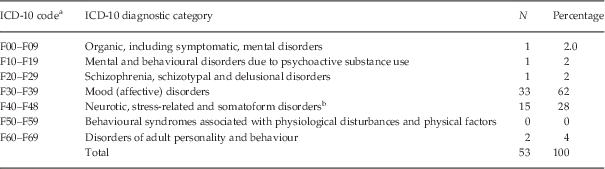
Eighteen patients (22%) referred to the neuropsychiatry clinic did not attend. Among those who attended, the most common diagnoses were mood disorders (ICD-10 code: F30–F39) (62%), and neurotic, stress-related and somatoform disorders, including dissociative (conversion) disorders (F40–F48) (28%) (Table 1). Psychiatric diagnosis at the neuropsychiatric was not related to gender (Pearson’s χ 2 10.604, p=0.477), neurological diagnosis (Pearson’s χ 2 79.155, p=0.128) or psychiatric history (Pearson’s χ 2 11.239, p=0.423).
Psychiatric diagnoses at a neuropsychiatry clinic over 2 years
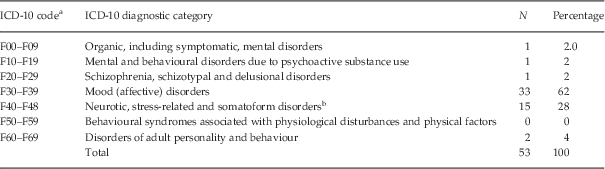
This table shows ICD-10 diagnostic categories for 53 patients (out of a total of 64 attendees) who were diagnosed with a mental disorder at the neuropsychiatry clinic over 2 years.
a ICD-10: International Classification of Diseases, 10th edition (World Health Organisation 1992).
b This category includes dissociative (conversion) disorders (F44).
The most common decision following psychiatric assessment was to offer a follow-up appointment for further management at the neuropsychiatry clinic (45%). Patients who were offered follow-up appointments re-attended a mean of three times (s.d. 3, range 1–17). Patients who did not need to re-attend were referred, with detailed treatment recommendations, to primary care/family doctor (15%), local mental health service (12%), psychology services (4%), multi-disciplinary liaison psychiatry services (2%) or social work department (1%). No specific action was recommended following 16% of assessments.
The most common outcome following assessment and treatment at the neuropsychiatry clinic was that the patient’s psychiatric symptoms improved but ongoing management was required (42%). The next most common outcomes were discharge to primary care/family doctor (23%), transfer to a local mental health service (9%) and complete resolution of the presenting psychiatric problem (9%). Other outcomes included no improvement by end of the study but still attending (6%), loss to follow-up (5%) and other (5%).
Discussion
Individuals referred to the neuropsychiatry clinic had a range of neurological diagnoses (most commonly epilepsy and idiopathic Parkinson’s disease) and a range of psychiatric diagnoses (most commonly mood disorders and neurotic, stress-related and somatoform disorders, including conversion disorders and anxiety). The most common reasons for referral were low mood or anxiety, and medically unexplained symptoms or apparent functional disease. A majority had no previous history of psychiatric illness.
At this neuropsychiatry clinic, psychiatric diagnosis was not related to neurological diagnosis, psychiatric history or gender. Given the select sample examined in this study, however, it is not possible to draw conclusions regarding the epidemiology of mental disorder in individuals with neurological illness compared with the general population; this topic, however, clearly merits future study.
Regarding the management of psychiatric illness in this group, the most common decision following psychiatric assessment was to offer further management at the neuropsychiatry clinic. This is consistent with the broader literature that highlights significant psychiatric comorbidity in this population (Martin Reference Martin2002; Insel & Quirion Reference Insel and Quirion2005). Future studies could usefully examine, in particular, the cost of functional or psychogenic disorders to the Irish health system, with a view to designing specialist services to improve outcome and decrease healthcare costs in this group.
The strengths of this study include its setting in a tertiary neurology service, duration of data collection (2 years) and the careful assessment of a broad range of variables relevant to psychiatric illness. Limitations include the study’s reliance on clinical ICD-10 categories for diagnosis, rather than more fine-grained structured diagnostic interviews; the study’s focus on a highly select population (at a dedicated neuropsychiatry clinic in a tertiary referral centre) which reduces generalisability; and the lack of detailed follow-up information on medication prescribed, treatments and long-term outcome. We are presently collecting data relating to a further 3 years of clinical activity at this clinic, using more fine-grained diagnostic categorisations and gathering more detailed information on treatment and outcome.
Conclusions
Individuals with neurological illness demonstrate significant symptoms of a range of mental disorders including, most commonly mood disorders and neurotic, stress-related and somatoform disorders, including conversion disorders. There is a need for further, more generalisable research into the characteristics and distribution of mental disorder in individuals with neurological disorders, and for the enhancement of integrated psychiatric and neurological services to address the comorbidities demonstrated in this population.
Acknowledgement
The authors are very grateful to the peer-reviewers for their helpful comments and suggestions.
Conflict of Interest
None.