Introduction
On 3 May 2004, 192 civil, military and federal police officers and private security agents were deployed to evict 14 families affected by the Candonga Hydroelectric Dam in the small community of São Sebastião de Soberbo, in the Alto Rio Doce region of south-east Minas Gerais, Brazil. ‘There were scenes of terror and humiliation … By day's end, nothing remained except the ruins and memories of old São Sebastião do Soberbo.’Footnote 1 At the end of 2004 and beginning of 2005, this human drama gave rise to a transnational campaign of protest about the human rights violations suffered by families displaced by the dam.Footnote 2 More than six years after the concession of the operating licence for the dam, complaints by dam-affected people continue, but now without press coverage.
This article analyses how the local press in Minas Gerais has reported protests against hydroelectric dams, alternately ignoring and highlighting them, sometimes legitimising and at other times criminalising them. The case study focuses on the Candonga Dam in order to examine how a specific anti-dam movement, the Movimento dos Atingidos por Barragens (Movement of Dam-Affected People, MAB), has been represented in press discourse between 1998 and 2005, at different moments and in specific circumstances. It analyses why and how these discourses have shifted, the factors at play, both internal and external to the media, and the wider implications for relations between social movements, the media and the state.
Anti-Dam Protests in Latin America and Brazil
The article first sets out the context of anti-dam protests in Brazil and Latin America in relation to concerns about the welfare of displaced populations, negative environmental impacts and the search for energy security. The first anti-dam movements emerged in Latin America in the 1970s in response to the major hydroelectric projects funded by the World Bank or national governments. Since then, growing networks of social movements and NGOs in Latin America have criticised the human rights violations and ecological impacts associated with dams and other large infrastructural projects, and stood up for vulnerable local populations. According to the NGOs International Rivers and the Interamerican Association for Environmental Defense, more than one million people have been affected by large dams in the region.Footnote 3
Brazil now depends on hydroelectricity for around 80 per cent of its energy needs. In the late 1970s and 1980s, conflicts resulting from the construction of large dams led to regional campaigns and resistance movements in southern Brazil, against the Machadinho and Itá dams on the Uruguai river; in the north-east, against the Itaparica Dam on the São Francisco river; and in eastern Amazonia, against large dams on the Xingú river. MAB emerged as a national organisation in the late 1980s and early 1990s.Footnote 4 In the 1990s, in Minas Gerais State, two large dam projects – Irapé, in the north-eastern region, and Pilar, in the south-east – caused socio-environmental conflicts and led to regional grassroots mobilisations in which activists combined institutionally and non-institutionally focused actions. In the 2000s MAB helped to set up the regional dam resistance movement, MAB-Alto Rio Doce (MAB-ARD), and provided support to those affected by the Candonga Dam. During this period, MAB coordinated direct actions with the foremost rural social movement in Brazil, the Movimento dos Trabalhadores Rurais Sem Terra (Landless Workers’ Movement, MST). It joined the MST in the Via Campesina, the largest peasant movement in Latin America and globally, through a variety of protest actions, in particular the occupation of the offices of the Brazilian power utility and environmental agencies.
Since the second half of the 1990s, the networks of social movements and NGOs opposing large dams and infrastructural projects have expanded and become more transnational. In 1997, the First International Meeting of People Affected by Dams, held in Curitiba, Brazil, attracted representatives from a number of Latin American countries. In 1999, the First Meeting of the Red Latinoamericana Contra Represas y por los Ríos (Latin American Network Against Dams and for Rivers, REDLAR) was held in São Paulo, and in 2002, its Second Meeting in Argentina was attended, for the first time, by Central American organisations.Footnote 5 The Second International Meeting of People Affected by Dams held in Bangkok in 2003 saw significant representation from South and Central America. During the period 2002–5, the Movimiento Mesoamericano Contra las Represas (Central American Anti-Dam Movement) was formed along with its Mexican counterpart, the Movimiento Mexicano contra las Represas y por la Defensa de los Ríos (Mexican Movement of Those Affected by Dams and in Defence of Rivers, MAPDER), in 2004. Since then, the latter has coordinated its actions as part of the wider Latin American and transnational anti-dam movements.Footnote 6 At Rivers for Life 3, the Third International Meeting of People Affected by Dams and their Allies, held in 2010 in the small Mexican village of Temacapulin on the Rio Verde (which has been fighting the Zapotillo Dam since 2008), 330 activists from 60 countries shared information and experiences, discussed international human rights legislation and the new global role of dam-builders in China and Brazil, and acquired new skills in online communication and use of video.Footnote 7 Similarly, the Fifth Pan-Amazonian Social Forum held in Santarém, Pará, Brazil, in November 2010 issued a declaration, the Carta de Santarém, decrying the mega-projects of the Iniciativa para la Integración de la Infraestructura Regional Suramericana (Initiative for the Integration of Regional Infrastructure in South America, IIRSA). These include the construction of hydroelectric dams on the region's rivers that would accelerate climate change and threaten the Earth and the peoples of Amazonia. One of the lines of action adopted was ‘To join forces against the construction of hydroelectric dams on Amazon rivers, especially the Belo Monte, Inambary, Paitzpatngo, Tapajós, Teles Pires, Jirau, Santo Antonio and Cachuela Esperanza dams’.Footnote 8
Soon after, the third Encontro Latinoamericano de Ciências Sociais e Barragens (Meeting of Latin American Social Sciences and Dams) was held in Belém, Pará. Roundtables condemned the Belo Monte Dam project and summarised the recently approved Final Report of the Presidential Special Commission, which investigated violations of the human rights of people affected by dams in Brazil. At the final assembly, researchers and activists created the Latin American Network for the Study of Dams (Rede Latino-Americana de Estudos de Represas, RELER).
Despite the growth of this coordinated resistance, public and private investment in large projects in infrastructure, energy, mining and metals has continued and expanded. In 2007 the federal government created and gave political priority to the Programa Acelerado de Crescimento (Accelerated Growth Plan, PAC), which became the principal plank of the Lula government's developmentalist strategy. The governmental discourse of progress and development advocated kick-starting growth through a macro-economic policy favouring the expansion of electricity-intensive export industries such as transnational aluminium enterprises. In June 2004, for example, the governor of Minas Gerais accompanied the president of Brazil on an official visit to China that produced a signed accord for a €1.3 billion project to build aluminium processing facilities in the Zona da Mata region of the state.Footnote 9 The Brazilian NGO Iracambi, located in that region, had already found out that the Companhia Brasileira de Alumínio (Brazilian Aluminium Company, CBA), part of the Votorantim Group, one of the largest and most powerful companies in Brazil, had obtained the second of three environmental licences required to initiate mining activities in a 75,000-hectare area with bauxite deposits that could potentially generate more than US$ 1 billion worth of aluminium.Footnote 10
Although the Lula administration discontinued the Cardoso government's policy of total privatisation of the electric power sector, it did provide incentives for public–private partnership. The 2007–11 PAC includes €67.3 billion in public and private investment in hydroelectric power generation. The principal investments were to be in Amazonia and Minas Gerais. In 2007 there were 210 hydroelectric dams in operation in Minas Gerais and the Programa de Geração Hidrelétrica em Minas Gerais (Programme for Hydroelectric Generation in Minas Gerais, PGHMG) 2007–27 proposed the construction of 380 additional dams, of which 45 would be large dams (usinas hidrelétricas, or UHEs) and 335 of small or medium proportions (pequenas centrais hidrelétricas, or PCHs). In Minas Gerais, the Rio Doce river basin has the largest number of dams in this programme: eight additional large dams and 114 additional small or medium-sized dams are planned for construction by 2027.Footnote 11
The broader geopolitical context of this policy is the expansion of major transnational capital in Brazil and a major part of South and Central America. Sevá argues that this is part of a ‘new continental configuration’ that began with the zones closest to the United States and included the first free trade treaty, the North American Free Trade Area, the Puebla–Panama Plan, the Colombia Plan, the IIRSA and the currently stalled continental Free Trade Area of the Americas.Footnote 12
Given the importance of these large projects for industrial and financial capital accumulation and for strategic western hemispheric geopolitics, researchers and NGOs point to a process of militarisation by governments seeking to guarantee the security of this natural resource wealth in regions such as the Amazon, south-eastern Mexico and Central America, through to Colombia and the São Francisco river in Brazil. Sevá notes that in 2008 the Brazilian Congress discussed the possibility that political protests by dam-affected people through organisations such as MAB could potentially develop into criminal acts and uprisings, and thus threaten national security. He argues that this would lay the groundwork for treating people affected or threatened by dams and by other large projects as ‘terrorists’.Footnote 13
One Mexican scholar has a similar perspective in his analysis of the Puebla-Bogotá Plan:
petroleum, water, electric energy and biodiversity will be the strategic resources that will be disputed by financial powers and will lead to wars and conflicts. In this manner, regional petromilitarisation and petropolitics has already become biopolitics and biomilitarisation, aquapolitics and aquamilitarisation, and hydropower politics and hydropower militarisation.Footnote 14
Acselrad and Bezerra, analysing these processes within a spatial and temporal context, argue that the global economic transformations of the last 25 years have seen Latin America
increasingly inserted within a new global geopolitical context of natural resources … whereby the advance of the frontier of natural resource exploitation frequently collides with local social subjects who attribute different meanings and uses to their common resources, and choose other modes of regulating time-space, with which they often associate their own identities. This is the root of what has been seen in Latin America as the spread of environmental conflicts.Footnote 15
They argue that, despite the tendency of governments to deny the existence of such conflicts, the latter gained visibility on the continent with mass mobilisations in Bolivia against the privatisation of water, in 2002, and the referendum on gas nationalisation, in 2004.Footnote 16 These analyses are echoed in the report of the Interamerican Association for Environmental Defense, which notes the harassment of leaders and communities when they have attempted to defend their rights in relation to large dams. International legal bodies have viewed harassment, such as the disproportionate use of force against peaceful protests, as tantamount to a criminalisation of public protest and contrary to international human rights law.Footnote 17
In this context, in which natural resources in the Amazon and Minas Gerais, in particular hydroelectric power, are objects of the advancing frontier of natural resource exploitation by industrial and financial capital, analysis of the press coverage of the Candonga Dam illustrates the use of journalism in the criminalisation of social movements past, present and future. Todd Gitlin, who studied the relationship of the media with social movements in the United States in the 1960s, showed that when such movements opposed the state and elite managers, the media either excluded them from coverage or distorted the movements’ real proposals and objectives.Footnote 18 In a similar vein, according to Rodríguez and associates, in recent decades the use of journalism in the criminalisation of social movements and their protests has been constant.Footnote 19 This is linked to what sociologist Boaventura de Sousa Santos identifies as ‘a juridical counterrevolution’ that is under way in various Latin American countries, including Brazil, defined as ‘a form of conservative judicial activism that consists of neutralising, by judicial means, many of the democratic advances achieved during the past two decades by political processes’. He notes that one of the most significant social movements in the continent, the MST, has become the target of attempts to outlaw its activities and even to ban it as an alleged terrorist organisation.Footnote 20
The context of Minas Gerais
Minas Gerais is the fourth-largest state in Brazil, with a territory roughly equal to that of France, and it has played a pivotal political and economic role in the nation's history. The eighteenth century saw a gold rush centred on the city of Ouro Preto (literally, ‘Black Gold’), which was also the birthplace of the independence movement of colonial Brazil from Portugal. In the twentieth century, Minas Gerais boasted the second-largest electorate after São Paulo State and an economy based on dairy production. Thus, in the first four decades of the Old Republic, Minas Gerais entered into the so-called café com leite (coffee with milk) power-alternating arrangement with São Paulo State. Minas Gerais later provided the nation with President Juscelino Kubitschek (1955–60), whose government was marked by rapid industrial development and the construction of the new capital, Brasília. However, conservative elites in Minas Gerais also supported the 1964 coup that overthrew the leftist government of João Goulart and ushered in two decades of military dictatorship. During the period of gradual political opening in the first half of the 1980s, the governor of Minas Gerais, Tancredo Neves, joined forces with various segments of civil and political society seeking the return of civilian rule in the Diretas Já (‘direct elections now’) campaign and was elected president in 1985. Although he died before taking office, the largely conservative Minas Gerais political and economic elite managed to maintain their influence in the governments of the new democracy.Footnote 21 Tancredo Neves’ popularity helped his grandson and personal secretary, Aécio Neves, in the latter's rapid political ascent from member of Congress to speaker of the lower house and then to governor of Minas Gerais for two terms, from 2002 to 2010. In 2006 and 2010 Neves sought, unsuccessfully, the presidential nomination of his party, the Partido da Social Democracia Brasileira (Brazilian Social Democracy Party, PSDB). Elected to the Senate in 2010, he is seen as a kingmaker in his state and the most probable opposition candidate for the presidency in 2014. Neves has supported the construction of hydroelectric dams in Minas Gerais to further industrial development and has obtained continuing support from the state's principal newspaper, the Estado de Minas.
MAB-ARD and the Candonga Dam conflict
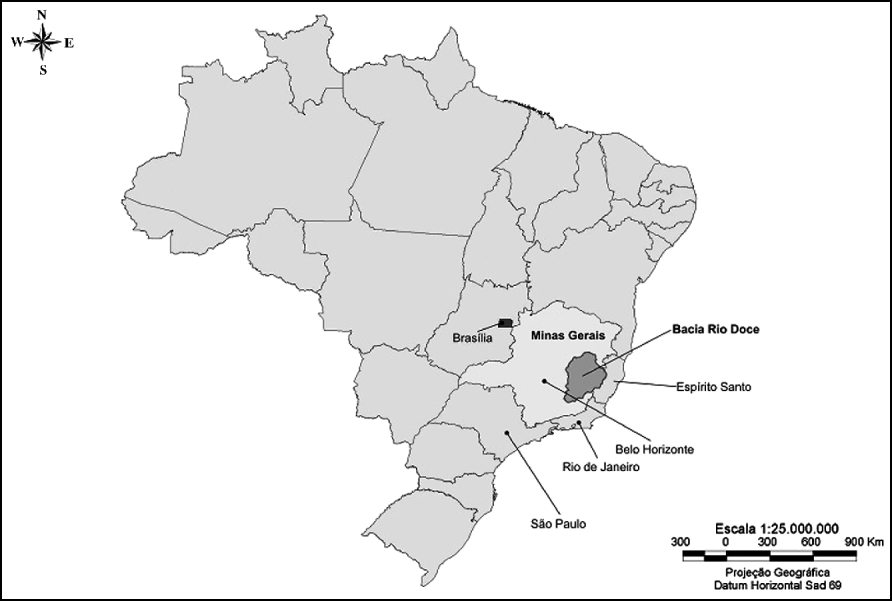
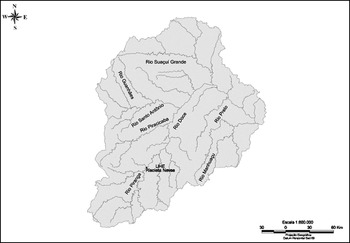
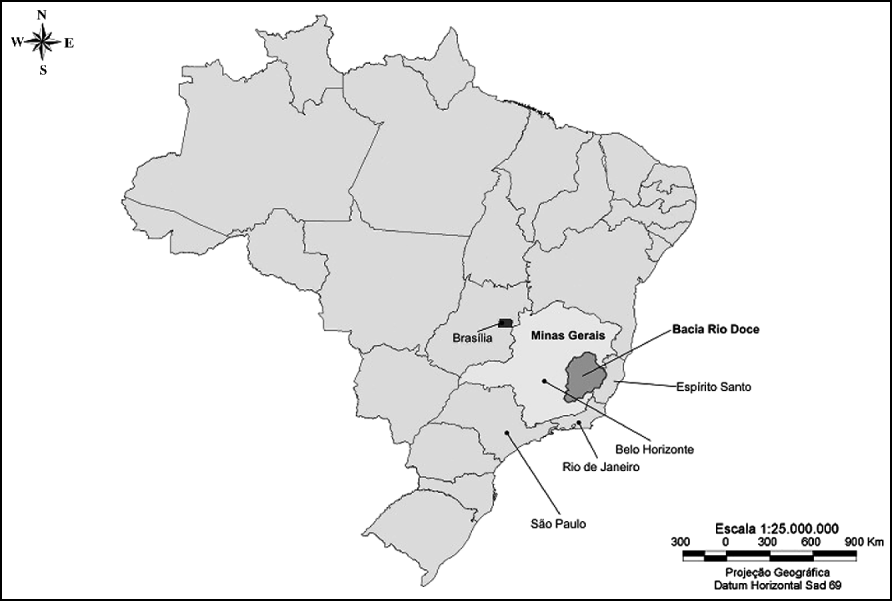
In the mid-1990s, news of plans to construct several hydroelectric dams in the Alto Rio Doce watershed, in south-eastern Minas Gerais, caught the attention of several professors of the Universidade Federal de Viçosa (Federal University of Viçosa, UFV), located in this region. Together with activists from the progressive wing of the Catholic Church, they began a university extension project to inform those communities that would be affected about the social and environmental impacts of dams and prepare them to participate in public hearings in the environmental licensing process (see Figures 1 and 2 to locate the Candonga Dam, renamed Risoleta Neves Dam, in the Rio Doce river basin).Footnote 22
Map of Brazil, locating Rio Doce River Basin in Minas Gerais, Brazil
Map of Rio Doce River Basin, Minas Gerais, Brazil, locating UHE Risoleta Neves (formerly Candonga Dam) on Rio Piranga

From 1999 to 2001, the participation of people affected by dams in regional marches and protests against the dam projects, with support from Church activists, contributed to the construction of a collective identity as atingidos por barragem (or simply atingidos). Between 2001 and 2004, MAB-ARD, aided by the national movement, adopted a strategy that emphasised tactics of confrontation and resistance and demonstrated an increasing capacity to mobilise and organise local campaigns and disseminate news of these conflicts through the internet and the media.
The Candonga Dam, located just a little over 100 kilometres from the municipality of Ouro Preto, affected the small municipality of Santa Cruz do Escalvado, which had a population of 5,380 in 2000. The principal productive activities in the region were related to farming of smallstock and small-scale surface mining. Among the districts of this municipality, the semi-rural village of São Sebastião do Soberbo was the one most negatively affected by the dam – in particular, residents, sharecroppers, fishermen and gold-panners. The village was quite typical for the interior of Minas Gerais.Footnote 23
The Candonga Hydroelectric Dam project was initiated by the Companhia Energética Elétrica Promoção e Participação (EPP), which formed the Candonga Consortium with the Canadian multinational corporation ALCAN. The latter, in turn, bought out EPP's share in 2001.Footnote 24 Early on, even before the year 2000, Consortium employees were continuously present in the community emphasising the supposed benefits that the dam project would bring, such as employment in construction and new houses for resettled families. The local people believed these promises. In 2000, the Consortium coordinated the first public hearing on the project, using audiovisual resources. ‘Local residents, inhibited, did not know what to say or ask.’Footnote 25 Their silence was ‘conveniently interpreted by the Consortium as a sign of approval and welcoming dam construction’.Footnote 26
The establishment of Nova Soberbo, begun in 2002, saw a conflictual process of ‘development-forced displacement and resettlement’.Footnote 27 Following an error in engineering in the construction of the resettlement, resulting in the demolition of 32 houses which were ‘totally non-compliant with the majority of basic norms’,Footnote 28 the environmental regulatory agency Fundação Estadual do Meio Ambiente (State Foundation for the Environment, FEAM) insisted that the community monitor the construction area. The operations licence was granted in 2004. The apparent beauty of Nova Soberbo disguised many problems for residents of the new town. The houses have high walls and are closed in with fences. The ‘backyards’ slope sharply and the soil lacks fertility, making vegetable gardening impossible. Due to the very limited space, some residents are forced to raise smallstock inside their houses.Footnote 29 On 4 May, after MAB's national office made public the traumatic eviction of the remaining families from old Soberbo, the NGO Global Justice initiated contacts with MAB-ARD, resulting in fieldwork research and the publication of the report Atingidos e barrados at the end of 2004.
Media Frames and Social Movements
There is a growing recognition in the literature on media and social movements of the importance, on the one hand, of ideology and power differentials and, on the other, of the particular characteristics of the press and its internal and external relations.Footnote 30 The argument of Rodríguez et al. that the state and media use journalism to frame protests by social movements as criminal certainly applies in Brazil and has affected MAB, the MST and various national and transnational NGOs. These authors argue that journalism contributes to criminalisation by depoliticising the population, as news reporting, principally on television, ends up emptying current affairs of politics and reducing them to a police crime report. This is ‘a way of avoiding politicisation, that is, thinking about social issues in relation to the actual conflict’.Footnote 31
Todd Gitlin's application of the concepts of frame and media frame to social movement–media relations is also pertinent to the Candonga case.Footnote 32 Gitlin defined media frames as ‘persistent patterns of cognition, interpretation, and presentation, of selection, emphasis, and exclusion, by which symbol-handlers routinely organize discourse, whether verbal or visual’.Footnote 33 Frames are put in place by ‘routines of news production’ by which different types of news ‘stories’ are processed, enabling the reporter to work with greater efficacy.Footnote 34 These routines are subject to ‘political pressures, interest group lobbying, pressure from advertisers and ideology, expressed consciously or unconsciously’, and are subjective expressions of the journalists themselves.Footnote 35
According to Gitlin, although dominant frames are reproduced by the media, their producers often do not imagine that these frames are hegemonic. The editing falls in line with the interests of national political elites and the state and excludes news that challenges these interests, for although the news production routines create the media frame, they are also subject to substantial political and economic pressures.Footnote 36 Thus, journalists establish a relationship with official sources and respond to those sources’ complaints when the news does not please them. This explains why, when social movements oppose state policy, the media are prone to excluding or labelling them, and misrepresenting movement goals. There are contradictions in this dynamic, however, and Gitlin recognises that it is also by means of the media that social movements can get their demands heard. At certain moments, the latter are able to publicise facts that involve them in a ‘public ideological space’ when the ‘limits of hegemonic routine’ are reached.Footnote 37 ‘As oppositional groups and movements make claims for coverage, reporters may change their images of their audience or even of the world … about what is “newsworthy”, “interesting”, or “important”.’Footnote 38
Gitlin notes that these changes can be subtle or conscious to greater or lesser degrees, since journalists are influenced to provide the news with a hegemonic focus, even when they resist pressures to do so. This is why the management of some newspapers rotates reporters, to avoid them developing symbiotic relationships with their sources, ‘since when social movements promote mobilisations which are newsworthy, reporters tend to report these events of opposition’.Footnote 39 Thus, the values of journalists are supported by production routines and shorthands that are sufficiently stable to sustain the hegemonic principle, yet sufficiently flexible to absorb new facts. The hegemonic system contributes to political and social stability in times of crisis, but demands by opposition movements can also displace hegemonic frames, which ‘begin to shift’.Footnote 40 When this occurs, newspaper editors come to sympathise with social movements and invert the frames. On the contrary, when the routine is hegemonic, opposition movements are distorted or excluded.
Data and Methods
This article examines state-wide press (the newspapers Estado de Minas and Hoje em Dia) and regional press (the newspaper Folha de Ponte Nova) and how they represent MAB, in the light of theories that explain the relationship between popular movements and journalism. The Estado de Minas was first published in 1928 and is now the most highly regarded newspaper in the state, though one author has alleged that it openly and systematically sides with those in power.Footnote 41Hoje em Dia was established, in 1988, by then-governor Newton Cardoso, who was politically at odds with the management of the Estado de Minas, with the intent of countering the latter's influence. It was then taken over by the Central Record de Comunicação group, owned by Bishop Edir Macedo, founder of the Igreja Universal do Reino de Deus (Universal Church of the Kingdom of God, IURD). Over the past 30 years the conservative-leaning IURD has constructed a communications empire and has become the third-largest Pentecostal group in Brazil, operating in almost 200 countries. The Folha de Ponte Nova also began publishing in 1988, but its main office and circulation is in a city in the interior. Founded by a journalist, a professor and businessman of Ponte Nova, with a circulation of 3,000 weekly copies distributed in the city and surrounding area, the newspaper is focused on the ‘development of Ponte Nova and the Rio Piranga Valley’.Footnote 42
We analysed articles from these newspapers published during the period March 1998 to August 2005 and carried out fieldwork during several periods during 2005 and 2007. We conducted semi-structured interviews with two advisers of MAB-ARD (activists of the Catholic Church), a journalist from MAB's national office, and editors and news editors of the newspapers in question.Footnote 43 The universe of information consisted of 80 newspaper articles from MAB's clippings archive about the Candonga Dam and its repercussions during the period under study, supplemented by press releases from MAB during this period. These three newspapers had published the largest number of news items concerning Candonga, enabling us to analyse the entire period of dam construction.
One criterion for article selection was print quality and uncut text, given that part of the material was obtained from MAB's own clippings archive while the rest was cut from the newspapers during the period of publication. Another criterion was that more than one of the three newspapers should have published an article on a topic on the same day in order to compare how each represented the facts. Overall, the analysis included five of the seven news articles published by the Estado de Minas, five of the 12 articles published by Hoje em Dia, and ten of the 37 published by the Folha de Ponte Nova. The texts report on distinct moments during the period 1998 to 2005.
We also used Fairclough's conception of critical discourse analysis as his theoretical framework is an innovative and useful tool for examining, in depth, the role of language in social transformation. Language is social practice, constituent and constitutive of the culture and the society. This helped us analyse how MAB is represented in the press during the specific socio-historical context of the building of the Candonga Dam.Footnote 44 First, we drafted an outline of a socio-semantic inventory of the modes in which the social actors can be represented; we then established the sociological and critical importance of the categories in order to analyse how these categories are produced linguistically. For this study, which identifies and analyses these internal characteristics of journalism in the production of news and construction of media frames, we chose discourse analysis, in particular the work of Van Leeuwen and his socio-semantic inventory approach.Footnote 45
Van Leeuwen's work presents a minute description of the modes by which the actors can be represented. For example, he notes that representations include or exclude social actors to ‘serve the interests and purposes of those producing the texts’.Footnote 46 Exclusions can be characterised by ‘concealment’, when the social actors are not cited, although it is known who they are; or ‘suppression’, when they are completely excluded through the omission of any signs of actions, activities or categories (of people). Both Van Leeuwen, from the perspective of linguistics, and Gitlin, from the field of journalism, utilise the concept of ‘exclusion’ to analyse representations of social actors in news items – that is, in the discourse of the press. Socio-political exclusion, as well as visibility, of peasants in Brazilian history can, of course, be seen long before the intensification of hydroelectric dam projects.Footnote 47
Zhouri and Oliveira discuss this representation of concealment or visibility of the atingido in a socio-political sense. In a field of struggles in which different positions (atingidos and entrepreneurs) confront one another, sustaining unequal forces, the affected populations lose visibility ‘as social subjects and as political actors endowed with desires and rights’.Footnote 48 Rodríguez et al. use class analysis and note that ‘criminalisation becomes a form of social exclusion’ in the socio-political sense, as the hegemonic ruling class uses this type of discourse to depoliticise societal problems. In this study of Candonga, we apply a combination of Van Leeuwen's concepts of exclusion, the ideas of absence or concealment and social exclusion in a socio-political sense, Gitlin's concept of media frames, and Rodríguez et al.'s notion of criminalisation of social movements. Initially we identified two media frames: one of exclusion and one of inclusion with criminalisation. However, further analysis revealed the presence of several news items that included MAB and provided, on balance, more aspects that gave voice and visibility to MAB rather than stressing negative aspects, such as criminalisation. Therefore we decided to classify these news items as a ‘frame of visibility’. The next part of this article provides a summarised analysis of the 20 news items sampled (ten of ‘exclusion’, three of ‘criminalisation’, seven of ‘visibility’), in light of our theoretical-methodological framework.
Framing MAB in Relation to the Candonga Hydroelectric Dam
By early 1998, a closely allied group of progressive Catholic Church and university activists had mobilised people affected by five hydroelectric dam projects in the Alto Rio Doce region. Nevertheless, the first article, a report from Hoje em Dia dated 15 March 1998, entitled ‘Communities Going Against the Flow on Dams’, represents atingidos, in terms of Van Leeuwen's categories, in an indeterminate manner, collectivising and aggregating them, variously, as ‘numerous communities’, ‘local population’, ‘a group’, ‘riverine communities’ and ‘thousands of people’. According to one journalist interviewed in this study, ‘atingidos have little capillarity in society’, meaning that they are relatively small, localised populations with limited political influence; this journalist also referred to the atingidos as ‘those people’.Footnote 49 Neither the incipient regional movement nor the Candonga Dam are mentioned by name in the article. In effect, atingidos are discursively excluded from the actual process of dam construction.
The Folha de Ponte Nova serves a municipality just 24 kilometres from the Candonga Dam. Yet, despite the proximity to the atingidos, in article number two, from 19 December 1998, ‘The Candonga Dam Evaluated’, the newspaper does not frame dam construction as a socio-cultural problem affecting the atingidos and gives no attention to the human side of the issue, which would normally be the typical subject matter of the cities section in newspapers, though the editor has declared that ‘MAB has space reserved for it in the newspaper’.Footnote 50 The copy relies on a technical discourse in which, despite the coverage being about ‘community resettlement’, atingidos are represented in a concealed form.Footnote 51 Although the municipal authorities are cited, the atingidos are not mentioned as a counterpoint to the dam-building enterprise.
The article touches on the Candonga Dam and environmental impact studies, but omits reference to the probable social and environmental impacts of the dam and to the incipient regional dam resistance movement, despite the fact that this group had previously criticised various negative impacts of dam projects in the region in a 1996 regional seminar and in three public hearings. The political moment of the publication of this article, 1998, coincides with the period in which, following his re-election to a second term as president, Fernando Henrique Cardoso maintained his energy policy. In this political context, most newspapers tended to continue to provide limited space to criticisms of federally supported hydroelectric dam construction.
Atingidos are actually represented for the first time in this study's sample in news article number three, in Hoje em Dia of 9 April 1999. In the title, ‘Community of Small Santa Cruz do Escalvado Meets Today to Discuss … Dam Project Changes Life’, the town is categorised by assimilation and aggregation.Footnote 52 There is also a negative connotation, however, that the community is insignificant and irrelevant, while the article treats Candonga as an important project for the region since it will generate electricity. The atingidos are lumped together in the phrase ‘79 families who have agreed to be transferred’. In addition to not specifying who ‘they’ are in the sentence ‘they have asked for the establishment of an environmental preservation area in Rio Doce’, the atingidos' request is portrayed as submissive supplication, not as a demand for rights. The Candonga Dam is seen as a project that will go ahead, whether or not it is accepted by the atingidos. Their situation is not problematised, but rather taken as given. By representing them in this manner, the newspaper leads readers to believe that the atingidos have already accepted the dam project. The text justifies the project and tries to represent dam construction as legitimate and worthy of support.
Article number four, from Hoje em Dia of 24 July 1999, entitled ‘Protest Against Dams’ and illustrated with a photo bearing the caption ‘Rural workers protest against dams in front of the State House’, is a factual article reporting a protest that occurred the previous day in front of the governor's mansion in Belo Horizonte, the state capital. Although the newspaper gives voice to the environmental secretary of the state government, which supports construction of the Candonga Dam, it also identifies MAB for the first time, relating the movement to the atingidos of the Alto Rio Doce region. The atingidos are categorised as ‘rural workers’ and ‘small farming families’. In this instance they are represented not as asking and requesting, but rather as demanding and protesting. In effect they are identified as a social movement, represented by the Associação dos Pescadores e Amigos do Rio Piranga (Association of Fishermen and Friends of the Piranga River, ASPARPI), the Comissão Pastoral da Terra (Pastoral Land Commission, CPT) and MAB, so this article can be classified as putting a frame of visibility around MAB.
Both texts number four (Hoje em Dia) and five (Estado de Minas) appeared on 24 July 1999. The first discusses how rural workers are conducting their ‘protest’, while the Estado de Minas article notes that ‘they are asking for the construction of dams in the Alto Rio Doce to be suspended’. However, the latter does not identify the people as members of MAB – that is, as demonstrators. The atingidos appear, collectively, as ‘a committee’, not as a social movement. They are represented as ‘farm hands’ – that is, peasant farmworkers who ‘are afraid of not having work’, since the dams will flood areas of subsistence agriculture. Within a frame of exclusion, both atingidos and MAB are concealed and the Candonga Dam is not mentioned by name. In article number six, in the Folha de Ponte Nova, 30 October 1999, entitled ‘Bidding at Auction for the Candonga Dam’, the dam itself is again downplayed. The text simply says that ‘additional information is available at www.aneel.com.br’ – that is, the affected community would have to consult the internet to obtain more information, implying some form of pseudo-democratisation since it appears to further access to information, though in a controlled form. MAB is not represented in the text, and the dam, in turn, is seen as an unimportant detail.
From 2001 onwards, MAB's strategy in Minas Gerais prioritised direct actions and confrontation aimed at pressuring dam-builders and the state agency FEAM. Meanwhile, the government's energy policy emphasised the urgency of dam construction to increase the generation of electric energy. This socio-political context, and the strengthening of the regional dam resistance movement (MAB-ARD), inevitably influenced discourse in the press. In October 2001, MAB initiated occupations of dam work sites and of the offices of companies involved in building the dam. MAB-ARD, which was now more structured and organised, sent press releases to newspapers, as the atingidos were increasingly feeling the impact of the Candonga Dam project and the disadvantages of the creation of the Nova Soberbo resettlement.
According to Padre Claret, a local campaigner, MAB-ARD's secretary sent out press releases containing a variety of news items indiscriminately to various press entities.Footnote 53 However, the national MAB office used a different tactic, according to the journalist responsible for its communications section. She commented that MAB did press work largely around ‘actions of the Movement’ and ‘in situations such as those of major conflict’. The regional MAB offices adopted the same strategy, for example around the march that MAB organised in 2006 from the Alto Rio Doce region to the state capital, when police violently attacked demonstrators.Footnote 54 Thus MAB tends to have some degree of influence on media framing by informing the press of its direct actions and situations of significant conflict, thereby increasing the likelihood of MAB being included in the news and gaining visibility. However, this strategy has its risks, as exemplified by the march to Belo Horizonte in 2006, in which press coverage highlighted direct actions that ended in a brawl.Footnote 55 The media frame thus presented of MAB became that of a group that threatens the public and often carries out premeditated actions that require police control.Footnote 56
The seventh news article, from the Folha de Ponte Nova of 30 June 2001 and entitled ‘Candonga Project Fuels Debate on Hydro-Electric Dams in Region’, might have discussed problems already under debate in relation to Candonga but instead cites only the benefits that the building of the dam would bring to the region, such as the creation of 785 jobs. In developmentalist ideology, job creation is always associated with economic development and growth. The article also comments that 167 people from local municipalities were trained to work on the Candonga project but does not specify whether these trained workers are residents of the directly affected communities or whether the jobs are temporary, and therefore less effective than permanent jobs in mitigating socio-economic impacts. For Rodríguez et al., policies such as the hiring of workers on a temporary basis for large projects are a form of co-optation, social control and depoliticisation of social movements. It was in 2001 that MAB's influence in the region increased significantly, yet the text occludes the organisation. Padre Claret sees this as a press tactic to ignore the movement's actions: ‘they [the press] may even be present, they film, but do not publish anything. In addition to hiding the movement from public awareness, the press can act as an informant to those with a stake in the construction of the dam.’
The title of article number eight, from the Estado de Minas of 13 March 2003, ‘Movement Protests Against Dam’, fails to identify which movement or even give the acronym MAB. However, this was the first of our news samples to give MAB a voice, as it identifies ‘Antonio Claret Fernandes, one of the Movement's co-ordinators’. In addition to their inclusion as ‘residents’, atingidos are also alluded to as an undifferentiated group of ‘300 people’ and ‘demonstrators’ making demands – that is, with MAB's support, atingidos are refusing to submit to the impositions of dam management and their demands are here presented as newsworthy. According to Gitlin, this is how the media confers importance upon the social movement while excluding its broader purposes and objectives.Footnote 57 As one Estado de Minas editor said, the focus is on ‘facts, as long as the Movement is not used as a tool of partisan politics’ – that is, as long as it does not promote protests, demonstrations and occupations.Footnote 58
Padre Claret's words convey a complaint and become the voice of the movement making demands. ‘According to Claret, residents were not satisfied with the Consortium's position’. However, atingidos are represented as ‘residents’ rather than as ‘demonstrators’, which would convey the idea of protest. The portrayal of atingidos as ‘families’ and ‘residents’ downplays the actions of the movement. Thus the text provides visibility, but excludes the purposes and actions of MAB.
In chronological terms, article number seven was published in June 2001, which was during the so-called apagão (electrical blackout).Footnote 59 Yet news items about the Candonga Dam appeared only in the Folha de Ponte Nova and did not appear in the other two newspapers until March 2003, when the apagão crisis was past but still fresh in the public memory. The Estado de Minas and Hoje em Dia, as state-wide newspapers with stronger ties to state government, reproduced the developmentalist policy of the government, for which the construction of new hydroelectric dams was the preferred solution to the energy crisis.Footnote 60 This may be why the text of the Estado de Minas portrays MAB and the atingidos as social actors undermining the government's strategy to avoid another apagão. Padre Claret believes that when the press perceived MAB as an NGO, it listened to the movement, but once MAB ‘made clear its principal objectives, marked by a proposal to transform society, the resistance of the press [to MAB] became greater’.Footnote 61
Article number nine, from Hoje em Dia, published two days later on 15 March 2003, begins to criminalise the movement with its title ‘Atingidos Invade Offices of the Vale [Company] in BH’). The use of the term ‘invasion’ connotes illegal trespassing on private (or public) property. When the press uses this term, it is frequently a reference to a protest by a social movement. For Baratta, a crime is a political phenomenon and those who commit a crime are regarded socially as members of a minority group that threatens the values of the ruling elites.Footnote 62 It follows from this logic that, when they protest, social movements are presented as a threat to public order. For Rodríguez et al., journalism contributes to the criminalisation of social movements, especially when the latter engage in demonstrations and ‘invasions’, by characterising social protest as something threatening to the ordinary citizen.Footnote 63 Like his counterpart at the Estado de Minas, the news editor of Hoje em Dia admitted that the press often acts in a reactive manner. According to him, MAB's actions should be reported, and ‘there is special and significant coverage when the protests result in violence, as in the case of the invasion of Cemig. In that case, the event was treated with greater importance, including a front-cover photograph’. Here MAB is criminalised when a brawl is associated with crime.Footnote 64 Padre Claret similarly suggests that, when the press ‘is unable to conceal’ the facts, it distorts them, portraying the protest as ‘a mob, radical and rowdy’, and emphasising an isolated incident during the demonstration ‘rather than commenting on the overall actions and purposes of the Movement’.Footnote 65 Although article number nine names Padre Claret as ‘one of the demonstration organisers’, the newspaper also highlights the dam's potential for generating electrical power, after reporting that the motive for the occupation was the failure of the company to resettle atingido residents. So, at the same time that the reader learns of the reason for the action, there is a counterpoint: the generation of 140 megawatts of energy. The text reports only the arguments of the company, not those of MAB.
Article number ten, from the same day in the Folha de Ponte Nova, is entitled ‘Following Break-In of Candonga, More Anti-Dam Protests’. The text highlights new anti-dam protests following the break-in and occupation of the construction site of Candonga on the morning of 11 March. However, as in the previous article, referring to the same protest, the use of the noun ‘break-in’ in the title and in the text ends up criminalising MAB. The protests took place during commemorations of the International Day of People Affected by Dams, 14 March, and during the days which followed. The text names authorities and leaders present at the protest, including the representative of MAB's national office, Sadi Baron, from Santa Catarina state. Nevertheless, in the caption of the photo which reads ‘State Legislator Padre João, Commander Figueirêdo and Sadi Baron, at the most tense moment of the negotiations’, Sadi Baron is not identified as the representative of MAB's national office, whereas the first two are represented through their functional positions (Commander Figueiredo is an official of the Military Police of Minas Gerais, the institution responsible for maintaining public order). According to Van Leeuwen, functionalisation occurs when social actors are referred to in terms of an activity, of something that they do – that is, an occupation or function.Footnote 66 Here the text excludes the anti-dam movement from visual representation.
The text also names an atingida resident, Maria Raimunda dos Santos, mentioning that she is 76 years old, followed by testimony about how she raised children and grandchildren in the place which now will be submerged. It also mentions resident João Caetano dos Santos, who disappeared two months previously, but omits the fact that he disappeared when he was living within the dam construction site. Apparently he had refused to leave his home, and the construction site was built around his house.Footnote 67 He continued living there but was required to use a company name-tag to get in and out of the construction site. His disappearance was never explained by the police. In the final part of the article, on the basis of an interview with the Consortium's institutional relations manager, the reporter comments that ‘The Consortium had no official knowledge of the case of João Caetano, which has been under investigation by the Military Police since 11 March’. Aside from the reason for his disappearance, this could have the effect of discouraging actions against the Consortium. Such fear leads to withdrawing from the collectivity and, consequently, to the demobilisation of the social movement. As in the previously cited articles of the Folha de Ponte Nova, at the end of the report, the representative of the Candonga Dam affirms that negotiations are proceeding normally, a form of assurance that the process is both legitimate and secure.
Article number 11, from the same newspaper, dated 12 April 2003, is entitled ‘March of Dam-Affected People Calls for “Justice and Peace”’. In the text and photographs, the atingidos are represented as demonstrators. The text gives voice to the secretary of MAB, Maria Francisca Oliveira, and to the leader and atingida Marta Caetano do Espírito Santo, and highlights the march of the people affected by dams. Therefore, this text is classified as having a frame of visibility. Article number 12, also from the Folha de Ponte Nova, of 19 April 2003, entitled ‘Controversy over Social Impacts of the Candonga Dam Moves to Public Hearing in BH’, reports on the public hearing and recalls other meetings and visits to Candonga that took place in the previous days. Social actors are named on the basis of the identity and functions which they share with others (categorisation). In effect, the text names social actors who are not atingidos. The newspaper names local authorities and also the representative of MAB, in addition to state legislators and the archbishop of Mariana. Nevertheless, it refers to the local populace in phrases such as ‘90 per cent of the atingidos’, ‘other representatives of the Anti-Dam Movement (MAB)’, ‘MAB’ and ‘atingidos’. It also refers to ‘a disappearance and a death’, yet fails to mention the name of the person who disappeared or the person who died. The text is centred on local authorities and politicians, by way of justifying the publication of the report in the politics section. Social actors are also ‘collectivised’ in article number 13, from the Estado de Minas, entitled ‘Commission Wants to Suspend Construction’.Footnote 68 Again, atingidos are portrayed as ‘residents’, ‘a commission’, ‘families’, ‘inhabitants’. The verbs ‘to want’ and ‘to complain’, found in the body of the text, reflect desire, which demonstrates that the atingidos are not passive subjects. On the other hand, here the authorities are represented in non-specific ways. This occurs when reference is made to ‘civil police’ and ‘legislators’. The text cites by name only the mayors of Rio Doce and Santa Cruz do Escalvado, who are of minimal relevance to the issue being discussed. This illustrates, once again, the alignment of the newspaper with the dominant elites. Article number 14, from the Folha de Ponte Nova, dated 12 March 2004, entitled ‘Copam/Feam May Approve Operating Licence for Candonga Dam on March 26’, was published during the period in which the Candonga Dam was about to be made operational. In the reference to the ‘parties involved with the project's impacts’, which, together with the Consortium, negotiate and resolve pending issues, the text excludes and suppresses the atingidos, who do not appear as social actors capable of participating in negotiations about their own future.
Article number 15, from the Estado de Minas, dated 4 May 2004, is entitled ‘Families Abandon Land about to be Flooded’. The newspaper was not present at the location to cover the departure of the families; it merely interviewed both sides to get their views. The text reports the withdrawal of the families from the district of São Sebastião do Soberbo, one of the most tense moments in the construction of the Candonga Dam. However, it implies that the families left their housing peacefully and voluntarily, which completely distorts the facts, since there was heavy police action to evict the remaining families, as we note at the beginning of this article. Thus the text omits the conflict within a frame of exclusion, although it names MAB's adviser, Maria Francisca de Oliveira, reporting the problems and demands of residents through her words, as well as the Consortium's public relations manager, Maurício Martins, who responds to MAB's demands.
There is no mention of the larger conflict in article number 16, from the Folha de Ponte Nova, dated 7 May 2004, just three days later, which makes reference to the families of the district of São Sebastião do Soberbo. In contrast to the Estado de Minas, the local newspaper was present to cover the story. The title, ‘Candonga is Going Through a New Phase of Confrontation’, suggests both action in the present (‘going through’), but also something already experienced (‘new phase’). The word ‘confrontation’ at least implies the negative manner in which the police enforced the departure of families from their residences. The text begins by reporting how this unfolded and the measures being taken, followed by details of the confrontation of 4 May. It names the atingidos and MAB as well as the authorities. However, in reporting the ‘resistance’ of evicted families who are not yet willing to resign themselves to their fate, the events are depicted as a ‘confrontation’. Indeed, the management of the dam considers the leaders of MAB-ARD to be criminals and defendants in a law suit brought by the Candonga Consortium with the aim of preventing them from carrying out any demonstrations at the dam construction site. This suit is ‘based on the absurd charge that they act as esbulhadores [literally, robbers or burglars] when in fact they are only exercising their right to free expression of thought and even the right to resistance, legitimately recognised in situations of oppression’.Footnote 69
The article, which names several atingidos who described the removal of the families, reports in detail that ‘there was a roadblock with tree trunks and branches, removed from the road by two tractors’. The text also notes that the Military Police ‘broke into the houses’, and illustrates this with a photo. Forcing entry into private properties would appear to contradict the police ideology of maintaining order. Alleged resistance on the part of atingidos is used to justify this level force by police, which in turn results in confrontation. According to Barros and Sylvestre, video recorded by a resident shows two buses filled with heavily armed police arriving at the village, followed by tractors, demolition equipment, moving vans and dogs. ‘When the police arrived, the population, completely terrorised, left their houses, intimidated by the size of the arsenal’. Some residents ‘remained motionless on the roads, watching from afar, anxious, frightened and petrified’.Footnote 70 Yet this is presented by the Folha de Ponte Nova text as atingidos resisting by ‘blocking the road’ and by the fact that ‘they did not sign the eviction order’. Resistance is thus interpreted as a crime in order to criminalise and judicialise social protest. Despite clearly presenting facts and photos and demonstrating that there was mutual ‘confrontation’ in the removal of the families, as reported in the title, the newspaper ends up ‘transmitting the voices of power’.Footnote 71
In article number 17, also from the Folha de Ponte Nova, of 2 July 2004 and entitled ‘Mayors Get Suspension of Court Order Preventing Formation of Candonga Lake’, it is not until the middle of the text that it is made clear that the preliminary injunction was the result of a petition by MAB. The article notes that ‘MAB continues protesting against the formation of the lake’, casting the movement in a negative light just as the media wages a negative campaign against the environmental licensing process.Footnote 72 From the viewpoint of elites, protest and resistance are forms of social action which present obstacles to the approving of licences for dam projects and, therefore, constitute an impediment to development and progress. Although the information published is directly linked to the atingidos, the text attributes no voice to them.
In article number 18, from the same newspaper, dated 10 September 2004, the atingidos’ protest is given visibility, particularly in the title – ‘From Ponte Nova to Congonhas, 120 km with Protest of Dam-Affected People’ – and in the photo caption, which represents the atingidos as demonstrators: ‘The demonstrators from Ponte Nova have travelled 120 km, joined by other groups of demonstrators, such as those from Ouro Preto and Mariana’. In the title, the ‘negative’ activity is ‘protest’, referred to in the text as nothing more than a long walk. Overall, the frame used is that of visibility, and nothing more.
Article number 19, of the Estado de Minas, dated 31 August 2005, was published in the economics section. The title, ‘Vale Reassesses Hydroelectric Dams’, reveals that the Vale do Rio Doce Company is re-evaluating the building of hydroelectric dams due to high costs that restrict the company's expansion. ‘Re-evaluation’ is a cognitive action of thinking and reasoning, in contrast to the atingidos, who undertake direct actions such as protests, walks, marches and demonstrations. In this news item, only the dam is represented. It concludes that news of the inauguration of one more hydroelectric dam in Minas Gerais has great influence in societies that prioritise the generation of electricity in development projects. A detail highlighted at the end of the text is that the reporter, who covered the inauguration of the dam, travelled to the locality courtesy of the Vale do Rio Doce. It is clear that the reporter is obliged, then, to give voice to those social actors connected to the Consortium entrepreneurs, ignoring any reference to the atingidos. The photograph used in the report is from the company's own publicity material. In cases like this, the newspaper does not send a photographer, only a reporter who is guided by the host company the entire time and sees only the dam. Therefore, atingidos are categorised by suppression – that is, radically excluded. Naturally, the frame of exclusion serves the interests and purposes of those who produce the texts, and when there is suppression, there is no mention of actions, activities or social actors (atingidos).
Article number 20 was published the same day but appeared in the politics section of Hoje em Dia. The two newspapers, which are rivals, approach the news item in different ways, each to their own advantage. In its title article 20 chooses to refer to the dam by its alternative name, the Risoleta Neves Dam, after the grandmother of the governor of Minas Gerais, Aécio Neves – this has the effect of personalising and legitimating the dam. The text names the president of the Vale do Rio Doce Company, Roger Agnelli, emphasising his warning about the risk of new rationing and his view that ‘investment in energy is fundamental to assure economic growth’, thus rubber-stamping the importance of the Candonga Dam and drawing a line under all the controversies surrounding its construction. The composition of the final paragraph summarises the way the press has viewed the Candonga issue. ‘The inauguration was watched from afar, from the top of a hill beyond the security area, by a group of residents of the region waving banners, who identified themselves as the Movement of Dam-Affected People’. Not only were the atingidos and MAB kept at a physical distance from the events affecting them, as the Military Police had prevented them from coming closer and carrying out protests, but they are also distant and indistinct in the press's obfuscatory reporting, excluded from photographs and voiceless in the text, in a clear example of the frame of exclusion.
The text concludes by saying that, with the opening of the dam, the district of São Sebastião do Soberbo was ‘submerged by the reservoir’ – implying that, after this final act, any voices of demonstration against the dam will be faint, distant and drowned out by the imperative of producing energy. Affected populations, it seems, should be resigned to having no way to fight against large companies that act in their own self-interest, displace people and exploit the nation's wealth.
Conclusions
Our analysis of selected newspaper articles spanning a seven-year period in relation to the Candonga Dam project has revealed how the press constructs and manages different news frames. Early on, the press chose to represent MAB by a frame of exclusion, during a period when any obstacle that might impede dam construction needed to be eliminated. This also occurred at critical junctures such as the removal of the families, when the media preferred to omit mention of the conflict. During the so-called ‘apagão’ the press again resorted to a discourse about the need to build dams. At the inauguration, MAB found itself both physically and discursively excluded from view. Within this hegemonic discourse, the notion of ‘progress’ becomes incontestable. In support of that ideology, the press reinforced the exclusion of dam-affected people. Movements such as MAB, which challenge dominant discourses, do not fit the media frames, so the press conceals and occludes them.
Initially the press denied MAB a voice, avoiding recognition of the existence of opposition movements. Atingidos were represented as passive subjects who accepted the dam project and were incapable of organising and fighting for their rights. Voice was given only to the company and to those actors that supported the project. This could be interpreted as a press position to avoid strengthening MAB and to preserve the interest of dam construction companies. In a later phase, when MAB used the tactic of occupying dam project work sites in addition to disseminating information, the press criminalised the movement by implication by portraying the occupation of dam construction sites and offices and related acts as ‘break-ins’, with the resulting connotations of crime and social threat. This kind of language is often used with regard to social movements, and ends up criminalising and depoliticising social protest. Even within the legal sphere, where the movement has filed its own petitions for an injunction and protested against judicial decisions on environmental licensing, protest is represented as an undesirable obstacle to dam construction and, therefore, an impediment to development and progress. Thus, MAB has been persistently represented as the enemy in a socio-environmental conflict between two distinct logics of perceiving the energy issue. Criminalising the movement is helpful to capital and the neoliberal state. As our analysis shows, the mass media reproduce hegemonic ideologies, reflecting close ties to the state and to large private corporations. In the short term, rejection of the dam project via the environmental licensing process would reduce corporate profits and make the project economically unviable, and reduce the growth rate of the power infrastructure designed to support the government's industrial policy. In the medium and long term, MAB's alternative proposals for energy policy and transformation of society are contrary to the hegemonic model.
In addition to its appearance in the press when it is criminalised, MAB acquires visibility at other junctures. Although its actions are minimised and its representatives frequently lack a voice, MAB appears in the press as a social movement that organises, protests, demonstrates, makes appeals and fights for change, even though it is denied the opportunity to present its own goals. In the state-wide press MAB crops up mainly in the factual news, which only narrates daily events and is not subject to more extensive reporting that might include the movement's proposals. The Folha de Ponte Nova, a weekly local newspaper, provides greater depth but also fails to provide comments on MAB's ideas and counter-proposals. For MAB, the press itself was a site for gaining visibility, publicising its actions and demands and amplifying its complaints, turning them into protests that could be heard by a broader public. Although MAB's broader project was not conveyed by the press, the movement did manage to create a chink in the media coverage to raise awareness among critical citizens about the atingidos’ struggles. Did this visible portrayal of MAB in some of the newspaper reports exemplify what Gitlin refers to as the ‘limits of the hegemonic routine’, in which journalists inverted its frames? Our analysis sample indicates that it did not. The news items consistently excluded or criminalised MAB, independent of context. In half of the articles examined, a frame of exclusion was used. In the rest, MAB was portrayed in the Candonga case as a movement advocating illegal acts, so visibility went hand-in-hand with downplaying of MAB's importance, criminalisation of its activities, exclusion of its aims and objectives, and besmirching of its image.
Where frame inversion has occurred in the representation of a Brazilian social movement is with the MST. In the mid-1990s it began a campaign in the mass media and in the cities to communicate that one of the objectives of its proposal for agrarian reform resettlements was the socio-economic sustainability of the landless in rural areas, which would reduce rural–urban migration and thereby reduce swelling urban populations, violence and insecurity. As a result, for a while the MST and its agrarian reform proposal gained the sympathy of a significant portion of the urban population and of the press, until it resumed and increased occupations of unproductive farms, when public opinion began to turn against it. MAB's campaign to reduce monthly electricity bills is also aimed primarily at urban populations and is trying to invert the hegemonic frame around energy policy and development. However, the power utility sector continues to exert a great deal of influence in the media by framing dam construction as the only guaranteed way to maintain the comforts provided by electricity, as well as macro-economic growth. Thus the media tends to continue to exclude or criminalise acts of resistance.
Our analysis is of particular relevance to Brazil's most controversial mega-dam project for decades. The Belo Monte Dam is a proposed hydroelectric complex on the Xingú river in Pará state in the Amazon region. If built, its installed capacity would be 11,233 megawatts, the third-largest in the world and the second-largest in Brazil. The electricity generated is intended to serve the general population through the national grid (70 per cent of output) and support mining and industry (up to 30 per cent of output). Supporters claim that construction of the dam will generate some 18,700 direct jobs and 25,000 indirect jobs. The dam was first mooted in 1975, but in the late 1980s, well-publicised protest by indigenous groups, supported by international NGOs and celebrities, thwarted construction of large dams on the Xingú river. Plans for the dam were revived in the late 1990s. By 2010 the project had been through the necessary impact assessments, and it was given the green light in mid-2011 by the government's own environmental and indigenous agencies under pressure from the executive. However, it has been the object of significant criticism in Brazil and internationally for its anticipated environmental and social impacts. The flooding of 258 square miles is likely to displace some 20,000 people, many of them from indigenous groups. Protests by those potentially affected are gathering pace and have been widely reported in the national and international media. A clear sign that mobilisation and protests will continue for an indeterminate period was an event held on 1 August 2011 to send Padre Claret and Padre José Geraldo as missionaries of the Catholic Church to work for several years with popular movements of resistance in the Xingú river region. Symbolically, the event was held in the rural community of Casa Nova in the Guaraciaba municipality, close to the Candonga Dam, where, in 1995, these two Catholic activists helped initiate local and regional resistance to the Pilar Dam and other dam projects.
This study has drawn on different theoretical and methodological frameworks, combining media frames, selection bias, environmental debate, journalism, the sociology of criminalisation, discourse analysis and linguistics to better understand how MAB and other social movements are represented in the press at different moments and in different contexts and circumstances. As the trend continues in Latin America towards large infrastructure, mining and hydroelectric dam projects, the social movement and NGO networks that get in the way may win visibility and voice, but they will also likely be dismissed, stigmatised and criminalised by vested interests. In this the press plays a complex and often contradictory role that is as yet not fully understood, and provides a rich field of analysis as these local, regional and global contests over models of social and economic development persist into the foreseeable future.